service GMC YUKON HYBRID 2010 Owner's Manual
[x] Cancel search | Manufacturer: GMC, Model Year: 2010, Model line: YUKON HYBRID, Model: GMC YUKON HYBRID 2010Pages: 120, PDF Size: 1.03 MB
Page 67 of 120
{WARNING:
Steam and scalding liquids from a hot cooling
system can blow out and burn you badly. They are
under pressure, and if you turn the coolant surge
tank pressure cap—even a little —they can come
out at high speed. Never turn the cap when the
cooling system, including the coolant surge tank
pressure cap, is hot. Wait for the cooling system
and coolant surge tank pressure cap to cool if you
ever have to turn the pressure cap.
Notice: Using coolant other than a pre‐mixed
DEX-COOL, available at your dealer/retailer, may
damage your vehicle. Any repairs would not be
covered by your warranty. Always use a pre‐mixed
DEX-COOL (silicate-free) coolant in your vehicle.
{WARNING:
You can be burned if you spill coolant on hot
engine parts. Coolant contains ethylene glycol
and it will burn if the engine parts are hot enough.
Do not spill coolant on a hot engine. If the DMCM coolant is empty , the vehicle must be
serviced by your dealer and a special fill procedure
must be followed.
Notice:
Attempting to fill the DMCM cooling surge
tank yourself when the fluid level is empty can
damage your vehicle. Your vehicle must be
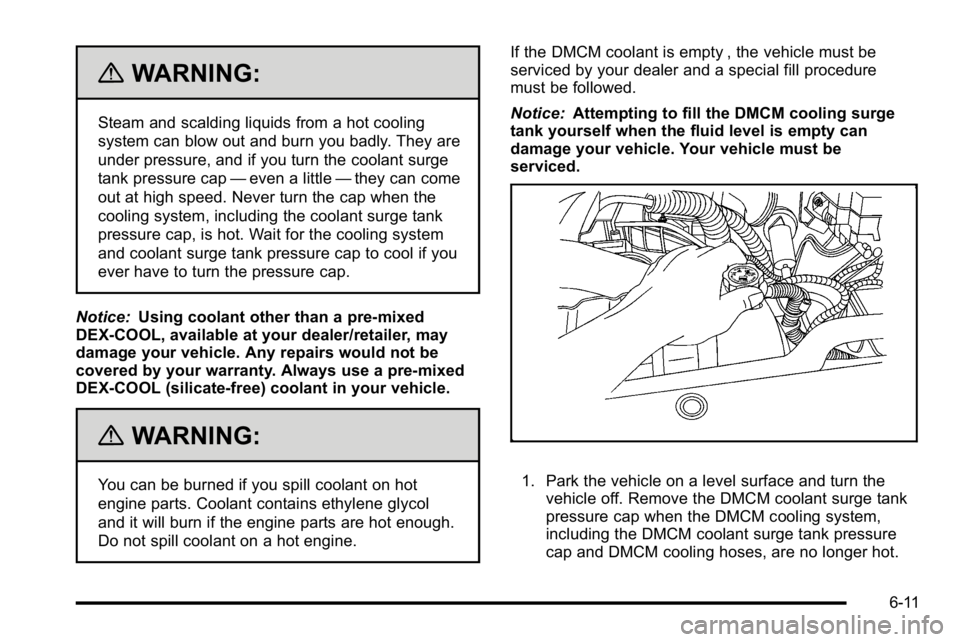
serviced.1. Park the vehicle on a level surface and turn the vehicle off. Remove the DMCM coolant surge tank
pressure cap when the DMCM cooling system,
including the DMCM coolant surge tank pressure
cap and DMCM cooling hoses, are no longer hot.
6-11
Page 68 of 120
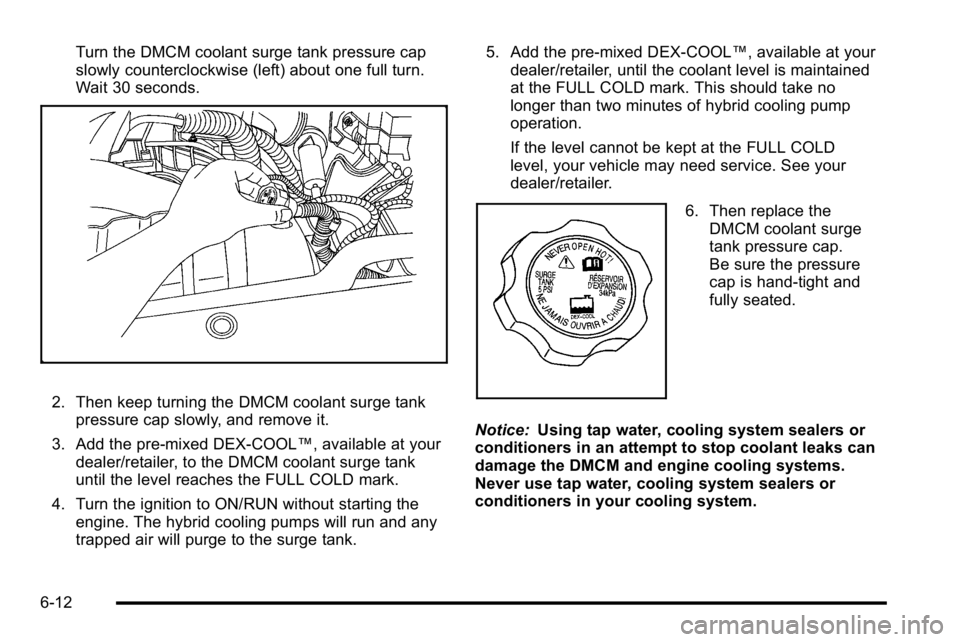
Turn the DMCM coolant surge tank pressure cap
slowly counterclockwise (left) about one full turn.
Wait 30 seconds.
2. Then keep turning the DMCM coolant surge tankpressure cap slowly, and remove it.
3. Add the pre‐mixed DEX‐COOL™, available at your dealer/retailer, to the DMCM coolant surge tank
until the level reaches the FULL COLD mark.
4. Turn the ignition to ON/RUN without starting the engine. The hybrid cooling pumps will run and any
trapped air will purge to the surge tank. 5. Add the pre‐mixed DEX‐COOL™, available at your
dealer/retailer, until the coolant level is maintained
at the FULL COLD mark. This should take no
longer than two minutes of hybrid cooling pump
operation.
If the level cannot be kept at the FULL COLD
level, your vehicle may need service. See your
dealer/retailer.
6. Then replace the
DMCM coolant surge
tank pressure cap.
Be sure the pressure
cap is hand-tight and
fully seated.
Notice: Using tap water, cooling system sealers or
conditioners in an attempt to stop coolant leaks can
damage the DMCM and engine cooling systems.
Never use tap water, cooling system sealers or
conditioners in your cooling system.
6-12
Page 71 of 120
Notice:
.Using the wrong fluid can badly damage
brake hydraulic system parts. For example,
just a few drops of mineral-based oil, such
as engine oil, in the brake hydraulic system
can damage brake hydraulic system parts
so badly that they will have to be replaced.
Do not let someone put in the wrong kind
of fluid.
.If brake fluid is spilled on the vehicle's
painted surfaces, the paint finish can be
damaged. Be careful not to spill brake fluid
on the vehicle. If you do, wash it off
immediately. See“Washing Your Vehicle”
in the owner manual.
Brake Wear
This vehicle has disc brakes. Disc brake pads have
built-in wear indicators that make a high-pitched
warning sound when the brake pads are worn and new
pads are needed. The sound can come and go or be
heard all the time the vehicle is moving, except when
applying the brake pedal firmly.
{WARNING:
The brake wear warning sound means that soon
the brakes will not work well. That could lead to
an accident. When the brake wear warning sound
is heard, have the vehicle serviced.
Notice: Continuing to drive with worn-out brake
pads could result in costly brake repair.
Some driving conditions or climates can cause a brake
squeal when the brakes are first applied or lightly
applied. This does not mean something is wrong with
the brakes.
6-15
Page 72 of 120
Properly torqued wheel nuts are necessary to help
prevent brake pulsation. When tires are rotated, inspect
brake pads for wear and evenly tighten wheel nuts in
the proper sequence to torque specifications in
“Capacities and Specifications”in the owner manual.
Brake linings should always be replaced as complete
axle sets.
Brake Pedal Travel
See your dealer/retailer if the brake pedal does not
return to normal height, or if there is a rapid increase in
pedal travel. This could be a sign that brake service
might be required.
Brake Adjustment
Every time the brakes are applied, the disc brakes
adjust for wear.
Replacing Brake System Parts
The braking system on a vehicle is complex. Its many
parts have to be of top quality and work well together if
the vehicle is to have really good braking. The vehicle
was designed and tested with top-quality brake parts. When parts of the braking system are replaced
—for
example, when the brake linings wear down and new
ones are installed —be sure to get new approved
replacement parts. If this is not done, the brakes might
not work properly. For example, if someone puts in
brake linings that are wrong for the vehicle, the balance
between the front and rear brakes can change —for the
worse. The braking performance expected can change
in many other ways if the wrong replacement brake
parts are installed.
Battery
This vehicle has a standard 12‐volt battery and a
high‐voltage hybrid battery.
Refer to the replacement number on the original battery
label when a new standard 12‐volt battery is needed.
6-16
Page 73 of 120
Only a trained service technician with the proper
knowledge and tools should inspect, test, or replace
the hybrid battery. See your dealer/retailer if the
hybrid battery needs service. The dealer/retailer
has information on how to recycle the hybrid
battery. There is also information available at
http://www.recyclemybattery.com.
If an airbag inflates or the vehicle has been in a crash,
the vehicle's sensing system might command the
automatic hybrid battery disconnect to open. See
Replacing Restraint System Parts After a Crash
on
page 2‑3for more information.
{DANGER:
Battery posts, terminals, and related accessories
contain lead and lead compounds, chemicals
known to the State of California to cause cancer
and reproductive harm. Wash hands after
handling.
Vehicle Storage
{WARNING:
Batteries have acid that can burn you and gas
that can explode. You can be badly hurt if you are
not careful. See Jump Starting
on page 6‑18
for tips on working around a battery without
getting hurt.
Infrequent Usage: Remove the 12‐volt battery black,
negative (−) cable from the battery to keep the battery
from running down.
Extended Storage: Remove the 12‐volt battery black,
negative (−) cable from the battery or use a battery
trickle charger.
Remember to reconnect the battery when ready to drive
the vehicle.
6-17
Page 78 of 120
8. Do not let the other end touch metal. Connect it tothe positive (+) terminal of the good battery. Use a
remote positive (+) if the vehicle has one.
9. Now connect the black negative (−) cable to the negative (−) terminal of the good battery. Use a
remote negative (−) if the vehicle has one.
Do not let the other end touch anything until the
next step. The other end of the negative (−) cable
does not go to the dead battery. It goes to a heavy,
unpainted metal engine part or to the remote
negative (−) terminal on the vehicle with the dead
battery. 10. Connect the other end of the negative (−) cable to
the remote negative (−) terminal, on the vehicle
with the dead battery.
11. Now start the vehicle with the good battery and run the engine for a while.
12. Try to start the vehicle that had the dead battery. If it will not start after a few tries, it probably needs
service.
Notice: If the jumper cables are connected or
removed in the wrong order, electrical shorting may
occur and damage the vehicle. The repairs would
not be covered by the vehicle warranty. Always
connect and remove the jumper cables in the
correct order, making sure that the cables do not
touch each other or other metal.
6-22
Page 81 of 120
4. Press the release tab, if bulb socket has one, andturn the bulb socket counterclockwise to remove it
from the taillamp assembly.
5. Pull the old bulb straight out from the bulb socket.
6. Press a new bulb into the bulb socket and insert it into the taillamp assembly. Turn the bulb socket
clockwise into the taillamp assembly until it clicks.
7. Reinstall the taillamp assembly. When reinstalling, make sure to line up the pins on the taillamp
assembly with the vehicle. If this is not done the
taillamp assembly cannot be correctly installed.
Replacement Bulbs
Exterior Lamp Bulb Number
Back-up Lamp and Rear Turn
Signal Lamp 3156
Sidemarker Lamp 194
For replacement bulbs not listed here, contact your
dealer/retailer.
Electrical System
High Voltage Devices and Wiring
{WARNING:
Exposure to high voltage can cause shock, burns,
and even death. The high voltage systems in your
vehicle can only be serviced by technicians with
special training.
High voltage devices are identified by labels.
Do not remove, open, take apart, or modify
these devices. High voltage cable or wiring has
orange covering. Do not probe, tamper with, cut,
or modify high voltage cable or wiring.
6-25
Page 82 of 120
Fuses and Circuit Breakers
The wiring circuits in the vehicle are protected from
short circuits by a combination of fuses, circuit breakers
and fusible thermal links. This greatly reduces the
chance of fires caused by electrical problems.
Be sure you replace a bad fuse with a new one of the
identical size and rating.
If you ever have a problem on the road and do not
have a spare fuse, you can borrow one that has the
same amperage. Just pick some feature of the vehicle
that you can get along without, like the radio or cigarette
lighter, and use its fuse, if it is the correct amperage.
Replace it as soon as you can.
The vehicle also has a special fuse in the battery box
for the 300-volt batteries. If this fuse has failed and
needs to be replaced, the vehicle will be disabled and
you will need to have the vehicle repaired by your
dealer/retailer. Do not attempt to self-service this fuse.
Underhood Fuse Block
Hybrid Auxiliary Underhood Fuse Block
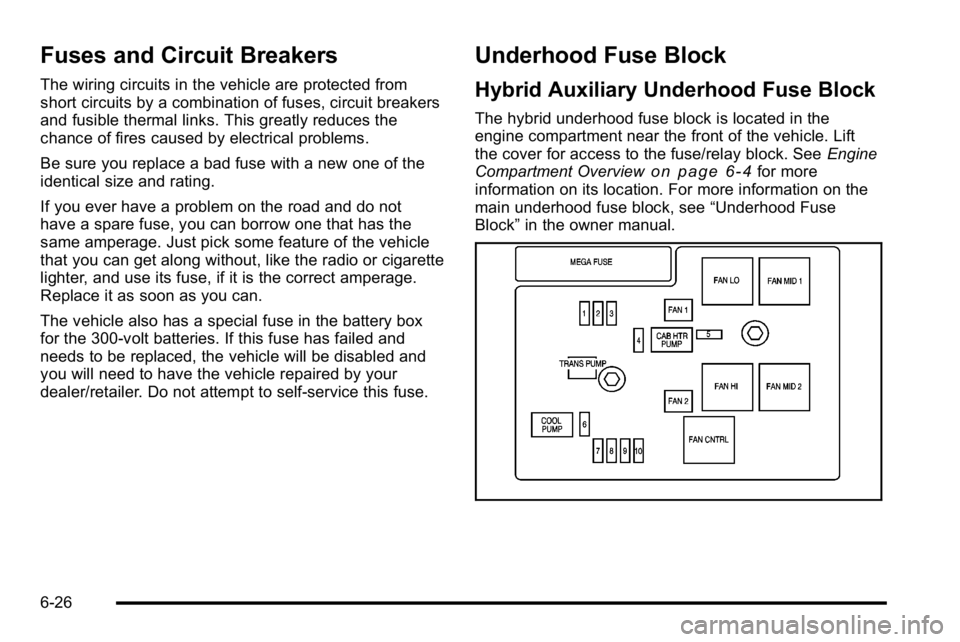
The hybrid underhood fuse block is located in the
engine compartment near the front of the vehicle. Lift
the cover for access to the fuse/relay block. SeeEngine
Compartment Overview
on page 6‑4for more
information on its location. For more information on the
main underhood fuse block, see “Underhood Fuse
Block” in the owner manual.
6-26
Page 87 of 120
TPMS Malfunction Light and Message
The TPMS will not function properly if one or more of
the TPMS sensors are missing or inoperable. When the
system detects a malfunction, the low tire warning light
flashes for about one minute and then stays on for the
remainder of the ignition cycle. A DIC warning message
is also displayed. The low tire warning light and DIC
warning message come on at each ignition cycle until
the problem is corrected. Some of the conditions that
can cause the malfunction light and DIC message to
come on are:
.The TPMS sensor matching process was started
but not completed or not completed successfully
after rotating the vehicle's tires. The DIC message
and TPMS malfunction light should go off once the
TPMS sensor matching process is performed
successfully. See“TPMS Sensor Matching
Process” later in this section.
.One or more TPMS sensors are missing or
damaged. The DIC message and the TPMS
malfunction light should go off when the TPMS
sensors are installed and the sensor matching
process is performed successfully. See your
dealer/retailer for service.
.Replacement tires or wheels do not match your
vehicle's original equipment tires or wheels.
Tires and wheels other than those recommended
for your vehicle could prevent the TPMS from
functioning properly. See “Buying New Tires”in
the Index of the owner manual.
.Operating electronic devices or being near facilities
using radio wave frequencies similar to the TPMS
could cause the TPMS sensors to malfunction.
If the TPMS is not functioning it cannot detect or signal
a low tire condition. See your dealer/retailer for service
if the TPMS malfunction light and DIC message comes
on and stays on.
6-31
Page 88 of 120
TPMS Sensor Matching Process
Each TPMS sensor has a unique identification code.
Any time you rotate your vehicle's tires or replace one
or more of the TPMS sensors, the identification codes
will need to be matched to the new tire/wheel position.
The sensors are matched to the tire/wheel positions in
the following order: driver side front tire, passenger
side front tire, passenger side rear tire, and driver side
rear tire using a TPMS diagnostic tool. See your
dealer/retailer for service.
The TPMS sensors can also be matched to each
tire/wheel position by increasing or decreasing the
tire's air pressure. If increasing the tire's air pressure,
do not exceed the maximum inflation pressure indicated
on the tire's sidewall.
To decrease air-pressure out of a tire you can use the
pointed end of the valve cap, a pencil-style air pressure
gage, or a key.
You have two minutes to match the first tire/wheel
position, and five minutes overall to match all four
tire/wheel positions. If it takes longer than two minutes,
to match the first tire and wheel, or more than
five minutes to match all four tire and wheel positions
the matching process stops and you need to start over.The TPMS sensor matching process is outlined below:
1. Set the parking brake.
2. Turn the ignition switch to ON/RUN with the engine off.
3. Press
QandKon the Remote Keyless Entry
(RKE) transmitter at the same time for
approximately five seconds. The horn sounds
twice to signal the receiver is in relearn mode and
TIRE LEARNING ACTIVE message displays on
the DIC screen.
4. Start with the driver side front tire.
5. Remove the valve cap from the valve cap stem. Activate the TPMS sensor by increasing or
decreasing the tire's air pressure for five seconds,
or until a horn chirp sounds. The horn chirp, which
may take up to 30 seconds to sound, confirms that
the sensor identification code has been matched to
this tire and wheel position.
6. Proceed to the passenger side front tire, and repeat the procedure in Step 5.
7. Proceed to the passenger side rear tire, and repeat the procedure in Step 5.
6-32