tow GMC YUKON HYBRID 2010 Owner's Manual
[x] Cancel search | Manufacturer: GMC, Model Year: 2010, Model line: YUKON HYBRID, Model: GMC YUKON HYBRID 2010Pages: 120, PDF Size: 1.03 MB
Page 54 of 120
6. Use an adequate clamping device designed fortowing to ensure that the front wheels are locked
into the straight position.
{WARNING:
Shifting a four-wheel-drive vehicle's transfer case
into N (Neutral) can cause the vehicle to roll even
if the transmission is in P (Park). The driver or
others could be injured. Make sure the parking
brake is firmly set before the transfer case is
shifted to N (Neutral).
7. Shift the transfer case to N (Neutral). See “Shifting
into N (Neutral)” underFour-Wheel Drive
on
page 3‑10
8. Turn the ignition to LOCK/OFF.
After towing, see “Shifting Out of N (Neutral)” under
Four-Wheel Drive on page 3‑10.
Towing a Trailer
For more information, see “Towing a Trailer”in the
owner manual Index.
Weight of the Trailer
How heavy can a trailer safely be?
It depends on how the rig is used. For example, speed,
altitude, road grades, outside temperature and how
much the vehicle is used to pull a trailer are all
important. It can depend on any special equipment
on the vehicle, and the amount of tongue weight the
vehicle can carry.
Maximum trailer weight is calculated assuming only the
driver is in the tow vehicle and it has all the required
trailering equipment. The weight of additional optional
equipment, passengers and cargo in the tow vehicle
must be subtracted from the maximum trailer weight.
Use the following charts to determine how much the
vehicle can weigh, based upon the vehicle model and
options.
5-8
Page 55 of 120
VehicleAxle Ratio Maximum Trailer Weight GCWR*
2WD 6.0L V8—Tahoe/
Yukon 3.08 6,200 lbs (2 812 kg) 12,000 lbs (5 443 kg)
2WD 6.0L V8 —Yukon
Denali 3.08 6,000 lbs (2 722 kg) 12,000 lbs (5 443 kg)
4WD 6.0L V8 —Tahoe/
Yukon 3.08 6,000 lbs (2 722 kg) 12,000 lbs (5 443 kg)
4WD 6.0L V8 —Yukon
Denali 3.08 5,700 lbs (2 586 kg) 12,000 lbs (5 443 kg)
*The Gross Combination Weight Rating (GCWR) is the total allowable weight of the completely loaded vehicle and
trailer including any passengers, cargo, equipment and conversions. The GCWR for the vehicle should not be
exceeded.
Trailer Brakes
If a trailer is being towed that has trailer brakes and the
trailer brakes are manually applied while driving slower
than 25 mph (40 km/h), the vehicle may go into auto
stop mode even if the brakes are not being pressed.
Using the trailer brake system manually can make
the hybrid vehicle perform as if the brake pedal in the vehicle is being pressed. The trailer brake operation
check will still work. If the trailer brakes are manually
applied for an extended period of time, the SERVICE
BRAKE SYSTEM DIC message comes on. The
message goes off after the trailer brakes have been
released. No other action is necessary. For more
information, see
“Trailer Brakes”in the Index of the
vehicle's owner manual.
5-9
Page 61 of 120
A. See“Engine Air Cleaner/Filter” in the owner
manual.
B. Drive Motor/Generator Control Module (DMCM). See Drive Motor/Generator Control Module
(DMCM) Cooling System on page 6‑9.
C. Engine Oil Dipstick. See “Engine Oil”in the owner
manual.
D. Automatic Transmission Fluid Dipstick. See Automatic Transmission Fluid on page 6‑5.
E. Brake Fluid Reservoir. See Brakes on page 6‑13.
F. See “Underhood Fuse Block” in the owner manual.
G. See “Windshield Washer Fluid” in the owner
manual.
H. Hybrid Auxiliary Fuse Block. See Underhood Fuse
Block on page 6‑26.
I. DMCM Coolant Surge Tank Pressure Cap. See Drive Motor/Generator Control Module (DMCM)
Coolant Surge Tank Pressure Cap on page 6‑8.
J. See “Coolant Surge Tank Pressure Cap” in the
owner manual.
K. Engine Oil Fill Cap. See “Engine Oil”in the owner
manual.Automatic Transmission Fluid
When to Check and Change Automatic
Transmission Fluid
It is usually not necessary to check the transmission
fluid level. The only reason for fluid loss is a
transmission leak or overheating the transmission.
If you suspect a small leak, then use the following
checking procedures to check the fluid level. However,
if there is a large leak, then it may be necessary to have
the vehicle towed to a dealer/retailer service department
and have it repaired before driving the vehicle further.
Notice: Use of the incorrect automatic transmission
fluid may damage the vehicle, and the damages may
not be covered by the vehicle's warranty. Always
use the automatic transmission fluid listed in
Recommended Fluids and Lubricants on page 7‑2.
Change the fluid and filter at the intervals listed in the
Maintenance Schedule. See Scheduled Maintenance in
the owner manual. Be sure to use the transmission fluid
listed in Recommended Fluids and Lubricants
on
page 7‑2.
6-5
Page 62 of 120
How to Check Automatic Transmission
Fluid
Notice:Too much or too little fluid can damage your
transmission. Too much can mean that some of the
fluid could come out and fall on hot engine parts or
exhaust system parts, starting a fire. Too little fluid
could cause the transmission to overheat. Be sure
to get an accurate reading if you check your
transmission fluid.
Before checking the fluid level, prepare the vehicle as
follows:
1. Start the engine and park the vehicle on a level surface. Keep the engine running.
2. Apply the parking brake and place the shift lever in P (Park).
3. With your foot on the brake pedal, move the shift lever through each gear range, pausing for about
three seconds in each range. Then, move the shift
lever back to P (Park).
4. Allow the engine to idle (500 –800 RPM) for at
least one minute. Slowly release the brake pedal.
5. Keep the engine running and press the Trip/Fuel button or trip odometer reset stem until TRANS
TEMP (Transmission Temperature) displays on the
Driver Information Center (DIC). 6. Using the TRANS TEMP reading, determine and
perform the appropriate check procedure. If the
TRANS TEMP reading is not within the required
temperature ranges, allow the vehicle to cool,
or operate the vehicle until the appropriate
transmission fluid temperature is reached.
Cold Check Procedure
Use this procedure only as a reference to determine if
the transmission has enough fluid to be operated safely
until a hot check procedure can be made. The hot
check procedure is the most accurate method to check
the fluid level. Perform the hot check procedure at the
first opportunity. Use this cold check procedure to check
fluid level when the transmission temperature is
between 24°C and 34°C (75°F and 93°F).
1. Locate the
transmission dipstick at
the rear of the engine
compartment, on the
passenger side of the
vehicle.
See Engine Compartment Overview
on page 6‑4for more information.
2. Pull out the dipstick and wipe it with a clean rag or paper towel.
6-6
Page 63 of 120
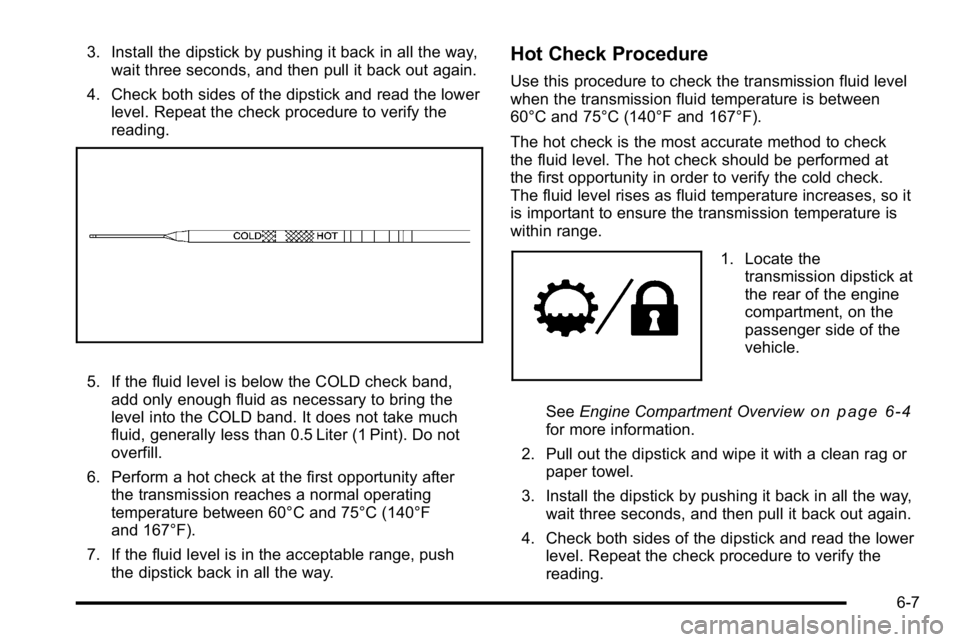
3. Install the dipstick by pushing it back in all the way,wait three seconds, and then pull it back out again.
4. Check both sides of the dipstick and read the lower level. Repeat the check procedure to verify the
reading.
5. If the fluid level is below the COLD check band,add only enough fluid as necessary to bring the
level into the COLD band. It does not take much
fluid, generally less than 0.5 Liter (1 Pint). Do not
overfill.
6. Perform a hot check at the first opportunity after the transmission reaches a normal operating
temperature between 60°C and 75°C (140°F
and 167°F).
7. If the fluid level is in the acceptable range, push the dipstick back in all the way.
Hot Check Procedure
Use this procedure to check the transmission fluid level
when the transmission fluid temperature is between
60°C and 75°C (140°F and 167°F).
The hot check is the most accurate method to check
the fluid level. The hot check should be performed at
the first opportunity in order to verify the cold check.
The fluid level rises as fluid temperature increases, so it
is important to ensure the transmission temperature is
within range.
1. Locate thetransmission dipstick at
the rear of the engine
compartment, on the
passenger side of the
vehicle.
See Engine Compartment Overview
on page 6‑4for more information.
2. Pull out the dipstick and wipe it with a clean rag or paper towel.
3. Install the dipstick by pushing it back in all the way, wait three seconds, and then pull it back out again.
4. Check both sides of the dipstick and read the lower level. Repeat the check procedure to verify the
reading.
6-7
Page 90 of 120
Tire Chains
{WARNING:
Do not use tire chains. There is not enough
clearance. Tire chains used on a vehicle without
the proper amount of clearance can cause
damage to the brakes, suspension, or other
vehicle parts. The area damaged by the tire
chains could cause you to lose control of the
vehicle and you or others may be injured in a
crash. Use another type of traction device
only if its manufacturer recommends it for use
on the vehicle and tire size combination and
road conditions. Follow that manufacturer's
instructions. To help avoid damage to the vehicle,
drive slowly, re‐adjust or remove the device if it
is contacting the vehicle, and do not spin the
wheels. If you do find traction devices that will fit,
install them on the rear tires.
If a Tire Goes Flat
Your vehicle has a tire inflator kit. There is no spare tire,
no tire changing equipment, and no place to store a tire.
It is unusual for a tire to blow out while you are driving,
especially if you maintain your tires properly. If air goes
out of a tire, it is much more likely to leak out slowly.
But, if you should ever have a blow out, here are a
few tips about what to expect and what to do:
If a front tire fails, the flat tire creates a drag that pulls
the vehicle toward that side. Take your foot off the
accelerator pedal and grip the steering wheel firmly.
Steer to maintain lane position, and then gently brake to
a stop well out of the traffic lane.
A rear blow out, particularly on a curve, acts much like a
skid and may require the same correction you would
use in a skid. In any rear blow out, remove your foot
from the accelerator pedal. Get the vehicle under
control by steering the way you want the vehicle to go.
It may be very bumpy and noisy, but you can still steer.
Gently brake to a stop, well off the road if possible.
6-34
Page 101 of 120
To install a new sealant canister:1. Align the sealant/air hose (F) with the slot in the air compressor.
2. Push the sealant canister (B) down and turn it clockwise.
3. Wrap the sealant/air hose (F) around the air compressor channel to stow it in its original
location.
4. Push the air compressor inflator hose (F) onto the sealant canister inlet and push the lever down.Tire Sealant and Compressor Kit
(With Selector Switch)
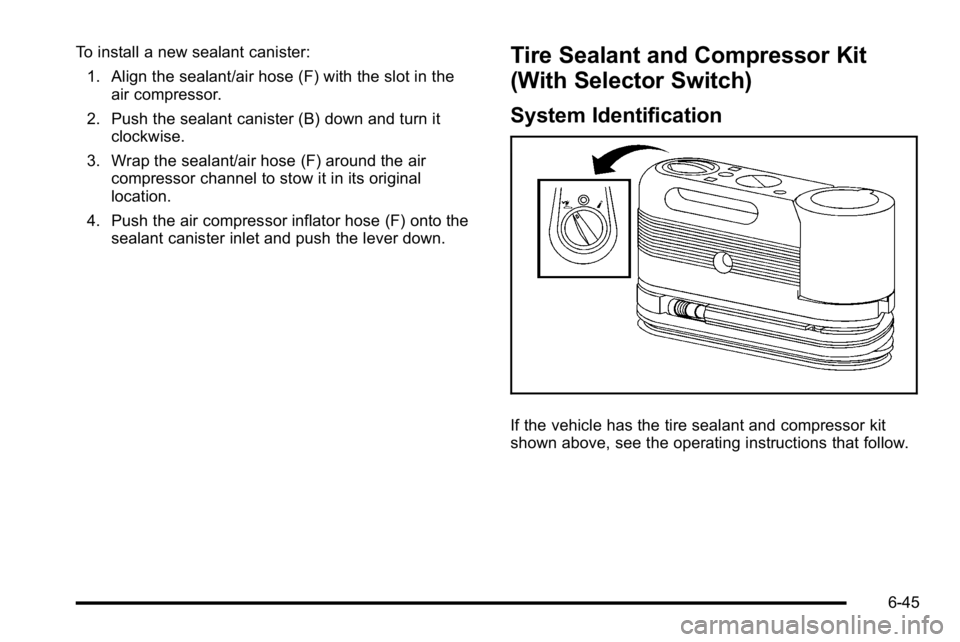
System Identification
If the vehicle has the tire sealant and compressor kit
shown above, see the operating instructions that follow.
6-45
Page 120 of 120

T
Tachometer . . . . . . . . . . . . . . . . . . . . . . . . . . . . . . . . . . . . . . . . . .4-4
TaillampsTurn Signal, Stoplamps and Back-up Lamps . . . . . . 6-24
Tires Chains . . . . . . . . . . . . . . . . . . . . . . . . . . . . . . . . . . . . . . . . . . . . 6-34
If a Tire Goes Flat . . . . . . . . . . . . . . . . . . . . . . . . . . . . . . . . 6-34
Inflation, Pressure . . . . . . . . . . . . . . . . . . . . . . . . . . . . . . . . 6-28
Inspection and Rotation . . . . . . . . . . . . . . . . . . . . . . . . . . 6-33
Sealant and Compressor Kit . . . . . . . . . . 6-35, 6-45, 6-55
Towing
Towing Your Vehicle . . . . . . . . . . . . . . . . . . . . . . . . . . . . . . . 5-2
Trailer . . . . . . . . . . . . . . . . . . . . . . . . . . . . . . . . . . . . . . . . . . . . . 5-8
Transmission, Automatic Fluid . . . . . . . . . . . . . . . . . . . . . . .6-5
V
Vehicle Running While Parked . . . . . . . . . . . . . . . . . . . . . . . . . . . . 3-18
Voltage Devices, and Wiring . . . . . . . . . . . . . . . . . . . . . . . . .6-3
W
Wiring, High Voltage Devices . . . . . . . . . . . . . . . . . . . . . . . .6-3
i - 4