maintenance schedule GMC YUKON XL 2007 User Guide
[x] Cancel search | Manufacturer: GMC, Model Year: 2007, Model line: YUKON XL, Model: GMC YUKON XL 2007Pages: 608, PDF Size: 3.01 MB
Page 474 of 608
When to Change Lubricant
Refer to the Maintenance Schedule to determine
how often to change the lubricant. See
Scheduled Maintenance on page 555.
What to Use
Refer to the Maintenance Schedule to determine
what kind of lubricant to use. SeeRecommended
Fluids and Lubricants on page 564.
Front Axle
When to Check and Change Lubricant
It is not necessary to regularly check front axle
uid unless you suspect there is a leak or you hear
an unusual noise. A uid loss could indicate a
problem. Have it inspected and repaired.
How to Check Lubricant
To get an accurate reading, the vehicle should be
on a level surface.
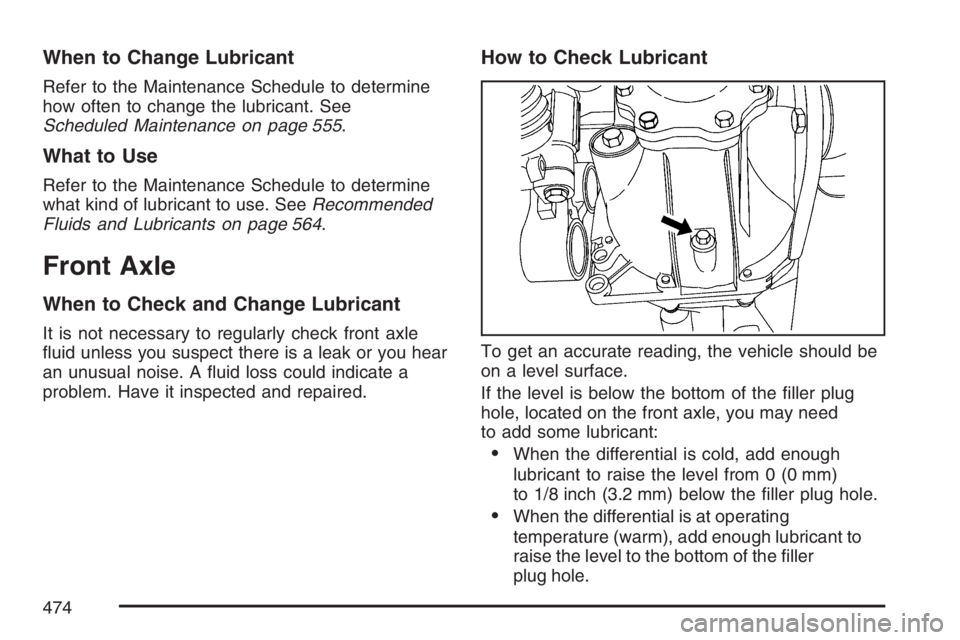
If the level is below the bottom of the ller plug
hole, located on the front axle, you may need
to add some lubricant:
When the differential is cold, add enough
lubricant to raise the level from 0 (0 mm)
to 1/8 inch (3.2 mm) below the ller plug hole.
When the differential is at operating
temperature (warm), add enough lubricant to
raise the level to the bottom of the ller
plug hole.
474
Page 475 of 608

What to Use
Refer to the Maintenance Schedule to determine
what kind of lubricant to use. SeeRecommended
Fluids and Lubricants on page 564.
Headlamp Aiming
The vehicle has a visual optical headlamp aiming
system. The aim of the headlamps have been
preset at the factory and should need no further
adjustment.
However, if the vehicle is damaged in an accident,
the aim of the headlamps may be affected and
adjustment may be necessary.
If oncoming vehicles ash their high beams at
you, this may mean the vertical aim of your
headlamps needs to be adjusted.
It is recommended that the vehicle is taken to your
dealer for service if the headlamps need to be
adjusted. It is possible however, to re-aim
the headlamps as described in the following
procedure.The vehicle should be properly prepared as
follows:
The vehicle should be placed so the
headlamps are 25 ft. (7.6 m) from a light
colored wall.
The vehicle must have all four tires on a level
surface which is level all the way to the wall.
The vehicle should be placed so it is
perpendicular to the wall.
The vehicle should not have any snow, ice, or
mud on it.
The vehicle should be fully assembled and all
other work stopped while headlamp aiming is
being performed.
The vehicle should be normally loaded with
a full tank of fuel and one person or
160 lbs (75 kg) sitting on the driver’s seat.
Tires should be properly inated.
The spare tire is in its proper location in the
vehicle.
Headlamp aiming is done with the vehicle’s
low-beam headlamps. The high-beam headlamps
will be correctly aimed if the low-beam headlamps
are aimed properly.
475
Page 481 of 608
Replacement Bulbs
Exterior Lamp Bulb Number
Back-up Lamp 7441
License Plate Lamp 168
Rear Turn Signal Lamp, Taillamp,
and Stoplamp3057
For replacement bulbs not listed here, contact
your dealer.
Windshield Wiper Blade
Replacement
Windshield wiper blades should be inspected for
wear or cracking. SeeScheduled Maintenance
on page 555.
Replacement blades come in different types and
are removed in different ways. To replace the
wiper blade assembly, do the following:
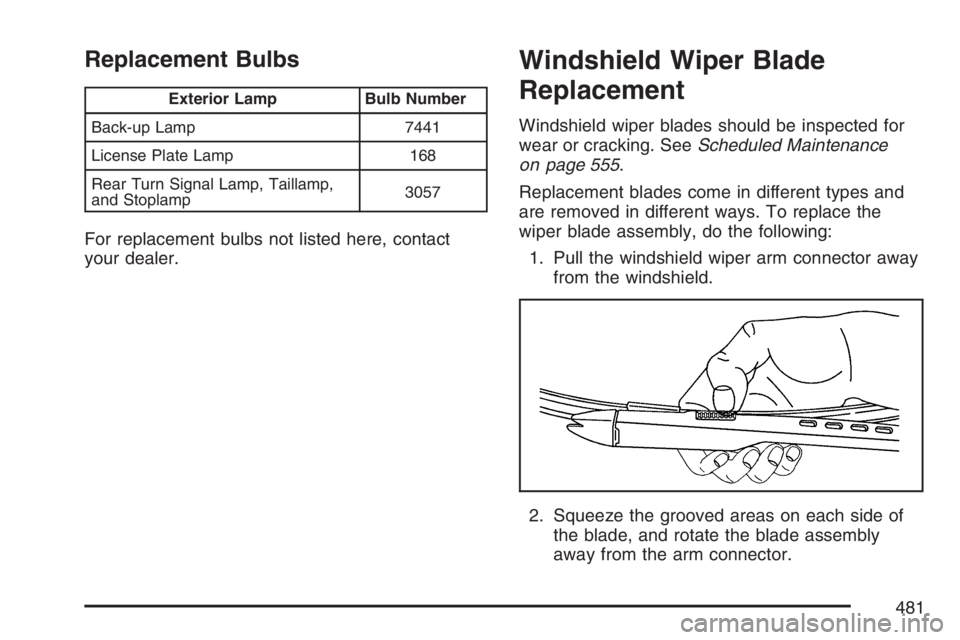
1. Pull the windshield wiper arm connector away
from the windshield.
2. Squeeze the grooved areas on each side of
the blade, and rotate the blade assembly
away from the arm connector.
481
Page 497 of 608
The Tire Pressure Monitor System (TPMS)
operates on a radio frequency and complies
with RSS-210 of Industry and Science Canada.
Operation is subject to the following
two conditions:
1. This device may not cause interference.
2. This device must accept any interference
received, including interference that may
cause undesired operation of the device.
Changes or modications to this system by other
than an authorized service facility could void
authorization to use this equipment.
Tire Inspection and Rotation
Tires should be rotated every 5,000 to 8,000 miles
(8 000 to 13 000 km).
Any time you notice unusual wear, rotate your
tires as soon as possible and check wheel
alignment. Also check for damaged tires or wheels.
SeeWhen It Is Time for New Tires on page 499
andWheel Replacement on page 504for
more information.Make sure the spare tire is stored securely. Push,
pull, and then try to rotate or turn the tire. If it
moves, use the ratchet/wheel wrench to tighten the
cable. SeeChanging a Flat Tire on page 508.
The purpose of regular rotation is to achieve more
uniform wear for all tires on the vehicle. The
rst rotation is the most important. SeeScheduled
Maintenance on page 555.
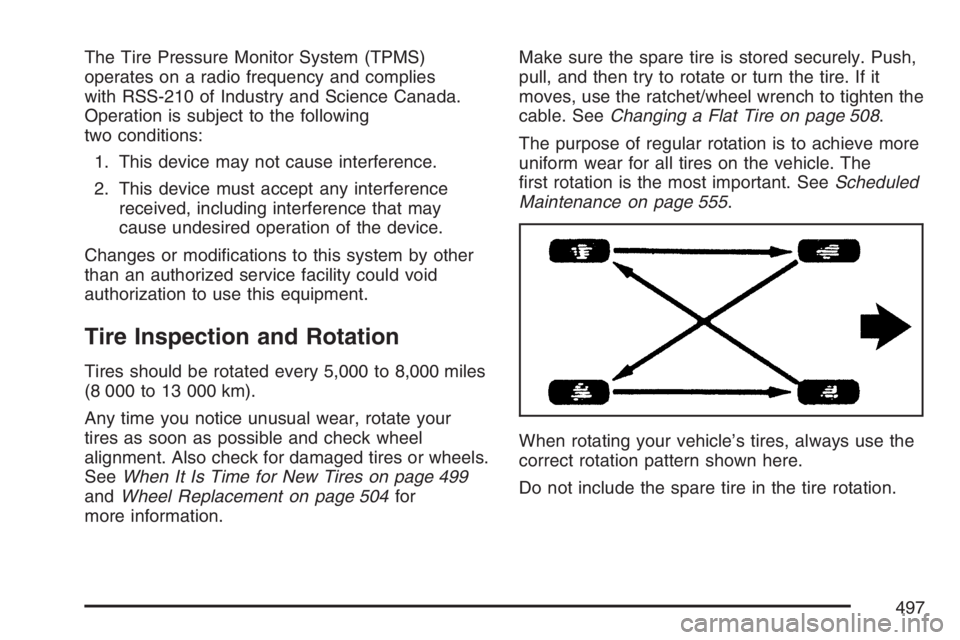
When rotating your vehicle’s tires, always use the
correct rotation pattern shown here.
Do not include the spare tire in the tire rotation.
497
Page 551 of 608
Maintenance Schedule.................................552
Introduction................................................552
Maintenance Requirements.........................552
Your Vehicle and the Environment.............552
Using the Maintenance Schedule...............553
Scheduled Maintenance..............................555
Additional Required Services......................557
Maintenance Footnotes..............................558Owner Checks and Services......................560
At Each Fuel Fill........................................560
At Least Once a Month..............................561
At Least Once a Year................................562
Recommended Fluids and Lubricants.........564
Normal Maintenance Replacement Parts....566
Engine Drive Belt Routing..........................567
Maintenance Record...................................567
Section 6 Maintenance Schedule
551
Page 552 of 608
Maintenance Schedule
Introduction
Important: Keep engine oil at the proper level
and change as recommended.
Have you purchased the GM Protection Plan?
The Plan supplements your new vehicle
warranties. See your Warranty and Owner
Assistance booklet or your dealer for details.
Maintenance Requirements
Notice:Maintenance intervals, checks,
inspections, replacement parts, and
recommended uids and lubricants as
prescribed in this manual are necessary to
keep your vehicle in good working condition.
Any damage caused by failure to follow
scheduled maintenance may not be covered by
warranty.
Your Vehicle and the Environment
Proper vehicle maintenance not only helps to keep
your vehicle in good working condition, but also
helps the environment. All recommended
maintenance is important. Improper vehicle
maintenance can even affect the quality of the air
we breathe. Improper uid levels or the wrong
tire ination can increase the level of emissions
from your vehicle. To help protect our environment,
and to keep your vehicle in good condition, be
sure to maintain your vehicle properly.
552
Page 553 of 608
Using the Maintenance Schedule
We at General Motors want to help you keep your
vehicle in good working condition. But we do
not know exactly how you will drive it. You may
drive very short distances only a few times a week.
Or you may drive long distances all the time in
very hot, dusty weather. You may use your vehicle
in making deliveries. Or you may drive it to
work, to do errands, or in many other ways.
Because of all the different ways people use their
vehicles, maintenance needs vary. You may
need more frequent checks and replacements.
So please read the following and note how
you drive. If you have any questions on how to
keep your vehicle in good condition, see your
GM Goodwrench
®dealer.This schedule is for vehicles that:
carry passengers and cargo within
recommended limits. You will nd these limits
on the tire and loading information label.
SeeLoading Your Vehicle on page 390.
are driven on reasonable road surfaces within
legal driving limits.
are driven off-road in the recommended
manner. SeeOff-Road Driving on page 356.
use the recommended fuel. SeeGasoline
Octane on page 428.
The services inScheduled Maintenance on
page 555should be performed when indicated.
SeeAdditional Required Services on page 557and
Maintenance Footnotes on page 558for further
information.
553
Page 555 of 608
Scheduled Maintenance
When the CHANGE ENGINE OIL message comes
on, it means that service is required for your
vehicle. Have your vehicle serviced as soon as
possible within the next 600 miles (1 000 km). It is
possible that, if you are driving under the best
conditions, the engine oil life system may not
indicate that vehicle service is necessary for over a
year. However, your engine oil and lter must be
changed at least once a year and at this time the
system must be reset. Your GM Goodwrench
®
dealer has GM-trained service technicians who will
perform this work using genuine GM parts and reset
the system.
If the engine oil life system is ever reset
accidentally, you must service your vehicle within
3,000 miles (5 000 km) since your last service.
Remember to reset the oil life system whenever
the oil is changed. SeeEngine Oil Life System on
page 441for information on the Engine Oil Life
System and resetting the system.When the CHANGE ENGINE OIL message
appears, certain services, checks, and inspections
are required. Required services are described
in the following for “MaintenanceI” and
“MaintenanceII.” Generally, it is recommended
that your rst service be MaintenanceI, your
second service be MaintenanceII, and that you
alternate MaintenanceIand MaintenanceII
thereafter. However, in some cases,
MaintenanceIImay be required more often.
MaintenanceI— Use MaintenanceIif the
CHANGE ENGINE OIL message comes on
within 10 months since the vehicle was purchased
or MaintenanceIIwas performed.
MaintenanceII— Use MaintenanceIIif the
previous service performed was MaintenanceI.
Always use MaintenanceIIwhenever the message
comes on 10 months or more since the last
service or if the message has not come on at all
for one year.
555
Page 556 of 608
Scheduled Maintenance
Service MaintenanceIMaintenanceII
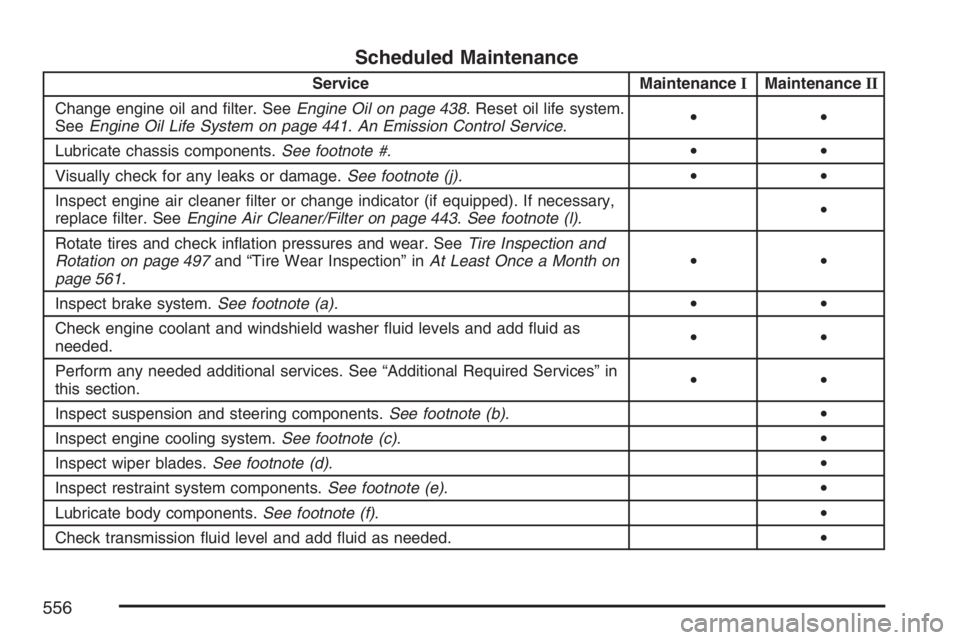
Change engine oil and lter. SeeEngine Oil on page 438. Reset oil life system.
SeeEngine Oil Life System on page 441.An Emission Control Service.••
Lubricate chassis components.See footnote #.••
Visually check for any leaks or damage.See footnote (j).••
Inspect engine air cleaner lter or change indicator (if equipped). If necessary,
replace lter. SeeEngine Air Cleaner/Filter on page 443.See footnote (l).•
Rotate tires and check ination pressures and wear. SeeTire Inspection and
Rotation on page 497and “Tire Wear Inspection” inAt Least Once a Month on
page 561.••
Inspect brake system.See footnote (a).••
Check engine coolant and windshield washer uid levels and add uid as
needed.••
Perform any needed additional services. See “Additional Required Services” in
this section.••
Inspect suspension and steering components.See footnote (b).•
Inspect engine cooling system.See footnote (c).•
Inspect wiper blades.See footnote (d).•
Inspect restraint system components.See footnote (e).•
Lubricate body components.See footnote (f).•
Check transmission uid level and add uid as needed.•
556
Page 568 of 608
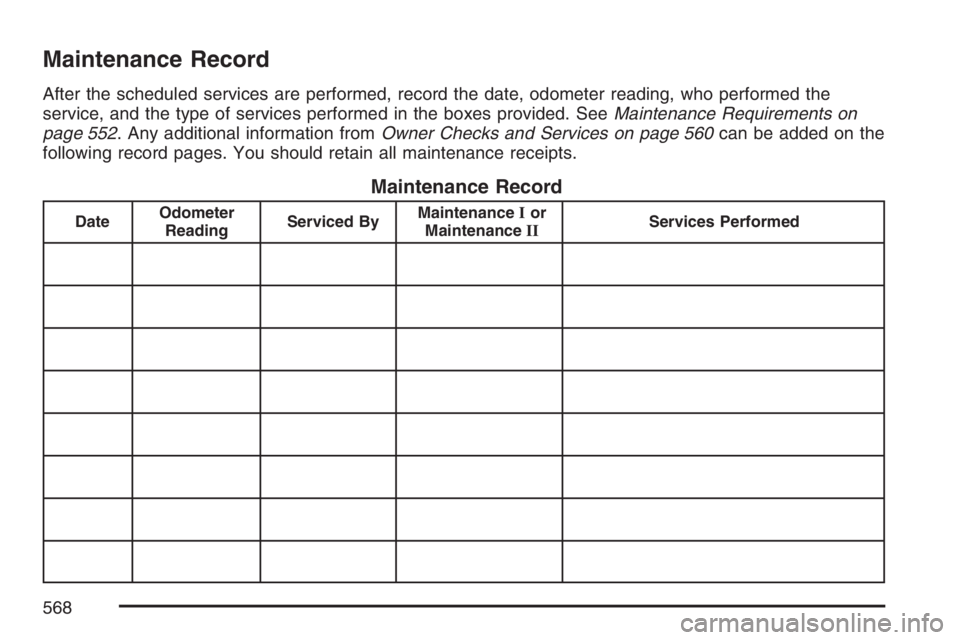
Maintenance Record
After the scheduled services are performed, record the date, odometer reading, who performed the
service, and the type of services performed in the boxes provided. SeeMaintenance Requirements on
page 552. Any additional information fromOwner Checks and Services on page 560can be added on the
following record pages. You should retain all maintenance receipts.
Maintenance Record
DateOdometer
ReadingServiced ByMaintenanceIor
MaintenanceIIServices Performed
568