towing GMC YUKON XL 2007 User Guide
[x] Cancel search | Manufacturer: GMC, Model Year: 2007, Model line: YUKON XL, Model: GMC YUKON XL 2007Pages: 608, PDF Size: 3.01 MB
Page 163 of 608
Cleaning the Mirror
Use a paper towel or similar material dampened
with glass cleaner. Do not spray glass cleaner
directly on the mirror as that may cause the liquid
cleaner to enter the mirror housing.
Outside Manual Mirrors
Adjust your outside mirrors so you can just see
the side of your vehicle and have a clear view of
objects behind you. The mirrors can be folded
in to enter narrow areas.
The use of hood-mounted air deectors and
add-on convex mirror attachments may adversely
affect mirror performance.
Outside Trailer-Tow Mirrors
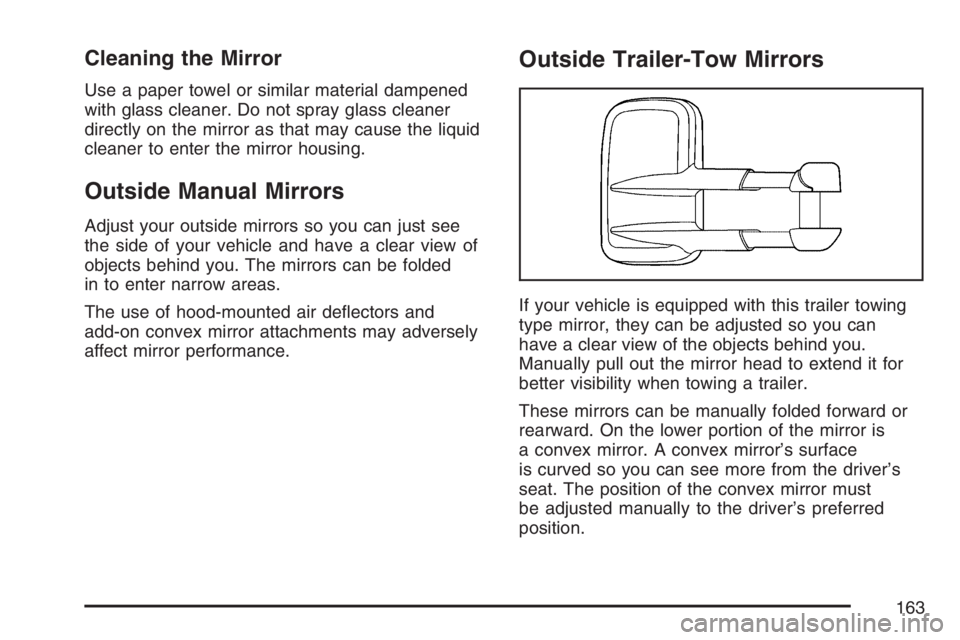
If your vehicle is equipped with this trailer towing
type mirror, they can be adjusted so you can
have a clear view of the objects behind you.
Manually pull out the mirror head to extend it for
better visibility when towing a trailer.
These mirrors can be manually folded forward or
rearward. On the lower portion of the mirror is
a convex mirror. A convex mirror’s surface
is curved so you can see more from the driver’s
seat. The position of the convex mirror must
be adjusted manually to the driver’s preferred
position.
163
Page 232 of 608
Brake System Warning Light
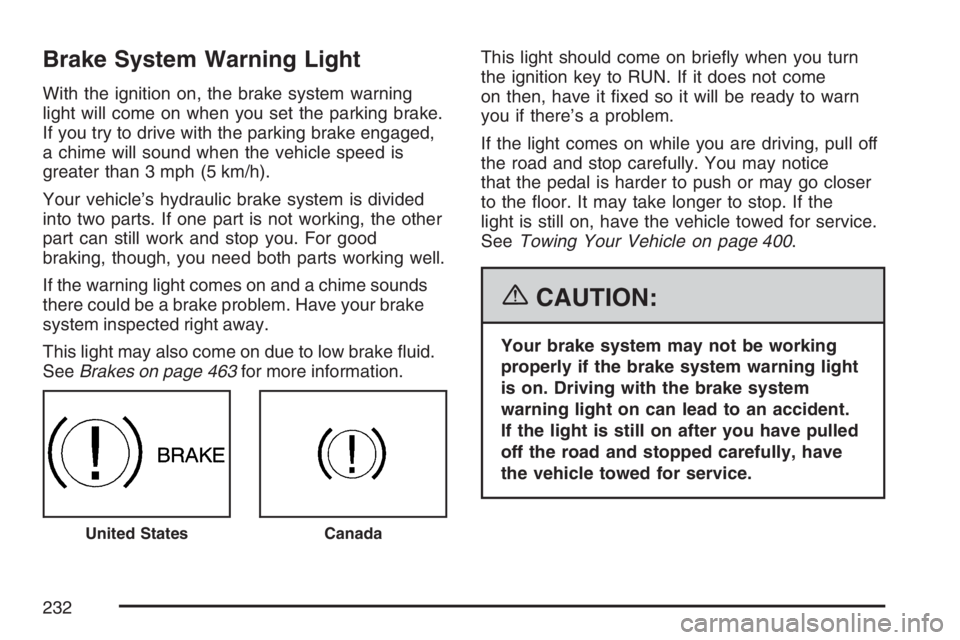
With the ignition on, the brake system warning
light will come on when you set the parking brake.
If you try to drive with the parking brake engaged,
a chime will sound when the vehicle speed is
greater than 3 mph (5 km/h).
Your vehicle’s hydraulic brake system is divided
into two parts. If one part is not working, the other
part can still work and stop you. For good
braking, though, you need both parts working well.
If the warning light comes on and a chime sounds
there could be a brake problem. Have your brake
system inspected right away.
This light may also come on due to low brake uid.
SeeBrakes on page 463for more information.This light should come on briey when you turn
the ignition key to RUN. If it does not come
on then, have it xed so it will be ready to warn
you if there’s a problem.
If the light comes on while you are driving, pull off
the road and stop carefully. You may notice
that the pedal is harder to push or may go closer
to the oor. It may take longer to stop. If the
light is still on, have the vehicle towed for service.
SeeTowing Your Vehicle on page 400.
{CAUTION:
Your brake system may not be working
properly if the brake system warning light
is on. Driving with the brake system
warning light on can lead to an accident.
If the light is still on after you have pulled
off the road and stopped carefully, have
the vehicle towed for service.
United StatesCanada
232
Page 237 of 608
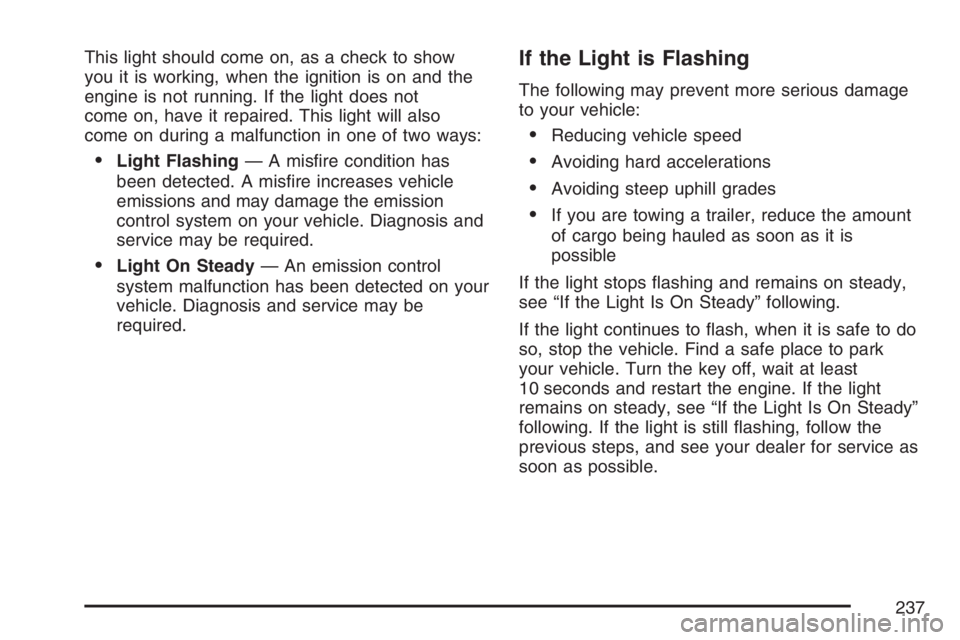
This light should come on, as a check to show
you it is working, when the ignition is on and the
engine is not running. If the light does not
come on, have it repaired. This light will also
come on during a malfunction in one of two ways:
Light Flashing— A misre condition has
been detected. A misre increases vehicle
emissions and may damage the emission
control system on your vehicle. Diagnosis and
service may be required.
Light On Steady— An emission control
system malfunction has been detected on your
vehicle. Diagnosis and service may be
required.
If the Light is Flashing
The following may prevent more serious damage
to your vehicle:
Reducing vehicle speed
Avoiding hard accelerations
Avoiding steep uphill grades
If you are towing a trailer, reduce the amount
of cargo being hauled as soon as it is
possible
If the light stops ashing and remains on steady,
see “If the Light Is On Steady” following.
If the light continues to ash, when it is safe to do
so, stop the vehicle. Find a safe place to park
your vehicle. Turn the key off, wait at least
10 seconds and restart the engine. If the light
remains on steady, see “If the Light Is On Steady”
following. If the light is still ashing, follow the
previous steps, and see your dealer for service as
soon as possible.
237
Page 242 of 608
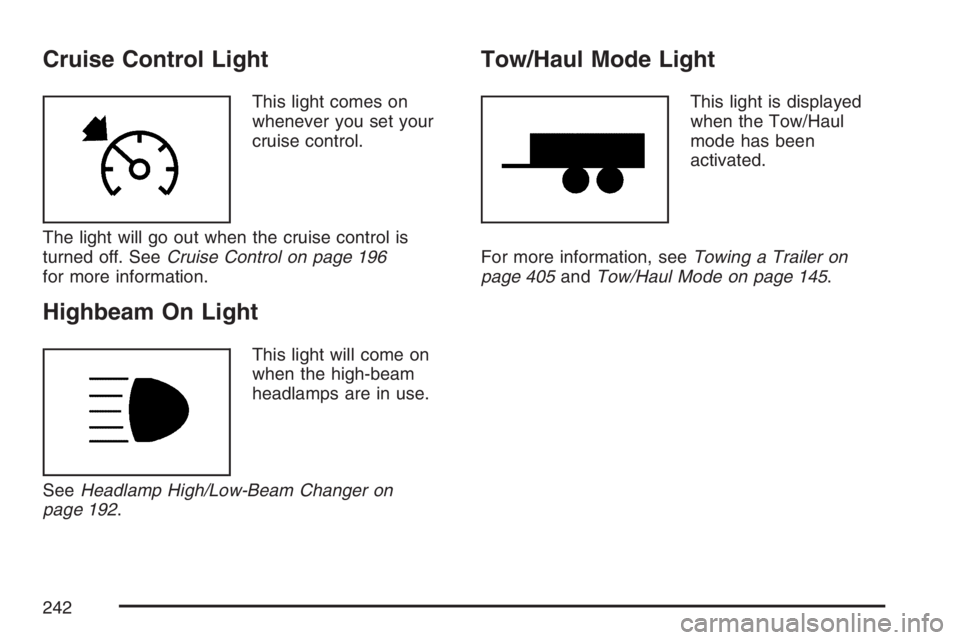
Cruise Control Light
This light comes on
whenever you set your
cruise control.
The light will go out when the cruise control is
turned off. SeeCruise Control on page 196
for more information.
Highbeam On Light
This light will come on
when the high-beam
headlamps are in use.
SeeHeadlamp High/Low-Beam Changer on
page 192.
Tow/Haul Mode Light
This light is displayed
when the Tow/Haul
mode has been
activated.
For more information, seeTowing a Trailer on
page 405andTow/Haul Mode on page 145.
242
Page 339 of 608
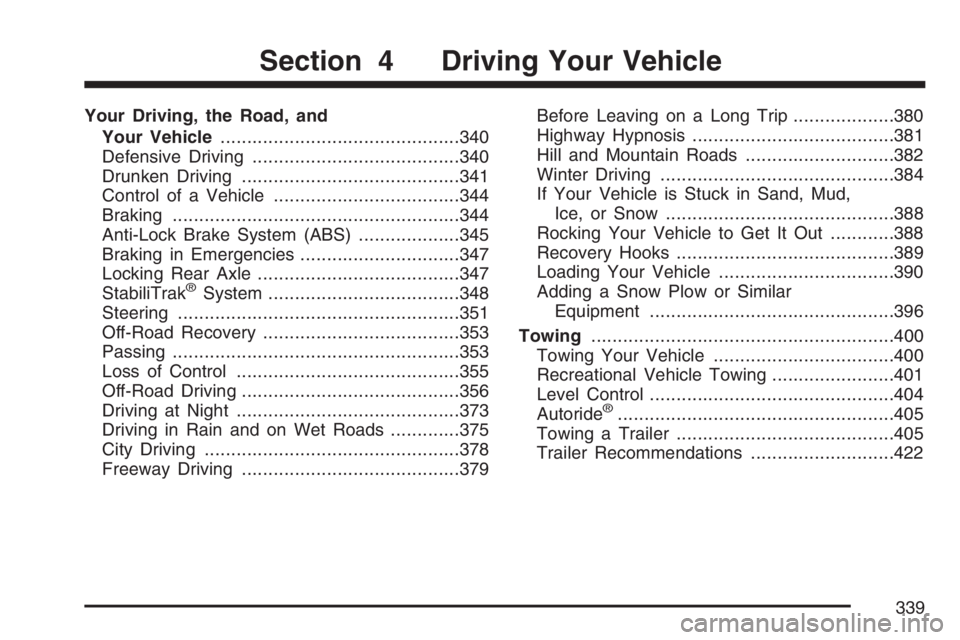
Your Driving, the Road, and
Your Vehicle.............................................340
Defensive Driving.......................................340
Drunken Driving.........................................341
Control of a Vehicle...................................344
Braking......................................................344
Anti-Lock Brake System (ABS)...................345
Braking in Emergencies..............................347
Locking Rear Axle......................................347
StabiliTrak
®System....................................348
Steering.....................................................351
Off-Road Recovery.....................................353
Passing......................................................353
Loss of Control..........................................355
Off-Road Driving.........................................356
Driving at Night..........................................373
Driving in Rain and on Wet Roads.............375
City Driving................................................378
Freeway Driving.........................................379Before Leaving on a Long Trip...................380
Highway Hypnosis......................................381
Hill and Mountain Roads............................382
Winter Driving............................................384
If Your Vehicle is Stuck in Sand, Mud,
Ice, or Snow...........................................388
Rocking Your Vehicle to Get It Out............388
Recovery Hooks.........................................389
Loading Your Vehicle.................................390
Adding a Snow Plow or Similar
Equipment..............................................396
Towing.........................................................400
Towing Your Vehicle..................................400
Recreational Vehicle Towing.......................401
Level Control..............................................404
Autoride
®....................................................405
Towing a Trailer.........................................405
Trailer Recommendations...........................422
Section 4 Driving Your Vehicle
339
Page 388 of 608
If Your Vehicle is Stuck in Sand,
Mud, Ice, or Snow
In order to free your vehicle when it is stuck, you
will need to spin the wheels, but you do not
want to spin your wheels too fast. The method
known as rocking can help you get out when you
are stuck, but you must use caution.
{CAUTION:
If you let your tires spin at high speed,
they can explode, and you or others could
be injured. And, the transmission or other
parts of the vehicle can overheat. That
could cause an engine compartment re
or other damage. When you are stuck,
spin the wheels as little as possible.
Do not spin the wheels above 35 mph
(55 km/h) as shown on the speedometer.Notice:Spinning your wheels can destroy
parts of your vehicle as well as the tires. If you
spin the wheels too fast while shifting your
transmission back and forth, you can destroy
your transmission.
For more information about using tire chains on
your vehicle, seeTire Chains on page 506.
Rocking Your Vehicle to Get It Out
First, turn your steering wheel left and right. That
will clear the area around your front wheels. If you
have a four-wheel-drive vehicle, shift into
Four-Wheel High or Four-Wheel Low. Turn the
StabiliTrak
®System off. SeeStabiliTrak®System
on page 348. Then shift back and forth between
REVERSE (R) and a forward gear, spinning the
wheels as little as possible. Release the accelerator
pedal while you shift, and press lightly on the
accelerator pedal when the transmission is in gear.
By slowly spinning your wheels in the forward and
reverse directions, you will cause a rocking motion
that may free your vehicle. If that does not get you
out after a few tries, you may need to be towed out.
Or, you can use your recovery hooks if your vehicle
has them. If you do need to be towed out, see
Towing Your Vehicle on page 400.
388
Page 392 of 608
5. Determine the combined weight of luggage
and cargo being loaded on the vehicle. That
weight may not safely exceed the available
cargo and luggage load capacity calculated
in Step 4.
6. If your vehicle will be towing a trailer, the load
from your trailer will be transferred to your
vehicle. Consult this manual to determine how
this reduces the available cargo and luggage
load capacity of your vehicle. SeeTowing
a Trailer on page 405for important information
on towing a trailer, towing safety rules and
trailering tips.
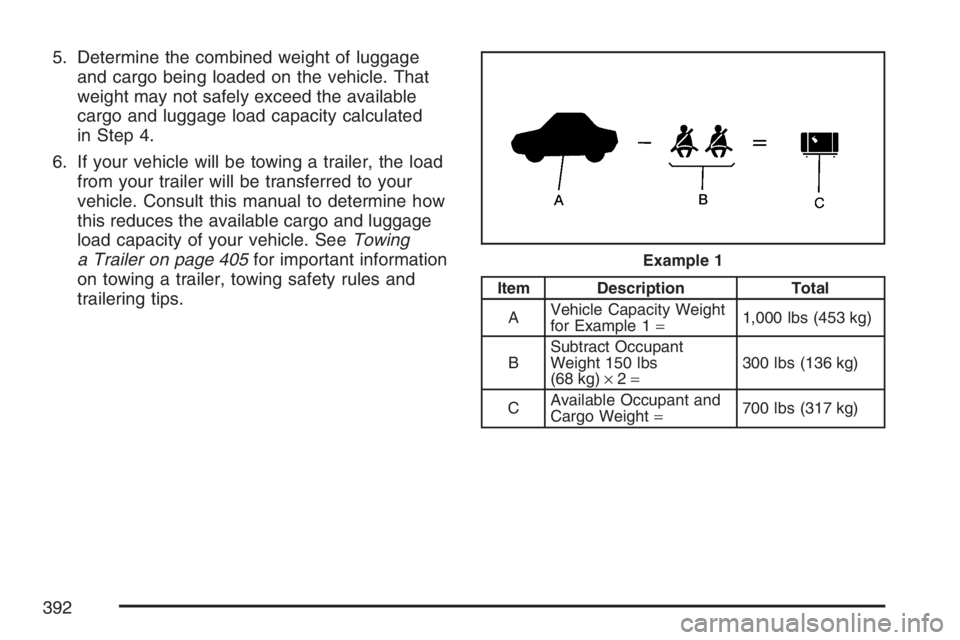
Item Description Total
AVehicle Capacity Weight
for Example 1=1,000 lbs (453 kg)
BSubtract Occupant
Weight 150 lbs
(68 kg)×2=300 lbs (136 kg)
CAvailable Occupant and
Cargo Weight=700 lbs (317 kg) Example 1
392
Page 400 of 608
Q:What is total vehicle reserve capacity?
A:This is the difference between your GVWR and
the weight of your vehicle with full fuel and
passengers. It is the amount of weight you can
add to your vehicle before reaching your
GVWR. Keep in mind that reserve capacity
numbers are intended as a guide when
selecting the amount of equipment or cargo
your vehicle can carry. If you are unsure
of your vehicle’s front, rear, or total weight, go
to a weigh station and weigh your vehicle.
Your dealer can also help you with this.
The total vehicle reserve capacity for your
vehicle can be found in the lower right corner
of the Certication/Tire label as shown
previously.
See your dealer for additional advice and
information about using a snow plow on your
vehicle. Also, seeLoading Your Vehicle on
page 390.
Emergency Roof Lamp Provisions
Vehicles with the RPO VYU snow plow prep
package also have an emergency roof lamp
provision package, RPO TRW. Wiring for the
emergency roof lamp is provided above the
overhead console. SeeAuxiliary Roof Mounted
Lamp on page 203for switch location.
Towing
Towing Your Vehicle
Consult your dealer or a professional towing
service if you need to have your disabled vehicle
towed. SeeRoadside Assistance Program on
page 577.
If you want to tow your vehicle behind another
vehicle for recreational purposes (such as behind
a motorhome), see “Recreational Vehicle
Towing” following.
400
Page 401 of 608
Recreational Vehicle Towing
Recreational vehicle towing means towing your
vehicle behind another vehicle – such as behind a
motorhome. The two most common types of
recreational vehicle towing are known as dinghy
towing, towing your vehicle with all four wheels on
the ground, and dolly towing, towing your
vehicle with two wheels on the ground and two
wheels up on a device known as a “dolly”.
With the proper preparation and equipment, many
vehicles can be towed in these ways. See
“Dinghy Towing” and “Dolly Towing”, following.
Here are some important things to consider before
you do recreational vehicle towing:
What’s the towing capacity of the towing
vehicle? Be sure you read the tow vehicle
manufacturer’s recommendations.
How far will you tow? Some vehicles have
restrictions on how far and how long they
can tow.
Do you have the proper towing equipment?
See your dealer or trailering professional
for additional advice and equipment
recommendations.
Is your vehicle ready to be towed? Just as
you would prepare your vehicle for a long
trip, you’ll want to make sure your vehicle is
prepared to be towed. SeeBefore Leaving on
a Long Trip on page 380.
Dinghy Towing
Two-Wheel-Drive Vehicles
Notice:If you tow a two-wheel-drive vehicle
with all four wheels on the ground, the
transmission could be damaged. The repairs
would not be covered by your warranty. Do not
tow a two-wheel-drive vehicle with all four
wheels on the ground.
Two-wheel-drive vehicles should not be towed
with all four wheels on the ground.
Two-wheel-drive transmissions have no provisions
for internal lubrication while being towed.
401
Page 402 of 608
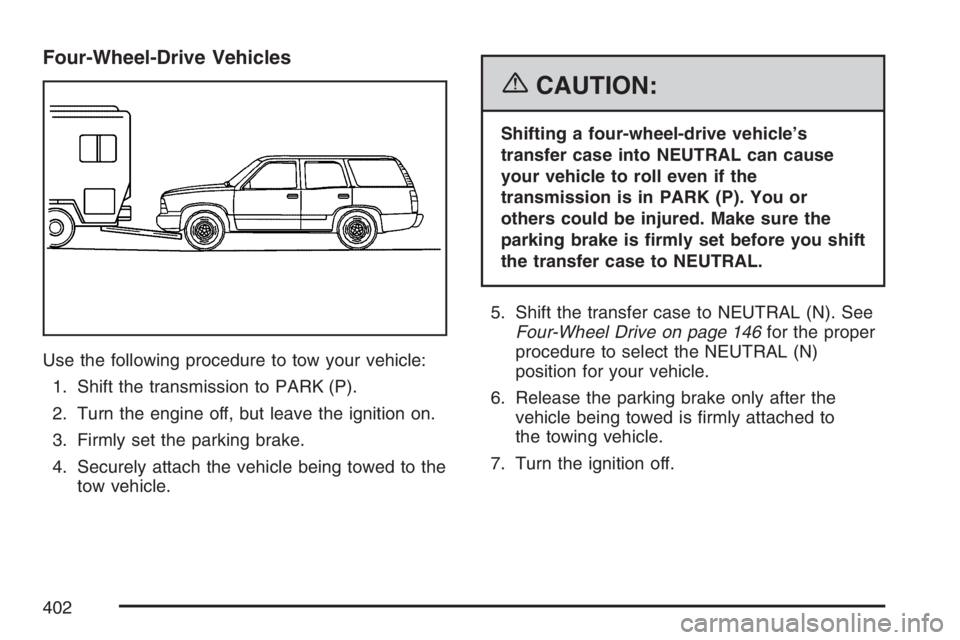
Four-Wheel-Drive Vehicles
Use the following procedure to tow your vehicle:
1. Shift the transmission to PARK (P).
2. Turn the engine off, but leave the ignition on.
3. Firmly set the parking brake.
4. Securely attach the vehicle being towed to the
tow vehicle.
{CAUTION:
Shifting a four-wheel-drive vehicle’s
transfer case into NEUTRAL can cause
your vehicle to roll even if the
transmission is in PARK (P). You or
others could be injured. Make sure the
parking brake is rmly set before you shift
the transfer case to NEUTRAL.
5. Shift the transfer case to NEUTRAL (N). See
Four-Wheel Drive on page 146for the proper
procedure to select the NEUTRAL (N)
position for your vehicle.
6. Release the parking brake only after the
vehicle being towed is rmly attached to
the towing vehicle.
7. Turn the ignition off.
402