transmission GMC YUKON XL 2007 Owner's Guide
[x] Cancel search | Manufacturer: GMC, Model Year: 2007, Model line: YUKON XL, Model: GMC YUKON XL 2007Pages: 608, PDF Size: 3.01 MB
Page 401 of 608
Recreational Vehicle Towing
Recreational vehicle towing means towing your
vehicle behind another vehicle – such as behind a
motorhome. The two most common types of
recreational vehicle towing are known as dinghy
towing, towing your vehicle with all four wheels on
the ground, and dolly towing, towing your
vehicle with two wheels on the ground and two
wheels up on a device known as a “dolly”.
With the proper preparation and equipment, many
vehicles can be towed in these ways. See
“Dinghy Towing” and “Dolly Towing”, following.
Here are some important things to consider before
you do recreational vehicle towing:
What’s the towing capacity of the towing
vehicle? Be sure you read the tow vehicle
manufacturer’s recommendations.
How far will you tow? Some vehicles have
restrictions on how far and how long they
can tow.
Do you have the proper towing equipment?
See your dealer or trailering professional
for additional advice and equipment
recommendations.
Is your vehicle ready to be towed? Just as
you would prepare your vehicle for a long
trip, you’ll want to make sure your vehicle is
prepared to be towed. SeeBefore Leaving on
a Long Trip on page 380.
Dinghy Towing
Two-Wheel-Drive Vehicles
Notice:If you tow a two-wheel-drive vehicle
with all four wheels on the ground, the
transmission could be damaged. The repairs
would not be covered by your warranty. Do not
tow a two-wheel-drive vehicle with all four
wheels on the ground.
Two-wheel-drive vehicles should not be towed
with all four wheels on the ground.
Two-wheel-drive transmissions have no provisions
for internal lubrication while being towed.
401
Page 402 of 608
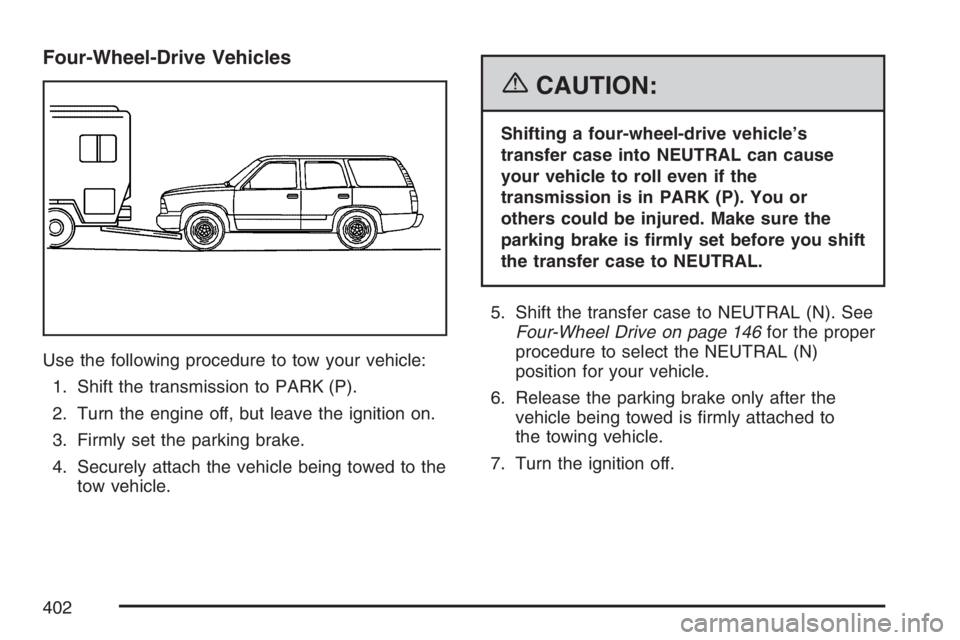
Four-Wheel-Drive Vehicles
Use the following procedure to tow your vehicle:
1. Shift the transmission to PARK (P).
2. Turn the engine off, but leave the ignition on.
3. Firmly set the parking brake.
4. Securely attach the vehicle being towed to the
tow vehicle.
{CAUTION:
Shifting a four-wheel-drive vehicle’s
transfer case into NEUTRAL can cause
your vehicle to roll even if the
transmission is in PARK (P). You or
others could be injured. Make sure the
parking brake is rmly set before you shift
the transfer case to NEUTRAL.
5. Shift the transfer case to NEUTRAL (N). See
Four-Wheel Drive on page 146for the proper
procedure to select the NEUTRAL (N)
position for your vehicle.
6. Release the parking brake only after the
vehicle being towed is rmly attached to
the towing vehicle.
7. Turn the ignition off.
402
Page 403 of 608

Dolly Towing
Two-Wheel-Drive Vehicles
Notice:If you tow a two-wheel-drive vehicle
with the rear wheels on the ground, the
transmission could be damaged. The repairs
would not be covered by your warranty. Never
tow your vehicle with the rear wheels on the
ground.
Two-wheel-drive vehicles should not be
towed with the rear wheels on the ground.
Two-wheel-drive transmissions have no provisions
for internal lubrication while being towed.
Two-wheel-drive vehicles can be towed on a dolly
with the front wheels on the ground provided
that the wheels are straight.
Four-Wheel-Drive Vehicles
If your vehicle is equipped with StabiliTrak®,itis
not designed to be dolly towed. If you need to tow
your vehicle, see “Dinghy Towing” earlier in this
section.If your vehicle is not equipped with StabiliTrak
®,
use the following procedure to tow your vehicle:
1. Drive the vehicle up onto the tow dolly.
2. Shift the transmission to PARK (P).
3. Turn the engine off, but leave the ignition on.
4. Firmly set the parking brake.
5. Securely attach the vehicle being towed to the
tow dolly.
403
Page 404 of 608
{CAUTION:
Shifting a four-wheel-drive vehicle’s
transfer case into NEUTRAL can cause
your vehicle to roll even if the
transmission is in PARK (P). You or
others could be injured. Make sure the
parking brake is rmly set before you shift
the transfer case to NEUTRAL.
6. Shift the transfer case to NEUTRAL. See
Four-Wheel Drive on page 146for the
proper procedure to select the NEUTRAL
position for your vehicle.
7. Release the parking brake only after the
vehicle being towed is rmly attached to
the towing vehicle.
Level Control
Automatic Level Control
The automatic level control rear suspension is
available on two-wheel drive and four-wheel drive
light-duty vehicles and comes as a part of the
Autoride
®suspension, if equipped.
This type of level control is fully automatic and will
provide a better leveled riding position as well
as better handling under a variety of passenger
and loading conditions. An air compressor
connected to the rear shocks will raise or lower
the rear of the vehicle to maintain proper vehicle
height. The system is activated when the
ignition key is turned to RUN and will automatically
adjust vehicle height thereafter. The system
may exhaust (lower vehicle height) for up to ten
minutes after the ignition key has been turned off.
You may hear the air compressor operating
when the height is being adjusted.
If a self-equalizing hitch is being used, it is
recommended to allow the shocks to inate,
thereby leveling the vehicle prior to adjusting
the hitch.
404
Page 406 of 608
Trailering is different than just driving your vehicle
by itself. Trailering means changes in acceleration,
braking, handling, durability and fuel economy.
Successful, safe trailering takes correct equipment,
and it has to be used properly.
That’s the reason for this part. In it are many
time-tested, important trailering tips and safety
rules. Many of these are important for your safety
and that of your passengers. So please read
this section carefully before you pull a trailer.
If You Do Decide To Pull A Trailer
If you do, here are some important points:
There are many different laws, including speed
limit restrictions, having to do with trailering.
Make sure your rig will be legal, not only where
you live but also where you’ll be driving. A
good source for this information can be state
or provincial police.
Consider using a sway control. See “Hitches”
later in this section.
Don’t tow a trailer at all during the rst
500 miles (800 km) your new vehicle is driven.
Your engine, axle or other parts could be
damaged.
Then, during the rst 500 miles (800 km) that
you tow a trailer, don’t drive over 50 mph
(80 km/h) and don’t make starts at full throttle.
This helps your engine and other parts of
your vehicle wear in at the heavier loads.
You can tow in DRIVE (D). You may want to
shift the transmission to THIRD (3) or, if
necessary, a lower gear selection if the
transmission shifts too often (e.g., under heavy
loads and/or hilly conditions). See “Tow/Haul
Mode” later in this section.
Three important considerations have to do with
weight:
The weight of the trailer
The weight of the trailer tongue
The weight on your vehicle’s tires
Tow/Haul Mode
Tow/Haul is a feature that assists when pulling a
heavy trailer or a large or heavy load. The
purpose of the Tow/Haul mode is to:
Reduce the frequency and improve the
predictability of transmission shifts when
pulling a heavy trailer or a large or heavy load.
406
Page 408 of 608

Tow/Haul is most useful under the following
driving conditions:
When pulling a heavy trailer or a large or
heavy load through rolling terrain.
When pulling a heavy trailer or a large or
heavy load in stop and go traffic.
When pulling a heavy trailer or a large or
heavy load in busy parking lots where
improved low speed control of the vehicle is
desired.
Operating the vehicle in tow/haul when lightly
loaded or with no trailer at all will not cause
damage. However, there is no benet to the
selection of Tow/Haul when the vehicle is
unloaded. Such a selection when unloaded may
result in unpleasant engine and transmission
driving characteristics and reduced fuel economy.
Tow/Haul is recommended only when pulling a
heavy trailer or a large or heavy load.
Weight of the Trailer
How heavy can a trailer safely be?
It depends on how you plan to use your rig.
For example, speed, altitude, road grades, outside
temperature and how much your vehicle is used
to pull a trailer are all important. It can also depend
on any special equipment that you have on your
vehicle, and the amount of tongue weight the
vehicle can carry. See “Weight of the Trailer
Tongue” later in this section for more information.
Maximum trailer weight is calculated assuming
only the driver is in the tow vehicle and it has all
the required trailering equipment. The weight
of additional optional equipment, passengers and
cargo in the tow vehicle must be subtracted
from the maximum trailer weight.
Use one of the following charts to determine how
much your vehicle can weigh, based upon
your vehicle model and options.
408
Page 418 of 608
Driving On Grades
Reduce speed and shift to a lower gearbefore
you start down a long or steep downgrade. If you
don’t shift down, you might have to use your
brakes so much that they would get hot and no
longer work well.
You can tow in DRIVE (D). You may want to shift
the transmission to THIRD (3) or, if necessary,
a lower gear selection if the transmission shifts too
often (e.g., under heavy loads and/or hilly
conditions).
You may also want to activate the tow/haul mode
if the transmission shifts too often. See “Tow/Haul
Mode” earlier in this section for more information.
When towing at high altitude on steep uphill
grades, consider the following: Engine coolant at
or near sea level will boil at a lower temperature
than at higher altitudes. If you turn your engine off
immediately after towing at high altitude on
steep uphill grades, your vehicle may show signs
similar to engine overheating.To avoid this, let the engine run while parked
(preferably on level ground) with the automatic
transmission in PARK (P) for a few minutes before
turning the engine off. If you do get the overheat
warning, seeEngine Overheating on page 452.
Parking on Hills
{CAUTION:
You really should not park your vehicle,
with a trailer attached, on a hill. If
something goes wrong, your rig could
start to move. People can be injured, and
both your vehicle and the trailer can be
damaged.
But if you ever have to park your rig on a hill,
here’s how to do it:
1. Apply your regular brake, but don’t shift into
PARK (P) yet.
2. Have someone place chocks under the trailer
wheels.
418
Page 420 of 608
Maintenance When Trailer Towing
Your vehicle will need service more often when
you’re pulling a trailer. See the Maintenance
Schedule for more on this. Things that are
especially important in trailer operation are
automatic transmission uid (don’t overll), engine
oil, axle lubricant, belts, cooling system and
brake system. Each of these is covered in this
manual, and the Index will help you nd them
quickly. If you’re trailering, it’s a good idea
to review these sections before you start your trip.
Check periodically to see that all hitch nuts and
bolts are tight.
Trailer Wiring Harness
Your vehicle is equipped with the following wiring
harnesses for towing a trailer.
Basic Trailer Wiring
The trailer wiring harness, with a seven-pin
connector, is located at the rear of the vehicle and
is tied to the vehicle’s frame. The harness
connector can be plugged into a seven-pin
universal heavy-duty trailer connector available
through your dealer.
The seven-wire harness contains the following
trailer circuits:
Yellow: Left Stop/Turn Signal
Dark Green: Right Stop/Turn Signal
Brown: Taillamps
White: Ground
Light Green: Back-up Lamps
Red: Battery Feed*
Dark Blue: Trailer Brake*
*The fuses for these two circuits are installed in
the underhood electrical center, but the wires
are not connected. They should be connected by
your dealer or a qualied service center.
420
Page 423 of 608
Service.........................................................426
Accessories and Modications....................426
California Proposition 65 Warning...............427
Doing Your Own Service Work...................427
Adding Equipment to the Outside of
Your Vehicle...........................................428
Fuel..............................................................428
Gasoline Octane........................................428
Gasoline Specications...............................428
California Fuel............................................429
Additives....................................................429
Fuel E85 (85% Ethanol).............................430
Fuels in Foreign Countries.........................431
Filling the Tank..........................................432
Filling a Portable Fuel Container................434
Checking Things Under the Hood..............434
Hood Release............................................435
Engine Compartment Overview...................436
Engine Oil..................................................438
Engine Oil Life System...............................441
Engine Air Cleaner/Filter.............................443
Automatic Transmission Fluid.....................445
Engine Coolant...........................................449Coolant Surge Tank Pressure Cap.............451
Engine Overheating....................................452
Overheated Engine Protection
Operating Mode......................................454
Cooling System..........................................455
Engine Fan Noise......................................460
Power Steering Fluid..................................461
Windshield Washer Fluid............................462
Brakes.......................................................463
Battery.......................................................466
Jump Starting.............................................467
Rear Axle.....................................................472
Four-Wheel Drive.........................................473
Front Axle....................................................474
Headlamp Aiming........................................475
Bulb Replacement........................................478
Halogen Bulbs............................................478
Taillamps, Turn Signal, Stoplamps and
Back-up Lamps.......................................478
License Plate Lamp....................................480
Replacement Bulbs....................................481
Section 5 Service and Appearance Care
423
Page 437 of 608
A. Engine Air Cleaner/Filter. SeeEngine Air
Cleaner/Filter on page 443.
B. Air Filter Restriction Indicator (If Equipped).
SeeEngine Air Cleaner/Filter on page 443.
C. Coolant Surge Tank and Pressure Cap.
SeeCooling System on page 455andCoolant
Surge Tank Pressure Cap on page 451.
D. Remote Positive (+) Terminal. SeeJump
Starting on page 467.
E. Battery. SeeBattery on page 466.
F. Engine Oil Fill Cap. See “When to Add Engine
Oil” underEngine Oil on page 438.
G. Automatic Transmission Dipstick. See
“Checking the Fluid Level” underAutomatic
Transmission Fluid on page 445.H. Remote Negative (−) Terminal (Out of View).
SeeJump Starting on page 467.
I. Engine Oil Dipstick (Out of View). See
“Checking Engine Oil” underEngine Oil on
page 438.
J. Engine Cooling Fan. SeeCooling System on
page 455.
K. Power Steering Fluid Reservoir. SeePower
Steering Fluid on page 461.
L. Brake Master Cylinder Reservoir. See “Brake
Fluid” underBrakes on page 463.
M. Underhood Fuse Block. SeeUnderhood Fuse
Block on page 543.
N. Windshield Washer Fluid Reservoir. See
“Adding Washer Fluid” underWindshield
Washer Fluid on page 462.
437