belt GMC YUKON XL 2007 Manual PDF
[x] Cancel search | Manufacturer: GMC, Model Year: 2007, Model line: YUKON XL, Model: GMC YUKON XL 2007Pages: 608, PDF Size: 3.01 MB
Page 340 of 608
Your Driving, the Road, and
Your Vehicle
Defensive Driving
The best advice anyone can give about driving is:
Drive defensively.
Please start with a very important safety device in
your vehicle: Buckle up. SeeSafety Belts:
They Are for Everyone on page 38.
{CAUTION:
Defensive driving really means “Be ready
for anything.” On city streets, rural roads,
or expressways, it means “Always expect
the unexpected.” Assume that pedestrians
or other drivers are going to be careless
and make mistakes. Anticipate what they
might do and be ready. Rear-end
collisions are about the most preventable
of accidents. Yet they are common. Allow
enough following distance. Defensive
driving requires that a driver concentrate
on the driving task. Anything that
distracts from the driving task makes
proper defensive driving more difficult
and can even cause a collision, with
resulting injury. Ask a passenger to help
do these things, or pull off the road in a
safe place to do them. These simple
defensive driving techniques could save
your life.
340
Page 352 of 608
Try to adjust your speed so you can “drive”
through the curve. Maintain a reasonable, steady
speed. Wait to accelerate until you are out of
the curve, and then accelerate gently into
the straightaway.
Adding non-GM accessories can affect your
vehicle’s performance. SeeAccessories and
Modications on page 426.
Steering in Emergencies
There are times when steering can be more
effective than braking. For example, you come over
a hill and nd a truck stopped in your lane, or a car
suddenly pulls out from nowhere, or a child darts
out from between parked cars and stops right in
front of you. You can avoid these problems by
braking — if you can stop in time. But sometimes
you cannot; there is not room. That is the time for
evasive action — steering around the problem.
Your vehicle can perform very well in emergencies
like these. First apply your brakes.
SeeBraking on page 344. It is better to remove as
much speed as you can from a possible collision.
Then steer around the problem, to the left or
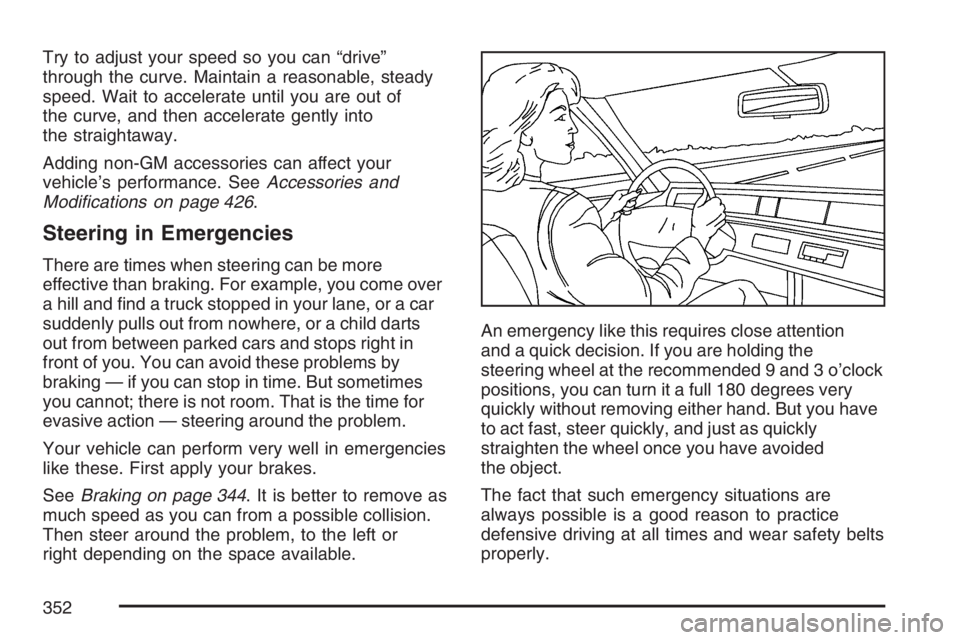
right depending on the space available.An emergency like this requires close attention
and a quick decision. If you are holding the
steering wheel at the recommended 9 and 3 o’clock
positions, you can turn it a full 180 degrees very
quickly without removing either hand. But you have
to act fast, steer quickly, and just as quickly
straighten the wheel once you have avoided
the object.
The fact that such emergency situations are
always possible is a good reason to practice
defensive driving at all times and wear safety belts
properly.
352
Page 360 of 608
Getting Familiar with Off-Road Driving
It is a good idea to practice in an area that is
safe and close to home before you go into
the wilderness. Off-road driving does require some
new and different skills. Here is what we mean.
Tune your senses to different kinds of signals.
Your eyes, for example, need to constantly sweep
the terrain for unexpected obstacles. Your ears
need to listen for unusual tire or engine sounds.
With your arms, hands, feet and body, you
will need to respond to vibrations and vehicle
bounce.
Controlling your vehicle is the key to successful
off-road driving. One of the best ways to
control your vehicle is to control your speed. Here
are some things to keep in mind. At higher
speeds:
You approach things faster and you have less
time to scan the terrain for obstacles.
You have less time to react.
You have more vehicle bounce when you
drive over obstacles.
You will need more distance for braking,
especially since you are on an unpaved
surface.
{CAUTION:
When you are driving off-road, bouncing
and quick changes in direction can easily
throw you out of position. This could
cause you to lose control and crash. So,
whether you are driving on or off the road,
you and your passengers should wear
safety belts.
360
Page 420 of 608
Maintenance When Trailer Towing
Your vehicle will need service more often when
you’re pulling a trailer. See the Maintenance
Schedule for more on this. Things that are
especially important in trailer operation are
automatic transmission uid (don’t overll), engine
oil, axle lubricant, belts, cooling system and
brake system. Each of these is covered in this
manual, and the Index will help you nd them
quickly. If you’re trailering, it’s a good idea
to review these sections before you start your trip.
Check periodically to see that all hitch nuts and
bolts are tight.
Trailer Wiring Harness
Your vehicle is equipped with the following wiring
harnesses for towing a trailer.
Basic Trailer Wiring
The trailer wiring harness, with a seven-pin
connector, is located at the rear of the vehicle and
is tied to the vehicle’s frame. The harness
connector can be plugged into a seven-pin
universal heavy-duty trailer connector available
through your dealer.
The seven-wire harness contains the following
trailer circuits:
Yellow: Left Stop/Turn Signal
Dark Green: Right Stop/Turn Signal
Brown: Taillamps
White: Ground
Light Green: Back-up Lamps
Red: Battery Feed*
Dark Blue: Trailer Brake*
*The fuses for these two circuits are installed in
the underhood electrical center, but the wires
are not connected. They should be connected by
your dealer or a qualied service center.
420
Page 424 of 608
Windshield Wiper Blade Replacement........481
Tires.............................................................482
Tire Sidewall Labeling................................484
Tire Terminology and Denitions................487
Ination - Tire Pressure..............................490
Tire Pressure Monitor System....................492
Tire Inspection and Rotation.......................497
When It Is Time for New Tires...................499
Buying New Tires.......................................500
Different Size Tires and Wheels.................502
Uniform Tire Quality Grading......................502
Wheel Alignment and Tire Balance.............504
Wheel Replacement...................................504
Tire Chains................................................506
If a Tire Goes Flat.....................................507
Changing a Flat Tire..................................508
Removing the Spare Tire and Tools...........509
Removing the Flat Tire and Installing the
Spare Tire..............................................513
Secondary Latch System............................519
Storing a Flat or Spare Tire and Tools.......522
Spare Tire..................................................526Appearance Care.........................................527
Cleaning the Inside of Your Vehicle...........528
Fabric/Carpet..............................................529
Leather......................................................530
Instrument Panel, Vinyl, and Other
Plastic Surfaces......................................531
Care of Safety Belts...................................531
Weatherstrips.............................................531
Washing Your Vehicle................................532
Cleaning Exterior Lamps/Lenses.................532
Finish Care................................................532
Windshield, Backglass, and
Wiper Blades..........................................534
Aluminum or Chrome-Plated Wheels..........534
Tires..........................................................535
Sheet Metal Damage..................................535
Finish Damage...........................................536
Underbody Maintenance.............................536
Chemical Paint Spotting.............................536
Vehicle Care/Appearance Materials............537
Vehicle Identication...................................538
Vehicle Identication Number (VIN)............538
Service Parts Identication Label................538
Section 5 Service and Appearance Care
424
Page 487 of 608
(A) Light Truck (LT-Metric) Tire:The United
States version of a metric tire sizing system. The
letters LT as the rst two characters in the tire
size means a light truck tire engineered to
standards set by the U.S. Tire and Rim
Association.
(B) Tire Width:The three-digit number indicates
the tire section width in millimeters from sidewall
to sidewall.
(C) Aspect Ratio:A two-digit number that
indicates the tire height-to-width measurements.
For example, if the tire size aspect ratio is
75, as shown in item C of the light truck
(LT-Metric) tire illustration, it would mean that the
tire’s sidewall is 75% as high as it is wide.
(D) Construction Code:A letter code is used to
indicate the type of ply construction in the tire.
The letter R means radial ply construction;
the letter D means diagonal or bias ply
construction; and the letter B means belted-bias
ply construction.
(E) Rim Diameter:Diameter of the wheel in
inches.(F) Service Description:The service description
indicates the load range and speed rating of a
tire. The load index can range from 1 to 279.
Speed ratings range from A to Z.
Tire Terminology and Denitions
Air Pressure:The amount of air inside the tire
pressing outward on each square inch of the
tire. Air pressure is expressed in pounds
per square inch (psi) or kilopascal (kPa).
Accessory Weight:This means the combined
weight of optional accessories. Some examples of
optional accessories are, automatic transmission,
power steering, power brakes, power windows,
power seats, and air conditioning.
Aspect Ratio:The relationship of a tire’s height
to its width.
Belt:A rubber coated layer of cords that is
located between the plies and the tread. Cords
may be made from steel or other reinforcing
materials.
Bead:The tire bead contains steel wires wrapped
by steel cords that hold the tire onto the rim.
487
Page 500 of 608
Buying New Tires
GM has developed and matched specic tires for
your vehicle. The original equipment tires
installed on your vehicle, when it was new, were
designed to meet General Motors Tire
Performance Criteria Specication (TPC spec)
system rating. If you need replacement tires, GM
strongly recommends that you get tires with
the same TPC Spec rating. This way, your vehicle
will continue to have tires that are designed to
give the same performance and vehicle safety,
during normal use, as the original tires.
GM’s exclusive TPC Spec system considers over
a dozen critical specications that impact the
overall performance of your vehicle, including
brake system performance, ride and handling,
traction control, and tire pressure monitoring
performance. GM’s TPC Spec number is molded
onto the tire’s sidewall by the tire manufacturer.
If the tires have an all-season tread design,
the TPC spec number will be followed by an MS
for mud and snow. SeeTire Sidewall Labeling
on page 484for additional information.{CAUTION:
Mixing tires could cause you to lose
control while driving. If you mix tires of
different sizes, brands, or types (radial
and bias-belted tires), the vehicle may not
handle properly, and you could have a
crash. Using tires of different sizes,
brands or types may also cause damage
to your vehicle. Be sure to use the same
size, brand, and type tires on all wheels.
Your vehicle may have a different size
spare than the road tires (those originally
installed on your vehicle). When new, your
vehicle included a spare tire and wheel
assembly with a similar overall diameter
as your vehicle’s road tires and wheels,
so it is all right to drive on it. Because
this spare was developed for use on your
vehicle, it will not affect vehicle handling.
500
Page 501 of 608
{CAUTION:
If you use bias-ply tires on your vehicle,
the wheel rim anges could develop
cracks after many miles of driving. A tire
and/or wheel could fail suddenly, causing
a crash. Use only radial-ply tires with the
wheels on your vehicle.
If you must replace your vehicle’s tires with those
that do not have a TPC Spec number, make
sure they are the same size, load range, speed
rating, and construction type (radial and
bias-belted tires) as your vehicle’s original tires.Vehicles that have a tire pressure monitoring
system may give an inaccurate low-pressure
warning if non-TPC spec rated tires are installed
on your vehicle. Non-TPC Spec rated tires
may give a low-pressure warning that is higher or
lower than the proper warning level you would
get with TPC Spec rated tires. SeeTire Pressure
Monitor System on page 492.
Your vehicle’s original equipment tires are listed
on the Tire and Loading Information Label.
This label is attached to the vehicle’s center pillar
(B-pillar). SeeLoading Your Vehicle on page 390,
for more information about the Tire and Loading
Information Label and its location on your vehicle.
501
Page 531 of 608
Instrument Panel, Vinyl, and Other
Plastic Surfaces
A soft cloth dampened with water may be used to
remove dust. If a more thorough cleaning is
necessary, a clean soft cloth dampened with a
mild soap solution can be used to gently remove
dust and dirt. Never use spot lifters or removers
on plastic surfaces. Many commercial cleaners and
coatings that are sold to preserve and protect
soft plastic surfaces may permanently change the
appearance and feel of your interior and are
not recommended. Do not use silicone or
wax-based products, or those containing organic
solvents to clean your vehicle’s interior because
they can alter the appearance by increasing
the gloss in a non-uniform manner.
Some commercial products may increase gloss on
your instrument panel. The increase in gloss
may cause annoying reections in the windshield
and even make it difficult to see through the
windshield under certain conditions.
Care of Safety Belts
Keep belts clean and dry.
{CAUTION:
Do not bleach or dye safety belts. If you
do, it may severely weaken them. In a
crash, they might not be able to provide
adequate protection. Clean safety belts
only with mild soap and lukewarm water.
Weatherstrips
Silicone grease on weatherstrips will make them
last longer, seal better, and not stick or squeak.
Apply silicone grease with a clean cloth. During
very cold, damp weather frequent application may
be required. SeeRecommended Fluids and
Lubricants on page 564.
531
Page 551 of 608
Maintenance Schedule.................................552
Introduction................................................552
Maintenance Requirements.........................552
Your Vehicle and the Environment.............552
Using the Maintenance Schedule...............553
Scheduled Maintenance..............................555
Additional Required Services......................557
Maintenance Footnotes..............................558Owner Checks and Services......................560
At Each Fuel Fill........................................560
At Least Once a Month..............................561
At Least Once a Year................................562
Recommended Fluids and Lubricants.........564
Normal Maintenance Replacement Parts....566
Engine Drive Belt Routing..........................567
Maintenance Record...................................567
Section 6 Maintenance Schedule
551