change GMC YUKON XL 2007 Owners Manual
[x] Cancel search | Manufacturer: GMC, Model Year: 2007, Model line: YUKON XL, Model: GMC YUKON XL 2007Pages: 608, PDF Size: 3.01 MB
Page 3 of 608

GENERAL MOTORS, GM, the GM Emblem,
GMC, the GMC Truck Emblem, and the name
YUKON are registered trademarks of General
Motors Corporation.
This manual includes the latest information at the
time it was printed. We reserve the right to make
changes after that time without further notice. For
vehicles rst sold in Canada, substitute the name
“General Motors of Canada Limited” for GMC
whenever it appears in this manual.
Keep this manual in the vehicle, so it will be there
if it is needed while you are on the road. If the
vehicle is sold, leave this manual in the vehicle.
Canadian Owners
A French language copy of this manual can be
obtained from your dealer or from:
Helm, Incorporated
P.O. Box 07130
Detroit, MI 48207
How to Use This Manual
Many people read the owner manual from
beginning to end when they rst receive their new
vehicle. If this is done, it can help you learn about
the features and controls for the vehicle. Pictures
and words work together in the owner manual to
explain things.
Index
A good place to quickly locate information about
the vehicle is the Index in the back of the manual.
It is an alphabetical list of what is in the manual
and the page number where it can be found.
Litho in U.S.A.
Part No. 15854793 A First Printing
©2005 General Motors Corporation. All Rights Reserved.
3
Page 11 of 608
Power Lumbar
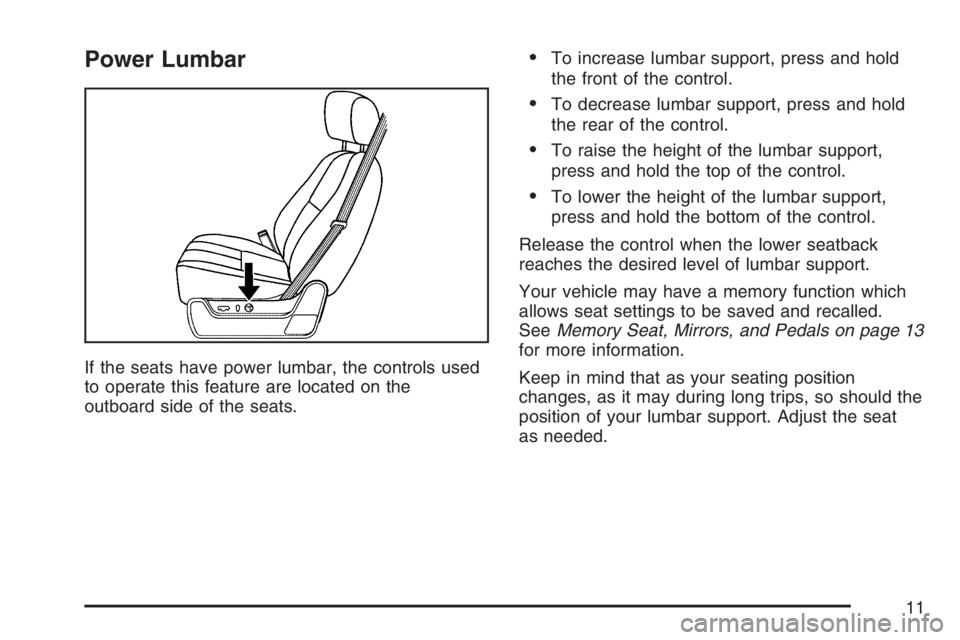
If the seats have power lumbar, the controls used
to operate this feature are located on the
outboard side of the seats.
To increase lumbar support, press and hold
the front of the control.
To decrease lumbar support, press and hold
the rear of the control.
To raise the height of the lumbar support,
press and hold the top of the control.
To lower the height of the lumbar support,
press and hold the bottom of the control.
Release the control when the lower seatback
reaches the desired level of lumbar support.
Your vehicle may have a memory function which
allows seat settings to be saved and recalled.
SeeMemory Seat, Mirrors, and Pedals on page 13
for more information.
Keep in mind that as your seating position
changes, as it may during long trips, so should the
position of your lumbar support. Adjust the seat
as needed.
11
Page 64 of 608

Infants and Young Children
Everyone in a vehicle needs protection! This
includes infants and all other children. Neither the
distance traveled nor the age and size of the
traveler changes the need, for everyone, to use
safety restraints. In fact, the law in every state
in the United States and in every Canadian
province says children up to some age must be
restrained while in a vehicle.{CAUTION:
Children can be seriously injured or
strangled if a shoulder belt is wrapped
around their neck and the safety belt
continues to tighten. Never leave children
unattended in a vehicle and never allow
children to play with the safety belts.
Every time infants and young children ride in
vehicles, they should have the protection provided
by appropriate restraints. Young children should
not use the vehicle’s adult safety belts alone,
unless there is no other choice. Instead, they need
to use a child restraint.
64
Page 105 of 608
Adding Equipment to Your
Airbag-Equipped Vehicle
Q:Is there anything I might add to the front
or sides of the vehicle that could keep the
airbags from working properly?
A:Yes. If you add things that change your
vehicle’s frame, bumper system, front end or
side sheet metal or height, they may keep the
airbag system from working properly. Also, the
airbag system may not work properly if you
relocate any of the airbag sensors. If you have
any questions about this, you should contact
Customer Assistance before you modify your
vehicle. The phone numbers and addresses for
Customer Assistance are in Step Two of the
Customer Satisfaction Procedure in this
manual. SeeCustomer Satisfaction Procedure
on page 572.
Q:Because I have a disability, I have to get
my vehicle modied. How can I nd out
whether this will affect my airbag system?
A:Changing or moving any parts of the front
seats, safety belts, the airbag sensing and
diagnostic module (located under the driver’s
seat), rollover sensor module (located under
the center console), instrument panel, steering
wheel, ceiling headliner, ceiling and pillar
garnish trim, roof-mounted rollover airbag
modules or airbag wiring can affect the
operation of the airbag system. If you have
questions, call Customer Assistance. The
phone numbers and addresses for Customer
Assistance are in Step Two of the Customer
Satisfaction Procedure in this manual. See
Customer Satisfaction Procedure on page 572.
105
Page 112 of 608
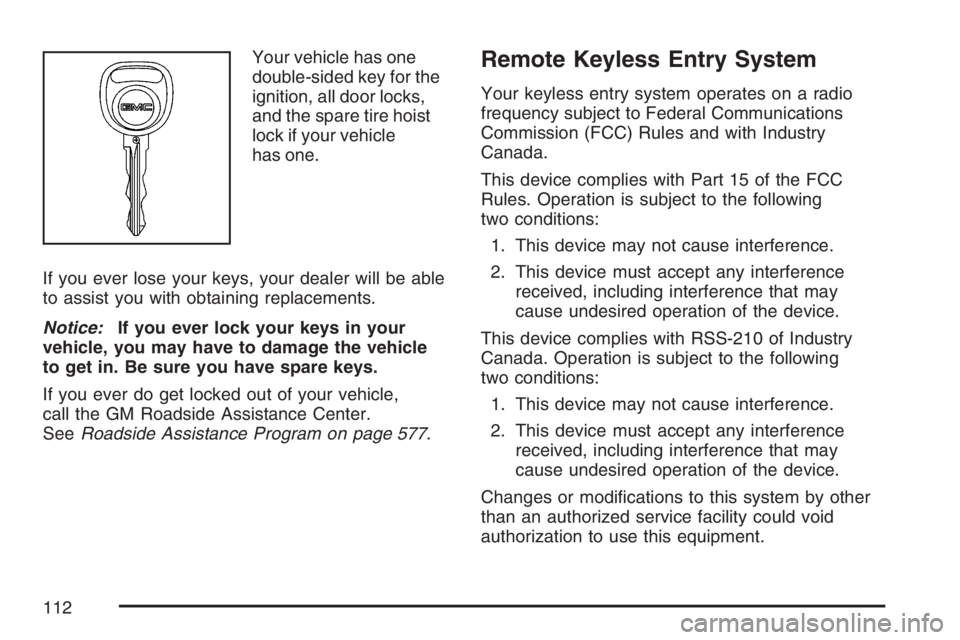
Your vehicle has one
double-sided key for the
ignition, all door locks,
and the spare tire hoist
lock if your vehicle
has one.
If you ever lose your keys, your dealer will be able
to assist you with obtaining replacements.
Notice:If you ever lock your keys in your
vehicle, you may have to damage the vehicle
to get in. Be sure you have spare keys.
If you ever do get locked out of your vehicle,
call the GM Roadside Assistance Center.
SeeRoadside Assistance Program on page 577.Remote Keyless Entry System
Your keyless entry system operates on a radio
frequency subject to Federal Communications
Commission (FCC) Rules and with Industry
Canada.
This device complies with Part 15 of the FCC
Rules. Operation is subject to the following
two conditions:
1. This device may not cause interference.
2. This device must accept any interference
received, including interference that may
cause undesired operation of the device.
This device complies with RSS-210 of Industry
Canada. Operation is subject to the following
two conditions:
1. This device may not cause interference.
2. This device must accept any interference
received, including interference that may
cause undesired operation of the device.
Changes or modications to this system by other
than an authorized service facility could void
authorization to use this equipment.
112
Page 116 of 608

Battery Replacement
Under normal use, the battery in your RKE
transmitter should last about four years.
You can tell the battery is weak if the transmitter
will not work at the normal range in any location.
If you have to get close to your vehicle before
the transmitter works, it is probably time to change
the battery.
The REPLACE BATTERY IN REMOTE KEY
message in the vehicle’s DIC will display if the
RKE transmitter battery is low. See “REPLACE
BATTERY IN REMOTE KEY” underDIC Warnings
and Messages on page 254for additional
information.
Notice:When replacing the battery, use care
not to touch any of the circuitry. Static
from your body transferred to these surfaces
may damage the transmitter.To replace the battery in the RKE transmitter do
the following:
1. Use a at object with a thin edge into the
notch, located below the trunk release
button, and separate the bottom half from the
top half of the transmitter.
2. Remove the old battery, but do not use a
metal object to do this.
116
Page 127 of 608

Obstacle Detection Features
If the liftgate encounters an obstacle during a
power open or close cycle, a warning chime will
sound and the liftgate will automatically reverse
direction to the full closed or open position.
After removing the obstruction, the liftgate may be
power opened or closed normally. If the liftgate
encounters multiple obstacles on the same power
cycle, the power function will deactivate, and
the liftgate will switch to manual operation.
The REAR ACCESS OPEN warning message in
the Driver Information Center (DIC) will indicate
that the liftgate is open. After removing the
obstructions, manually open the liftgate to the full
open position or close the liftgate to the fully
closed and latched position. The liftgate will now
resume normal power operation.
Your vehicle has pinch sensors located on the
side edges of the liftgate. If an object is caught
between the liftgate and the body and presses
against this sensor, the liftgate will reverse
direction and open fully. The liftgate will remain
open until it is activated again or closed manually.
Manual Operation of Power Liftgate
To change the liftgate to
manual operation,
toggle the switch on the
overhead console to
the “Disable” position
indicated by a circle.
With the power liftgate disabled and the door
unlocked, the power liftgate can be manually
opened and closed.
To open the liftgate, press the touchpad on the
handle on the outside of the liftgate, and lift
the gate open. To close the liftgate, use the pull
cup or pull strap to lower the liftgate and close.
The liftgate latch will power cinch to closed
position. Always close the liftgate before driving.
If the RKE button or the power close button on the
liftgate is pressed while power operation is
disabled, the lights will ash three times, but the
liftgate will not move.
127
Page 134 of 608

PASS-Key®III+
The PASS-Key®III+ system operates on a radio
frequency subject to Federal Communications
Commission (FCC) Rules and with Industry
Canada.
This device complies with Part 15 of the FCC
Rules. Operation is subject to the following
two conditions:
1. This device may not cause harmful
interference.
2. This device must accept any interference
received, including interference that may
cause undesired operation.
This device complies with RSS-210 of Industry
Canada. Operation is subject to the following
two conditions:
1. This device may not cause interference.
2. This device must accept any interference
received, including interference that may
cause undesired operation of the device.
Changes or modications to this system by other
than an authorized service facility could void
authorization to use this equipment.PASS-Key
®III+ uses a radio frequency
transponder in the key that matches a decoder in
your vehicle.
PASS-Key®III+ Operation
Your vehicle has PASS-Key®III+ (Personalized
Automotive Security System) theft-deterrent
system. PASS-Key
®III+ is a passive
theft-deterrent system. This means you do not
have to do anything special to arm or disarm the
system. It works when you transition the key
to RUN, ACCESSORY or START from the
OFF position.
When the PASS-Key
®III+ system senses that
someone is using the wrong key, it prevents
the vehicle from starting. Anyone using a
trial-and-error method to start the vehicle will be
discouraged because of the high number of
electrical key codes.
If the engine does not start and the security light
on the instrument panel comes on when trying
to start the vehicle, the key may have a damaged
transponder. Turn the ignition off and try again.
134
Page 139 of 608

2. If the engine does not start within 10 seconds,
push the accelerator pedal all the way to the
oor, while you hold the ignition key in
START. When the engine starts, let go of the
key and let up on the accelerator pedal.
Wait about 15 seconds between each try.
When starting your engine in very cold weather
(below 0°F or−18°C), do this:
1. With your foot off the accelerator pedal, turn
the ignition key to START and hold it there up
to 15 seconds. When the engine starts, let
go of the key.
2. If your engine still will not start, or starts but
then stops, it could be ooded with too much
gasoline. Try pushing your accelerator
pedal all the way to the oor and holding it
there as you hold the key in START for about
three seconds.When the engine starts, let go of the key and
accelerator. If the vehicle starts briey but then
stops again, do the same thing, but this time
keep the pedal down for ve or six seconds.
This clears the extra gasoline from the engine.
Notice:Your engine is designed to work with
the electronics in your vehicle. If you add
electrical parts or accessories, you could
change the way the engine operates. Before
adding electrical equipment, check with
your dealer. If you do not, your engine might
not perform properly. Any resulting damage
would not be covered by your vehicle’s
warranty.
139
Page 140 of 608
Adjustable Throttle and Brake Pedal
If your vehicle has this feature, you can change
the position of the throttle and brake pedals.
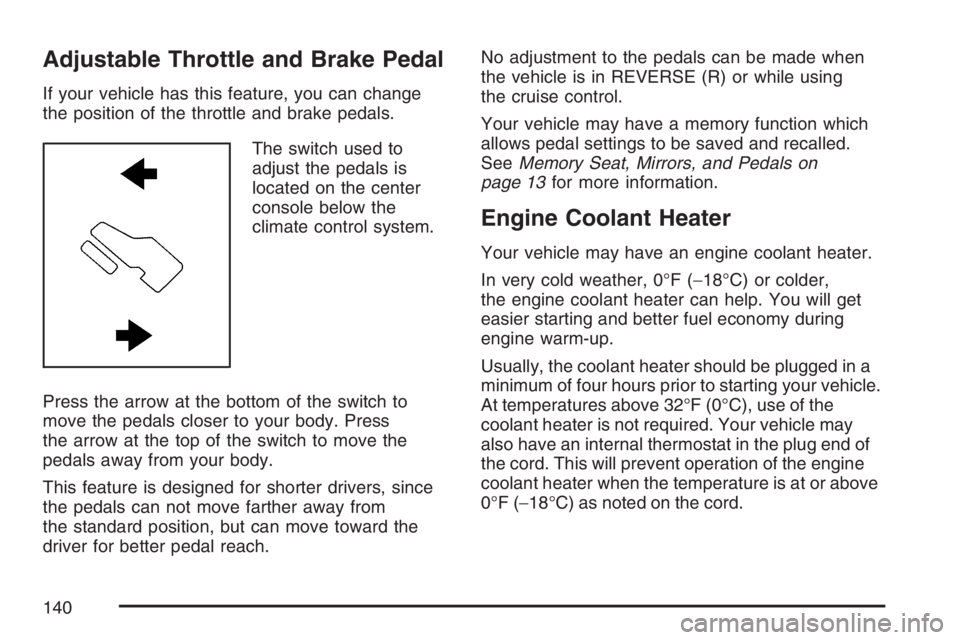
The switch used to
adjust the pedals is
located on the center
console below the
climate control system.
Press the arrow at the bottom of the switch to
move the pedals closer to your body. Press
the arrow at the top of the switch to move the
pedals away from your body.
This feature is designed for shorter drivers, since
the pedals can not move farther away from
the standard position, but can move toward the
driver for better pedal reach.No adjustment to the pedals can be made when
the vehicle is in REVERSE (R) or while using
the cruise control.
Your vehicle may have a memory function which
allows pedal settings to be saved and recalled.
SeeMemory Seat, Mirrors, and Pedals on
page 13for more information.
Engine Coolant Heater
Your vehicle may have an engine coolant heater.
In very cold weather, 0°F (−18°C) or colder,
the engine coolant heater can help. You will get
easier starting and better fuel economy during
engine warm-up.
Usually, the coolant heater should be plugged in a
minimum of four hours prior to starting your vehicle.
At temperatures above 32°F (0°C), use of the
coolant heater is not required. Your vehicle may
also have an internal thermostat in the plug end of
the cord. This will prevent operation of the engine
coolant heater when the temperature is at or above
0°F (−18°C) as noted on the cord.
140