warning GMC YUKON XL 2010 Owner's Manual
[x] Cancel search | Manufacturer: GMC, Model Year: 2010, Model line: YUKON XL, Model: GMC YUKON XL 2010Pages: 614, PDF Size: 4.64 MB
Page 66 of 614
Returning the Seatback(s) to the
Upright Position
To return the seatback to the upright position, do the
following:1. Open the liftgate to access the controls for the seat.
2. Pull up on the seatback until it locks into the upright position.
{WARNING:
If either seatback is not locked, it could move
forward in a sudden stop or crash. That could
cause injury to the person sitting there. Always
push and pull on the seatbacks to be sure they
are locked.
3. Push and pull on the seatback to make sure it is locked.
Tumbling the Third Row Seat
The seat can be tumbled forward for additional cargo
space.
To tumble the seat, do the following:
1. Open the liftgate to access the controls for the seat.
2. Make sure the head rests are completely lowered and there is nothing under, in front of, or on
the seat.
3. Fold the seatbacks forward using the instructions previously listed under “Folding the Seatbacks”.
You will not be able to unlatch the seat from the
floor unless the seatback is folded down.
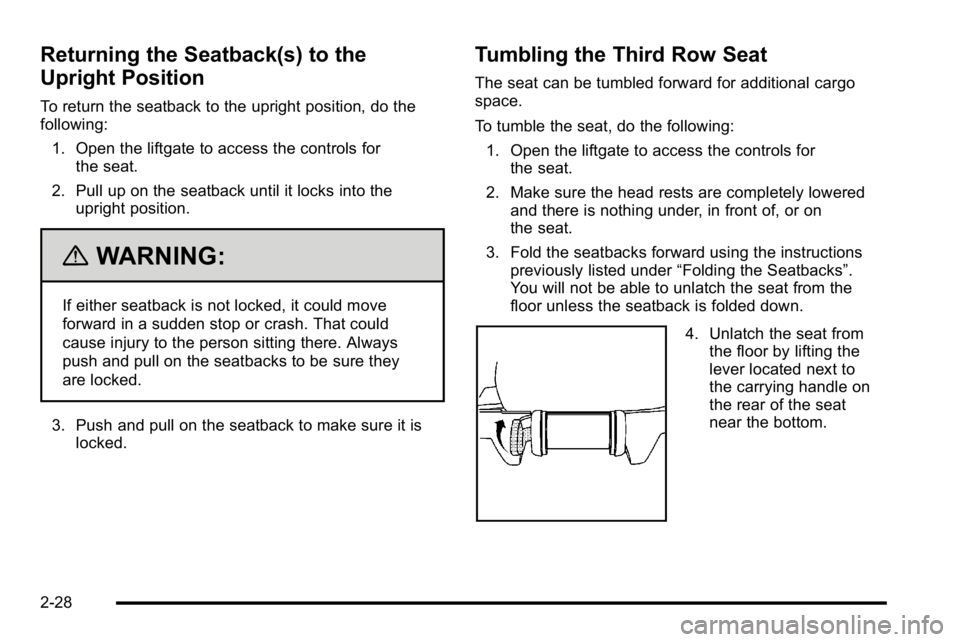
4. Unlatch the seat from the floor by lifting the
lever located next to
the carrying handle on
the rear of the seat
near the bottom.
2-28
Page 67 of 614
5. Lift the rear of the seat up from the floor.
6. Tilt the seat fully forward to lock it into place.
7. Push and pull on the seat to make sure it is locked.
Put the seat in this position only when necessary for
additional cargo space.
Returning the Third Row Seat from a
Tumbled Position
To return the seat to the normal seating position, do the
following: 1. Open the liftgate to access the controls for the seat.
2. Make sure there is nothing that could become trapped under the seat.
3. Release the seat from the tumbled position by lifting the lever located next to the carrying handle
at the bottom rear of the seat. 4. Pull the seat down until it latches to the floor.
The seatback cannot be raised if the seat is not
latched to the floor.
5. Pull up on the seatback until it locks into the upright position.
{WARNING:
If either seatback is not locked, it could move
forward in a sudden stop or crash. That could
cause injury to the person sitting there. Always
push and pull on the seatbacks to be sure they
are locked.
6. Push and pull on the seatback to make sure it is locked.
2-29
Page 68 of 614
Removing the Third Row Seat
To remove the seat, do the following:1. Open the liftgate to access the controls for the seat.
2. Fold the seatback forward using the instructions listed under “Folding the Seatbacks” previously.
The seat cannot be removed unless the seatback
is folded.
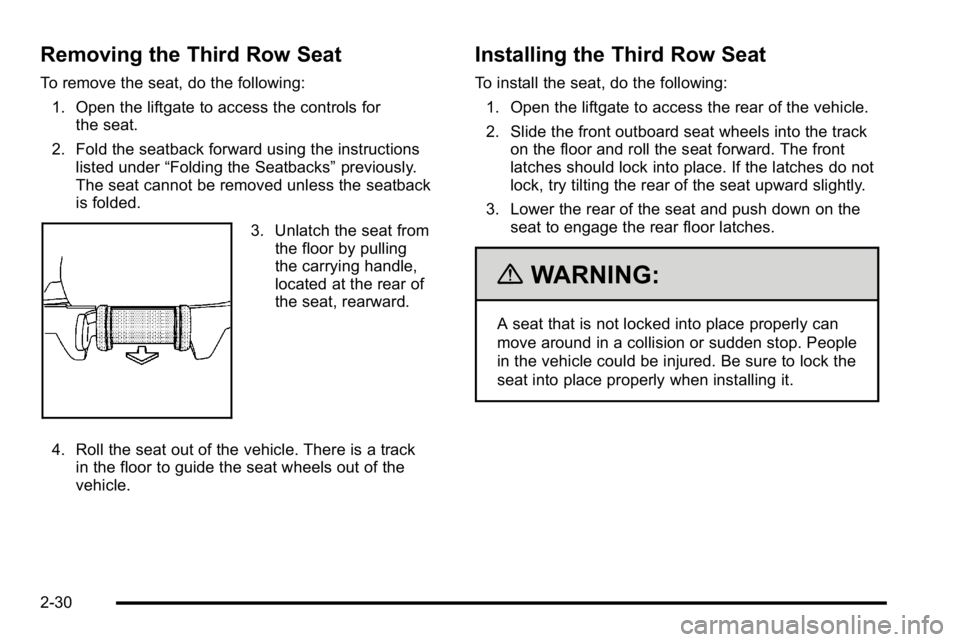
3. Unlatch the seat from the floor by pulling
the carrying handle,
located at the rear of
the seat, rearward.
4. Roll the seat out of the vehicle. There is a track in the floor to guide the seat wheels out of the
vehicle.
Installing the Third Row Seat
To install the seat, do the following:
1. Open the liftgate to access the rear of the vehicle.
2. Slide the front outboard seat wheels into the track on the floor and roll the seat forward. The front
latches should lock into place. If the latches do not
lock, try tilting the rear of the seat upward slightly.
3. Lower the rear of the seat and push down on the seat to engage the rear floor latches.
{WARNING:
A seat that is not locked into place properly can
move around in a collision or sudden stop. People
in the vehicle could be injured. Be sure to lock the
seat into place properly when installing it.
2-30
Page 69 of 614
4. Push and pull on the seat to make sure it is lockedinto place. The seatback cannot be raised to the
upright position unless the seat is secured to the
floor.
5. Pull up on the seatback until it locks into the upright position.
{WARNING:
If either seatback is not locked, it could move
forward in a sudden stop or crash. That could
cause injury to the person sitting there. Always
push and pull on the seatbacks to be sure they
are locked.
6. Push and pull on the seatback to make sure it is locked.
{WARNING:
A safety belt that is improperly routed, not
properly attached, or twisted will not provide the
protection needed in a crash. The person wearing
the belt could be seriously injured. After raising
the rear seatback, always check to be sure that
the safety belts are properly routed and attached,
and are not twisted.
7. Make sure the safety belts are returned to the original position over the seatbacks.
2-31
Page 70 of 614
Safety Belts
Safety Belts: They Are for Everyone
This section of the manual describes how to use safety
belts properly. It also describes some things not to do
with safety belts.
{WARNING:
Do not let anyone ride where a safety belt cannot
be worn properly. In a crash, if you or your
passenger(s) are not wearing safety belts, the
injuries can be much worse. You can hit things
inside the vehicle harder or be ejected from the
vehicle. You and your passenger(s) can be
seriously injured or killed. In the same crash, you
might not be, if you are buckled up. Always fasten
your safety belt, and check that your passenger(s)
are restrained properly too.
{WARNING:
It is extremely dangerous to ride in a cargo area,
inside or outside of a vehicle. In a collision,
people riding in these areas are more likely to
be seriously injured or killed. Do not allow people
to ride in any area of your vehicle that is not
equipped with seats and safety belts. Be sure
everyone in your vehicle is in a seat and using a
safety belt properly.
This vehicle has indicators as a reminder to buckle the
safety belts. See Safety Belt Reminders
on page 4‑31for additional information.
2-32
Page 77 of 614
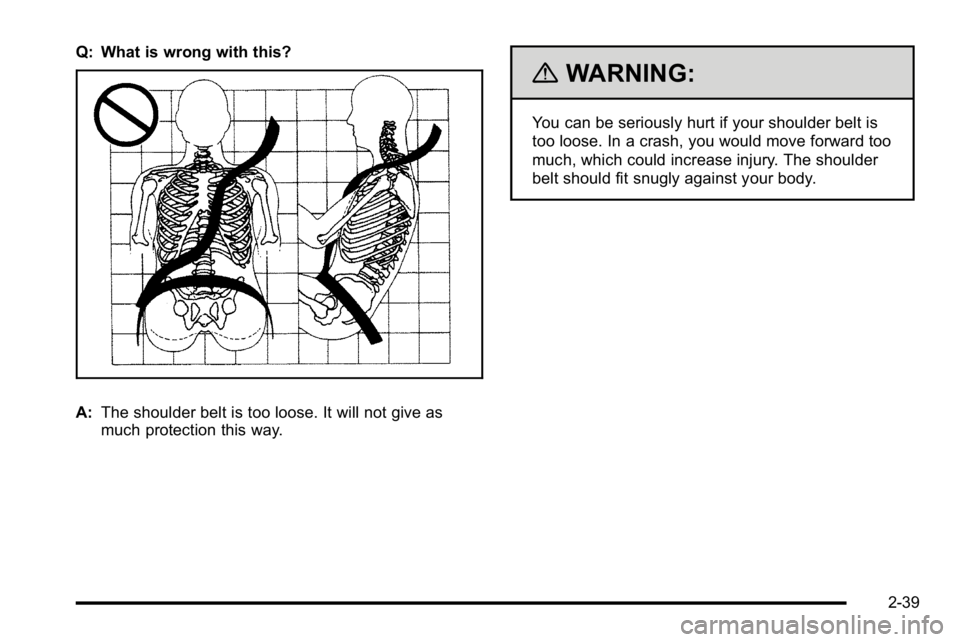
Q: What is wrong with this?
A:The shoulder belt is too loose. It will not give as
much protection this way.
{WARNING:
You can be seriously hurt if your shoulder belt is
too loose. In a crash, you would move forward too
much, which could increase injury. The shoulder
belt should fit snugly against your body.
2-39
Page 78 of 614
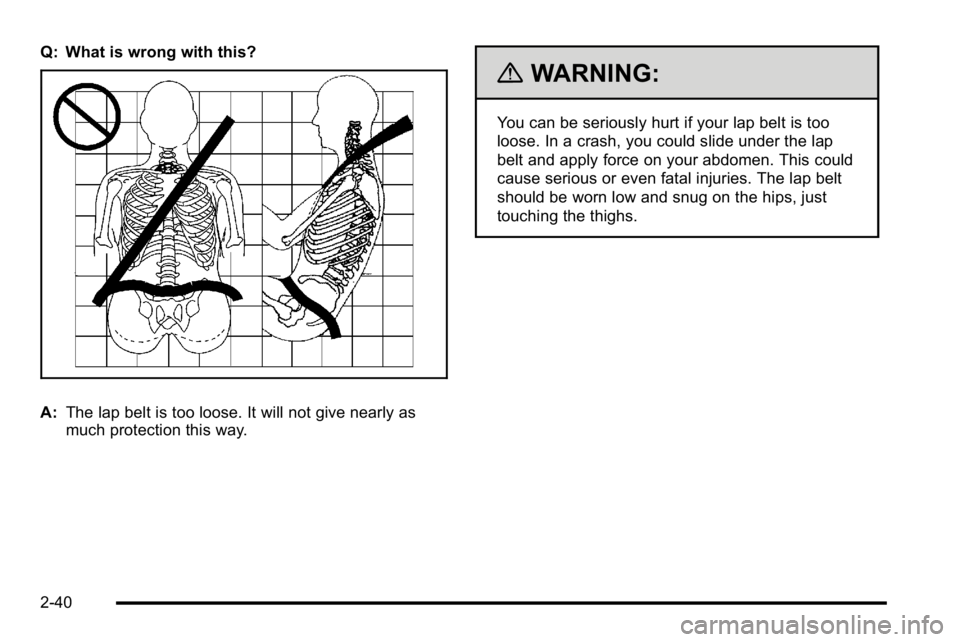
Q: What is wrong with this?
A:The lap belt is too loose. It will not give nearly as
much protection this way.
{WARNING:
You can be seriously hurt if your lap belt is too
loose. In a crash, you could slide under the lap
belt and apply force on your abdomen. This could
cause serious or even fatal injuries. The lap belt
should be worn low and snug on the hips, just
touching the thighs.
2-40
Page 79 of 614
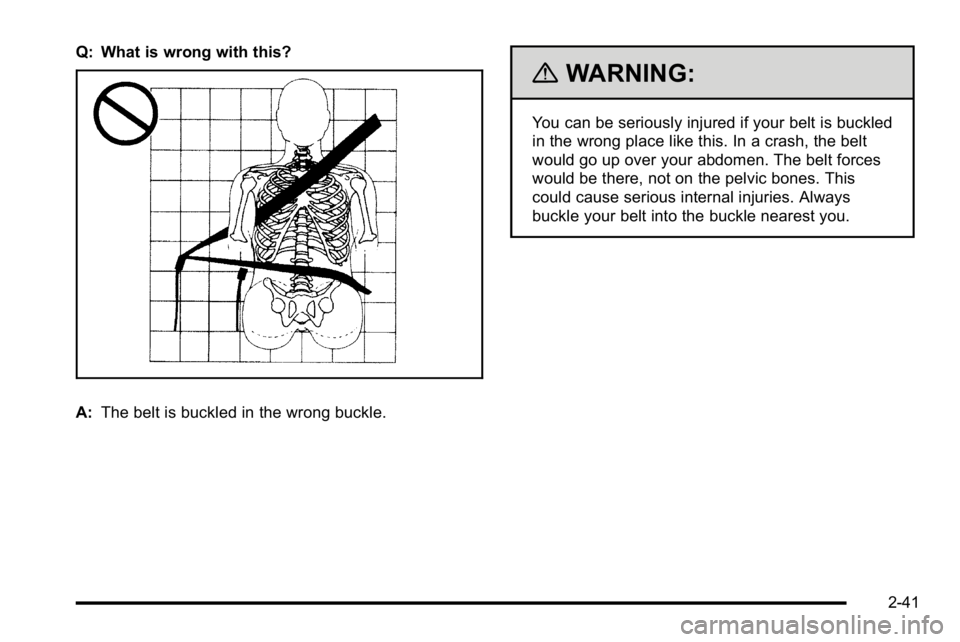
Q: What is wrong with this?
A:The belt is buckled in the wrong buckle.
{WARNING:
You can be seriously injured if your belt is buckled
in the wrong place like this. In a crash, the belt
would go up over your abdomen. The belt forces
would be there, not on the pelvic bones. This
could cause serious internal injuries. Always
buckle your belt into the buckle nearest you.
2-41
Page 80 of 614
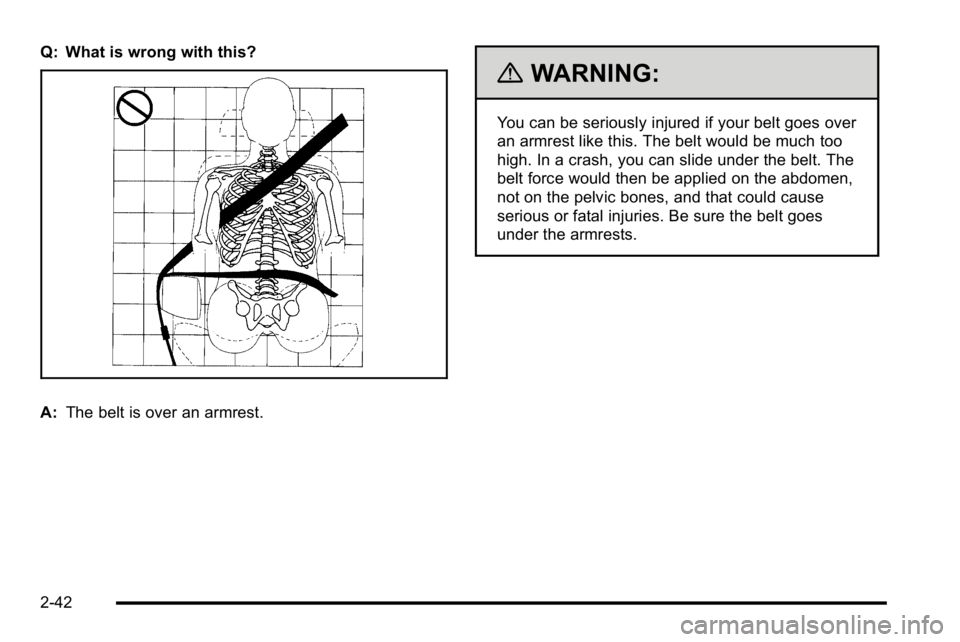
Q: What is wrong with this?
A:The belt is over an armrest.
{WARNING:
You can be seriously injured if your belt goes over
an armrest like this. The belt would be much too
high. In a crash, you can slide under the belt. The
belt force would then be applied on the abdomen,
not on the pelvic bones, and that could cause
serious or fatal injuries. Be sure the belt goes
under the armrests.
2-42
Page 81 of 614
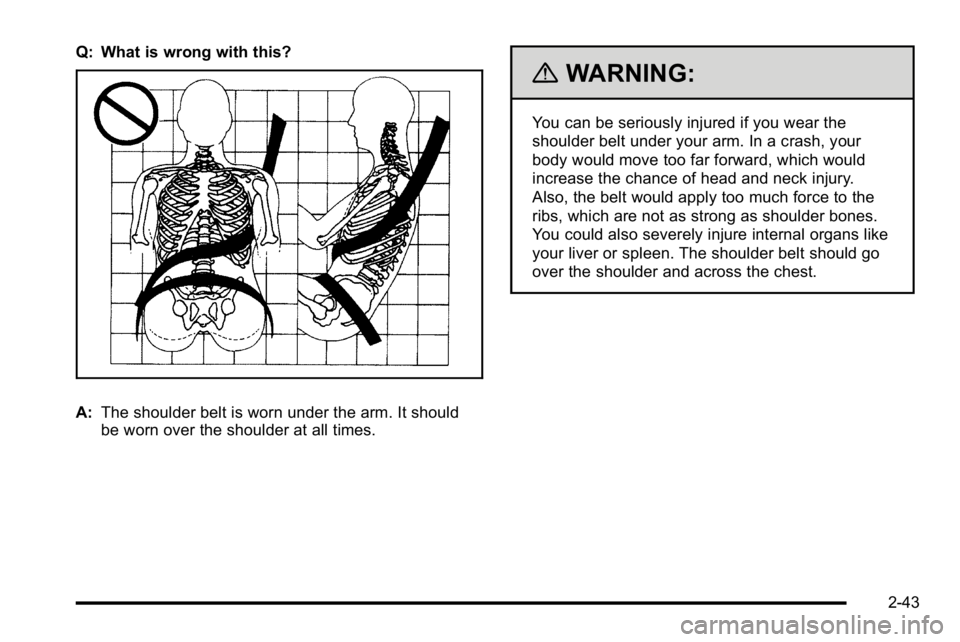
Q: What is wrong with this?
A:The shoulder belt is worn under the arm. It should
be worn over the shoulder at all times.
{WARNING:
You can be seriously injured if you wear the
shoulder belt under your arm. In a crash, your
body would move too far forward, which would
increase the chance of head and neck injury.
Also, the belt would apply too much force to the
ribs, which are not as strong as shoulder bones.
You could also severely injure internal organs like
your liver or spleen. The shoulder belt should go
over the shoulder and across the chest.
2-43