engine oil GMC YUKON XL 2010 Owner's Guide
[x] Cancel search | Manufacturer: GMC, Model Year: 2010, Model line: YUKON XL, Model: GMC YUKON XL 2010Pages: 614, PDF Size: 4.64 MB
Page 471 of 614
Overheated Engine Protection
Operating Mode
If an overheated engine condition exists and the
ENGINE POWER IS REDUCED message is displayed,
an overheat protection mode which alternates firing
groups of cylinders helps prevent engine damage.
In this mode, you will notice a loss in power and engine
performance. This operating mode allows the vehicle
to be driven to a safe place in an emergency. Driving
extended miles (km) and/or towing a trailer in the
overheat protection mode should be avoided.
Notice:After driving in the overheated engine
protection operating mode, to avoid engine damage,
allow the engine to cool before attempting any
repair. The engine oil will be severely degraded.
Repair the cause of coolant loss, change the oil
and reset the oil life system. See Engine Oil
on
page 6‑18.
Engine Fan Noise
If the vehicle has a clutched engine cooling fan, when
the clutch is engaged, the fan spins faster to provide
more air to cool the engine. In most everyday driving
conditions, the fan is spinning slower and the clutch is
not fully engaged. This improves fuel economy and
reduces fan noise. Under heavy vehicle loading, trailer
towing, and/or high outside temperatures, the fan speed
increases as the clutch more fully engages, so you may
hear an increase in fan noise. This is normal and should
not be mistaken as the transmission slipping or making
extra shifts. It is merely the cooling system functioning
properly. The fan will slow down when additional cooling
is not required and the clutch disengages.
You may also hear this fan noise when you start the
engine. It will go away as the fan clutch partially
disengages.
If the vehicle has electric cooling fans, you may hear
the fans spinning at low speed during most everyday
driving. The fans may turn off if no cooling is required.
Under heavy vehicle loading, trailer towing, and/or high
outside temperatures, or if you are operating the air
conditioning system, the fans may change to high
speed and you may hear an increase in fan noise.
This is normal and indicates that the cooling system is
functioning properly. The fans will change to low speed
when additional cooling is no longer required.
6-39
Page 475 of 614
Checking Brake Fluid
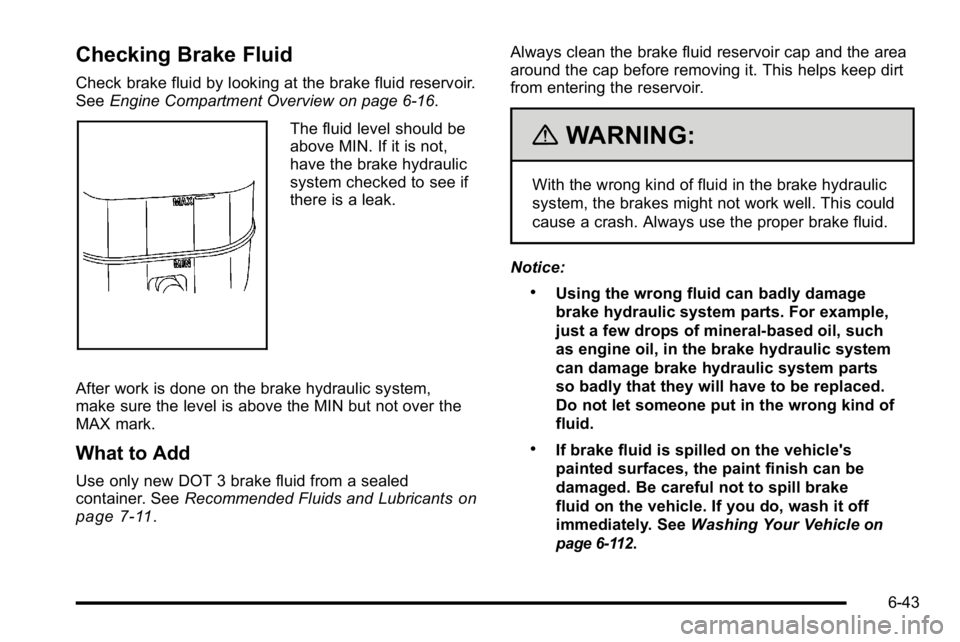
Check brake fluid by looking at the brake fluid reservoir.
SeeEngine Compartment Overview on page 6‑16.
The fluid level should be
above MIN. If it is not,
have the brake hydraulic
system checked to see if
there is a leak.
After work is done on the brake hydraulic system,
make sure the level is above the MIN but not over the
MAX mark.
What to Add
Use only new DOT 3 brake fluid from a sealed
container. See Recommended Fluids and Lubricantson
page 7‑11. Always clean the brake fluid reservoir cap and the area
around the cap before removing it. This helps keep dirt
from entering the reservoir.
{WARNING:
With the wrong kind of fluid in the brake hydraulic
system, the brakes might not work well. This could
cause a crash. Always use the proper brake fluid.
Notice:
.Using the wrong fluid can badly damage
brake hydraulic system parts. For example,
just a few drops of mineral-based oil, such
as engine oil, in the brake hydraulic system
can damage brake hydraulic system parts
so badly that they will have to be replaced.
Do not let someone put in the wrong kind of
fluid.
.If brake fluid is spilled on the vehicle's
painted surfaces, the paint finish can be
damaged. Be careful not to spill brake
fluid on the vehicle. If you do, wash it off
immediately. See Washing Your Vehicle
on
page 6‑112
.
6-43
Page 555 of 614
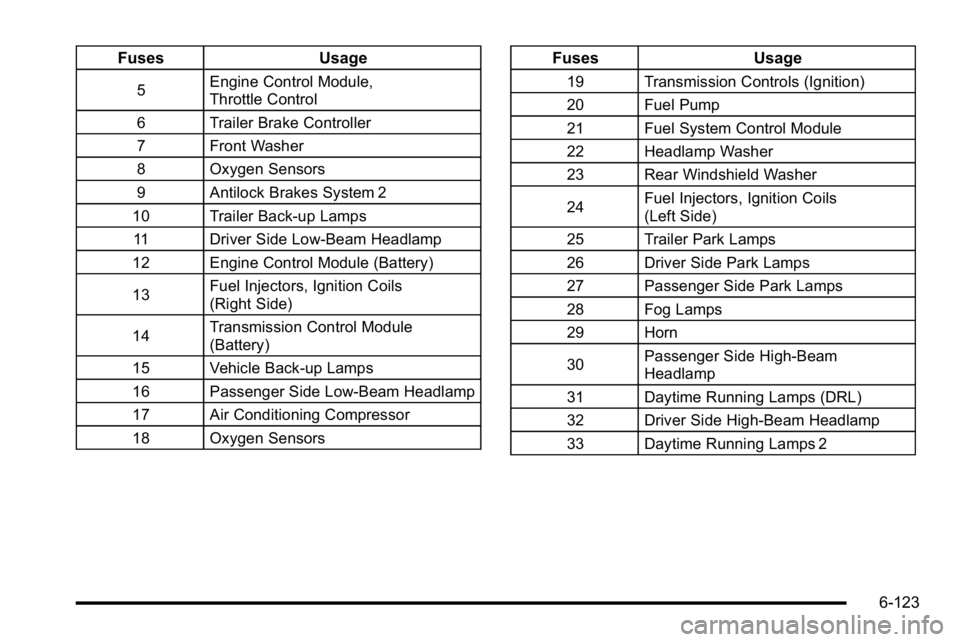
FusesUsage
5Engine Control Module,
Throttle Control
6 Trailer Brake Controller
7 Front Washer
8 Oxygen Sensors
9 Antilock Brakes System 2
10 Trailer Back-up Lamps 11 Driver Side Low-Beam Headlamp
12 Engine Control Module (Battery)
13 Fuel Injectors, Ignition Coils
(Right Side)
14 Transmission Control Module
(Battery)
15 Vehicle Back-up Lamps
16 Passenger Side Low-Beam Headlamp
17 Air Conditioning Compressor
18 Oxygen Sensors
Fuses Usage
19 Transmission Controls (Ignition)
20 Fuel Pump
21 Fuel System Control Module
22 Headlamp Washer
23 Rear Windshield Washer
24Fuel Injectors, Ignition Coils
(Left Side)
25 Trailer Park Lamps
26 Driver Side Park Lamps
27 Passenger Side Park Lamps
28 Fog Lamps
29 Horn
30 Passenger Side High-Beam
Headlamp
31 Daytime Running Lamps (DRL)
32 Driver Side High-Beam Headlamp
33 Daytime Running Lamps 2
6-123
Page 558 of 614
Capacities and Specifications
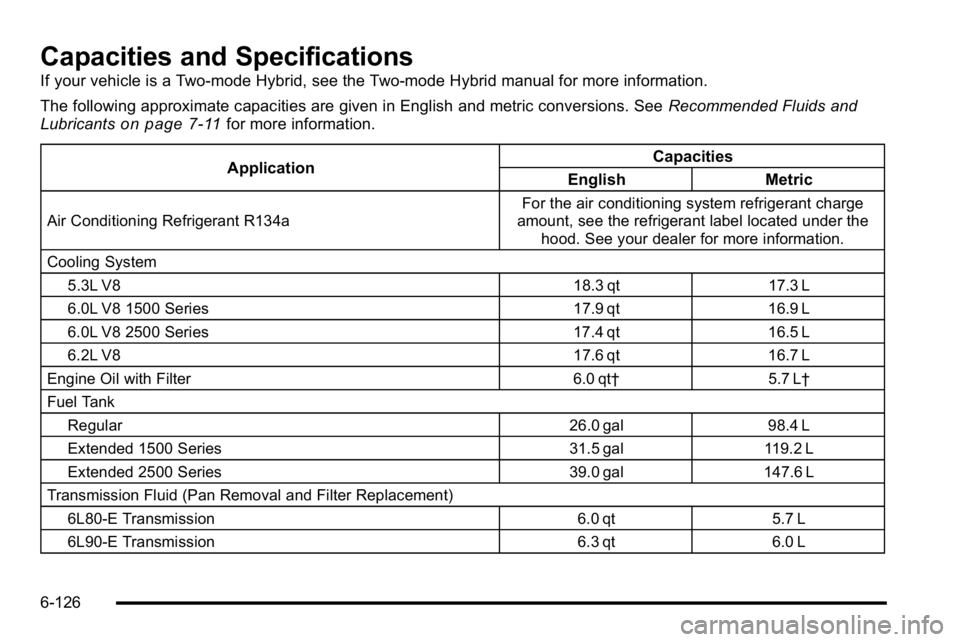
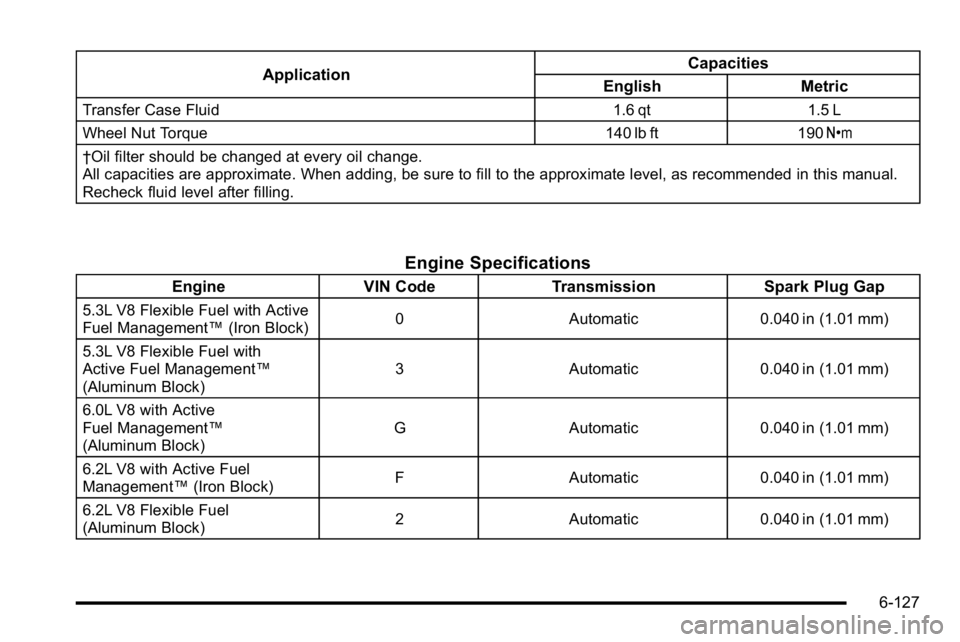
If your vehicle is a Two-mode Hybrid, see the Two-mode Hybrid manual for more information.
The following approximate capacities are given in English and metric conversions. SeeRecommended Fluids and
Lubricants
on page 7‑11for more information.
Application Capacities
English Metric
Air Conditioning Refrigerant R134a For the air conditioning system refrigerant charge
amount, see the refrigerant label located under the hood. See your dealer for more information.
Cooling System 5.3L V8 18.3 qt17.3 L
6.0L V8 1500 Series 17.9 qt16.9 L
6.0L V8 2500 Series 17.4 qt16.5 L
6.2L V8 17.6 qt16.7 L
Engine Oil with Filter 6.0 qt†5.7 L†
Fuel Tank
Regular 26.0 gal98.4 L
Extended 1500 Series 31.5 gal119.2 L
Extended 2500 Series 39.0 gal147.6 L
Transmission Fluid (Pan Removal and Filter Replacement)
6L80-E Transmission 6.0 qt5.7 L
6L90-E Transmission 6.3 qt6.0 L
6-126
Page 559 of 614
ApplicationCapacities
English Metric
Transfer Case Fluid 1.6 qt1.5 L
Wheel Nut Torque 140 lb ft190Y
†Oil filter should be changed at every oil change.
All capacities are approximate. When adding, be sure to fill to the approximate level, as recommended in this manual.
Recheck fluid level after filling.
Engine Specifications
Engine VIN CodeTransmission Spark Plug Gap
5.3L V8 Flexible Fuel with Active
Fuel Management™(Iron Block) 0 Automatic 0.040 in (1.01 mm)
5.3L V8 Flexible Fuel with
Active Fuel Management™
(Aluminum Block) 3 Automatic 0.040 in (1.01 mm)
6.0L V8 with Active
Fuel Management™
(Aluminum Block) G Automatic 0.040 in (1.01 mm)
6.2L V8 with Active Fuel
Management™ (Iron Block) F Automatic 0.040 in (1.01 mm)
6.2L V8 Flexible Fuel
(Aluminum Block) 2 Automatic 0.040 in (1.01 mm)
6-127
Page 563 of 614
At your dealer, you can be certain that you will receive
the highest level of service available. Your dealer has
specially trained service technicians, uses genuine
replacement parts, as well as, up to date tools and
equipment to ensure fast and accurate diagnostics.
The proper replacement parts, fluids, and lubricants to
use are listed inRecommended Fluids and Lubricants
on page 7‑11andMaintenance Replacement Partson
page 7‑13. We recommend the use of genuine parts
from your dealer.
Rotation of New Tires
To maintain ride, handling, and performance of the
vehicle, it is important that the first rotation service
for new tires be performed when they have 8 000 to
13 000 km (5,000 to 8,000 miles). See Tire Inspection
and Rotation on page 6‑78.
Scheduled Maintenance
When the Change Engine Oil Soon
Message Displays
Change engine oil and filter. See Engine Oilon
page 6‑18. An Emission Control Service.
When the Change Engine Oil Soon message displays,
service is required for the vehicle as soon as possible,
within the next 1 000 km/600 miles. If driving under the
best conditions, the engine oil life system might not
indicate the need for vehicle service for more than
a year. The engine oil and filter must be changed at
least once a year and the oil life system must be reset.
Your dealer has trained service technicians who will
perform this work and reset the system. If the engine
oil life system is reset accidentally, service the vehicle
within 5 000 km/3,000 miles since the last service.
Reset the oil life system whenever the oil is changed.
See Engine Oil Life System on page 6‑20.
7-3
Page 564 of 614
When the Change Engine Oil Soon message displays,
certain services, checks, and inspections are required.
The services described for MaintenanceIshould be
performed at every engine oil change. The services
described for Maintenance IIshould be
performed when:
.Maintenance Iwas performed the last time the
engine oil was changed.
.It has been 10 months or more since the Change
Engine Oil Soon message has displayed or since
the last service.
Maintenance I
.Change engine oil and filter. See Engine Oilon
page 6‑18. An Emission Control Service.
.Engine coolant level check. See Engine Coolanton page 6‑32.
.Windshield washer fluid level check.
SeeWindshield Washer Fluid on page 6‑41.
.Tire inflation check. See Inflation - Tire Pressureon page 6‑72.
.Tire wear inspection. See Tire Inspection and
Rotation on page 6‑78.
.Rotate tires. See Tire Inspection and Rotationon
page 6‑78.
.Fluids visual leak check (or every 12 months,
whichever occurs first). A leak in any system must
be repaired and the fluid level checked.
.Engine air cleaner filter inspection (vehicles driven
in dusty conditions only). See Engine Air Cleaner/
Filter on page 6‑22.
.Brake system inspection (or every 12 months,
whichever occurs first).
Maintenance II
.Perform all services described in Maintenance I.
.Steering and suspension inspection. Visual
inspection for damaged, loose, or missing parts
or signs of wear.
.Lubricate the front suspension, steering linkage,
and parking brake cable guides. Control arm
ball joints on 2500 series vehicles require
lubrication but should not be lubricated unless
their temperature is−12°C (10°F) or higher, or
they could be damaged. Control arm ball joints
on 1500 series vehicles are maintenance‐free.
.Engine cooling system inspection. Visual
inspection of hoses, pipes, fittings, and clamps
and replacement, if needed.
7-4
Page 565 of 614
.Windshield wiper blade inspection for wear,
cracking, or contamination and windshield
and wiper blade cleaning, if contaminated. See
Windshield, Backglass, and Wiper Blades
on
page 6‑114. Worn or damaged wiper blade
replacement. See Windshield Wiper Blade
Replacement on page 6‑61.
.Body hinges and latches, key lock cylinders,
folding seat hardware, and liftgate hinges,
linkage, and handle pivot points lubrication.
See Recommended Fluids and Lubricants
on
page 7‑11. More frequent lubrication may be
required when vehicle is exposed to a corrosive
environment. Applying silicone grease on
weatherstrips with a clean cloth makes them
last longer, seal better, and not stick or squeak.
.Restraint system component check. See Checking
the Restraint Systems on page 2‑101.
.Automatic transmission fluid level check
and adding fluid, if needed. See Automatic
Transmission Fluid (4-Speed Transmission)
on
page 6‑24or Automatic Transmission Fluid
(6-Speed Transmission) on page 6‑27.
.Four‐wheel drive vehicles: Transfer case fluid level
check and adding fluid, if needed.
.Engine air cleaner filter inspection. See Engine Air
Cleaner/Filter on page 6‑22.
Additional Required Services
At Each Fuel Stop
.Engine oil level check. See Engine Oilon
page 6‑18.
.Engine coolant level check. See Engine Coolanton page 6‑32.
.Windshield washer fluid level check.
SeeWindshield Washer Fluid on page 6‑41.
Once a Month
.Tire inflation check. See Inflation - Tire Pressureon page 6‑72.
.Tire wear inspection. See Tire Inspection and
Rotation on page 6‑78.
Once a Year
.Starter switch check. See Owner Checks and
Services on page 7‑9.
.Parking brake and automatic transmission P (Park)
mechanism check. See Owner Checks and
Services on page 7‑9.
7-5
Page 566 of 614
.Automatic transmission shiftlock control system
check. SeeOwner Checks and Serviceson
page 7‑9.
.Ignition transmission lock check. See Owner
Checks and Services on page 7‑9.
.Hood and liftgate gas strut support service.
Visually inspect gas strut for signs of wear,
corrosion, cracks, loss of lubricant, or other
damage. Check the hold open ability of gas strut.
Replace as necessary with genuine parts from
your dealer.
.Engine cooling system and pressure cap pressure
check. Radiator and air conditioning condenser
outside cleaning. See Cooling System
on
page 6‑30.
.Exhaust system and nearby heat shields
inspection for loose or damaged components.
.Accelerator pedal check for damage, high effort,
or binding. Replace if needed.
First Engine Oil Change After Every
40 000 km/25,000 Miles
.Fuel system inspection for damage or leaks.
First Engine Oil Change After Every
80 000 km/50,000 Miles
.Engine air cleaner filter replacement. See Engine
Air Cleaner/Filter on page 6‑22.
.Automatic transmission fluid change (severe
service) for vehicles with Gross Vehicle Weight
Rating (GVWR) over 3 901 kg (8,600 lbs) or mainly
driven in heavy city traffic in hot weather, in hilly
or mountainous terrain, when frequently towing a
trailer, or used for taxi, police, or delivery service.
See Automatic Transmission Fluid (4-Speed
Transmission)
on page 6‑24or Automatic
Transmission Fluid (6-Speed Transmission)on
page 6‑27.
.Four‐wheel drive only: Transfer case fluid change
(severe service) for vehicles mainly driven when
frequently towing a trailer, or used for taxi, police,
or delivery service. Check vent hose at transfer
case for kinks and proper installation. Check to
be sure vent hose is unobstructed, clear, and free
of debris. During any maintenance, if a power
washer is used to clean mud and dirt from the
underbody, care should be taken to not directly
spray the transfer case output seals. High pressure
water can overcome the seals and contaminate
the transfer case fluid. Contaminated fluid will
decrease the life of the transfer case and should
be replaced.
7-6
Page 567 of 614
.Evaporative control system inspection. Check all
fuel and vapor lines and hoses for proper hook‐up,
routing, and condition. Check that the purge valve,
if the vehicle has one, works properly. Replace as
needed.An Emission Control Service. The U.S.
Environmental Protection Agency or the California
Air Resources Board has determined that the
failure to perform this maintenance item will not
nullify the emission warranty or limit recall liability
prior to the completion of the vehicle's useful
life. We, however, urge that all recommended
maintenance services be performed at the
indicated intervals and the maintenance be
recorded.
First Engine Oil Change After Every
160 000 km/100,000 Miles
.Automatic transmission fluid change (normal
service). See Automatic Transmission Fluid
(4-Speed Transmission)
on page 6‑24or
Automatic Transmission Fluid (6-Speed
Transmission) on page 6‑27.
.Four‐wheel drive only: Transfer case fluid change
(normal service). Check vent hose at transfer
case for kinks and proper installation. Check to
be sure vent hose is unobstructed, clear, and free
of debris. During any maintenance, if a power
washer is used to clean mud and dirt from the
underbody, care should be taken to not directly
spray the transfer case output seals. High pressure
water can overcome the seals and contaminate
the transfer case fluid. Contaminated fluid will
decrease the life of the transfer case and should
be replaced.
.Spark plug replacement and spark plug wires
inspection. An Emission Control Service.
First Engine Oil Change After Every
240 000 km/150,000 Miles
.Engine cooling system drain, flush, and refill,
cooling system and cap pressure check, and
cleaning of outside of radiator and air conditioning
condenser (or every 5 years, whichever occurs
first). SeeEngine Coolant
on page 6‑32.
An Emission Control Service.
.Engine accessory drive belt inspection for fraying,
excessive cracks, or obvious damage and
replacement, if needed. An Emission Control
Service.
7-7