wheel GMC YUKON XL 2010 Manual Online
[x] Cancel search | Manufacturer: GMC, Model Year: 2010, Model line: YUKON XL, Model: GMC YUKON XL 2010Pages: 614, PDF Size: 4.64 MB
Page 408 of 614
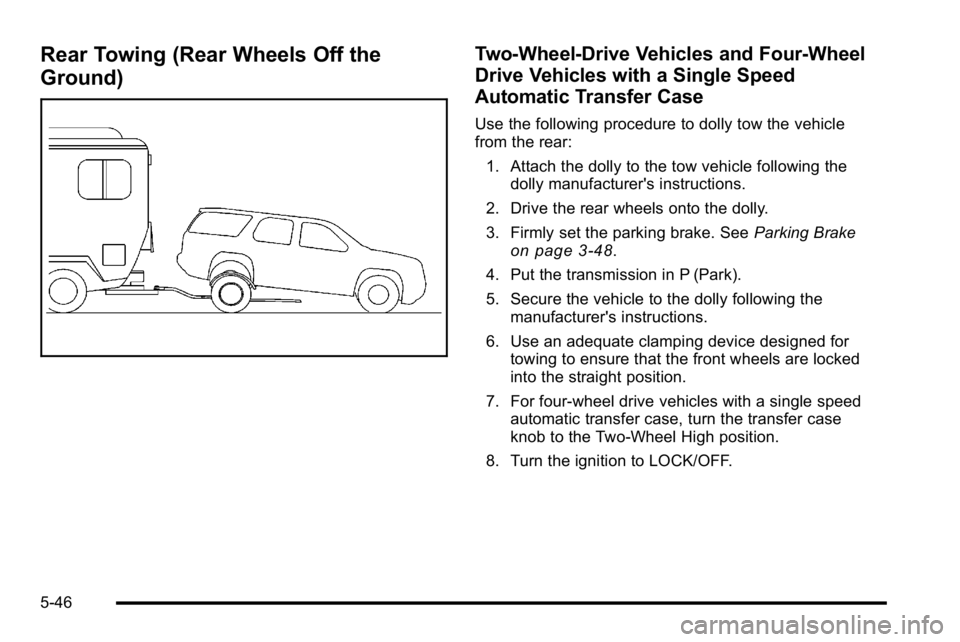
Rear Towing (Rear Wheels Off the
Ground)Two-Wheel-Drive Vehicles and Four-Wheel
Drive Vehicles with a Single Speed
Automatic Transfer Case
Use the following procedure to dolly tow the vehicle
from the rear:1. Attach the dolly to the tow vehicle following the dolly manufacturer's instructions.
2. Drive the rear wheels onto the dolly.
3. Firmly set the parking brake. See Parking Brake
on page 3‑48.
4. Put the transmission in P (Park).
5. Secure the vehicle to the dolly following the manufacturer's instructions.
6. Use an adequate clamping device designed for towing to ensure that the front wheels are locked
into the straight position.
7. For four-wheel drive vehicles with a single speed automatic transfer case, turn the transfer case
knob to the Two-Wheel High position.
8. Turn the ignition to LOCK/OFF.
5-46
Page 409 of 614
Four-Wheel Drive Vehicles with a
Two Speed Automatic Transfer Case
Use the following procedure to dolly tow a four-wheel
drive vehicle from the rear:1. Attach the dolly to the tow vehicle following the dolly manufacturer's instructions.
2. Drive the rear wheels onto the dolly.
3. Firmly set the parking brake. See Parking Brake
on page 3‑48.
4. Put the transmission in P (Park).
5. Secure the vehicle to the dolly following the manufacturer's instructions.
6. Use an adequate clamping device designed for towing to ensure that the front wheels are locked
into the straight position.
{WARNING:
Shifting a four-wheel-drive vehicle's transfer case
into N (Neutral) can cause the vehicle to roll even
if the transmission is in P (Park). The driver or
others could be injured. Make sure the parking
brake is firmly set before the transfer case is
shifted to N (Neutral).
7. Shift the transfer case to N (Neutral). See “Shifting
into N (Neutral)” under“Four-Wheel Drive”.
8. Turn the ignition to LOCK/OFF.
After towing, see “Shifting Out of N (Neutral)” under
“Four-Wheel Drive”.
5-47
Page 410 of 614
Level Control
Automatic Level Control
The automatic level control rear suspension is available
on light‐duty vehicles and comes as a part of the
Autoride
®suspension, if equipped.
This type of level control is fully automatic and will
provide a better leveled riding position as well as
better handling under a variety of passenger and
loading conditions. An air compressor connected to
the rear shocks will raise or lower the rear of the
vehicle to maintain proper vehicle height. The system
is activated when the ignition key is turned to ON/RUN
and will automatically adjust vehicle height thereafter.
The system may exhaust (lower vehicle height) for up
to ten minutes after the ignition key has been turned off.
You may hear the air compressor operating when the
height is being adjusted.
If a weight‐distributing hitch is being used, it is
recommended to allow the shocks to inflate, thereby
leveling the vehicle prior to adjusting the hitch.
Autoride®
With this feature, improved vehicle ride and handling is
provided under a variety of passenger and loading
conditions.
The system is fully automatic and uses a computer
controller to continuously monitor vehicle speed, wheel
to body position, lift/dive and steering position of the
vehicle. The controller then sends signals to each shock
absorber to independently adjust the damping level to
provide the optimum vehicle ride.
Autoride also interacts with the tow/haul mode that,
when activated, will provide additional control of the
shock absorbers. This additional control results in better
ride and handling characteristics when the vehicle is
loaded or towing a trailer. See “Tow/Haul Mode”under
Towing a Trailer
on page 5‑49for more information.
5-48
Page 413 of 614
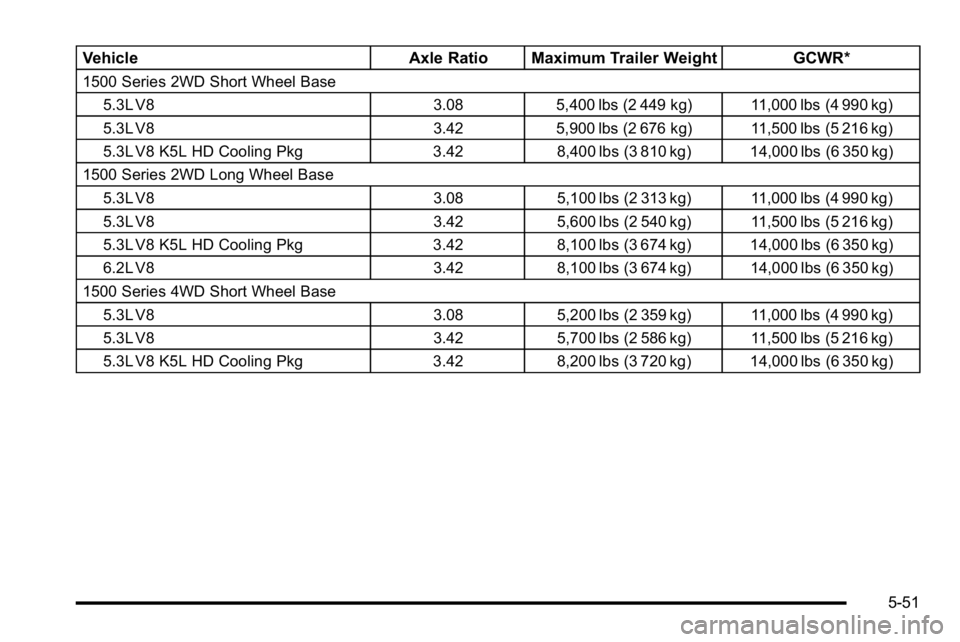
VehicleAxle Ratio Maximum Trailer Weight GCWR*
1500 Series 2WD Short Wheel Base
5.3L V8 3.08 5,400 lbs (2 449 kg) 11,000 lbs (4 990 kg)
5.3L V8 3.42 5,900 lbs (2 676 kg) 11,500 lbs (5 216 kg)
5.3L V8 K5L HD Cooling Pkg 3.42 8,400 lbs (3 810 kg) 14,000 lbs (6 350 kg)
1500 Series 2WD Long Wheel Base
5.3L V8 3.08 5,100 lbs (2 313 kg) 11,000 lbs (4 990 kg)
5.3L V8 3.42 5,600 lbs (2 540 kg) 11,500 lbs (5 216 kg)
5.3L V8 K5L HD Cooling Pkg 3.42 8,100 lbs (3 674 kg) 14,000 lbs (6 350 kg)
6.2L V8 3.42 8,100 lbs (3 674 kg) 14,000 lbs (6 350 kg)
1500 Series 4WD Short Wheel Base 5.3L V8 3.08 5,200 lbs (2 359 kg) 11,000 lbs (4 990 kg)
5.3L V8 3.42 5,700 lbs (2 586 kg) 11,500 lbs (5 216 kg)
5.3L V8 K5L HD Cooling Pkg 3.42 8,200 lbs (3 720 kg) 14,000 lbs (6 350 kg)
5-51
Page 414 of 614
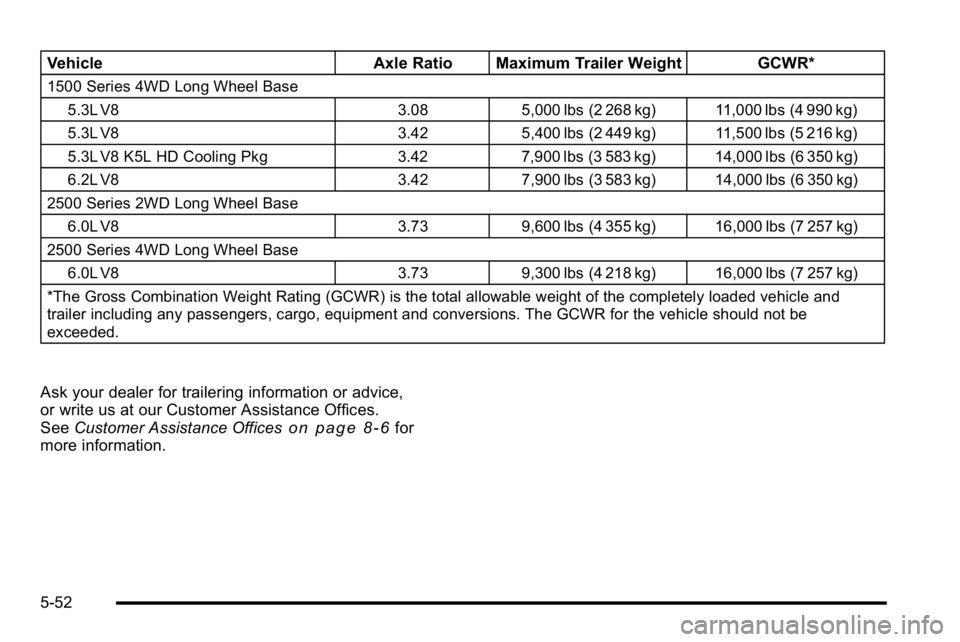
VehicleAxle Ratio Maximum Trailer Weight GCWR*
1500 Series 4WD Long Wheel Base
5.3L V8 3.08 5,000 lbs (2 268 kg) 11,000 lbs (4 990 kg)
5.3L V8 3.42 5,400 lbs (2 449 kg) 11,500 lbs (5 216 kg)
5.3L V8 K5L HD Cooling Pkg 3.42 7,900 lbs (3 583 kg) 14,000 lbs (6 350 kg)
6.2L V8 3.42 7,900 lbs (3 583 kg) 14,000 lbs (6 350 kg)
2500 Series 2WD Long Wheel Base 6.0L V8 3.73 9,600 lbs (4 355 kg) 16,000 lbs (7 257 kg)
2500 Series 4WD Long Wheel Base 6.0L V8 3.73 9,300 lbs (4 218 kg) 16,000 lbs (7 257 kg)
*The Gross Combination Weight Rating (GCWR) is the total allowable weight of the completely loaded vehicle and
trailer including any passengers, cargo, equipment and conversions. The GCWR for the vehicle should not be
exceeded.
Ask your dealer for trailering information or advice,
or write us at our Customer Assistance Offices.
See Customer Assistance Offices
on page 8‑6for
more information.
5-52
Page 415 of 614
Weight of the Trailer Tongue
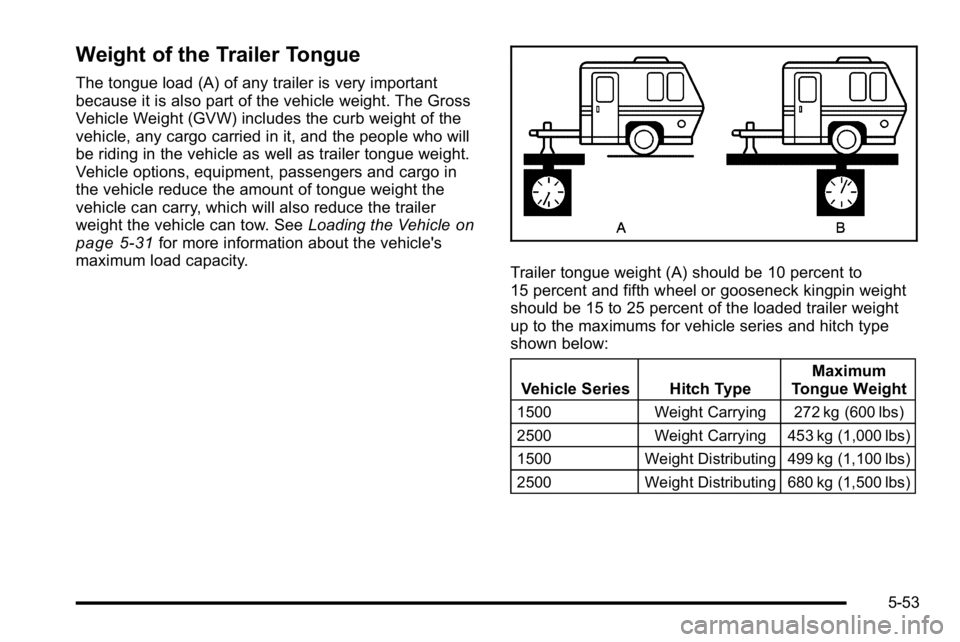
The tongue load (A) of any trailer is very important
because it is also part of the vehicle weight. The Gross
Vehicle Weight (GVW) includes the curb weight of the
vehicle, any cargo carried in it, and the people who will
be riding in the vehicle as well as trailer tongue weight.
Vehicle options, equipment, passengers and cargo in
the vehicle reduce the amount of tongue weight the
vehicle can carry, which will also reduce the trailer
weight the vehicle can tow. SeeLoading the Vehicle
on
page 5‑31for more information about the vehicle's
maximum load capacity.
Trailer tongue weight (A) should be 10 percent to
15 percent and fifth wheel or gooseneck kingpin weight
should be 15 to 25 percent of the loaded trailer weight
up to the maximums for vehicle series and hitch type
shown below:
Vehicle Series Hitch Type Maximum
Tongue Weight
1500 Weight Carrying 272 kg (600 lbs)
2500 Weight Carrying 453 kg (1,000 lbs)
1500 Weight Distributing 499 kg (1,100 lbs)
2500 Weight Distributing 680 kg (1,500 lbs)
5-53
Page 419 of 614
Trailer Brakes
A loaded trailer that weighs more than 2,000 lbs
(900 kg) needs to have its own brake system that is
adequate for the weight of the trailer. Be sure to read
and follow the instructions for the trailer brakes so they
are installed, adjusted and maintained properly.
Since the vehicle is equipped with StabiliTrak
®, the
trailer brakes cannot tap into the vehicle's hydraulic
system.
Integrated Trailer Brake Control System
The vehicle may have an
Integrated Trailer Brake
Control (ITBC) system for
electric trailer brakes. This symbol is located on the Trailer Brake Control
Panel on vehicles with an Integrated Trailer Brake
Control System. The power output to the trailer brakes
is based on the amount of brake pressure being applied
by the vehicle’
s brake system. This available power
output to the trailer brakes can be adjusted to a wide
range of trailering situations.
The ITBC system is integrated with the vehicle’s brake,
anti‐lock brake and StabiliTrak systems. In trailering
conditions that cause the vehicle’s anti‐lock brake
or StabiliTrak systems to activate, power sent to the
trailer's brakes will be automatically adjusted to
minimize trailer wheel lock-up. This does not imply
that the trailer has the StabiliTrak system.
If the vehicle’s brake, anti‐lock brake or StabiliTrak
systems are not functioning properly, the ITBC system
may not be fully functional or may not function at all.
Make sure all of these systems are fully operational
to ensure full functionality of the ITBC system.
5-57
Page 424 of 614

5. Drive the vehicle with the trailer attached on alevel road surface representative of the towing
condition and free of traffic at about 20 to 25 mph
(32 to 40 km/h) and fully apply the Manual Trailer
Brake Apply lever.
Adjusting trailer gain at speeds lower than
20 to 25 mph (32 to 40 km/h) may result in an
incorrect gain setting.
6. Adjust the Trailer Gain to just below the point of trailer wheel lock-up, indicated by trailer wheel
squeal or tire smoke when a trailer wheel locks.
Trailer wheel lock-up may not occur if towing a
heavily loaded trailer. In this case, adjust the
Trailer Gain to the highest allowable setting for
the towing condition.
7. Re-adjust Trailer Gain any time vehicle loading, trailer loading or road surface conditions change or
if trailer wheel lock-up is noticed at any time while
towingOther ITBC Related DIC Messages
In addition to displaying TRAILER GAIN and TRAILER
OUTPUT through the DIC, trailer connection and ITBC
system status is displayed in the DIC.
TRAILER CONNECTED –This message will be
briefly displayed when a trailer with electric brakes
is first connected to the vehicle. This message will
automatically turn off in about ten seconds. The driver
can also acknowledge this message before it
automatically turns off.
CHECK TRAILER WIRING –This message will be
displayed if:
1. The ITBC system first determines connection to a trailer with electric brakes and then the trailer
harness becomes disconnected from the vehicle.
If the disconnect occurs while the vehicle is
stationary, this message will automatically turn off
in about thirty seconds. This message will also turn
off if the driver acknowledges this message off or if
the trailer harness is re-connected.
If the disconnect occurs while the vehicle is
moving, this message will continue until the ignition
is turned off. This message will also turn off if the
driver acknowledges this message off or if the
trailer harness is re-connected.
5-62
Page 427 of 614
Backing Up
Hold the bottom of the steering wheel with one hand.
Then, to move the trailer to the left, move that hand to
the left. To move the trailer to the right, move your hand
to the right. Always back up slowly and, if possible,
have someone guide you.
Making Turns
Notice:Making very sharp turns while trailering
could cause the trailer to come in contact with the
vehicle. The vehicle could be damaged. Avoid
making very sharp turns while trailering.
When turning with a trailer, make wider turns than
normal. Do this so the trailer will not strike soft
shoulders, curbs, road signs, trees or other objects.
Avoid jerky or sudden maneuvers. Signal well in
advance.
If the trailer turn signal bulbs burn out, the arrows on the
instrument panel will still flash for turns. It is important to
check occasionally to be sure the trailer bulbs are still
working.
Driving On Grades
Reduce speed and shift to a lower gear beforestarting
down a long or steep downgrade. If the transmission
is not shifted down, the brakes might get hot and no
longer work well.
Vehicles can tow in D (Drive). Shift the transmission to
a lower gear if the transmission shifts too often under
heavy loads and/or hilly conditions.
The tow/haul mode may be used if the transmission
shifts too often. See Tow/Haul Mode on page 3‑39.
When towing at high altitude on steep uphill grades,
consider the following: Engine coolant will boil at a
lower temperature than at normal altitudes. If the engine
is turned off immediately after towing at high altitude on
steep uphill grades, the vehicle may show signs similar
to engine overheating. To avoid this, let the engine run
while parked, preferably on level ground, with the
automatic transmission in P (Park) for a few minutes
before turning the engine off. If the overheat warning
comes on, see Engine Overheating on page 6‑36.
5-65
Page 428 of 614
Parking on Hills
{WARNING:
Parking the vehicle on a hill with the trailer
attached can be dangerous. If something goes
wrong, the rig could start to move. People can be
injured, and both the vehicle and the trailer can be
damaged. When possible, always park the rig on
a flat surface.
If parking the rig on a hill: 1. Press the brake pedal, but do not shift into P (Park) yet. Turn the wheels into the curb if facing downhill
or into traffic if facing uphill.
2. Have someone place chocks under the trailer wheels.
3. When the wheel chocks are in place, release the regular brakes until the chocks absorb the load.
4. Reapply the brake pedal. Then apply the parking brake and shift into P (Park).
5. If the vehicle is four-wheel-drive and has a two-speed transfer case, be sure the transfer
case is in a drive gear and not in N (Neutral).
6. Release the brake pedal.
{WARNING:
It can be dangerous to get out of the vehicle if the
shift lever is not fully in P (Park) with the parking
brake firmly set. The vehicle can roll.
If the engine has been left running, the vehicle
can move suddenly. You or others could be
injured. To be sure the vehicle will not move,
even when on fairly level ground, use the steps
that follow.
Always put the shift lever fully in P (Park) with the
parking brake firmly set.
If the transfer case on a four-wheel-drive vehicle
is in N (Neutral), the vehicle will be free to roll,
even if the shift lever is in P (Park). Be sure the
transfer case is in a drive gear —not in
N (Neutral).
5-66