brake GMC YUKON XL 2018 Owners Manual
[x] Cancel search | Manufacturer: GMC, Model Year: 2018, Model line: YUKON XL, Model: GMC YUKON XL 2018Pages: 425, PDF Size: 7.37 MB
Page 353 of 425
GMC Yukon/Yukon XL/Denali Owner Manual (GMNA-Localizing-U.S./
Canada/Mexico-11349262) - 2018 - crc - 6/20/17
352 Vehicle Care Warning (Continued)HANDLING. For more information
go to www.P65Warnings.ca.gov/
passenger-vehicle.
See California Proposition
65 Warning 0 277 and the back
cover.
{ WarningBatteries can hurt you. They can
be dangerous because:
.
They contain acid that can
burn you.
.
They contain gas that can
explode or ignite.
.
They contain enough
electricity to burn you.
If you do not follow these steps
exactly, some or all of these
things can hurt you. CautionIgnoring these steps could result
in costly damage to the vehicle
that would not be covered by the
vehicle warranty. Trying to start
the vehicle by pushing or pulling it
will not work, and it could damage
the vehicle.
1. Check the other vehicle.
It must have a 12-volt battery
with a negative ground system.
CautionIf the other vehicle does not have
a 12-volt system with a negative
ground, both vehicles can be
damaged. Only use a vehicle that
has a 12-volt system with a
negative ground for jump starting.
2. Get the vehicles close enough
so the jumper cables can
reach, but be sure the vehicles
are not touching each other.
If they are, it could cause an unwanted ground connection.
You would not be able to start
your vehicle, and the bad
grounding could damage the
electrical systems.
To avoid the possibility of the
vehicles rolling, set the parking
brake firmly on both vehicles
involved in the jump start
procedure. Put the automatic
transmission in P (Park) or a
manual transmission in Neutral
before setting the parking
brake. For vehicles with
four-wheel-drive with a
N (Neutral) transfer case
position, be sure the transfer
case is in a drive gear — not
N (Neutral).
Caution
If any accessories are left on or
plugged in during the jump
starting procedure, they could be
damaged. The repairs would not
be covered by the vehicle
(Continued)
Page 357 of 425
GMC Yukon/Yukon XL/Denali Owner Manual (GMNA-Localizing-U.S./
Canada/Mexico-11349262) - 2018 - crc - 6/20/17
356 Vehicle Care dinghy and dolly towing. Dinghy
towing is towing the vehicle with all
four wheels on the ground. Dolly
towing is towing the vehicle with two
wheels on the ground and two
wheels on a dolly.
Follow the tow vehicle
manufacturer ’ s instructions. See
your dealer or trailering professional
for additional advice and equipment
recommendations.
CautionUse of a shield mounted in front
of the vehicle grille could restrict
airflow and cause damage to the
transmission. The repairs would
not be covered by the vehicle
warranty. If using a shield, only
use one that attaches to the
towing vehicle. Dinghy Towing Two-Wheel-Drive Vehicles
CautionIf the two-wheel-drive vehicle is
towed with all four wheels on the
ground, the drivetrain
components could be damaged.
The repairs would not be covered
by the vehicle warranty.
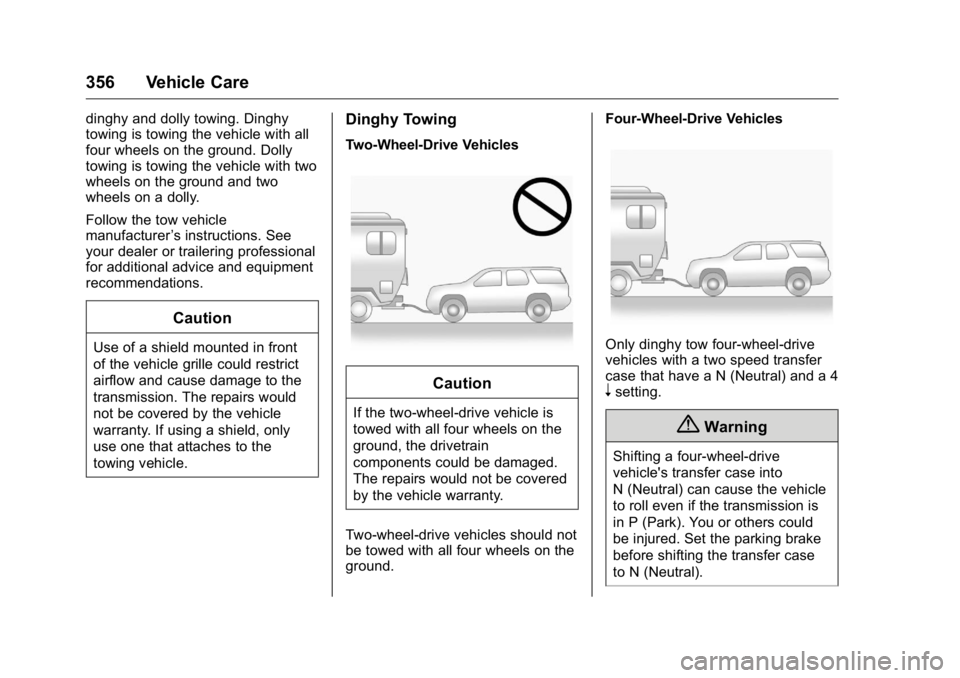
Two-wheel-drive vehicles should not
be towed with all four wheels on the
ground. Four-Wheel-Drive Vehicles
Only dinghy tow four-wheel-drive
vehicles with a two speed transfer
case that have a N (Neutral) and a 4
n setting.
{ Warning
Shifting a four-wheel-drive
vehicle's transfer case into
N (Neutral) can cause the vehicle
to roll even if the transmission is
in P (Park). You or others could
be injured. Set the parking brake
before shifting the transfer case
to N (Neutral).
Page 358 of 425
GMC Yukon/Yukon XL/Denali Owner Manual (GMNA-Localizing-U.S./
Canada/Mexico-11349262) - 2018 - crc - 6/20/17
Vehicle Care 357To dinghy tow:
1. Position the vehicle being
towed behind the tow vehicle,
facing forward and on a level
surface.
2. Securely attach the vehicle
being towed to the tow vehicle.
3. Apply the parking brake and
start the engine.
4. Shift the transfer case to
N (Neutral). See “ Shifting into
N (Neutral) ” under Four-Wheel
Drive 0 222 . Check that the
vehicle is in N (Neutral) by
starting the engine and shifting
the transmission to
R (Reverse) and then to D
(Drive). There should be no
movement of the vehicle while
shifting.
5. Shift the transmission into
D (Drive). Turn the engine off. CautionFailure to disconnect the negative
battery cable or to have it contact
the terminals can cause damage
to the vehicle.
6. Disconnect the negative
battery cable at the battery and
secure the nut and bolt. Cover
the negative battery post with a
non-conductive material to
prevent any contact with the
negative battery terminal.
7. Shift the transmission to
P (Park).
Caution
If the steering column is locked,
vehicle damage may occur.
8. Move the steering wheel to
make sure the steering column
is unlocked.
9. With a foot on the brake pedal,
release the parking brake. 10. Keep the ignition key in the
towed vehicle in ACC/
ACCESSORY to prevent the
steering column from locking.
If equipped with Keyless
Access, keep the RKE
transmitter outside of the
vehicle, and manually lock the
doors. Access the vehicle as if
it has a dead RKE transmitter
battery, by using the key in the
door lock.
Disconnecting the Towed Vehicle
Before disconnecting the towed
vehicle:
1. Park on a level surface.
2. Set the parking brake, then
shift the transmission to
P (Park).
3. Connect the battery.
4. Apply the brake pedal.
Page 359 of 425
GMC Yukon/Yukon XL/Denali Owner Manual (GMNA-Localizing-U.S./
Canada/Mexico-11349262) - 2018 - crc - 6/20/17
358 Vehicle Care 5. Turn the ignition to ON/RUN
with the engine off. Shift the
transfer case out of N (Neutral)
to 2
m . See “ Shifting out of
N (Neutral) ” under Four-Wheel
Drive 0 222 . See your dealer if
the transfer case cannot be
shifted out of N (Neutral).
6. Check that the vehicle is in 2
mby starting the engine and
shifting the transmission to
R (Reverse) and then to D
(Drive). There should be
movement of the vehicle while
shifting.
7. Shift the transmission to
P (Park) and turn off the
ignition.
8. Disconnect the vehicle from the
tow vehicle.
9. Release the parking brake.
10. Reset any lost presets.
The outside temperature
display will default to 0 °C
(32 °F) but will reset with
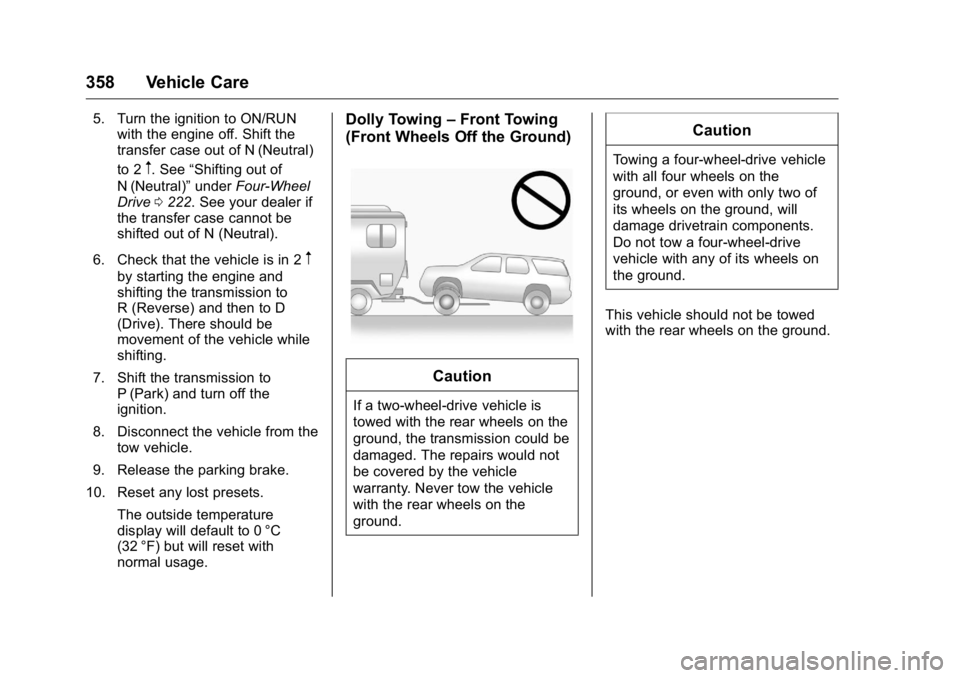
normal usage. Dolly Towing – Front Towing
(Front Wheels Off the Ground)
CautionIf a two-wheel-drive vehicle is
towed with the rear wheels on the
ground, the transmission could be
damaged. The repairs would not
be covered by the vehicle
warranty. Never tow the vehicle
with the rear wheels on the
ground. CautionTowing a four-wheel-drive vehicle
with all four wheels on the
ground, or even with only two of
its wheels on the ground, will
damage drivetrain components.
Do not tow a four-wheel-drive
vehicle with any of its wheels on
the ground.
This vehicle should not be towed
with the rear wheels on the ground.
Page 360 of 425
GMC Yukon/Yukon XL/Denali Owner Manual (GMNA-Localizing-U.S./
Canada/Mexico-11349262) - 2018 - crc - 6/20/17
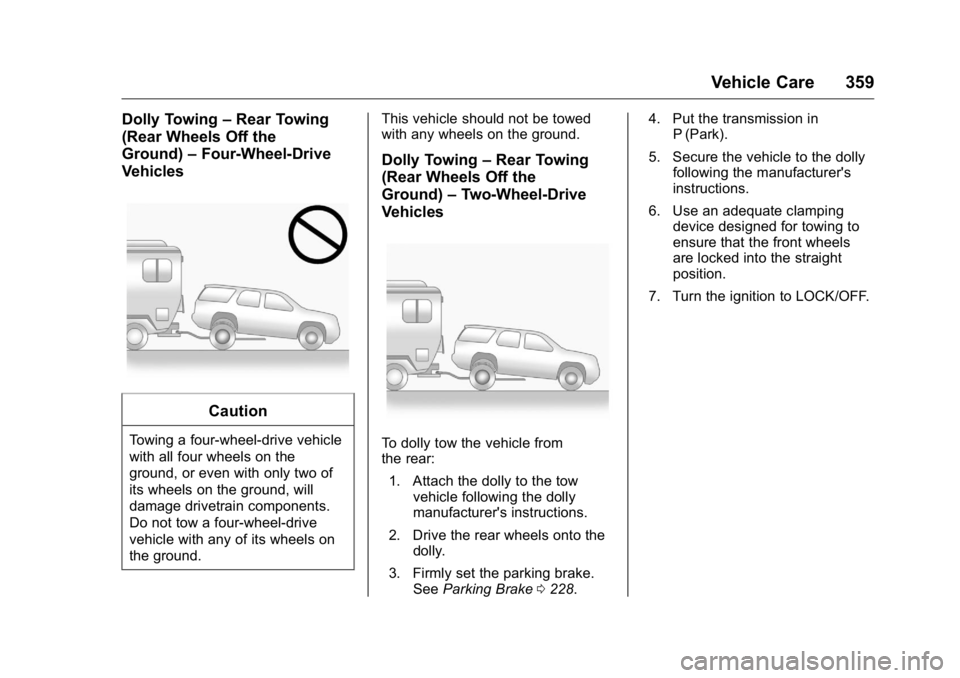
Vehicle Care 359Dolly Towing – Rear Towing
(Rear Wheels Off the
Ground) – Four-Wheel-Drive
Vehicles
Caution
Towing a four-wheel-drive vehicle
with all four wheels on the
ground, or even with only two of
its wheels on the ground, will
damage drivetrain components.
Do not tow a four-wheel-drive
vehicle with any of its wheels on
the ground. This vehicle should not be towed
with any wheels on the ground.
Dolly Towing – Rear Towing
(Rear Wheels Off the
Ground) – Two-Wheel-Drive
Vehicles
To dolly tow the vehicle from
the rear:
1. Attach the dolly to the tow
vehicle following the dolly
manufacturer's instructions.
2. Drive the rear wheels onto the
dolly.
3. Firmly set the parking brake.
See Parking Brake 0 228 . 4. Put the transmission in
P (Park).
5. Secure the vehicle to the dolly
following the manufacturer's
instructions.
6. Use an adequate clamping
device designed for towing to
ensure that the front wheels
are locked into the straight
position.
7. Turn the ignition to LOCK/OFF.
Page 364 of 425
GMC Yukon/Yukon XL/Denali Owner Manual (GMNA-Localizing-U.S./
Canada/Mexico-11349262) - 2018 - crc - 6/20/17
Vehicle Care 363can be removed by rubbing with a
clean cloth. See Recommended
Fluids and Lubricants 0 379 .
Tires Use a stiff brush with tire cleaner to
clean the tires.
CautionUsing petroleum-based tire
dressing products on the vehicle
may damage the paint finish and/
or tires. When applying a tire
dressing, always wipe off any
overspray from all painted
surfaces on the vehicle.
Wheels and Trim — Aluminum
or Chrome Use a soft, clean cloth with mild
soap and water to clean the wheels.
After rinsing thoroughly with clean
water, dry with a soft, clean towel.
A wax may then be applied. CautionChrome wheels and other chrome
trim may be damaged if the
vehicle is not washed after driving
on roads that have been sprayed
with magnesium, calcium,
or sodium chloride. These
chlorides are used on roads for
conditions such as ice and dust.
Always wash the chrome with
soap and water after exposure.
CautionTo avoid surface damage, do not
use strong soaps, chemicals,
abrasive polishes, cleaners,
brushes, or cleaners that contain
acid on aluminum or
chrome-plated wheels. Use only
approved cleaners. Also, never
drive a vehicle with aluminum or
chrome-plated wheels through an
automatic car wash that uses
silicone carbide tire cleaning
(Continued) Caution (Continued) brushes. Damage could occur
and the repairs would not be
covered by the vehicle warranty.
Brake System Visually inspect brake lines and
hoses for proper hook-up, binding,
leaks, cracks, chafing, etc. Inspect
disc brake pads for wear and rotors
for surface condition. Inspect drum
brake linings/shoes for wear or
cracks. Inspect all other brake parts.
Steering, Suspension, and
Chassis Components Visually inspect steering,
suspension, and chassis
components for damaged, loose,
or missing parts or signs of wear at
least once a year.
Inspect power steering for proper
attachment, connections, binding,
leaks, cracks, chafing, etc.
Visually check constant velocity joint
boots and axle seals for leaks.
Page 370 of 425
GMC Yukon/Yukon XL/Denali Owner Manual (GMNA-Localizing-U.S./
Canada/Mexico-11349262) - 2018 - crc - 6/20/17
Service and Maintenance 369
Service and
Maintenance General Information General Information . . . . . . . . . . 369
Maintenance Schedule Maintenance Schedule . . . . . . . 370
Special Application Services Special Application
Services . . . . . . . . . . . . . . . . . . . . 376
Additional Maintenance
and Care Additional Maintenance
and Care . . . . . . . . . . . . . . . . . . . . 376
Recommended Fluids,
Lubricants, and Parts Recommended Fluids and
Lubricants . . . . . . . . . . . . . . . . . . . 379
Maintenance Replacement
Parts . . . . . . . . . . . . . . . . . . . . . . . . 380
Maintenance Records
Maintenance Records . . . . . . . . 382 General Information Your vehicle is an important
investment. This section describes
the required maintenance for the
vehicle. Follow this schedule to help
protect against major repair
expenses resulting from neglect or
inadequate maintenance. It may
also help to maintain the value of
the vehicle if it is sold. It is the
responsibility of the owner to have
all required maintenance performed.
Your dealer has trained technicians
who can perform required
maintenance using genuine
replacement parts. They have
up-to-date tools and equipment for
fast and accurate diagnostics. Many
dealers have extended evening and
Saturday hours, courtesy
transportation, and online
scheduling to assist with service
needs.
Your dealer recognizes the
importance of providing
competitively priced maintenance
and repair services. With trained
technicians, the dealer is the place
for routine maintenance such as oil changes and tire rotations and
additional maintenance items like
tires, brakes, batteries, and wiper
blades.
CautionDamage caused by improper
maintenance can lead to costly
repairs and may not be covered
by the vehicle warranty.
Maintenance intervals, checks,
inspections, recommended fluids,
and lubricants are important to
keep the vehicle in good working
condition.
Do not have chemical flushes that
are not approved by GM
performed on the vehicle. The
use of flushes, solvents, cleaners,
or lubricants that are not
approved by GM could damage
the vehicle, requiring expensive
repairs that are not covered by
the vehicle warranty.
The Tire Rotation and Required
Services are the responsibility of the
vehicle owner. It is recommended to
Page 372 of 425
GMC Yukon/Yukon XL/Denali Owner Manual (GMNA-Localizing-U.S./
Canada/Mexico-11349262) - 2018 - crc - 6/20/17
Service and Maintenance 371a year and the oil life system must
be reset. Your trained dealer
technician can perform this work.
If the engine oil life system is reset
accidentally, service the vehicle
within 5 000 km/3,000 mi since the
last service. Reset the oil life
system when the oil is changed.
See Engine Oil Life System 0 285 .
Tire Rotation and Required
Services Every 12 000 km/
7,500 mi Rotate the tires, if recommended for
the vehicle, and perform the
following services. See Tire
Rotation 0 334 .
.
Check engine oil level and oil
life percentage. If needed,
change engine oil and filter, and
reset oil life system.
See Engine Oil 0 283 and
Engine Oil Life System 0 285 . .
Check engine coolant level. See
Cooling System 0 291 .
.
Check windshield washer fluid
level. See Washer Fluid 0 296 .
.
Visually inspect windshield wiper
blades for wear, cracking,
or contamination. See Exterior
Care 0 360 . Replace worn or
damaged wiper blades. See
Wiper Blade Replacement
0 303 .
.
Check tire inflation pressures.
See Tire Pressure 0 327 .
.
Inspect tire wear. See Tire
Inspection 0 333 .
.
Visually check for fluid leaks.
.
Inspect engine air cleaner filter.
See Engine Air Cleaner/Filter
0 290 .
.
Inspect brake system. See
Exterior Care 0 360 . .
Visually inspect steering,
suspension, and chassis
components for damaged, loose,
or missing parts or signs of wear
at least once a year. See
Exterior Care 0 360 . Lubricate
the suspension and steering
components at least every other
oil change (if equipped with
grease fittings).
.
Check restraint system
components. See Safety System
Check 0 83 .
.
Visually inspect fuel system for
damage or leaks.
.
Visually inspect exhaust system
and nearby heat shields for
loose or damaged parts.
.
Lubricate body components. See
Exterior Care 0 360 .
.
Check starter switch. See Starter
Switch Check 0 302 .
Page 373 of 425

GMC Yukon/Yukon XL/Denali Owner Manual (GMNA-Localizing-U.S./
Canada/Mexico-11349262) - 2018 - crc - 6/20/17
372 Service and Maintenance .
Check automatic transmission
shift lock control function. See
Automatic Transmission Shift
Lock Control Function Check
0 302 .
.
Check ignition transmission lock.
See Ignition Transmission Lock
Check 0 303 .
.
Check parking brake and
automatic transmission park
mechanism. See Park Brake and
P (Park) Mechanism Check
0 303 .
.
Check accelerator pedal for
damage, high effort, or binding.
Replace if needed.
.
Visually inspect gas strut for
signs of wear, cracks, or other
damage. Check the hold open
ability of the strut. If the hold
open is low, service the gas
strut. See Gas Strut(s) 0 305 .
.
Inspect sunroof track and seal,
if equipped. See Sunroof 0 58 .
.
Verify spare tire key lock
operation and lubricate as
needed. See Tire Changing
0 342 .
Page 374 of 425
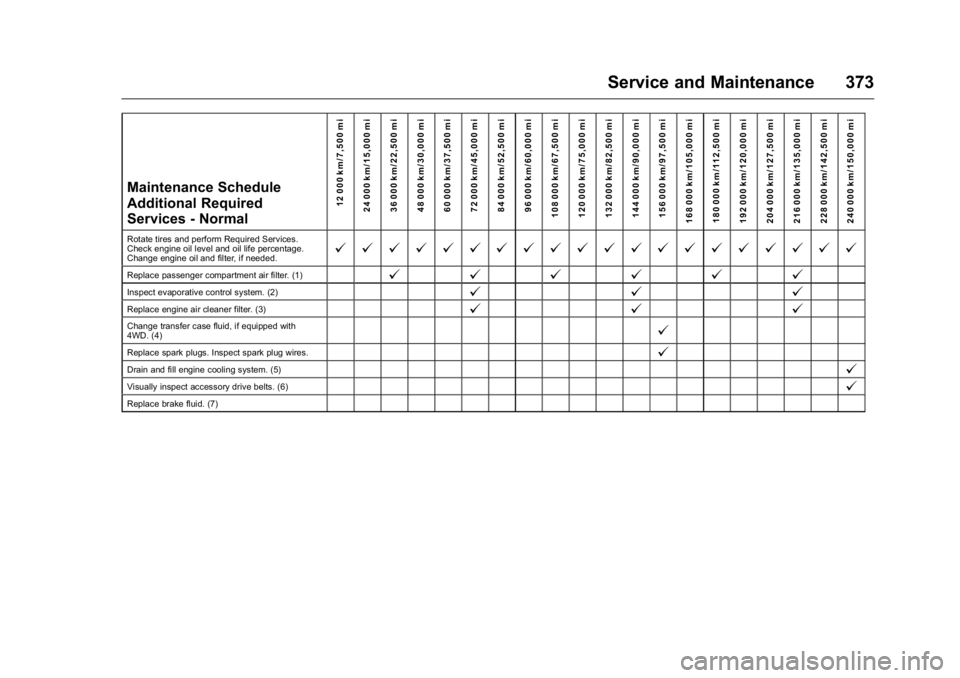
GMC Yukon/Yukon XL/Denali Owner Manual (GMNA-Localizing-U.S./
Canada/Mexico-11349262) - 2018 - crc - 6/20/17
Service and Maintenance 373Maintenance Schedule
Additional Required
Services - Normal
12 000 km/7,500 mi
24 000 km/15,000 mi
36 000 km/22,500 mi
48 000 km/30,000 mi
60 000 km/37,500 mi
72 000 km/45,000 mi
84 000 km/52,500 mi
96 000 km/60,000 mi
108 000 km/67,500 mi
120 000 km/75,000 mi
132 000 km/82,500 mi
144 000 km/90,000 mi
156 000 km/97,500 mi
168 000 km/105,000 mi
180 000 km/112,500 mi
192 000 km/120,000 mi
204 000 km/127,500 mi
216 000 km/135,000 mi
228 000 km/142,500 mi
240 000 km/150,000 miRotate tires and perform Required Services.
Check engine oil level and oil life percentage.
Change engine oil and filter, if needed.
@ @ @ @ @ @ @ @ @ @ @ @ @ @ @ @ @ @ @ @Replace passenger compartment air filter. (1)
@ @ @ @ @ @Inspect evaporative control system. (2)
@ @ @Replace engine air cleaner filter. (3)
@ @ @Change transfer case fluid, if equipped with
4WD. (4)
@Replace spark plugs. Inspect spark plug wires.
@Drain and fill engine cooling system. (5)
@Visually inspect accessory drive belts. (6)
@Replace brake fluid. (7)