service reset GMC YUKON XL DENALI 2007 User Guide
[x] Cancel search | Manufacturer: GMC, Model Year: 2007, Model line: YUKON XL DENALI, Model: GMC YUKON XL DENALI 2007Pages: 608, PDF Size: 2.92 MB
Page 473 of 608
Headlamp Aiming
The vehicle has a visual optical headlamp aiming
system. The aim of the headlamps have been
preset at the factory and should need no further
adjustment.
However, if the vehicle is damaged in an accident,
the aim of the headlamps may be affected and
adjustment may be necessary.
If oncoming vehicles ash their high beams at
you, this may mean the vertical aim of your
headlamps needs to be adjusted.
It is recommended that the vehicle is taken to your
dealer for service if the headlamps need to be
adjusted. It is possible however, to re-aim the
headlamps as described in the following procedure.
The vehicle should be properly prepared as follows:
The vehicle should be placed so the headlamps
are 25 ft. (7.6 m) from a light colored wall.
The vehicle must have all four tires on a level
surface which is level all the way to the wall.
The vehicle should be placed so it is
perpendicular to the wall.
The vehicle should not have any snow, ice,
or mud on it.
The vehicle should be fully assembled and all
other work stopped while headlamp aiming is
being performed.
The vehicle should be normally loaded with a
full tank of fuel and one person or 160 lbs
(75 kg) sitting on the driver’s seat.
Tires should be properly inated.
The spare tire is in its proper location in the
vehicle.
Headlamp aiming is done with the vehicle’s
low-beam headlamps. The high-beam headlamps
will be correctly aimed if the low-beam headlamps
are aimed properly.
473
Page 493 of 608
Your vehicle’s TPMS can alert you about a low
tire pressure condition but it does not replace
normal tire maintenance. SeeTire Inspection and
Rotation on page 496andTires on page 480.
Notice:Do not use a tire sealant if your
vehicle has Tire Pressure Monitors. The liquid
sealant can damage the tire pressure monitor
sensors.
Resetting the TPMS Identication Codes
Each TPMS sensor has a unique identication
code. Any time you rotate your vehicle’s tires or
replace one or more of the TPMS sensors,
the identication codes will need to be matched
to the new tire/wheel position. The sensors
are matched to the tire/wheel positions in the
following order: driver’s side front tire, passengers
side front tire, passengers side rear tire, and
driver’s side rear tire using a TPMS diagnostic tool.
See your GM dealer for service.The TPMS sensors may also be matched to each
tire/wheel position by increasing or decreasing
the tire’s air pressure. If increasing the tire’s
air pressure, do not exceed the maximum ination
pressure indicated on the tire’s sidewall.
You will have two minutes to match the rst
tire/wheel position, and ve minutes overall to
match all four tire/wheel positions. If it takes longer
than two minutes, to match the rst tire and
wheel, or more than ve minutes to match all
four tire and wheel positions the matching process
stops and you will need to start over.
493
Page 494 of 608
The TPMS sensor matching process is outlined
below:
1. Set the parking brake.
2. Turn the ignition switch to RUN with the
engine off.
3. Using the DIC, press the vehicle information
button until the PRESS
VTO RELEARN
TIRE POSITIONS message displays.
4. Press the set/reset button. The horn will
sound twice to indicate the TPMS receiver
is ready, and the TIRE LEARNING ACTIVE
message will display.
5. Start with the driver’s side front tire.
6. Remove the valve cap from the valve cap
stem. Activate the TPMS sensor by
increasing or decreasing the tire’s air pressure
for ve seconds, or until a horn chirp
sounds. The horn chirp, which make take up
to 30 seconds to sound, conrms that the
sensor identication code has been matched
to this tire and wheel position. To decrease
air-pressure out of a tire you can use the
pointed end of the valve cap, a pencil-style
air pressure gage, or a key.7. Proceed to the passenger’s side front tire, and
repeat the procedure in Step 6.
8. Proceed to the passenger’s side rear tire, and
repeat the procedure in Step 6.
9. Proceed to the driver’s side rear tire, and
repeat the procedure in Step 6.
10. After hearing the conrming horn chirp for the
driver’s side rear tire, the horn chirp will sound
two more times to signal the tire learning
mode is no longer active. Turn the ignition
switch to LOCK.
11. Set all four tires to the recommended air
pressure level as indicated on the Tire
and Loading Information label.
12. Put the valve caps back on the valve stems
The spare tire does not have a TPMS sensor.
If you replace one of the road tires with the spare,
the SERVICE TIRE MONITOR message will be
displayed on the DIC screen. This message should
go off once you re-install the road tire containing
the TPMS sensor.
494
Page 551 of 608
If you want to purchase service information, see
Service Publications Ordering Information on
page 589.
Owner Checks and Services on page 557tells you
what should be checked, when to check it, and
what you can easily do to help keep your vehicle in
good condition.
The proper replacement parts, uids, and
lubricants to use are listed inRecommended
Fluids and Lubricants on page 561andNormal
Maintenance Replacement Parts on page 563.
When your vehicle is serviced, make sure these
are used. All parts should be replaced and all
necessary repairs done before you or anyone else
drives the vehicle. We recommend the use of
genuine GM parts.Scheduled Maintenance
When the CHANGE ENGINE OIL SOON message
comes on, it means that service is required for
your vehicle. Have your vehicle serviced as
soon as possible within the next 600 miles
(1 000 km). It is possible that, if you are driving
under the best conditions, the engine oil life
system may not indicate that vehicle service is
necessary for over a year. However, your engine
oil and lter must be changed at least once a
year and at this time the system must be reset.
Your GM Goodwrench
®dealer has GM-trained
service technicians who will perform this work
using genuine GM parts and reset the system.
551
Page 552 of 608
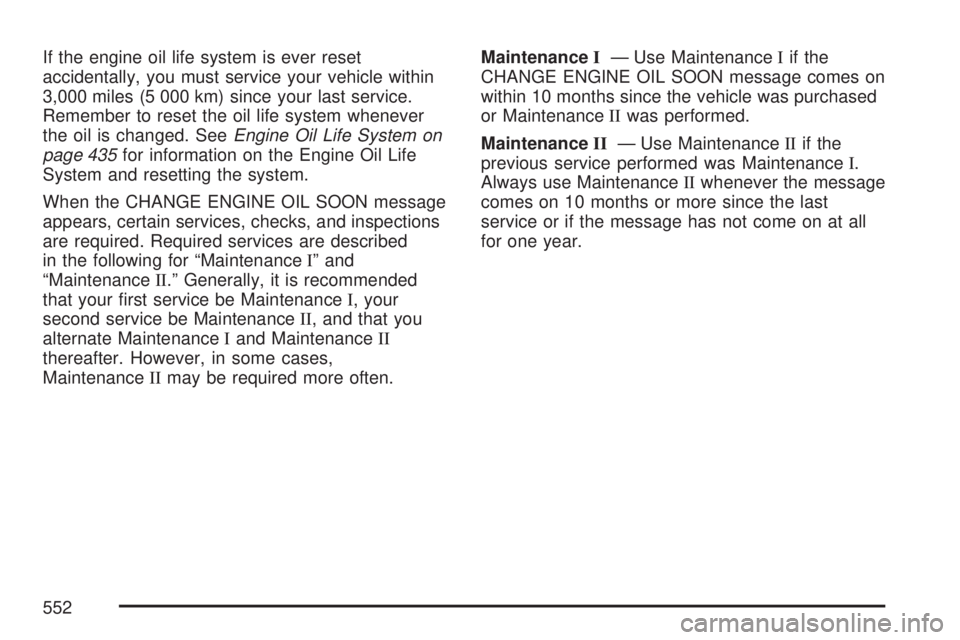
If the engine oil life system is ever reset
accidentally, you must service your vehicle within
3,000 miles (5 000 km) since your last service.
Remember to reset the oil life system whenever
the oil is changed. SeeEngine Oil Life System on
page 435for information on the Engine Oil Life
System and resetting the system.
When the CHANGE ENGINE OIL SOON message
appears, certain services, checks, and inspections
are required. Required services are described
in the following for “MaintenanceI” and
“MaintenanceII.” Generally, it is recommended
that your rst service be MaintenanceI, your
second service be MaintenanceII, and that you
alternate MaintenanceIand MaintenanceII
thereafter. However, in some cases,
MaintenanceIImay be required more often.MaintenanceI— Use MaintenanceIif the
CHANGE ENGINE OIL SOON message comes on
within 10 months since the vehicle was purchased
or MaintenanceIIwas performed.
MaintenanceII— Use MaintenanceIIif the
previous service performed was MaintenanceI.
Always use MaintenanceIIwhenever the message
comes on 10 months or more since the last
service or if the message has not come on at all
for one year.
552
Page 553 of 608
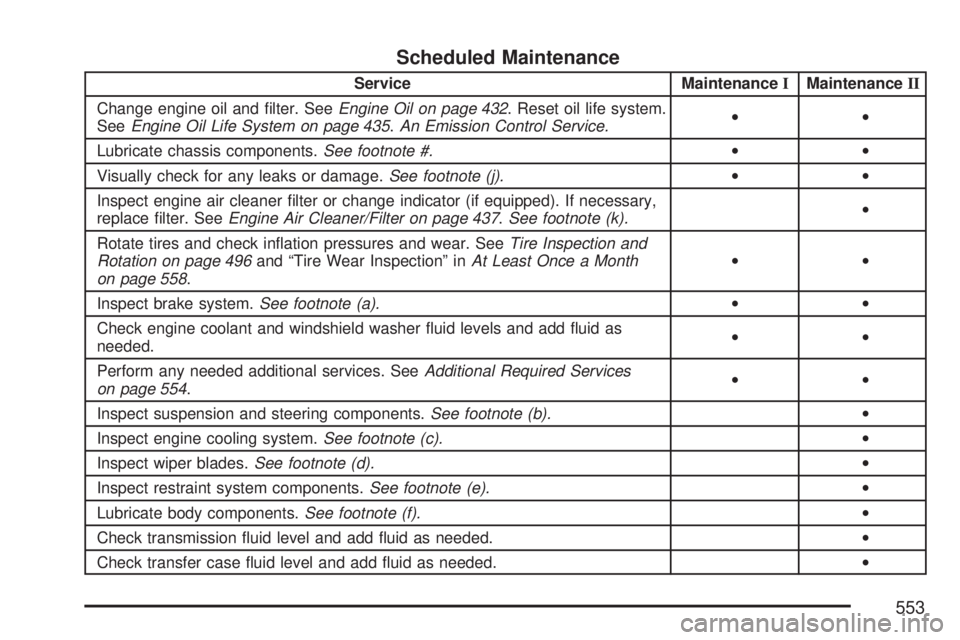
Scheduled Maintenance
Service MaintenanceIMaintenanceII
Change engine oil and lter. SeeEngine Oil on page 432. Reset oil life system.
SeeEngine Oil Life System on page 435.An Emission Control Service.••
Lubricate chassis components.See footnote #.••
Visually check for any leaks or damage.See footnote (j).••
Inspect engine air cleaner lter or change indicator (if equipped). If necessary,
replace lter. SeeEngine Air Cleaner/Filter on page 437.See footnote (k).•
Rotate tires and check ination pressures and wear. SeeTire Inspection and
Rotation on page 496and “Tire Wear Inspection” inAt Least Once a Month
on page 558.••
Inspect brake system.See footnote (a).••
Check engine coolant and windshield washer uid levels and add uid as
needed.••
Perform any needed additional services. SeeAdditional Required Services
on page 554.••
Inspect suspension and steering components.See footnote (b).•
Inspect engine cooling system.See footnote (c).•
Inspect wiper blades.See footnote (d).•
Inspect restraint system components.See footnote (e).•
Lubricate body components.See footnote (f).•
Check transmission uid level and add uid as needed.•
Check transfer case uid level and add uid as needed.•
553