steering wheel GREAT WALL FLORID 2008 User Guide
[x] Cancel search | Manufacturer: GREAT WALL, Model Year: 2008, Model line: FLORID, Model: GREAT WALL FLORID 2008Pages: 281, PDF Size: 43.97 MB
Page 98 of 281
Downloaded from www.Manualslib.com manuals search engine 91Suspension System
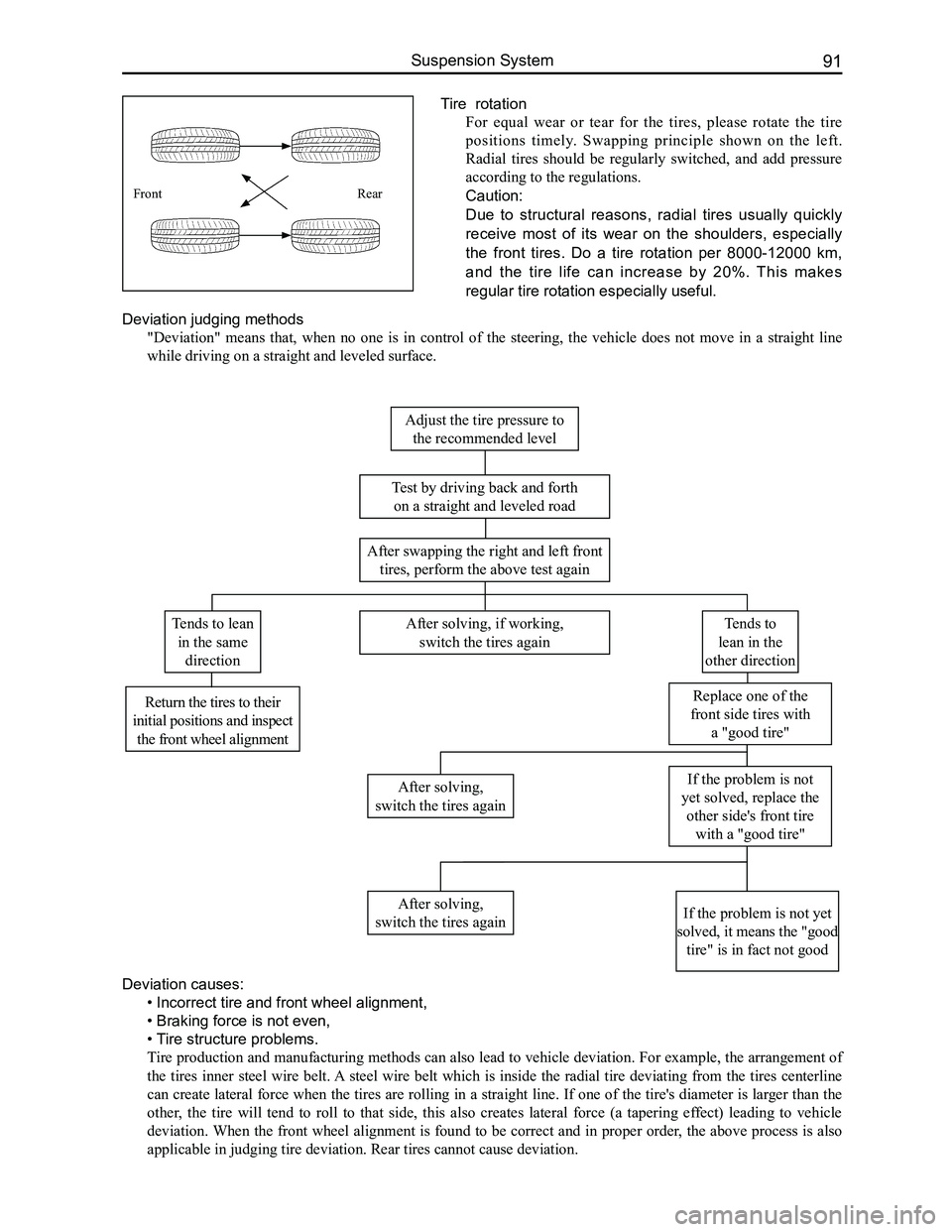
Deviation judging methods
"Deviation" means that, when no one is in control of the steering, the vehicle does not move in a straight line
while driving on a straight and leveled surface.
Deviation causes:
• Incorrect tire and front wheel alignment,
• Braking force is not even,
• Tire structure problems.
Tire production and manufacturing methods can also lead to vehicle deviation. For example, the arrangement of
the tires inner steel wire belt. A steel wire belt which is inside the radial tire deviating from the tires centerline
can create lateral force when the tires are rolling in a straight line. If one of the tire's diameter is larger than the
other, the tire will tend to roll to that side, this also creates lateral force (a tapering effect) leading to vehicle
deviation. When the front wheel alignment is found to be correct and in proper order, the above process is also
applicable in judging tire deviation. Rear tires cannot cause deviation.\
After solving, if working,
switch the tires again
Return the tires to their
initial positions and inspect
the front wheel alignment
After solving,
switch the tires again
Tire rotation
For equal wear or tear for the tires, please rotate the tire
positions timely. Swapping principle shown on the left.
Radial tires should be regularly switched, and add pressure
according to the regulations.
Caution:
Due to structural reasons, radial tires usually quickly
receive most of its wear on the shoulders, especially
the front tires. Do a tire rotation per 8000-12000 km,
and the tire life can increase by 20%. This makes
regular tire rotation especially useful.
Test by driving back and forth
on a straight and leveled road
Tends to lean
in the same
direction
If the problem is not yet
solved, it means the "good
tire" is in fact not good
If the problem is not
yet solved, replace the
other side's front tire
with a "good tire"
Replace one of the
front side tires with
a "good tire"
Tends to
lean in the
other direction
FrontRear
Adjust the tire pressure to
the recommended level
After swapping the right and left front
tires, perform the above test again
After solving,
switch the tires again
Page 102 of 281
Downloaded from www.Manualslib.com manuals search engine 95Brake System
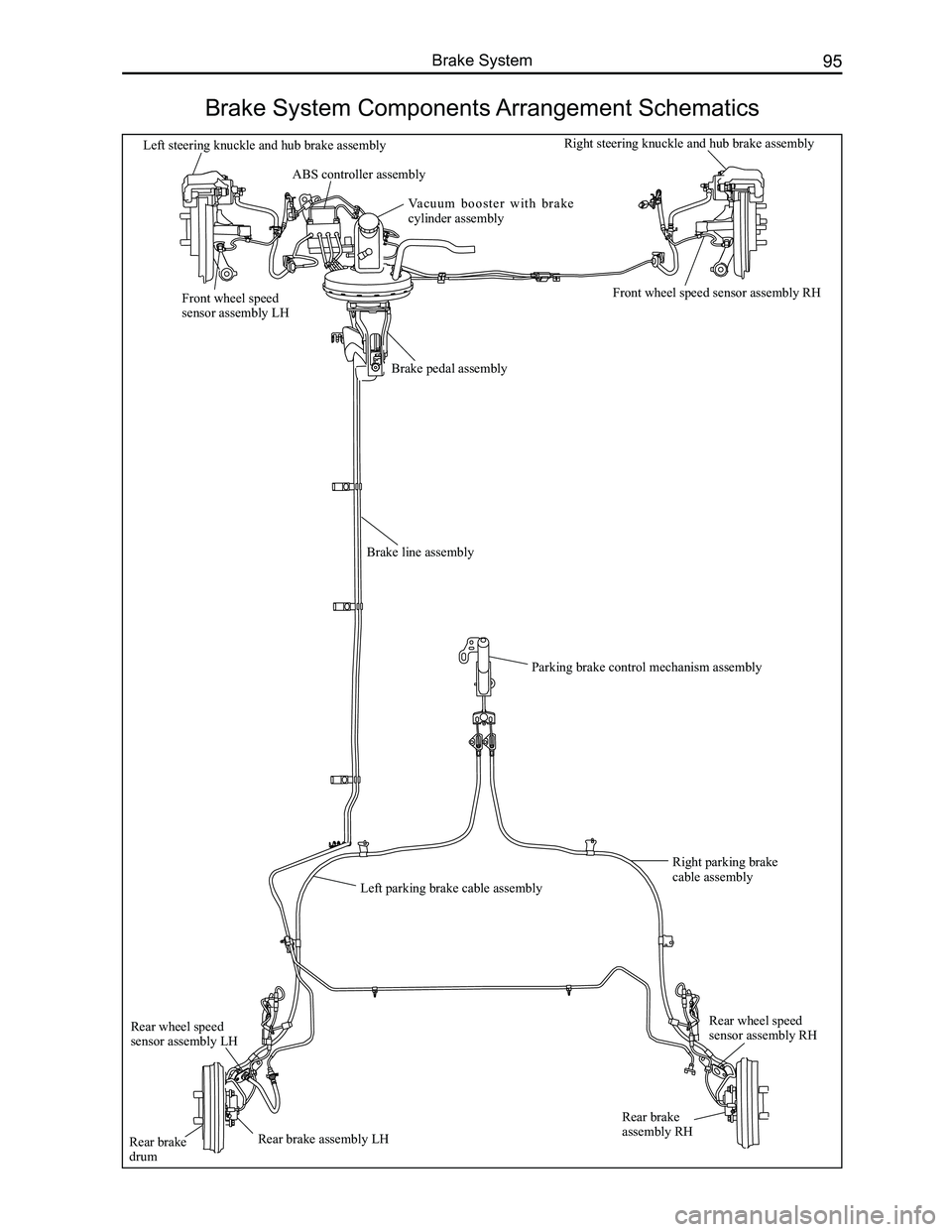
Brake System Components Arrangement Schematics
Brake pedal assembly
Vacuum booster with brake cylinder assembly
Left steering knuckle and hub brake assembly
Left parking brake cable assembly
Rear brake assembly RHRear brake drum
Rear wheel speed sensor assembly RH
Right parking brake cable assembly
ABS controller assembly
Right steering knuckle and hub brake assembly
Brake line assembly
Rear wheel speed
sensor assembly LH
Front wheel speed sensor assembly RHFront wheel speed sensor assembly LH
Rear brake assembly LH
Parking brake control mechanism assembly
Page 114 of 281
Downloaded from www.Manualslib.com manuals search engine 107Brake System
Anti-lock Brake System
ABS/EBD introduction
1. Operation
The vehicle's Anti-lock Brake System (ABS) is a type of increasingly popular brake safety device. It detects the
wheel's speed using wheel speed sensor detection. After signal processing, the wheel speed will be transferred
to the computer, which controls the solenoid valve’s operating condition and the pressure inside the brake wheel
cylinder to avoid wheel locking by using certain calculations and control methods based on the wheel speed.
ABS helps the vehicle to avoid sliding, deviation, fishtailing, and losing steering control capacity. ABS improves
the vehicle’s handling capability, stability and shortens braking distance. It also helps the vehicle to avoid the
partial wear and tear of wheels, hence improves the tire's useful life.
Electronic Brake Distribution (EBD) is used to adjust the vehicle's rear wheel brake pressure by using the ABS
components when the ABS does not respond to vehicle braking. It is also used to balance the vehicle’s front and
rear wheel brake pressure, maximizing the vehicle's braking efficiency. EBD uses the ABS components, yet its
controlling logic is independent from the ABS. After the ABS responds, the EBD will disengage.
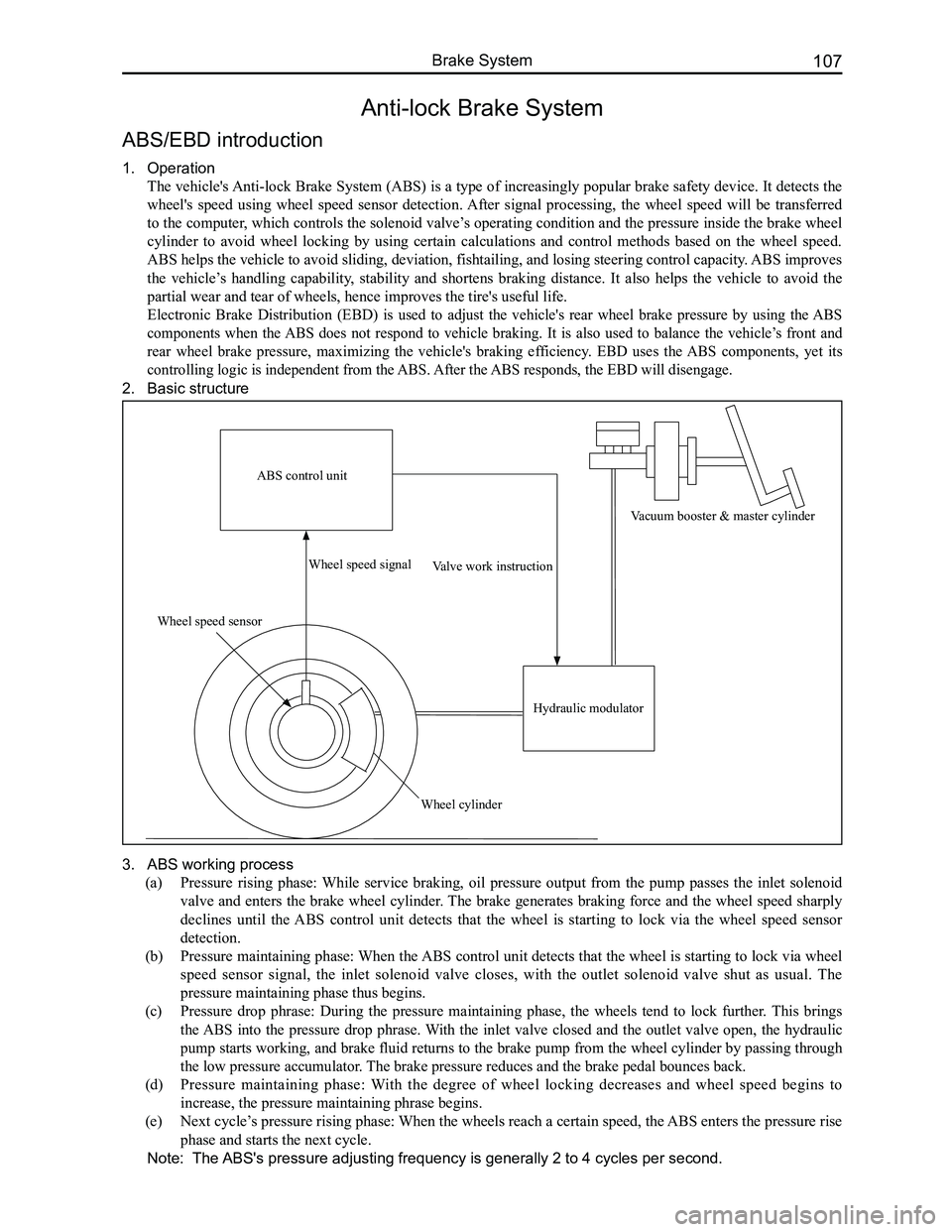
2. Basic structure
3. ABS working process
(a) Pressure rising phase: While service braking, oil pressure output from the pump passes the inlet solenoid
valve and enters the brake wheel cylinder. The brake generates braking force and the wheel speed sharply
declines until the ABS control unit detects that the wheel is starting to lock via the wheel speed sensor
detection.
(b) Pressure maintaining phase: When the ABS control unit detects that the wheel is starting to lock via wheel
speed sensor signal, the inlet solenoid valve closes, with the outlet solenoid valve shut as usual. The
pressure maintaining phase thus begins.
(c) Pressure drop phrase: During the pressure maintaining phase, the wheels tend to lock further. This brings
the ABS into the pressure drop phrase. With the inlet valve closed and the outlet valve open, the hydraulic
pump starts working, and brake fluid returns to the brake pump from the wheel cylinder by passing through
the low pressure accumulator. The brake pressure reduces and the brake pedal bounces back.
(d) Pressure maintaining phase: With the degree of wheel locking decreases and wheel speed begins to
increase, the pressure maintaining phrase begins.
(e) Next cycle’s pressure rising phase: When the wheels reach a certain speed, the ABS enters the pressure rise
phase and starts the next cycle.
Note: The ABS's pressure adjusting frequency is generally 2 to 4 cycles per second.
ABS control unit
Wheel speed sensor
Wheel speed signal
Wheel cylinder
Valve work instruction
Hydraulic modulator
Vacuum booster & master cylinder
Page 115 of 281
Downloaded from www.Manualslib.com manuals search engine GWFLORID Maintenance Manual108
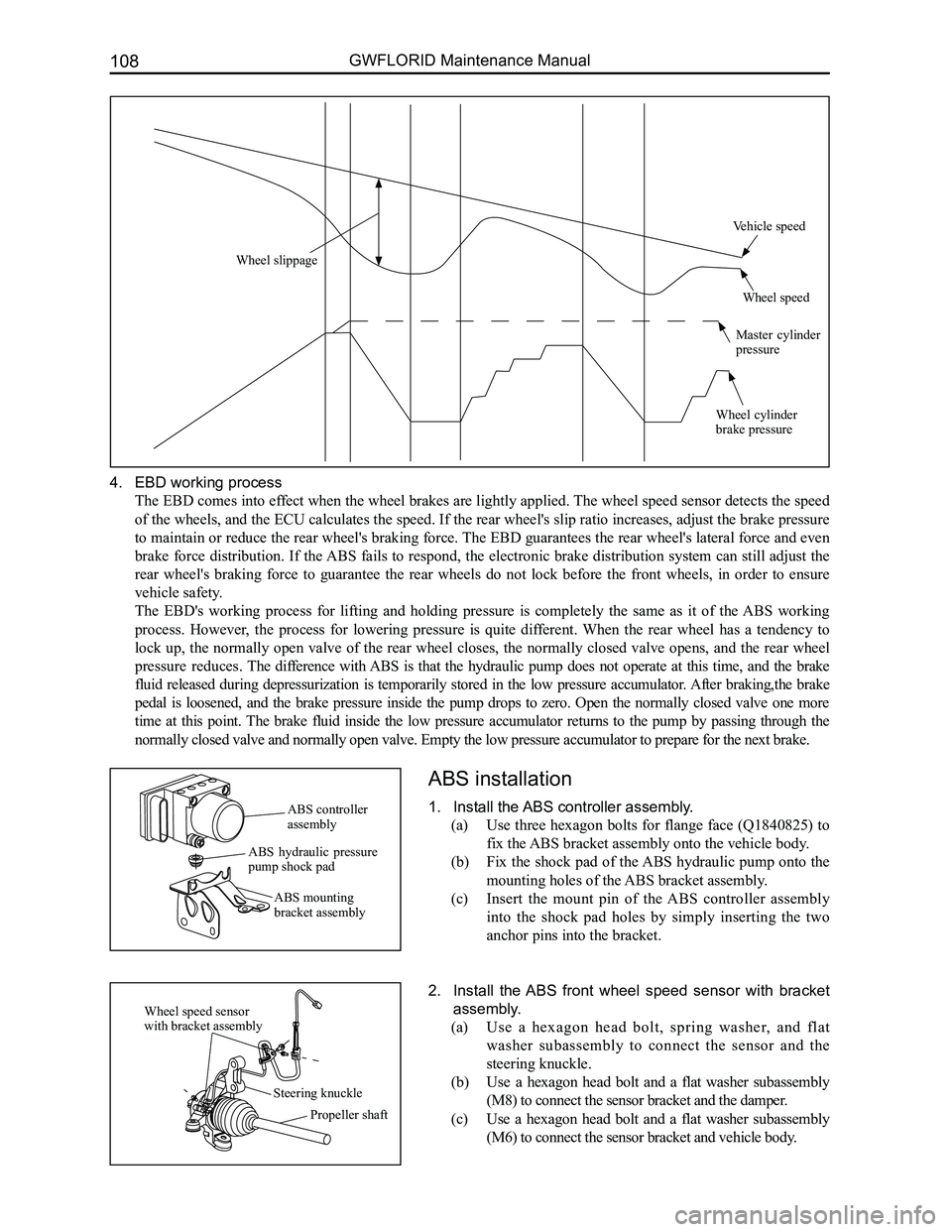
4. EBD working process
The EBD comes into effect when the wheel brakes are lightly applied. The wheel speed sensor detects the speed
of the wheels, and the ECU calculates the speed. If the rear wheel's slip ratio increases, adjust the brake pressure
to maintain or reduce the rear wheel's braking force. The EBD guarantees the rear wheel's lateral force and even
brake force distribution. If the ABS fails to respond, the electronic brake distribution system can still adjust the
rear wheel's braking force to guarantee the rear wheels do not lock before the front wheels, in order to ensure
vehicle safety.
The EBD's working process for lifting and holding pressure is completely the same as it of the ABS working
process. However, the process for lowering pressure is quite different. When the rear wheel has a tendency to
lock up, the normally open valve of the rear wheel closes, the normally closed valve opens, and the rear wheel
pressure reduces. The difference with ABS is that the hydraulic pump does not operate at this time, and the brake
fluid released during depressurization is temporarily stored in the low pressure accumulator. After braking,the brake
pedal is loosened, and the brake pressure inside the pump drops to zero. Open the normally closed valve one more
time at this point. The brake fluid inside the low pressure accumulator returns to the pump by passing through the
normally closed valve and normally open valve. Empty the low pressure ac\
cumulator to prepare for the next brake.
ABS installation
1. Install the ABS controller assembly.
(a) Use three hexagon bolts for flange face (Q1840825) to
fix the ABS bracket assembly onto the vehicle body.
(b) Fix the shock pad of the ABS hydraulic pump onto the
mounting holes of the ABS bracket assembly.
(c) Insert the mount pin of the ABS controller assembly
into the shock pad holes by simply inserting the two
anchor pins into the bracket.
2. Install the ABS front wheel speed sensor with bracket
assembly.
(a) Use a hexagon head bolt, spring washer, and flat
washer subassembly to connect the sensor and the
steering knuckle.
(b) Use a hexagon head bolt and a flat washer subassembly
(M8) to connect the sensor bracket and the damper.
(c) Use a hexagon head bolt and a flat washer subassembly
(M6) to connect the sensor bracket and vehicle body.
ABS controller assembly
ABS hydraulic pressure pump shock pad
ABS mounting bracket assembly
Wheel speed sensor with bracket assembly
Steering knuckle
Propeller shaft
Wheel slippage
Vehicle speed
Wheel speed
Master cylinder pressure
Wheel cylinder brake pressure
Page 119 of 281
Downloaded from www.Manualslib.com manuals search engine GWFLORID Maintenance Manual112
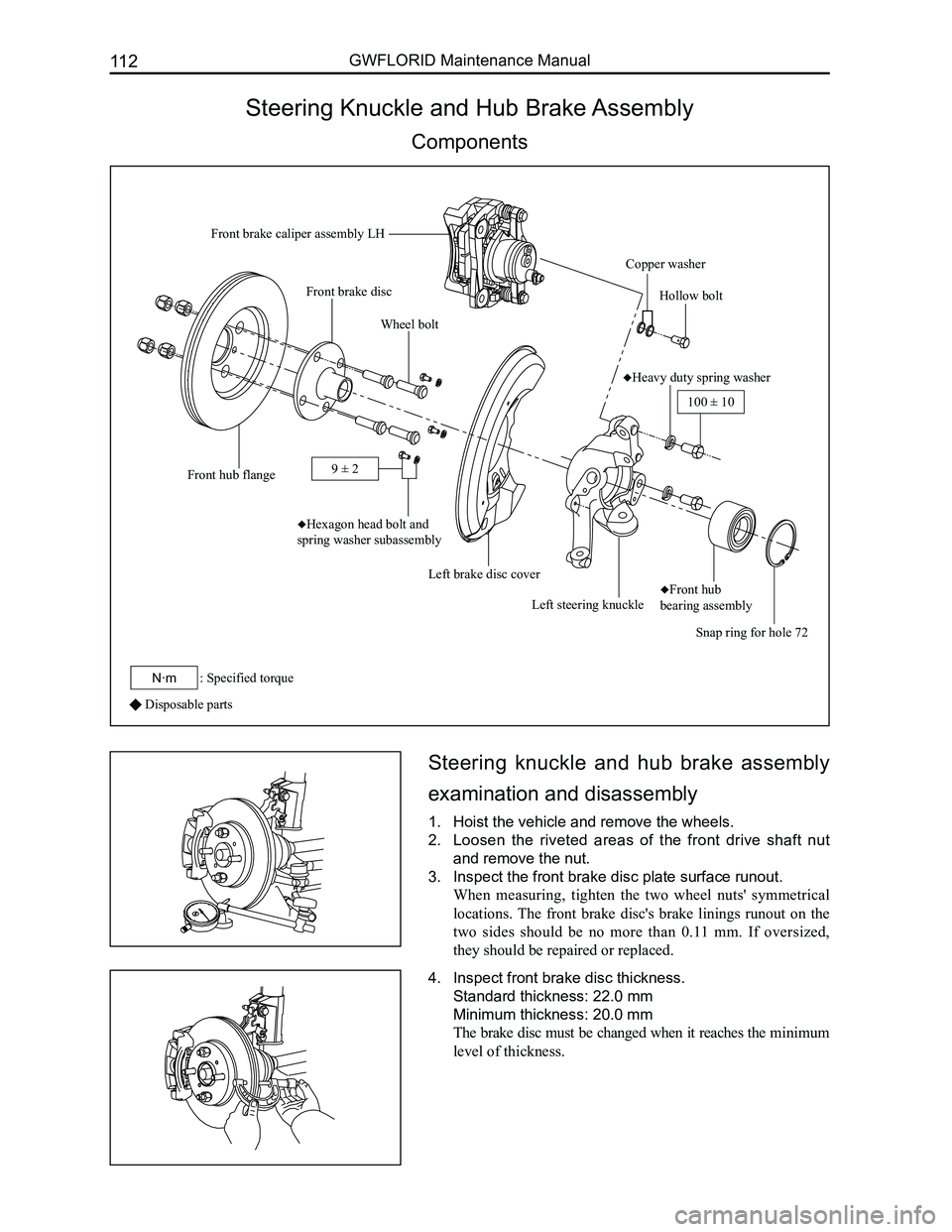
Steering Knuckle and Hub Brake Assembly
Components
Disposable parts
Steering knuckle and hub brake assembly
examination and disassembly
1. Hoist the vehicle and remove the wheels.
2. Loosen the riveted areas of the front drive shaft nut
and remove the nut.
3. Inspect the front brake disc plate surface runout.
When measuring, tighten the two wheel nuts' symmetrical
locations. The front brake disc's brake linings runout on the
two sides should be no more than 0.11 mm. If oversized,
they should be repaired or replaced.
4. Inspect front brake disc thickness.
Standard thickness: 22.0 mm
Minimum thickness: 20.0 mm
The brake disc must be changed when it reaches the minimum
level of thickness.
Front brake caliper assembly LH
Copper washer
Hollow bolt
♦Heavy duty spring washer
Snap ring for hole 72
♦Front hub
bearing assemblyLeft steering knuckle
Left brake disc cover
♦Hexagon head bolt and
spring washer subassembly
Wheel bolt
Front hub flange
Front brake disc
100 ± 10
: Specified torqueN·m
9 ± 2
Page 121 of 281
Downloaded from www.Manualslib.com manuals search engine GWFLORID Maintenance Manual114
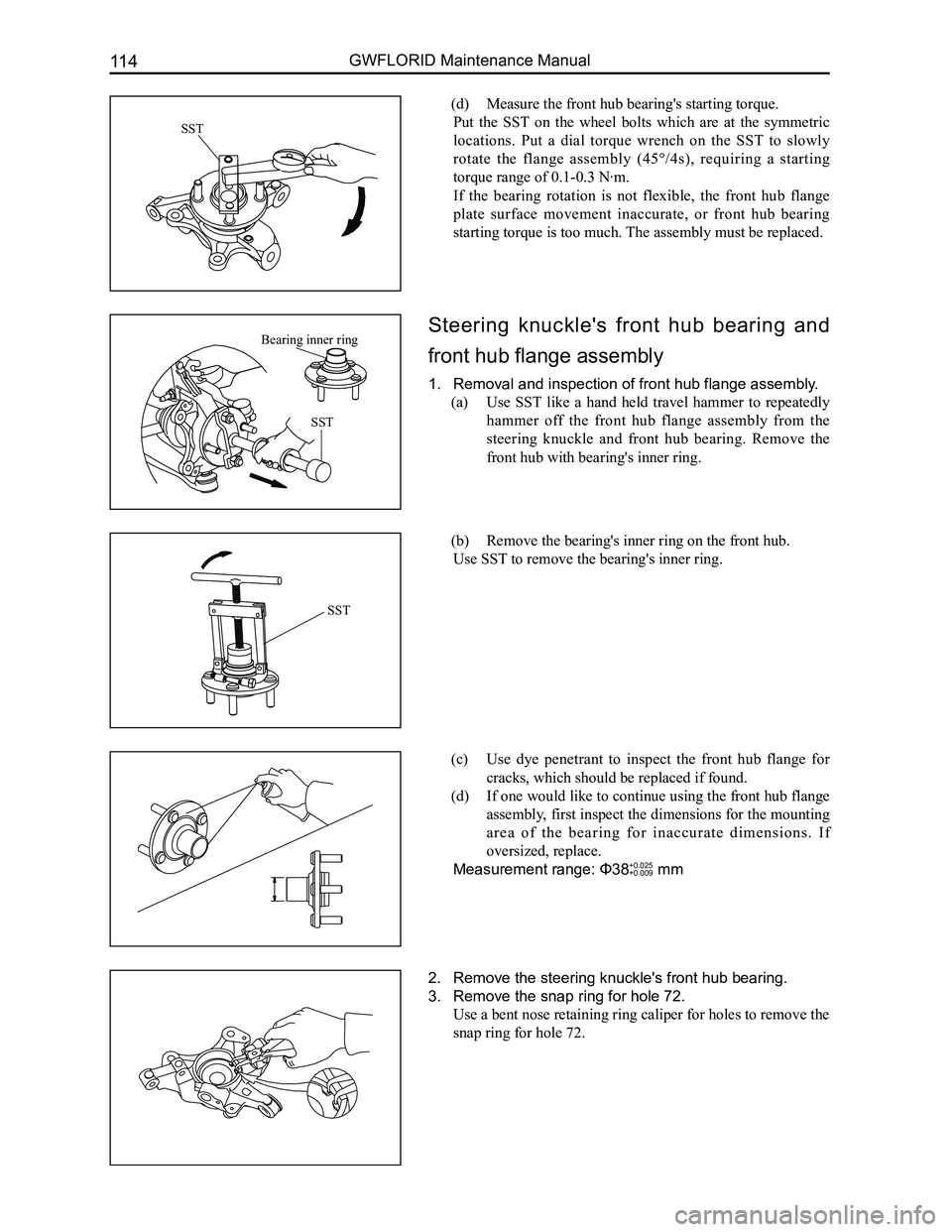
(d) Measure the front hub bearing's starting torque.
Put the SST on the wheel bolts which are at the symmetric
locations. Put a dial torque wrench on the SST to slowly
rotate the flange assembly (45°/4s), requiring a starting
torque range of 0.1-0.3 N·m.
If the bearing rotation is not flexible, the front hub flange
plate surface movement inaccurate, or front hub bearing
starting torque is too much. The assembly must be replaced.
Steering knuckle's front hub bearing and
front hub flange assembly
1. Removal and inspection of front hub flange assembly.
(a) Use SST like a hand held travel hammer to repeatedly
hammer off the front hub flange assembly from the
steering knuckle and front hub bearing. Remove the
front hub with bearing's inner ring.
(b) Remove the bearing's inner ring on the front hub.
Use SST to remove the bearing's inner ring.
SST
SST
Bearing inner ring
SST
(c) Use dye penetrant to inspect the front hub flange for
cracks, which should be replaced if found.
(d) If one would like to continue using the front hub flange
assembly, first inspect the dimensions for the mounting
area of the bearing for inaccurate dimensions. If
oversized, replace.
Measurement range: Φ38+0.025 +0.009 mm
2. Remove the steering knuckle's front hub bearing.
3. Remove the snap ring for hole 72.
Use a bent nose retaining ring caliper for holes to remove the
snap ring for hole 72.
Page 123 of 281
Downloaded from www.Manualslib.com manuals search engine GWFLORID Maintenance Manual116
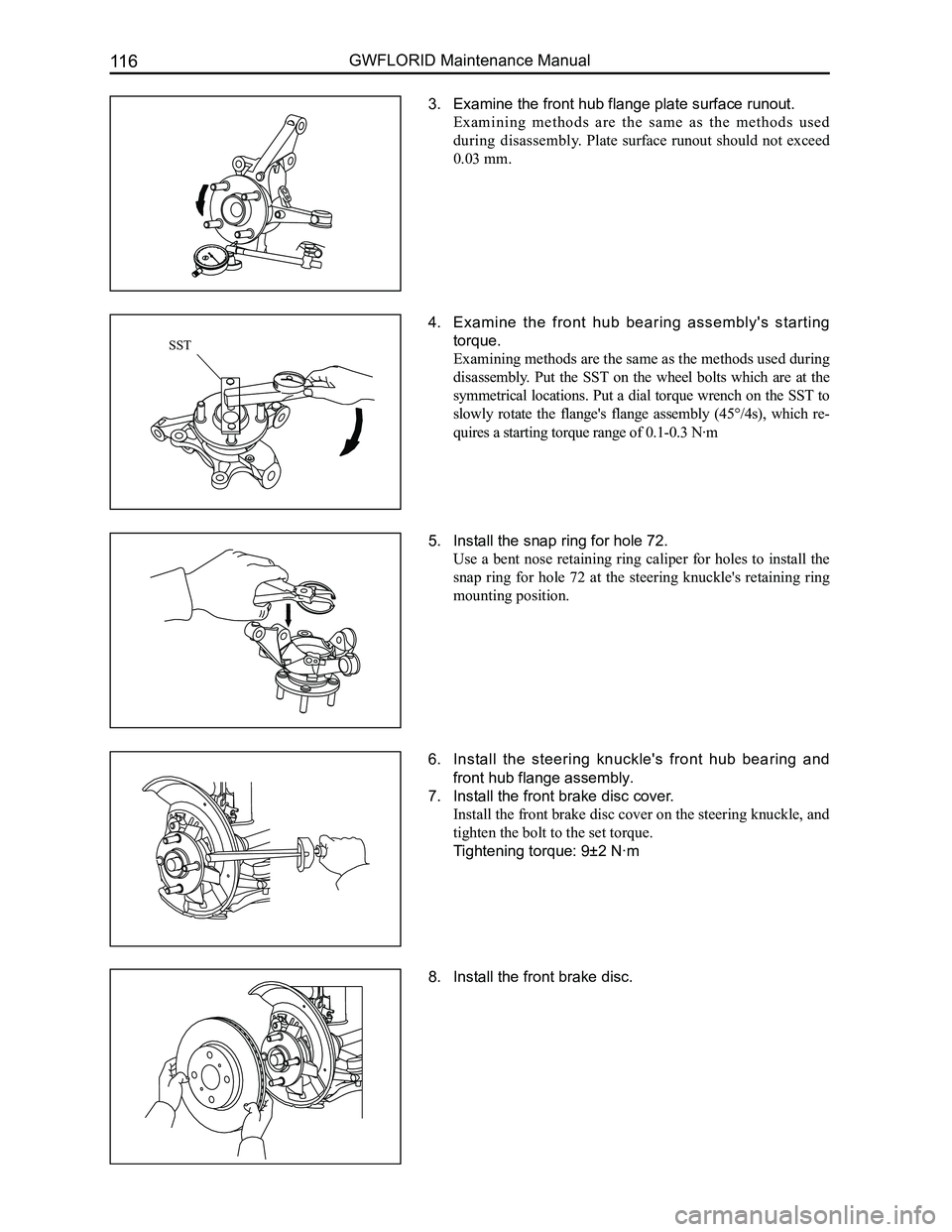
3. Examine the front hub flange plate surface runout.
Examining methods are the same as the methods used
during disassembly. Plate surface runout should not exceed
0.03 mm.
4. Examine the front hub bearing assembly's starting
torque.
Examining methods are the same as the methods used during
disassembly. Put the SST on the wheel bolts which are at the
symmetrical locations. Put a dial torque wrench on the SST to
slowly rotate the flange's flange assembly (45°/4s), which re-
quires a starting torque range of 0.1-0.3 N·m
5. Install the snap ring for hole 72.
Use a bent nose retaining ring caliper for holes to install the
snap ring for hole 72 at the steering knuckle's retaining ring
mounting position.
6. Install the steering knuckle's front hub bearing and
front hub flange assembly.
7. Install the front brake disc cover.
Install the front brake disc cover on the steering knuckle, and
tighten the bolt to the set torque.
Tightening torque: 9±2 N·m
SST
8. Install the front brake disc.
Page 124 of 281
Downloaded from www.Manualslib.com manuals search engine 117Brake System
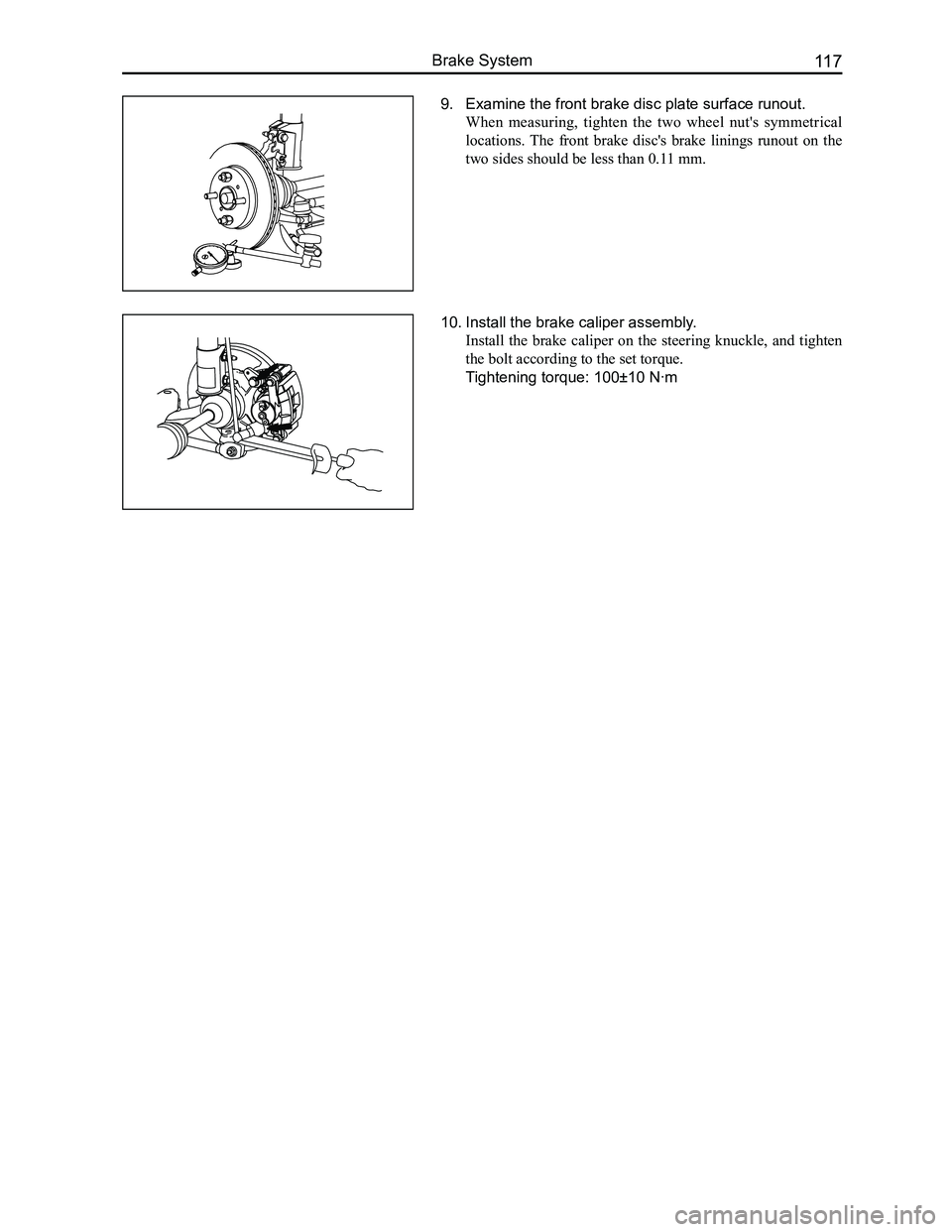
9. Examine the front brake disc plate surface runout.
When measuring, tighten the two wheel nut's symmetrical
locations. The front brake disc's brake linings runout on the
two sides should be less than 0.11 mm.
10. Install the brake caliper assembly.
Install the brake caliper on the steering knuckle, and tighten
the bolt according to the set torque.
Tightening torque: 100±10 N·m
Page 142 of 281
Downloaded from www.Manualslib.com manuals search engine 135Steering System
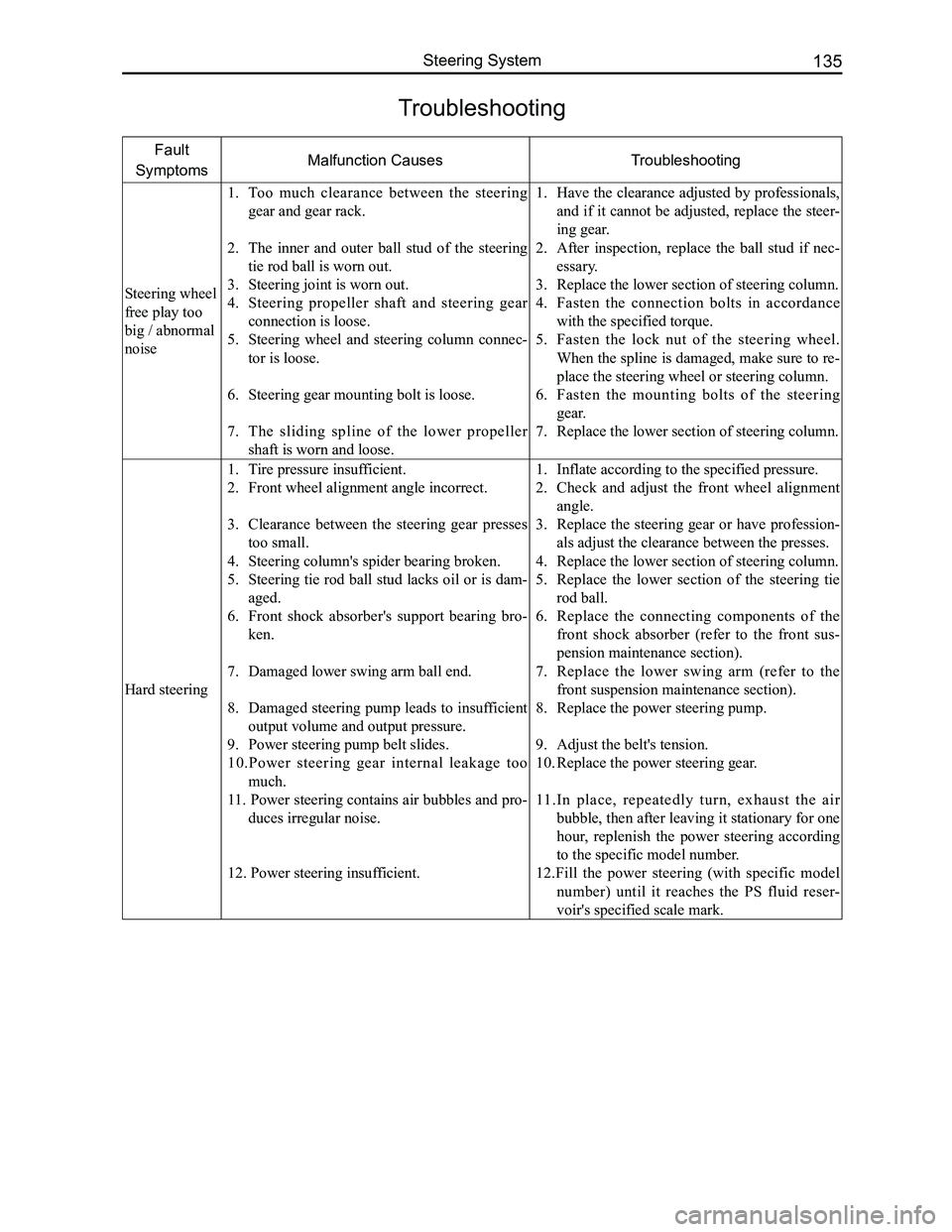
Troubleshooting
Fault
SymptomsMalfunction CausesTroubleshooting
Steering wheel
free play too
big / abnormal
noise
1. Too much clearance between the steering
gear and gear rack.
2. The inner and outer ball stud of the steering
tie rod ball is worn out.
3. Steering joint is worn out.
4. Steering propeller shaft and steering gear
connection is loose.
5. Steering wheel and steering column connec-
tor is loose.
6. Steering gear mounting bolt is loose.
7. The sliding spline of the lower propeller
shaft is worn and loose.
1. Have the clearance adjusted by professionals,
and if it cannot be adjusted, replace the steer-
ing gear.
2. After inspection, replace the ball stud if nec-
essary.
3. Replace the lower section of steering column.
4. Fasten the connection bolts in accordance
with the specified torque.
5. Fasten the lock nut of the steering wheel.
When the spline is damaged, make sure to re-
place the steering wheel or steering column.
6. Fasten the mounting bolts of the steering
gear.
7. Replace the lower section of steering column.
Hard steering
1. Tire pressure insufficient.
2. Front wheel alignment angle incorrect.
3. Clearance between the steering gear presses
too small.
4. Steering column's spider bearing broken.
5. Steering tie rod ball stud lacks oil or is dam-
aged.
6. Front shock absorber's support bearing bro-
ken.
7. Damaged lower swing arm ball end.
8. Damaged steering pump leads to insufficient
output volume and output pressure.
9. Power steering pump belt slides.
10.Power steering gear internal leakage too
much.
11. Power steering contains air bubbles and pro-
duces irregular noise.
12. Power steering insufficient.
1. Inflate according to the specified pressure.
2. Check and adjust the front wheel alignment
angle.
3. Replace the steering gear or have profession-
als adjust the clearance between the presses.
4. Replace the lower section of steering column.
5. Replace the lower section of the steering tie
rod ball.
6. Replace the connecting components of the
front shock absorber (refer to the front sus-
pension maintenance section).
7. Replace the lower swing arm (refer to the
front suspension maintenance section).
8. Replace the power steering pump.
9. Adjust the belt's tension.
10. Replace the power steering gear.
11.In place, repeatedly turn, exhaust the air
bubble, then after leaving it stationary for one
hour, replenish the power steering according
to the specific model number.
12.Fill the power steering (with specific model
number) until it reaches the PS fluid reser-
voir's specified scale mark.
Page 143 of 281
Downloaded from www.Manualslib.com manuals search engine GWFLORID Maintenance Manual136
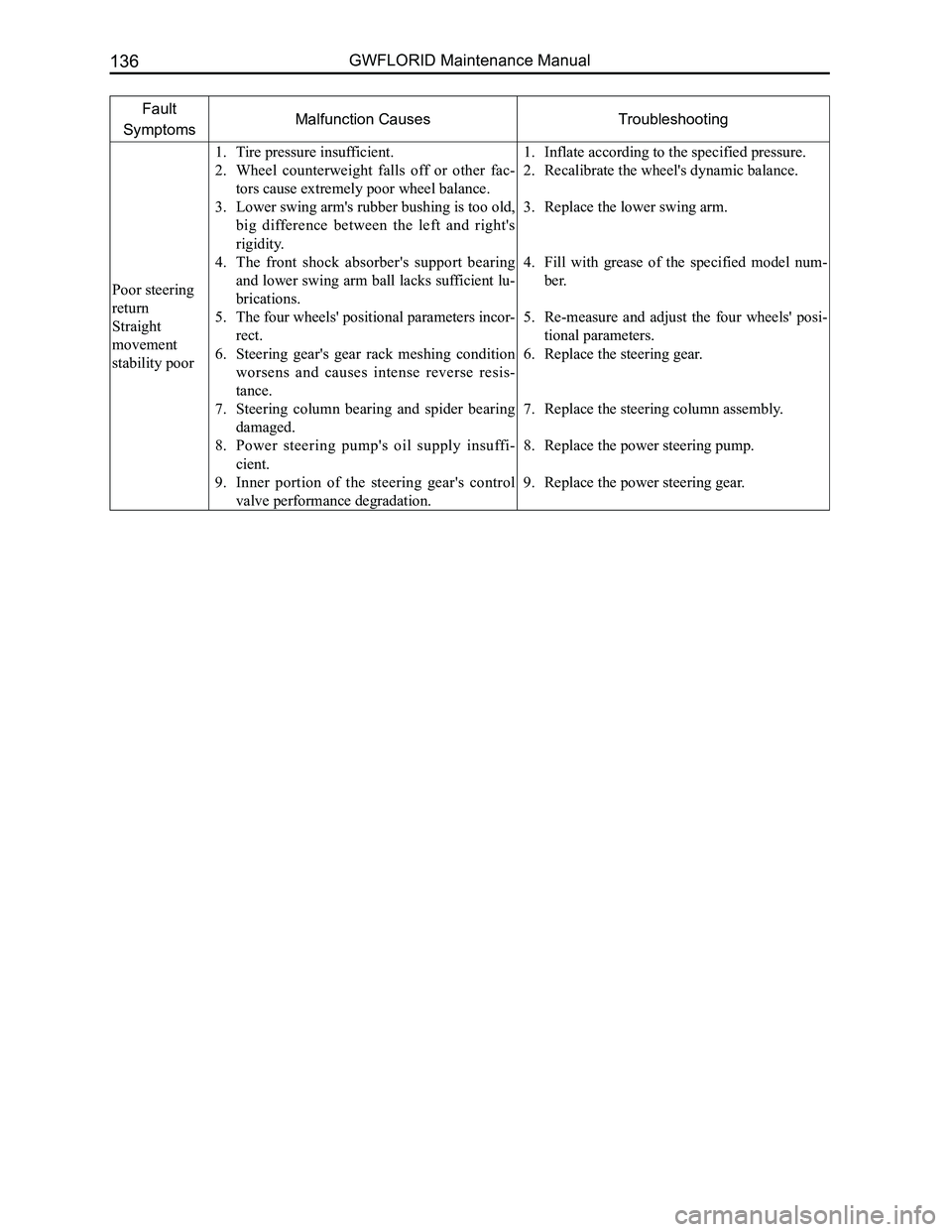
Fault
SymptomsMalfunction CausesTroubleshooting
Poor steering
return
Straight
movement
stability poor
1. Tire pressure insufficient.
2. Wheel counterweight falls off or other fac-
tors cause extremely poor wheel balance.
3. Lower swing arm's rubber bushing is too old,
big difference between the left and right's
rigidity.
4. The front shock absorber's support bearing
and lower swing arm ball lacks sufficient lu-
brications.
5. The four wheels' positional parameters incor-
rect.
6. Steering gear's gear rack meshing condition
worsens and causes intense reverse resis-
tance.
7. Steering column bearing and spider bearing
damaged.
8. Power steering pump's oil supply insuffi-
cient.
9. Inner portion of the steering gear's control
valve performance degradation.
1. Inflate according to the specified pressure.
2. Recalibrate the wheel's dynamic balance.
3. Replace the lower swing arm.
4. Fill with grease of the specified model num-
ber.
5. Re-measure and adjust the four wheels' posi-
tional parameters.
6. Replace the steering gear.
7. Replace the steering column assembly.
8. Replace the power steering pump.
9. Replace the power steering gear.