tire pressure GREAT WALL FLORID 2008 User Guide
[x] Cancel search | Manufacturer: GREAT WALL, Model Year: 2008, Model line: FLORID, Model: GREAT WALL FLORID 2008Pages: 281, PDF Size: 43.97 MB
Page 142 of 281
Downloaded from www.Manualslib.com manuals search engine 135Steering System
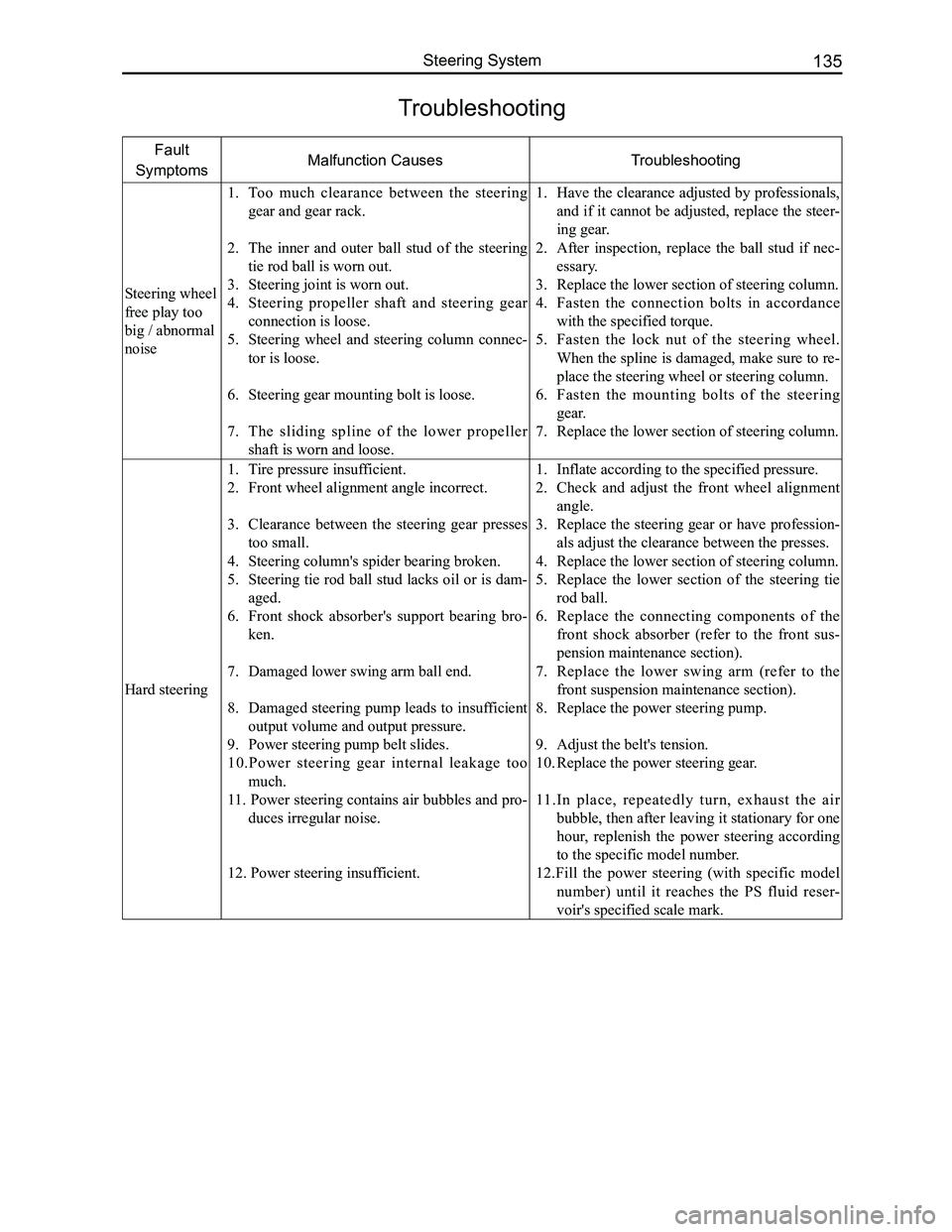
Troubleshooting
Fault
SymptomsMalfunction CausesTroubleshooting
Steering wheel
free play too
big / abnormal
noise
1. Too much clearance between the steering
gear and gear rack.
2. The inner and outer ball stud of the steering
tie rod ball is worn out.
3. Steering joint is worn out.
4. Steering propeller shaft and steering gear
connection is loose.
5. Steering wheel and steering column connec-
tor is loose.
6. Steering gear mounting bolt is loose.
7. The sliding spline of the lower propeller
shaft is worn and loose.
1. Have the clearance adjusted by professionals,
and if it cannot be adjusted, replace the steer-
ing gear.
2. After inspection, replace the ball stud if nec-
essary.
3. Replace the lower section of steering column.
4. Fasten the connection bolts in accordance
with the specified torque.
5. Fasten the lock nut of the steering wheel.
When the spline is damaged, make sure to re-
place the steering wheel or steering column.
6. Fasten the mounting bolts of the steering
gear.
7. Replace the lower section of steering column.
Hard steering
1. Tire pressure insufficient.
2. Front wheel alignment angle incorrect.
3. Clearance between the steering gear presses
too small.
4. Steering column's spider bearing broken.
5. Steering tie rod ball stud lacks oil or is dam-
aged.
6. Front shock absorber's support bearing bro-
ken.
7. Damaged lower swing arm ball end.
8. Damaged steering pump leads to insufficient
output volume and output pressure.
9. Power steering pump belt slides.
10.Power steering gear internal leakage too
much.
11. Power steering contains air bubbles and pro-
duces irregular noise.
12. Power steering insufficient.
1. Inflate according to the specified pressure.
2. Check and adjust the front wheel alignment
angle.
3. Replace the steering gear or have profession-
als adjust the clearance between the presses.
4. Replace the lower section of steering column.
5. Replace the lower section of the steering tie
rod ball.
6. Replace the connecting components of the
front shock absorber (refer to the front sus-
pension maintenance section).
7. Replace the lower swing arm (refer to the
front suspension maintenance section).
8. Replace the power steering pump.
9. Adjust the belt's tension.
10. Replace the power steering gear.
11.In place, repeatedly turn, exhaust the air
bubble, then after leaving it stationary for one
hour, replenish the power steering according
to the specific model number.
12.Fill the power steering (with specific model
number) until it reaches the PS fluid reser-
voir's specified scale mark.
Page 143 of 281
Downloaded from www.Manualslib.com manuals search engine GWFLORID Maintenance Manual136
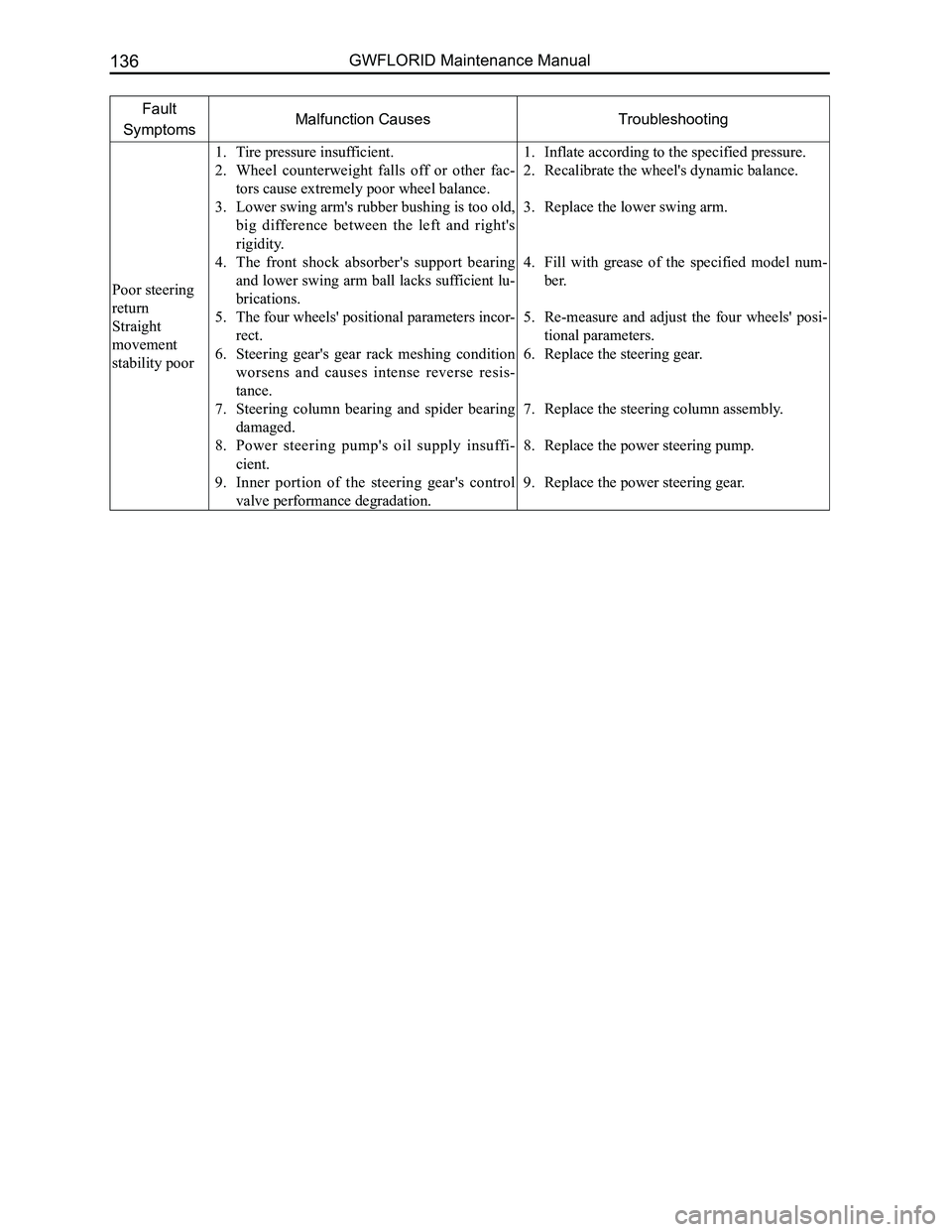
Fault
SymptomsMalfunction CausesTroubleshooting
Poor steering
return
Straight
movement
stability poor
1. Tire pressure insufficient.
2. Wheel counterweight falls off or other fac-
tors cause extremely poor wheel balance.
3. Lower swing arm's rubber bushing is too old,
big difference between the left and right's
rigidity.
4. The front shock absorber's support bearing
and lower swing arm ball lacks sufficient lu-
brications.
5. The four wheels' positional parameters incor-
rect.
6. Steering gear's gear rack meshing condition
worsens and causes intense reverse resis-
tance.
7. Steering column bearing and spider bearing
damaged.
8. Power steering pump's oil supply insuffi-
cient.
9. Inner portion of the steering gear's control
valve performance degradation.
1. Inflate according to the specified pressure.
2. Recalibrate the wheel's dynamic balance.
3. Replace the lower swing arm.
4. Fill with grease of the specified model num-
ber.
5. Re-measure and adjust the four wheels' posi-
tional parameters.
6. Replace the steering gear.
7. Replace the steering column assembly.
8. Replace the power steering pump.
9. Replace the power steering gear.
Page 148 of 281
Downloaded from www.Manualslib.com manuals search engine 141Steering System
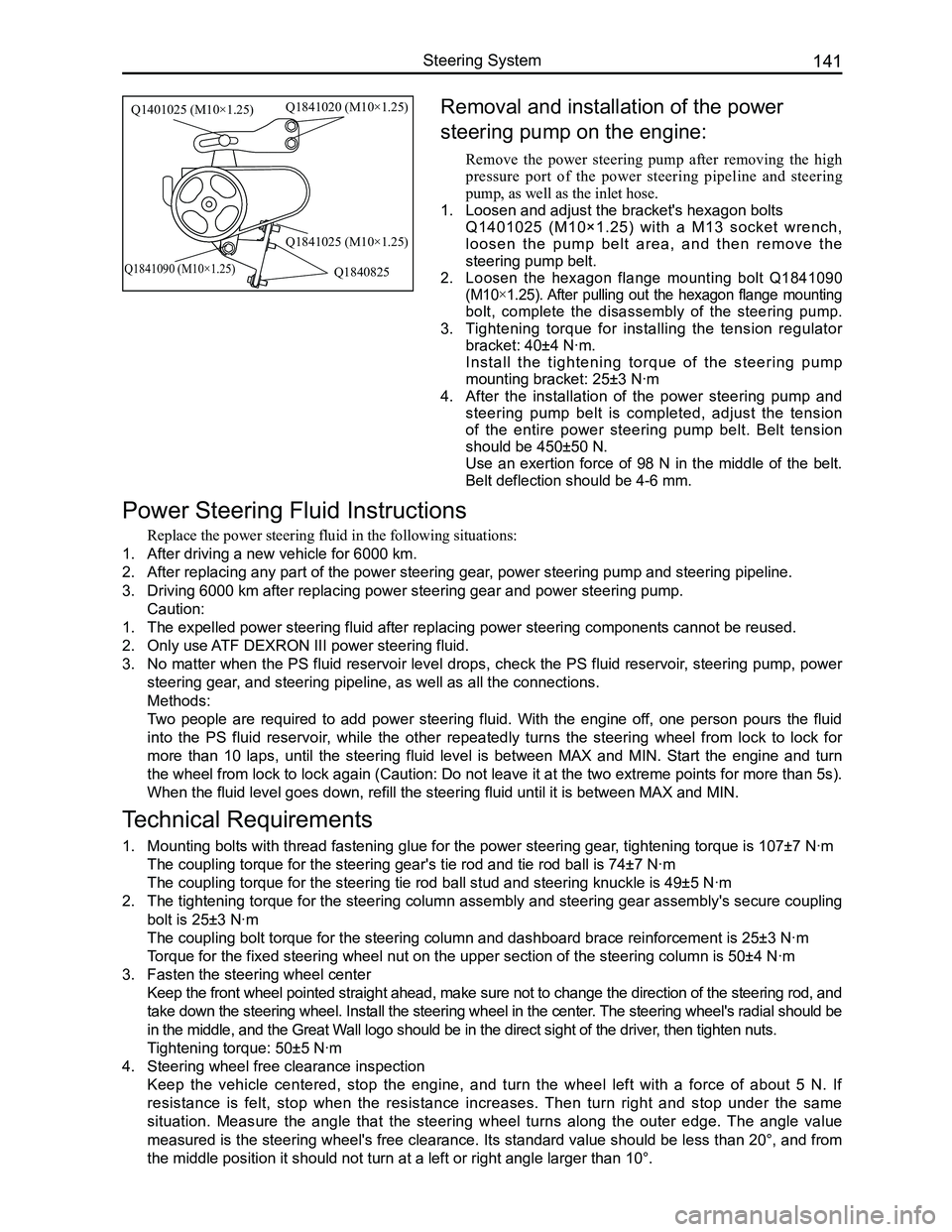
Removal and installation of the power
steering pump on the engine:
Remove the power steering pump after removing the high
pressure port of the power steering pipeline and steering
pump, as well as the inlet hose.
1. Loosen and adjust the bracket's hexagon bolts
Q1401025 (M10×1.25) with a M13 socket wrench,
l o o s e n t h e p u m p b e l t a r e a , a n d t h e n r e m o v e t h e
steering pump belt.
2. Loosen the hexagon flange mounting bolt Q1841090
(M10×1.25). After pulling out the hexagon flange mounting
bolt, complete the disassembly of the steering pump.
3. Tightening torque for installing the tension regulator
bracket: 40±4 N·m.
Install the tightening torque of the steering pump
mounting bracket: 25±3 N·m
4. After the installation of the power steering pump and
steering pump belt is completed, adjust the tension
of the entire power steering pump belt. Belt tension
should be 450±50 N.
Use an exertion force of 98 N in the middle of the belt.
Belt deflection should be 4-6 mm.
Power Steering Fluid Instructions
Replace the power steering fluid in the following situations:
1. After driving a new vehicle for 6000 km.
2. After replacing any part of the power steering gear, power steering pump and steering pipeline.
3. Driving 6000 km after replacing power steering gear and power steering p\
ump.
Caution:
1. The expelled power steering fluid after replacing power steering compone\
nts cannot be reused.
2. Only use ATF DEXRON III power steering fluid.
3. No matter when the PS fluid reservoir level drops, check the PS fluid reservoir, steering pump, power
steering gear, and steering pipeline, as well as all the connections.
Methods:
Two people are required to add power steering fluid. With the engine off, one person pours the fluid
into the PS fluid reservoir, while the other repeatedly turns the steering wheel from lock to lock for
more than 10 laps, until the steering fluid level is between MAX and MIN. Start the engine and turn
the wheel from lock to lock again (Caution: Do not leave it at the two extreme points for more than 5s).
When the fluid level goes down, refill the steering fluid until it is be\
tween MAX and MIN.
Technical Requirements
1. Mounting bolts with thread fastening glue for the power steering gear, tightening torque is 107±7 N·m
The coupling torque for the steering gear's tie rod and tie rod ball is \
74±7 N·m
The coupling torque for the steering tie rod ball stud and steering knuc\
kle is 49±5 N·m
2. The tightening torque for the steering column assembly and steering gear assembly's secure coupling
bolt is 25±3 N·m
The coupling bolt torque for the steering column and dashboard brace rei\
nforcement is 25±3 N·m
Torque for the fixed steering wheel nut on the upper section of the steer\
ing column is 50±4 N·m
3. Fasten the steering wheel center
Keep the front wheel pointed straight ahead, make sure not to change the direction of the steering rod, and
take down the steering wheel. Install the steering wheel in the center. The steering wheel's radial should be
in the middle, and the Great Wall logo should be in the direct sight of the driver, then tighten nuts.
Tightening torque: 50±5 N·m
4. Steering wheel free clearance inspection
Keep the vehicle centered, stop the engine, and turn the wheel left with a force of about 5 N. If
resistance is felt, stop when the resistance increases. Then turn right and stop under the same
situation. Measure the angle that the steering wheel turns along the outer edge. The angle value
measured is the steering wheel's free clearance. Its standard value should be less than 20°, and from
the middle position it should not turn at a left or right angle larger t\
han 10°.
Q1401025 (M10×1.25)Q1841020 (M10×1.25)
Q1841025 (M10×1.25)
Q1840825Q1841090 (M10×1.25)
Page 210 of 281
Downloaded from www.Manualslib.com manuals search engine 203Air Conditioning System
Areas of Importance
1. When putting in a new compressor, adjust the new compressor's inner lubricant to make it the same
level as of the old compressor's.
2. When the air conditioner malfunctions, if the pipeline, condenser or evaporator is the source of the
damage leading to its replacement, just add model number RS20 profession\
al lubricant 5-10 ml.
3. The compressor is a high speed operating component, the smallest impurity in the air conditioning
system can lead to the compressor's damage, therefore the entire air conditioning system must be
cleaned.
4. In order to avoid liquid damage to the compressor, pay careful attention when filling the refrigerant.
When the vehicle stopped, fill the liquid refrigerant from the high pressure side. When in operation, fill
the liquid refrigerant from the low pressure side.
5. When undergoing maintenance, pay attention that the amount of refrigerant being added is 510±10 g.
Observe through the check glass to determine if there is sufficient new refrigerant charge.
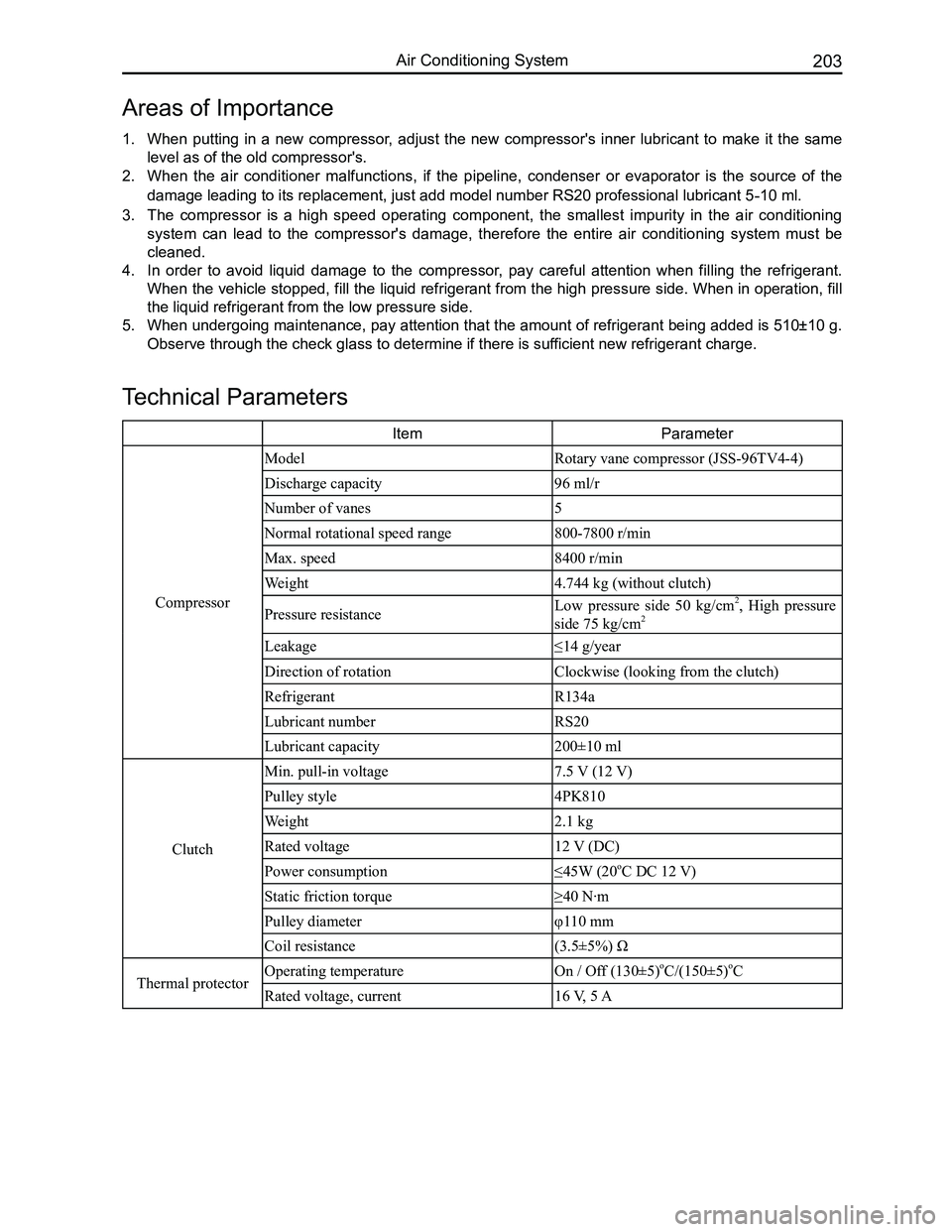
ItemParameter
Compressor
ModelRotary vane compressor (JSS-96TV4-4)
Discharge capacity96 ml/r
Number of vanes5
Normal rotational speed range800-7800 r/min
Max. speed8400 r/min
Weight4.744 kg (without clutch)
Pressure resistanceLow pressure side 50 kg/cm2, High pressure
side 75 kg/cm2
Leakage≤14 g/year
Direction of rotationClockwise (looking from the clutch)
RefrigerantR134a
Lubricant numberRS20
Lubricant capacity 200±10 ml
Clutch
Min. pull-in voltage7.5 V (12 V)
Pulley style 4PK810
Weight2.1 kg
Rated voltage12 V (DC)
Power consumption≤45W (20oC DC 12 V)
Static friction torque≥40 N·m
Pulley diameterφ110 mm
Coil resistance(3.5±5%) Ω
Thermal protectorOperating temperatureOn / Off (130±5)oC/(150±5)oC
Rated voltage, current16 V, 5 A
Technical Parameters
Page 215 of 281
Downloaded from www.Manualslib.com manuals search engine GWFLORID Maintenance Manual208
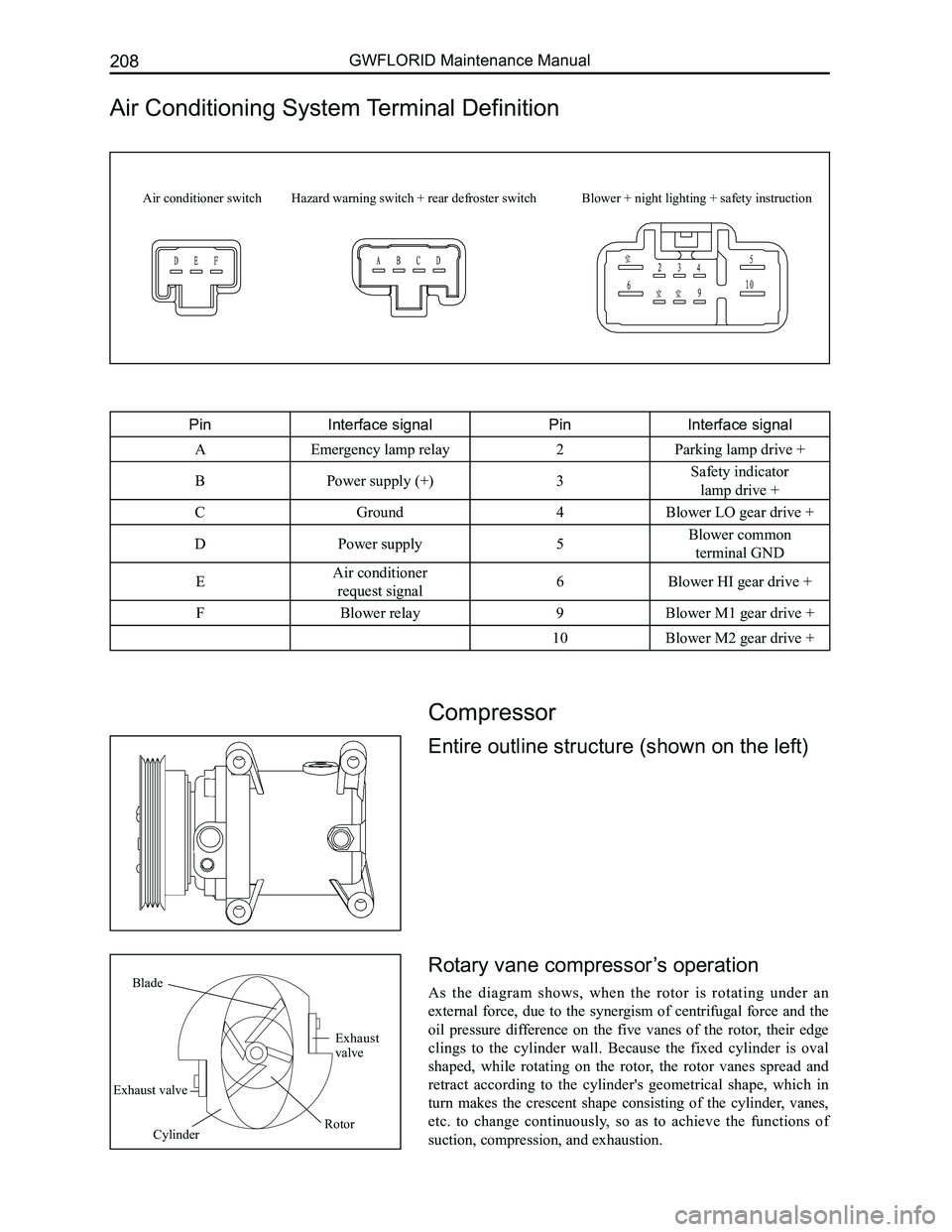
Air Conditioning System Terminal Definition
PinInterface signalPinInterface signal
AEmergency lamp relay2Parking lamp drive +
BPower supply (+)3Safety indicator
lamp drive +
CGround4Blower LO gear drive +
DPower supply5Blower common
terminal GND
EAir conditioner
request signal6Blower HI gear drive +
FBlower relay9Blower M1 gear drive +
10Blower M2 gear drive +
Air conditioner switchHazard warning switch + rear defroster switchBlower + night lighting + safety instruction
Cylinder
Blade
Exhaust valve
Rotor
Exhaust valve
Compressor
Entire outline structure (shown on the left)
Rotary vane compressor’s operation
As the diagram shows, when the rotor is rotating under an
external force, due to the synergism of centrifugal force and the
oil pressure difference on the five vanes of the rotor, their edge
clings to the cylinder wall. Because the fixed cylinder is oval
shaped, while rotating on the rotor, the rotor vanes spread and
retract according to the cylinder's geometrical shape, which in
turn makes the crescent shape consisting of the cylinder, vanes,
etc. to change continuously, so as to achieve the functions of
suction, compression, and exhaustion.