cylinder GREAT WALL FLORID 2008 Owner's Guide
[x] Cancel search | Manufacturer: GREAT WALL, Model Year: 2008, Model line: FLORID, Model: GREAT WALL FLORID 2008Pages: 281, PDF Size: 43.97 MB
Page 162 of 281
Downloaded from www.Manualslib.com manuals search engine 155Vehicle Body Electronic System
Condenser fan motor
Connected compressor
Oil pressure switch
Front oxygen sensor
Connected reverse switch
Connected engine speed sensor Connected
ignition coil
Connected speed sensor Connected coolant temp. sensor
Canister control valve
Connected combination meter A
Connected antenna
Diagnostic port
Connected AC switch Connected air conditioner temperature sensor
Front passenger side airbag
Connected speed adjustive resistance, blower
Front window regulator RH
Front window regulator switch RH
Front medium woofer RH
Front tweeter LH Right outer electric mirror
Front passenger side central door lock switch
Front door lamp switch RH
Front passenger seat belt pretensioner Front door lock motor RH
Ground
plate 3
Connected cigarette lighter (lighting)
Connected cigarette lighter
Front passenger seat belt switch
Connected parking brake switch Connected air conditioner governor & front
passenger seat belt unfastened indicator lamp
Connected CD player
Connected engine ECUConnected ground P1#
Connected ground P2#
Connected starter
Connected knock sensor
Connected starter field coil
Connected inlet
temperature pressure
sensor
connected
electronic throttle
Rear oxygen sensor
Connected 4th
cylinder injection
nozzle
Connected 3rd
cylinder injection
nozzle
Connected 2nd
cylinder injection
nozzle
Connected 1st
cylinder
injection nozzle
Connected generator
Connected engine armature Connected front combination lamp RH
Connected front fog lamp RH
Connected rear washer motor
Connected front washer motor
Connected front wheel speed sensor RH
Right ground
Connected A/C pressure switch
Connected phase sensor
Connected low
pitched horn
Connected front
combination lamp LH
Rediator fan motor
Connected front
fog lamp LH
Connected high pitched horn
Battery
negative
Body
ground
Battery
Left ground Connected
brake lamp
switch Connected brake fluid warning switch
Connected theft deterrent indicator Theft deterrent ECU 1Connected lock
cylinder lightConnected ignition
switch (white)
The key is inserted into the switch
Right combination switch (wiper) Connected airbag ECU (yellow)Ground
plate 2
Ground
plate 4
Connected accelerator pedal
Ground plate 1
Left outer electric mirror
Front medium woofer LH Front door lock motor LH
Rear medium woofer LH
Rear window regulator switch LH
Rear door lock motor LH Rear door lamp switch LH
Ground point ACapacitor
Vehicle power supply
Rear fog lamp LH Left license plate lamp
High mounted brake lamp
Ground point Trunk opener switch
Trunk motorRear wiper motor
Rear windshield defroster “-”
Trunk lamp switch Right license plate lamp
Rear fog lamp RH
Rear combination lamp RHRear wheel speed sensor RH
Rear window
regulator RH
Rear window
regulator switch RH
Rear door lock motor RH
Rear door lamp switch RH Rear medium woofer RH
Ground point B
Rear combination lamp LH
Rear windshield defroster “+”
Rear wheel speed
sensor LH
Rear window regulator LH
Fuel pump, fuel sensor
Rear interior dome lamp
Front door lamp
switch LH
Driver seat belt pretensioner Driver seat belt switch
Front tweeter LH
Connected light brightness regulator switch
Connected rearview mirror switch (white)
Connected glove box lamp
Front window regulator LH Left combination switch (light)
Connected main airbag, horn switch
Window regulator mainly
control switch, central door
lock mainly control switch Connected central door lock controller (white)
Connected front wiper motor
Connected clutch
switch
Connected ABS ECUBattery
positive
Connected front wheel
speed sensor LH Engine groud
Starter connect to
battery positive
Generator connect to
battery positive
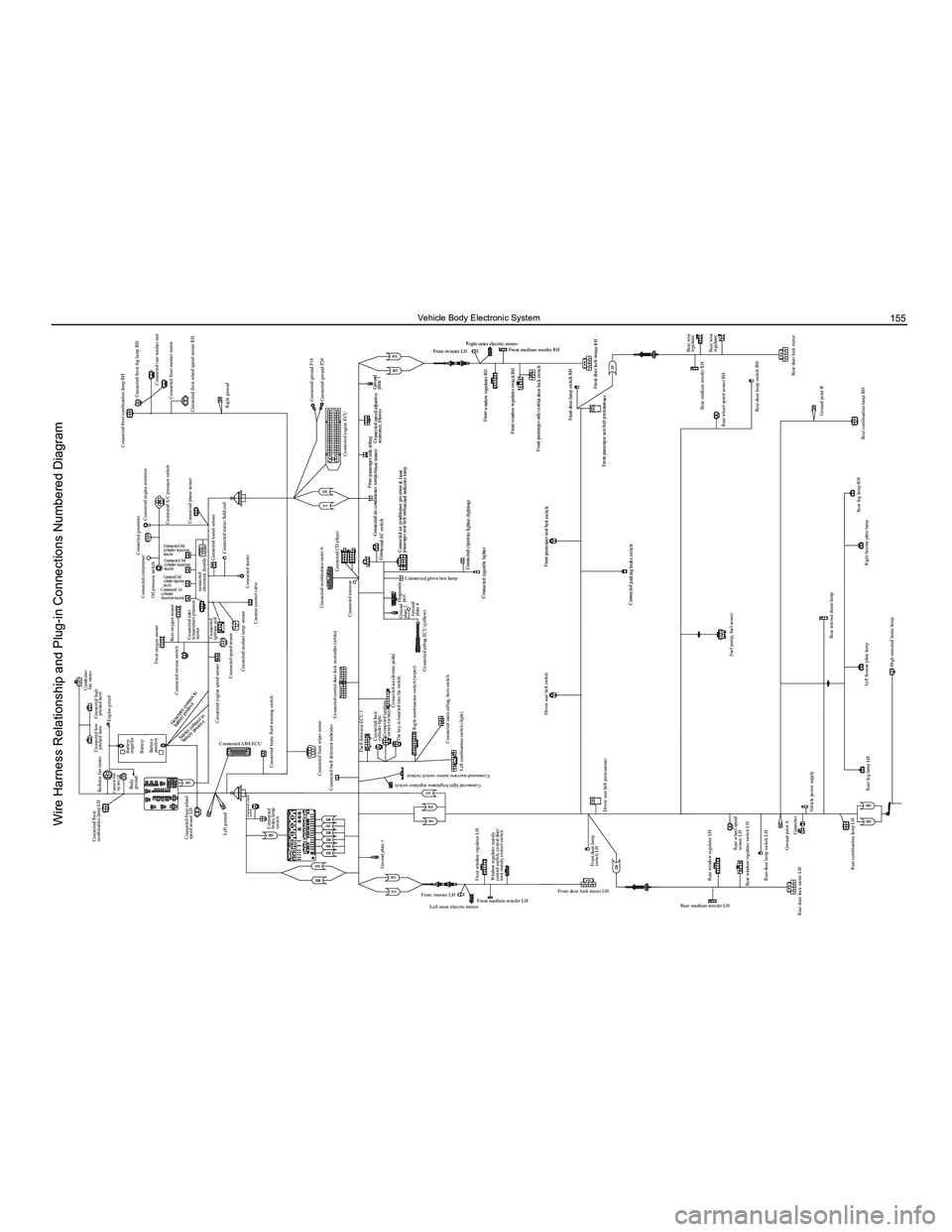
Wire Harness Relationship and Plug-in Connections Numbered Diagram
Page 180 of 281
Downloaded from www.Manualslib.com manuals search engine 173Vehicle Body Electronic System
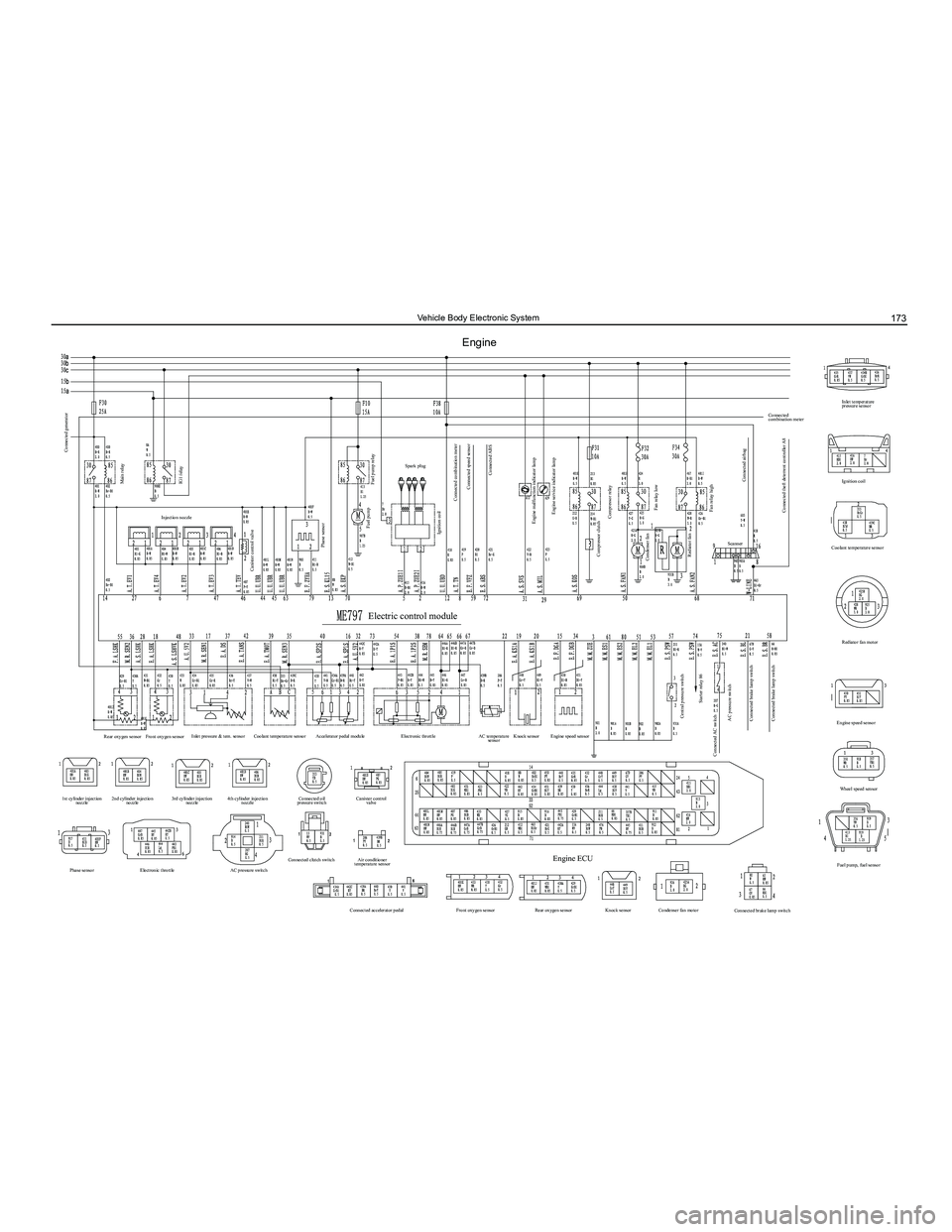
Engine
Connected generator
Canister control valve
Rear oxygen sensor
1st cylinder injection nozzle
Phase sensor Electronic throttle AC pressure switchConnected clutch switch
Air conditioner
temperature sensor
Connected accelerator pedal Front oxygen sensorRear oxygen sensorKnock sensorCondenser fan motor
Connected brake lamp switch
Engine ECU
2nd cylinder injection
nozzle 3rd cylinder injection
nozzle 4th cylinder injection
nozzle Connected oil
pressure switch Canister control
valve
Front oxygen sensor
Inlet pressure & tem. sensor
Coolant temperature sensor Accelerator pedal module Electronic throttle AC temperature
sensor Knock sensor
Engine speed sensor
Phase sensor
Fuel pump relay
Connected combination meter Connected speed sensor
Engine malfunction indicator lamp Engine service indicator lamp
Compressor relay
Compressor clutch
Central pressure switch Starter relay 86
Connected AC switch AC pressure switch
Connected brake lamp switch
Connected brake lamp switch Condenser fan
Rediator fan Fan relay lowScanner
Fan relay high
Connected airbag
Connected theft deterrent controller A8
Connected
combination meter
Ignition coil
Coolant temperature sensor
Rediator fan motor
Engine speed sensor Wheel speed sensor
Fuel pump, fuel sensor Inlet temperature
pressure sensor
Connected ABS
Spark plug
Fuel pump
Electric control module
Ignition coil
Main relay
Injection nozzle
IG1 relay
Page 182 of 281
Downloaded from www.Manualslib.com manuals search engine 175Vehicle Body Electronic System
Electric horn
Horn switch
High pitched Electric horn
Low pitched Electric horn
Front fog lamp LH
Front fog lamp RH
Left outer electric rearview mirror (left turn signal lamp) Right outer electric rearview mirror
(right turn signal lamp) Left combination switch (light)
Horn switch High pitched horn Low pitched horn Connected left
license plate lamp Connected light brightness
regulator switch Connected headlight vertical
adjustment switch
Front fog lamp LH
Front combination lamp RH Front combination lamp LH Rear combination lamp LH Rear combination lamp RH Rear defroster & alarm switch Connected rear fog lamp RH Connected rear fog lamp LH Connected left headlight
vertical adjustment motor Connected right headlight
vertical adjustment motor Connected right license
plate lamp
Front fog lamp RH
Rear fog lamp LH
Rear fog lamp RH
Rear fog indicator lamp
Left headlight adjustment motor
Right headlight adjustment motor High beam relay
Lamp
ON Low
beam
Low
beam High
beam
High
beam Over-
taking
Over-
taking
Lamp
Off
Low beam relay
Parking lamp relay
Flasher relay
Connected combination
meter A18
Connected central
control ECU #8
Connected central
control ECU #1
Connected central
control ECU #2
Connected central
control ECU #14
Front parking
lamp LH Front turn signal
lamp LH
Rear turn signal
lamp LH
Left turn
signal lamp
Left turn
signal lamp
Front turn
signal lamp RH
Rear turn signal
lamp RH
Right turn
signal lamp
Right turn
signal lamp
Front parking
lamp RH
Rear parking
lamp LH
Rear parking
lamp RH
Left license
plate lamp
Right license
plate lamp
Light main switch indicator
Turn signal lamp switch
Alarm switch Light brightness regulator switch
Ignition key cylinder light Glove box lamp
Reading lamp (Elite) Reading lamp
Rear interior dome lamp
Connected central control ECU #9
High beam indicator Left headlight
Right headlight Headlight vertical switch
red and
white
red and
white
Fog lamp switch
Pin
position Pin
position
Left turn
Right turn Off
Front fog
lamp
Rear fog
lamp Off
Horn relay
Front fog lamp relay
Rear fog lamp relay
Lighting system Steering & alarm lamp control system
Interior lighting system
Terminal
Location
Off On
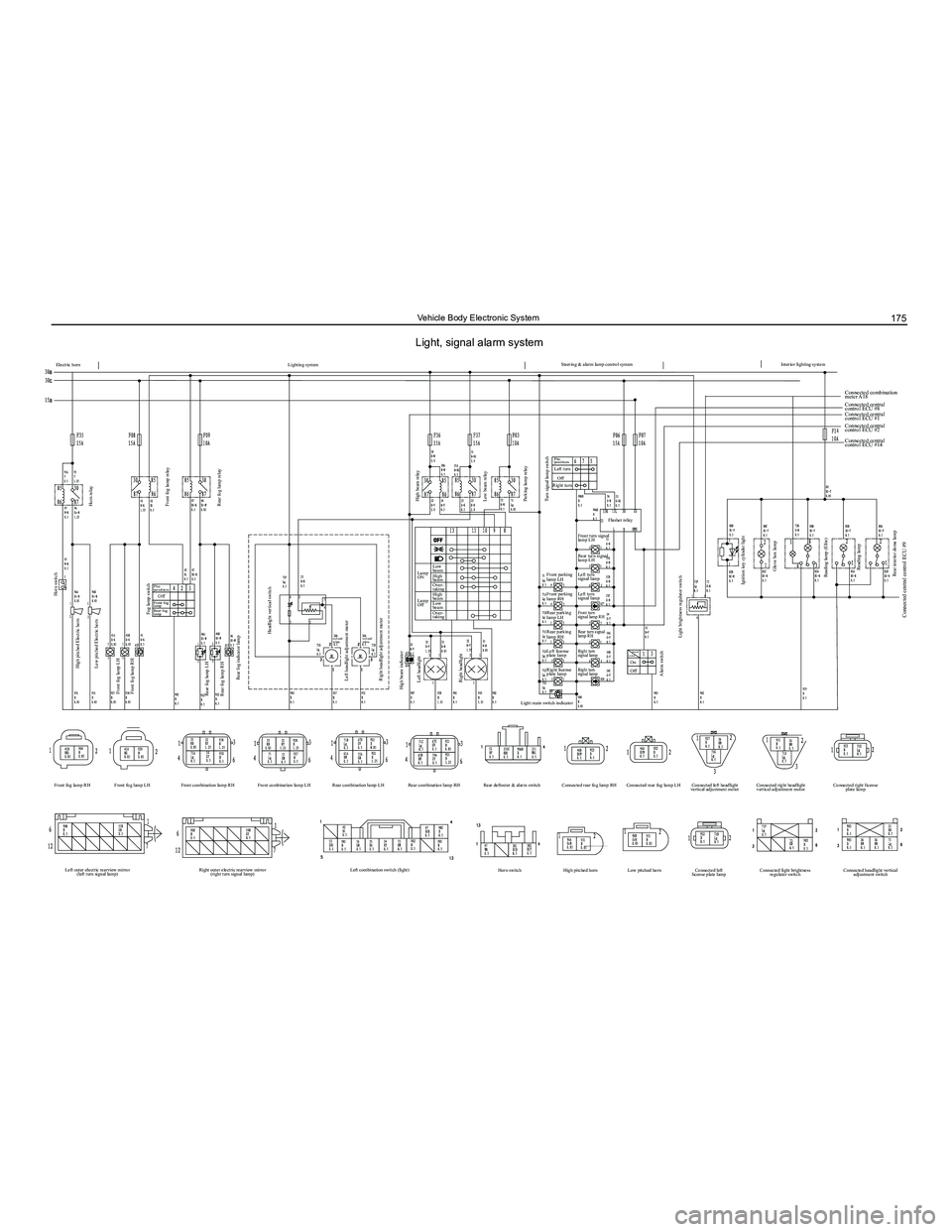
Light, signal alarm system
Page 193 of 281
Downloaded from www.Manualslib.com manuals search engine GWFLORID Maintenance Manual186
Immobilizer System
Immobilizer system composition
This vehicle's engine immobilizer system consists of a theft deterrent ECU assembly, a theft deterrent coil as-
sembly, and two theft deterrent converter assemblies. The theft deterrent coil assembly is put on the head of
ignition lock cylinder, with the other end connected to the theft deterrent ECU assembly. The two theft deterrent
converter assemblies are separately installed inside the plastic handles\
of the two keys.
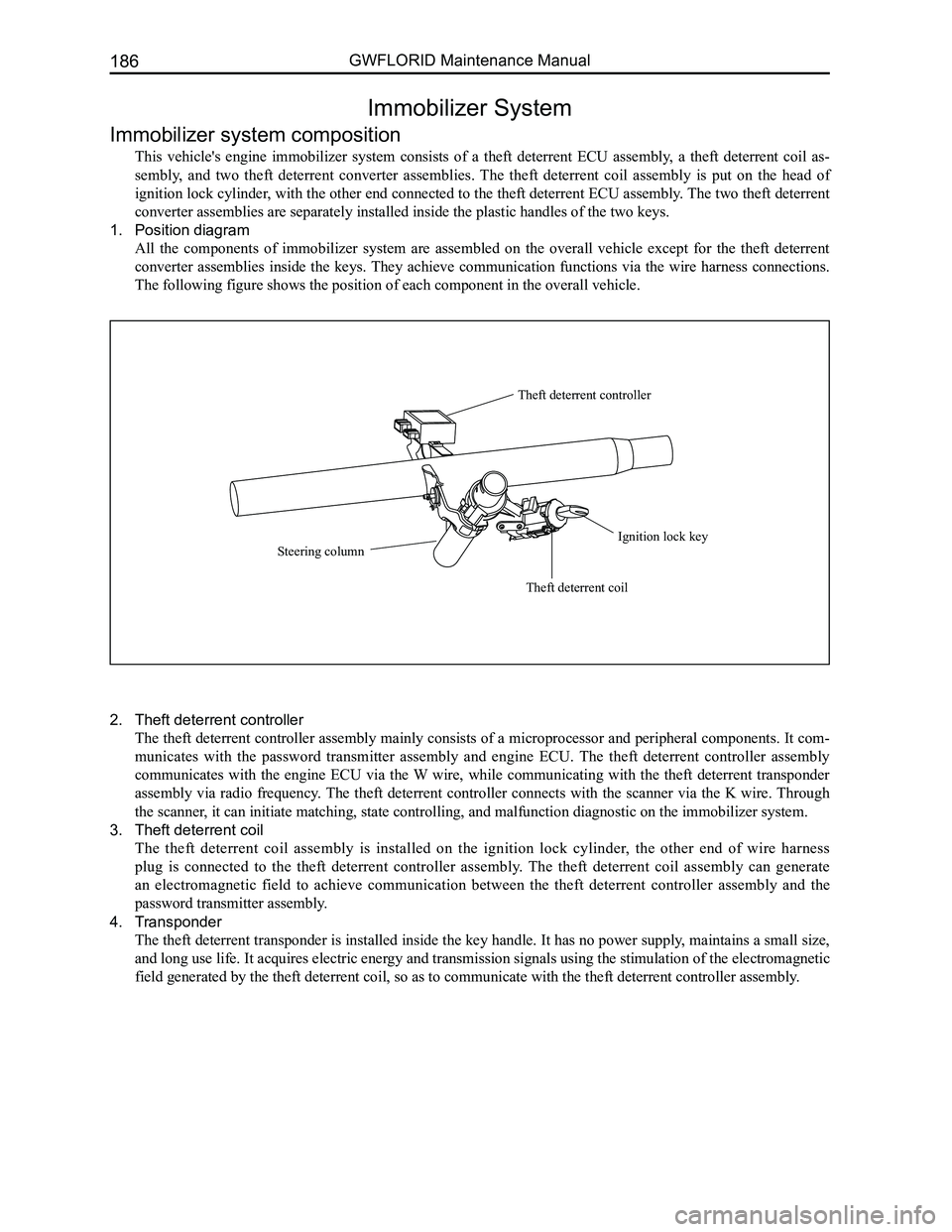
1. Position diagram
All the components of immobilizer system are assembled on the overall vehicle except for the theft deterrent
converter assemblies inside the keys. They achieve communication functions via the wire harness connections.
The following figure shows the position of each component in the overall\
vehicle.
Theft deterrent controller
Ignition lock key
Theft deterrent coil
Steering column
2. Theft deterrent controller
The theft deterrent controller assembly mainly consists of a microprocessor and peripheral components. It com-
municates with the password transmitter assembly and engine ECU. The theft deterrent controller assembly
communicates with the engine ECU via the W wire, while communicating with the theft deterrent transponder
assembly via radio frequency. The theft deterrent controller connects with the scanner via the K wire. Through
the scanner, it can initiate matching, state controlling, and malfunction diagnosti\
c on the immobilizer system.
3. Theft deterrent coil
The theft deterrent coil assembly is installed on the ignition lock cylinder, the other end of wire harness
plug is connected to the theft deterrent controller assembly. The theft deterrent coil assembly can generate
an electromagnetic field to achieve communication between the theft deterrent controller assembly and the
password transmitter assembly.
4. Transponder
The theft deterrent transponder is installed inside the key handle. It has no power supply, maintains a small size,
and long use life. It acquires electric energy and transmission signals using the stimulation of the electromagnetic
field generated by the theft deterrent coil, so as to communicate with t\
he theft deterrent controller assembly.
Page 195 of 281
Downloaded from www.Manualslib.com manuals search engine GWFLORID Maintenance Manual188
not necessarily mean that engine start failure is due to a immobilizer system malfunction. The reasons for start-
ing engine failures are numerous, including factors like fuel, gas, fire, electricity, wires, etc. If the engine cannot
start, first check if the immobilizer system is working normally. This can be judged by looking at the flashing
theft deterrent indicator lamp which is located on the dashboard in front of the driver seat: Insert the key into the
lock cylinder and turn it to the "ON" position. If a legal key is used to start the engine, once the warning lamp is
connected to the ON end and the transponder is confirmed, the LED will remain unlit. Then when the ON end is
disconnected and the key is pulled out, the LED will shine for 0.25 s and darken for 4 s, as to act as a warning.
If an illegal key is used to start up the engine or there is something wrong with the system, the alarm indicator
lamp will shine for 0.25 s and darken for 4 s. If all is normal, then check the other parts of the engine. If abnor-
mal, first perform immobilizer system troubleshooting. A scanner can be used to judge if the immobilizer system
is working normally, but the precondition is that the scanner must be able to establish communication with the
theft deterrent controller.
1. If communication cannot be established, consider the following:
(a) Check whether the battery voltage is higher than 9 V
(b) Check whether the scanner plug is well contacted to the vehicle socket
(c) Use a multimeter to check whether the 7 pin of the OBD-II plug (diagnostic plug) is connected to the theft
deterrent controller's A7 pin
(d) Check whether the power supply of the theft deterrent controller is normal. (Use a multimeter to measure
whether the voltage of the theft deterrent controller's socket A1 pin and A2 pin is higher than 9 V)
(e) Then adopt the substitution method, which is to replace the theft deterrent controller to check if there is
anything wrong with the theft deterrent controller.
• If the failure is related to the theft deterrent controller, change it and initiate re-matching.
• If the failure has nothing to do with the theft deterrent controller, remove the electronic controller which
is connected to the alarm's K wire, such as the ABS controller, engine electrojet controller, airbag ECU
assembly, etc., as to ascertain if the present fault is caused by the wire harness connected with the theft
deterrent controller's K wire.
2. If communication can be established
Connect the scanner to the vehicle diagnostic port. Insert the key into the steering lock, and turn it to the "ON"
position, then select the scanner to check the immobilizer system's trou\
ble code.
3. Security system troubleshooting
Investigate the problem and perform troubleshooting according to the tro\
uble code on the scanner:
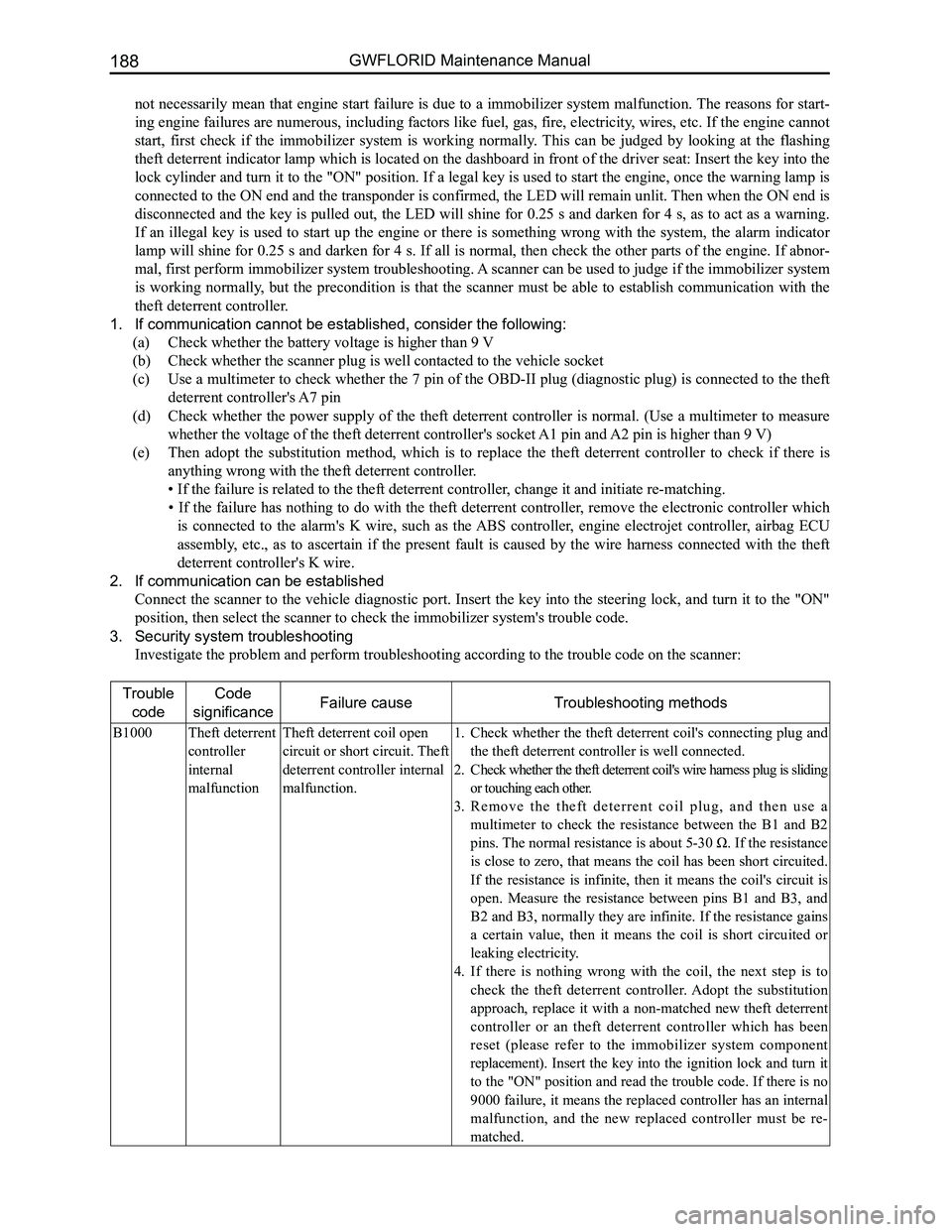
Trouble
code
Code
significanceFailure causeTroubleshooting methods
B1000Theft deterrent
controller
internal
malfunction
Theft deterrent coil open
circuit or short circuit. Theft
deterrent controller internal
malfunction.
Check whether the theft deterrent coil's connecting plug and 1.
the theft deterrent controller is well connected.
Check whether the theft deterrent coil's wire harness plug is sliding 2.
or touching each other.
R e m o v e t h e t h e f t d e t e r r e n t c o i l p l u g , a n d t h e n u s e a 3.
multimeter to check the resistance between the B1 and B2
pins. The normal resistance is about 5-30 Ω. If the resistance
is close to zero, that means the coil has been short circuited.
If the resistance is infinite, then it means the coil's circuit is
open. Measure the resistance between pins B1 and B3, and
B2 and B3, normally they are infinite. If the resistance gains
a certain value, then it means the coil is short circuited or
leaking electricity.
If there is nothing wrong with the coil, the next step is to 4.
check the theft deterrent controller. Adopt the substitution
approach, replace it with a non-matched new theft deterrent
controller or an theft deterrent controller which has been
reset (please refer to the immobilizer system component
replacement). Insert the key into the ignition lock and turn it
to the "ON" position and read the trouble code. If there is no
9000 failure, it means the replaced controller has an internal
malfunction, and the new replaced controller must be re-
matched.
Page 215 of 281
Downloaded from www.Manualslib.com manuals search engine GWFLORID Maintenance Manual208
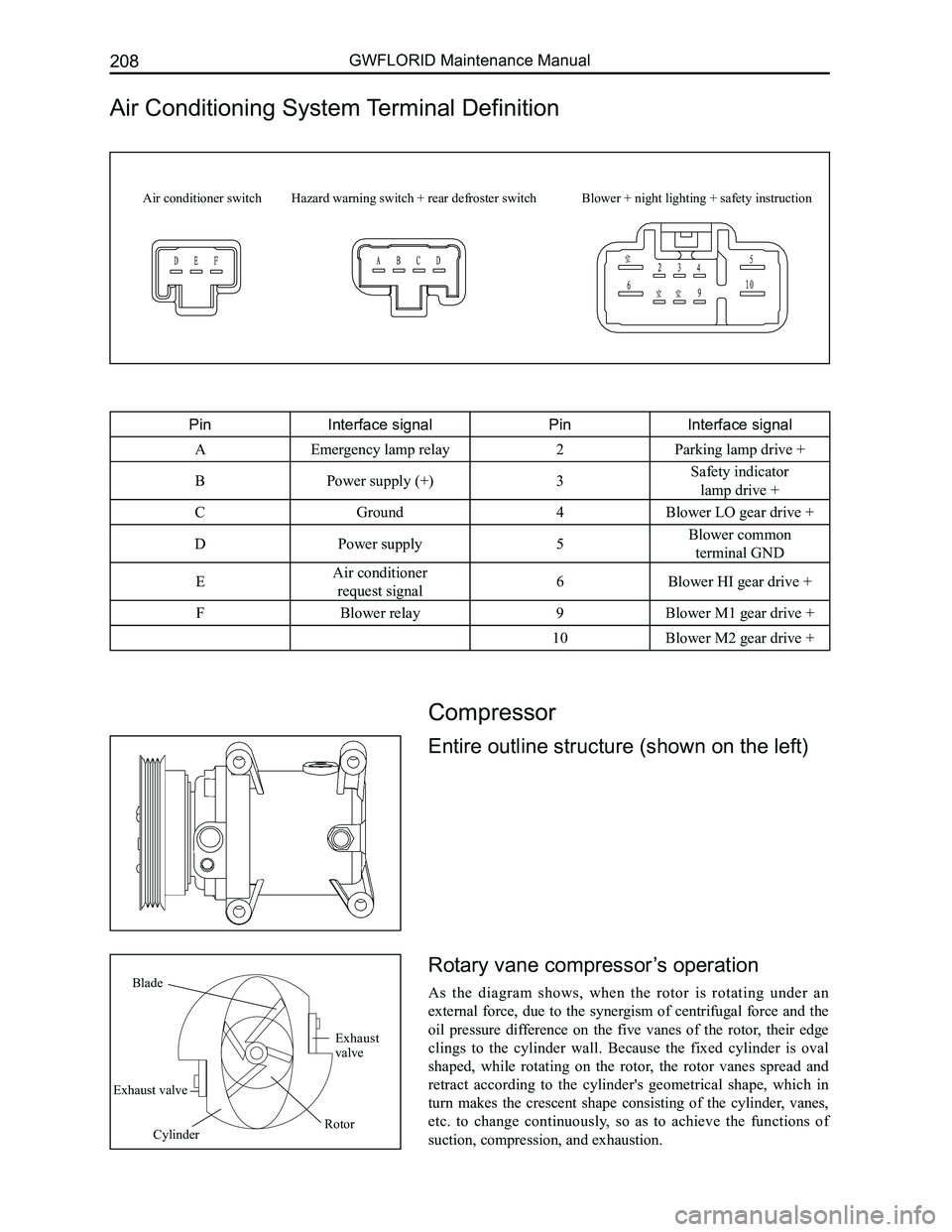
Air Conditioning System Terminal Definition
PinInterface signalPinInterface signal
AEmergency lamp relay2Parking lamp drive +
BPower supply (+)3Safety indicator
lamp drive +
CGround4Blower LO gear drive +
DPower supply5Blower common
terminal GND
EAir conditioner
request signal6Blower HI gear drive +
FBlower relay9Blower M1 gear drive +
10Blower M2 gear drive +
Air conditioner switchHazard warning switch + rear defroster switchBlower + night lighting + safety instruction
Cylinder
Blade
Exhaust valve
Rotor
Exhaust valve
Compressor
Entire outline structure (shown on the left)
Rotary vane compressor’s operation
As the diagram shows, when the rotor is rotating under an
external force, due to the synergism of centrifugal force and the
oil pressure difference on the five vanes of the rotor, their edge
clings to the cylinder wall. Because the fixed cylinder is oval
shaped, while rotating on the rotor, the rotor vanes spread and
retract according to the cylinder's geometrical shape, which in
turn makes the crescent shape consisting of the cylinder, vanes,
etc. to change continuously, so as to achieve the functions of
suction, compression, and exhaustion.
Page 218 of 281
Downloaded from www.Manualslib.com manuals search engine 211Air Conditioning System
Clutch Installation
1. Install the solenoid coil at the place pressing up against the head cover's end surface and pay atten-
tion to insert the dowel pin of the solenoid coil into the bottom hole of the head cover. Put the retaining
ring into the groove with circlip pliers, and press the solenoid coil's connecting wire onto the pressing
line plate on the head cover with a SST.
2. Put the compressor on a specially designed fixture or platform, with its head cover facing upwards.
Press the pulley into the head cover shaft, and put the pulley bearing's retaining ring into the groove
with circlip pliers.
3. Install the armature onto the main shaft's spline and seize the clutch's triangular piece with a clamp.
Then tighten the inner hexagon lock screws and washers with a torque wrench. Screw torque should
be between 150-180 N·m. After installation is done, make sure to check if the clutch's pulley and
armature are able to operate freely, and also check the clearance between the pulley and armature,
which should be 0.3-0.6 mm.
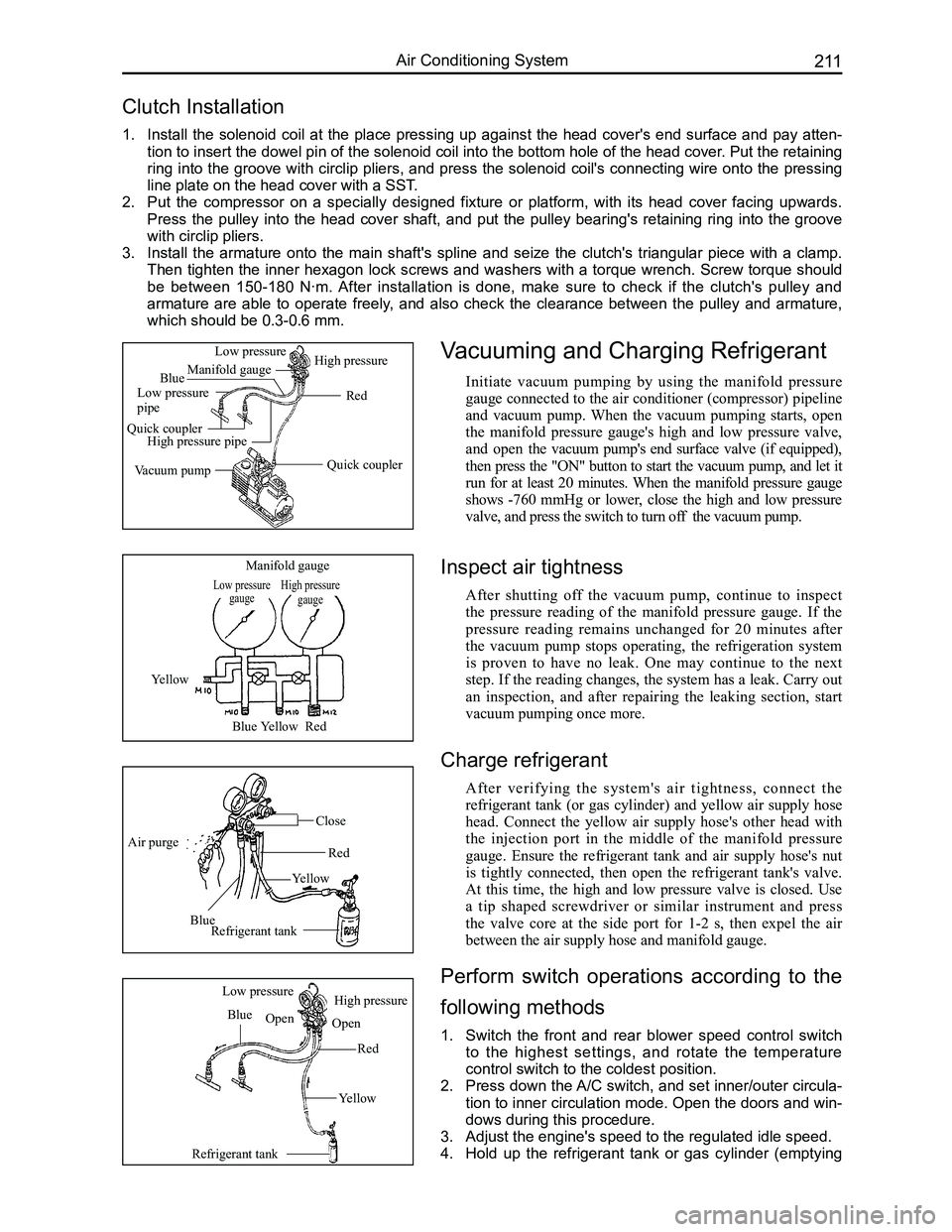
Vacuuming and Charging Refrigerant
Initiate vacuum pumping by using the manifold pressure
gauge connected to the air conditioner (compressor) pipeline
and vacuum pump. When the vacuum pumping starts, open
the manifold pressure gauge's high and low pressure valve,
and open the vacuum pump's end surface valve (if equipped),
then press the "ON" button to start the vacuum pump, and let it
run for at least 20 minutes. When the manifold pressure gauge
shows -760 mmHg or lower, close the high and low pressure
valve, and press the switch to turn off the vacuum pump.
Low pressure gaugeHigh pressure gauge
Manifold gauge
Yellow
BlueYellowRed
Air purge
Blue
Yellow
Red
Close
Refrigerant tank
Refrigerant tank
Blue
Red
Yellow
Low pressureHigh pressure
OpenOpen
Quick coupler
Red
Manifold gauge
Low pressure pipe
Quick couplerHigh pressure pipe
Vacuum pump
Low pressureHigh pressure
Blue
Inspect air tightness
After shutting off the vacuum pump, continue to inspect
the pressure reading of the manifold pressure gauge. If the
pressure reading remains unchanged for 20 minutes after
the vacuum pump stops operating, the refrigeration system
is proven to have no leak. One may continue to the next
step. If the reading changes, the system has a leak. Carry out
an inspection, and after repairing the leaking section, start
vacuum pumping once more.
Charge refrigerant
After verifying the system's air tightness, connect the
refrigerant tank (or gas cylinder) and yellow air supply hose
head. Connect the yellow air supply hose's other head with
the injection port in the middle of the manifold pressure
gauge. Ensure the refrigerant tank and air supply hose's nut
is tightly connected, then open the refrigerant tank's valve.
At this time, the high and low pressure valve is closed. Use
a tip shaped screwdriver or similar instrument and press
the valve core at the side port for 1-2 s, then expel the air
between the air supply hose and manifold gauge.
Perform switch operations according to the
following methods
1. Switch the front and rear blower speed control switch
to the highest settings, and rotate the temperature
control switch to the coldest position.
2. Press down the A/C switch, and set inner/outer circula-
tion to inner circulation mode. Open the doors and win-
dows during this procedure.
3. Adjust the engine's speed to the regulated idle speed.
4. Hold up the refrigerant tank or gas cylinder (emptying
Page 241 of 281
Downloaded from www.Manualslib.com manuals search engine GWFLORID Maintenance Manual234
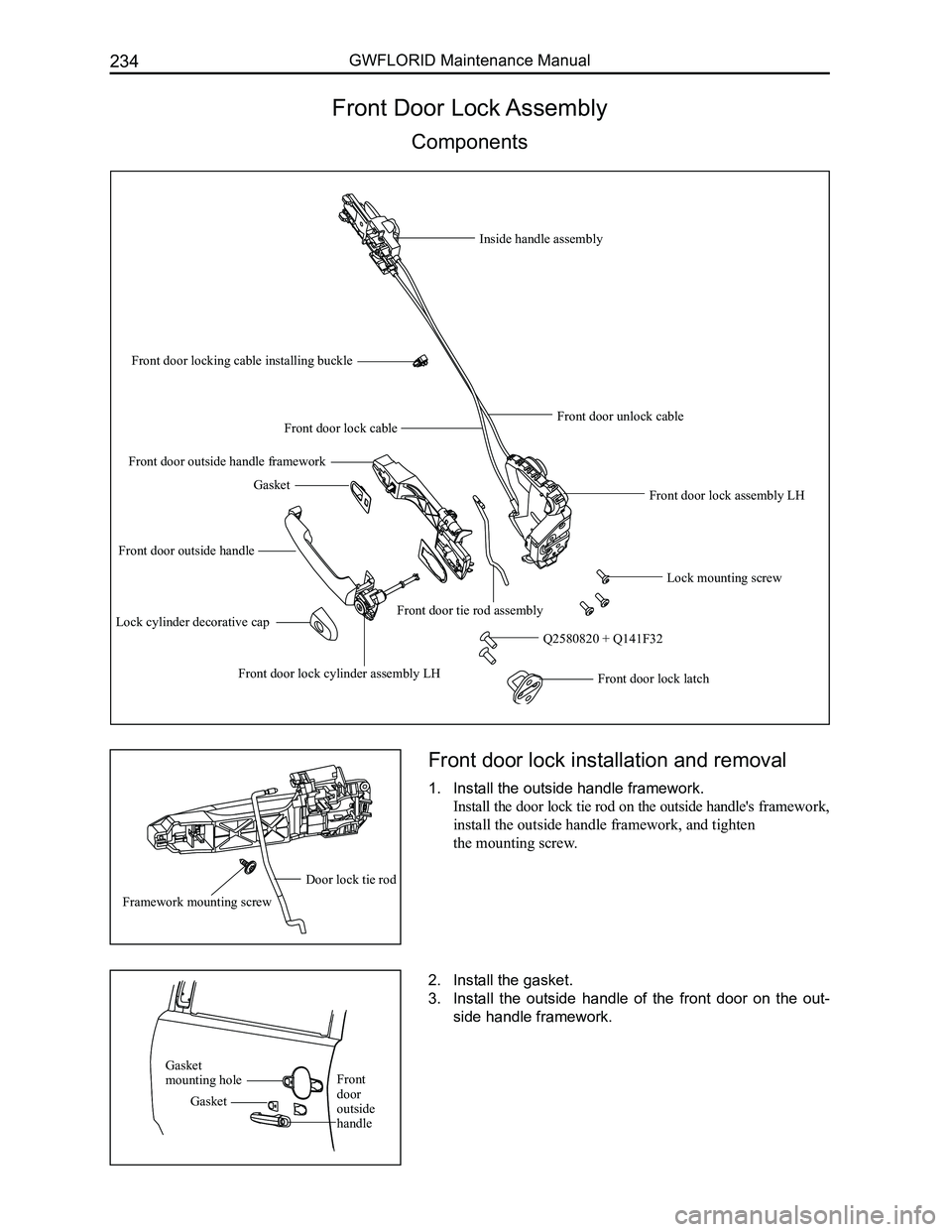
Front Door Lock Assembly
Components
Front door lock installation and removal
1. Install the outside handle framework.
Install the door lock tie rod on the outside handle's framework,
install the outside handle framework, and tighten
the mounting screw.
2. Install the gasket.
3. Install the outside handle of the front door on the out-
side handle framework.
Inside handle assembly
Front door lock assembly LH
Lock mounting screw
Gasket
Front door locking cable installing buckle
Front door unlock cableFront door lock cable
Front door lock latchFront door lock cylinder assembly LH
Lock cylinder decorative cap
Front door outside handle
Gasket
Front door outside handle framework
Front door tie rod assembly
Q2580820 + Q141F32
Framework mounting screw
Door lock tie rod
Front door outside handle
Gasket mounting hole
Page 242 of 281
Downloaded from www.Manualslib.com manuals search engine 235Vehicle Body
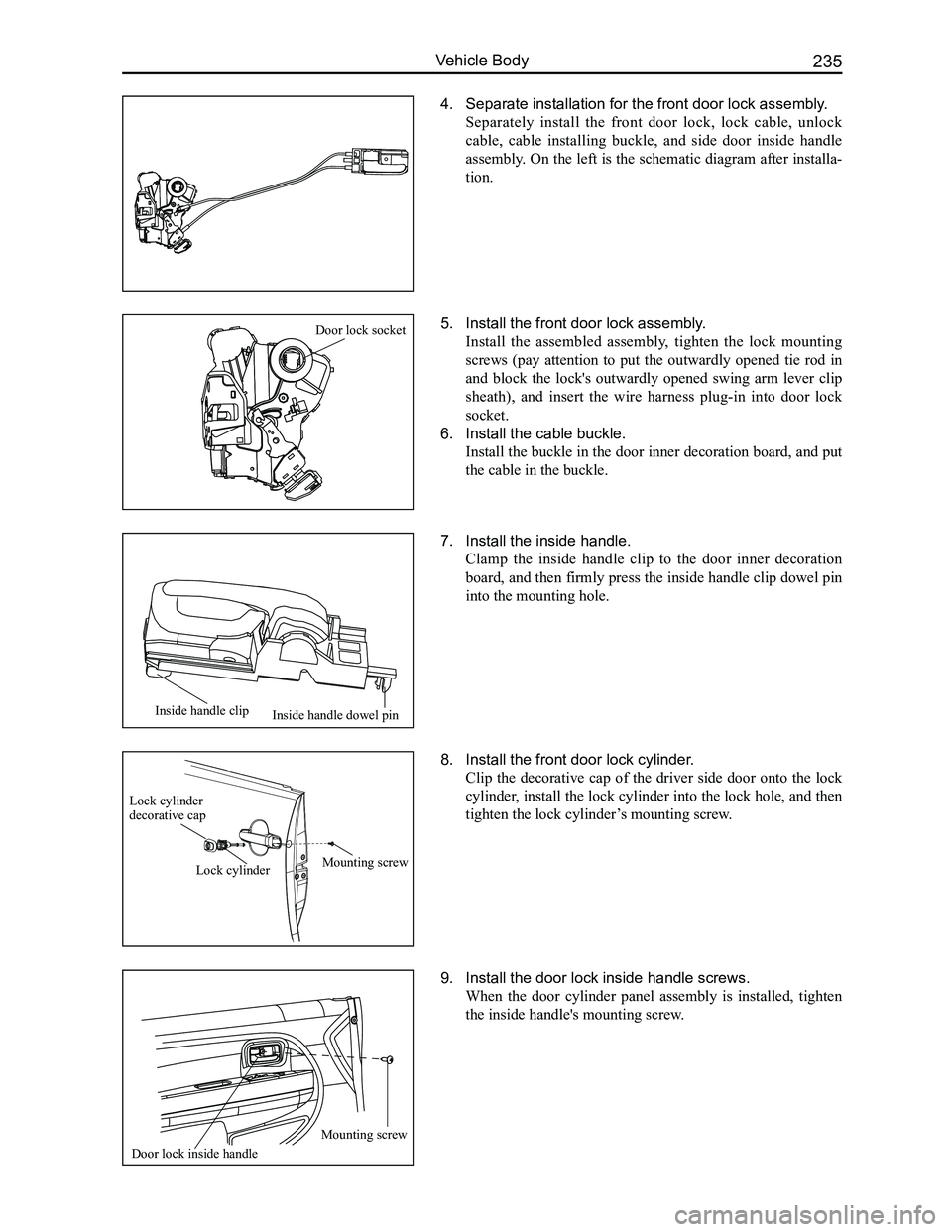
4. Separate installation for the front door lock assembly.
Separately install the front door lock, lock cable, unlock
cable, cable installing buckle, and side door inside handle
assembly. On the left is the schematic diagram after installa-
tion.
7. Install the inside handle.
Clamp the inside handle clip to the door inner decoration
board, and then firmly press the inside handle clip dowel pin
into the mounting hole.
8. Install the front door lock cylinder.
Clip the decorative cap of the driver side door onto the lock
cylinder, install the lock cylinder into the lock hole, and then
tighten the lock cylinder’s mounting screw.
5. Install the front door lock assembly.
Install the assembled assembly, tighten the lock mounting
screws (pay attention to put the outwardly opened tie rod in
and block the lock's outwardly opened swing arm lever clip
sheath), and insert the wire harness plug-in into door lock
socket.
6. Install the cable buckle.
Install the buckle in the door inner decoration board, and put
the cable in the buckle.
9. Install the door lock inside handle screws.
When the door cylinder panel assembly is installed, tighten
the inside handle's mounting screw.
Door lock socket
Inside handle dowel pinInside handle clip
Lock cylinder decorative cap
Lock cylinderMounting screw
Mounting screw
Door lock inside handle
Page 245 of 281
Downloaded from www.Manualslib.com manuals search engine GWFLORID Maintenance Manual238
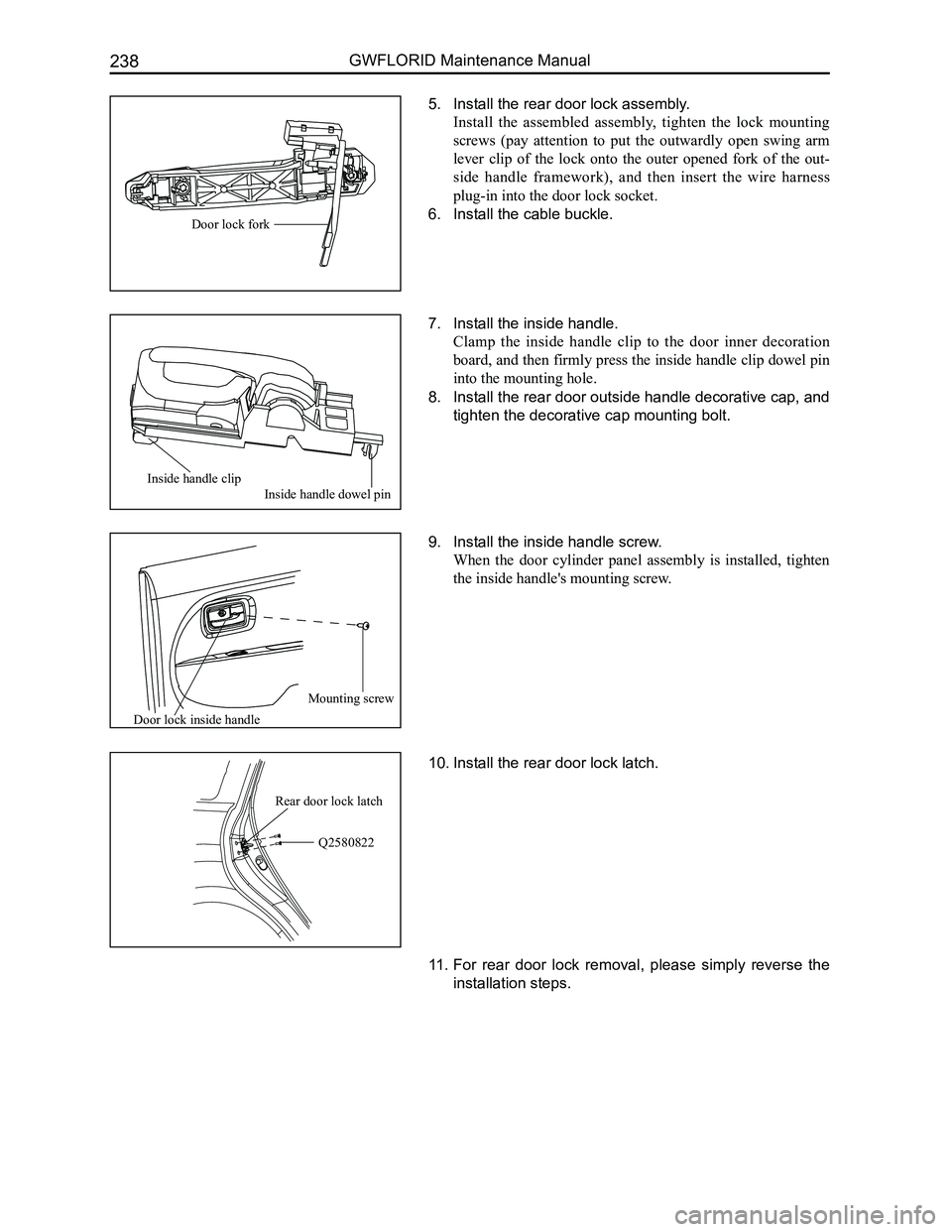
5. Install the rear door lock assembly.
Install the assembled assembly, tighten the lock mounting
screws (pay attention to put the outwardly open swing arm
lever clip of the lock onto the outer opened fork of the out-
side handle framework), and then insert the wire harness
plug-in into the door lock socket.
6. Install the cable buckle.
7. Install the inside handle.
Clamp the inside handle clip to the door inner decoration
board, and then firmly press the inside handle clip dowel pin
into the mounting hole.
8. Install the rear door outside handle decorative cap, and
tighten the decorative cap mounting bolt.
9. Install the inside handle screw.
When the door cylinder panel assembly is installed, tighten
the inside handle's mounting screw.
10. Install the rear door lock latch.
11. For rear door lock removal, please simply reverse the
installation steps.
Door lock fork
Inside handle dowel pin
Inside handle clip
Mounting screw
Door lock inside handle
Rear door lock latch
Q2580822