air conditioning GREAT WALL FLORID 2008 Service Manual
[x] Cancel search | Manufacturer: GREAT WALL, Model Year: 2008, Model line: FLORID, Model: GREAT WALL FLORID 2008Pages: 281, PDF Size: 43.97 MB
Page 4 of 281

Downloaded from www.Manualslib.com manuals search engine Chapter One: Overview ........................................................................\
........................................1
How to Use This Manual ...................................................................................\
...........2
Identifying Number Location ..................................................................................\
......3
Comprehensive Repair Instructions .............................................................................4
General Repair Methods and Operations ....................................................................9
Chapter Two: Overall Parameters ........................................................................\
......................10
Basic Parameters of the Overall Vehicle ...................................................................11
Engine Technical Parameters ..................................................................................\
..12
Chassis’ Main Assembly Technical Parameters .........................................................13
Vehicle Structure Type and Parameters ....................................................................15
Air Conditioning System Structure and Parameters ..................................................16
Electrical System Structure and Parameters .............................................................16
Grade Specification and Filled Quantity of Each
Individual Functioning Component’s Working Agent ..................................................18
Torque Specifications for Key Operational Bolts ........................................................18
Vehicle Body’s Basic Calibration Measurements ......................................................22
Chapter Three: Fuel Supply and Exhaust System .....................................................................29
Fuel Supply System ...................................................................................\
................30
Components ..................................................................................\
..........................30
Fuel Tank Removal ..................................................................................\
................31
Fuel Pump and Charcoal Canister Removal ...........................................................31
Fuel Filter Removal ...................................................................................\
...............31
Fuel Filler Pipe Assembly Removal .........................................................................32
Exhaust System ...................................................................................\
......................33
Components ..................................................................................\
..........................33
Exhaust System Removal ...................................................................................\
.....34
Exhaust System Installation ...................................................................................\
..35
Chapter Four: Clutch Operational System........................................................................\
..........36
Areas of Importance ..................................................................................\
................37
Troubleshooting ..................................................................................\
.......................37
Clutch Operational System ..................................................................................\
......38
Components ..................................................................................\
..........................38
Clutch Master Cylinder Removal .............................................................................38
Clutch Master Cylinder Installation ..........................................................................40
Clutch Pedal Removal ..................................................................................\
...........40
Clutch Pedal Installation ..................................................................................\
........40
Clutch Pedal Examination and Adjustment ..............................................................41
CONTENTS
Page 6 of 281

Downloaded from www.Manualslib.com manuals search engine Technical Requirements ..................................................................................\
........141
Chapter Nine: Vehicle Body Electrical System ........................................................................\
.142
Basic Information on the Electrical System .............................................................143
Fuse Box ...................................................................................\
...............................144
Overall Vehicle’s Grounding Point Schematics ........................................................150
Key Electrical Component’s Module Schematics for the Overall Vehicle ................151
Wire Harness Distribution Chart for the Overall Vehicle ..........................................152
Wire Harness Relationship and Plug-in Connections Numbered Diagram ..............155
Wire Harness Plug-in Connectors and Pin Function Diagram .................................156
Electrical Wiring Diagram for the Overall Vehicle ....................................................167
Chapter Ten: Electrical Accessories ........................................................................\
.................177
Reverse Sensor ..................................................................................\
.....................178
Combination Meter ..................................................................................\
................180
Central Door Lock ...................................................................................\
.................181
Power Windows ..................................................................................\
.....................184
Immobilizer System ..................................................................................\
...............186
CD Player ..................................................................................\
..............................193
DVD Player ..................................................................................\
............................195
Chapter Eleven: Air Conditioning System........................................................................\
........202
Areas of Importance ..................................................................................\
..............203
Technical Parameters ..................................................................................\
............203
Troubleshooting ..................................................................................\
.....................204
Air Conditioning System’s Structure Diagram and Fundamentals ...........................207
Air Conditioning System Overview ..........................................................................207
Air Conditioning System Terminal Definition ............................................................208
Compressor ..................................................................................\
...........................208
Electromagnetic Clutch ...................................................................................\
.........210
Vacuuming and Charging Refrigerant ......................................................................211
Filling Quantity and Method for Refrigerant Oil ........................................................212
Daily Maintenance of the Air Conditioning System .................................................212
Chapter Twelve: Airbags ........................................................................\
...................................213
Airbag Electronic Control Unit ..................................................................................214
Diagnostic Scanner ...................................................................................\
...............215
Troubleshooting ..................................................................................\
.....................216
Vehicle Collision Diagnostics ..................................................................................\
.226
Removal Method for Individual Components ...........................................................227
Driver Side Airbag Module (DAB), Front Passenger Side
Airbag Module (PAB), Clock Spring, and Steering Wheel .......................................228
Airbag Module Disposal ...................................................................................\
........230
Page 17 of 281
Downloaded from www.Manualslib.com manuals search engine GWFLORID Maintenance Manual10
Overall Parameters
Basic Parameters of the Overall Vehicle ............................11
Engine Technical Parameters .............................................12
Chassis' Main Assembly Technical Parameters .................13
Vehicle Structure Type and Parameters .............................15
Air Conditioning System Structure and Parameters ...........16
Electrical System Structure and Parameters ......................16
Grade Specification and Filled Quantity of Each
Individual Functioning Component's Working Agent ..........18
Torque Specifications for Key Operational Bolts ................18
Vehicle Body's Basic Calibration Measurements ..............22
Page 22 of 281
Downloaded from www.Manualslib.com manuals search engine 15Overall Parameters
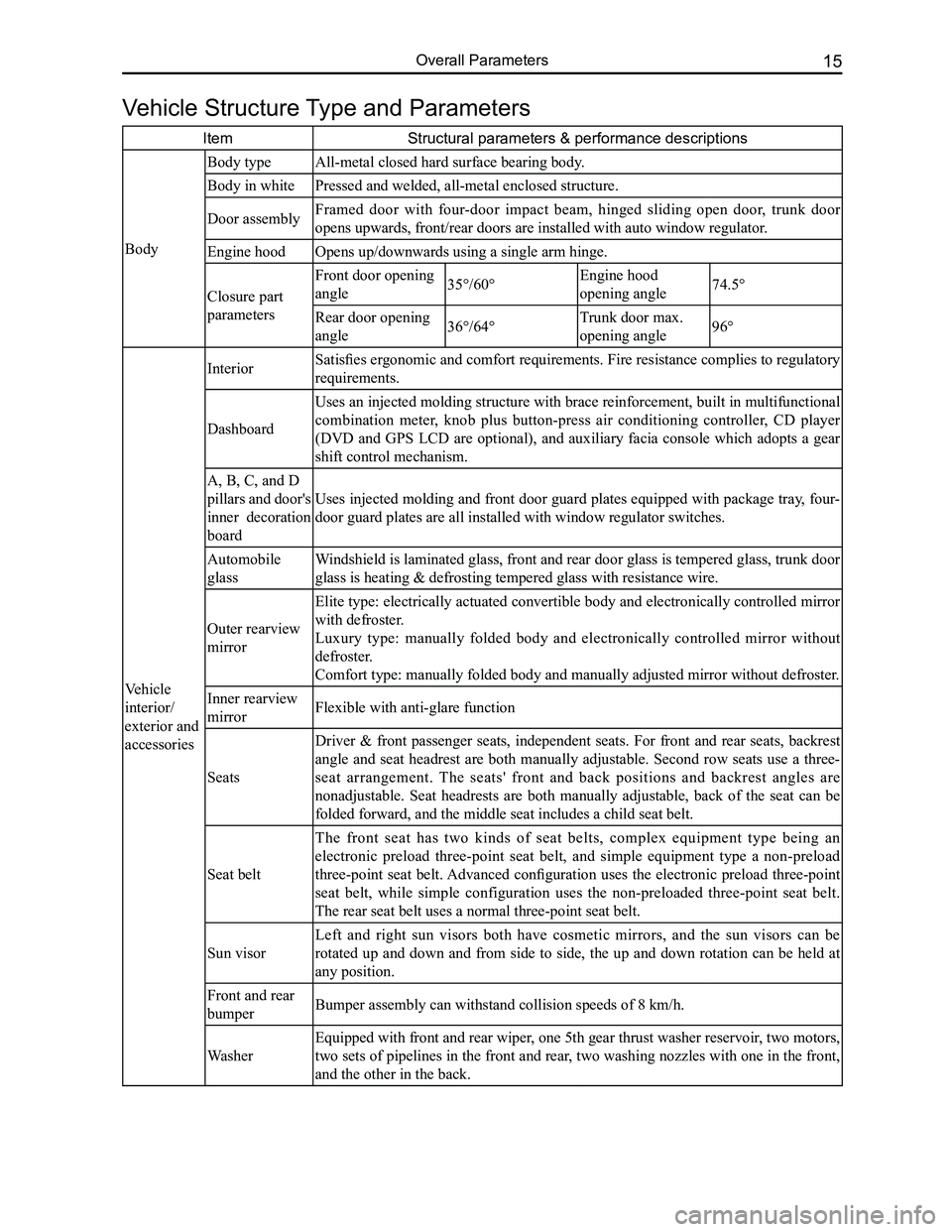
Vehicle Structure Type and Parameters
ItemStructural parameters & performance descriptions
Body
Body typeAll-metal closed hard surface bearing body.
Body in whitePressed and welded, all-metal enclosed structure.
Door assemblyFramed door with four-door impact beam, hinged sliding open door, trunk door
opens upwards, front/rear doors are installed with auto window regulator\
.
Engine hoodOpens up/downwards using a single arm hinge.
Closure part
parameters
Front door opening
angle35°/60°Engine hood
opening angle74.5°
Rear door opening
angle36°/64°Trunk door max.
opening angle96°
Vehicle
interior/
exterior and
accessories
Interior Satisfies ergonomic and comfort requirements. Fire resistance complies to regulatory
requirements.
Dashboard
Uses an injected molding structure with brace reinforcement, built in multifunctional
combination meter, knob plus button-press air conditioning controller, CD player
(DVD and GPS LCD are optional), and auxiliary facia console which adopts a gear
shift control mechanism.
A, B, C, and D
pillars and door's
inner decoration
board
Uses injected molding and front door guard plates equipped with package tray, four-
door guard plates are all installed with window regulator switches.
Automobile
glass
Windshield is laminated glass, front and rear door glass is tempered glass, trunk door
glass is heating & defrosting tempered glass with resistance wire.
Outer rearview
mirror
Elite type: electrically actuated convertible body and electronically controlled mirror
with defroster.
Luxury type: manually folded body and electronically controlled mirror without
defroster.
Comfort type: manually folded body and manually adjusted mirror without \
defroster.
Inner rearview
mirrorFlexible with anti-glare function
Seats
Driver & front passenger seats, independent seats. For front and rear seats, backrest
angle and seat headrest are both manually adjustable. Second row seats use a three-
seat arrangement. The seats' front and back positions and backrest angles are
nonadjustable. Seat headrests are both manually adjustable, back of the seat can be
folded forward, and the middle seat includes a child seat belt.
Seat belt
The front seat has two kinds of seat belts, complex equipment type being an
electronic preload three-point seat belt, and simple equipment type a non-preload
three-point seat belt. Advanced configuration uses the electronic preload three-point
seat belt, while simple configuration uses the non-preloaded three-point seat belt.
The rear seat belt uses a normal three-point seat belt.
Sun visor
Left and right sun visors both have cosmetic mirrors, and the sun visors can be
rotated up and down and from side to side, the up and down rotation can be held at
any position.
Front and rear
bumperBumper assembly can withstand collision speeds of 8 km/h.
Washer
Equipped with front and rear wiper, one 5th gear thrust washer reservoir, two motors,
two sets of pipelines in the front and rear, two washing nozzles with one in the front,
and the other in the back.
Page 23 of 281
Downloaded from www.Manualslib.com manuals search engine GWFLORID Maintenance Manual16
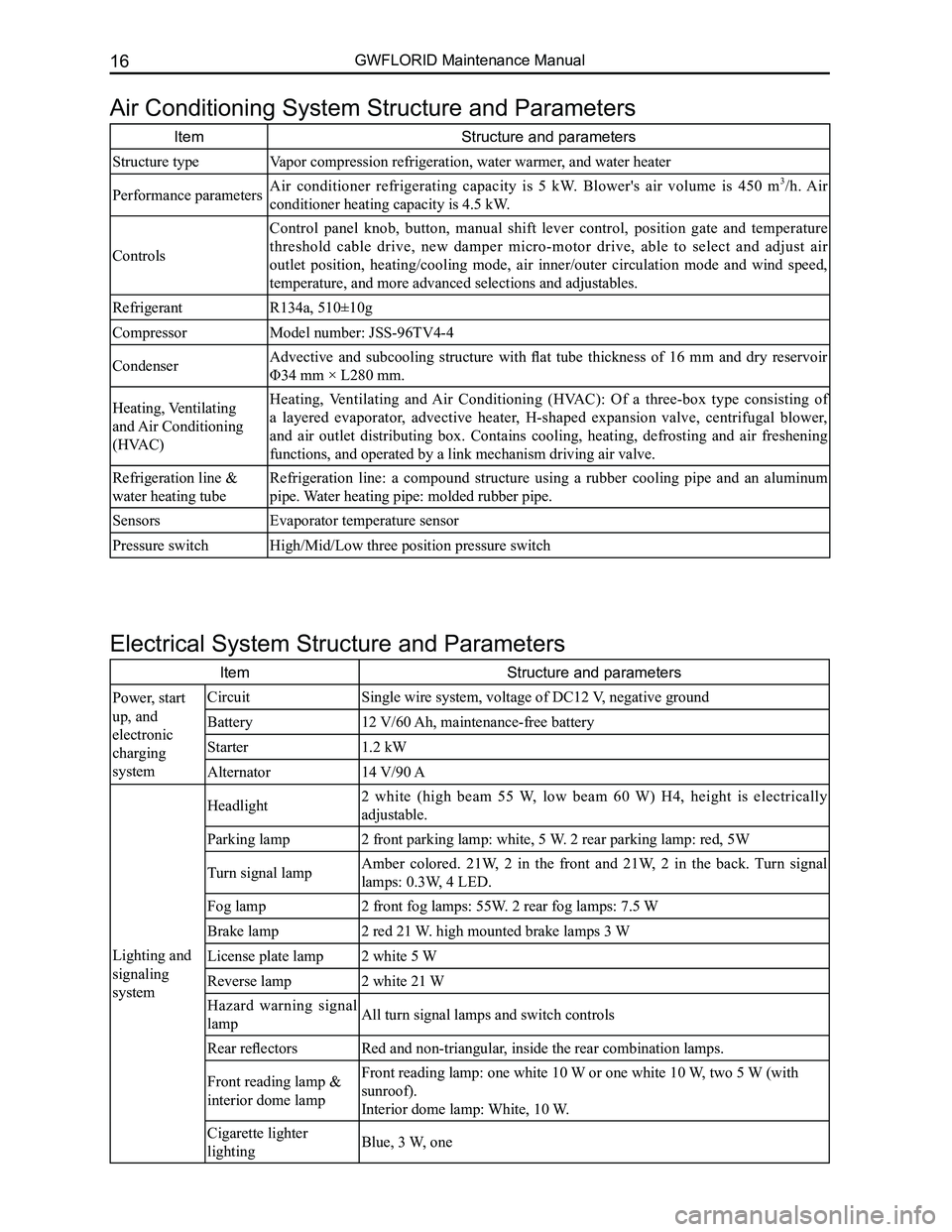
Air Conditioning System Structure and Parameters
ItemStructure and parameters
Structure typeVapor compression refrigeration, water warmer, and water heater
Performance parametersAir conditioner refrigerating capacity is 5 kW. Blower's air volume is 450 m3/h. Air
conditioner heating capacity is 4.5 kW.
Controls
Control panel knob, button, manual shift lever control, position gate and temperature
threshold cable drive, new damper micro-motor drive, able to select and adjust air
outlet position, heating/cooling mode, air inner/outer circulation mode and wind speed,
temperature, and more advanced selections and adjustables.
RefrigerantR134a, 510±10g
CompressorModel number: JSS-96TV4-4
CondenserAdvective and subcooling structure with flat tube thickness of 16 mm and dry reservoir
Φ34 mm × L280 mm.
Heating, Ventilating
and Air Conditioning
(HVAC)
Heating, Ventilating and Air Conditioning (HVAC): Of a three-box type consisting of
a layered evaporator, advective heater, H-shaped expansion valve, centrifugal blower,
and air outlet distributing box. Contains cooling, heating, defrosting and air freshening
functions, and operated by a link mechanism driving air valve.
Refrigeration line &
water heating tube
Refrigeration line: a compound structure using a rubber cooling pipe and an aluminum
pipe. Water heating pipe: molded rubber pipe.
SensorsEvaporator temperature sensor
Pressure switchHigh/Mid/Low three position pressure switch
Electrical System Structure and Parameters
ItemStructure and parameters
Power, start
up, and
electronic
charging
system
CircuitSingle wire system, voltage of DC12 V, negative ground
Battery12 V/60 Ah, maintenance-free battery
Starter1.2 kW
Alternator14 V/90 A
Lighting and
signaling
system
Headlight2 white (high beam 55 W, low beam 60 W) H4, height is electrically
adjustable.
Parking lamp2 front parking lamp: white, 5 W. 2 rear parking lamp: red, 5W
Turn signal lampAmber colored. 21W, 2 in the front and 21W, 2 in the back. Turn signal
lamps: 0.3W, 4 LED.
Fog lamp2 front fog lamps: 55W. 2 rear fog lamps: 7.5 W
Brake lamp2 red 21 W. high mounted brake lamps 3 W
License plate lamp2 white 5 W
Reverse lamp2 white 21 W
Hazard warning signal
lampAll turn signal lamps and switch controls
Rear reflectorsRed and non-triangular, inside the rear combination lamps.
Front reading lamp &
interior dome lamp
Front reading lamp: one white 10 W or one white 10 W, two 5 W (with
sunroof).
Interior dome lamp: White, 10 W.
Cigarette lighter
lightingBlue, 3 W, one
Page 177 of 281
Downloaded from www.Manualslib.com manuals search engine GWFLORID Maintenance Manual170
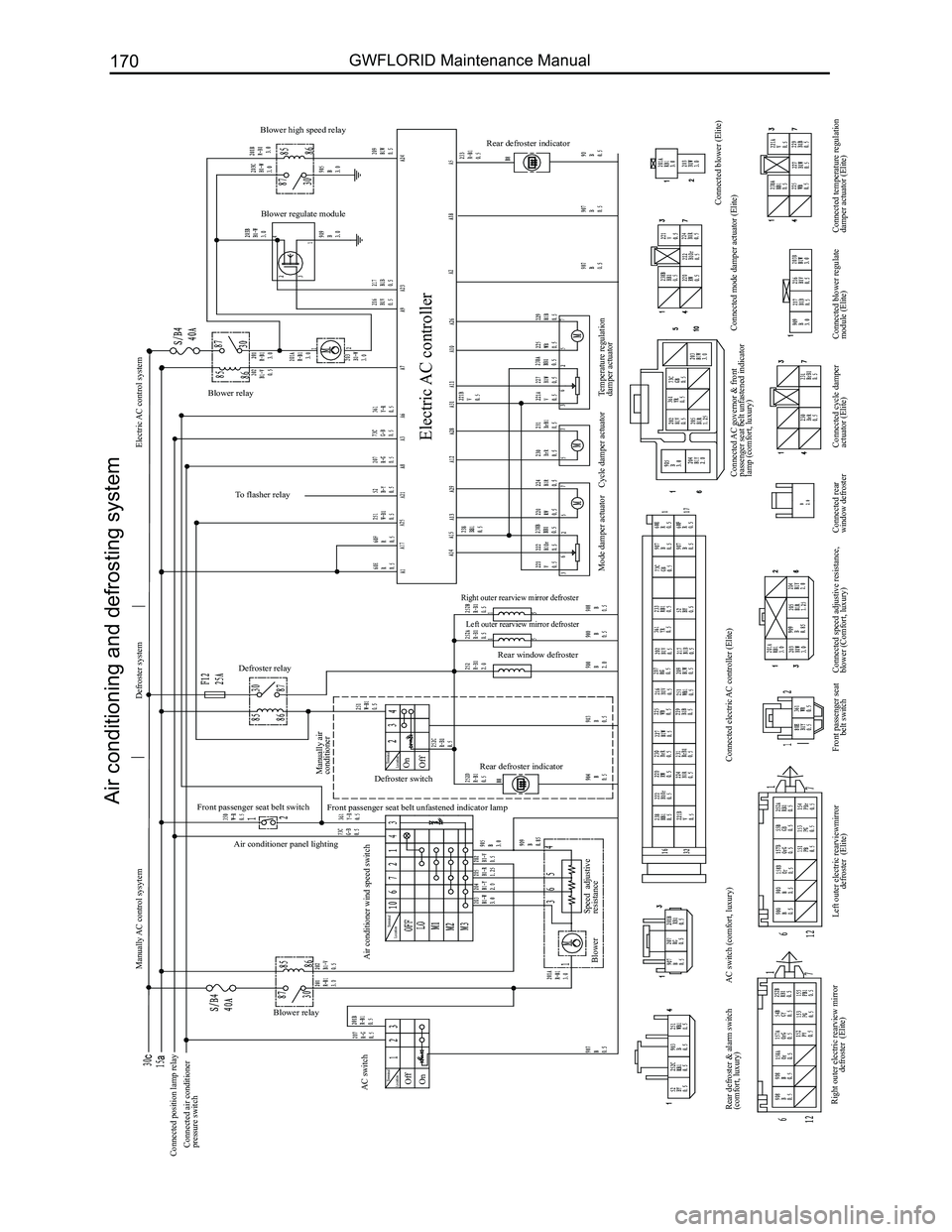
Air conditioning and defrosting system
Rear window defroster
Connected position lamp relay Manually AC control sysytem
Defroster system Electric AC control system
Connected air conditioner
pressure switch
Blower relay
Air conditioner
panel lighting Defroster switch
Rear defroster indicator
Left outer rearview mirror defroster
Right outer rearview mirror defroster
Front passenger seat belt switch Defroster relay
To flasher relay
Blower relay Blower regulate module
Blower high speed relay
Rear defroster indicator
Front passenger seat belt unfastened indicator lamp
Air conditioner wind speed switch
Blower Speed adjustive
resistance
Rear defroster & alarm switch
(comfort, luxury) Right outer electric rearview mirror defroster (Elite) Left outer electric rearviewmirror
defroster (Elite) Front passenger seat
belt switch Connected speed adjustive resistance,
blower (Comfort, luxury) Connected rear
window defroster Connected cycle damper
actuator (Elite) Connected blower regulate
module (Elite) Connected temperature regulation
damper actuator (Elite)
AC switch (comfort, luxury)
Connected electric AC controller (Elite)
Connected AC governor & front
passenger seat belt unfastened indicator
lamp (comfort, luxury) Connected mode damper actuator (Elite) Connected blower (Elite)
Mode damper actuator
Cycle damper actuator Temperature regulation
damper actuator
Manually
air
conditioner
Electric AC controller
AC switch
Off
On Off On Terminal
Terminal Terminal
Location Location
Location
Page 209 of 281
Downloaded from www.Manualslib.com manuals search engine GWFLORID Maintenance Manual202
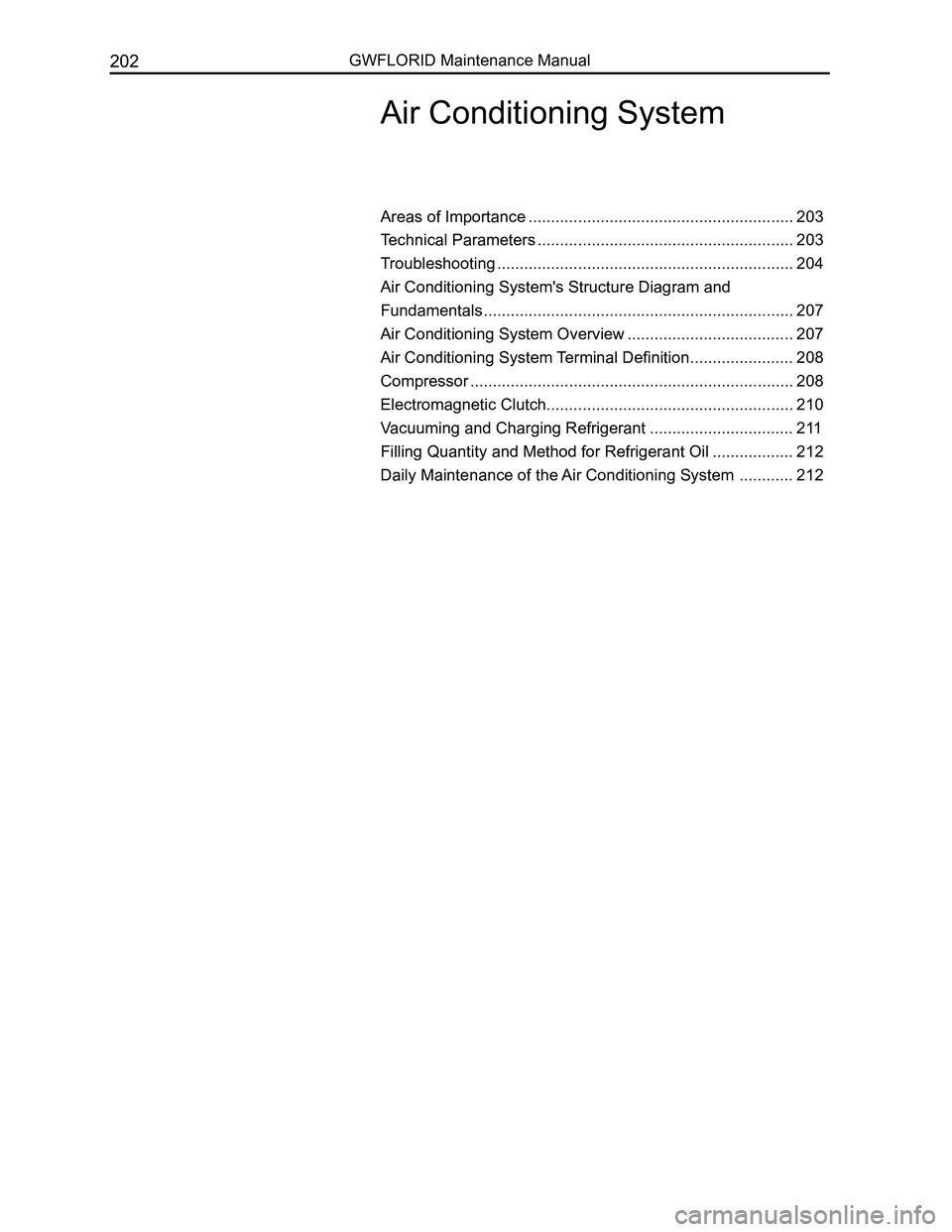
Air Conditioning System
Areas of Importance ...........................................................203
Technical Parameters .........................................................203
Troubleshooting ..................................................................204
Air Conditioning System's Structure Diagram and
Fundamentals .....................................................................207
Air Conditioning System Overview .....................................207
Air Conditioning System Terminal Definition .......................208
Compressor ........................................................................\
208
Electromagnetic Clutch.......................................................210
Vacuuming and Charging Refrigerant ................................211
Filling Quantity and Method for Refrigerant Oil ..................212
Daily Maintenance of the Air Conditioning System ............212
Page 210 of 281
Downloaded from www.Manualslib.com manuals search engine 203Air Conditioning System
Areas of Importance
1. When putting in a new compressor, adjust the new compressor's inner lubricant to make it the same
level as of the old compressor's.
2. When the air conditioner malfunctions, if the pipeline, condenser or evaporator is the source of the
damage leading to its replacement, just add model number RS20 profession\
al lubricant 5-10 ml.
3. The compressor is a high speed operating component, the smallest impurity in the air conditioning
system can lead to the compressor's damage, therefore the entire air conditioning system must be
cleaned.
4. In order to avoid liquid damage to the compressor, pay careful attention when filling the refrigerant.
When the vehicle stopped, fill the liquid refrigerant from the high pressure side. When in operation, fill
the liquid refrigerant from the low pressure side.
5. When undergoing maintenance, pay attention that the amount of refrigerant being added is 510±10 g.
Observe through the check glass to determine if there is sufficient new refrigerant charge.
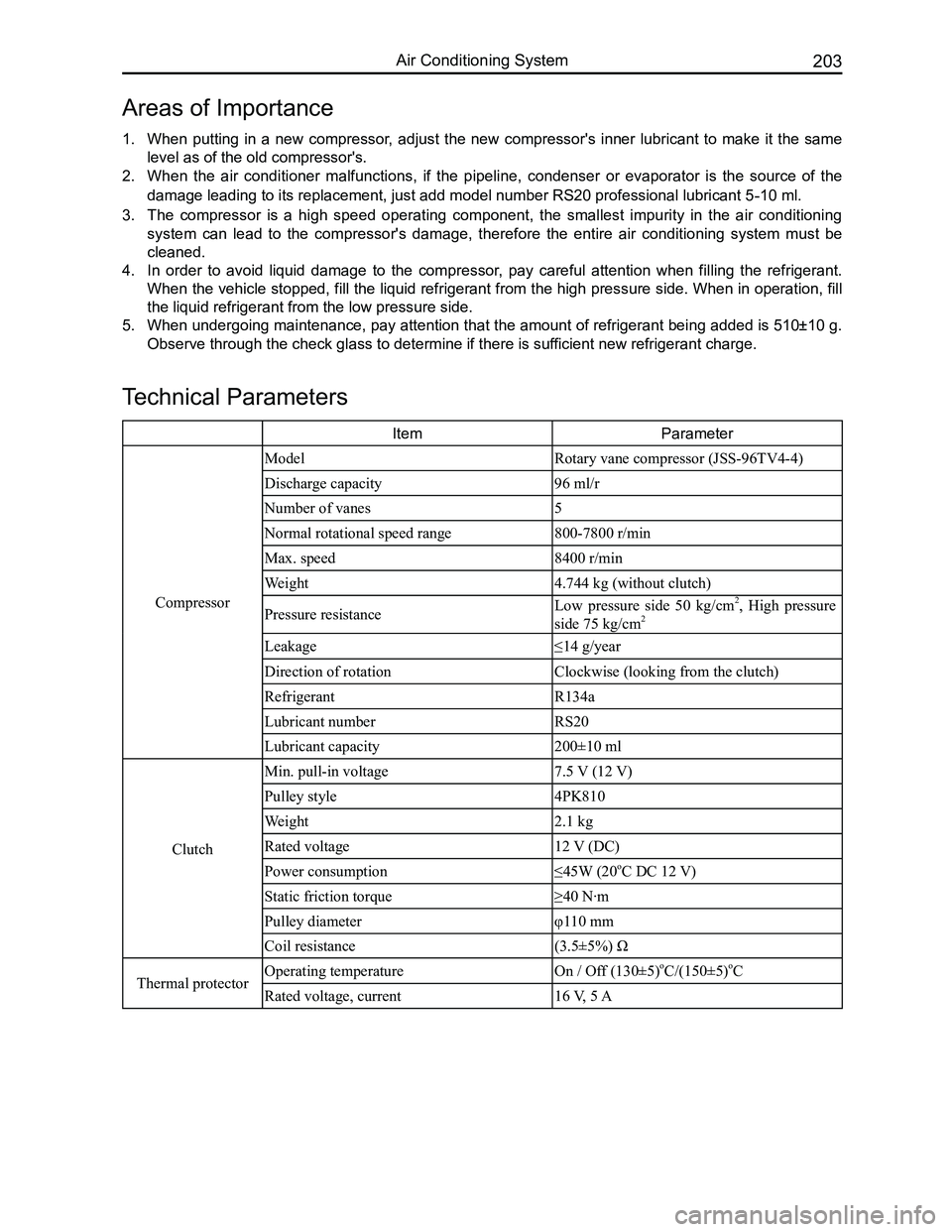
ItemParameter
Compressor
ModelRotary vane compressor (JSS-96TV4-4)
Discharge capacity96 ml/r
Number of vanes5
Normal rotational speed range800-7800 r/min
Max. speed8400 r/min
Weight4.744 kg (without clutch)
Pressure resistanceLow pressure side 50 kg/cm2, High pressure
side 75 kg/cm2
Leakage≤14 g/year
Direction of rotationClockwise (looking from the clutch)
RefrigerantR134a
Lubricant numberRS20
Lubricant capacity 200±10 ml
Clutch
Min. pull-in voltage7.5 V (12 V)
Pulley style 4PK810
Weight2.1 kg
Rated voltage12 V (DC)
Power consumption≤45W (20oC DC 12 V)
Static friction torque≥40 N·m
Pulley diameterφ110 mm
Coil resistance(3.5±5%) Ω
Thermal protectorOperating temperatureOn / Off (130±5)oC/(150±5)oC
Rated voltage, current16 V, 5 A
Technical Parameters
Page 212 of 281
Downloaded from www.Manualslib.com manuals search engine 205Air Conditioning System
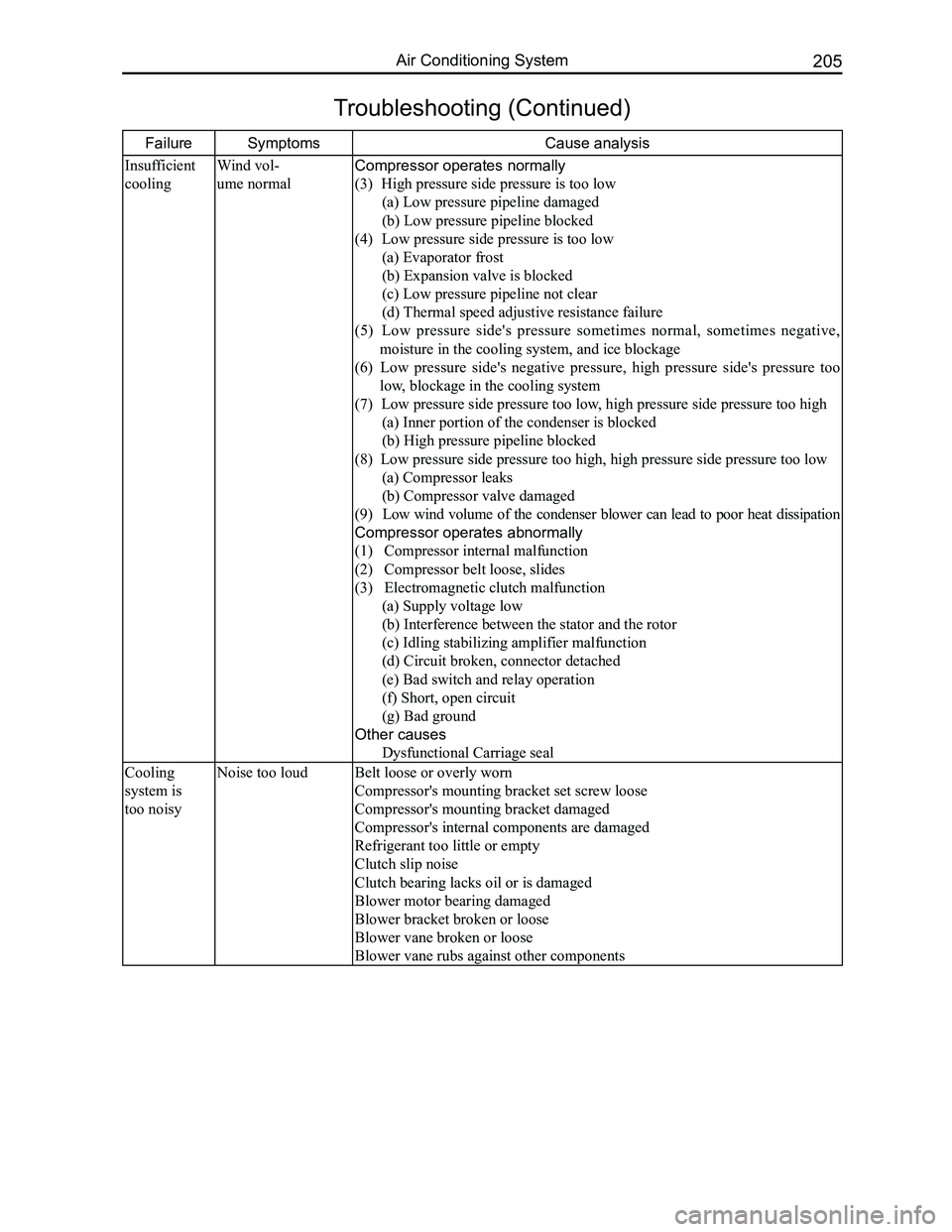
FailureSymptoms Cause analysis
Insufficient
cooling
Wind vol-
ume normal
Compressor operates normally
(3) High pressure side pressure is too low
(a) Low pressure pipeline damaged
(b) Low pressure pipeline blocked
(4) Low pressure side pressure is too low
(a) Evaporator frost
(b) Expansion valve is blocked
(c) Low pressure pipeline not clear
(d) Thermal speed adjustive resistance failure
(5) Low pressure side's pressure sometimes normal, sometimes negative,
moisture in the cooling system, and ice blockage
(6) Low pressure side's negative pressure, high pressure side's pressure too
low, blockage in the cooling system
(7) Low pressure side pressure too low, high pressure side pressure too high
(a) Inner portion of the condenser is blocked
(b) High pressure pipeline blocked
(8) Low pressure side pressure too high, high pressure side pressure \
too low
(a) Compressor leaks
(b) Compressor valve damaged
(9) Low wind volume of the condenser blower can lead to poor heat dissipation
Compressor operates abnormally
(1) Compressor internal malfunction
(2) Compressor belt loose, slides
(3) Electromagnetic clutch malfunction
(a) Supply voltage low
(b) Interference between the stator and the rotor
(c) Idling stabilizing amplifier malfunction
(d) Circuit broken, connector detached
(e) Bad switch and relay operation
(f) Short, open circuit
(g) Bad ground
Other causes
Dysfunctional Carriage seal
Cooling
system is
too noisy
Noise too loudBelt loose or overly worn
Compressor's mounting bracket set screw loose
Compressor's mounting bracket damaged
Compressor's internal components are damaged
Refrigerant too little or empty
Clutch slip noise
Clutch bearing lacks oil or is damaged
Blower motor bearing damaged
Blower bracket broken or loose
Blower vane broken or loose
Blower vane rubs against other components
Troubleshooting (Continued)
Page 214 of 281
Downloaded from www.Manualslib.com manuals search engine 207Air Conditioning System
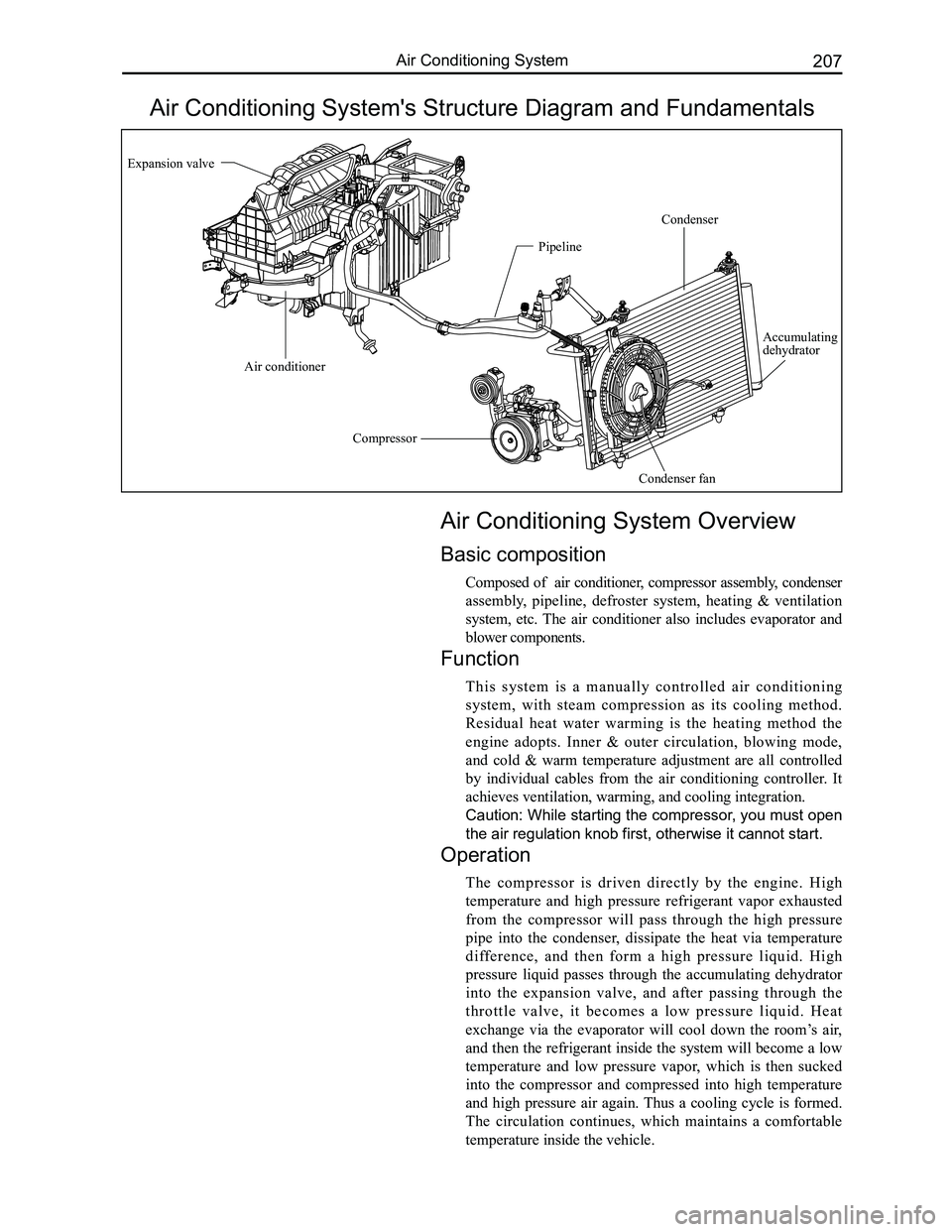
Air Conditioning System's Structure Diagram and Fundamentals
Air Conditioning System Overview
Basic composition
Composed of air conditioner, compressor assembly, condenser
assembly, pipeline, defroster system, heating & ventilation
system, etc. The air conditioner also includes evaporator and
blower components.
Function
This system is a manually controlled air conditioning
system, with steam compression as its cooling method.
Residual heat water warming is the heating method the
engine adopts. Inner & outer circulation, blowing mode,
and cold & warm temperature adjustment are all controlled
by individual cables from the air conditioning controller. It
achieves ventilation, warming, and cooling integration.
Caution: While starting the compressor, you must open
the air regulation knob first, otherwise it cannot start.
Operation
The compressor is driven directly by the engine. High
temperature and high pressure refrigerant vapor exhausted
from the compressor will pass through the high pressure
pipe into the condenser, dissipate the heat via temperature
difference, and then form a high pressure liquid. High
pressure liquid passes through the accumulating dehydrator
into the expansion valve, and after passing through the
throttle valve, it becomes a low pressure liquid. Heat
exchange via the evaporator will cool down the room’s air,
and then the refrigerant inside the system will become a low
temperature and low pressure vapor, which is then sucked
into the compressor and compressed into high temperature
and high pressure air again. Thus a cooling cycle is formed.
The circulation continues, which maintains a comfortable
temperature inside the vehicle.
Expansion valve
Compressor
Condenser fan
Condenser
Pipeline
Air conditioner
Accumulating dehydrator