alarm GREAT WALL FLORID 2008 Service Manual
[x] Cancel search | Manufacturer: GREAT WALL, Model Year: 2008, Model line: FLORID, Model: GREAT WALL FLORID 2008Pages: 281, PDF Size: 43.97 MB
Page 21 of 281
Downloaded from www.Manualslib.com manuals search engine GWFLORID Maintenance Manual14
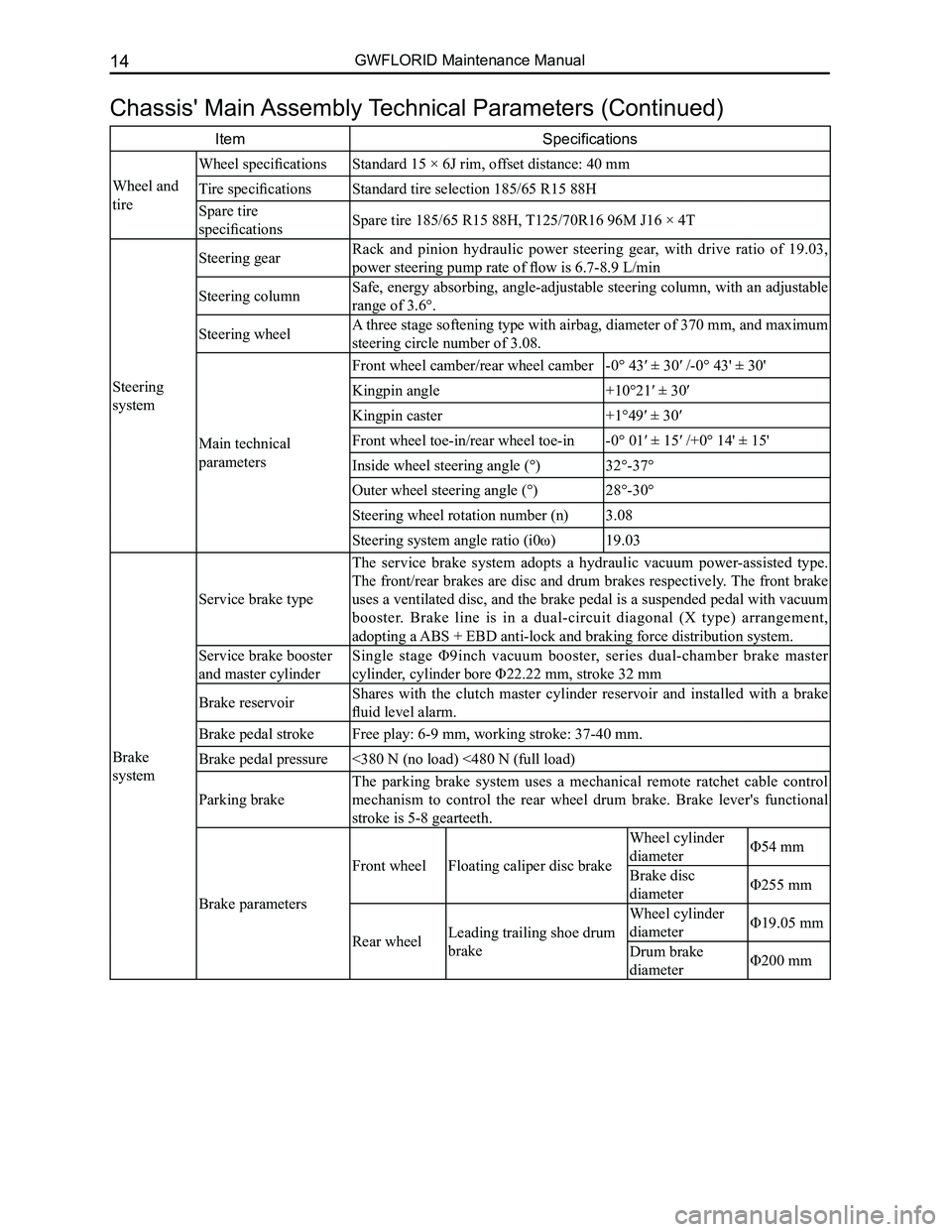
Chassis' Main Assembly Technical Parameters (Continued)
ItemSpecifications
Wheel and
tire
Wheel specificationsStandard 15 × 6J rim, offset distance: 40 mm
Tire specificationsStandard tire selection 185/65 R15 88H
Spare tire
specificationsSpare tire 185/65 R15 88H, T125/70R16 96M J16 × 4T
Steering
system
Steering gearRack and pinion hydraulic power steering gear, with drive ratio of 19.03,
power steering pump rate of flow is 6.7-8.9 L/min
Steering columnSafe, energy absorbing, angle-adjustable steering column, with an adjustable
range of 3.6°.
Steering wheelA three stage softening type with airbag, diameter of 370 mm, and maximum
steering circle number of 3.08.
Main technical
parameters
Front wheel camber/rear wheel camber-0° 43′ ± 30′ /-0° 43' ± 30'
Kingpin angle+10°21′ ± 30′
Kingpin caster+1°49′ ± 30′
Front wheel toe-in/rear wheel toe-in-0° 01′ ± 15′ /+0° 14' ± 15'
Inside wheel steering angle (°)32°-37°
Outer wheel steering angle (°)28°-30°
Steering wheel rotation number (n)3.08
Steering system angle ratio (i0ω)19.03
Brake
system
Service brake type
The service brake system adopts a hydraulic vacuum power-assisted type.
The front/rear brakes are disc and drum brakes respectively. The front brake
uses a ventilated disc, and the brake pedal is a suspended pedal with vacuum
booster. Brake line is in a dual-circuit diagonal (X type) arrangement,
adopting a ABS + EBD anti-lock and braking force distribution system.
Service brake booster
and master cylinder
Single stage Φ9inch vacuum booster, series dual-chamber brake master
cylinder, cylinder bore Φ22.22 mm, stroke 32 mm
Brake reservoirShares with the clutch master cylinder reservoir and installed with a brake
fluid level alarm.
Brake pedal strokeFree play: 6-9 mm, working stroke: 37-40 mm.
Brake pedal pressure<380 N (no load) <480 N (full load)
Parking brake
The parking brake system uses a mechanical remote ratchet cable control
mechanism to control the rear wheel drum brake. Brake lever's functional
stroke is 5-8 gearteeth.
Brake parameters
Front wheelFloating caliper disc brake
Wheel cylinder
diameterΦ54 mm
Brake disc
diameterΦ255 mm
Rear wheelLeading trailing shoe drum
brake
Wheel cylinder
diameterΦ19.05 mm
Drum brake
diameterΦ200 mm
Page 125 of 281
Downloaded from www.Manualslib.com manuals search engine GWFLORID Maintenance Manual118
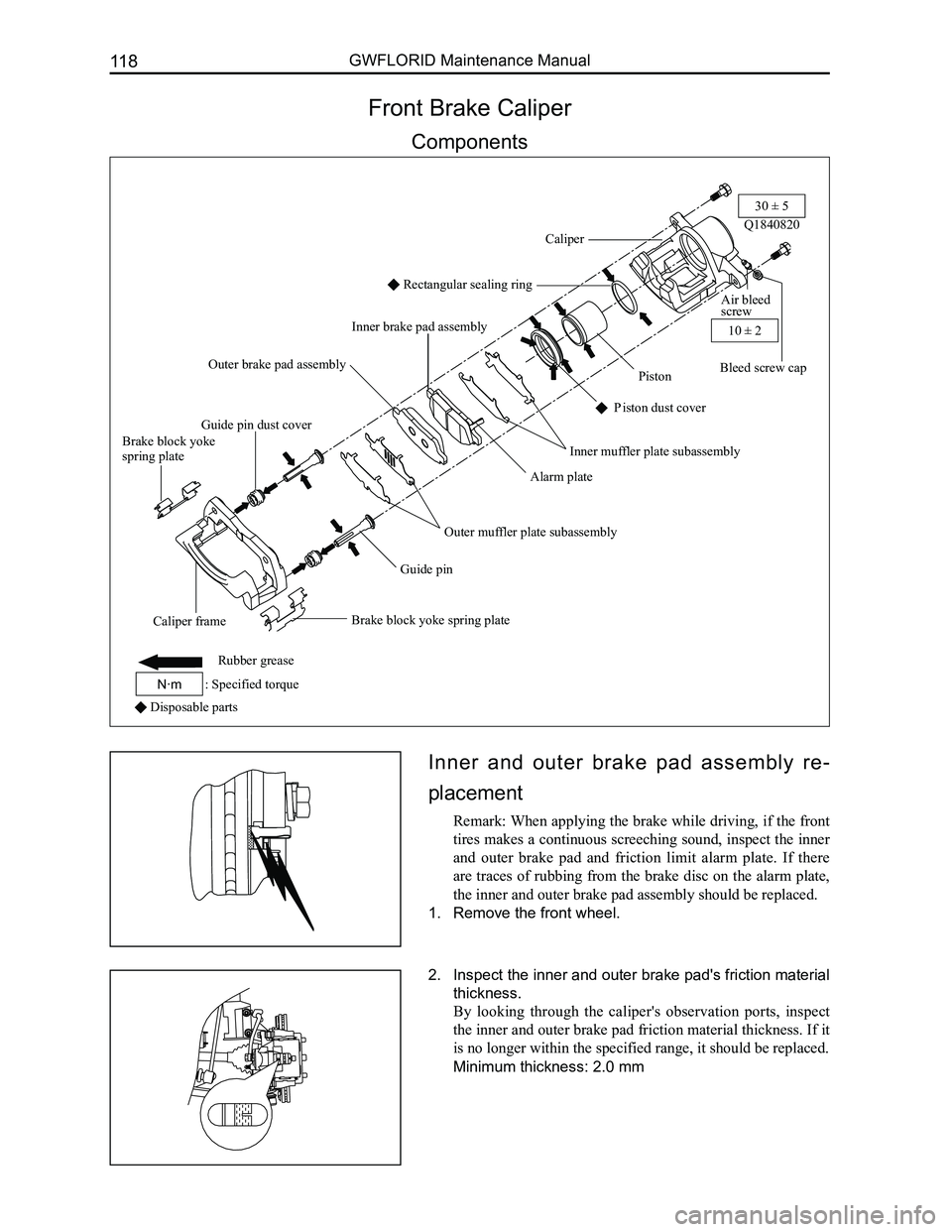
Front Brake Caliper
Components
Disposable parts
Inner and outer brake pad assembly re-
placement
Remark: When applying the brake while driving, if the front
tires makes a continuous screeching sound, inspect the inner
and outer brake pad and friction limit alarm plate. If there
are traces of rubbing from the brake disc on the alarm plate,
the inner and outer brake pad assembly should be replaced.
1. Remove the front wheel.
2. Inspect the inner and outer brake pad's friction material
thickness.
By looking through the caliper's observation ports, inspect
the inner and outer brake pad friction material thickness. If it
is no longer within the specified range, it should be replaced.
Minimum thickness: 2.0 mm
Bleed screw cap
Air bleed screw
Caliper
Rectangular sealing ring
Piston
P iston dust cover
Inner muffler plate subassembly
Alarm plate
Inner brake pad assembly
Outer brake pad assembly
Outer muffler plate subassembly
Guide pin
Guide pin dust cover
Caliper frame
Brake block yoke spring plate
Brake block yoke spring plate
30 ± 5
: Specified torqueN·m
10 ± 2
Q1840820
Rubber grease
Page 127 of 281
Downloaded from www.Manualslib.com manuals search engine GWFLORID Maintenance Manual120
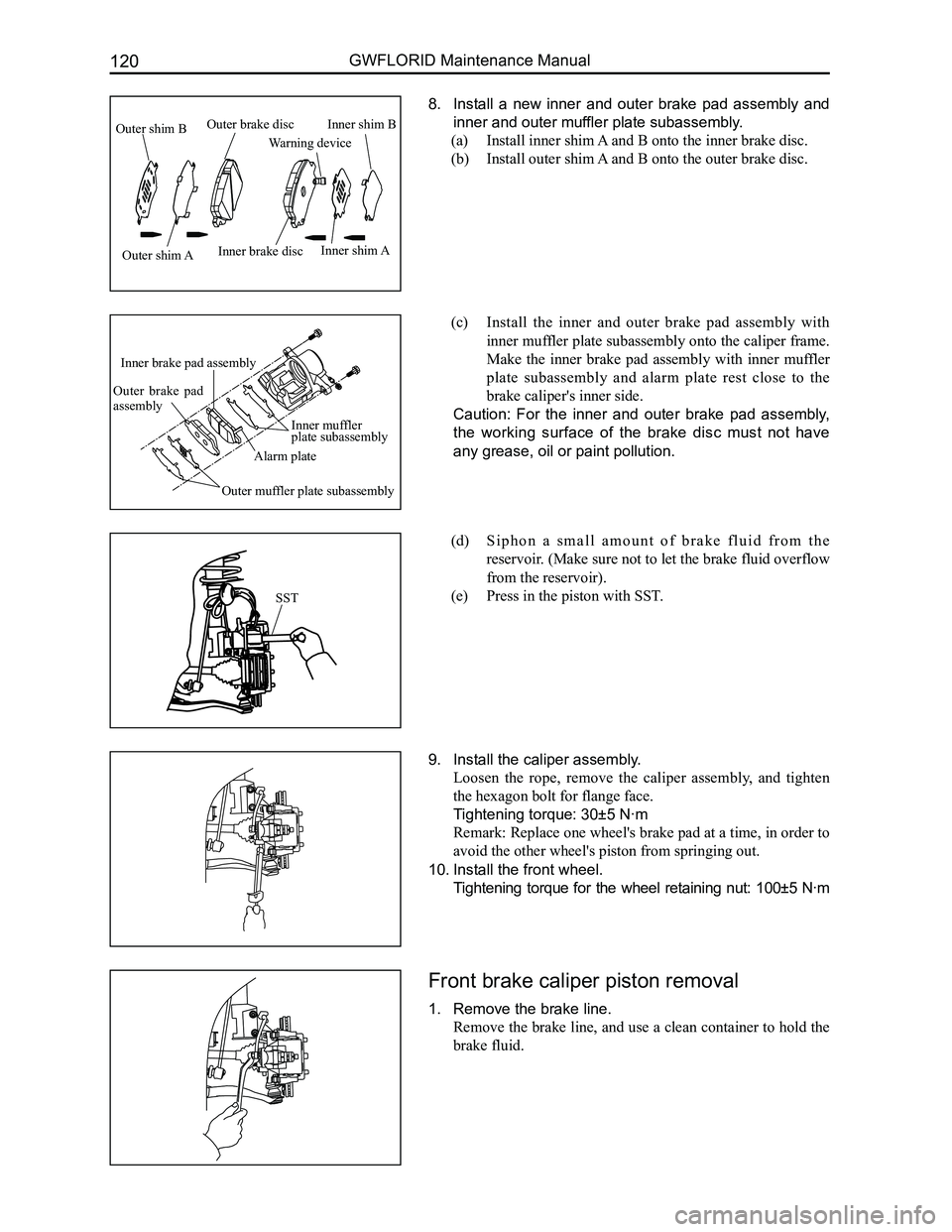
8. Install a new inner and outer brake pad assembly and
inner and outer muffler plate subassembly.
(a) Install inner shim A and B onto the inner brake disc.
(b) Install outer shim A and B onto the outer brake disc.
(c) Install the inner and outer brake pad assembly with
inner muffler plate subassembly onto the caliper frame.
Make the inner brake pad assembly with inner muffler
plate subassembly and alarm plate rest close to the
brake caliper's inner side.
Caution: For the inner and outer brake pad assembly,
the working surface of the brake disc must not have
any grease, oil or paint pollution.
(d) S i p h o n a s m a l l a m o u n t o f b r a k e f l u i d f r o m t h e
reservoir. (Make sure not to let the brake fluid overflow
from the reservoir).
(e) Press in the piston with SST.
9. Install the caliper assembly.
Loosen the rope, remove the caliper assembly, and tighten
the hexagon bolt for flange face.
Tightening torque: 30±5 N·m
Remark: Replace one wheel's brake pad at a time, in order to
avoid the other wheel's piston from springing out.
10. Install the front wheel.
Tightening torque for the wheel retaining nut: 100±5 N·m
Front brake caliper piston removal
1. Remove the brake line.
Remove the brake line, and use a clean container to hold the
brake fluid.
SST
Outer shim B
Outer shim AInner brake disc
Warning device
Inner shim B
Inner shim A
Outer brake disc
Inner muffler plate subassembly
Alarm plate
Inner brake pad assembly
Outer brake pad assembly
Outer muffler plate subassembly
Page 129 of 281
Downloaded from www.Manualslib.com manuals search engine GWFLORID Maintenance Manual122
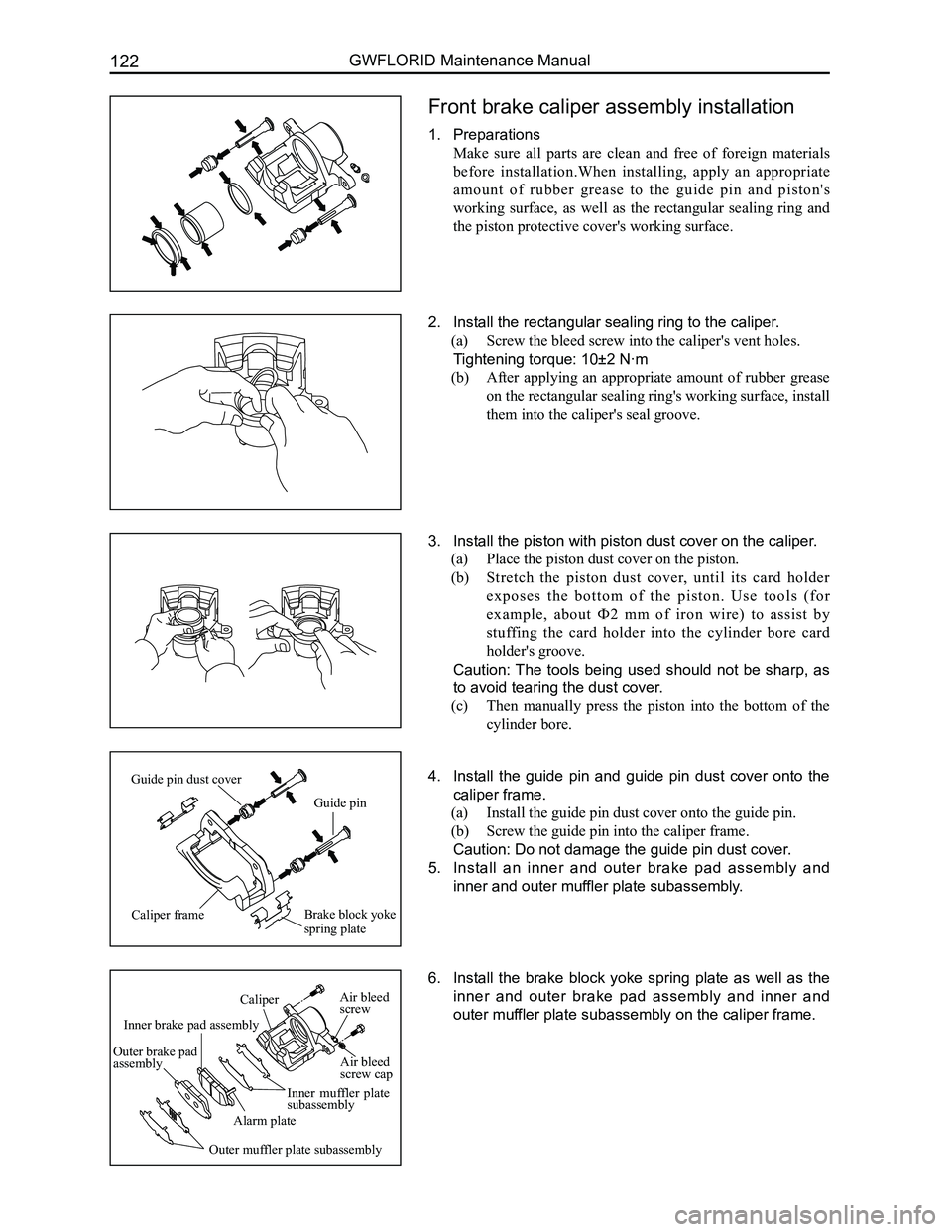
Front brake caliper assembly installation
1. Preparations
Make sure all parts are clean and free of foreign materials
before installation.When installing, apply an appropriate
amount of rubber grease to the guide pin and piston's
working surface, as well as the rectangular sealing ring and
the piston protective cover's working surface.
2. Install the rectangular sealing ring to the caliper.
(a) Screw the bleed screw into the caliper's vent holes.
Tightening torque: 10±2 N·m
(b) After applying an appropriate amount of rubber grease
on the rectangular sealing ring's working surface, install
them into the caliper's seal groove.
3. Install the piston with piston dust cover on the caliper.
(a) Place the piston dust cover on the piston.
(b) Stretch the piston dust cover, until its card holder
exposes the bottom of the piston. Use tools (for
example, about Ф2 mm of iron wire) to assist by
stuffing the card holder into the cylinder bore card
holder's groove.
Caution: The tools being used should not be sharp, as
to avoid tearing the dust cover.
(c) Then manually press the piston into the bottom of the
cylinder bore.
4. Install the guide pin and guide pin dust cover onto the
caliper frame.
(a) Install the guide pin dust cover onto the guide pin.
(b) Screw the guide pin into the caliper frame.
Caution: Do not damage the guide pin dust cover.
5. Install an inner and outer brake pad assembly and
inner and outer muffler plate subassembly.
6. Install the brake block yoke spring plate as well as the
inner and outer brake pad assembly and inner and
outer muffler plate subassembly on the caliper frame.
Guide pin
Guide pin dust cover
Caliper frameBrake block yoke spring plate
Air bleed screw cap
Air bleed screw Caliper
Inner muffler plate subassembly
Alarm plate
Inner brake pad assembly
Outer brake pad assembly
Outer muffler plate subassembly
Page 176 of 281
Downloaded from www.Manualslib.com manuals search engine 169Vehicle Body Electronic System
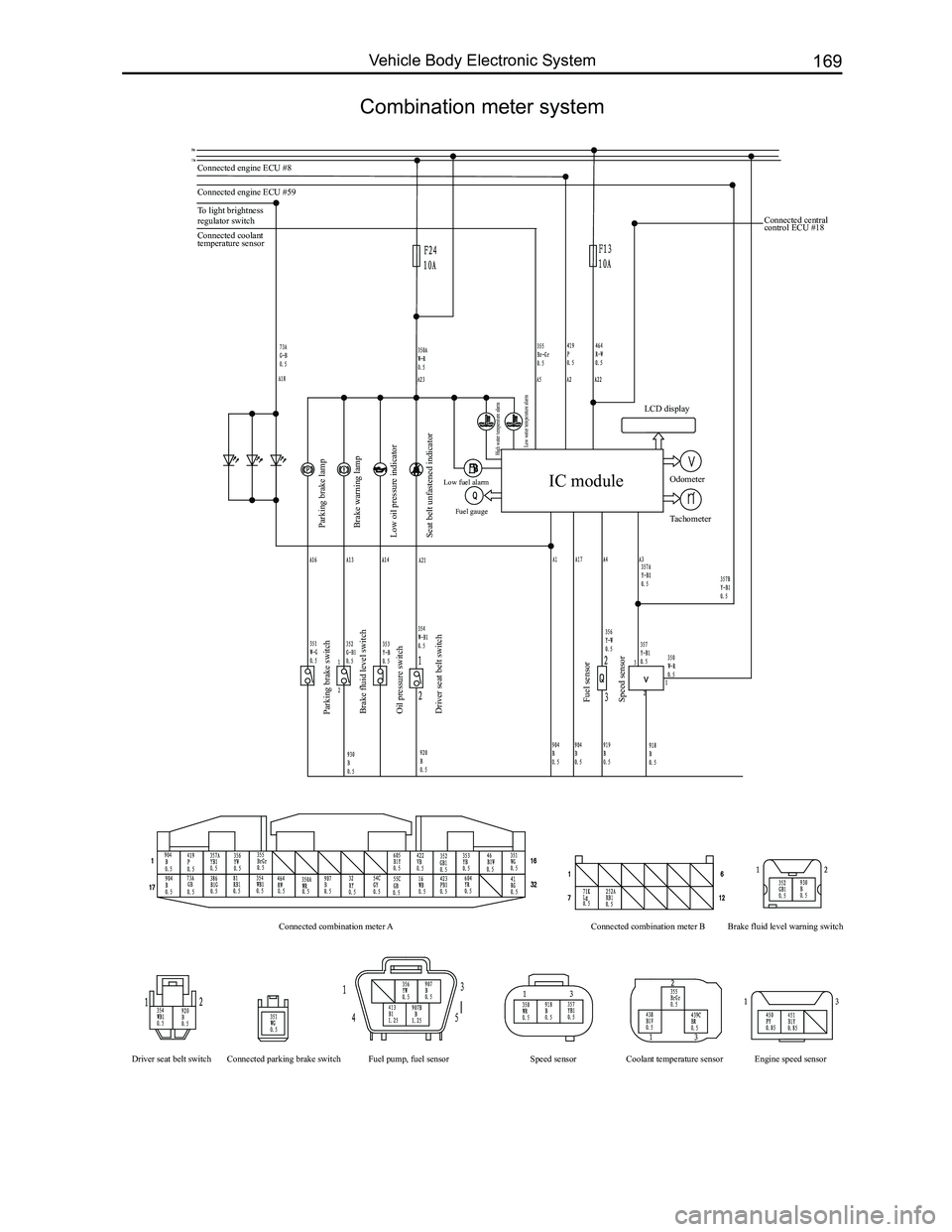
Combination meter system
Connected engine ECU #8
Connected engine ECU #59
To light brightness
regulator switch
Parking brake lamp
Parking brake switch
Brake fluid level switch
Oil pressure switch
Driver seat belt switch
Fuel sensor
Speed sensor
Connected combination meter A
Driver seat belt switch Connected parking brake switch Fuel pump, fuel sensor Coolant temperature sensor Engine speed sensor
Speed sensor Connected combination meter B
Brake fluid level warning switch
Brake warning lamp
Low oil pressure indicator
Seat belt unfastened indicator
Low fuel alarm Fuel gauge
High water temperature alarm
Low water temperature alarm
Connected coolant
temperature sensor Connected central
control ECU #18
IC module
LCD display
Odometer
Tachometer
Page 177 of 281
Downloaded from www.Manualslib.com manuals search engine GWFLORID Maintenance Manual170
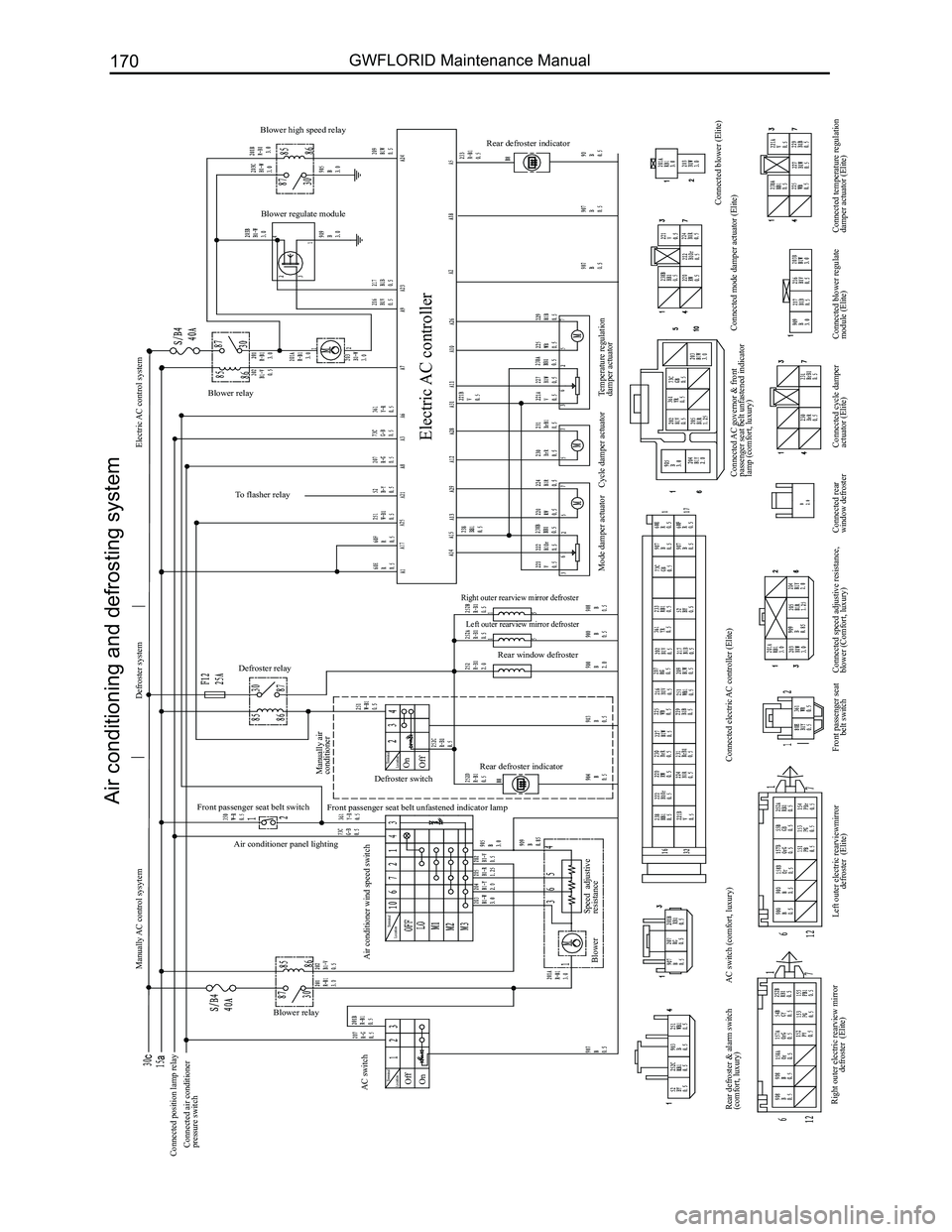
Air conditioning and defrosting system
Rear window defroster
Connected position lamp relay Manually AC control sysytem
Defroster system Electric AC control system
Connected air conditioner
pressure switch
Blower relay
Air conditioner
panel lighting Defroster switch
Rear defroster indicator
Left outer rearview mirror defroster
Right outer rearview mirror defroster
Front passenger seat belt switch Defroster relay
To flasher relay
Blower relay Blower regulate module
Blower high speed relay
Rear defroster indicator
Front passenger seat belt unfastened indicator lamp
Air conditioner wind speed switch
Blower Speed adjustive
resistance
Rear defroster & alarm switch
(comfort, luxury) Right outer electric rearview mirror defroster (Elite) Left outer electric rearviewmirror
defroster (Elite) Front passenger seat
belt switch Connected speed adjustive resistance,
blower (Comfort, luxury) Connected rear
window defroster Connected cycle damper
actuator (Elite) Connected blower regulate
module (Elite) Connected temperature regulation
damper actuator (Elite)
AC switch (comfort, luxury)
Connected electric AC controller (Elite)
Connected AC governor & front
passenger seat belt unfastened indicator
lamp (comfort, luxury) Connected mode damper actuator (Elite) Connected blower (Elite)
Mode damper actuator
Cycle damper actuator Temperature regulation
damper actuator
Manually
air
conditioner
Electric AC controller
AC switch
Off
On Off On Terminal
Terminal Terminal
Location Location
Location
Page 182 of 281
Downloaded from www.Manualslib.com manuals search engine 175Vehicle Body Electronic System
Electric horn
Horn switch
High pitched Electric horn
Low pitched Electric horn
Front fog lamp LH
Front fog lamp RH
Left outer electric rearview mirror (left turn signal lamp) Right outer electric rearview mirror
(right turn signal lamp) Left combination switch (light)
Horn switch High pitched horn Low pitched horn Connected left
license plate lamp Connected light brightness
regulator switch Connected headlight vertical
adjustment switch
Front fog lamp LH
Front combination lamp RH Front combination lamp LH Rear combination lamp LH Rear combination lamp RH Rear defroster & alarm switch Connected rear fog lamp RH Connected rear fog lamp LH Connected left headlight
vertical adjustment motor Connected right headlight
vertical adjustment motor Connected right license
plate lamp
Front fog lamp RH
Rear fog lamp LH
Rear fog lamp RH
Rear fog indicator lamp
Left headlight adjustment motor
Right headlight adjustment motor High beam relay
Lamp
ON Low
beam
Low
beam High
beam
High
beam Over-
taking
Over-
taking
Lamp
Off
Low beam relay
Parking lamp relay
Flasher relay
Connected combination
meter A18
Connected central
control ECU #8
Connected central
control ECU #1
Connected central
control ECU #2
Connected central
control ECU #14
Front parking
lamp LH Front turn signal
lamp LH
Rear turn signal
lamp LH
Left turn
signal lamp
Left turn
signal lamp
Front turn
signal lamp RH
Rear turn signal
lamp RH
Right turn
signal lamp
Right turn
signal lamp
Front parking
lamp RH
Rear parking
lamp LH
Rear parking
lamp RH
Left license
plate lamp
Right license
plate lamp
Light main switch indicator
Turn signal lamp switch
Alarm switch Light brightness regulator switch
Ignition key cylinder light Glove box lamp
Reading lamp (Elite) Reading lamp
Rear interior dome lamp
Connected central control ECU #9
High beam indicator Left headlight
Right headlight Headlight vertical switch
red and
white
red and
white
Fog lamp switch
Pin
position Pin
position
Left turn
Right turn Off
Front fog
lamp
Rear fog
lamp Off
Horn relay
Front fog lamp relay
Rear fog lamp relay
Lighting system Steering & alarm lamp control system
Interior lighting system
Terminal
Location
Off On
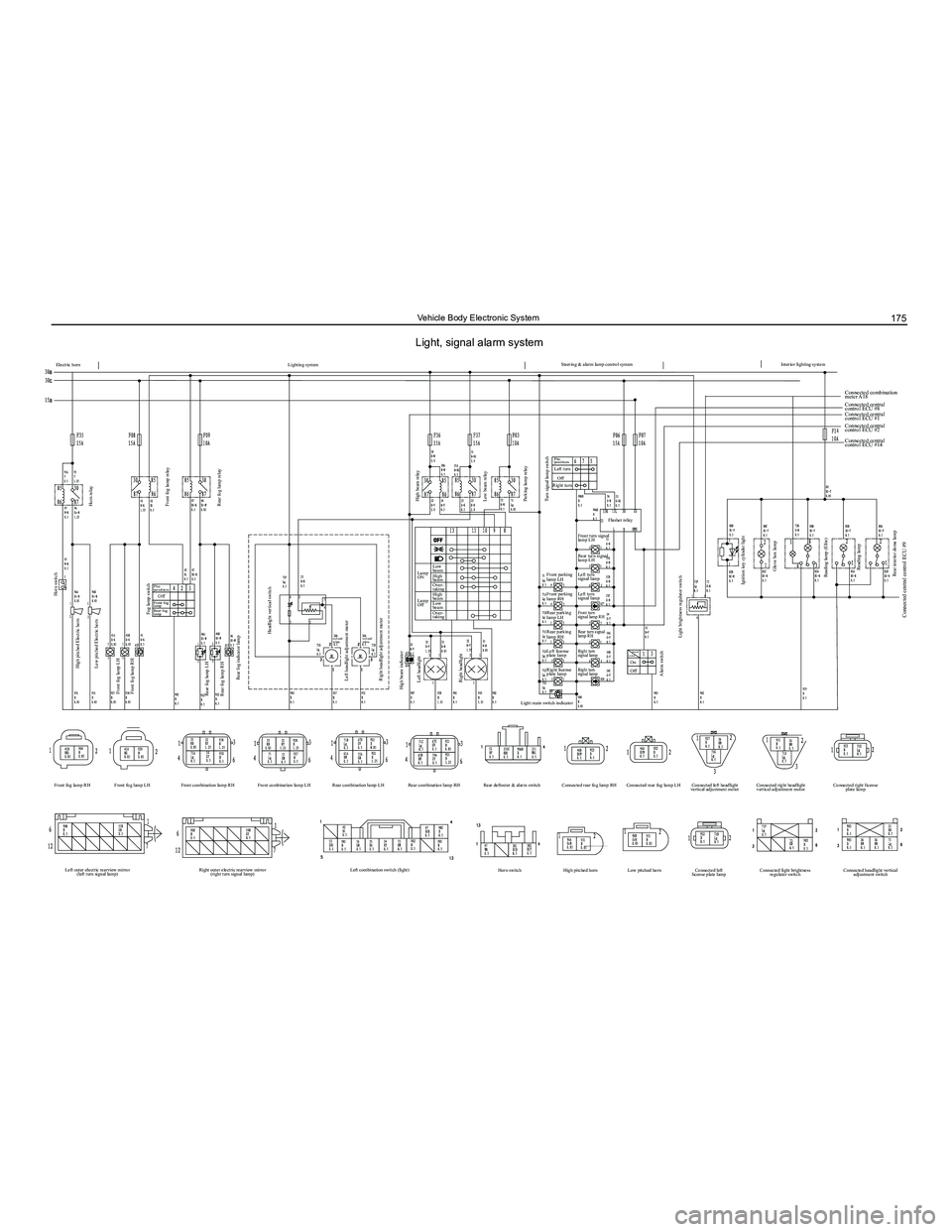
Light, signal alarm system
Page 186 of 281
Downloaded from www.Manualslib.com manuals search engine 179Electrical Accessories
Functional description and display program
1. This system will be activated within the first second after engaging the reverse gear. There will be two
beeps indicating the system is working properly.
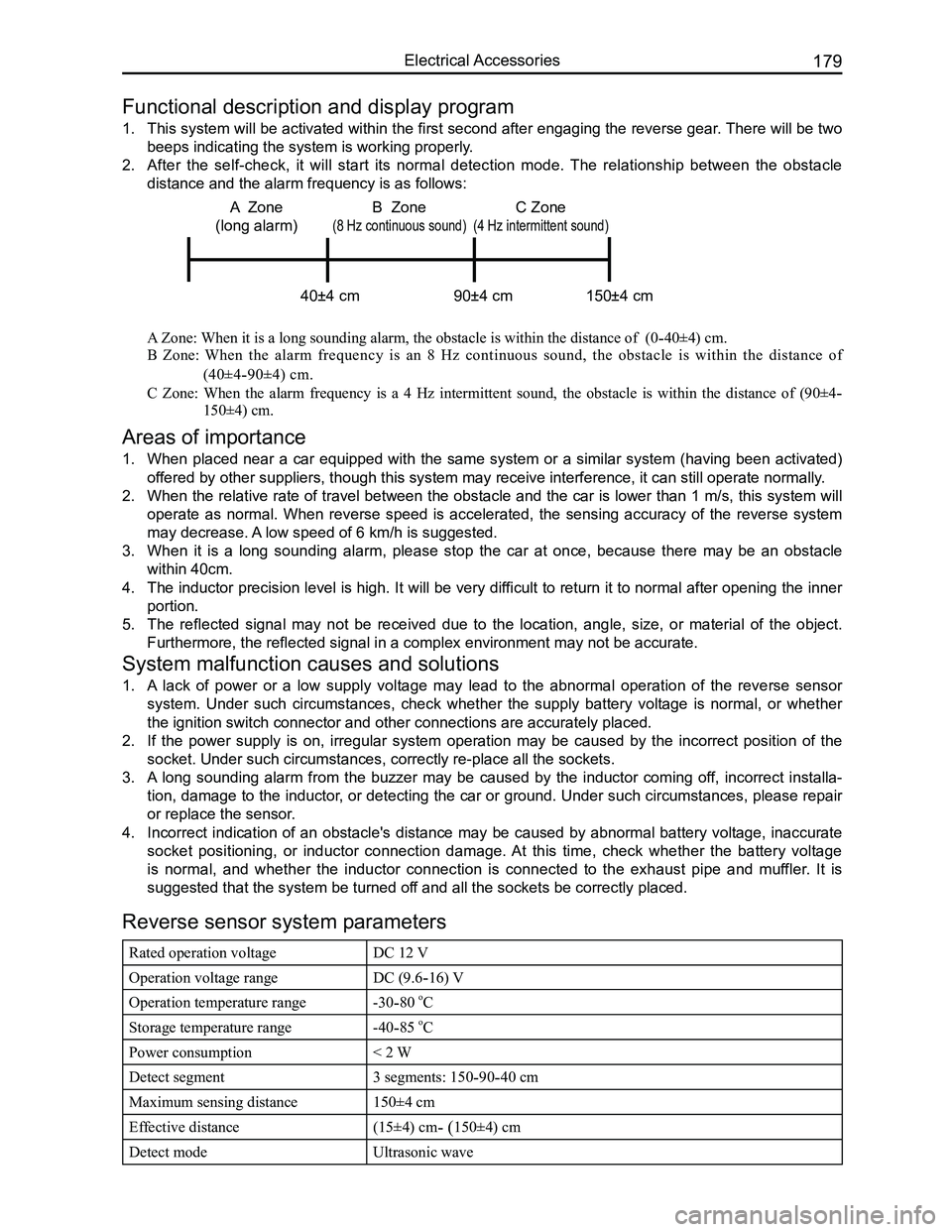
2. After the self-check, it will start its normal detection mode. The relationship between the obstacle
distance and the alarm frequency is as follows:
A Zone: When it is a long sounding alarm, the obstacle is within the distance of (0-40±4) cm.
B Zone: When the alarm frequency is an 8 Hz continuous sound, the obstacle is within the distance of
(40±4-90±4) cm.
C Zone: When the alarm frequency is a 4 Hz intermittent sound, the obstacle is within the distance of (90±4-
150±4) cm.
Areas of importance
1. When placed near a car equipped with the same system or a similar system (having been activated)
offered by other suppliers, though this system may receive interference, i\
t can still operate normally.
2. When the relative rate of travel between the obstacle and the car is lower than 1 m/s, this system will
operate as normal. When reverse speed is accelerated, the sensing accuracy of the reverse system
may decrease. A low speed of 6 km/h is suggested.
3. When it is a long sounding alarm, please stop the car at once, because there may be an obstacle
within 40cm.
4. The inductor precision level is high. It will be very difficult to return it to normal after opening the inner
portion.
5. The reflected signal may not be received due to the location, angle, size, or material of the object.
Furthermore, the reflected signal in a complex environment may not be ac\
curate.
System malfunction causes and solutions
1. A lack of power or a low supply voltage may lead to the abnormal operation of the reverse sensor
system. Under such circumstances, check whether the supply battery voltage is normal, or whether
the ignition switch connector and other connections are accurately place\
d.
2. If the power supply is on, irregular system operation may be caused by the incorrect position of the
socket. Under such circumstances, correctly re-place all the sockets.
3. A long sounding alarm from the buzzer may be caused by the inductor coming off, incorrect installa-
tion, damage to the inductor, or detecting the car or ground. Under such circumstances, please repair
or replace the sensor.
4. Incorrect indication of an obstacle's distance may be caused by abnormal battery voltage, inaccurate
socket positioning, or inductor connection damage. At this time, check whether the battery voltage
is normal, and whether the inductor connection is connected to the exhaust pipe and muffler. It is
suggested that the system be turned off and all the sockets be correctly placed.
Reverse sensor system parameters
Rated operation voltageDC 12 V
Operation voltage rangeDC (9.6-16) V
Operation temperature range-30-80 oC
Storage temperature range-40-85 oC
Power consumption< 2 W
Detect segment3 segments: 150-90-40 cm
Maximum sensing distance150±4 cm
Effective distance(15±4) cm- (150±4) cm
Detect modeUltrasonic wave
C Zone
(4 Hz intermittent sound)
40±4 cm 90±4 cm 150±4 cm
A Zone
(long alarm)
B Zone
(8 Hz continuous sound)
Page 195 of 281
Downloaded from www.Manualslib.com manuals search engine GWFLORID Maintenance Manual188
not necessarily mean that engine start failure is due to a immobilizer system malfunction. The reasons for start-
ing engine failures are numerous, including factors like fuel, gas, fire, electricity, wires, etc. If the engine cannot
start, first check if the immobilizer system is working normally. This can be judged by looking at the flashing
theft deterrent indicator lamp which is located on the dashboard in front of the driver seat: Insert the key into the
lock cylinder and turn it to the "ON" position. If a legal key is used to start the engine, once the warning lamp is
connected to the ON end and the transponder is confirmed, the LED will remain unlit. Then when the ON end is
disconnected and the key is pulled out, the LED will shine for 0.25 s and darken for 4 s, as to act as a warning.
If an illegal key is used to start up the engine or there is something wrong with the system, the alarm indicator
lamp will shine for 0.25 s and darken for 4 s. If all is normal, then check the other parts of the engine. If abnor-
mal, first perform immobilizer system troubleshooting. A scanner can be used to judge if the immobilizer system
is working normally, but the precondition is that the scanner must be able to establish communication with the
theft deterrent controller.
1. If communication cannot be established, consider the following:
(a) Check whether the battery voltage is higher than 9 V
(b) Check whether the scanner plug is well contacted to the vehicle socket
(c) Use a multimeter to check whether the 7 pin of the OBD-II plug (diagnostic plug) is connected to the theft
deterrent controller's A7 pin
(d) Check whether the power supply of the theft deterrent controller is normal. (Use a multimeter to measure
whether the voltage of the theft deterrent controller's socket A1 pin and A2 pin is higher than 9 V)
(e) Then adopt the substitution method, which is to replace the theft deterrent controller to check if there is
anything wrong with the theft deterrent controller.
• If the failure is related to the theft deterrent controller, change it and initiate re-matching.
• If the failure has nothing to do with the theft deterrent controller, remove the electronic controller which
is connected to the alarm's K wire, such as the ABS controller, engine electrojet controller, airbag ECU
assembly, etc., as to ascertain if the present fault is caused by the wire harness connected with the theft
deterrent controller's K wire.
2. If communication can be established
Connect the scanner to the vehicle diagnostic port. Insert the key into the steering lock, and turn it to the "ON"
position, then select the scanner to check the immobilizer system's trou\
ble code.
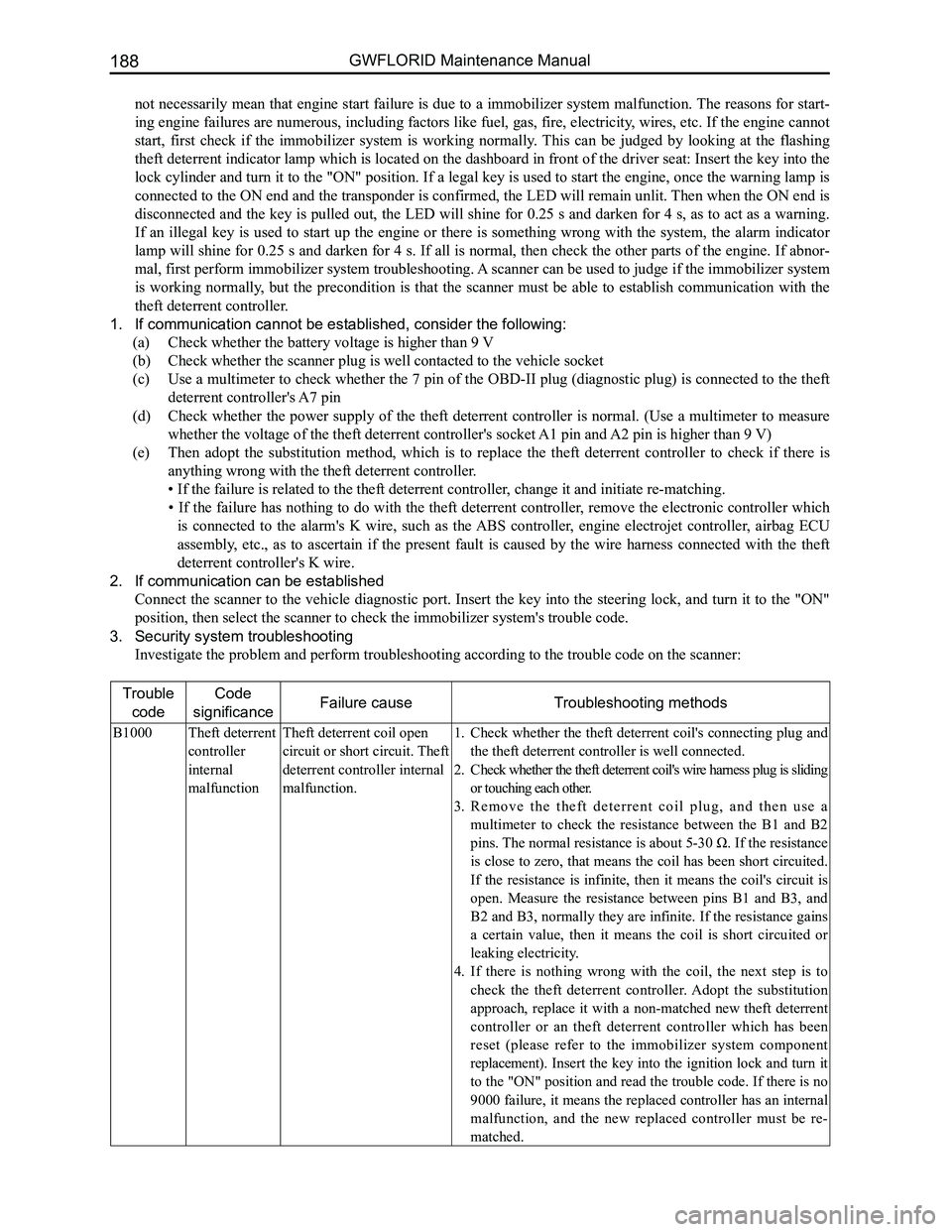
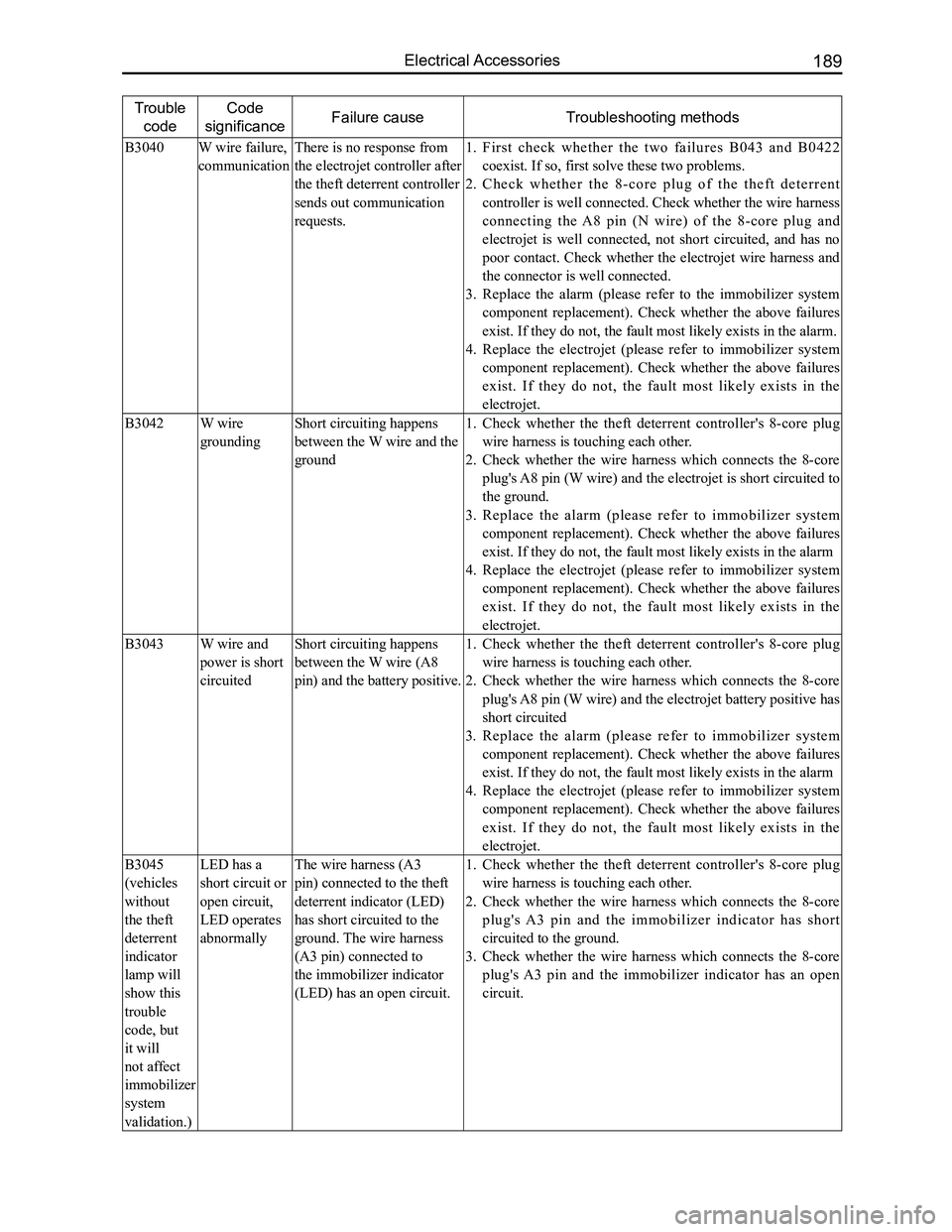
3. Security system troubleshooting
Investigate the problem and perform troubleshooting according to the tro\
uble code on the scanner:
Trouble
code
Code
significanceFailure causeTroubleshooting methods
B1000Theft deterrent
controller
internal
malfunction
Theft deterrent coil open
circuit or short circuit. Theft
deterrent controller internal
malfunction.
Check whether the theft deterrent coil's connecting plug and 1.
the theft deterrent controller is well connected.
Check whether the theft deterrent coil's wire harness plug is sliding 2.
or touching each other.
R e m o v e t h e t h e f t d e t e r r e n t c o i l p l u g , a n d t h e n u s e a 3.
multimeter to check the resistance between the B1 and B2
pins. The normal resistance is about 5-30 Ω. If the resistance
is close to zero, that means the coil has been short circuited.
If the resistance is infinite, then it means the coil's circuit is
open. Measure the resistance between pins B1 and B3, and
B2 and B3, normally they are infinite. If the resistance gains
a certain value, then it means the coil is short circuited or
leaking electricity.
If there is nothing wrong with the coil, the next step is to 4.
check the theft deterrent controller. Adopt the substitution
approach, replace it with a non-matched new theft deterrent
controller or an theft deterrent controller which has been
reset (please refer to the immobilizer system component
replacement). Insert the key into the ignition lock and turn it
to the "ON" position and read the trouble code. If there is no
9000 failure, it means the replaced controller has an internal
malfunction, and the new replaced controller must be re-
matched.
Page 196 of 281
Downloaded from www.Manualslib.com manuals search engine 189Electrical Accessories
Trouble
code
Code
significanceFailure causeTroubleshooting methods
B3040W wire failure,
communication
There is no response from
the electrojet controller after
the theft deterrent controller
sends out communication
requests.
First check whether the two failures B043 and B0422 1.
coexist. If so, first solve these two problems.
C h e c k w h e t h e r t h e 8 - c o r e p l u g o f t h e t h e f t d e t e r r e n t 2.
controller is well connected. Check whether the wire harness
connecting the A8 pin (N wire) of the 8-core plug and
electrojet is well connected, not short circuited, and has no
poor contact. Check whether the electrojet wire harness and
the connector is well connected.
Replace the alarm (please refer to the immobilizer system 3.
component replacement). Check whether the above failures
exist. If they do not, the fault most likely exists in the alarm.
Replace the electrojet (please refer to immobilizer system 4.
component replacement). Check whether the above failures
exist. If they do not, the fault most likely exists in the
electrojet.
B3042W wire
grounding
Short circuiting happens
between the W wire and the
ground
Check whether the theft deterrent controller's 8-core plug 1.
wire harness is touching each other.
Check whether the wire harness which connects the 8-core 2.
plug's A8 pin (W wire) and the electrojet is short circuited to
the ground.
Replace the alarm (please refer to immobilizer system 3.
component replacement). Check whether the above failures
exist. If they do not, the fault most likely exists in the alarm
Replace the electrojet (please refer to immobilizer system 4.
component replacement). Check whether the above failures
exist. If they do not, the fault most likely exists in the
electrojet.
B3043W wire and
power is short
circuited
Short circuiting happens
between the W wire (A8
pin) and the battery positive.
Check whether the theft deterrent controller's 8-core plug 1.
wire harness is touching each other.
Check whether the wire harness which connects the 8-core 2.
plug's A8 pin (W wire) and the electrojet battery positive has
short circuited
Replace the alarm (please refer to immobilizer system 3.
component replacement). Check whether the above failures
exist. If they do not, the fault most likely exists in the alarm
Replace the electrojet (please refer to immobilizer system 4.
component replacement). Check whether the above failures
exist. If they do not, the fault most likely exists in the
electrojet.
B3045
(vehicles
without
the theft
deterrent
indicator
lamp will
show this
trouble
code, but
it will
not affect
immobilizer
system
validation.)
LED has a
short circuit or
open circuit,
LED operates
abnormally
The wire harness (A3
pin) connected to the theft
deterrent indicator (LED)
has short circuited to the
ground. The wire harness
(A3 pin) connected to
the immobilizer indicator
(LED) has an open circuit.
Check whether the theft deterrent controller's 8-core plug 1.
wire harness is touching each other.
Check whether the wire harness which connects the 8-core 2.
plug's A3 pin and the immobilizer indicator has short
circuited to the ground.
Check whether the wire harness which connects the 8-core 3.
plug's A3 pin and the immobilizer indicator has an open
circuit.