length GREAT WALL FLORID 2008 Service Manual
[x] Cancel search | Manufacturer: GREAT WALL, Model Year: 2008, Model line: FLORID, Model: GREAT WALL FLORID 2008Pages: 281, PDF Size: 43.97 MB
Page 18 of 281
Downloaded from www.Manualslib.com manuals search engine 11Overall Parameters
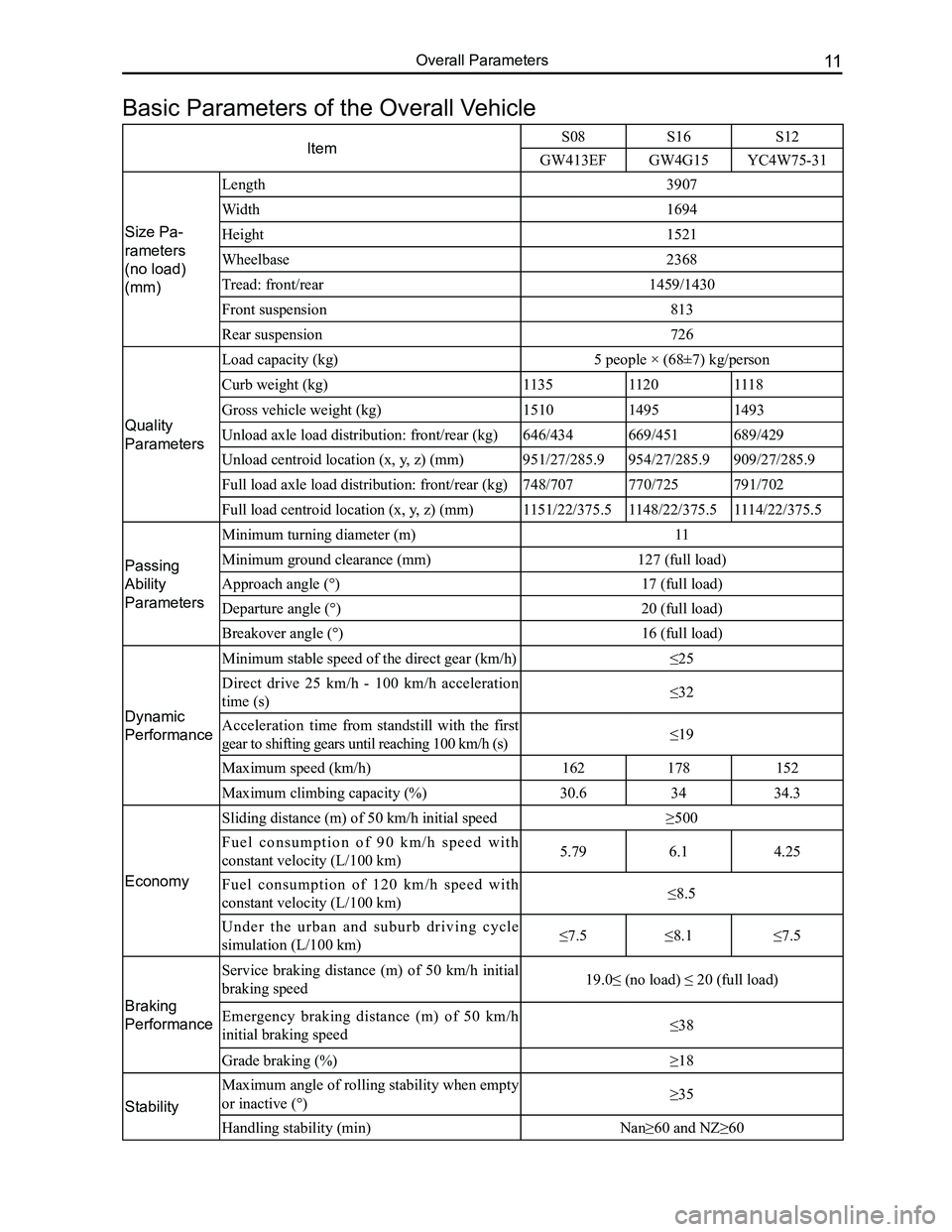
ItemS08 S16S12
GW413EFGW4G15YC4W75-31
Size Pa-
rameters
(no load)
(mm)
Length3907
Width1694
Height1521
Wheelbase2368
Tread: front/rear1459/1430
Front suspension813
Rear suspension726
Quality
Parameters
Load capacity (kg)5 people × (68±7) kg/person
Curb weight (kg)113511201118
Gross vehicle weight (kg)151014951493
Unload axle load distribution: front/rear (kg)646/434669/451689/429
Unload centroid location (x, y, z) (mm)951/27/285.9954/27/285.9909/27/285.9
Full load axle load distribution: front/rear (kg)748/707770/725791/702
Full load centroid location (x, y, z) (mm)1151/22/375.51148/22/375.51114/22/375.5
Passing
Ability
Parameters
Minimum turning diameter (m)11
Minimum ground clearance (mm)127 (full load)
Approach angle (°)17 (full load)
Departure angle (°)20 (full load)
Breakover angle (°)16 (full load)
Dynamic
Performance
Minimum stable speed of the direct gear (km/h)≤25
Direct drive 25 km/h - 100 km/h acceleration
time (s)≤32
Acceleration time from standstill with the first
gear to shifting gears until reaching 100 km/h (s)≤19
Maximum speed (km/h)162178152
Maximum climbing capacity (%)30.63434.3
Economy
Sliding distance (m) of 50 km/h initial speed≥500
F u e l c o n s u m p t i o n o f 9 0 k m / h s p e e d w i t h
constant velocity (L/100 km)5.796.14.25
Fuel consumption of 120 km/h speed with
constant velocity (L/100 km)≤8.5
U n d e r t h e u r b a n a n d s u b u r b d r i v i n g c y c l e
simulation (L/100 km)≤7.5≤8.1≤7.5
Braking
Performance
Service braking distance (m) of 50 km/h initial
braking speed19.0≤ (no load) ≤ 20 (full load)
Emergency braking distance (m) of 50 km/h
initial braking speed ≤38
Grade braking (%)≥18
Stability
Maximum angle of rolling stability when empty
or inactive (°)≥35
Handling stability (min)Nan≥60 and NZ≥60
Basic Parameters of the Overall Vehicle
Page 29 of 281
Downloaded from www.Manualslib.com manuals search engine GWFLORID Maintenance Manual22
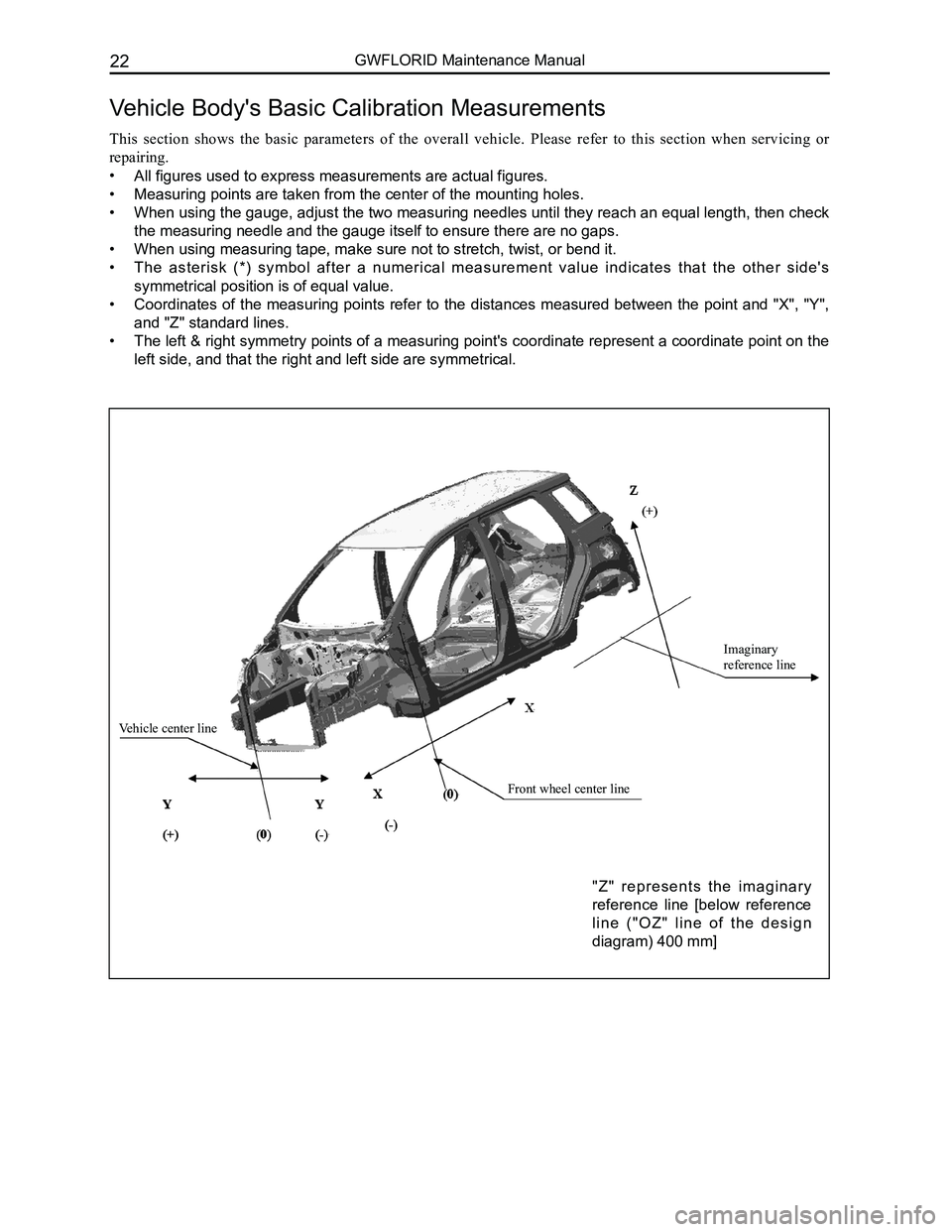
Imaginary
reference line
Front wheel center line
Vehicle center line
"Z" represents the imaginary
reference line [below reference
l i n e ( " O Z " l i n e o f t h e d e s i g n
diagram) 400 mm]
Vehicle Body's Basic Calibration Measurements
This section shows the basic parameters of the overall vehicle. Please refer to this section when servicing or
repairing.
• All figures used to express measurements are actual figures.
• Measuring points are taken from the center of the mounting holes.
• When using the gauge, adjust the two measuring needles until they reach an equal length, then check
the measuring needle and the gauge itself to ensure there are no gaps.
• When using measuring tape, make sure not to stretch, twist, or bend it. \
• The asterisk (*) symbol after a numerical measurement value indicates that the other side's
symmetrical position is of equal value.
• Coordinates of the measuring points refer to the distances measured between the point and "X", "Y",
and "Z" standard lines.
• The left & right symmetry points of a measuring point's coordinate represent a coordinate point on the
left side, and that the right and left side are symmetrical.
Page 137 of 281
Downloaded from www.Manualslib.com manuals search engine GWFLORID Maintenance Manual130
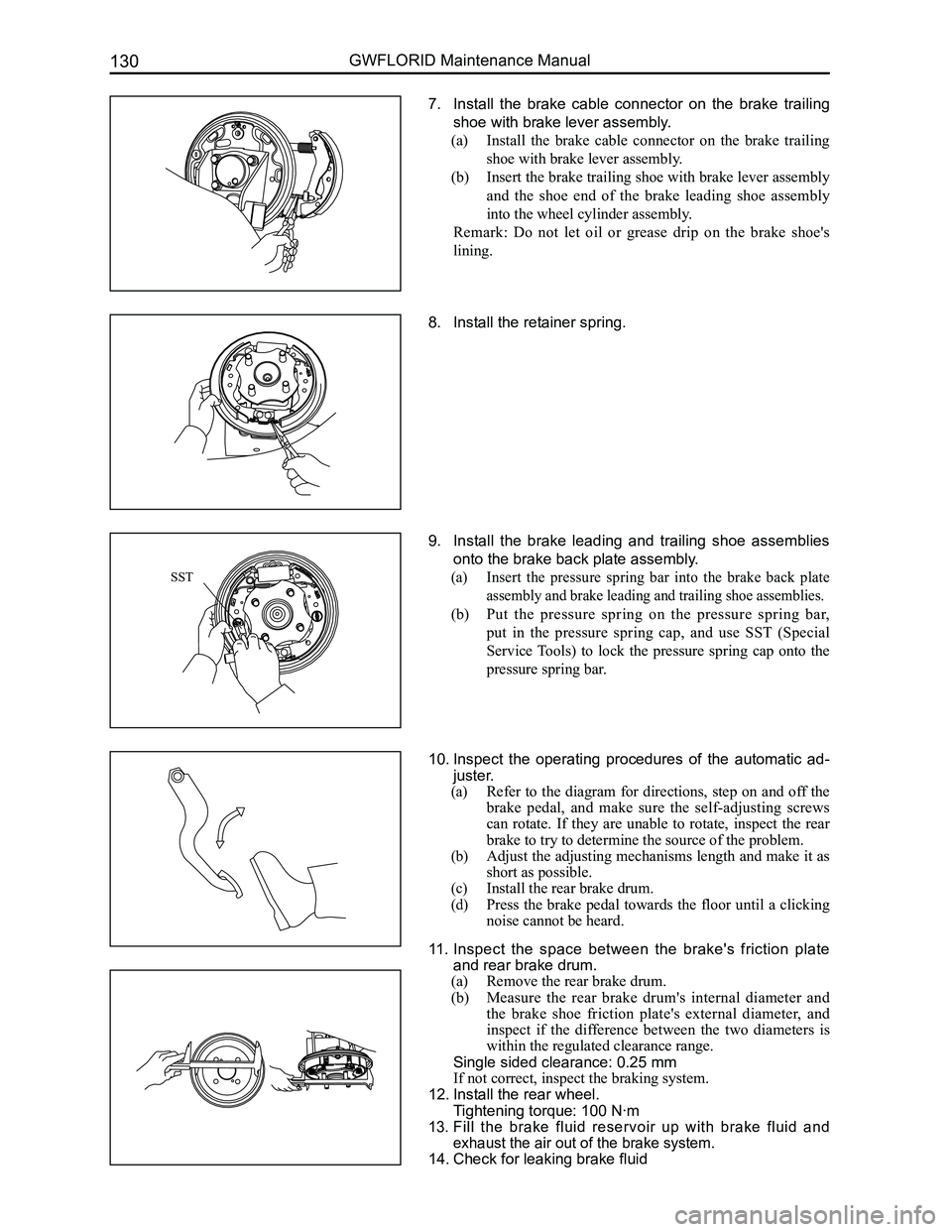
7. Install the brake cable connector on the brake trailing
shoe with brake lever assembly.
(a) Install the brake cable connector on the brake trailing
shoe with brake lever assembly.
(b) Insert the brake trailing shoe with brake lever assembly
and the shoe end of the brake leading shoe assembly
into the wheel cylinder assembly.
Remark: Do not let oil or grease drip on the brake shoe's
lining.
8. Install the retainer spring.
9. Install the brake leading and trailing shoe assemblies
onto the brake back plate assembly.
(a) Insert the pressure spring bar into the brake back plate
assembly and brake leading and trailing shoe assemblies.
(b) Put the pressure spring on the pressure spring bar,
put in the pressure spring cap, and use SST (Special
Service Tools) to lock the pressure spring cap onto the
pressure spring bar.
10. Inspect the operating procedures of the automatic ad-
juster.
(a) Refer to the diagram for directions, step on and off the
brake pedal, and make sure the self-adjusting screws
can rotate. If they are unable to rotate, inspect the rear
brake to try to determine the source of the problem.
(b) Adjust the adjusting mechanisms length and make it as
short as possible.
(c) Install the rear brake drum.
(d) Press the brake pedal towards the floor until a clicking
noise cannot be heard.
11. Inspect the space between the brake's friction plate
and rear brake drum.
(a) Remove the rear brake drum.
(b) Measure the rear brake drum's internal diameter and
the brake shoe friction plate's external diameter, and
inspect if the difference between the two diameters is
within the regulated clearance range.
Single sided clearance: 0.25 mm
If not correct, inspect the braking system.
12. Install the rear wheel.
Tightening torque: 100 N·m
13. Fill the brake fluid reservoir up with brake fluid and
exhaust the air out of the brake system.
14. Check for leaking brake fluid
SST