ECU GREAT WALL HOVER 2006 Service User Guide
[x] Cancel search | Manufacturer: GREAT WALL, Model Year: 2006, Model line: HOVER, Model: GREAT WALL HOVER 2006Pages: 425, PDF Size: 26.05 MB
Page 356 of 425
CD Player and Air Conditioning System-3
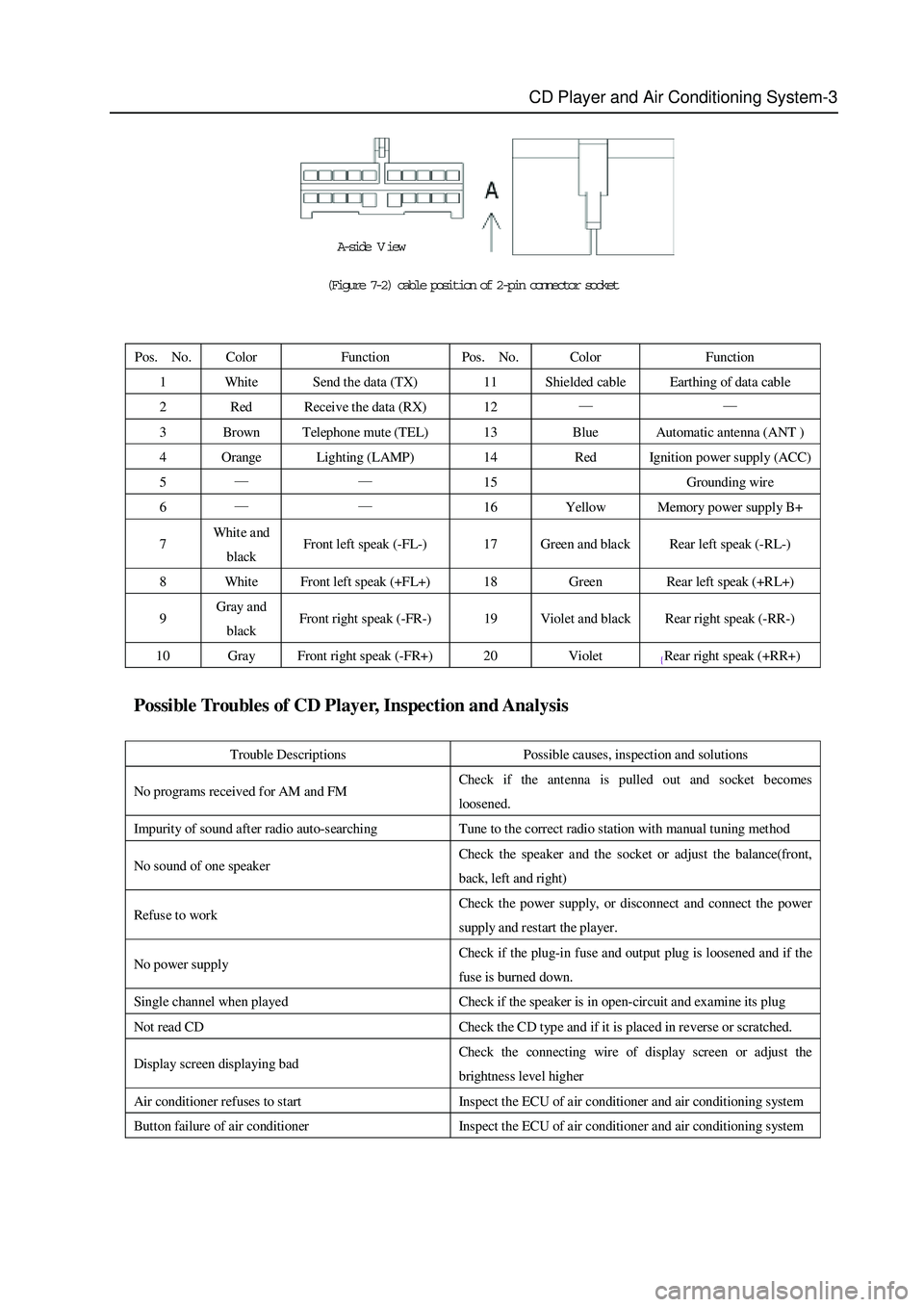
(Figure 7-2) cable position of 2-pin connector socket
Pos. No. Color Function Pos. No. Color Function
1 Whit e Send the data (TX) 11 Shielded cable Earthing of data cable
2 Red Receive the data (RX) 12 — —
3 Brown Telephone mute (TEL) 13 Blue Automatic antenna (ANT )
4 Orange Lighting (LAMP) 14 Red Ignition power supply (ACC)
5 — — 15 Grounding wire
6 — — 16 Yellow Memory power supply B+
7 Whit e and
black Front left speak (-FL-) 17 Green and black Rear left speak (-RL-)
8 White Front left speak (+FL+) 18 Green Rear left speak (+RL+)
9 Gray and
black Front right speak (-FR-) 19 Violet and black Rear right speak (-RR-)
10 Gray Front right speak (-FR+) 20 Violet {Rear right speak (+RR+)
Possible Troubles of CD Player, Inspection and Analysis
Trouble Descriptions Possible causes, inspection and solutions
No programs received for AM and FM Check if the antenna is pulled out and socket becomes
loosened.
Impurity of sound after radio auto-searching Tune to the correct radio station with manual tuning method
No sound of one speaker Check the speaker a nd the socket or adjust the balance(front,
back, left and right)
Refuse to work Check the power supply, or disconnect and connect the power
supply and restart the player.
No power supply Check if the plug-in fuse and output plug is loosened and if the
fuse is burned down.
Single channel when played Check if the speaker is in open-circuit and examine its plug
Not read CD Check the CD type and if it is placed in reverse or scratched.
Display screen displaying bad Check the connecting wire of display screen or adjust the
brightness level higher
Air conditioner refuses to start Inspect the ECU of air conditioner and air conditioning system
Button failure of air conditioner Inspect the ECU of air conditioner and air conditioning system
A-side V iew
Page 357 of 425
CD Player and Air Conditioning System-4
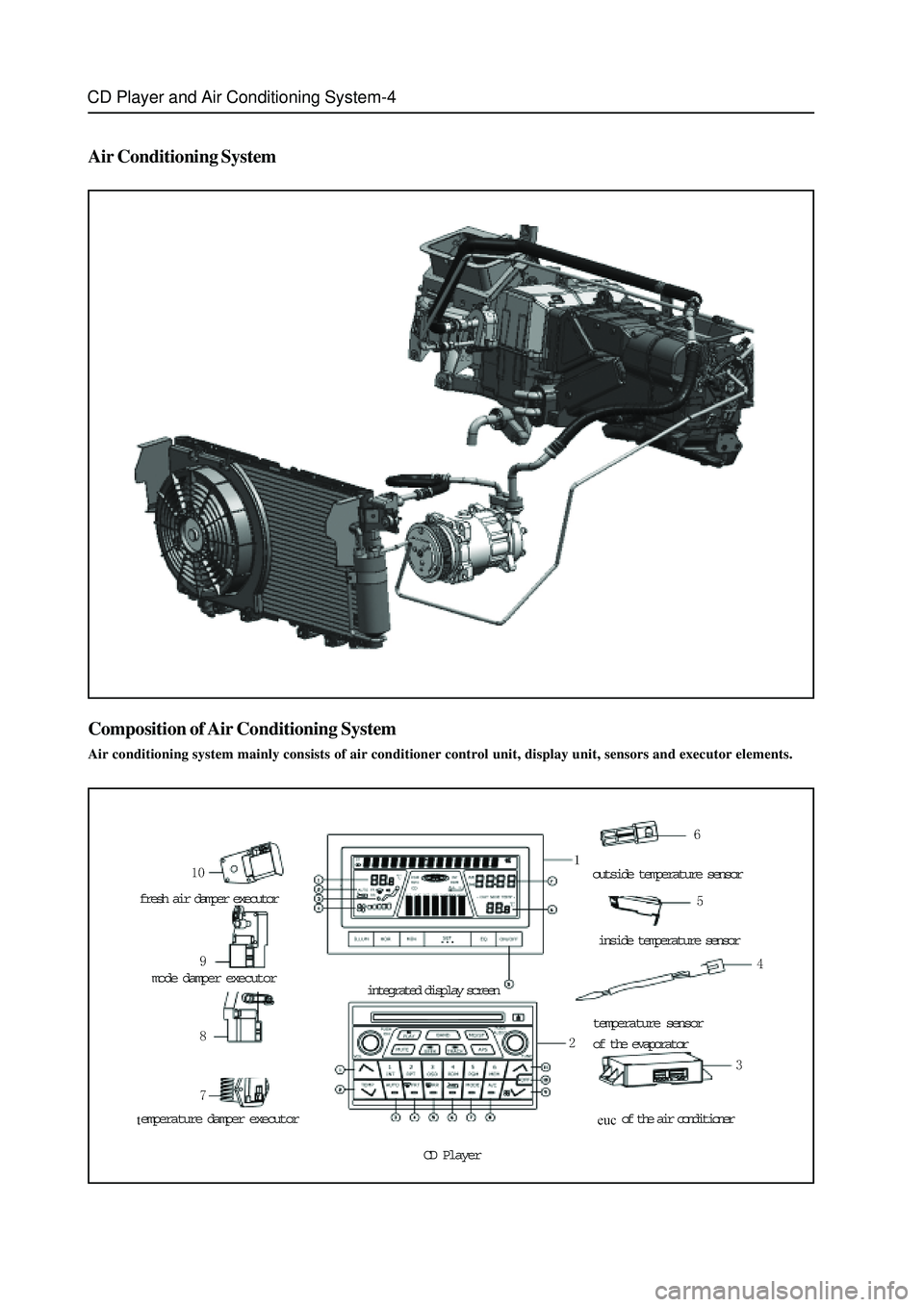
Air Conditioning System
Composition of Air Conditioning System
Air conditioning system mainly consists of air conditioner control unit, display unit, sensors and executor elements.
fresh air damper executor
mode damper executor
emperature damper executor
integrated display screen
CD Player
outside temperature sensor
inside temperature sensor
temperature sensor
of the evaporator
of the air conditioner
Page 358 of 425
CD Player and Air Conditioning System-5
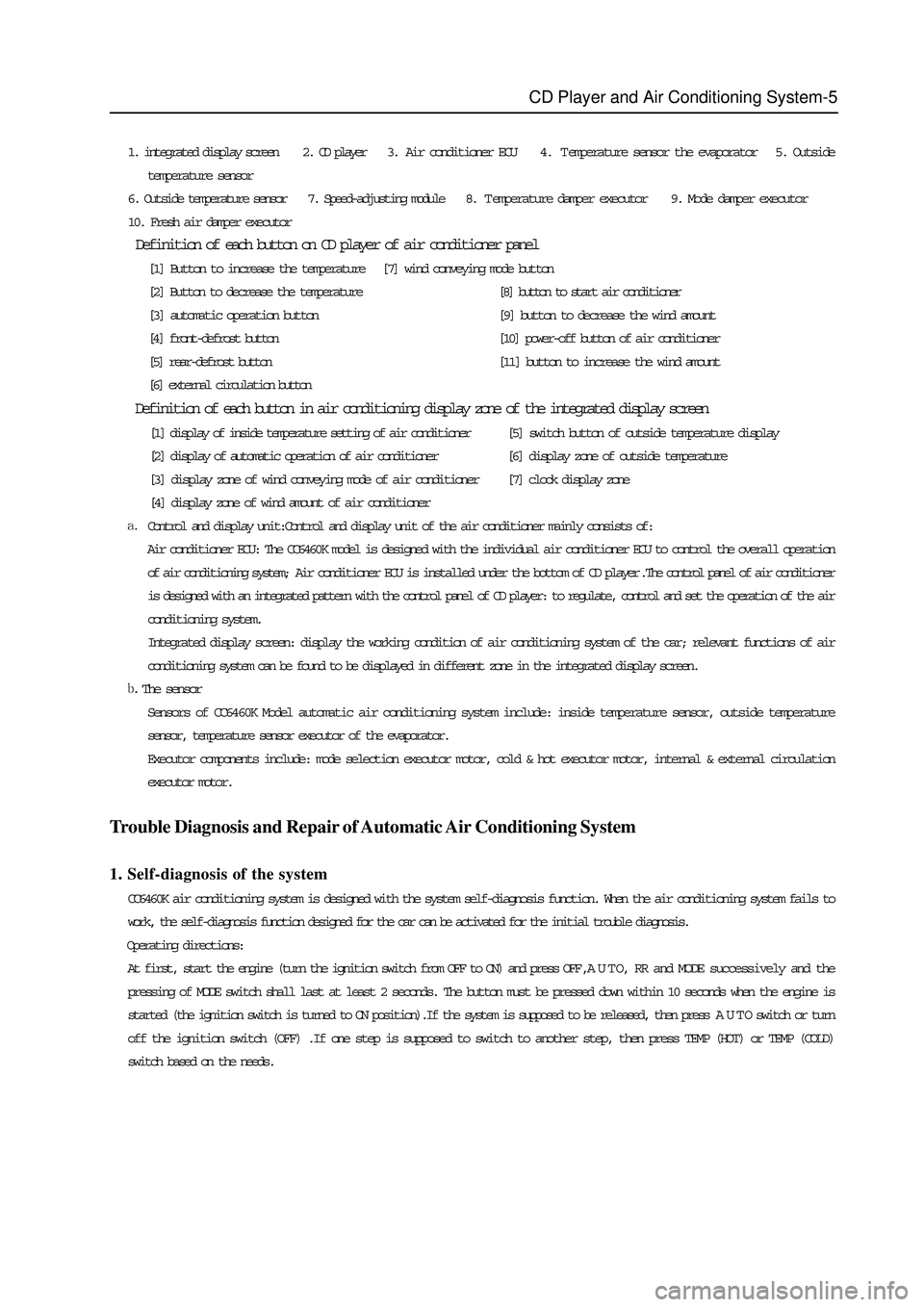
1. integrated display screen 2. CD player 3. Air conditioner ECU 4. Temperature sensor the evaporator 5. Outside
temperature sensor
6. Outside temperature sensor 7. Speed-adjusting module 8. Temperature damper executor 9. Mode damper executor
10. Fresh air damper executor
Definition of each button on CD player of air conditioner panel
[1] Button to increase the temperature [7] wind conveying mode button
[2] Button to decrease the temperature[8] button to start air conditioner
[3] automatic operation button[9] button to decrease the wind amount
[4] front-defrost button[10] power-off button of air conditioner
[5] rear-defrost button[11] button to increase the wind amount
[6] external circulation button
Definition of each button in air conditioning display zone of the integrated display screen
[1] display of inside temperature setting of air conditioner[5] switch button of outside temperature display
[2] display of automatic operation of air conditioner[6] display zone of outside temperature
[3] display zone of wind conveying mode of air conditioner[7] clock display zone
[4] display zone of wind amount of air conditioner
Control and display unit:Control and display unit of the air conditioner mainly consists of:
Air conditioner ECU: The CC6460K model is designed with the individual air conditioner ECU to control the overall operation
of air conditioning system; Air conditioner ECU is installed under the bottom of CD player.The control panel of air conditioner
is designed with an integrated pattern with the control panel of CD player: to regulate, control and set the operation of the air
conditioning system.
Integrated display screen: display the working condition of air conditioning system of the car; relevant functions of air
conditioning system can be found to be displayed in different zone in the integrated display screen.
The sensor
Sensors of CC6460K Model automatic air conditioning system include: inside temperature sensor, outside temperature
sensor, temperature sensor executor of the evaporator.
Executor components include: mode selection executor motor, cold & hot executor motor, internal & external circulation
executor motor.
Trouble Diagnosis and Repair of Automatic Air Conditioning System
1. Self-diagnosis of the system
CC6460K air conditioning system is designed with the system self-diagnosis function. When the air conditioning system fails to
work, the self-diagnosis function designed for the car can be activated for the initial trouble diagnosis.
Operating directions:
At first, start the engine (turn the ignition switch from OFF to ON) and press OFF , A U T O, RR and MODE successively and the
pressing of MODE switch shall last at least 2 seconds. The button must be pressed down within 10 seconds when the engine is
started (the ignition switch is turned to ON position).If the system is supposed to be released, then press A U T O switch or turn
off the ignition switch (OFF) .If one step is supposed to switch to another step, then press TEMP (HOT) or TEMP (COLD)
switch based on the needs.
Page 361 of 425
CD Player and Air Conditioning System-8
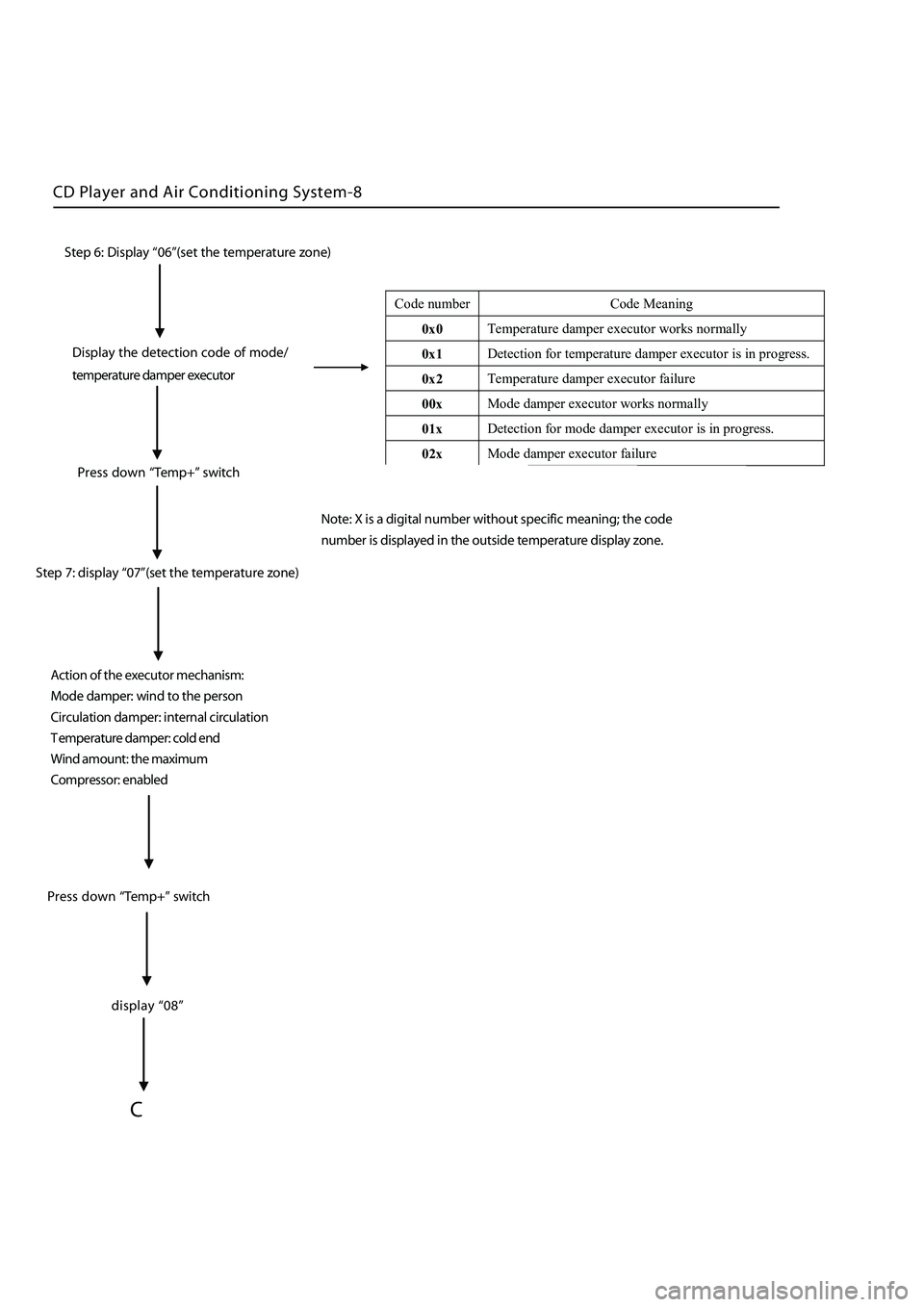
Step 6: Display “06”(set the temperature zone)
Press down “Temp+” switch
Display the detection code of mode/
temperature damper executor
Press down “Te mp+” switch
Step 7: display
“07”(set the temperature zone)
Action of the executor mechanism
:
M ode damper: wind to the person
Circulation damper: internal circulation
Te mperature damper: cold end
Wind amount: the maximum
Compressor: enabled Note: X is a digital number without specific meaning; the code
number
is displayed in the outside temperature display zone.
d isplay
“08”
C
Code number Code Meaning
0x0 Temperature damper executor works normally
0x1 Detection for temperature damper executor is in progress.
0x2 Temperature damper executor failure
00x Mode damper executor works normally
01x Detection for mode damper executor is in progress.
02x Mode damper executor failure
Page 362 of 425
CD Player and Air Conditioning System-9
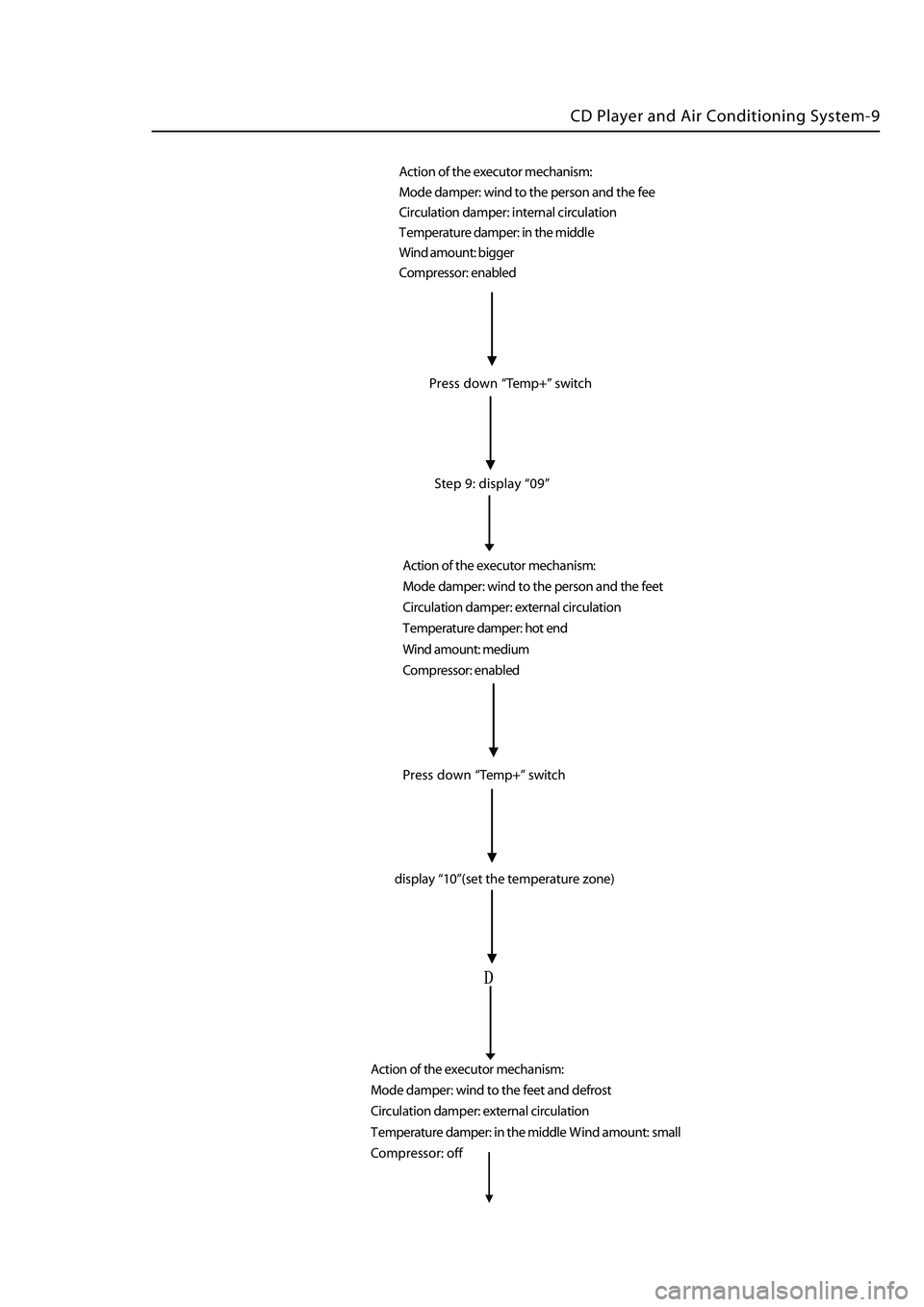
Step 9: display “09”
Action of the executor mechanism:
Mode damper: wind to the person and the fee
Circulation damper: internal circulation
Temperature damper: in the middle
W ind amount: bigger
Compressor: enabled
Action of the executor mechanism
:
M ode damper: wind to the feet and defrost
Circulation damper: external circulation
Te
m perature damper: in the middle Wind amount: small
Compressor: off
display
“
10”(set the temperature zone)
Action of the executor mechanism
:
M
ode damper: wind to the person and the feet
Circulation damper: external circulation
Te mperature damper: hot end
Wind amount: medium
Compressor: enabled
Press down
“Temp+” switch
Press
down
“Temp+” switch
Page 363 of 425
CD Player and Air Conditioning System-10
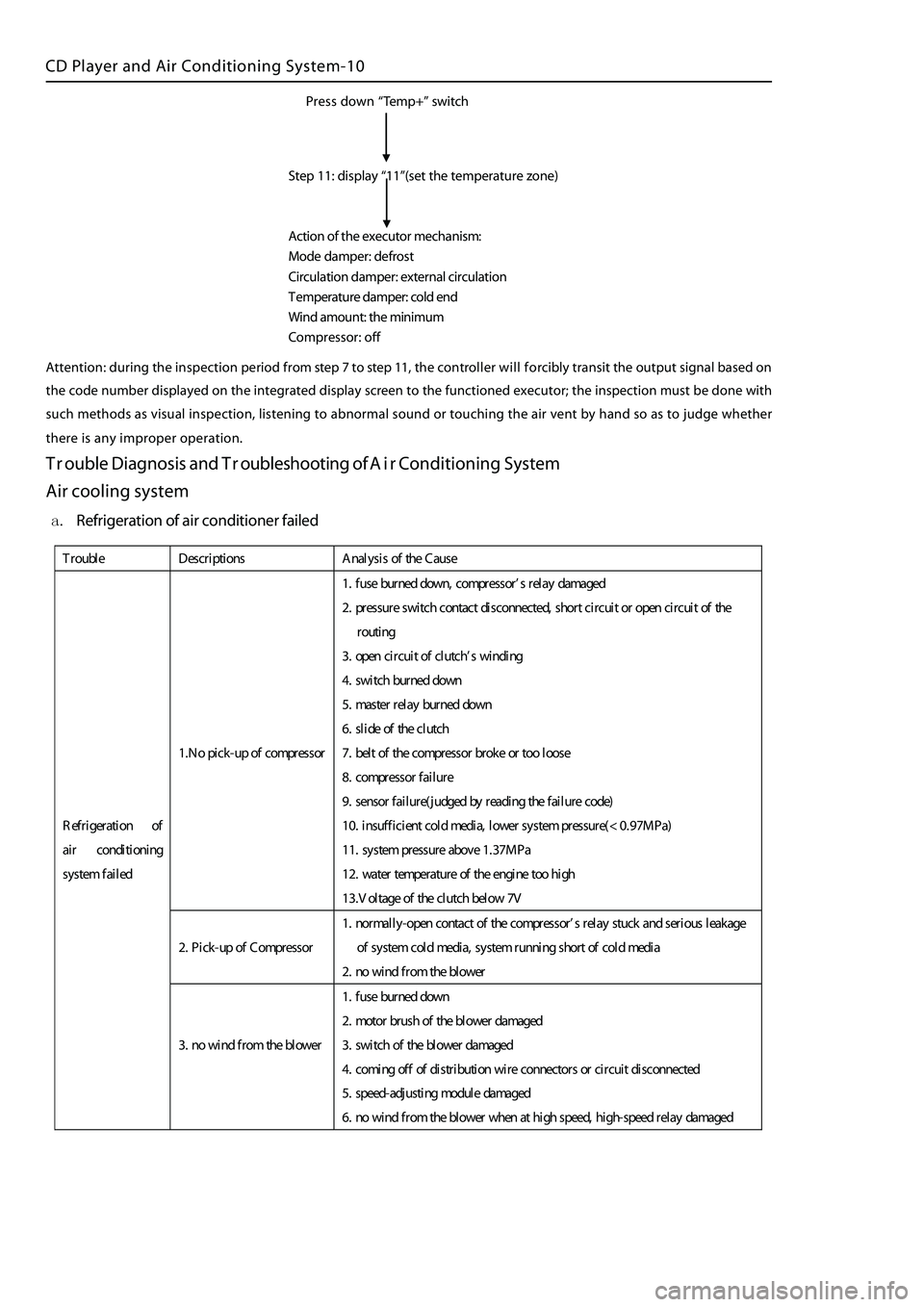
Refrigeration of air conditioner failed
T rou ble Des crip tion s Ana l ysis o f the Cause
1.No pick -up o f com pressor 1.
fuse burned down , com presso r’s r elay dama ge
d
2. pressu re sw itch contac t d isco nn ected, short c ircu itor open circ uit o f the
ro utin
g
3. open circ ui t o f clutch’ s w indi ng
4. sw itch burned down
5. ma ster relay b urne d d ow
n
6.
s lid e o f the clut ch
7. beltof the c om presso r b roke ortoo l oose
8. comp ressor failur
e
9. sens or failur e(ju dg ed by read ing t he failu recode
)
10. insu ffic ient cold me dia, lowe r system p ress ur e(< 0 .97M Pa
)
11. system pressu re abov e 1 .37M Pa
12. water t em peratu re of the e ngine t oo high
13. V oltag e o f the clut ch below 7
V
2. Pick -up o f Com pressor 1.
norm
ally -ope n c ontact of the c om presso r’s r elay stuc k a nd seriou s leaka ge
of system cold me dia, system runn ing s hortof cold me di
a
2. no wind from the b lowe
r
R e frig eratio n of
ai r c ondition in
g
syst emfaile
d
3.no wind from the b lowe
r 1.
fuse burned down
2. mo tor b rush ofthe b lowe r dam aged
3. sw itch ofthe b lowe r dam aged
4. comi ng off o f d istrib utio n w ire c onnector s o r circu itdisc
onne cted
5. speed-ad justin g m odule d amaged
6. no wind from the b lowe r w hen a t high s peed, h igh- sp ee d r elay dama ge
d
Press down “Temp+” switch
Step 11: display “11”(set the temperature zone)
Action of the executor mechanism
:
M ode damper: defrost
Circulation damper: external circulation
Te mperature damper: cold end
Wind amount: the minimum
Compressor: off
Attention: during the inspection period fr om step 7 to step 11, the controlle r
will for cibly transit the output signal based on
the code number displayed on the integrated display screen to the functioned executor; the inspection must be done with
such
m ethods as visual inspection, listening to abnormal sound or touching the air vent by hand so as to judge whether
there is any improper operation.
T rouble Diagnosis and T roubleshooting of A i r Conditioning System
Air cooling system
Page 366 of 425
CD Player and Air Conditioning System-13
1 .CC6460K air conditioning system is designed with SD7V16 compressor, whose refrigeration oil type as
specified is SP-10P AG; hence application of other type of refrigeration oil may damage the parts and compo
nents of the compressor. When the
air conditioning system goes through maintenance and replacement of
parts, it should be added with new refrigeration oil, whose volume is listed as follows: the evaporator and
condenser: 30ml; the drier: 20ml; the pipeline: 10ml.
Addition of refrigeration oil can be available with two methods: The direct addition and the vacuum suction
2 .D irect addition method
a. remove the oil filler plug and fill with the specified SP-10P AG refrigeration oil.
b. observe through the hole of oil filter plug and rotate front plate of clutch to make the piston connecting rod right positio n in the
center of the hole of oil filter plug.
c. insert the dipstick along the right side of piston connecting rod till the top of dipstick touches the case of the compresso
r
d. pull out the dipstick and examine the graduations (grooves) of refrigeration oil, the readings shall be within the range of 4-6
scales
.
e. screw firmly the oil filter plug with the fastening torque of 14.7± 4.9N
.m
3. Vacuum suction method:
Firstly pump out the refrigerating system to the vacuum of 0.2x10⁵Pa, and then fill with the specified 0.2x10 5 Pa refrigeration oil;
the detailed steps are as follows:
a. switch off the high-pressure manual valve and the auxiliary valve.
b. dismantle the high-pressure side hose from the manifold pressure gauge and insert it into the oil cu
p
c. open the auxiliary valve and have the refrigeration oil sucked into the refrigerating system from the oil cup.
d. when the refrigeration oil in the oil cup is almost pumped out to the vacuum, then immediately turn off the auxiliary valve
to
prevent the air from being sucked into the system
.
e. secure the hose adapter at high-pressure side to the manifold pressure gauge, start the vacuum pump and turn on the high-
pressure manual valve, then turn on the auxiliary valve to pump the system to the vacuum state of 0.2x10
5Pa, keep such state
for 15mins so as to discharge out the air flowing into the system along with the oil.
V ol ume of Refrigeration Oil Addition and its Methods
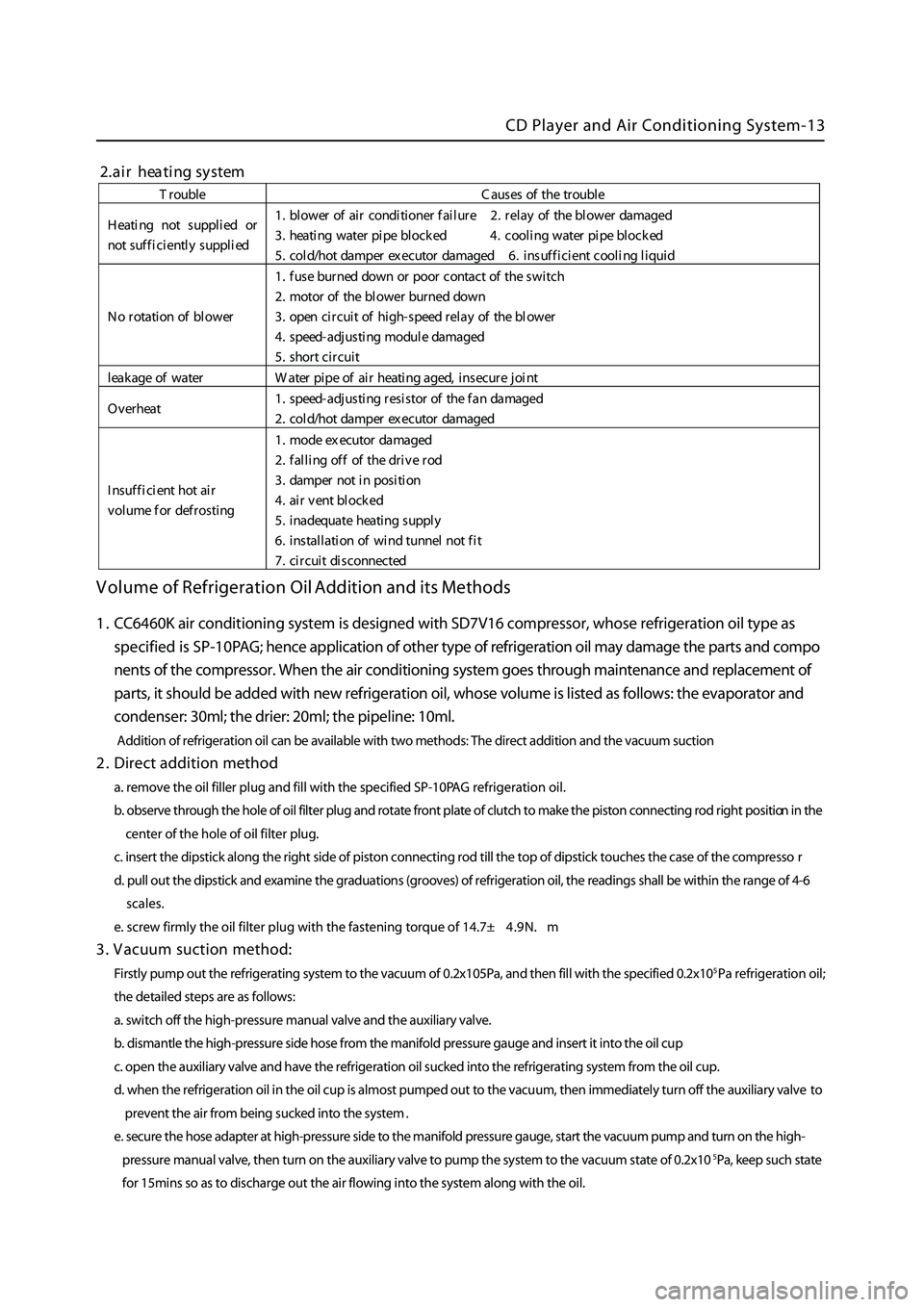
2.ai r h eating system
T r oubl e Cau ses o f the trouble
H e ati n g n otsuppl i ed or
no t s
uf f i cientl y suppl i ed 1.
blow erof air c ondition erf ai l u re 2.relay o f the blow erdamage
d
3. heati n g w ater pipe bloc k e d 4 . coo ling water p i pe b lock ed
5. col d/h ot damp erexecutor damage d 6. ins
uf f i cien t c oo ling l iqu id
N o rotation ofblow er 1.
f use burned
down orpoor contac t o f the switch
2. mo tor o f the blowe r burne d d ow
n
3. op en circ uit o f h igh- sp eed relay o f the blow er
4. speed-ad j usti n g m odule d am aged
5. short c ircu it
leak age o f w ater W ater p ipe o f ai rhe ati n g a ged, inse cu re j oi nt
O v erhe at 1.
speed-ad j usti n g r esi sto r o f the f an d am aged
2. col d/h ot damp erexecutor damaged
I nsu f f i cien t h otair
vo lume f or d efro stin
g 1.
mode executor dama ge
d
2. f al li n g o f fof the d riv e ro
d
3. damp ernot in p osi ti o
n
4. air v ent b l ock ed
5. inad equa te heatin g s
upply
6. inst
alla tion ofwind tunn elno t fi t
7. circ uit d i sco nn ecte
d
Page 370 of 425
CD Player and Air Conditioning System-17
Daily Maintenance of Air Conditioning System
In order to ensure normal operation of air conditioning system, maintenance and care services shall be frequently performed for the
air conditioning system. The daily maintenance of air conditioning system is illustrated as follows:
1. Inspect, wash and clean the condenser of air conditioning system, requiring that radiator pins are clean and there is no dirt
between the pins. After the car runs in the rain or on the muddy road, the fan of the condenser should be inspected to find
whether it bears the earth, sand, stone and etc, and remove them if any.
2. Check the quantity of the working media of the refrigerating system; when the compressor set works normally, observe the
liquid viewing glass, under the normal circumstance, there shall be not air bubbles in the glass.
3. Inspect the drive belt. The belt between the compressor and the engine should be tensioned.
4. Check if there is any abnormal noise or odor in the air conditioning system.
5. Check if the temperature difference between the air inlet and outlet of the compressor is normal.
6. Check if the hose of the refrigerating system is in an apparent good condition and connections of all joints are secure.
7. Check if the pipeline of the refrigerating system collides with other parts and components, and if there is any oil leakage trace
left at each joint.
8. Check if the circuit connection of the refrigerating system is secure and if there is an occurrence of short circuit and falling off
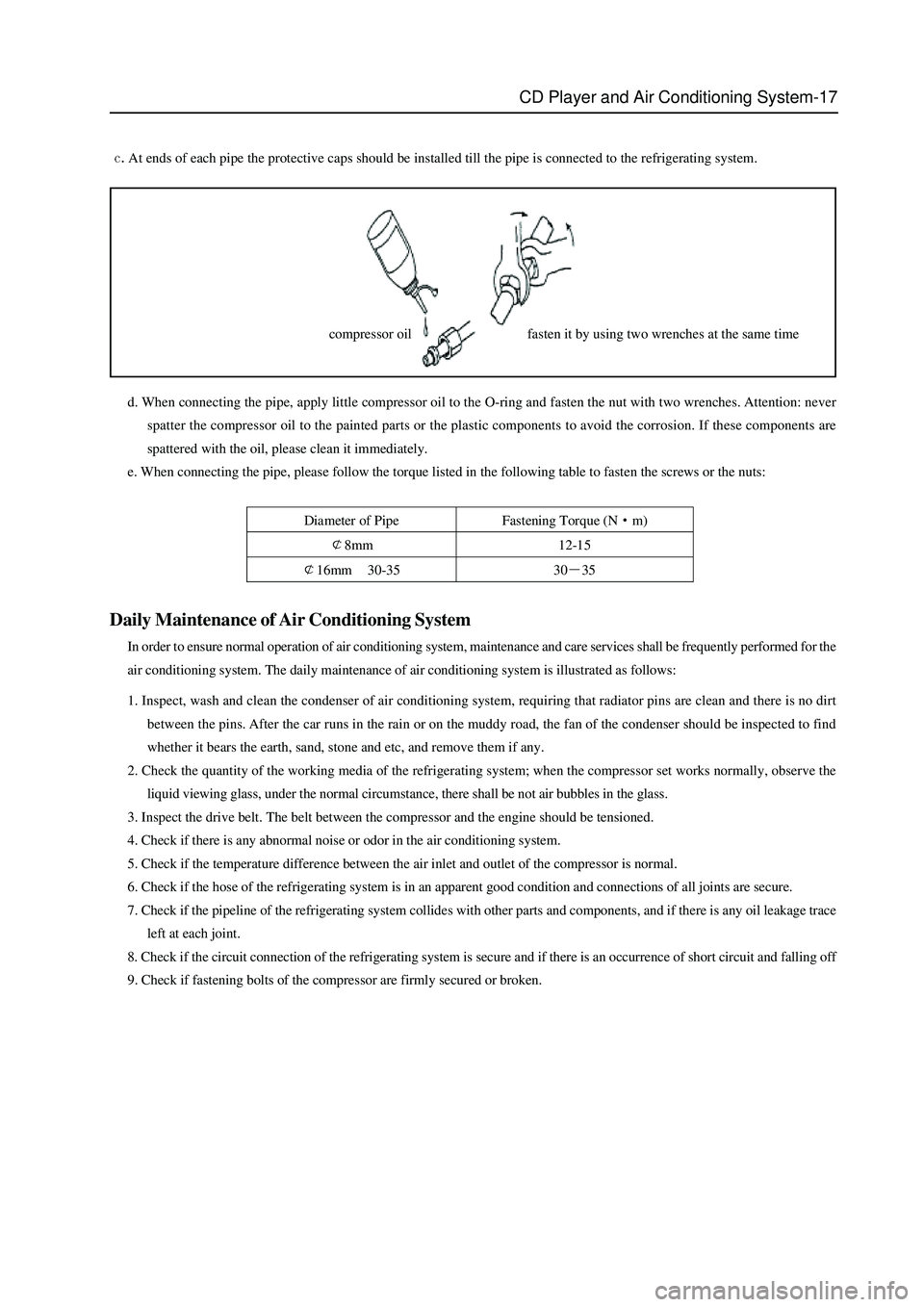
9. Check if fastening bolts of the compressor are firmly secured or broken. d. When connecting the pipe, apply little compressor oil to the O-ring and fasten the nut with two wrenches. Attention: never
spatter the compressor oil to the painted parts or the plastic components to avoid the corrosion. If these components are
spattered with the oil, please clean it immediately.
e. When connecting the pipe, please follow the torque listed in the following table to fasten the screws or the nuts:
Diameter of Pipe Fastening Torque (N·m)
¢8mm 12-15
¢16mm 30-35 30-35
At ends of each pipe the protective caps should be installed till the pipe is connected to the refrigerating system.
compressor oil fasten it by using two wrenches at the same time
Page 372 of 425
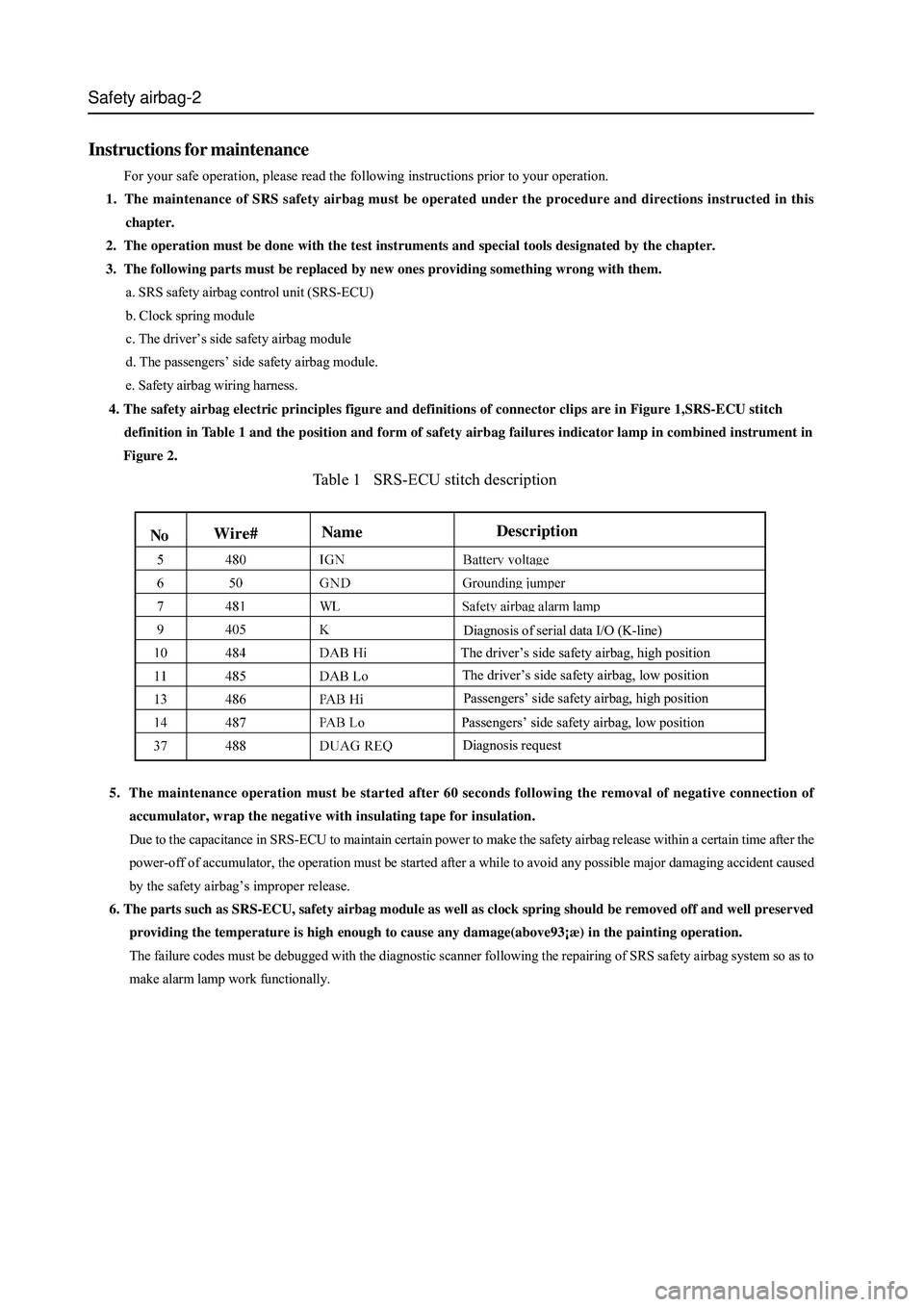
Safety airbag-2
Table 1 SRS-ECU stitch description
5. The maintenance operation must be started after 60 seconds following the removal of negative connection of
accumulator, wrap the negative with insulating tape for insulation.
Due to the capacitance in SRS-ECU to maintain certain power to make the safety airbag release within a certain time after the
power-off of accumulator, the operation must be started after a while to avoid any possible major damaging accident caused
by the safety airbag’s improper release.
6. The parts such as SRS-ECU, safety airbag module as well as clock spring should be removed off and well preserved
providing the temperature is high enough to cause any damage(above93¡æ) in the painting operation.
The failure codes must be debugged with the diagnostic scanner following the repairing of SRS safety airbag system so as to
make alarm lamp work functionally.
Instructions for maintenance
For your safe operation, please read the following instructions prior to your operation.
1. The maintenance of SRS safety airbag must be operated under the procedure and directions instructed in this
chapter.
2. The operation must be done with the test instruments and special tools designated by the chapter.
3. The following parts must be replaced by new ones providing something wrong with them.
a. SRS safety airbag control unit (SRS-ECU)
b. Clock spring module
c. The driver’s side safety airbag module
d. The passengers’ side safety airbag module.
e. Safety airbag wiring harness.
4. The safety airbag electric principles figure and definitions of connector clips are in Figure 1,SRS-ECU stitch
definition in Table 1 and the position and form of safety airbag failures indicator lamp in combined instrument in
Figure 2.
The driver’s side safety airbag, low position
Wire#Description
Name
Diagnosis request
The driver’s side safety airbag, high position
Passengers’ side safety airbag, high position
Passengers’ side safety airbag, low position
Diagnosis of serial data I/O (K-line)
Page 375 of 425
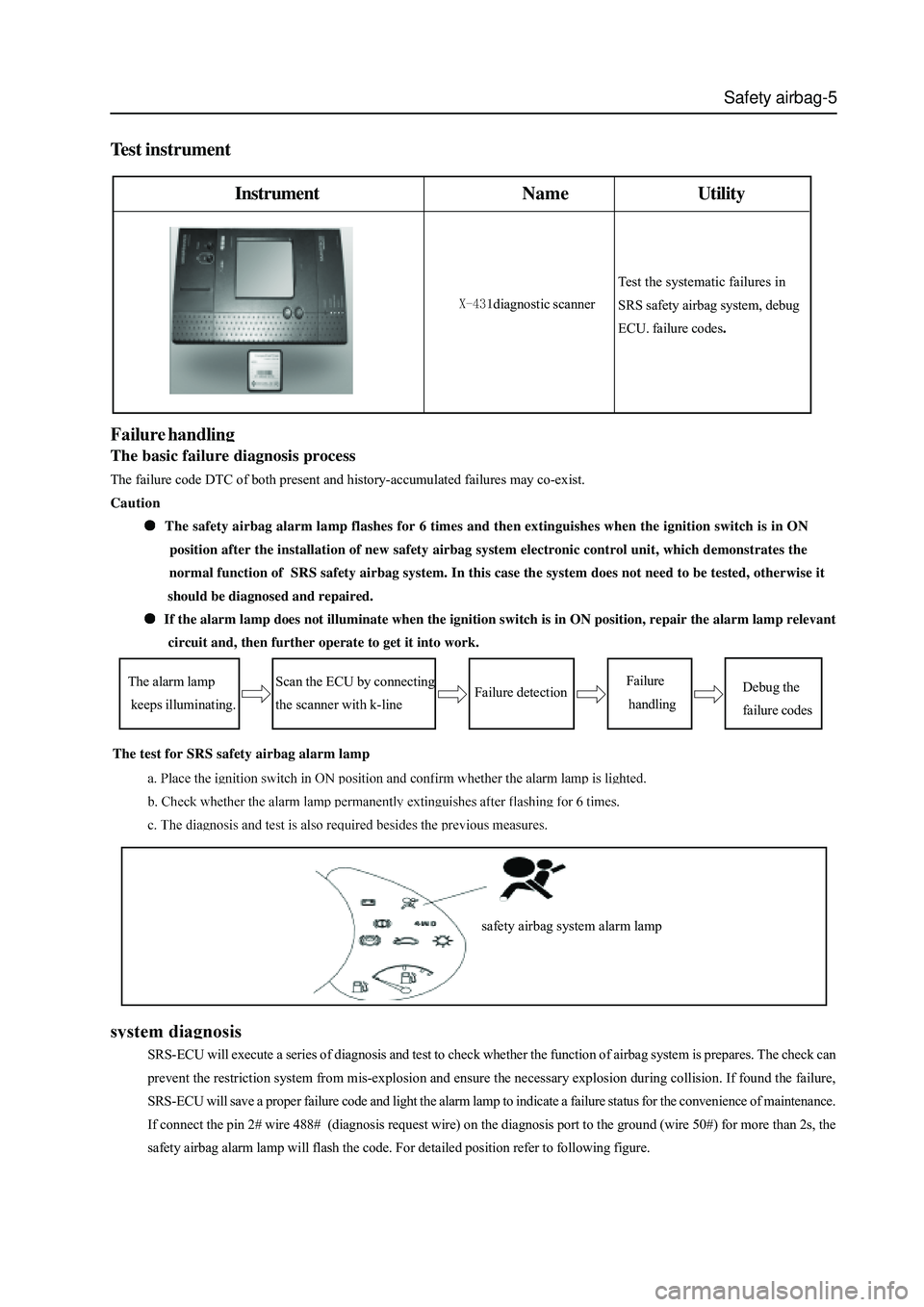
Safety airbag-5
Test instrument
InstrumentNameUtility
diagnostic scanner
The alarm lamp
keeps illuminating.Failure
handlingDebug the
failure codes
Test the systematic failures in
SRS safety airbag system, debug
ECU. failure codes.
The basic failure diagnosis process
The failure code DTC of both present and history-accumulated failures may co-exist.
Caution
The safety airbag alarm lamp flashes for 6 times and then extinguishes when the ignition switch is in ON
position after the installation of new safety airbag system electronic control unit, which demonstrates the
normal function of SRS safety airbag system. In this case the system does not need to be tested, otherwise it
should be diagnosed and repaired.
If the alarm lamp does not illuminate when the ignition switch is in ON position, repair the alarm lamp relevant
circuit and, then further operate to get it into work.
Scan the ECU by connecting
the scanner with k-lineFailure detection
The test for SRS safety airbag alarm lamp
SRS-ECU will execute a series of diagnosis and test to check whether the function of airbag system is prepares. The check can
prevent the restriction system from mis-explosion and ensure the necessary explosion during collision. If found the failure,
SRS-ECU will save a proper failure code and light the alarm lamp to indicate a failure status for the convenience of maintenance.
If connect the pin 2# wire 488# (diagnosis request wire) on the diagnosis port to the ground (wire 50#) for more than 2s, the
safety airbag alarm lamp will flash the code. For detailed position refer to following figure.safety airbag system alarm lamp