check engine GREAT WALL HOVER 2006 Service User Guide
[x] Cancel search | Manufacturer: GREAT WALL, Model Year: 2006, Model line: HOVER, Model: GREAT WALL HOVER 2006Pages: 425, PDF Size: 26.05 MB
Page 162 of 425
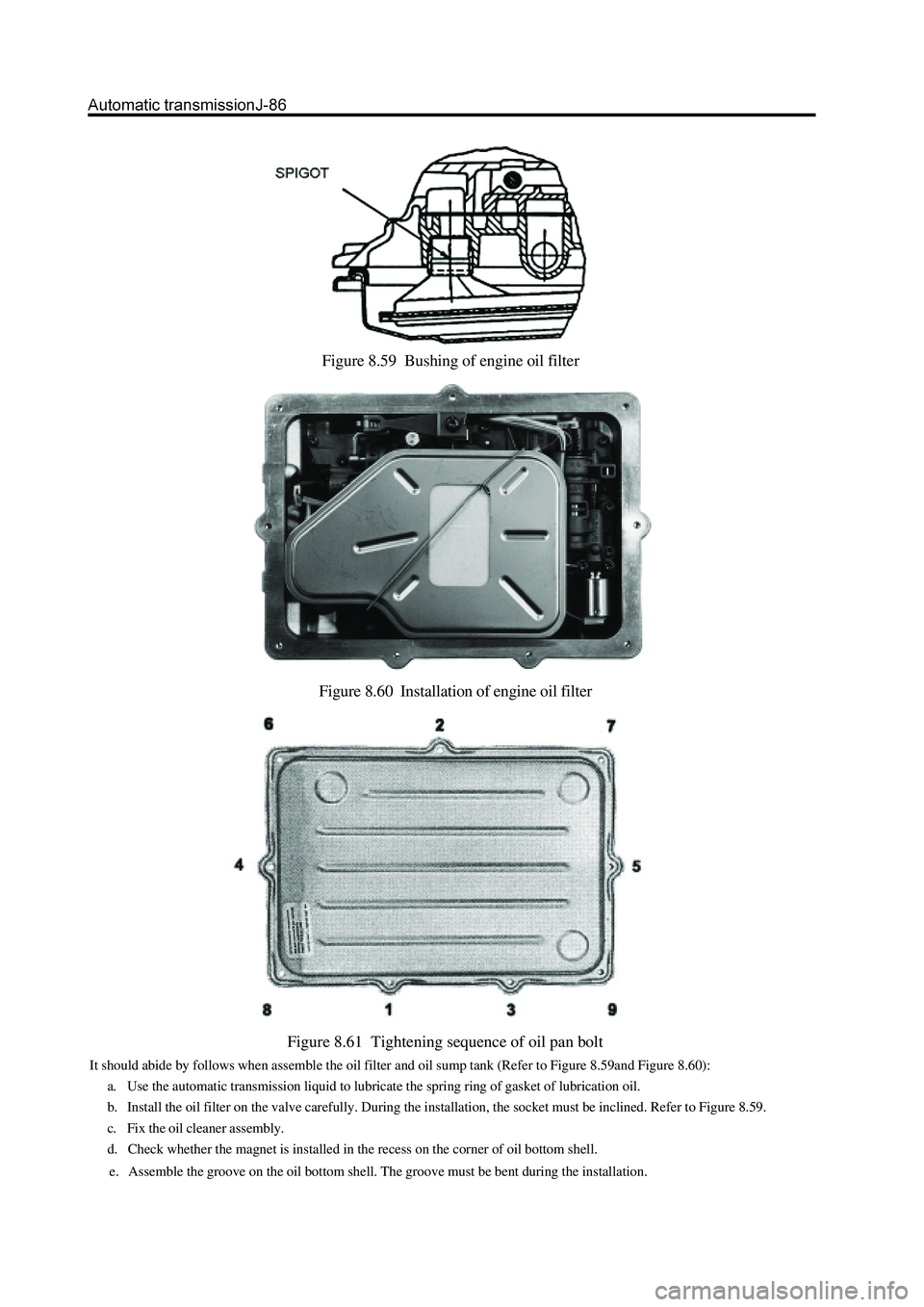
Figure 8.59 Bushing of engine oil filter
Figure 8.60 Installation of engine oil filter
Figure 8.61 Tightening sequence of oil pan bolt
It should abide by follows when assemble the oil filter and oil sump tank (Refer to Figure 8.59and Figure 8.60):
a. Use the automatic transmission liquid to lubricate the spring ring of gasket of lubrication oil.
b. Install the oil filter on the valve carefully. During the installation, the socket must be inclined. Refer to Figure 8.59.
c. Fix the oil cleaner assembly.
d. Check whether the magnet is installed in the recess on the corner of oil bottom shell.
e. Assemble the groove on the oil bottom shell. The groove must be bent during the installation.
Page 269 of 425
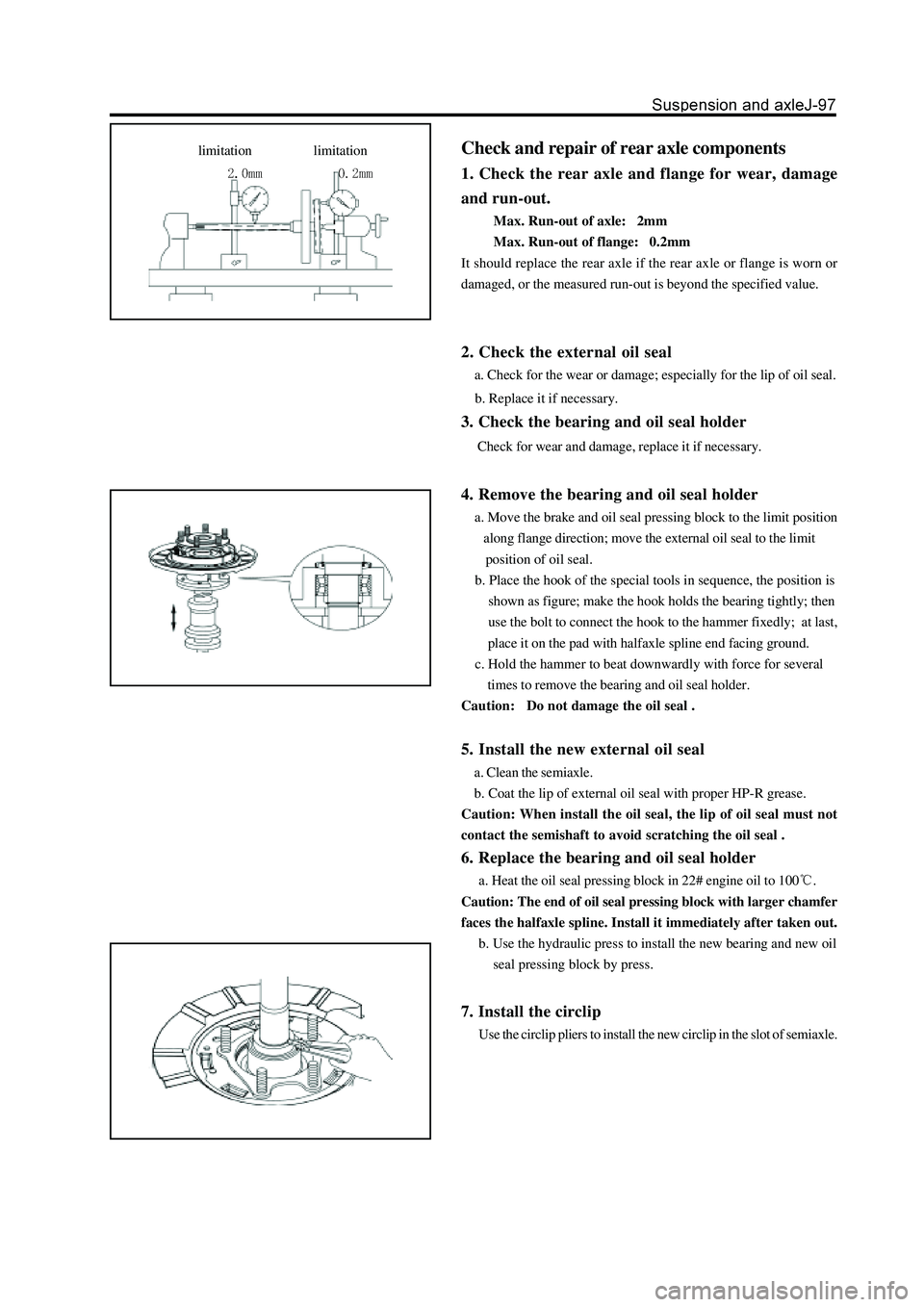
limitationlimitationCheck and repair of rear axle components
1. Check the rear axle and flange for wear, damage
and run-out.
Max. Run-out of axle: 2mm
Max. Run-out of flange: 0.2mm
It should replace the rear axle if the rear axle or flange is worn or
damaged, or the measured run-out is beyond the specified value.
2. Check the external oil seal
a. Check for the wear or damage; especially for the lip of oil seal.
b. Replace it if necessary.
3. Check the bearing and oil seal holder
Check for wear and damage, replace it if necessary.
4. Remove the bearing and oil seal holder
a. Move the brake and oil seal pressing block to the limit position
along flange direction; move the external oil seal to the limit
position of oil seal.
b. Place the hook of the special tools in sequence, the position is
shown as figure; make the hook holds the bearing tightly; then
use the bolt to connect the hook to the hammer fixedly; at last,
place it on the pad with halfaxle spline end facing ground.
c. Hold the hammer to beat downwardly with force for several
times to remove the bearing and oil seal holder.
Caution: Do not damage the oil seal .
5. Install the new external oil seal
a. Clean the semiaxle.
b. Coat the lip of external oil seal with proper HP-R grease.
Caution: When install the oil seal, the lip of oil seal must not
contact the semishaft to avoid scratching the oil seal .
6. Replace the bearing and oil seal holder
a. Heat the oil seal pressing block in 22# engine oil to 100.
Caution: The end of oil seal pressing block with larger chamfer
faces the halfaxle spline. Install it immediately after taken out.
b. Use the hydraulic press to install the new bearing and new oil
seal pressing block by press.
7. Install the circlip
Use the circlip pliers to install the new circlip in the slot of semiaxle.
Page 291 of 425
Brake-5
Check and adjustment
Check and adjustment of brake pedal
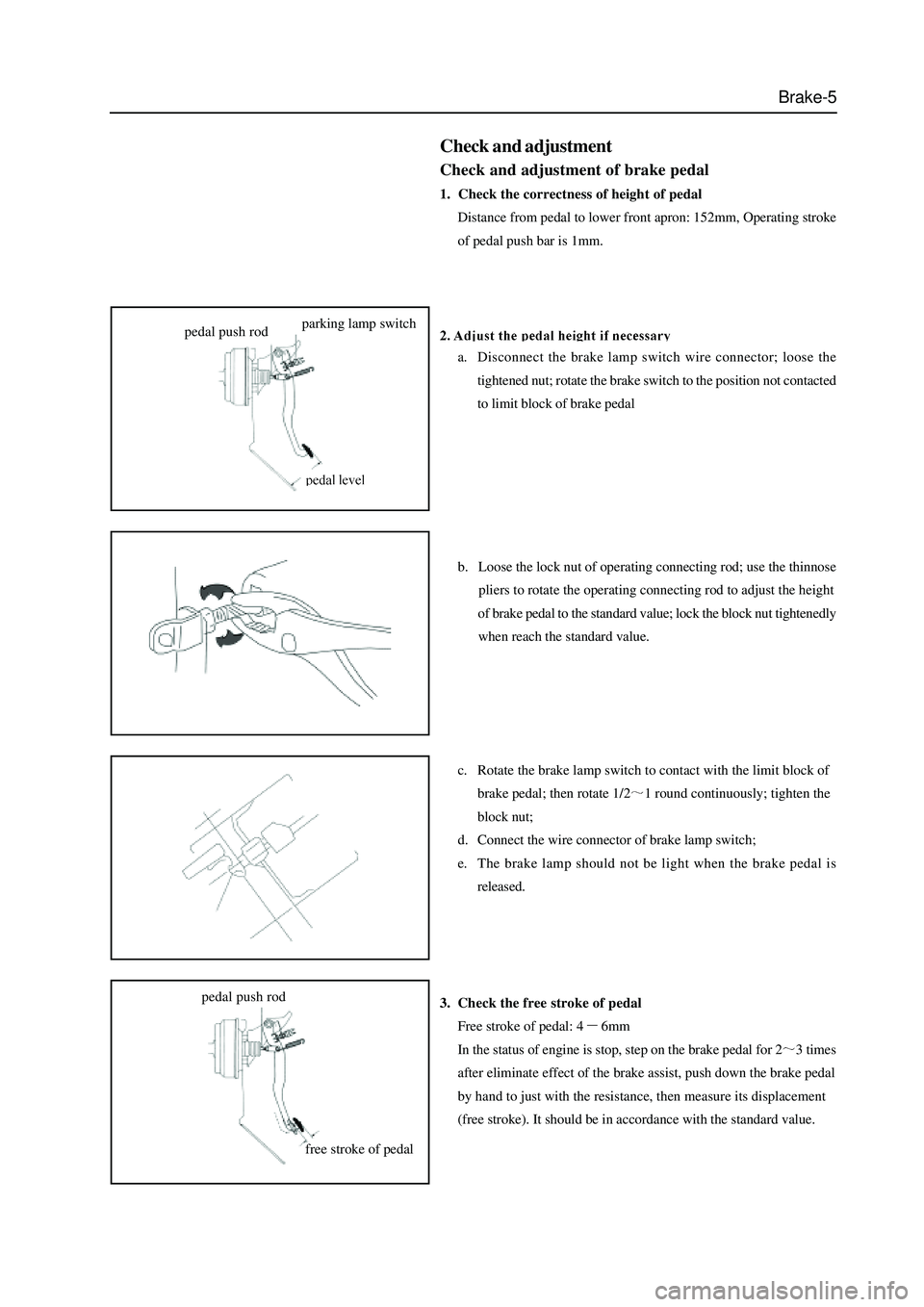
1. Check the correctness of height of pedal
Distance from pedal to lower front apron: 152mm, Operating stroke
of pedal push bar is 1mm.
a. Disconnect the brake lamp switch wire connector; loose the
tightened nut; rotate the brake switch to the position not contacted
to limit block of brake pedal
b. Loose the lock nut of operating connecting rod; use the thinnose
pliers to rotate the operating connecting rod to adjust the height
of brake pedal to the standard value; lock the block nut tightenedly
when reach the standard value.
c. Rotate the brake lamp switch to contact with the limit block of
brake pedal; then rotate 1/2
1 round continuously; tighten the
block nut;
d. Connect the wire connector of brake lamp switch;
e. The brake lamp should not be light when the brake pedal is
released.
3. Check the free stroke of pedal
Free stroke of pedal: 4
6mm
In the status of engine is stop, step on the brake pedal for 2
3 times
after eliminate effect of the brake assist, push down the brake pedal
by hand to just with the resistance, then measure its displacement
(free stroke). It should be in accordance with the standard value.
pedal push rodparking lamp switch
free stroke of pedal pedal push rod
Page 292 of 425
Brake-6
4. Adjust the stroke of pedal if necessary
a. Rotate the pedal push bar to adjust the free stroke if the stroke
length is improper.
b. Start the engine to confirm the free stroke of pedal.
c. Check the height of pedal after adjusts the free stroke of pedal.
d. The height difference of brake pedal and clutch pedal to front
apron is 0
8mm.
e. The height difference of brake pedal and accelerator pedal to the
front apron is 45
5mm.
Vacuum assist
Remarks:
Use the vacuum assist tester to check the operation of vacuum
assist if possible.
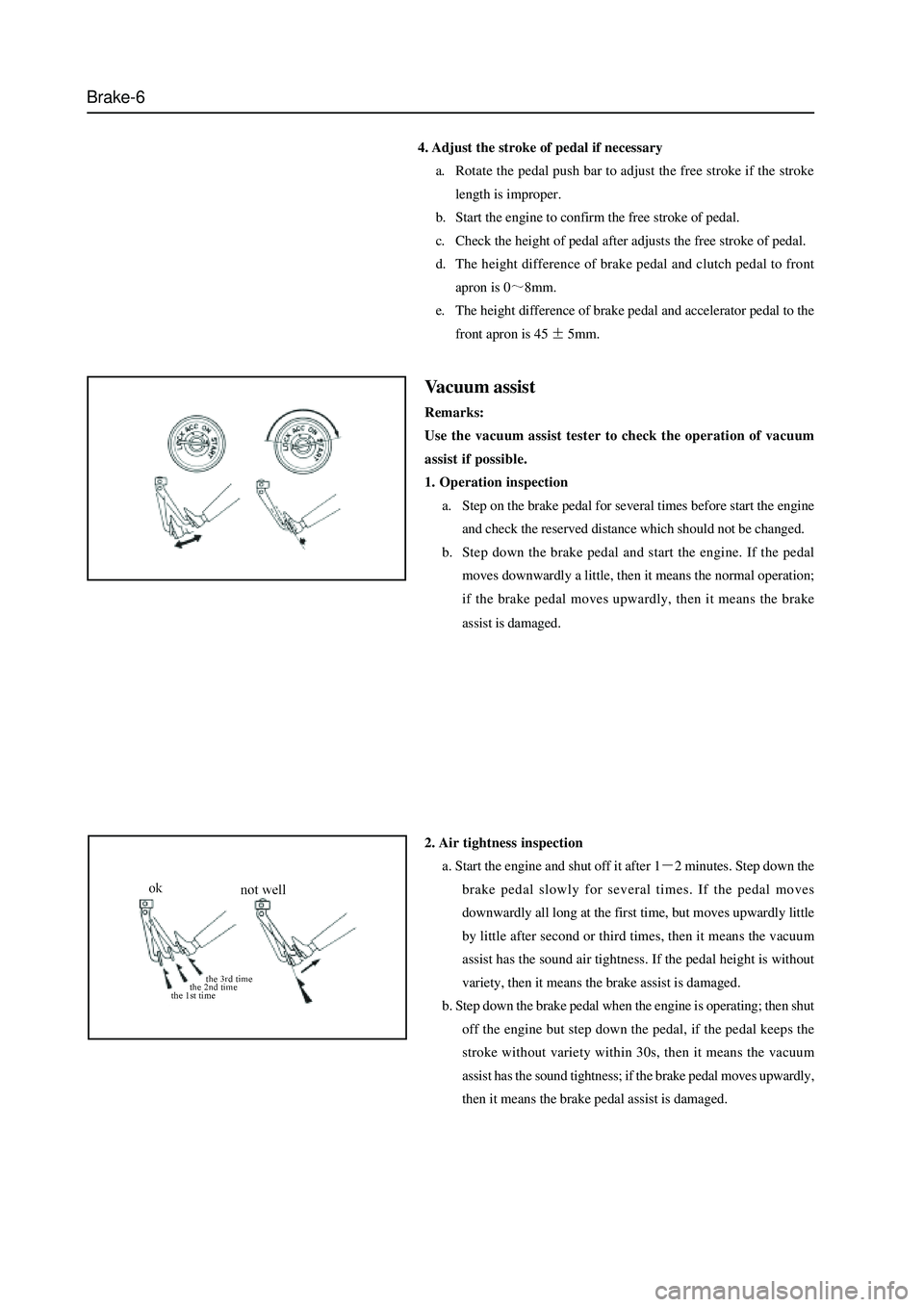
1. Operation inspection
a. Step on the brake pedal for several times before start the engine
and check the reserved distance which should not be changed.
b. Step down the brake pedal and start the engine. If the pedal
moves downwardly a little, then it means the normal operation;
if the brake pedal moves upwardly, then it means the brake
assist is damaged.
2. Air tightness inspection
a. Start the engine and shut off it after 1
2 minutes. Step down the
brake pedal slowly for several times. If the pedal moves
downwardly all long at the first time, but moves upwardly little
by little after second or third times, then it means the vacuum
assist has the sound air tightness. If the pedal height is without
variety, then it means the brake assist is damaged.
b. Step down the brake pedal when the engine is operating; then shut
off the engine but step down the pedal, if the pedal keeps the
stroke without variety within 30s, then it means the vacuum
assist has the sound tightness; if the brake pedal moves upwardly,
then it means the brake pedal assist is damaged.
Page 368 of 425
CD Player and Air Conditioning System-15
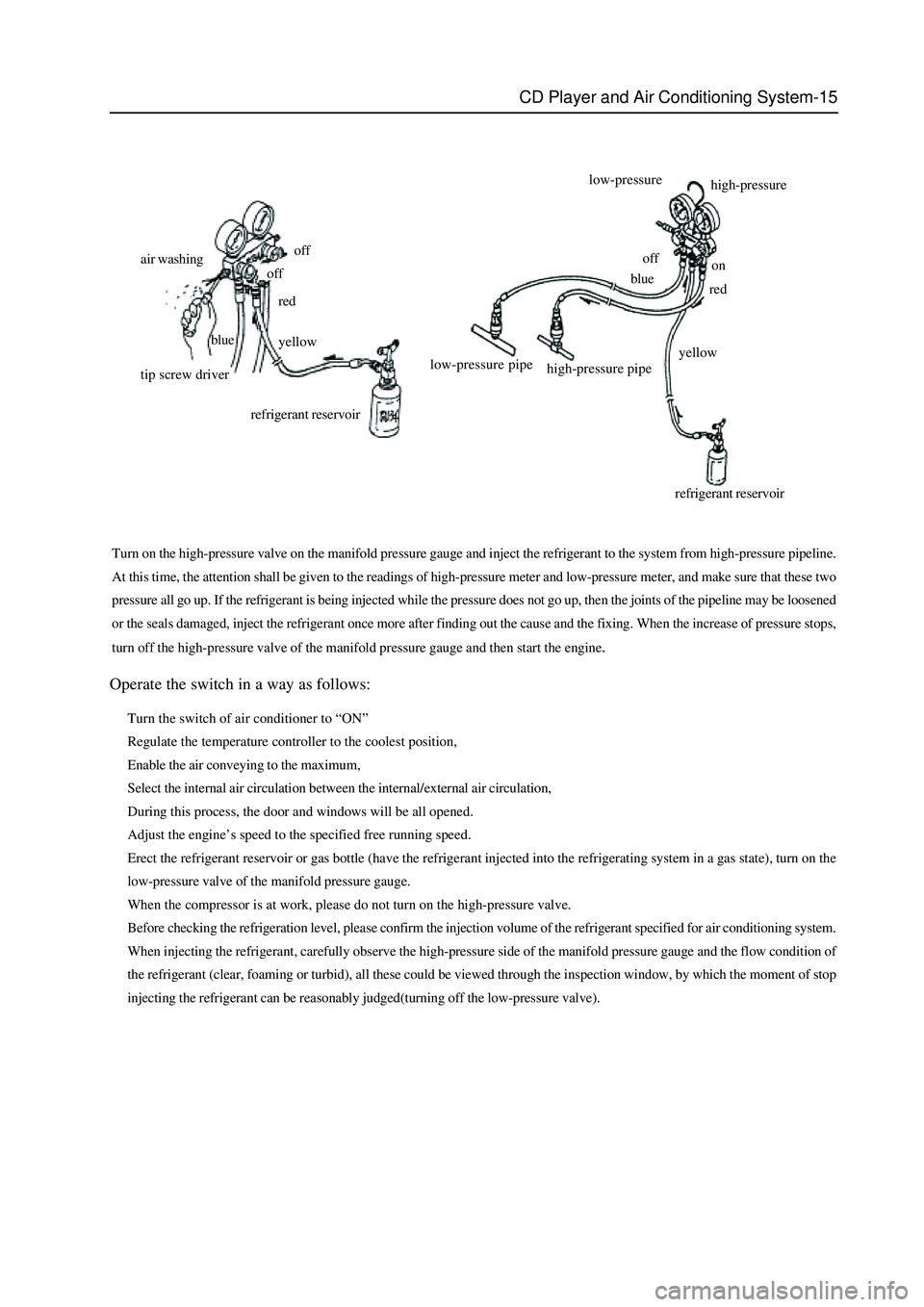
Turn on the high-pressure valve on the manifold pressure gauge and inject the refrigerant to the system from high-pressure pipeline.
At this time, the attention shall be given to the readings of high-pressure meter and low-pressure meter, and make sure that these two
pressure all go up. If the refrigerant is being injected while the pressure does not go up, then the joints of the pipeline may be loosened
or the seals damaged, inject the refrigerant once more after finding out the cause and the fixing. When the increase of pressure stops,
turn off the high-pressure valve of the manifold pressure gauge and then start the engine
.
Operate the switch in a way as follows:
Turn the switch of air conditioner to “ON”
Regulate the temperature controller to the coolest position,
Enable the air conveying to the maximum,
Select the internal air circulation between the internal/external air circulation,
During this process, the door and windows will be all opened.
Adjust the engine’s speed to the specified free running speed.
Erect the refrigerant reservoir or gas bottle (have the refrigerant injected into the refrigerating system in a gas state), turn on the
low-pressure valve of the manifold pressure gauge.
When the compressor is at work, please do not turn on the high-pressure valve.
Before checking the refrigeration level, please confirm the injection volume of the refrigerant specified for air conditioning system.
When injecting the refrigerant, carefully observe the high-pressure side of the manifold pressure gauge and the flow condition of
the refrigerant (clear, foaming or turbid), all these could be viewed through the inspection window, by which the moment of stop
injecting the refrigerant can be reasonably judged(turning off the low-pressure valve).
air washingoff
off
tip screw driverred
yellow blue
refrigerant reservoirhigh-pressure low-pressure
off
low-pressure pipe
high-pressure pipe
refrigerant reservoiryellowred blueon
Page 370 of 425
CD Player and Air Conditioning System-17
Daily Maintenance of Air Conditioning System
In order to ensure normal operation of air conditioning system, maintenance and care services shall be frequently performed for the
air conditioning system. The daily maintenance of air conditioning system is illustrated as follows:
1. Inspect, wash and clean the condenser of air conditioning system, requiring that radiator pins are clean and there is no dirt
between the pins. After the car runs in the rain or on the muddy road, the fan of the condenser should be inspected to find
whether it bears the earth, sand, stone and etc, and remove them if any.
2. Check the quantity of the working media of the refrigerating system; when the compressor set works normally, observe the
liquid viewing glass, under the normal circumstance, there shall be not air bubbles in the glass.
3. Inspect the drive belt. The belt between the compressor and the engine should be tensioned.
4. Check if there is any abnormal noise or odor in the air conditioning system.
5. Check if the temperature difference between the air inlet and outlet of the compressor is normal.
6. Check if the hose of the refrigerating system is in an apparent good condition and connections of all joints are secure.
7. Check if the pipeline of the refrigerating system collides with other parts and components, and if there is any oil leakage trace
left at each joint.
8. Check if the circuit connection of the refrigerating system is secure and if there is an occurrence of short circuit and falling off
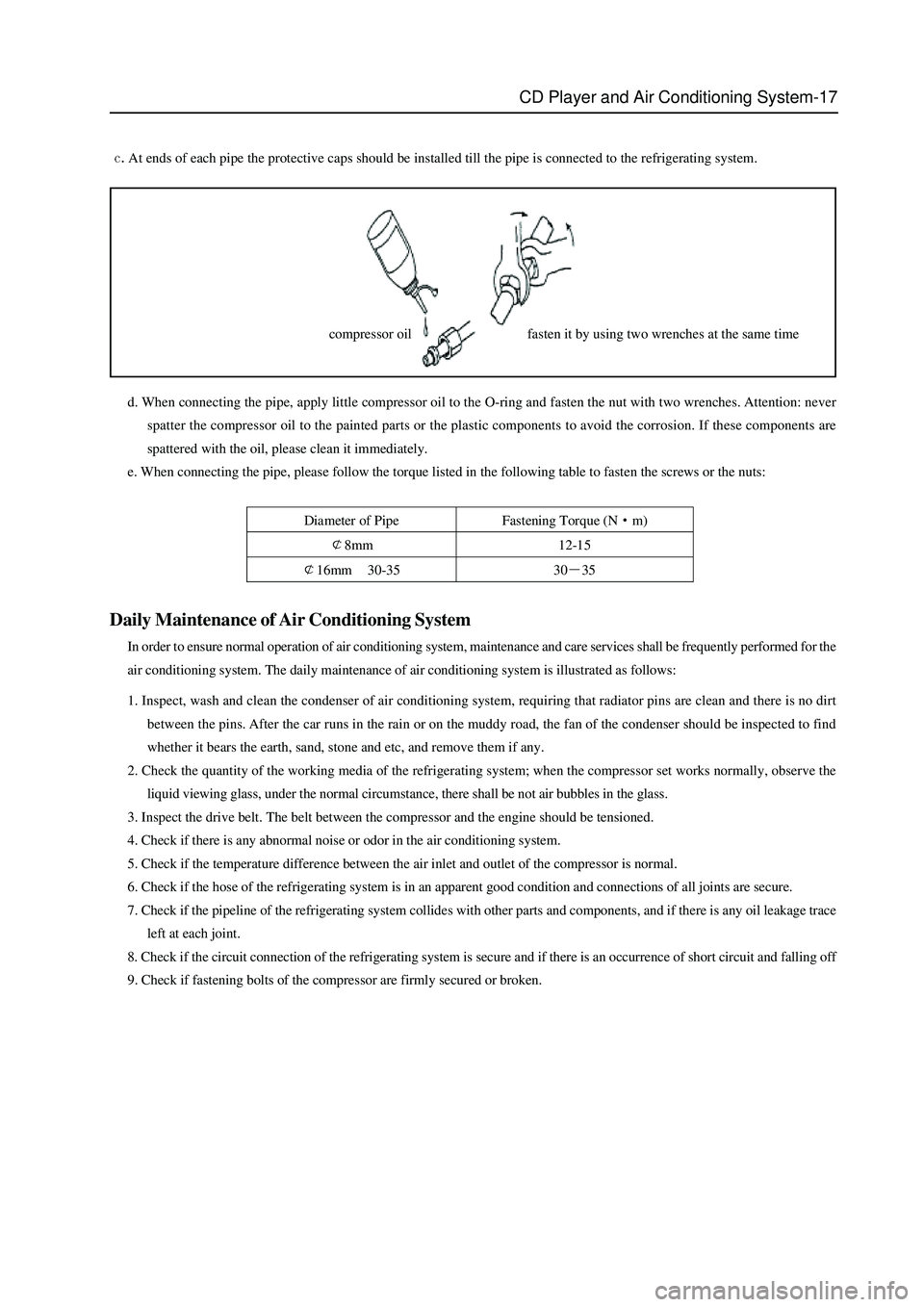
9. Check if fastening bolts of the compressor are firmly secured or broken. d. When connecting the pipe, apply little compressor oil to the O-ring and fasten the nut with two wrenches. Attention: never
spatter the compressor oil to the painted parts or the plastic components to avoid the corrosion. If these components are
spattered with the oil, please clean it immediately.
e. When connecting the pipe, please follow the torque listed in the following table to fasten the screws or the nuts:
Diameter of Pipe Fastening Torque (N·m)
¢8mm 12-15
¢16mm 30-35 30-35
At ends of each pipe the protective caps should be installed till the pipe is connected to the refrigerating system.
compressor oil fasten it by using two wrenches at the same time