steering GREAT WALL HOVER 2006 Service User Guide
[x] Cancel search | Manufacturer: GREAT WALL, Model Year: 2006, Model line: HOVER, Model: GREAT WALL HOVER 2006Pages: 425, PDF Size: 26.05 MB
Page 174 of 425
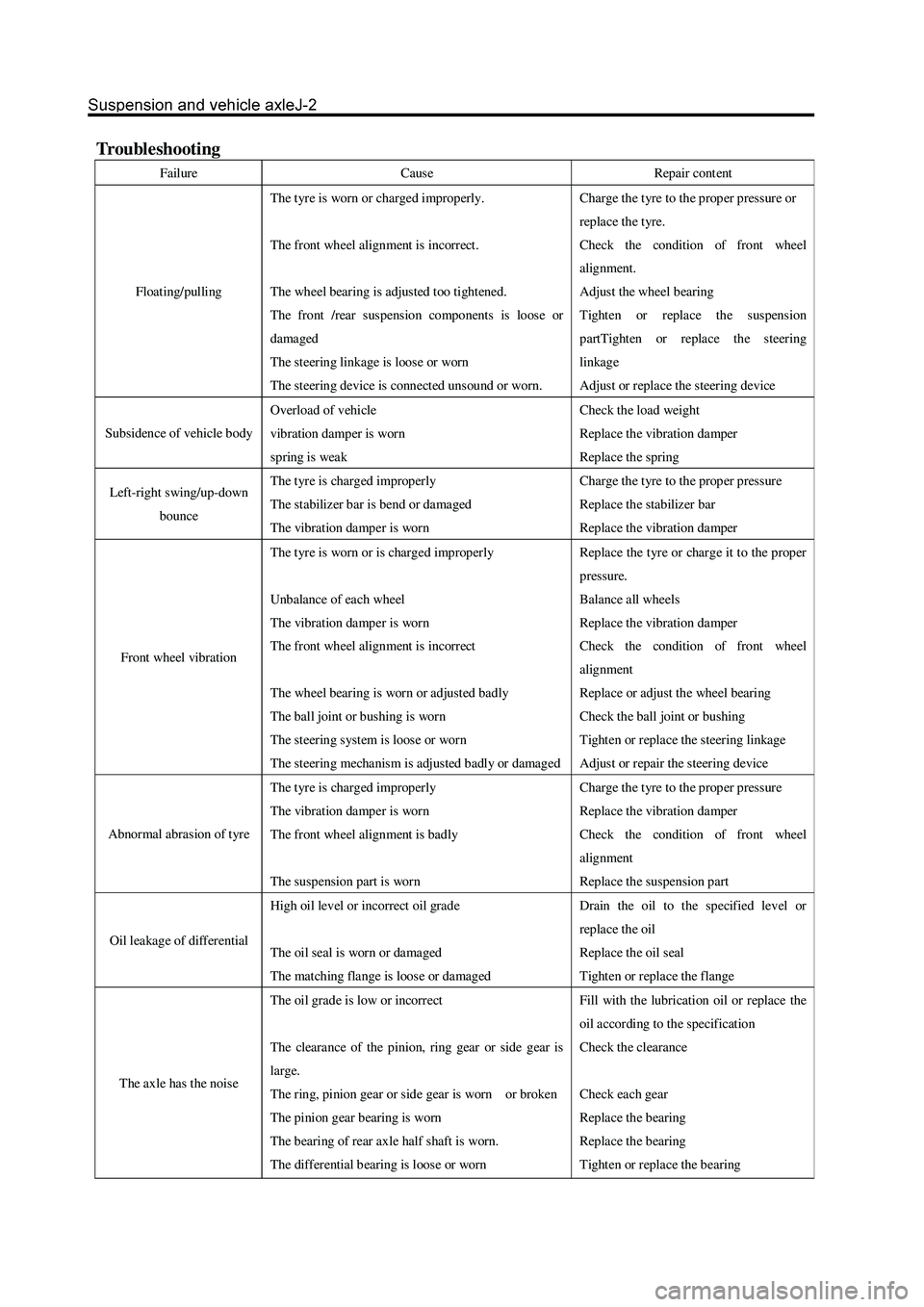
Troubleshooting
Failure Cause Repair cont ent
Floating/pulling The t yre is worn or charged improperly.
The front wheel alignment is incorrect.
The wheel bearing is adjusted too tightened.
The front /rear suspension components is loose or
damaged
The steering linkage is loose or worn
The steering device is connect ed unsound or worn. Charge the t yre to the prop er pressur e or
repla ce the t yre.
Check the condition of front wheel
alignment.
Adjust the wheel bearing
Tighten or replace the suspension
partTighten or replace the steering
linkage
Adjust or replace the steering device
Subsidence of vehicle body Overload of vehicle
vibration damper is worn
spring is weak Check the load weight
Replace the vibration damper
Replace the spring
Left-right swing/up-down
bounce The t yre is charged improperly
The stabilizer bar is bend or damaged
The vibration damper is worn Charge the t yre to the prop er pressur e
Replace the stabilizer bar
Replace the vibration damper
Front wheel vibration The t yre is worn or is charged improperly
Unbalance of each wheel
The vibration damper is worn
The front wheel alignment is incorrect
The wheel bearing is worn or adjusted badly
The ball joint or bushing is worn
The steering system is loose or worn
The steering mechanism is adjusted badly or damaged Repla ce the t yr e or char ge it to the prop er
pressure.
Balance all wheels
Replace the vibration damper
Check the condition of front wheel
alignment
Replace or adjust the wheel bearing
Check the ball joint or bushing
Tighten or replace the steering linkage
Adjust or repair the steering device
Abnormal abrasion of tyre The t yre is charged improperly
The vibration damper is worn
The front wheel alignment is badly
The suspension part is worn Charge the t yre to the prop er pressur e
Replace the vibration damper
Check the condition of front wheel
alignment
Replace the suspension part
Oil leakage of differential High oil level or incorrect oil grade
The oil seal is worn or damaged
The matching flange is loose or damaged Drain the oil to the specified level or
repla ce the oil
Replace the oil seal
Tighten or replace the flange
The axle has the nois e The oil grade is low or incorrect
The clearance of the pinion, ring gear or side gear is
large.
The ring, pinion gear or side gear is worn or broken
The pinion gear bearing is worn
The b earing of rear axle half shaft is worn.
The differential b earing is loos e or worn Fill with the lubrication oil or replace the
oil according to the specification
Check the clearance
Check each gear
Replace the bearing
Replace the bearing
Tighten or replace the bearing
Page 175 of 425
Front wheel alignment
1. Process the following inspection and eliminate
all problems
a. Check the wear condition of tyre and proper inflation.
Tyre inflation pressure: 230kPa
b. Check the wheel bearing of front wheel for loose.
c. Check the front suspension for loose.
d. Check the steering drive device for loose.
e. Process the standard elastic test; check thefrontvibration damper
for normal operation.
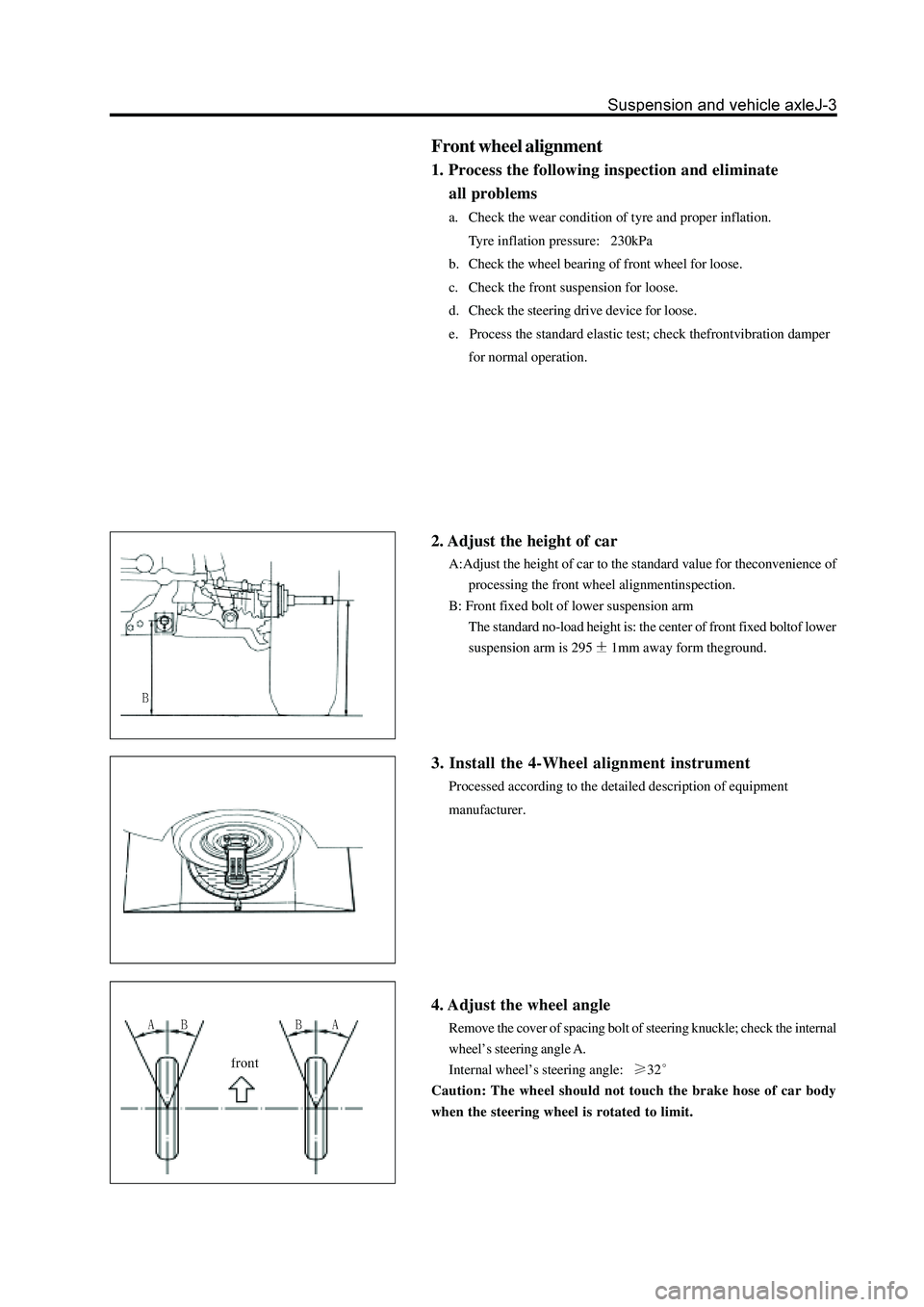
3. Install the 4-Wheel alignment instrument
Processed according to the detailed description of equipment
manufacturer.
4. Adjust the wheel angle
Remove the cover of spacing bolt of steering knuckle; check the internal
wheel’s steering angle A.
Internal wheel’s steering angle:
32
Caution: The wheel should not touch the brake hose of car body
when the steering wheel is rotated to limit.
2. Adjust the height of car
A:Adjust the height of car to the standard value for theconvenience of
processing the front wheel alignmentinspection.
B: Front fixed bolt of lower suspension arm
The standard no-load height is: the center of front fixed boltof lower
suspension arm is 295
1mm away form theground.
Page 179 of 425
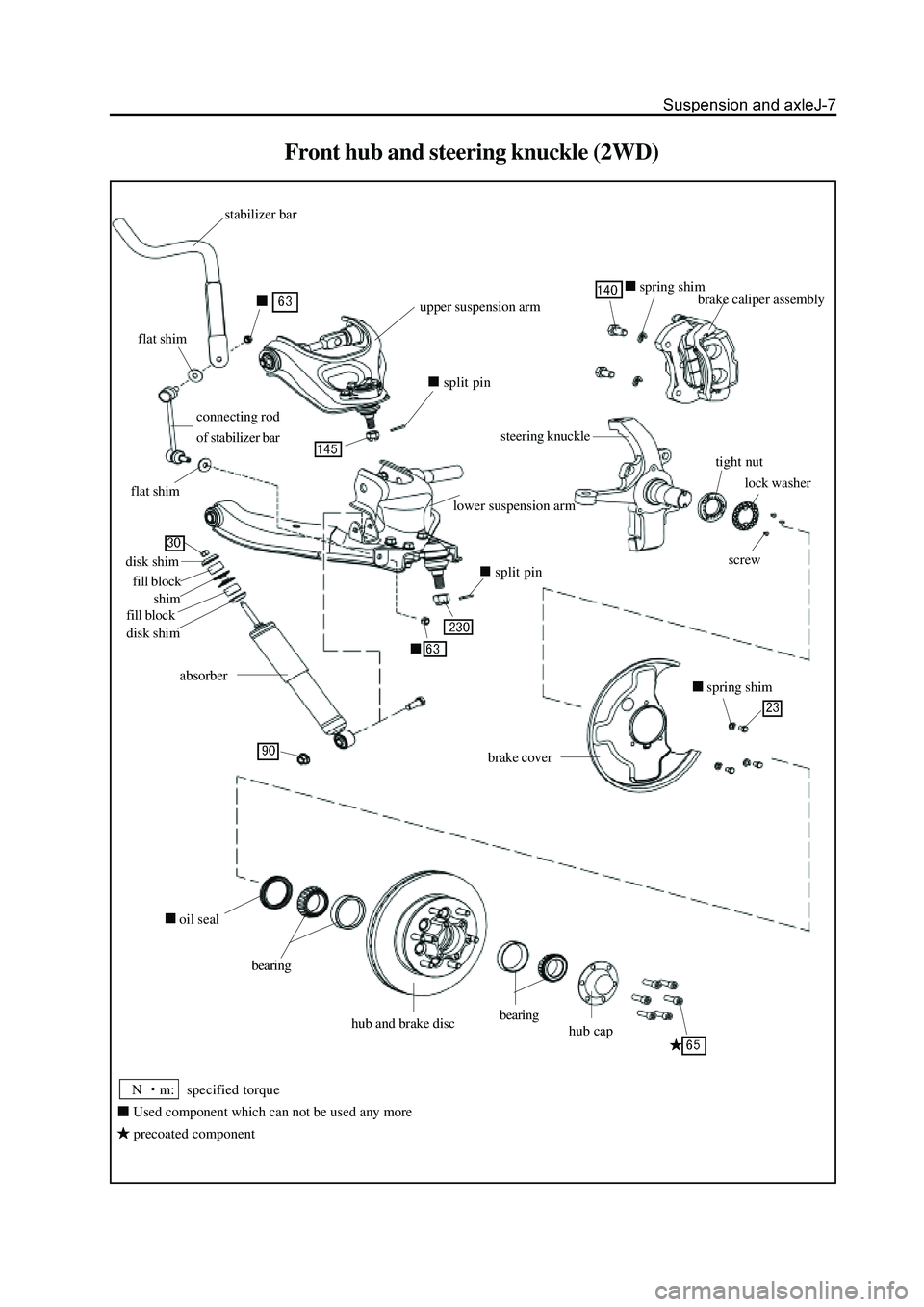
Front hub and steering knuckle (2WD)
stabilizer bar
connecting rod
of stabilizer bar
flat shim
disk shim
fill block
shim
fill block
disk shim
absorber
bearing
hub cap
brake cover
spring shim
split pin
lower suspension arm
split pin
upper suspension arm
spring shimbrake caliper assembly
steering knuckle
tight nut
lock washer
screw
oil seal
bearing
hub and brake disc flat shim
N
m: specified torque
Used component which can not be used any more
precoated component
Page 182 of 425
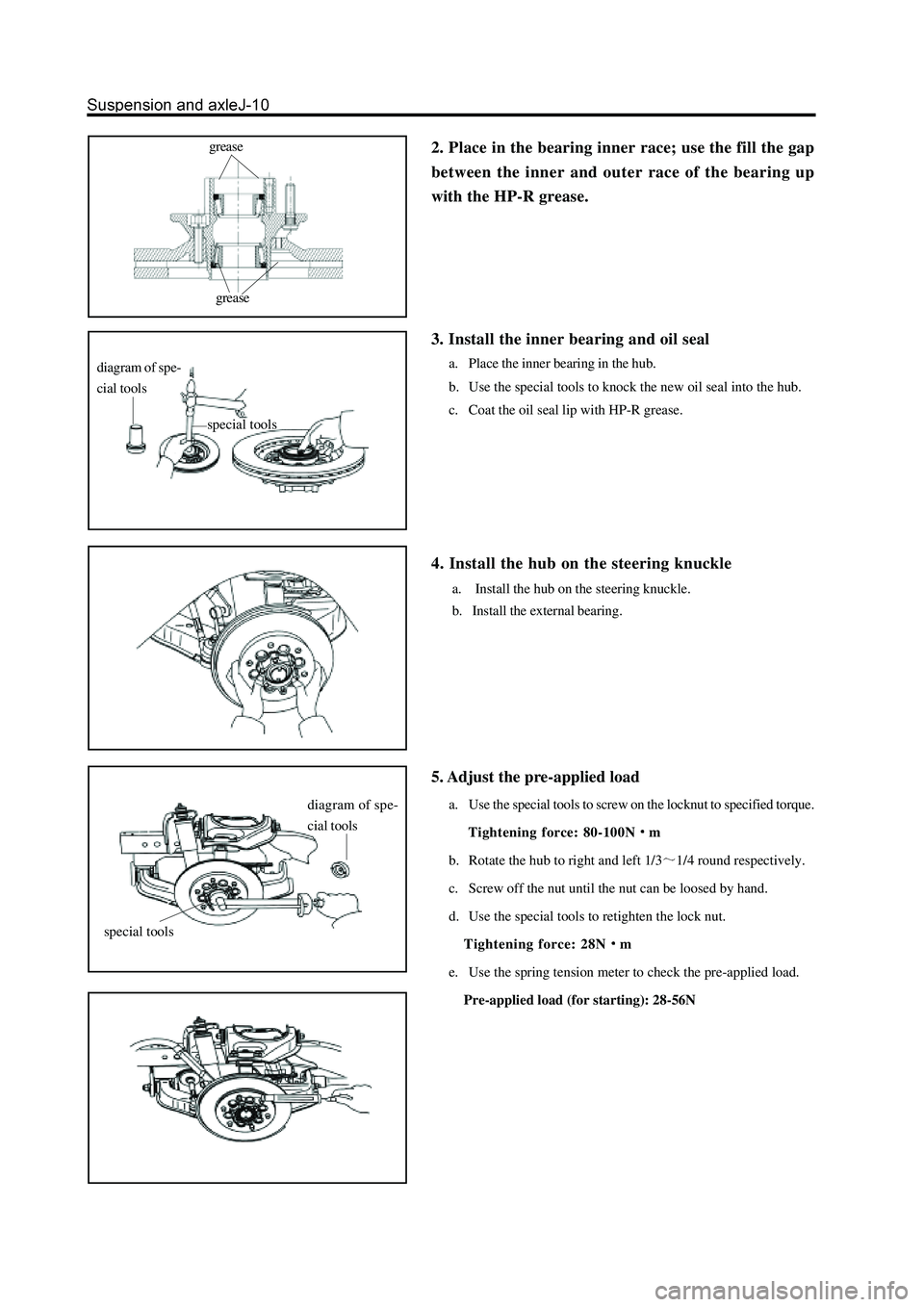
2. Place in the bearing inner race; use the fill the gap
between the inner and outer race of the bearing up
with the HP-R grease.grease
grease
3. Install the inner bearing and oil seal
a. Place the inner bearing in the hub.
b. Use the special tools to knock the new oil seal into the hub.
c. Coat the oil seal lip with HP-R grease.
4. Install the hub on the steering knuckle
a. Install the hub on the steering knuckle.
b. Install the external bearing.
diagram of spe-
cial tools
special tools
5. Adjust the pre-applied load
a. Use the special tools to screw on the locknut to specified torque.
Tightening force: 80-100N
m
b. Rotate the hub to right and left 1/3
1/4 round respectively.
c. Screw off the nut until the nut can be loosed by hand.
d. Use the special tools to retighten the lock nut.
Tightening force: 28N
m
e. Use the spring tension meter to check the pre-applied load.
Pre-applied load (for starting): 28-56N
diagram of spe-
cial tools
special tools
Page 183 of 425
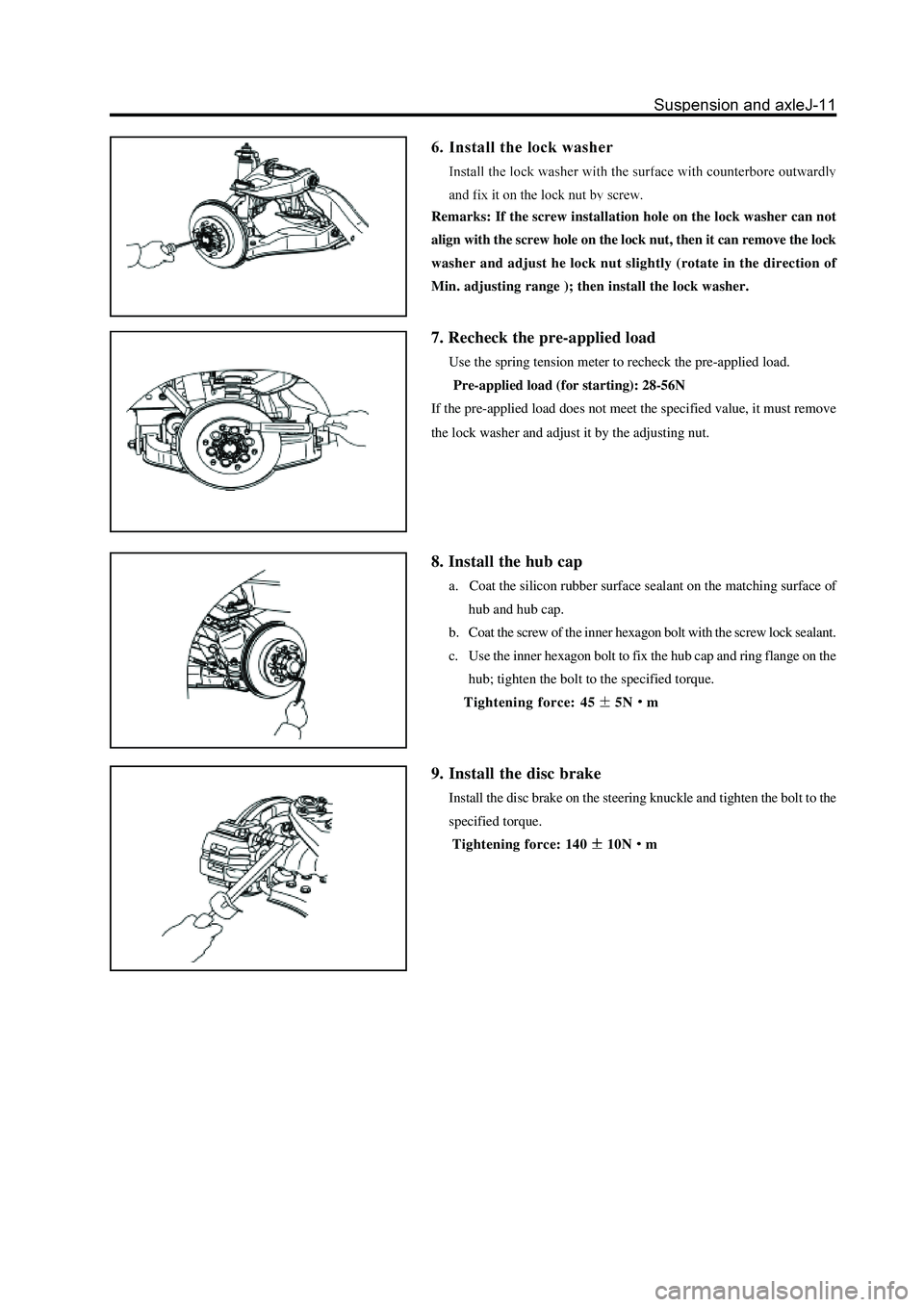
Remarks: If the screw installation hole on the lock washer can not
align with the screw hole on the lock nut, then it can remove the lock
washer and adjust he lock nut slightly (rotate in the direction of
Min. adjusting range ); then install the lock washer.
7. Recheck the pre-applied load
Use the spring tension meter to recheck the pre-applied load.
Pre-applied load (for starting): 28-56N
If the pre-applied load does not meet the specified value, it must remove
the lock washer and adjust it by the adjusting nut.
8. Install the hub cap
a. Coat the silicon rubber surface sealant on the matching surface of
hub and hub cap.
b. Coat the screw of the inner hexagon bolt with the screw lock sealant.
c. Use the inner hexagon bolt to fix the hub cap and ring flange on the
hub; tighten the bolt to the specified torque.
Tightening force: 45
5Nm
9. Install the disc brake
Install the disc brake on the steering knuckle and tighten the bolt to the
specified torque.
Tightening force: 140
10Nm
Page 184 of 425
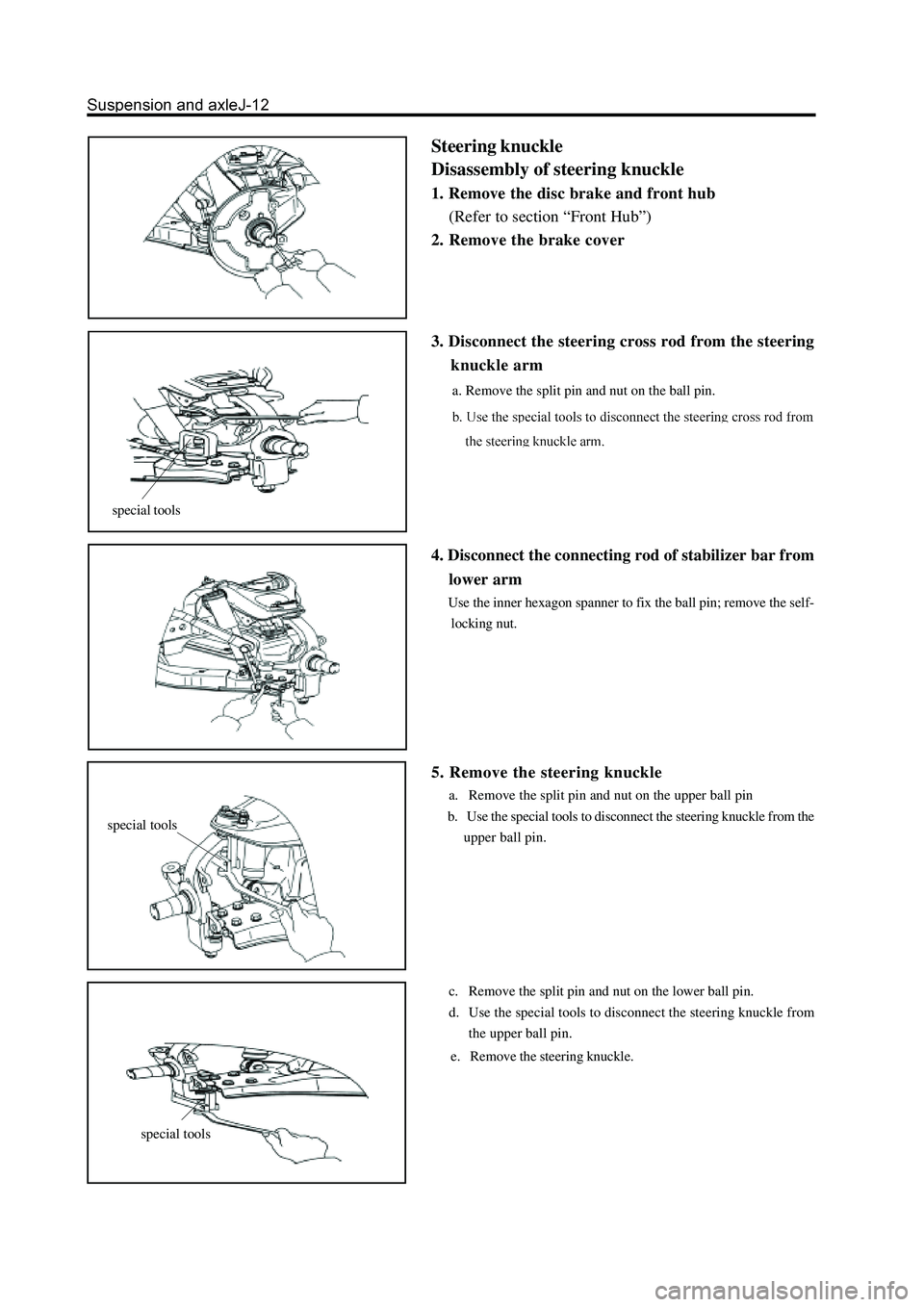
Steering knuckle
Disassembly of steering knuckle
1. Remove the disc brake and front hub
(Refer to section “Front Hub”)
2. Remove the brake cover
special tools
special tools
special tools
3. Disconnect the steering cross rod from the steering
knuckle arm
a. Remove the split pin and nut on the ball pin.
4. Disconnect the connecting rod of stabilizer bar from
lower arm
Use the inner hexagon spanner to fix the ball pin; remove the self-
locking nut.
5. Remove the steering knuckle
a. Remove the split pin and nut on the upper ball pin
b. Use the special tools to disconnect the steering knuckle from the
upper ball pin.
c. Remove the split pin and nut on the lower ball pin.
d. Use the special tools to disconnect the steering knuckle from
the upper ball pin.
e. Remove the steering knuckle.
Page 185 of 425
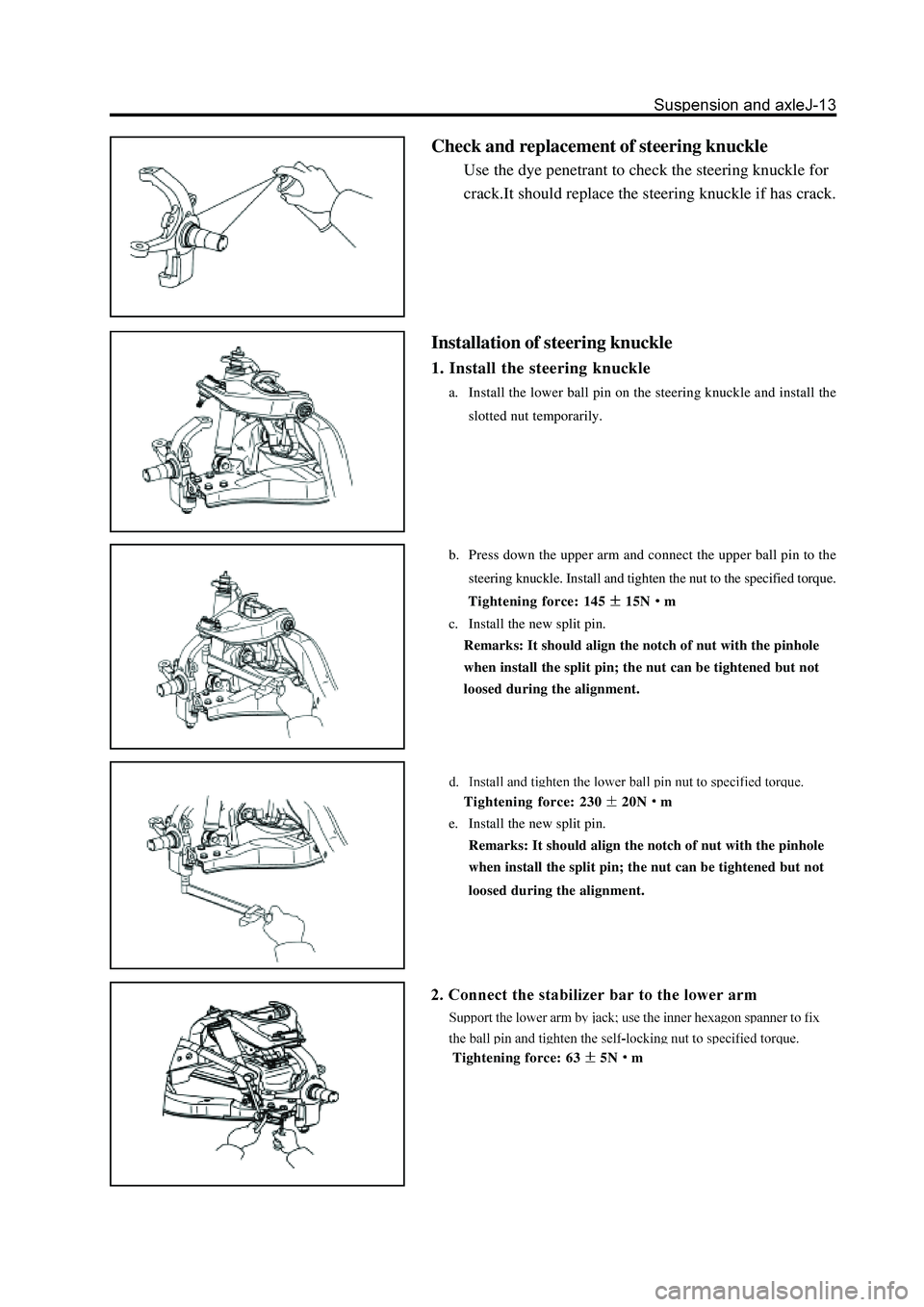
Check and replacement of steering knuckle
Use the dye penetrant to check the steering knuckle for
crack.It should replace the steering knuckle if has crack.
Installation of steering knuckle
1. Install the steering knuckle
a. Install the lower ball pin on the steering knuckle and install the
slotted nut temporarily.
b. Press down the upper arm and connect the upper ball pin to the
steering knuckle. Install and tighten the nut to the specified torque.
Tightening force: 145
15Nm
c. Install the new split pin.
Remarks: It should align the notch of nut with the pinhole
when install the split pin; the nut can be tightened but not
loosed during the alignment.
Tightening force: 23020Nm
e. Install the new split pin.
Remarks: It should align the notch of nut with the pinhole
when install the split pin; the nut can be tightened but not
loosed during the alignment.
Tightening force: 635Nm
Page 186 of 425
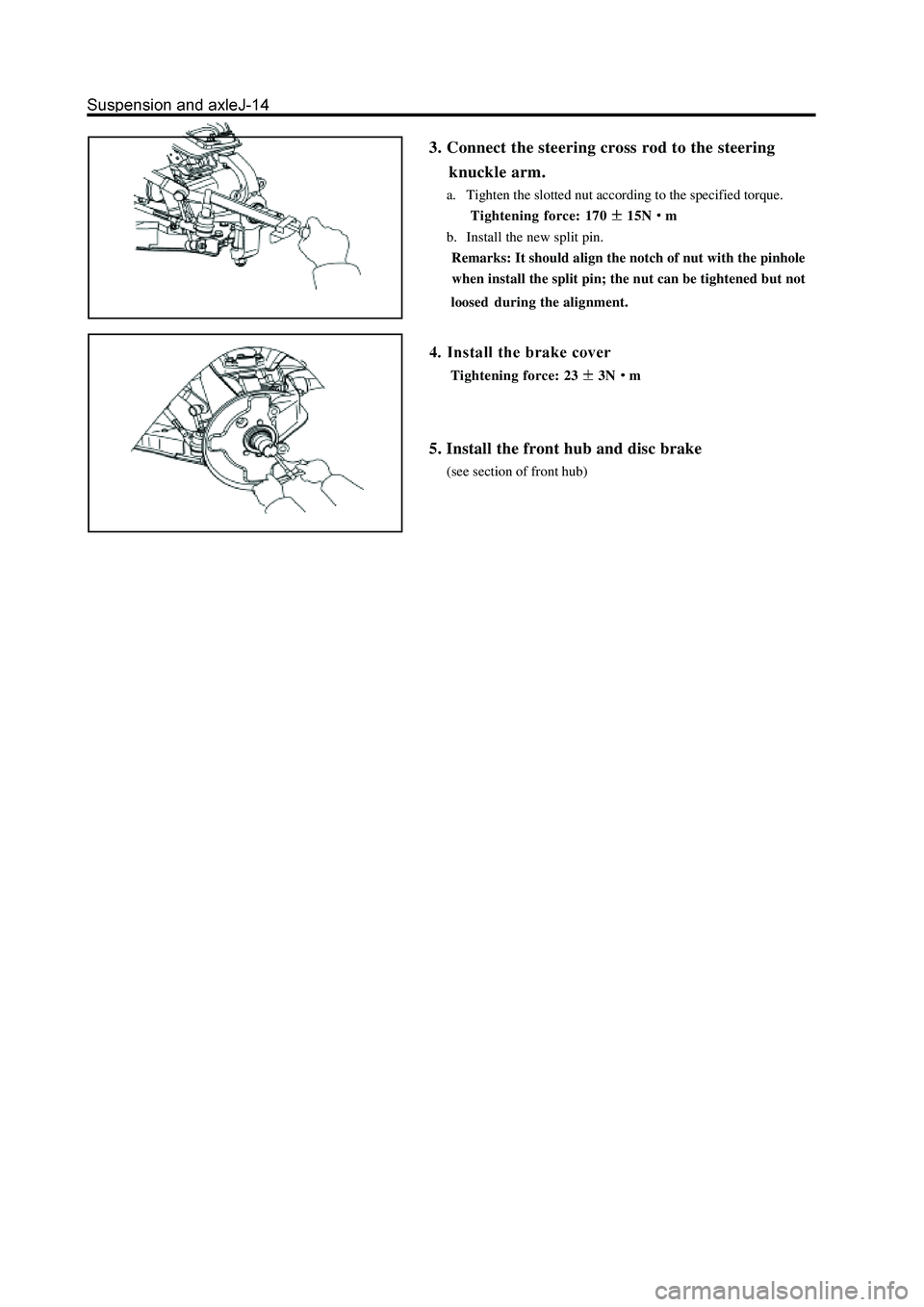
3. Connect the steering cross rod to the steering
knuckle arm.
a. Tighten the slotted nut according to the specified torque.
Tightening force: 170
15Nm
b. Install the new split pin.
Remarks: It should align the notch of nut with the pinhole
when install the split pin; the nut can be tightened but not
loosedduring the alignment.
Tightening force: 233Nm
5. Install the front hub and disc brake
(see section of front hub)
Page 187 of 425
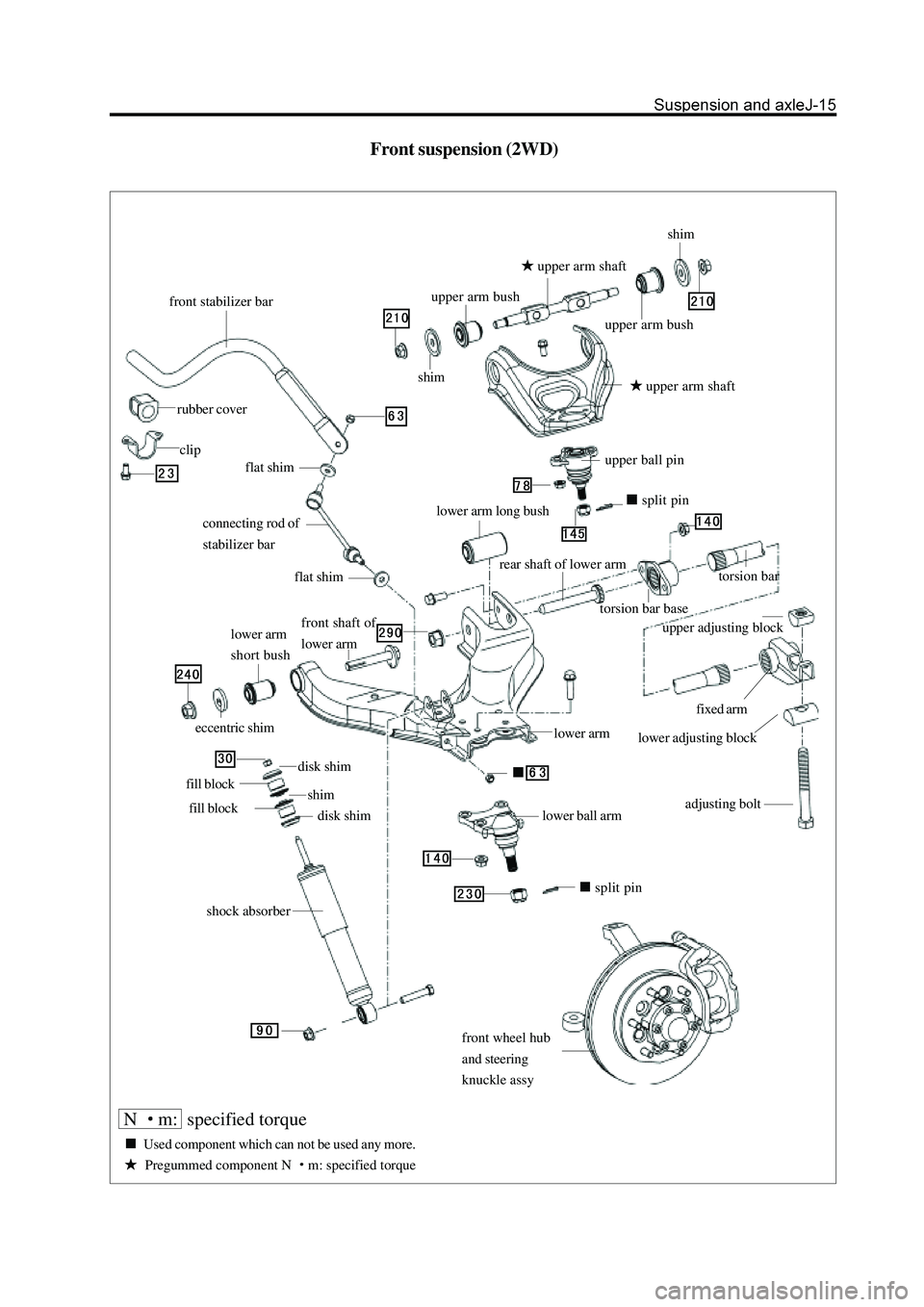
Front suspension (2WD)
front stabilizer bar
rubber cover
clip
connecting rod of
stabilizer bar
flat shim
front shaft of
lower arm
split pin
adjusting bolt
lower adjusting block
fixed arm
upper adjusting block
lower arm
rear shaft of lower arm
torsion bar base
torsion bar
lower arm long bushsplit pin
upper ball pin
upper arm shaft
upper arm bush
flat shim
lower arm
short bush
eccentric shim
disk shim
fill block
fill block
disk shim shim
shock absorbershimshim
upper arm bush
upper arm shaft
lower ball arm
front wheel hub
and steering
knuckle assy
N m: specified torque
Used component which can not be used any more.
Pregummed component N m: specified torque
Page 188 of 425
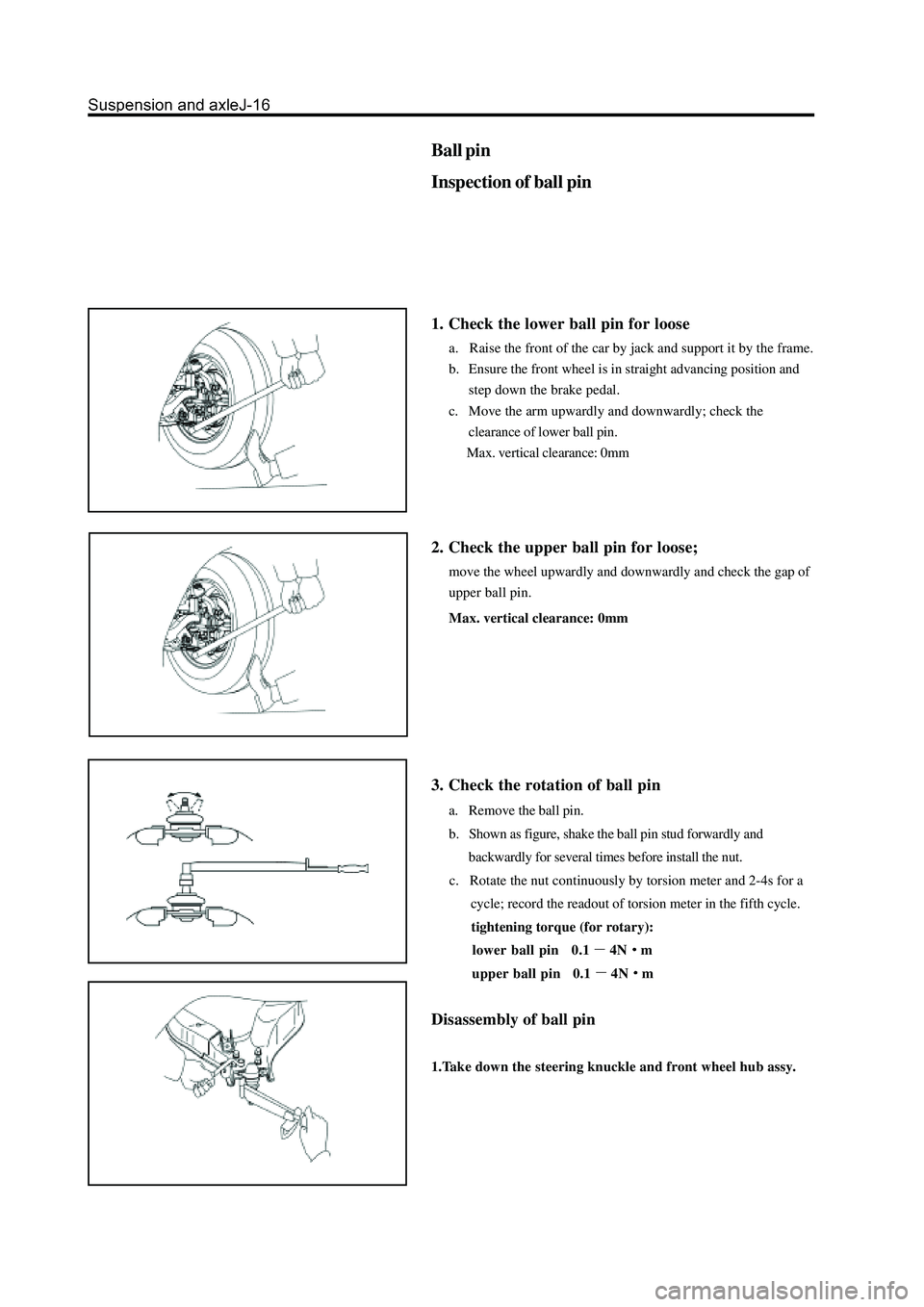
Ball pin
Inspection of ball pin
1. Check the lower ball pin for loose
a. Raise the front of the car by jack and support it by the frame.
b. Ensure the front wheel is in straight advancing position and
step down the brake pedal.
c. Move the arm upwardly and downwardly; check the
clearance of lower ball pin.
Max. vertical clearance: 0mm
2. Check the upper ball pin for loose;
move the wheel upwardly and downwardly and check the gap of
upper ball pin.
Max. vertical clearance: 0mm
3. Check the rotation of ball pin
a. Remove the ball pin.
b. Shown as figure, shake the ball pin stud forwardly and
backwardly for several times before install the nut.
c. Rotate the nut continuously by torsion meter and 2-4s for a
cycle; record the readout of torsion meter in the fifth cycle.
tightening torque (for rotary):
lower ball pin 0.1
4Nm
upper ball pin 0.1
4Nm
Disassembly of ball pin
1.Take down the steering knuckle and front wheel hub assy.