oil GREAT WALL HOVER 2006 Service Owner's Manual
[x] Cancel search | Manufacturer: GREAT WALL, Model Year: 2006, Model line: HOVER, Model: GREAT WALL HOVER 2006Pages: 425, PDF Size: 26.05 MB
Page 80 of 425
Automatic transmission-4
10. The gross weight of the transmission is 76kg; mostly weight is on the front of the transmission (side of torque converter). This
should be considered when design the handling/assembly tools.
11. The crankshaft speed/position sensor is installed on the top of transmission torque converter housing which must be installed
after the transmission is installed on the engine. The sensor will be damaged if it is installed before the installation of
transmission.
12. The transmission use the breathing tube connected to rear end of transmission. The tube must not be restricted or blocked
otherwise the air pressure in transmission will be increased. It is unallowable that the water/dirty/dust enters into the
breathing tube; otherwise the transmission will be damaged.
Removal of transmission
If the transmission needs removing for any reasons, following is the preventive measure to help the remove.
1. Must not only support the oil pan in middle of transmission for it will be deformed and leaked. The oil pan will not be deformed
when supports its external edge.
2. It must not allow the transmission to connect to the engine when the rear end is without connection, otherwise the exhaust
system of vehicle will be damaged.
3. Remove all torque converter bolts and push back the torque converter before remove the bolt connected the torque converter
housing to engine. Once all bolts connected the torque converter housing to engine are removed, use the torque converter the
push the transmission from the location pin, then ensure the torque converter is on the transmission and the transmission is
separated form location pin.
4. Install the dustproof cover on the cooler connector rapidly after open the oil cooler pipe; otherwise the oil leakage from the
torque converter will be 2L. The odometer dustproof cover can prevent the dirty from entering into the transmission and avoids
the leakage of oil form transmission.
5. The engine speed sensor is installed on the top of transmission and should be removed before the transmission is removed form
the engine, for the sensor will be damaged during the removal process of the transmission.
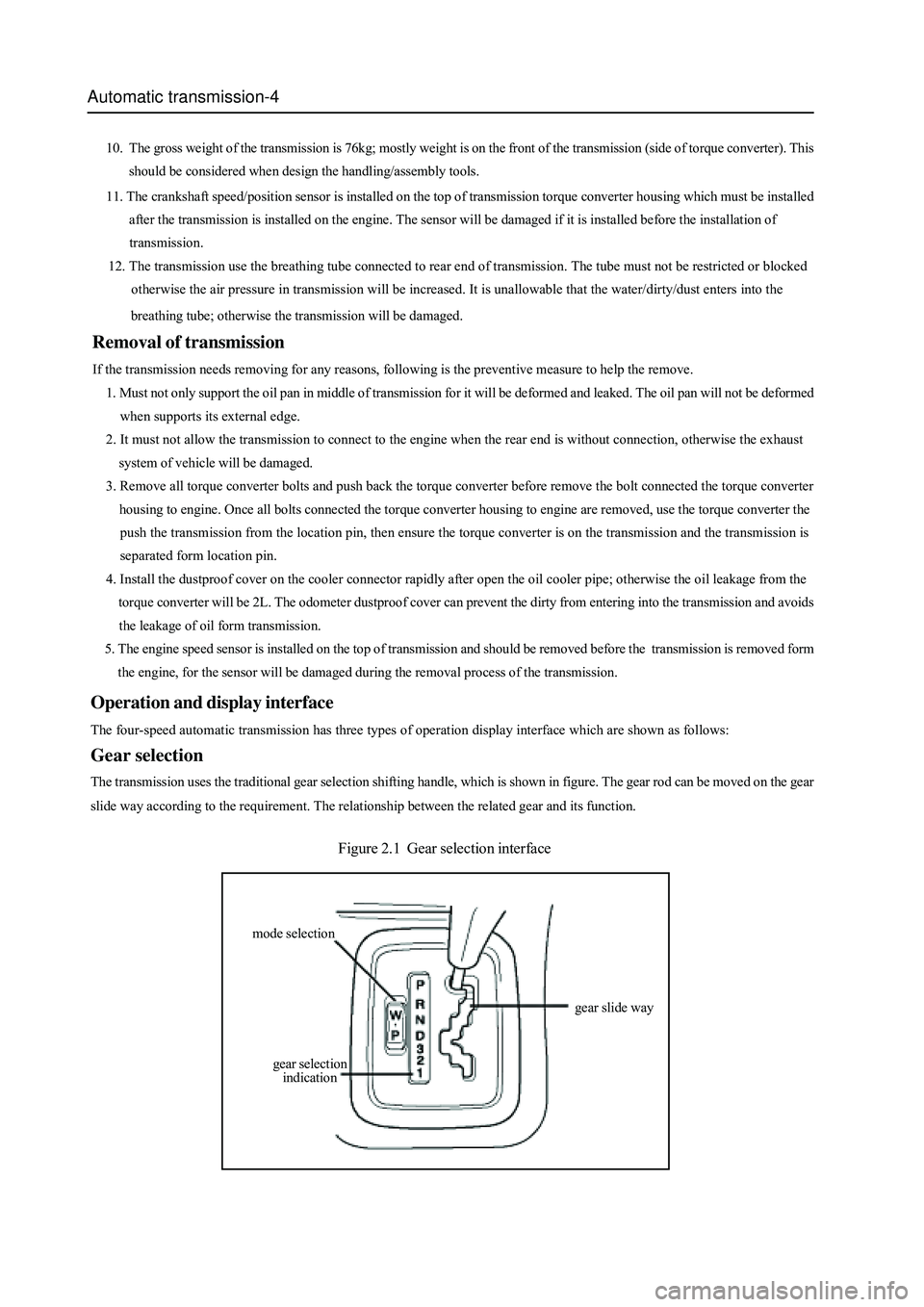
Figure 2.1 Gear selection interface
mode selection
gear selection
indicationgear slide way
Operation and display interface
The four-speed automatic transmission has three types of operation display interface which are shown as follows:
Gear selection
The transmission uses the traditional gear selection shifting handle, which is shown in figure. The gear rod can be moved on the gear
slide way according to the requirement. The relationship between the related gear and its function.
Page 89 of 425
Automatic transmission-13
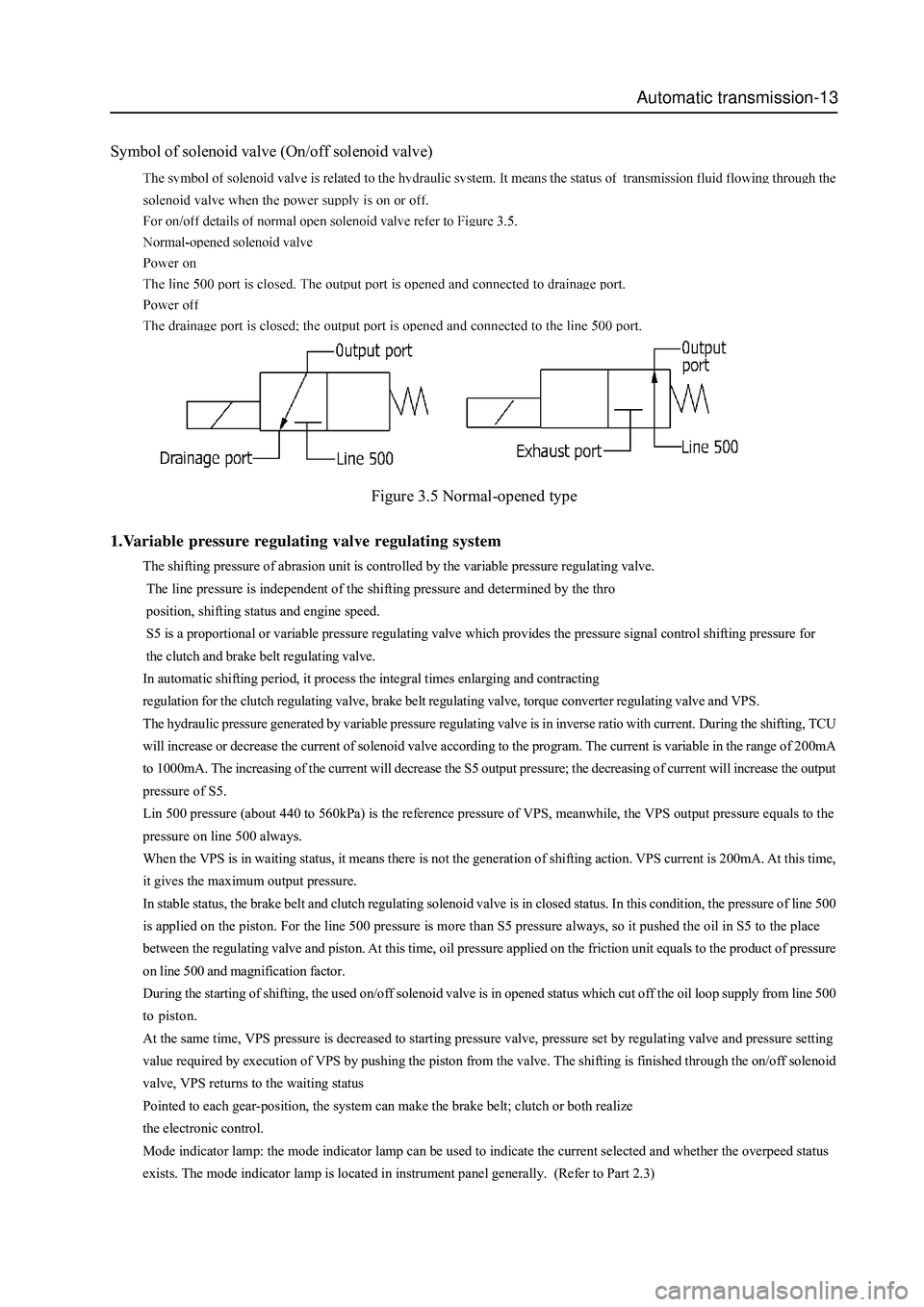
Symbol of solenoid valve (On/off solenoid valve)
Figure 3.5 Normal-opened type
1.Variable pressure regulating valve regulating system
The shifting pressure of abrasion unit is controlled by the variable pressure regulating valve.
The line pressure is independent of the shifting pressure and determined by the thro
position, shifting status and engine speed.
S5 is a proportional or variable pressure regulating valve which provides the pressure signal control shifting pressure for
the clutch and brake belt regulating valve.
In automatic shifting period, it process the integral times enlarging and contracting
regulation for the clutch regulating valve, brake belt regulating valve, torque converter regulating valve and VPS.
The hydraulic pressure generated by variable pressure regulating valve is in inverse ratio with current. During the shifting, TCU
will increase or decrease the current of solenoid valve according to the program. The current is variable in the range of 200mA
to 1000mA. The increasing of the current will decrease the S5 output pressure; the decreasing of current will increase the output
pressure of S5.
Lin 500 pressure (about 440 to 560kPa) is the reference pressure of VPS, meanwhile, the VPS output pressure equals to the
pressure on line 500 always.
When the VPS is in waiting status, it means there is not the generation of shifting action. VPS current is 200mA. At this time,
it gives the maximum output pressure.
In stable status, the brake belt and clutch regulating solenoid valve is in closed status. In this condition, the pressure of line 500
is applied on the piston. For the line 500 pressure is more than S5 pressure always, so it pushed the oil in S5 to the place
between the regulating valve and piston. At this time, oil pressure applied on the friction unit equals to the product of pressure
on line 500 and magnification factor.
During the starting of shifting, the used on/off solenoid valve is in opened status which cut off the oil loop supply from line 500
to piston.
At the same time, VPS pressure is decreased to starting pressure valve, pressure set by regulating valve and pressure setting
value required by execution of VPS by pushing the piston from the valve. The shifting is finished through the on/off solenoid
valve, VPS returns to the waiting status
Pointed to each gear-position, the system can make the brake belt; clutch or both realize
the electronic control.
Mode indicator lamp: the mode indicator lamp can be used to indicate the current selected and whether the overpeed status
exists. The mode indicator lamp is located in instrument panel generally. (Refer to Part 2.3)
Page 92 of 425
Automatic transmission-16
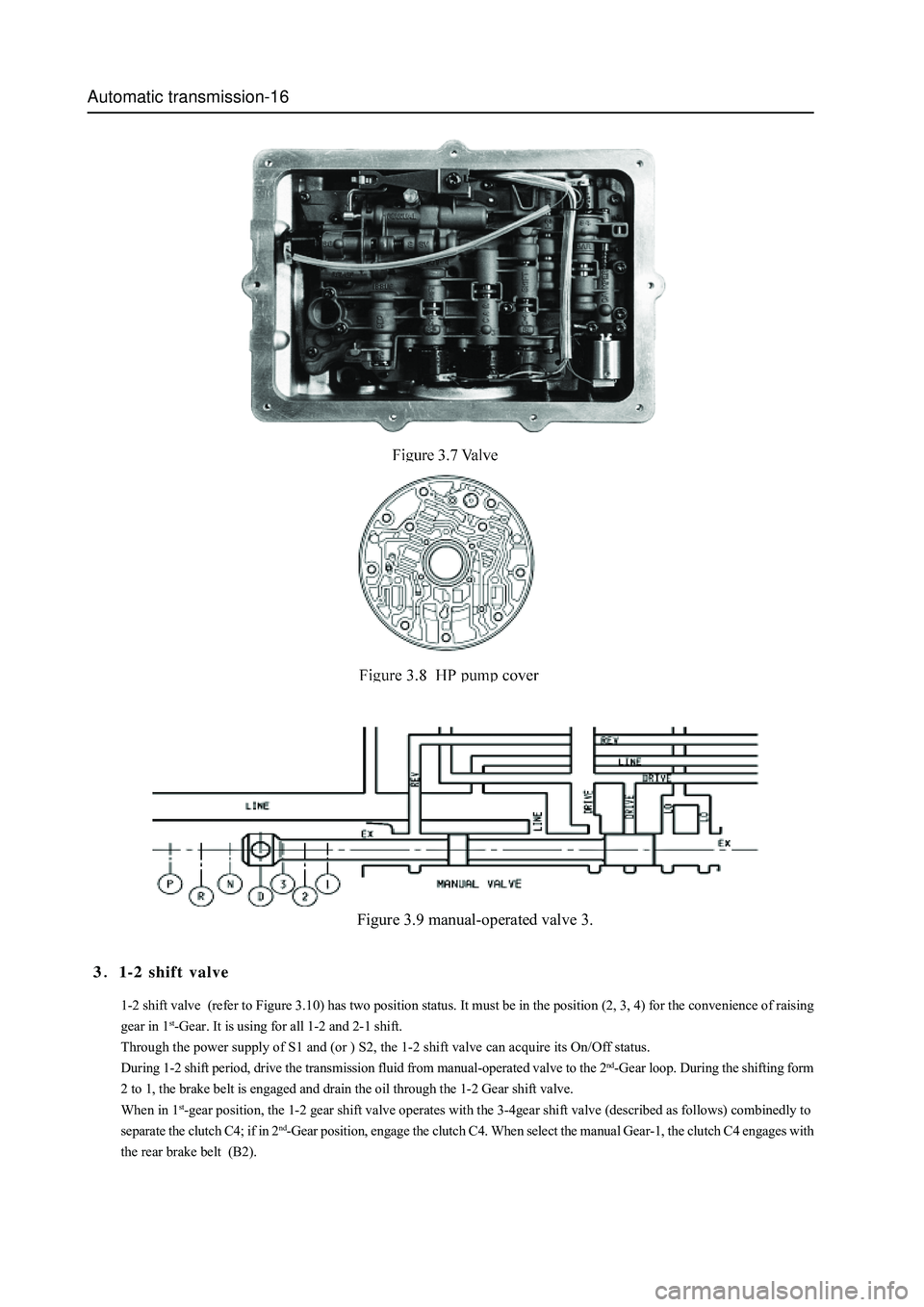
Figure 3.9 manual-operated valve 3.
1-2 shift valve (refer to Figure 3.10) has two position status. It must be in the position (2, 3, 4) for the convenience of raising
gear in 1
st-Gear. It is using for all 1-2 and 2-1 shift.
Through the power supply of S1 and (or ) S2, the 1-2 shift valve can acquire its On/Off status.
During 1-2 shift period, drive the transmission fluid from manual-operated valve to the 2
nd-Gear loop. During the shifting form
2 to 1, the brake belt is engaged and drain the oil through the 1-2 Gear shift valve.
When in 1
st-gear position, the 1-2 gear shift valve operates with the 3-4gear shift valve (described as follows) combinedly to
separate the clutch C4; if in 2
nd-Gear position, engage the clutch C4. When select the manual Gear-1, the clutch C4 engages with
the rear brake belt (B2).
31-2 shift valve
Page 93 of 425
Automatic transmission-17
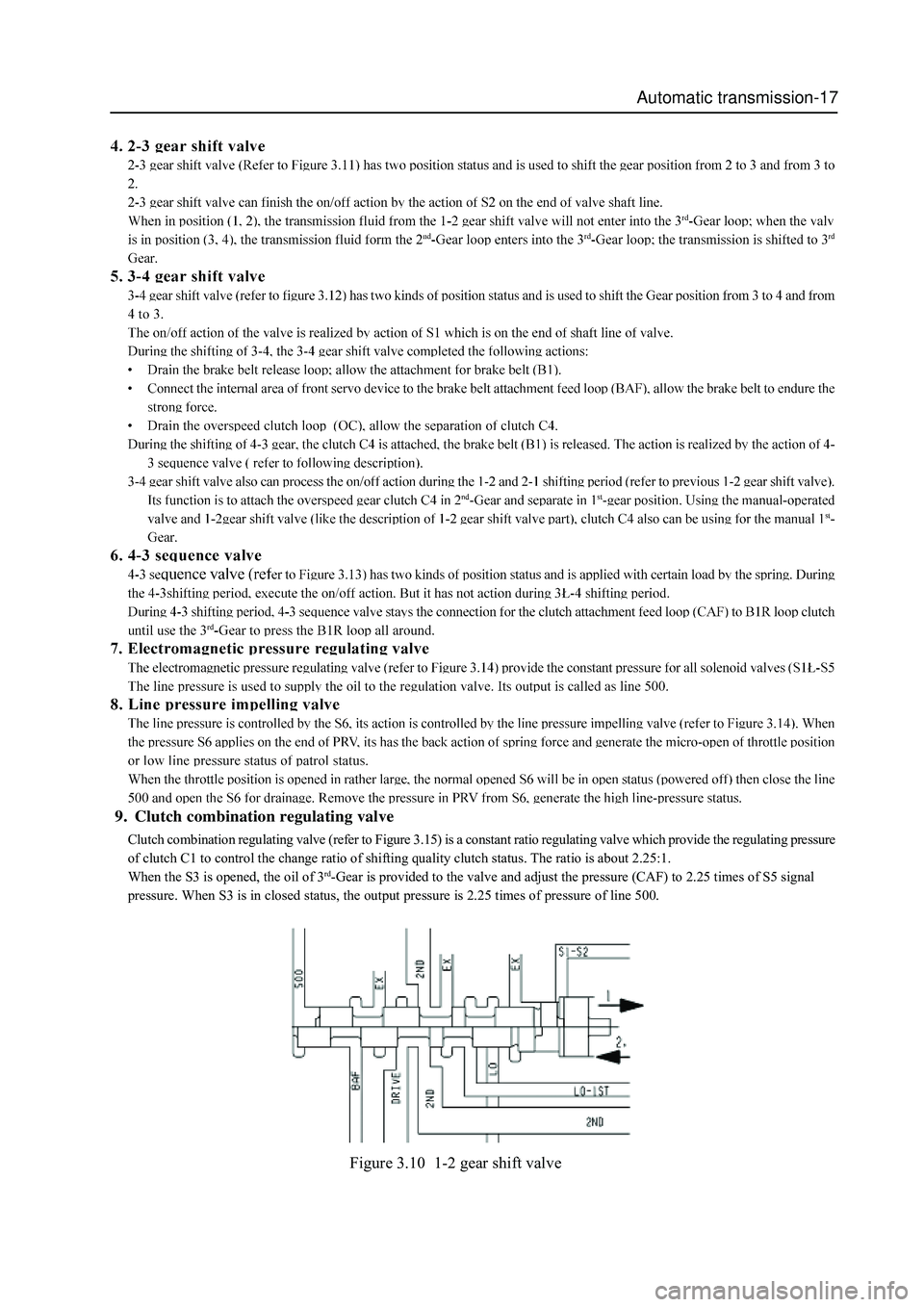
Figure 3.10 1-2 gear shift valve
Clutch combination regulating valve (refer to Figure 3.15) is a constant ratio regulating valve which provide the regulating pressure
of clutch C1 to control the change ratio of shifting quality clutch status. The ratio is about 2.25:1.
When the S3 is opened, the oil of 3
rd-Gear is provided to the valve and adjust the pressure (CAF) to 2.25 times of S5 signal
pressure. When S3 is in closed status, the output pressure is 2.25 times of pressure of line 500.
9. Clutch combination regulating valve
Page 96 of 425
Automatic transmission-20
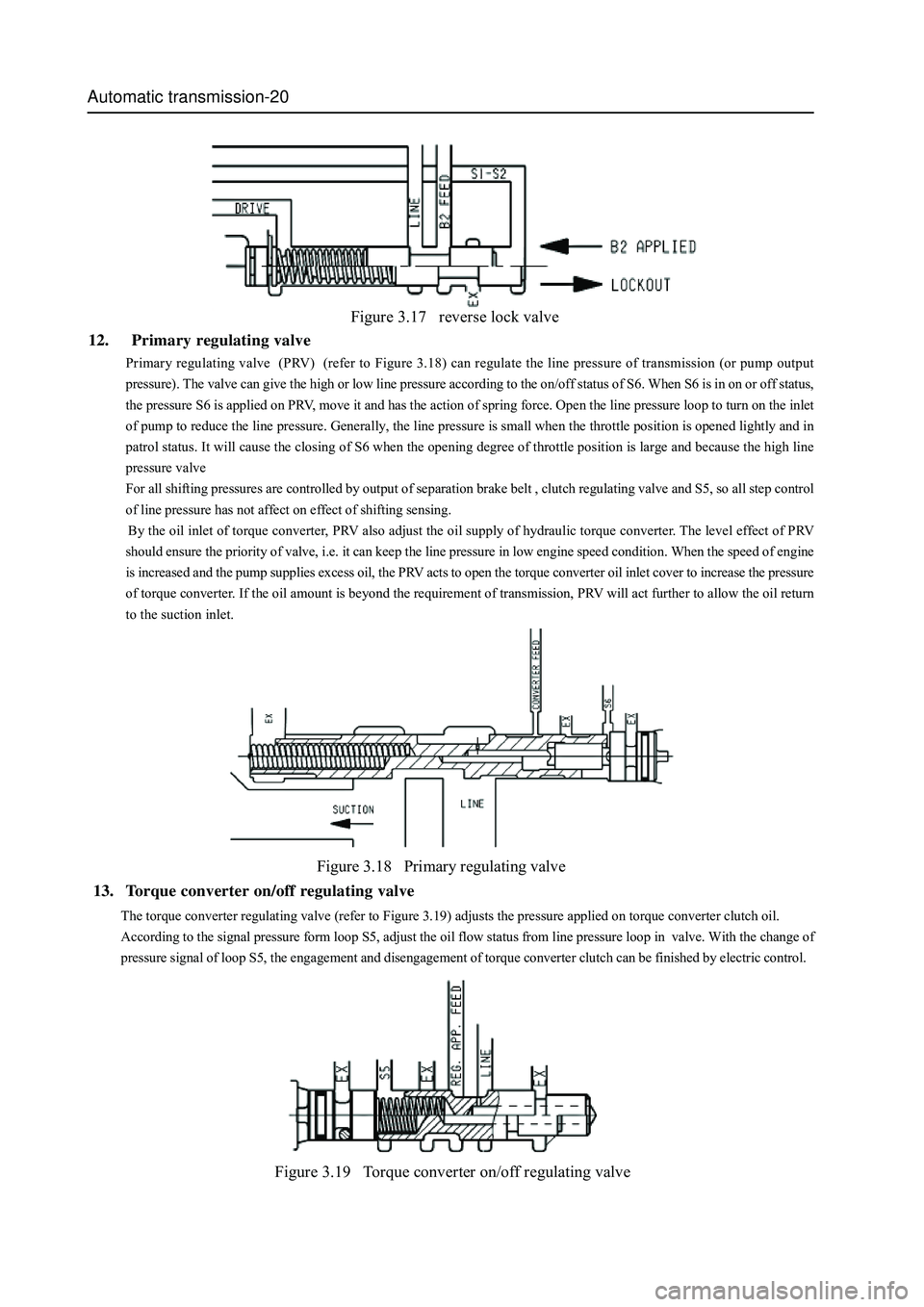
Figure 3.17 reverse lock valve
12. Primary regulating valve
Primary regulating valve (PRV) (refer to Figure 3.18) can regulate the line pressure of transmission (or pump output
pressure). The valve can give the high or low line pressure according to the on/off status of S6. When S6 is in on or off status,
the pressure S6 is applied on PRV, move it and has the action of spring force. Open the line pressure loop to turn on the inlet
of pump to reduce the line pressure. Generally, the line pressure is small when the throttle position is opened lightly and in
patrol status. It will cause the closing of S6 when the opening degree of throttle position is large and because the high line
pressure valve
For all shifting pressures are controlled by output of separation brake belt , clutch regulating valve and S5, so all step control
of line pressure has not affect on effect of shifting sensing.
By the oil inlet of torque converter, PRV also adjust the oil supply of hydraulic torque converter. The level effect of PRV
should ensure the priority of valve, i.e. it can keep the line pressure in low engine speed condition. When the speed of engine
is increased and the pump supplies excess oil, the PRV acts to open the torque converter oil inlet cover to increase the pressure
of torque converter. If the oil amount is beyond the requirement of transmission, PRV will act further to allow the oil return
to the suction inlet.
Figure 3.18 Primary regulating valve
Figure 3.19 Torque converter on/off regulating valve
The torque converter regulating valve (refer to Figure 3.19) adjusts the pressure applied on torque converter clutch oil.
According to the signal pressure form loop S5, adjust the oil flow status from line pressure loop in valve. With the change of
pressure signal of loop S5, the engagement and disengagement of torque converter clutch can be finished by electric control.
13. Torque converter on/off regulating valve
Page 99 of 425
Automatic transmission-23
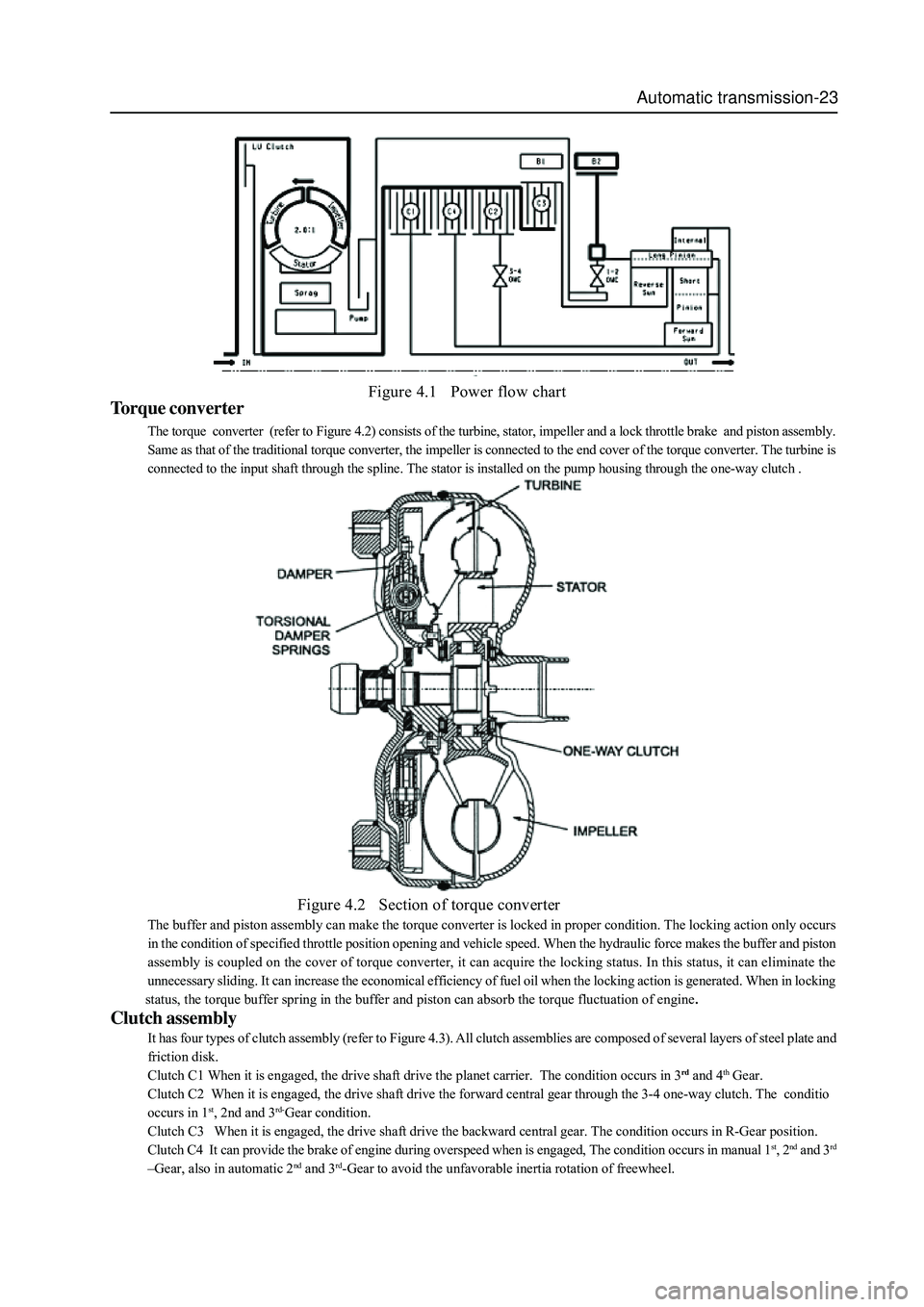
Figure 4.1 Power flow chart
Torque converter
The torque converter (refer to Figure 4.2) consists of the turbine, stator, impeller and a lock throttle brake and piston assembly.
Same as that of the traditional torque converter, the impeller is connected to the end cover of the torque converter. The turbine is
connected to the input shaft through the spline. The stator is installed on the pump housing through the one-way clutch .
Figure 4.2 Section of torque converter
The buffer and piston assembly can make the torque converter is locked in proper condition. The locking action only occurs
in the condition of specified throttle position opening and vehicle speed. When the hydraulic force makes the buffer and piston
assembly is coupled on the cover of torque converter, it can acquire the locking status. In this status, it can eliminate the
unnecessary sliding. It can increase the economical efficiency of fuel oil when the locking action is generated. When in locking
status, the torque buffer spring in the buffer and piston can absorb the torque fluctuation of engine
.
Clutch assembly
It has four types of clutch assembly (refer to Figure 4.3). All clutch assemblies are composed of several layers of steel plate and
friction disk.
Clutch C1 When it is engaged, the drive shaft drive the planet carrier. The condition occurs in 3
rd and 4th Gear.
Clutch C2 When it is engaged, the drive shaft drive the forward central gear through the 3-4 one-way clutch. The conditio
occurs in 1
st, 2nd and 3rd-Gear condition.
Clutch C3 When it is engaged, the drive shaft drive the backward central gear. The condition occurs in R-Gear position.
Clutch C4 It can provide the brake of engine during overspeed when is engaged, The condition occurs in manual 1
st, 2nd and 3rd
–Gear, also in automatic 2nd and 3rd-Gear to avoid the unfavorable inertia rotation of freewheel.
Page 102 of 425
Automatic transmission-26
Power transmission
Introduction
It has the following power transmission pointed to different Gear-position:
power transmission N-Gear and P-Gear
power transmission R-Gear
power transmission manual 1
power transmission Automatic 1st-Gear
power transmission Automatic 2nd -Gear
power transmission Automatic 3rd -Gear
power transmission Automatic 3rd-Gear locking
power transmission Automatic 4th -Gear (overspeed -gear)
power transmission Automatic 4th -Gear locking
For description of each kind of power transmission condition, refer to following parts.
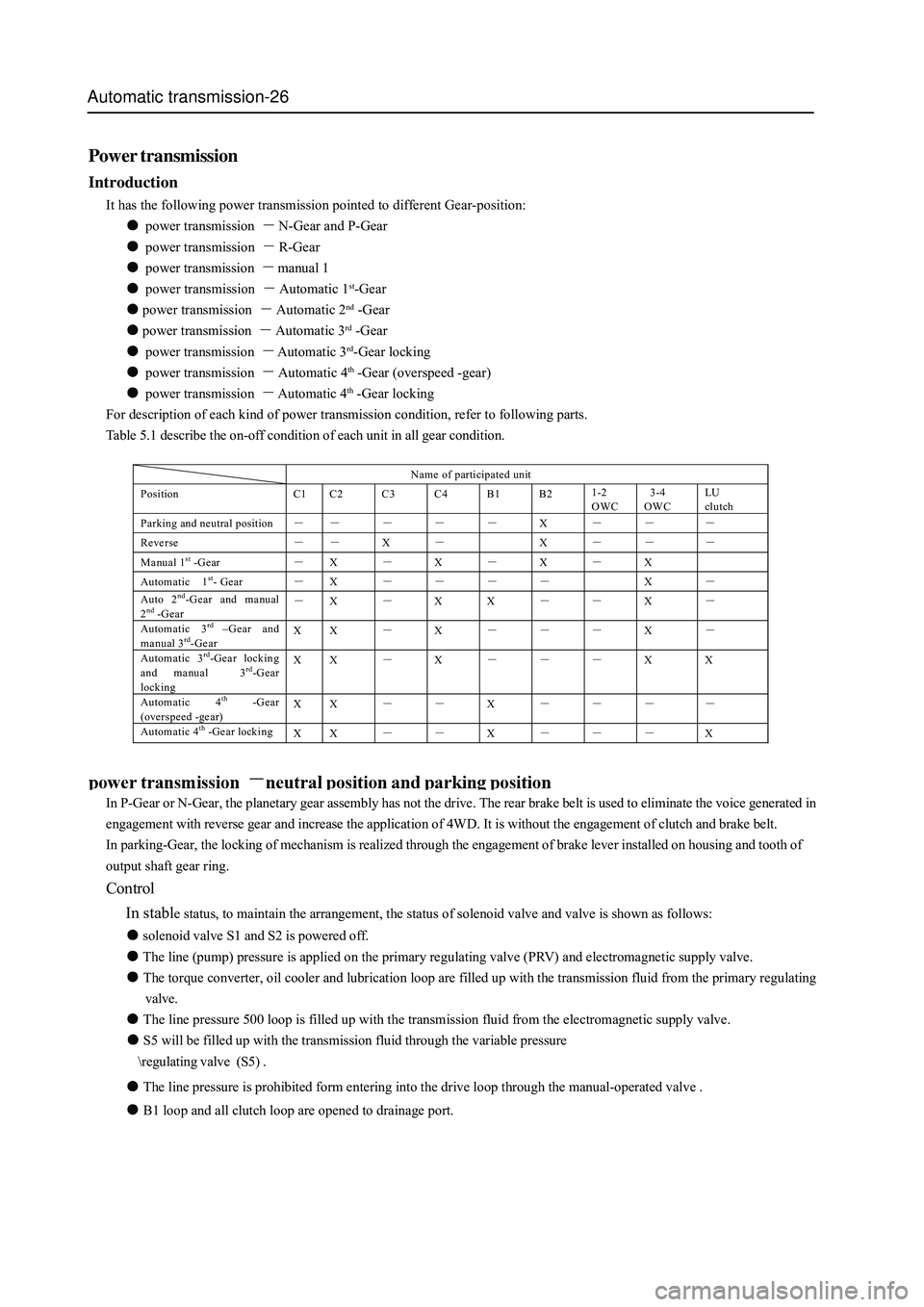
Table 5.1 describe the on-off condition of each unit in all gear condition.
Name of participated unit
Position C1 C2 C3 C4 B1 B2 1-2
OWC 3-4
OWC LU
clutch
Parking and neutral position - - - - - X - - -
Reverse - - X - X - - -
Manual 1st -G ear - X - X - X - X
Automatic 1st- Gear - X - - - - X -
Auto 2nd-Gear and manual
2nd -G ear - X - X X - - X - Automatic 3rd –Gear and
manual 3rd-Gear X X - X - - - X - Automatic 3rd-Gear locking
and manual 3rd-Gear
locking X X - X - - - X X
Automatic 4th -Gear
(overspeed -gear) X X - - X - - - -
Automatic 4th -Gear locking
X X - - X - - - X
In P-Gear or N-Gear, the planetary gear assembly has not the drive. The rear brake belt is used to eliminate the voice generated in
engagement with reverse gear and increase the application of 4WD. It is without the engagement of clutch and brake belt.
In parking-Gear, the locking of mechanism is realized through the engagement of brake lever installed on housing and tooth of
output shaft gear ring.
Control
In stabl
e status, to maintain the arrangement, the status of solenoid valve and valve is shown as follows:
solenoid valve S1 and S2 is powered off.
The line (pump) pressure is applied on the primary regulating valve (PRV) and electromagnetic supply valve.
The torque converter, oil cooler and lubrication loop are filled up with the transmission fluid from the primary regulating
valve.
The line pressure 500 loop is filled up with the transmission fluid from the electromagnetic supply valve.
S5 will be filled up with the transmission fluid through the variable pressure
egulating valve (S5) .
The line pressure is prohibited form entering into the drive loop through the manual-operated valve .
B1 loop and all clutch loop are opened to drainage port.
Page 105 of 425
Automatic transmission-29
In reverse-Gear position, the drive of transmission is sent to the clutch hub through the input shaft and rear clutch piston. In this
condition, the description of each function unit of transmission is shown as follows:
The clutch C3 is engaged and drive the reverse central gear to rotate in clockwise.
The engagement of B2 brake belt cause the rest of the planetary gear carrier, then make the long planetary gear rotates
around its shaft anticlockwise.
The long planetary gear drives the internal gear ring rotates anticlockwise .
Use the spline to connect the inner gear ring to the output shaft and drive the gear ring rotate anticlockwise or in reverse.
Control:
In stable status, to maintain the arrangement, the action of solenoid valve and valve is shown as follows:
A solenoid valve S1 or S2 is closed at least. (Refer to the part in section 3.3.11, related to condition when S1 and S2 is
closed.)
The line pressure reaches the internal surface and external surface of rear servo piston through the reverse lock valve
directly.
The line pressure urges the reverse-Gear loop oil pass through the manual-operated valve.
The reverse-Gear loop oil is circuited to clutch C3 through the manual-operated valve.
In the transmission whiteout HP pump shell, the reverse-Gear loop also can reaches the spring end of the primary
regulating valve to support the spring and push the line-pressure regulating valve.
The oil loop of execution line of all other clutches and brake belts is opened to leaking port.
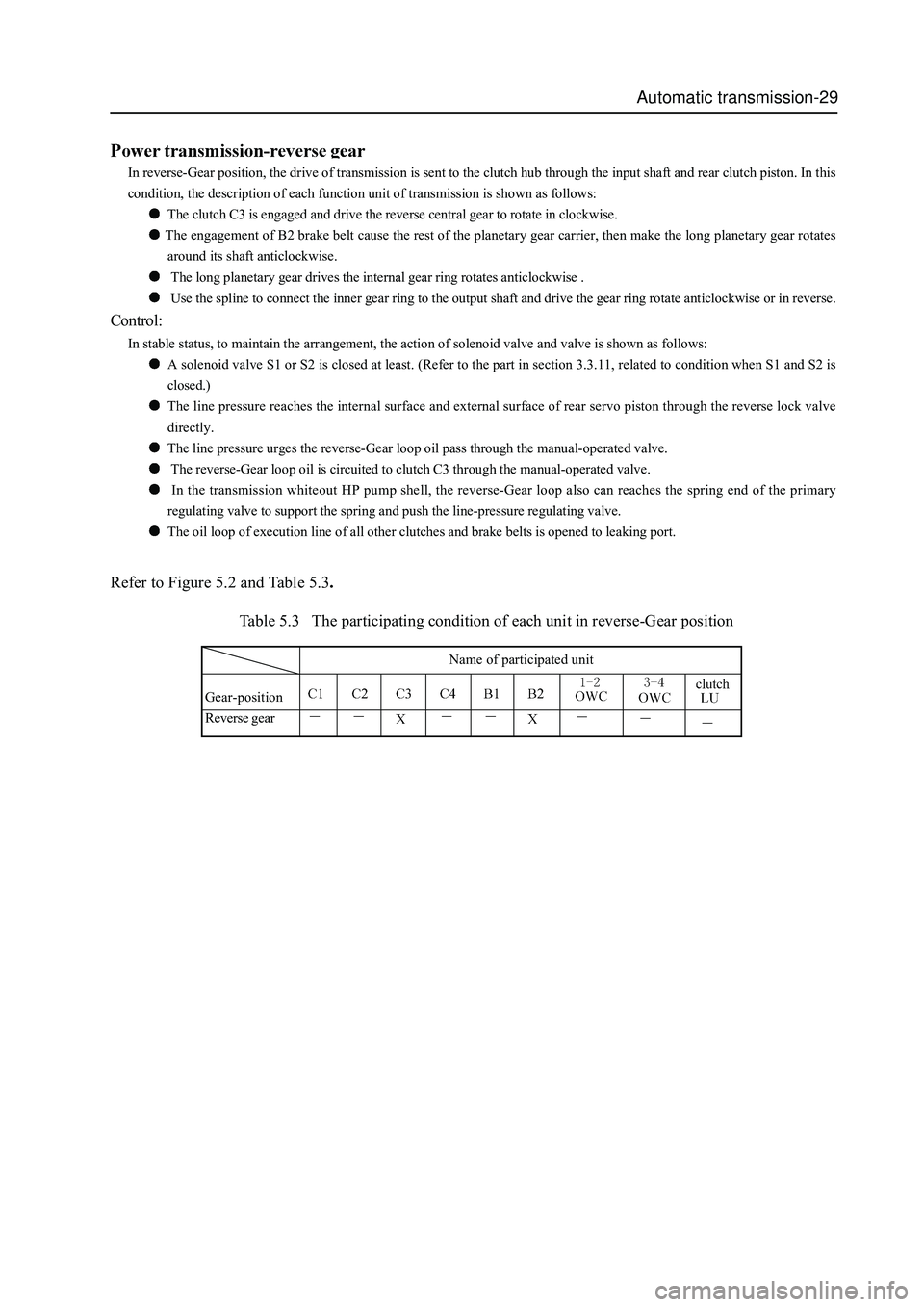
Refer to Figure 5.2 and Table 5.3.
Table 5.3 The participating condition of each unit in reverse-Gear position
Gear-position
Reverse gear
Name of participated unit
Page 107 of 425
Automatic transmission-31
Power transmission manual 1st-Gear
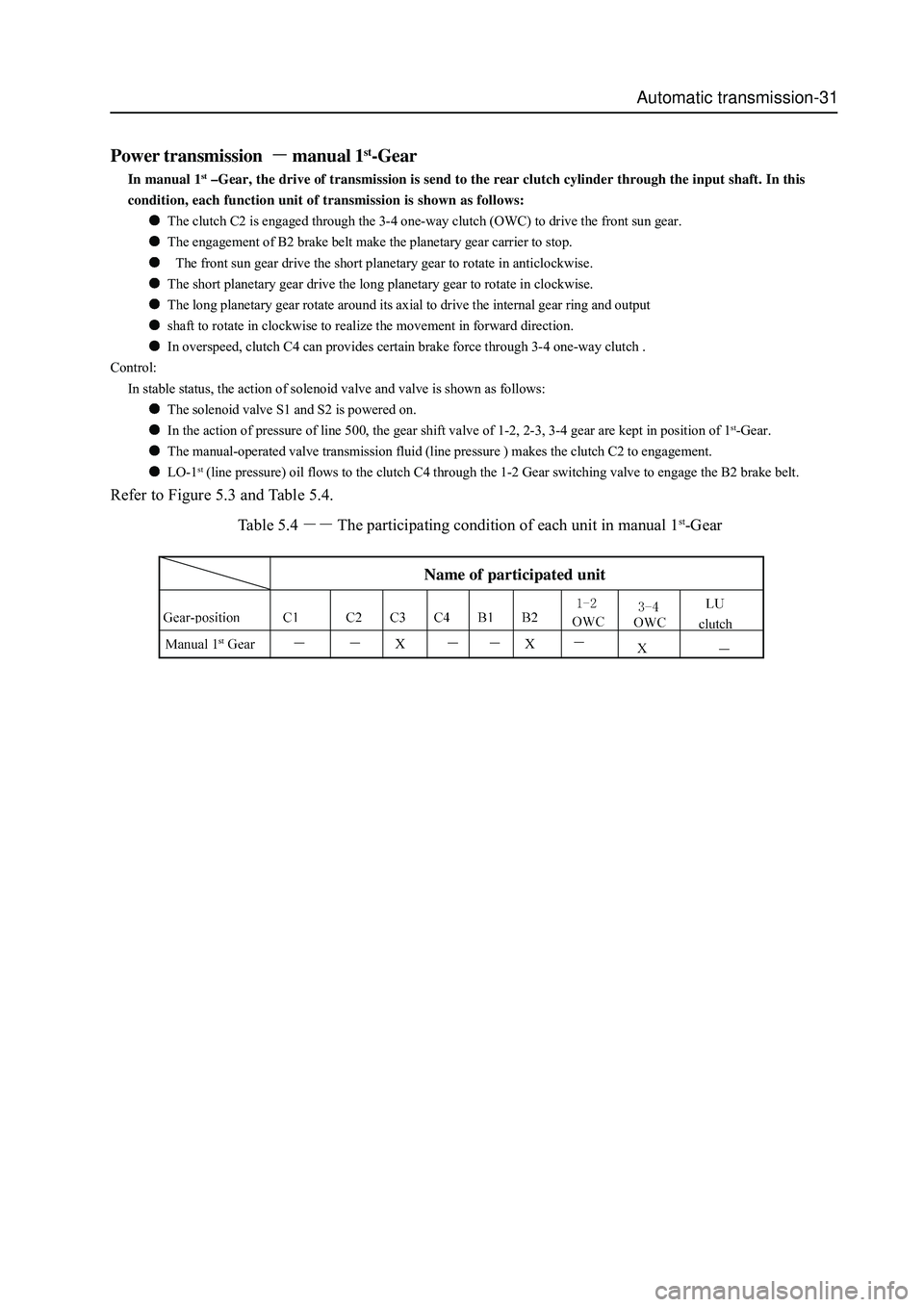
In manual 1st –Gear, the drive of transmission is send to the rear clutch cylinder through the input shaft. In this
condition, each function unit of transmission is shown as follows:
The clutch C2 is engaged through the 3-4 one-way clutch (OWC) to drive the front sun gear.
The engagement of B2 brake belt make the planetary gear carrier to stop.
The front sun gear drive the short planetary gear to rotate in anticlockwise.
The short planetary gear drive the long planetary gear to rotate in clockwise.
The long planetary gear rotate around its axial to drive the internal gear ring and output
shaft to rotate in clockwise to realize the movement in forward direction.
In overspeed, clutch C4 can provides certain brake force through 3-4 one-way clutch .
Control:
In stable status, the action of solenoid valve and valve is shown as follows:
The solenoid valve S1 and S2 is powered on.
In the action of pressure of line 500, the gear shift valve of 1-2, 2-3, 3-4 gear are kept in position of 1st-Gear.
The manual-operated valve transmission fluid (line pressure ) makes the clutch C2 to engagement.
LO-1st (line pressure) oil flows to the clutch C4 through the 1-2 Gear switching valve to engage the B2 brake belt.
Refer to Figure 5.3 and Table 5.4.
Table 5.4
The participating condition of each unit in manual 1st-Gear
Name of participated unit
X X
Page 109 of 425
Automatic transmission-33
Power transmission automatic 1st-Gear
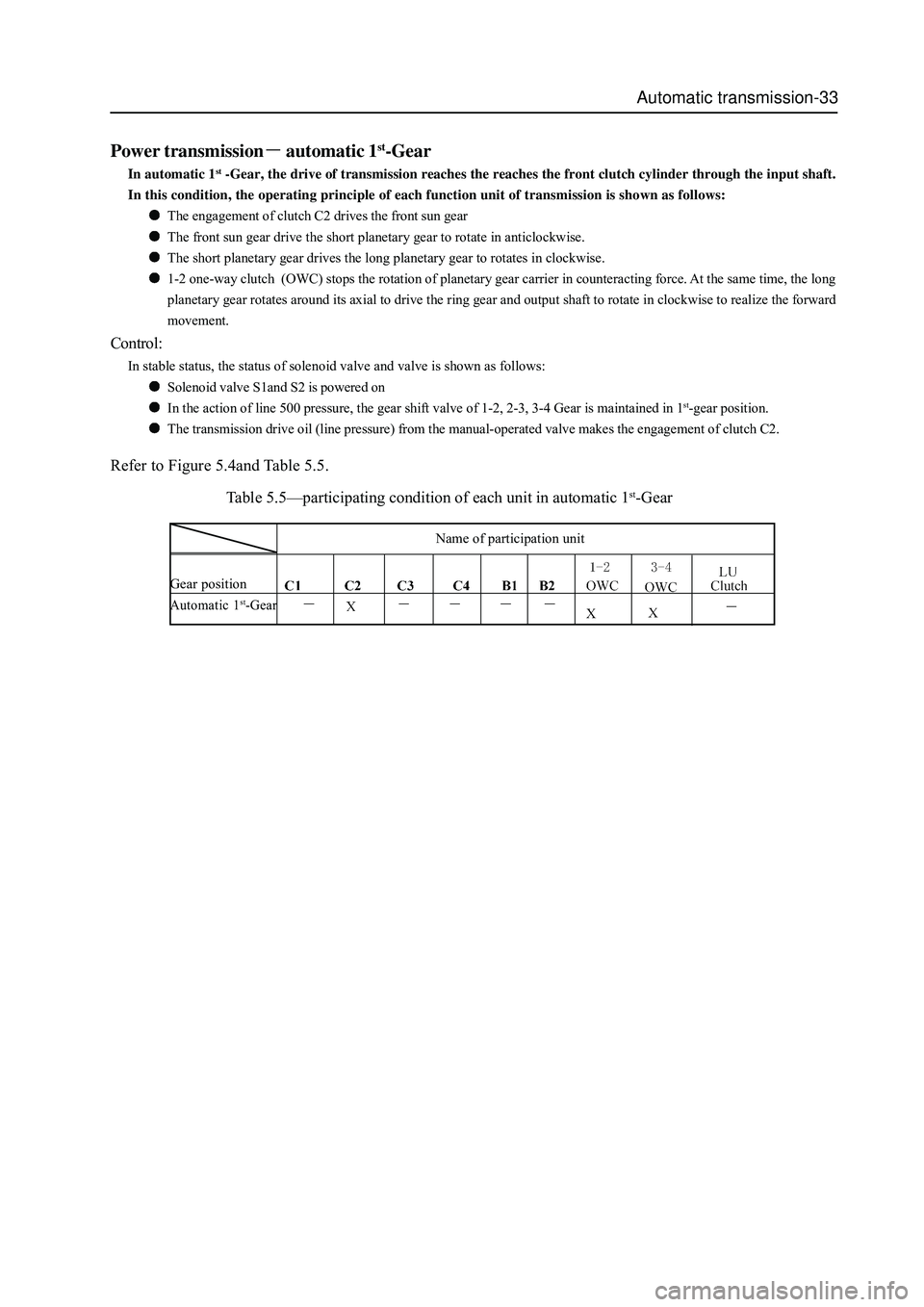
In automatic 1st -Gear, the drive of transmission reaches the reaches the front clutch cylinder through the input shaft.
In this condition, the operating principle of each function unit of transmission is shown as follows:
The engagement of clutch C2 drives the front sun gear
The front sun gear drive the short planetary gear to rotate in anticlockwise.
The short planetary gear drives the long planetary gear to rotates in clockwise.
1-2 one-way clutch (OWC) stops the rotation of planetary gear carrier in counteracting force. At the same time, the long
planetary gear rotates around its axial to drive the ring gear and output shaft to rotate in clockwise to realize the forward
movement.
Control:
In stable status, the status of solenoid valve and valve is shown as follows:
Solenoid valve S1and S2 is powered on
In the action of line 500 pressure, the gear shift valve of 1-2, 2-3, 3-4 Gear is maintained in 1st-gear position.
The transmission drive oil (line pressure) from the manual-operated valve makes the engagement of clutch C2.
Table 5.5—participating condition of each unit in automatic 1st-Gear
Name of participation unit
Gear position
Automatic 1st-Gear
Refer to Figure 5.4and Table 5.5.