ECU HONDA ACCORD 2001 CF / 6.G User Guide
[x] Cancel search | Manufacturer: HONDA, Model Year: 2001, Model line: ACCORD, Model: HONDA ACCORD 2001 CF / 6.GPages: 355, PDF Size: 6 MB
Page 36 of 355
Move the vehicle seat to the rear-
most position.
Check that the child’s seat belt is
properly positioned and secured.
If you decide that a child can saf ely
ride up f ront, be sure to:
Caref ully read the owner’s manual
and make sure you understand all
seat belt instructions and all saf ety
inf ormation.
Have the child sit up straight, back
against the seat, and feet on or
near the f loor. Supervise the child. Even mature
children sometimes need to be
reminded to f asten the seat belts
or sit properly.
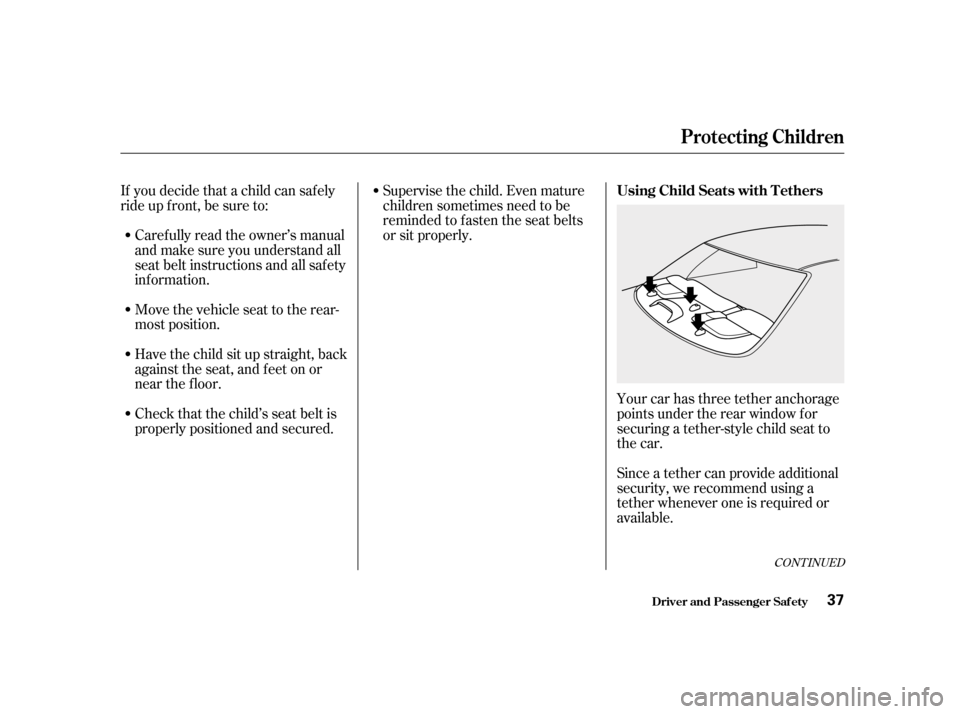
Your car has three tether anchorage
points under the rear window f or
securing a tether-style child seat to
the car.
Since a tether can provide additional
security, we recommend using a
tether whenever one is required or
available.
CONT INUED
Using Child Seats with T ethers
Protecting Children
Driver and Passenger Saf ety37
Page 37 of 355
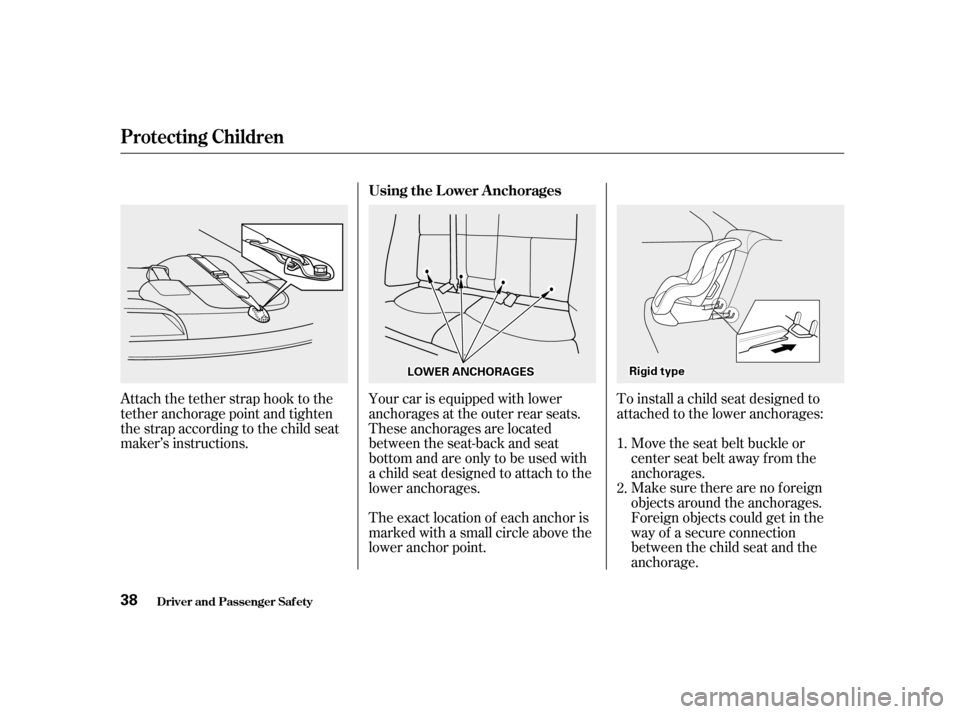
Attach the tether strap hook to the
tether anchorage point and tighten
the strap according to the child seat
maker’s instructions.To install a child seat designed to
attached to the lower anchorages:
Move the seat belt buckle or
center seat belt away from the
anchorages.
Make sure there are no f oreign
objects around the anchorages.
Foreign objects could get in the
way of a secure connection
between the child seat and the
anchorage.
Your car is equipped with lower
anchorages at the outer rear seats.
These anchorages are located
between the seat-back and seat
bottom and are only to be used with
a child seat designed to attach to the
lower anchorages.
The exact location of each anchor is
marked with a small circle above the
lower anchor point.
1. 2.
Protecting Children
Driver and Passenger Saf etyUsing the L ower Anchorages
38
LLOOWWEERRAANNCCHHOORRAAGGEESSRRiiggiiddttyyppee
Page 38 of 355
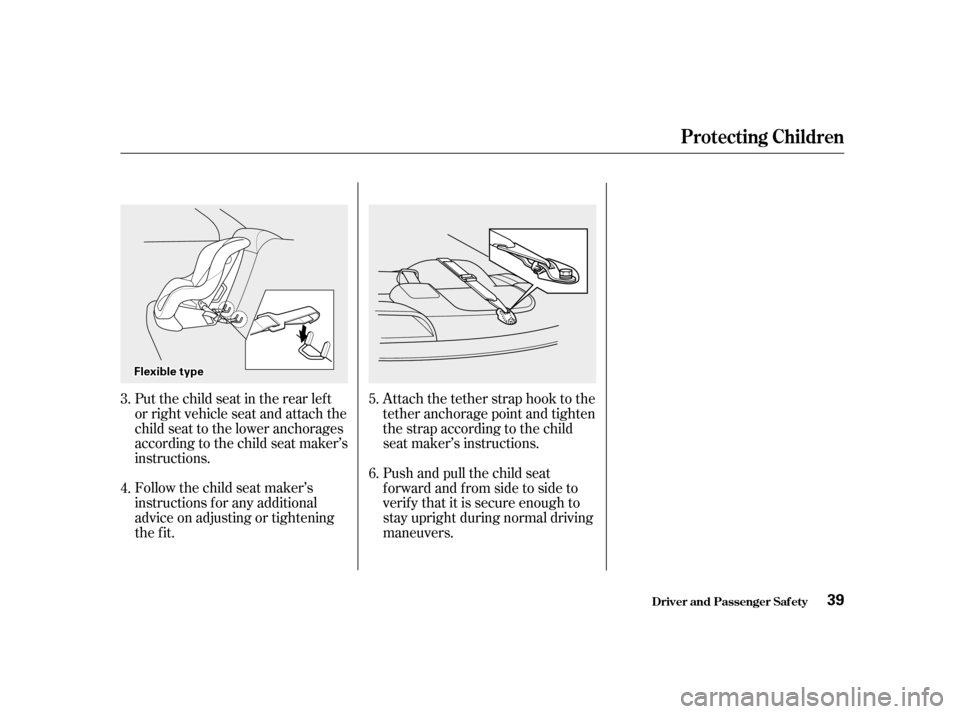
Put the child seat in the rear lef t
or right vehicle seat and attach the
child seat to the lower anchorages
according to the child seat maker’s
instructions.
Follow the child seat maker’s
instructions f or any additional
advice on adjusting or tightening
the fit.Attach the tether strap hook to the
tether anchorage point and tighten
the strap according to the child
seat maker’s instructions.
Push and pull the child seat
f orward and f rom side to side to
verif y that it is secure enough to
stay upright during normal driving
maneuvers.
3. 4.
5. 6.
Protecting Children
Driver and Passenger Saf ety
39
FFlleexxiibblleettyyppee
Page 39 of 355
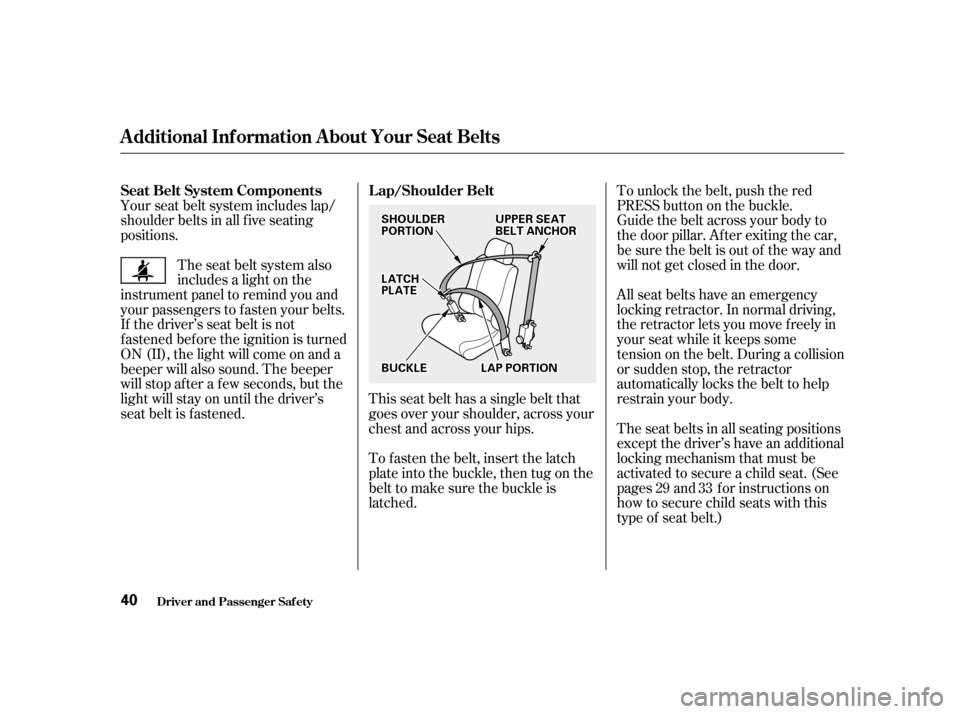
This seat belt has a single belt that
goes over your shoulder, across your
chest and across your hips.
Your seat belt system includes lap/
shoulder belts in all f ive seating
positions.
The seat belt system also
includes a light on the
instrument panel to remind you and
your passengers to f asten your belts.
If the driver’s seat belt is not
fastened before the ignition is turned
ON (II), the light will come on and a
beeper will also sound. The beeper
will stop af ter a f ew seconds, but the
light will stay on until the driver’s
seat belt is f astened.
The seat belts in all seating positions
except the driver’s have an additional
locking mechanism that must be
activated to secure a child seat. (See
pages and f or instructions on
how to secure child seats with this
type of seat belt.)
All seat belts have an emergency
locking retractor. In normal driving,
the retractor lets you move f reely in
your seat while it keeps some
tension on the belt. During a collision
or sudden stop, the retractor
automatically locks the belt to help
restrain your body.
Guide the belt across your body to
the door pillar. Af ter exiting the car,
be sure the belt is out of the way and
will not get closed in the door.
To unlock the belt, push the red
PRESSbuttononthebuckle.
To fasten the belt, insert the latch
plate into the buckle, then tug on the
belt to make sure the buckle is
latched. 29 33
Seat Belt System Components L ap/Shoulder Belt
Additional Inf ormation About Your Seat Belts
Driver and Passenger Saf ety
40
SSHHOOUULLDDEERRPPOORRTTIIOONNUUPPPPEERRSSEEAATTBBEELLTTAANNCCHHOORR
LLAATTCCHHPPLLAATTEE
BBUUCCKKLLEELLAAPPPPOORRTTIIOONN
Page 66 of 355
Make sure the rear window is clear
and you have good visibility bef ore
starting to drive.
The def ogger and antenna wires on
the inside of the rear window can be
accidentally damaged. When
cleaning the glass, always wipe side
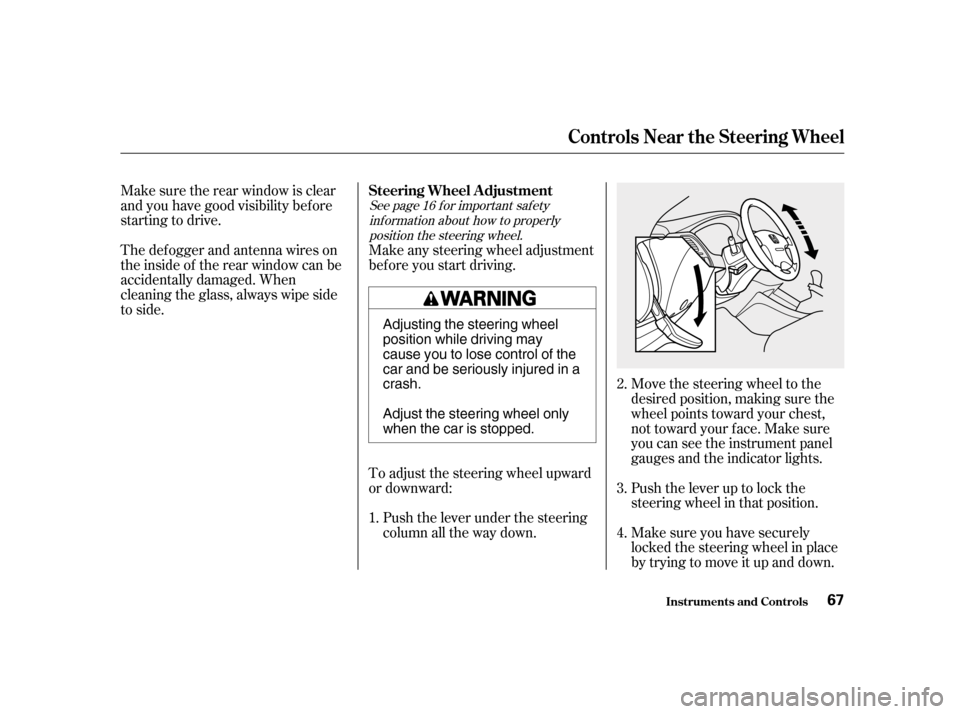
to side.Make sure you have securely
locked the steering wheel in place
by trying to move it up and down.
Push the lever up to lock the
steering wheel in that position.
Move the steering wheel to the
desired position, making sure the
wheel points toward your chest,
not toward your f ace. Make sure
you can see the instrument panel
gauges and the indicator lights.
Make any steering wheel adjustment
bef ore you start driving.
To adjust the steering wheel upward
or downward:
Push the lever under the steering
column all the way down.
1. 2. 3. 4.
See page f or important saf ety
inf ormation about how to properlyposition the steering wheel. 16
Controls Near the Steering Wheel
Inst rument s and Cont rols
Steering Wheel A djustment
67
Adjusting the steering wheel
position while driving may
cause you to lose control of the
car and be seriously injured in acrash.
Adjust the steering wheel only
when the car is stopped.
Page 76 of 355

CONT INUED
You cannot lock or unlock the doors
with the remote transmitter if any
door is not f ully closed or the key is
in the ignition switch.
When you push the LOCK button a
second time within 5 seconds after
you have locked the doors, the horn
will sound once to verify that the
security system will be set.To open the trunk, push the Trunk
Release button f or approximately
one second.
The trunk will not open if the key is
in the ignition switch.
Panic mode allows you to remotely
activate your car’s security system to
attract attention. When activated, the
horn will sound, and the exterior
lights will f lash, f or about 30 seconds.
To activate panic mode, press and
hold the PANIC button for about two
seconds.
To cancel Panic mode bef ore 30
seconds, press any button on the
remote transmitter. You can also
turn the ignition switch to ON (II).
If you unlock the doors with the
remote transmitter, but do not open
any of the doors within 20 seconds,
the doors automatically relock and
the security system sets.
Keys and Locks
Inst rument s and Cont rols
Panic Mode
77
Page 82 of 355

While training or using the
transmitter, make sure you have a
clear view of the garage door or gate,
and that no one will be injured by its
movement.
Always ref er to the operating
instructions and saf ety inf ormation
that came with your garage door
opener or other equipment you
intend to operate with the HomeLink
Universal Transmitter. If you do not
have this inf ormation, you should
contact the manuf acturer of the
equipment.
If you are training the transmitter to
operate a garage door or gate, it is
recommended that you unplug the
motor f or that device during training.
Repeatedly pressing the remote
control button could burn out the
motor. The HomeLink transmitter stores
the code in a permanent memory.
There should be no need to retrain
the transmitter if your car’s battery
goes dead or is disconnected.
If your garage door opener was
manuf actured bef ore April 1982, you
may not be able to program the
HomeLink Universal Transmitter to
operate it. Garage door openers
manufactured before that date do
not have a safety feature that causes
them to stop and reverse if an
obstacle is detected during closing,
increasing the risk of injury. If you
have questions, call (800) 355-3515.
The HomeLink Universal
Transmitter built into your car can
be programmed to operate remotely-
controlled devices around your home,
such as garage doors, lighting, or
home security systems. It can
replaceuptothreeremote
transmitters.
If you have problems with training
the HomeLink Universal
Transmitter, or would like
inf ormation on home products that
can be operated by the transmitter,
call (800) 355-3515. On the Internet,
go to www.homelink.jci.com.
On all V6 modelsImportant Saf ety Precautions
General Inf ormation
Customer Assistance
HomeL ink Universal T ransmitter
Inst rument s and Cont rols
83
Page 84 of 355

Canadian Owners:
The remote control you are training
from may stop transmitting after two
seconds. This is not long enough f or
the HomeLink transmitter to learn
thecode.Releaseandpressthe
button on the remote control every
two seconds until the transmitter has
learned the code.The red light in the transmitter
should begin f lashing. It will f lash
slowly at first, then rapidly.
When the red light f lashes rapidly,
release both buttons. The
transmitter should have learned
the code f rom the remote control.
Plug in the garage door opener
motor, then test the transmitter
button by pushing it. It should
operate the garage door.
If the button does not work, repeat
this procedure to train it again. If it still does not work, you may have a
variable or rolling code garage
door opener. Test this by pressing
and holding the HomeLink
transmitter button you just trained.
If the red light blinks f or two
seconds,thenstayson,youhavea
rolling code garage door opener.
You may be able to verify this with
the manufacturer’s documentation.
Go to ‘‘Training With a Rolling
Code System.’’
Repeat these steps to train the
other two transmitter buttons to
operate any other remotely-
controlled devices around your
home (lighting, automatic gate,
security system, etc.).
For security purposes, newer garage
door opening systems use a ‘‘rolling’’
or variable code. Inf ormation f rom
the remote control and the garage
door opener are needed bef ore the
HomeLink transmitter can operate
the garage door opener.
The‘‘Training the Transmitter’’
procedure trains the HomeLink
transmitter to the proper garage
door opener code. The f ollowing
procedure synchronizes the
HomeLink transmitter to the garage
door opener so they send and
receive the correct codes.
5. 6.
8.
7.
CONT INUED
T raining With a Rolling Code
System
Inst rument s and Cont rols
HomeL ink Universal T ransmitter
85
Page 93 of 355
Never drive with the seat-back
f olded down and the trunk lid open.
See on
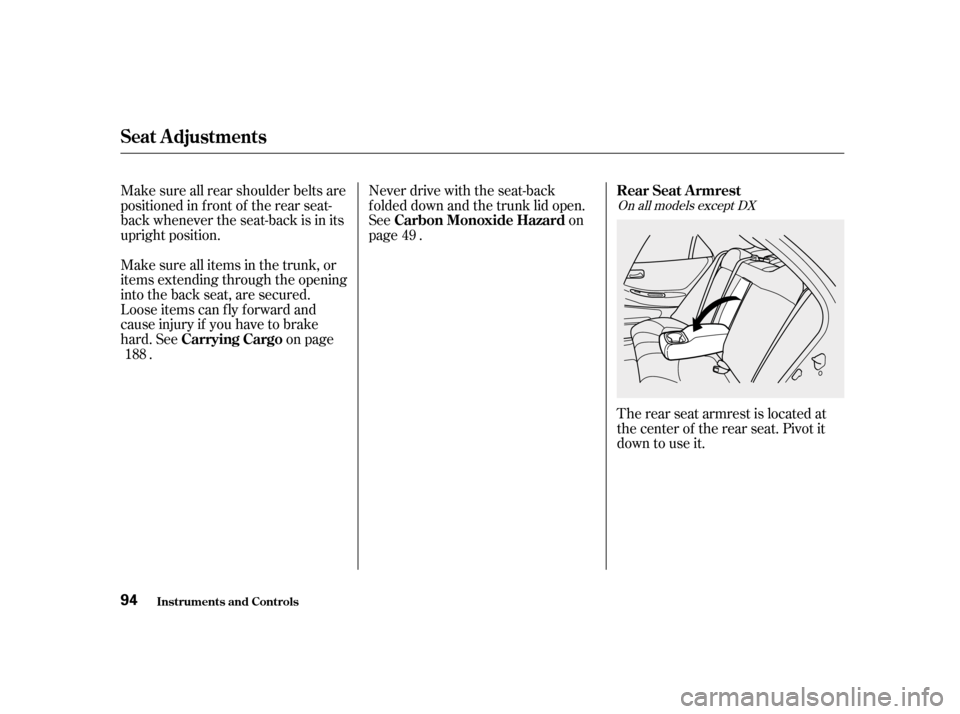
page .The rear seat armrest is located at
the center of the rear seat. Pivot it
down to use it.
Make sure all rear shoulder belts are
positioned in f ront of the rear seat-
back whenever the seat-back is in its
upright position.
Make sure all items in the trunk, or
items extending through the opening
into the back seat, are secured.
Looseitemscanflyforwardand
cause injury if you have to brake
hard. See on page
. 49
188
On all models except DX
Carbon Monoxide Hazard Rear Seat Armrest
Carrying Cargo
Seat A djustments
Inst rument s and Cont rols
94
Page 94 of 355
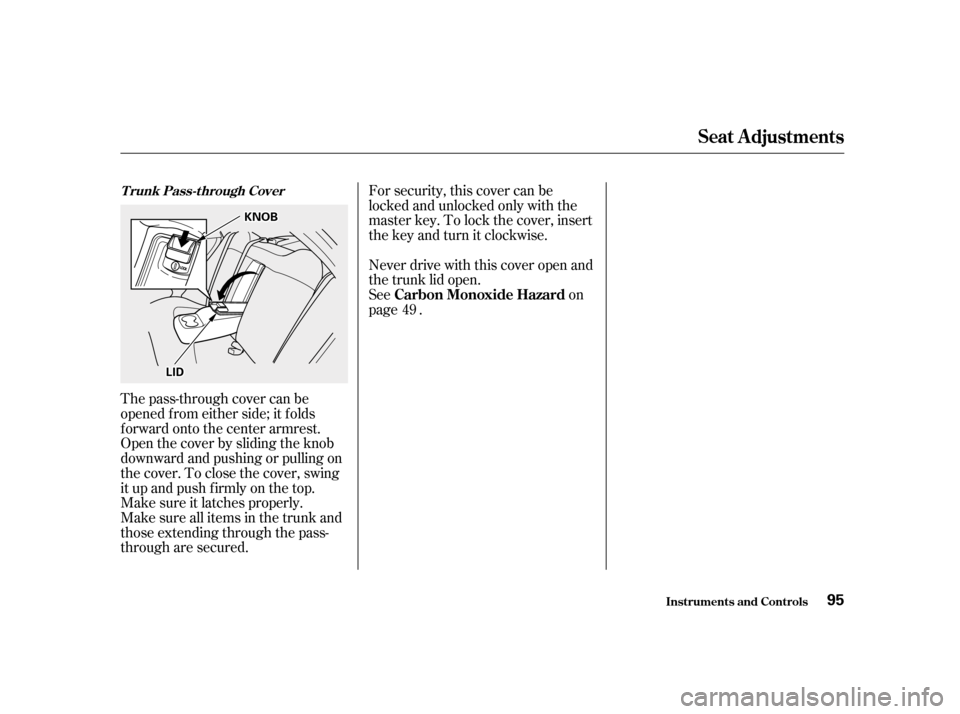
For security, this cover can be
locked and unlocked only with the
master key. To lock the cover, insert
thekeyandturnitclockwise.
The pass-through cover can be
opened f rom either side; it f olds
f orward onto the center armrest.
Open the cover by sliding the knob
downward and pushing or pulling on
the cover. To close the cover, swing
it up and push f irmly on the top.
Make sure it latches properly.
Make sure all items in the trunk and
those extending through the pass-
through are secured. Never drive with this cover open and
the trunk lid open.
See on
page .
49
Seat A djustments
Inst rument s and Cont rols
T runk Pass-t hrough Cover
Carbon Monoxide Hazard
95
KKNNOOBB
LLIIDD