child seat HONDA ACCORD 2002 CL7 / 7.G User Guide
[x] Cancel search | Manufacturer: HONDA, Model Year: 2002, Model line: ACCORD, Model: HONDA ACCORD 2002 CL7 / 7.GPages: 223, PDF Size: 3.8 MB
Page 20 of 223
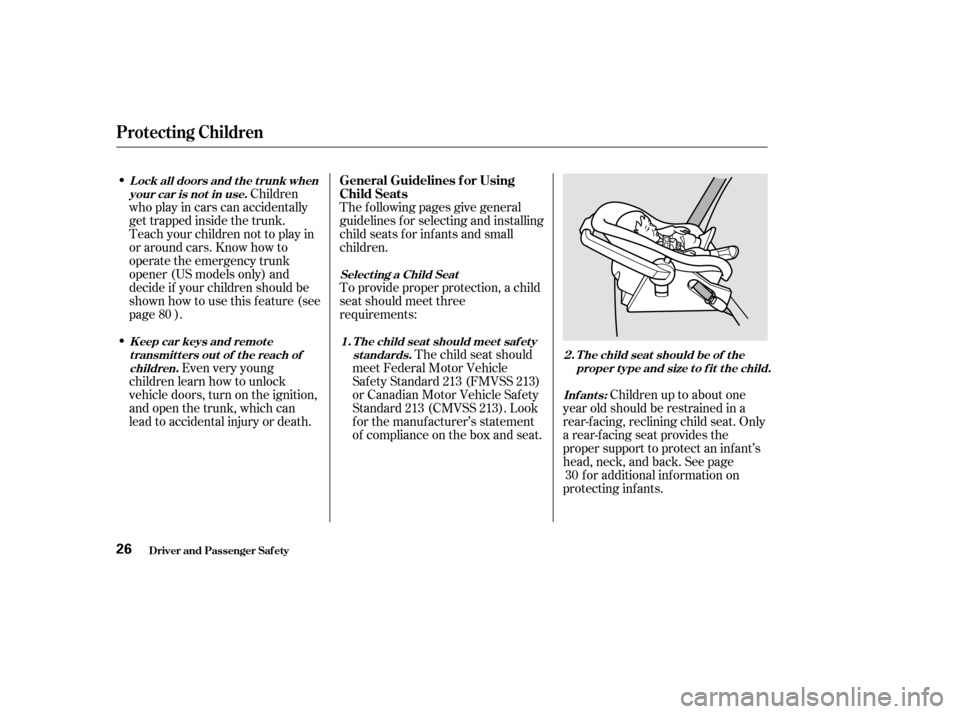
Childrenuptoaboutone
year old should be restrained in a
rear-f acing, reclining child seat. Only
a rear-f acing seat provides the
proper support to protect an inf ant’s
head, neck, and back. See page for additional information on
protecting inf ants.
The f ollowing pages give general
guidelines f or selecting and installing
child seats f or inf ants and small
children.
To provide proper protection, a child
seat should meet three
requirements:
The child seat should
meet Federal Motor Vehicle
Saf ety Standard 213 (FMVSS 213)
or Canadian Motor Vehicle Saf ety
Standard 213 (CMVSS 213). Look
for the manufacturer’s statement
of compliance on the box and seat.
Children
who play in cars can accidentally
get trapped inside the trunk.
Teach your children not to play in
or around cars. Know how to
operate the emergency trunk
opener (US models only) and
decide if your children should be
shown how to use this f eature (see
page ).
Even very young
children learn how to unlock
vehicle doors, turn on the ignition,
and open the trunk, which can
lead to accidental injury or death. 80
30
T he child seat should be of theproper t ype and size t o f it t he child.
Inf ant s:
Select ing a Child Seat
T he child seat should meet saf et yst andards.
L ock all doors and t he t runk when
your car is not in use.
K eep car keys and remot etransmitters out of the reach of
children. 2.
1.
General Guidelines f or Using
Child Seats
Protecting Children
Driver and Passenger Saf ety26
Page 21 of 223
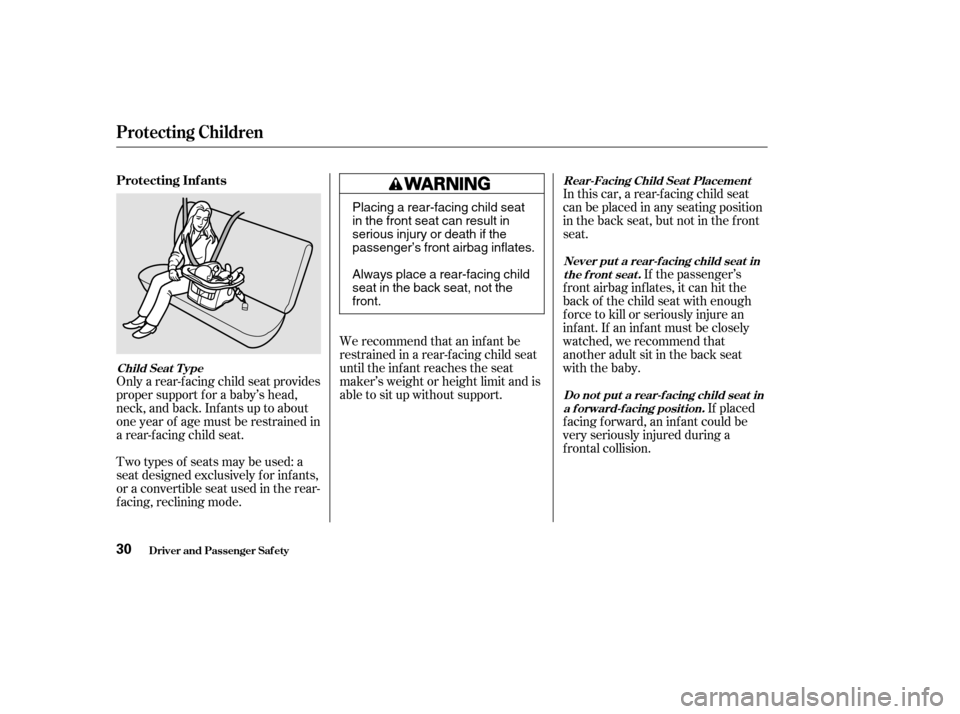
Only a rear-f acing child seat provides
proper support f or a baby’s head,
neck, and back. Inf ants up to about
one year of age must be restrained in
a rear-f acing child seat.In this car, a rear-f acing child seat
can be placed in any seating position
in the back seat, but not in the front
seat.
Two types of seats may be used: a
seat designed exclusively f or inf ants,
or a convertible seat used in the rear-
f acing, reclining mode. We recommend that an inf ant be
restrained in a rear-f acing child seat
until the inf ant reaches the seat
maker’s weight or height limit and is
able to sit up without support.
If the passenger’s
f ront airbag inf lates, it can hit the
back of the child seat with enough
f orce to kill or seriously injure an
inf ant. If an inf ant must be closely
watched, we recommend that
another adult sit in the back seat
with the baby.
If placed
f acing f orward, an inf ant could be
very seriously injured during a
f rontal collision.
Protecting Inf ants
Child Seat T ype
Rear-Facing Child Seat Placement
Never put a rear-f acing child seat inthe front seat.
Do not put a rear-f acing child seat ina f orward-f acing position.
Protecting Children
Driver and Passenger Saf ety30
Placing a rear-facing child seat
in the front seat can result in
serious injury or death if the
passenger’s front airbag inflates.
Always place a rear-facing child
seat in the back seat, not thefront.
Page 22 of 223
CONT INUED
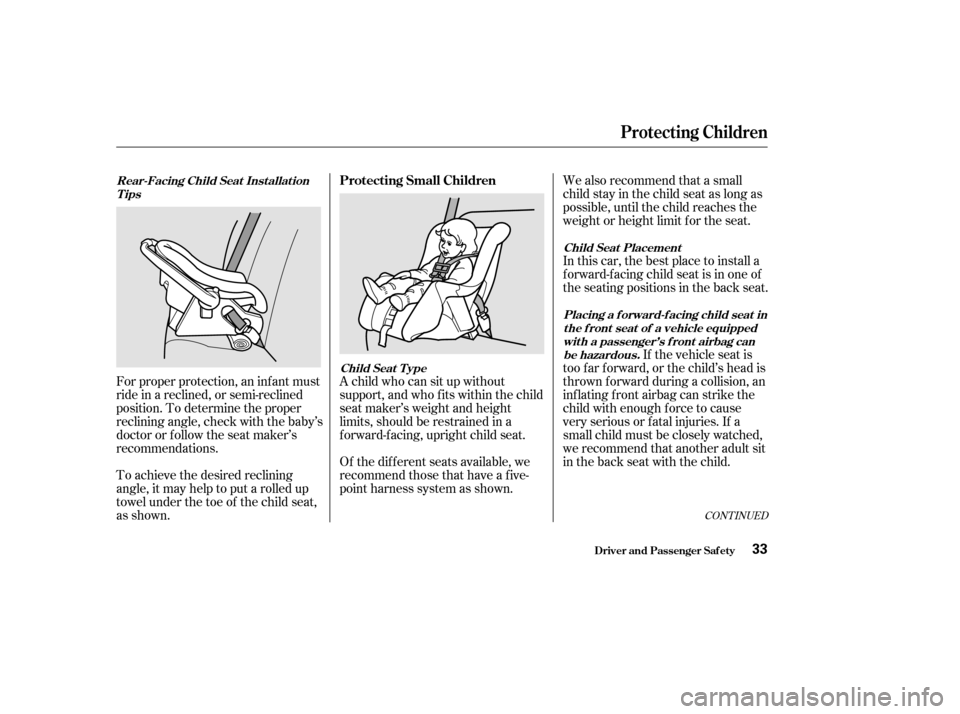
To achieve the desired reclining
angle, it may help to put a rolled up
towel under the toe of the child seat,
as shown.
Forproperprotection,aninfantmust
ride in a reclined, or semi-reclined
position. To determine the proper
reclining angle, check with the baby’s
doctor or f ollow the seat maker’s
recommendations. We also recommend that a small
child stay in the child seat as long as
possible, until the child reaches the
weight or height limit f or the seat.
In this car, the best place to install a
f orward-f acing child seat is in one of
the seating positions in the back seat.
If the vehicle seat is
too far forward, or the child’s head is
thrown f orward during a collision, an
inflating front airbag can strike the
child with enough f orce to cause
very serious or f atal injuries. If a
small child must be closely watched,
we recommend that another adult sit
in the back seat with the child.
A child who can sit up without
support, and who f its within the child
seat maker’s weight and height
limits, should be restrained in a
f orward-f acing, upright child seat.
Of the different seats available, we
recommend those that have a f ive-
point harness system as shown.
Protecting Children
Driver and Passenger Saf ety
Rear-Facing Child Seat Inst allat ion
Tips
Child Seat Placement
Placing a f orward-f acing child seat int he f ront seat of a vehicle equippedwit h a passenger’s f ront airbag can
be hazardous.
Child Seat T ypeProtecting Small Children
33
Page 23 of 223
When a child reaches the
recommended weight or height limit
for a forward-facing child seat, the
child should sit in the back seat and
wear a lap/shoulder belt.
If a child is too short f or the shoulder
part of the belt to properly f it, we
recommend that the child use a
booster seat until the child is tall
enough to use the seat belt without a
booster.
The f ollowing pages give
instructions on how to check proper
seat belt f it, what kind of booster
seat to use if one is needed, and
important precautions f or a child
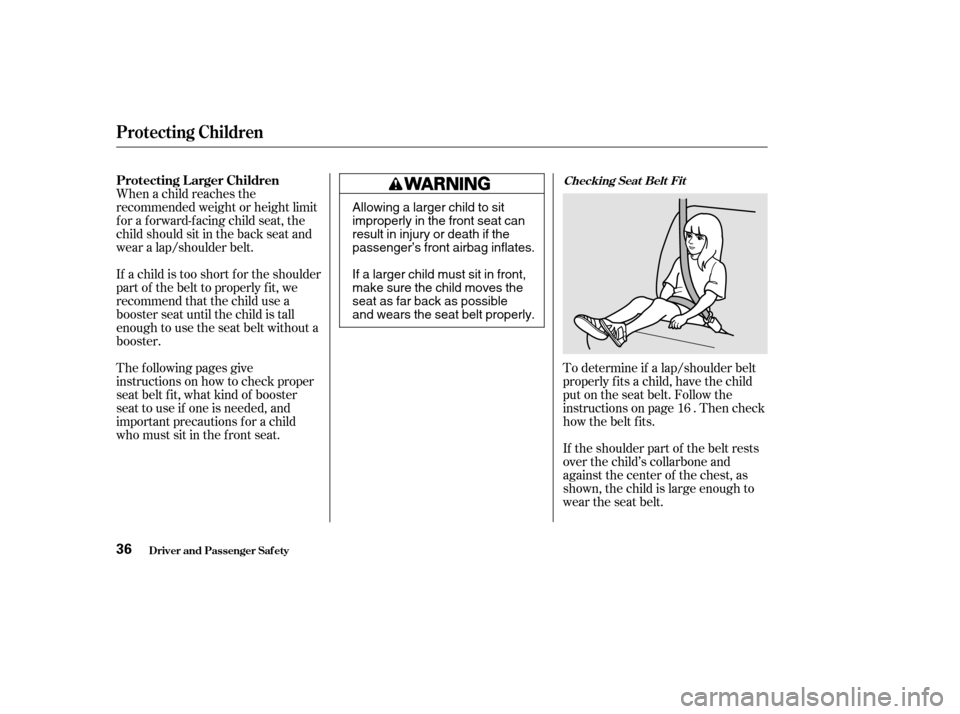
who must sit in the f ront seat.To determine if a lap/shoulder belt
properly f its a child, have the child
put on the seat belt. Follow the
instructions on page . Then check
how the belt f its.
If the shoulder part of the belt rests
over the child’s collarbone and
against the center of the chest, as
shown, the child is large enough to
wear the seat belt.16
Checking Seat Belt Fit
Protecting Children
Driver and Passenger Saf ety
Protecting L arger Children
36
Allowing a larger child to sit
improperly in the front seat can
result in injury or death if the
passenger’s front airbag inflates.
If a larger child must sit in front,
make sure the child moves the
seat as far back as possible
and wears the seat belt properly.
Page 24 of 223
Move the vehicle seat to the rear-
most position.
Check that the child’s seat belt is
properly positioned and secured.
If you decide that a child can saf ely
ride up f ront, be sure to:
Caref ully read the owner’s manual
and make sure you understand all
seat belt instructions and all saf ety
inf ormation.
Have the child sit up straight, back
against the seat, and feet on or
near the f loor. Supervise the child. Even mature
children sometimes need to be
reminded to f asten the seat belts
or sit properly.
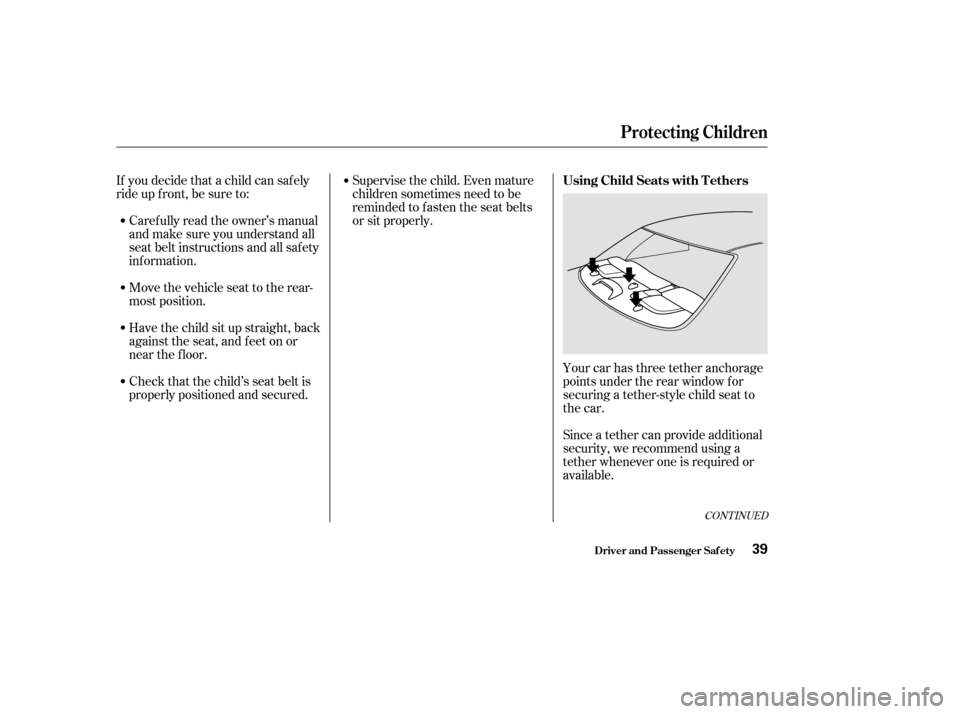
Yourcarhasthreetetheranchorage
points under the rear window f or
securing a tether-style child seat to
the car.
Since a tether can provide additional
security, we recommend using a
tether whenever one is required or
available.
CONT INUED
Using Child Seats with T ethers
Protecting Children
Driver and Passenger Saf ety39
Page 25 of 223
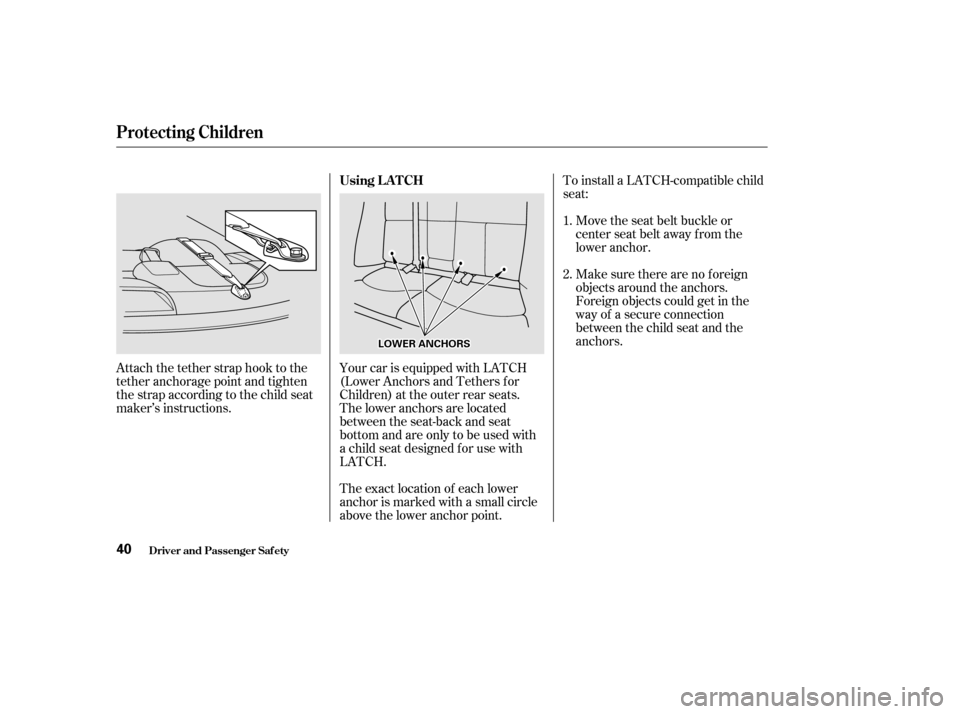
Attach the tether strap hook to the
tether anchorage point and tighten
the strap according to the child seat
maker’s instructions.Your car is equipped with LATCH
(Lower Anchors and Tethers f or
Children) at the outer rear seats.
The lower anchors are located
between the seat-back and seat
bottom and are only to be used with
a child seat designed f or use with
LATCH.
The exact location of each lower
anchor is marked with a small circle
above the lower anchor point.To install a LATCH-compatible child
seat:
Move the seat belt buckle or
center seat belt away from the
lower anchor.
Make sure there are no f oreign
objects around the anchors.
Foreign objects could get in the
way of a secure connection
between the child seat and the
anchors.
1. 2.
Protecting Children
Driver and Passenger Saf ety
Using L A T CH
40
LLOOWWEERRAANNCCHHOORRSS
Page 26 of 223
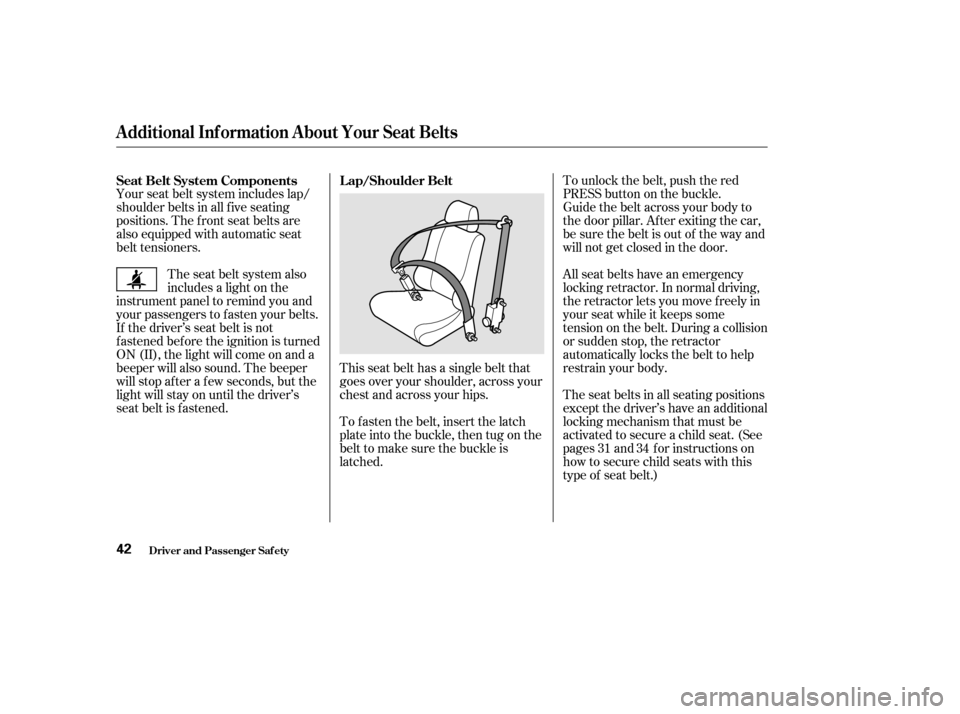
This seat belt has a single belt that
goes over your shoulder, across your
chest and across your hips. The seat belts in all seating positionsexcept the driver’s have an additional
locking mechanism that must be
activated to secure a child seat. (See
pages and f or instructions on
how to secure child seats with this
type of seat belt.)
All seat belts have an emergency
locking retractor. In normal driving,
the retractor lets you move f reely in
your seat while it keeps some
tension on the belt. During a collision
or sudden stop, the retractor
automatically locks the belt to help
restrain your body.
Guide the belt across your body to
the door pillar. Af ter exiting the car,
be sure the belt is out of the way and
will not get closed in the door.
To unlock the belt, push the red
PRESSbuttononthebuckle.
To fasten the belt, insert the latch
plate into the buckle, then tug on the
belt to make sure the buckle is
latched.
Your seat belt system includes lap/
shoulder belts in all f ive seating
positions. The f ront seat belts are
also equipped with automatic seat
belt tensioners.
The seat belt system also
includes a light on the
instrument panel to remind you and
your passengers to f asten your belts.
If the driver’s seat belt is not
fastened before the ignition is turned
ON (II), the light will come on and a
beeper will also sound. The beeper
will stop af ter a f ew seconds, but the
light will stay on until the driver’s
seat belt is f astened.
31 34
Seat Belt System Components L ap/Shoulder Belt
Additional Inf ormation About Your Seat Belts
Driver and Passenger Saf ety42
Page 31 of 223

If the light comes on at any other
time, or does not come on at all, you
should have the system checked by
your dealer. For example:If the SRS indicator light does not
come on after you turn the ignition
ON (II).
If the light stays on after the
engine starts.
If the light comes on or f lashes on
andoff whileyoudrive.
If you see any of these indications,
your f ront or side airbags may not
deploy, your passenger’s side airbag
automatic cutoff system may not
work properly, or your seat belt
tensioners may not work when you
need them. See your Honda dealer
as soon as possible. This light alerts you that
the passenger’s side airbag
has been automatically shut off.
To reduce the risk of injury f rom an
inf lating side airbag, your car has an
automatic cutoff system for the
passenger’s side airbag.
Although Honda does not encourage
children to ride in the f ront, this
system is designed to shut of f the
side airbag if a child leans sideways
and the child’s head is in the side
airbag deployment path.
Additional Inf ormation About Your Airbags
Driver and Passenger Saf ety
How the Side Airbag Of f
Indicator L ight Works
48
Ignoring the SRS indicator light
can result in serious injury or
death if the airbags, cutoff
system, or tensioners do not
work properly.
Have your vehicle checked by a
dealer as soon as possible if
the SRS light alerts you to a
potential problem.
Page 35 of 223

This section gives inf ormation about
the controls and displays that
contribute to the daily operation of
your Honda. All the essential
controls are within easy reach............................
Control Locations . 54
...............................
Indicator Lights . 55
.............................................
Gauges . 60
...............................
Speedometer . 60
.................................
Tachometer . 60
.....................................
Odometer . 60
...................................
Trip Meter . 61
...................
Temperature Gauge . 61
..................................
Fuel Gauge . 61
Maintenance Required
...................................
Indicator . 62
Controls Near the Steering .......................................
Wheel . 63
...................................
Headlights . 64 Automatic Lighting Off
.....................................
Feature . 65
............
Daytime Running Lights . 65
....
Instrument Panel Brightness . 65
................................
Turn Signals . 66
.....................
Windshield Wipers . 66
..................
Windshield Washers . 68
..........................
Hazard Warning . 68
.............
Rear Window Def ogger . 68
......
Steering Wheel Adjustment . 69
...............................
Keys and Locks . 70
..............................................
Keys . 70
....................
Immobilizer System . 71
............................
Ignition Switch . 72
..................................
Door Locks . 73
......................
Power Door Locks . 74
...................
Remote Transmitter . 75
..............
Childproof Door Locks . 79
...........................................
Trunk . 79
........
Emergency Trunk Opener . 80
....................................
Glove Box . 81
............................
Seat Adjustments . 82
.............
Front Seat Adjustments . 82
Driver’s Seat Manual Height
..............................
Adjustment . 83 Driver’s Seat Power Height
..............................
Adjustment . 83
Driver’s Seat Full Power ............................
Adjustments . 84
...........
Driver’s Lumbar Support . 85
Front Passenger’s Seat
............................
Adjustments . 86
..........................
Head Restraints . 86
.......................
Folding Rear Seat . 87
......................
Rear Seat Armrest . 88
....................................
Seat Heaters . 90
..............................
Power Windows . 91
.........................................
Moonroof . 92
.............................................
Mirrors . 93
....
Adjusting the Power Mirrors . 94
.................................
Parking Brake . 95
....................................
Digital Clock . 96
...................
Console Compartment . 97
..........................................
Coin Box . 97
.............................
Beverage Holder . 98
..........................................
Sun Visor . 99
..................................
Vanity Mirror . 99
........................
Sunglasses Holder . 100
.............
Accessory Power Socket . 100
...............................
Interior Lights . 101
Instruments and Controls
Inst rument s and Cont rols53
Page 53 of 223
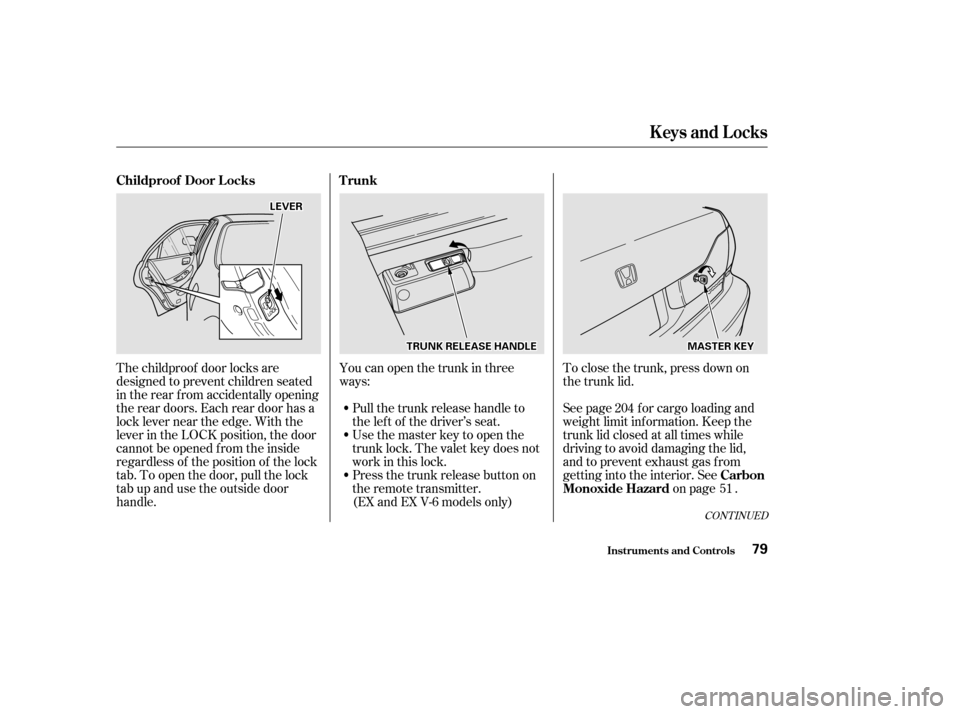
The childproof door locks are
designed to prevent children seated
in the rear f rom accidentally opening
the rear doors. Each rear door has a
lock lever near the edge. With the
lever in the LOCK position, the door
cannot be opened f rom the inside
regardless of the position of the lock
tab. To open the door, pull the lock
tab up and use the outside door
handle.To close the trunk, press down on
the trunk lid.
See page f or cargo loading and
weight limit inf ormation. Keep the
trunk lid closed at all times while
driving to avoid damaging the lid,
and to prevent exhaust gas from
getting into the interior. See
on page .
Youcanopenthetrunkinthree
ways:
Pull the trunk release handle to
the lef t of the driver’s seat.
Usethemasterkeytoopenthe
trunk lock. The valet key does not
work in this lock.
Press the trunk release button on
the remote transmitter. 204
51
(EX and EX V-6 models only)
CONT INUED
Childproof Door L ocks T runk
Carbon
Monoxide Hazard
Keys and Locks
Inst rument s and Cont rols79
LLEEVVEERR
TTRRUUNNKKRREELLEEAASSEEHHAANNDDLLEEMMAASSTTEERRKKEEYY