ESP HONDA ACCORD 2012 8.G User Guide
[x] Cancel search | Manufacturer: HONDA, Model Year: 2012, Model line: ACCORD, Model: HONDA ACCORD 2012 8.GPages: 449, PDF Size: 9.32 MB
Page 214 of 449
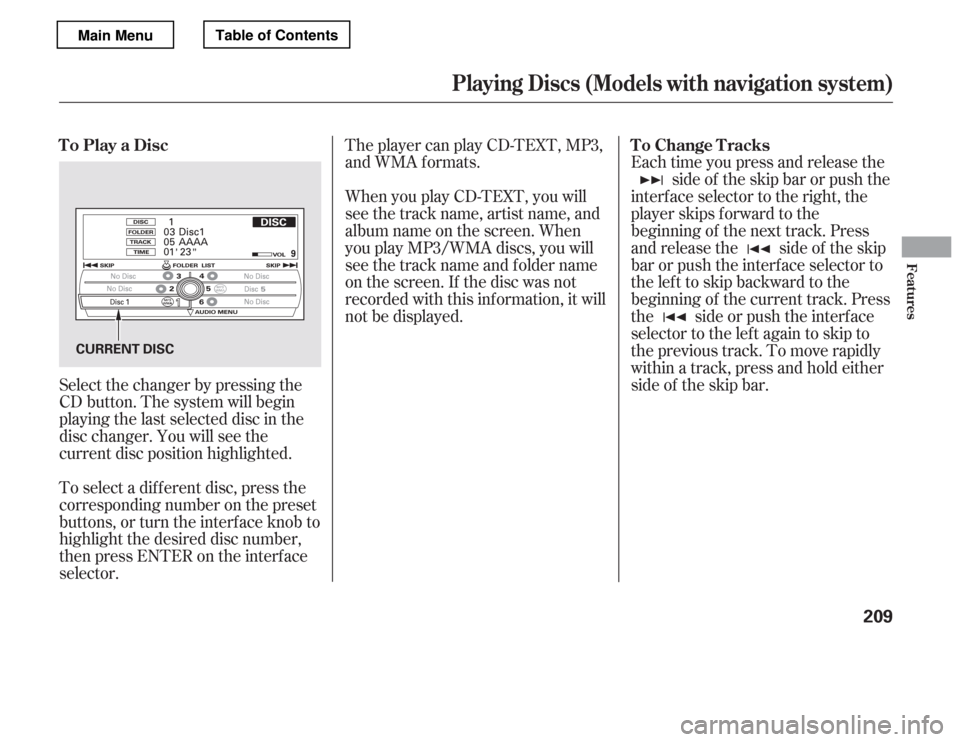
When you play CD-TEXT, you will
see the track name, artist name, and
album name on the screen. When
you play MP3/WMA discs, you will
see the track name and folder name
on the screen. If the disc was not
recorded with this inf ormation, it will
not be displayed.
The player can play CD-TEXT, MP3,
and WMA formats.
Select the changer by pressing the
CD button. The system will begin
playing the last selected disc in the
disc changer. You will see the
current disc position highlighted.
To select a dif f erent disc, press the
corresponding number on the preset
buttons, or turn the interf ace knob to
highlight the desired disc number,
then press ENTER on the interf ace
selector. Each time you press and release the
side of the skip bar or push the
interface selector to the right, the
player skips f orward to the
beginning of the next track. Press
and release the side of the skip
barorpushtheinterfaceselectorto
thelefttoskipbackwardtothe
beginning of the current track. Press
the side or push the interf ace
selector to the left again to skip to
the previous track. To move rapidly
within a track, press and hold either
side of the skip bar.
To Play a Disc
To Change Tracks
Playing Discs (Models with navigation system)
Features
209
CURRENT DISC
Main MenuTable of Contents
Page 218 of 449
CONT INUED
The changer plays MP3/WMA discs
in recorded order. Maximum
playable file layers are 8, and total
playable tracks are 255. If your disc
has a complex structure, the changer
takessometimetoreadthedisc
bef ore beginning play.
Depending on the sof tware the f iles
were made with, it may not be
possible to play some f iles, or display
some text data.
To play an MP3/WMA disc, use the
disc controls previously described,
along with the f ollowing inf ormation.While playing an MP3/WMA disc,
you can select a f older within the
disc by pressing either side of the
category bar. Each time you press
either side of the bar, the folder title
and its f irst f ile’s inf ormation appear
in the center display in recorded
order.
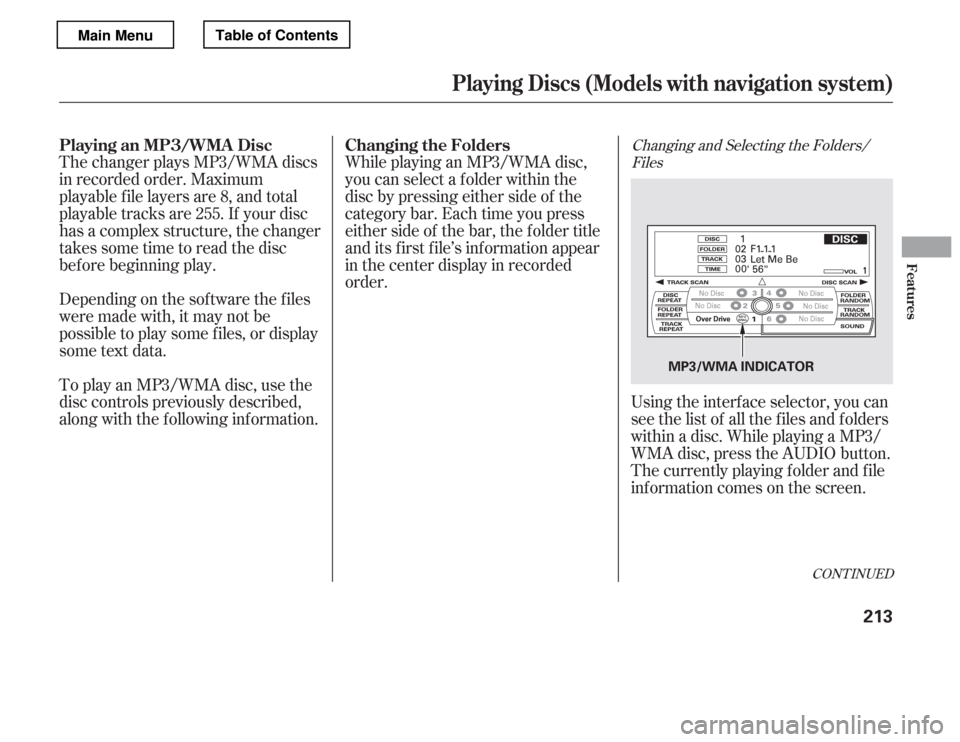
Using the interf ace selector, you can
see the list of all the f iles and f olders
within a disc. While playing a MP3/
WMA disc, press the AUDIO button.
The currently playing f older and f ile
inf ormation comes on the screen.
Changing and Selecting the Folders/FilesPlaying an MP3/WMA Disc Changing the Folders
Playing Discs (Models with navigation system)
Features
213
MP3/WMA INDICATOR
Main MenuTable of Contents
Page 221 of 449
To remove a different disc from the
changer,firstselectitbypressing
the corresponding number on the
preset button or turning the
interf ace knob, and pressing ENTER
on the interf ace selector. When that
disc begins playing, press the eject
button.
When you press the eject button
while listening to the radio, or with
the audio system turned of f , the disc
that was last selected is ejected.
Af ter that disc is ejected, pressing
the eject button again will eject the
next disc in numerical order. By
doing this six times, you can remove
all the discs f rom the changer.You can also eject discs when the
ignition switch is of f :
To eject one disc, press and release
the eject button.
To eject all discs, press and hold the
eject button until the f irst disc begins
to eject.
For inf ormation on how to handle
and protect compact discs, see page
.
237
Playing Discs (Models with navigation system)
Protecting Discs
216
Main MenuTable of Contents
Page 246 of 449
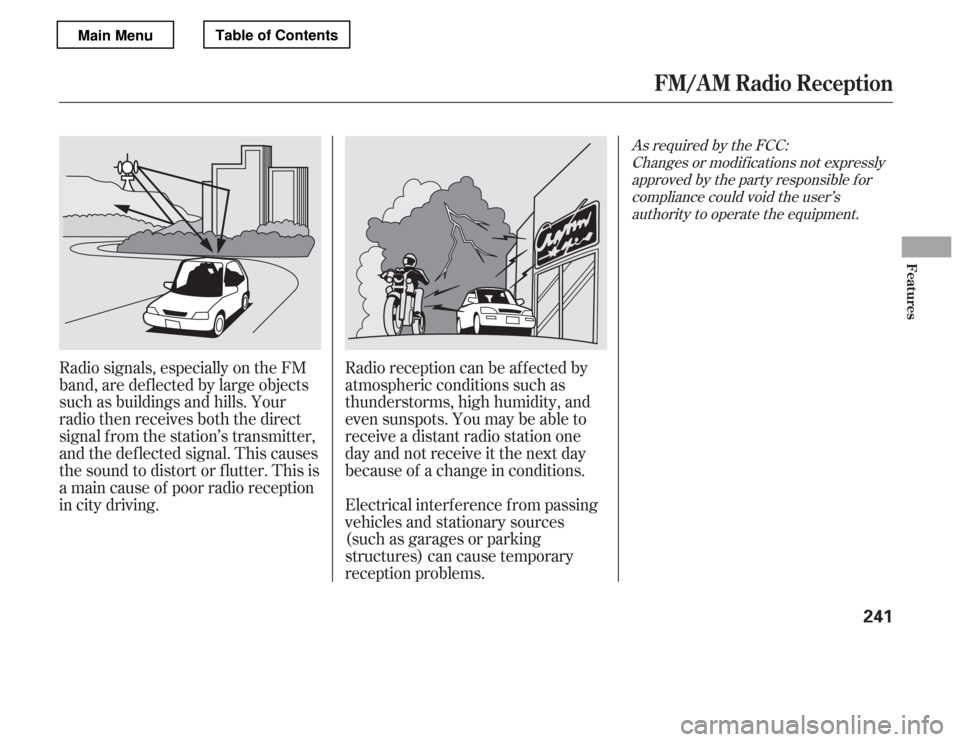
Radio signals, especially on the FM
band, are def lected by large objects
such as buildings and hills. Your
radio then receives both the direct
signal f rom the station’s transmitter,
and the def lected signal. This causes
the sound to distort or flutter. This is
a main cause of poor radio reception
in city driving.Radio reception can be af f ected by
atmospheric conditions such as
thunderstorms, high humidity, and
even sunspots. You may be able to
receive a distant radio station one
day and not receive it the next day
because of a change in conditions.
Electrical interf erence f rom passing
vehicles and stationary sources
(such as garages or parking
structures) can cause temporary
reception problems.
As required by the FCC:
Changes or modif ications not expressly
approved by the party responsible f orcompliance could void the user’s authority to operate the equipment.
FM/A M Radio Recept ion
Features
241
Main MenuTable of Contents
Page 266 of 449
HomeLinkis a registered
trademark of Johnson Controls, Inc.As required by the FCC:
This device complies with Part 15 of the
FCC rules. Operation is subject to thef ollowing two conditions: (1) This devicemay not cause harmf ul interf erence, and (2) this device must accept any
interf erence received, including interf erence that may cause undesiredoperation.
Changes or modif ications not expresslyapproved by the party responsible f or compliance could void the user’sauthority to operate the equipment.
This device complies with IndustryCanada Standard RSS-210.
Operation is subject to the f ollowing twoconditions: (1) this device may not cause
interf erence, and (2) this device must accept any interf erence that may causeundesired operation of the device.
HomeL inkUniversal T ransceiver
Features
261
Main MenuTable of Contents
Page 291 of 449
Thename and logos are
registered trademarks owned by
Bluetooth SIG, Inc. and any use of
such marks by Honda Motor Co.,
Ltd. is under license. Other
trademarks and trade names are
those of their respective owners. Refer to the navigation system
manual f or operation of the rearview
camera.Bluetooth
As required by the FCC:
This device complies with Part 15 of the
FCC rules. Operation is subject to thef ollowing two conditions: (1) This device
may not cause harmf ul interf erence, and(2) this device must accept any
interf erence received, including
interf erence that may cause undesiredoperation.
Changes or modif ications not expresslyapproved by the party responsible f or compliance could void the user’sauthority to operate the equipment. On models with navigation system
This device complies with Industry Canada Standard RSS-210.
Operation is subject to the f ollowing twoconditions: (1) this device may not cause interf erence, and (2) this device must
accept any interf erence that may cause undesired operation of the device.
Bluet oot h
Wireless Technology
Rearview Camera and Monitor
BluetoothHandsFreeL ink, Rearview Camera and Monitor
286
Main MenuTable of Contents
Page 326 of 449
The VSA system cannot enhance the
vehicle’s driving stability in all
situations and does not control your
vehicle’s entire braking system. It is
still your responsibility to drive and
corner at reasonable speeds and to
leave a sufficient margin of safety.
The vehicle stability assist (VSA)
system helps to stabilize the vehicle
during cornering if the vehicle turns
more or less than desired. It also
assists you in maintaining traction
while accelerating on loose or
slippery road surf aces. It does this
by regulating the engine’s output and
by selectively applying the brakes.
When VSA is off, the VSA OFF
indicator comes on as a reminder.
When VSA activates, you will see the
VSA system indicator blink.
If this indicator comes on while
driving, pull to the side of the road
when it is saf e, and turn of f the
engine. Reset the system by
restarting the engine. If the VSA
system indicator stays on or comes
back on while driving, have the VSA
system inspected by your dealer.
The main f unction of the
VSA system is generally known as
Electronic Stability Control (ESC).
The system also includes a traction
control f unction. If the low tire pressure indicator or
TPMS indicator comes on, the VSA
system automatically turns on even if
the VSA system is turned of f by
pressing the VSA OFF switch (see
page ). If this happens, you
cannot turn the VSA system of f by
pressing the VSA OFF switch again.
Without VSA, your vehicle will have
normal braking and cornering ability,
but it will not have VSA traction and
stability enhancement.
When VSA activates, you may notice
that the engine does not respond to
the accelerator in the same way it
does at other times. There may also
be some noise f rom the VSA
hydraulic system. You will also see
the VSA system indicator blink. 322
Vehicle Stability Assist
(VSA ) System Indicator
VSA OFF Indicator
Vehicle St abilit y A ssist (VSA), aka Electronic Stability Control (ESC), System
Driving
321
NOTE:
Main MenuTable of Contents
Page 330 of 449
As required by the FCC:This device complies with Part 15 of the
FCC rules. Operation is subject to thef ollowing two conditions: (1) This device may not cause harmf ul interf erence, and(2) this device must accept any
interf erence received, includinginterf erence that may cause undesiredoperation.
Changes or modif ications not expresslyapproved by the party responsible f orcompliance could void the user’sauthority to operate the equipment.
This device complies with IndustryCanada Standard RSS-210.
Operation is subject to the f ollowing two conditions: (1) this device may not cause
interf erence, and (2) this device mustaccept any interf erence that may cause undesired operation of the device.
If you have a f lat tire, the low tire
pressure indicator will come on.
Replace the flat tire with the
compact spare tire (see page ).
Each wheel (except the compact
sparetirewheel)isequippedwitha
tire pressure sensor. You must use
TPMS specif ic wheels. It is
recommended that you always have
your tires serviced by your dealer or
qualif ied technician. The low tire pressure indicator or
the TPMS indicator will go off, after
several miles (kilometers) driving,
when you replace the spare tire with
the specif ied regular tire equipped
with the tire pressure monitor sensor.
Never use a puncture-repairing agent
in a f lat tire. If used, you will have to
replace the tire pressure sensor.
Havetheflattirerepairedbyyour
dealer as soon as possible.
After you replace the flat tire with
thecompactsparetire,thelowtire
pressure indicator stays on. This is
normal; the system is not monitoring
the spare tire pressure. Manually
check the spare tire pressure to be
sure it is correct. Af ter several miles
(kilometers) driving with the
compact spare tire, the TPMS
indicator comes on and the low tire
pressure indicator goes of f . 384
Changing a T ire with T PMS
Tire Pressure Monitoring System (TPMS)
Driving
325
Main MenuTable of Contents
Page 407 of 449
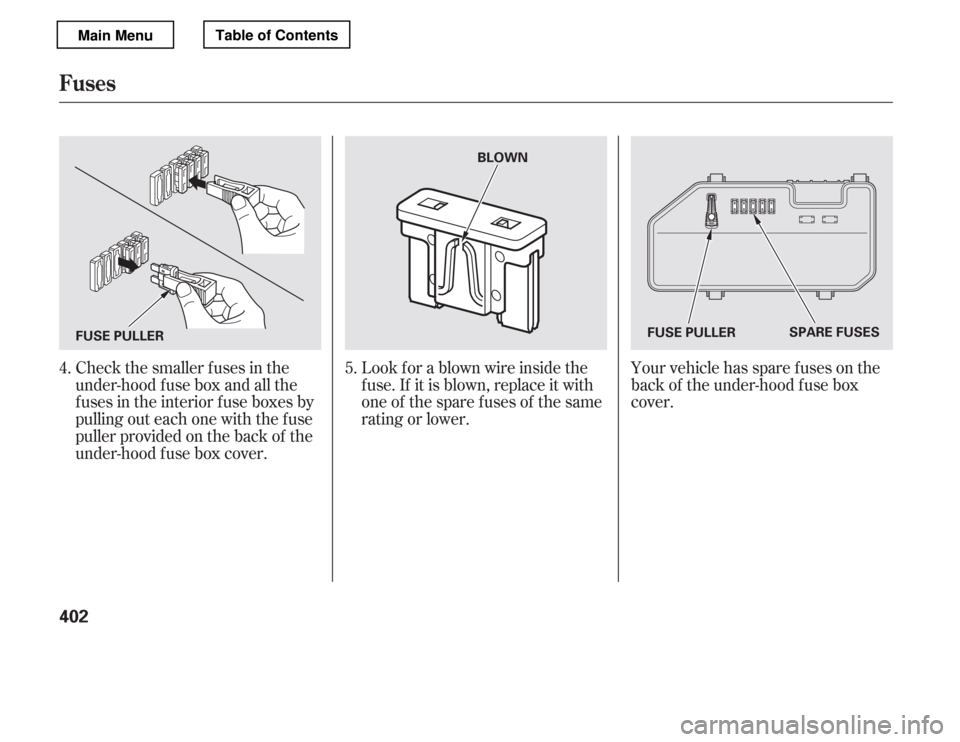
Your vehicle has spare fuses on the
back of the under-hood f use box
cover.
Look f or a blown wire inside the
fuse.Ifitisblown,replaceitwith
oneof thesparefusesof thesame
rating or lower.
Check the smaller f uses in the
under-hood f use box and all the
fuses in the interior fuse boxes by
pulling out each one with the f use
pullerprovidedonthebackof the
under-hood f use box cover. 5.
4.
Fuses
402
BLOWN
SPARE FUSES
FUSE PULLER FUSE PULLER
Main MenuTable of Contents
Page 422 of 449
Warning: The temperature grade f or
this tire is established f or a tire that
is properly inf lated and not
overloaded. Excessive speed,
underinf lation, or excessive loading,
either separately or in combination,
can cause heat buildup and possible
tire f ailure.
The temperature grades are A (the
highest), B, and C, representing the
tire’s resistance to the generation of
heat and its ability to dissipate heat
when tested under controlled
conditions on a specif ied indoor
laboratory test wheel. Sustained high
temperature can cause the material
of the tire to degenerate and reduce
tire life, and excessive temperature
can lead to sudden tire f ailure. The
grade C corresponds to a level of
perf ormance which all passenger car
tires must meet under the Federal
Motor Vehicle Saf ety Standard No.
109. Grades B and A represent
higher levels of perf ormance on the
laboratory test wheel than the
minimum required by law.
Temperature
DOT T ire Quality Grading (U.S. Vehicles)
T echnical Inf ormat ion
417
Main MenuTable of Contents