Snow HONDA ACCORD 2014 9.G User Guide
[x] Cancel search | Manufacturer: HONDA, Model Year: 2014, Model line: ACCORD, Model: HONDA ACCORD 2014 9.GPages: 595
Page 471 of 595
470
uuWhen Driving uTPMS (Tire Pressure Monitoring System)
Driving
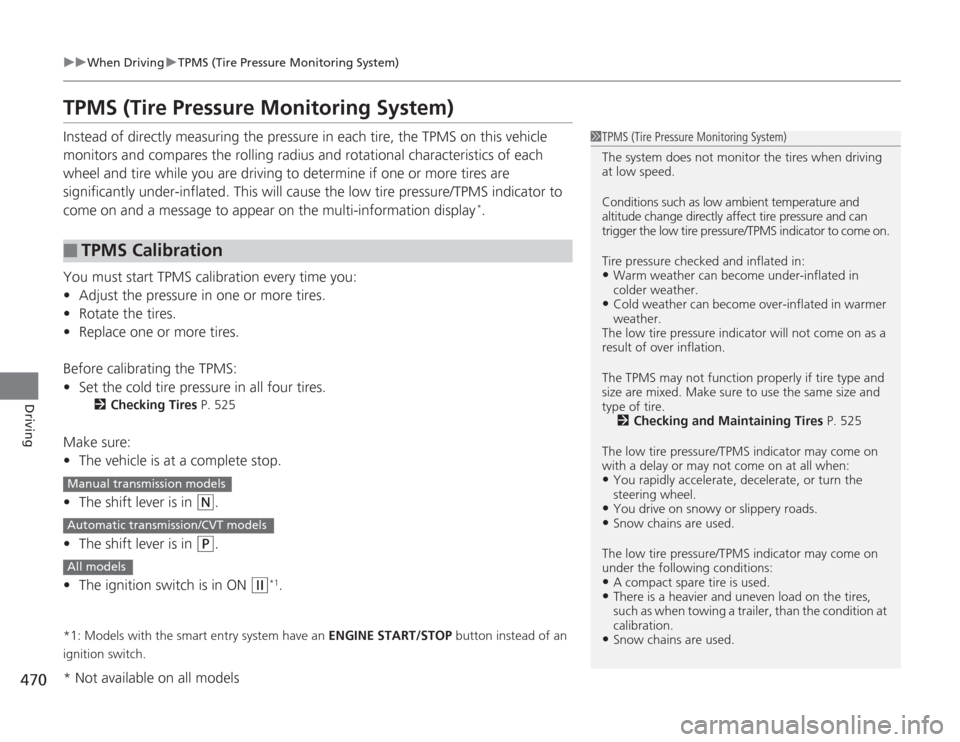
TPMS (Tire Pressure Monitoring System)Instead of directly measuring the pressure in each tire, the TPMS on this vehicle
monitors and compares the rolling radius and rotational characteristics of each
wheel and tire while you are driving to determine if one or more tires are
significantly under-inflated. This will cause the low tire pressure/TPMS indicator to
come on and a message to appear on the multi-information display
*.
You must start TPMS calibration every time you:
• Adjust the pressure in one or more tires.
• Rotate the tires.
• Replace one or more tires.
Before calibrating the TPMS:
• Set the cold tire pressure in all four tires.
2 Checking Tires P. 525
Make sure:
•The vehicle is at a complete stop.
• The shift lever is in
(N
.
• The shift lever is in
(P
.
• The ignition switch is in ON
(w
*1.
*1: Models with the smart entry system have an ENGINE START/STOP button instead of an
ignition switch.■
TPMS Calibration
1 TPMS (Tire Pressure Monitoring System)
The system does not monitor the tires when driving
at low speed.
Conditions such as low ambient temperature and
altitude change directly affect tire pressure and can
trigger the low tire pressure/TPMS indicator to come on.
Tire pressure checked and inflated in:•Warm weather can become under-inflated in
colder weather.•Cold weather can become over-inflated in warmer
weather.
The low tire pressure i ndicator will not come on as a
result of over inflation.
The TPMS may not function properly if tire type and
size are mixed. Make sure to use the same size and
type of tire. 2 Checking and Maintaining Tires P. 525
The low tire pressure/TPMS indicator may come on
with a delay or may not come on at all when:•You rapidly accele rate, decelerate, or turn the
steering wheel.•You drive on snowy or slippery roads.•Snow chains are used.
The low tire pressure/TPMS indicator may come on
under the following conditions:•A compact spare tire is used.•There is a heavier and uneven load on the tires,
such as when towing a trailer, than the condition at
calibration.•Snow chains are used.
Manual transmission modelsAutomatic transmission/CVT modelsAll models* Not available on all models
Page 472 of 595
471
uuWhen Driving uTPMS (Tire Pressure Monitoring System)
Driving
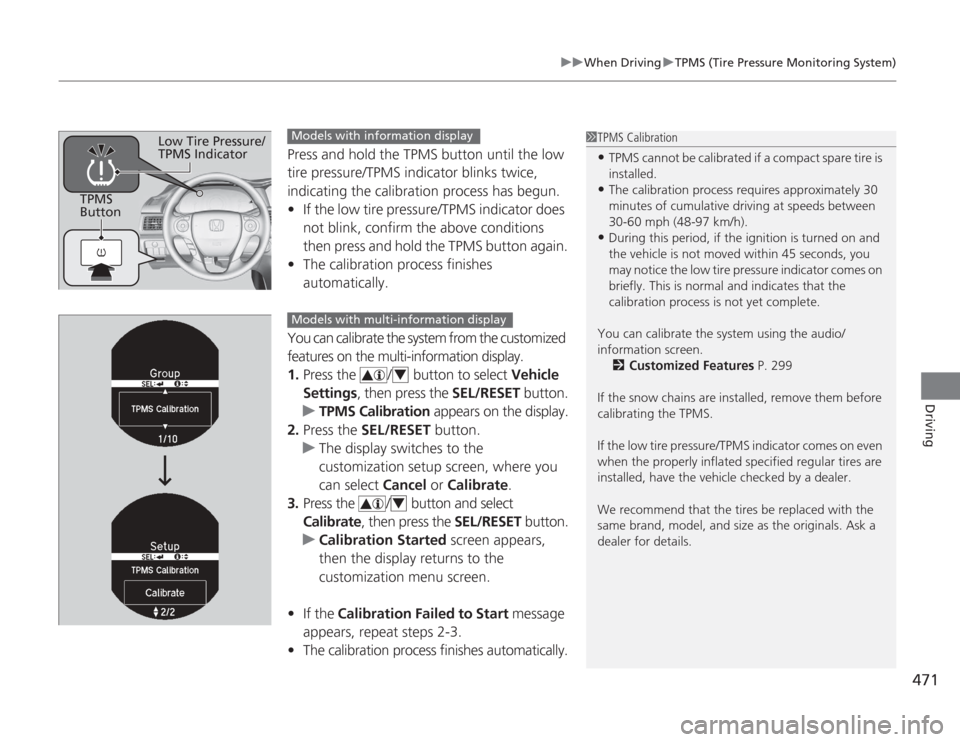
Press and hold the TPMS button until the low
tire pressure/TPMS indicator blinks twice,
indicating the calibration process has begun.
• If the low tire pressure/TPMS indicator does
not blink, confirm the above conditions
then press and hold the TPMS button again.
• The calibration process finishes
automatically.
You can calibrate the system from the customized
features on the multi-information display.
1. Press the / button to select Vehicle
Settings, then press the SEL/RESET button.
u TPMS Calibration appears on the display.
2. Press the SEL/RESET button.
u The display switches to the
customization setup screen, where you
can select Cancel or Calibrate .
3. Press the / button and select
Calibrate , then press the SEL/RESET button.
u Calibration Started screen appears,
then the display returns to the
customization menu screen.
• If the Calibration Failed to Start message
appears, repeat steps 2-3.
• The calibration process finishes automatically.
1TPMS Calibration•TPMS cannot be calibrated if a compact spare tire is
installed.•The calibration process requires approximately 30
minutes of cumulative driving at speeds between
30-60 mph (48-97 km/h).•During this period, if the ignition is turned on and
the vehicle is not moved within 45 seconds, you
may notice the low tire pressure indicator comes on
briefly. This is normal and indicates that the
calibration process is not yet complete.
You can cali brate the system using the audio/
information screen. 2 Customized Features P. 299
If the snow chains are installed, remove them before
calibrating the TPMS.
If the low tire pressure/TPMS indicator comes on even
when the properly inflated specified regular tires are
installed, have the vehicle checked by a dealer.
We recommend that the tires be replaced with the
same brand, model, and size as the originals. Ask a
dealer for details.
TPMS
Button
Low Tire Pressure/
TPMS Indicator
Models with information displayModels with multi-information display
44
Page 477 of 595
476
uuBraking uABS (Anti-lock Brake System)
Driving
ABS (Anti-lock Brake System)Helps prevent the wheels from locking up, and help s you retain steering control by
pumping the brakes rapidly, much faster than you.
The electronic brake distribution (EBD) system, which is part of the ABS, also
balances the front-to-rear braking distribution according to vehicle loading.
You should never pump the brake pedal. Let the ABS work for you by always
keeping firm, steady pressure on the brake pedal. This is sometimes referred to as
“stomp and steer.”■
ABS operation
The brake pedal may pulsate slightly when the ABS is working. Keep holding the
pedal firmly down. On dry pavement, you will need to press on the brake pedal very
hard before the ABS activates. However, you may feel the ABS activate immediately
if you are trying to stop on snow or ice.
When the vehicle speed goes under 6 mph (10 km/h), the ABS stops.
■
ABS
1 ABS (Anti-lock Brake System)
NOTICEThe ABS may not function correctly if you use an
incorrect tire type and size.
When the ABS indicator comes on while driving,
there may be a problem with the system.
While normal braking is not affected, there is a
possibility of the ABS not operating. Have the vehicle
checked by a dealer immediately.
The ABS does not reduce the time or distance it takes
to stop the vehicle. It only helps with steering control
during hard braking.
In the following cases, your vehicle may need more
stopping distance than a vehicle without the ABS:•When driving on rough road surfaces, including
when driving on uneven surfaces, such as gravel or
snow.•When snow chains are installed.
You may hear a motor sound coming from the
engine compartment while system checks are being
performed immediatel y after starting the engine or
while driving. This is normal.
Page 479 of 595
478Driving
Parking Your VehicleWhen Stopped1.Depress the brake pedal firmly.
2. Firmly apply the parking brake.
3. Move the shift lever from
(D
to
(P
.
3. Move the shift lever to
(R
or
(1
.
4. Turn off the engine.
Always set the parking brake firmly, in particular if you are parked on an incline.
1 Parking Your Vehicle
Do not park your vehicle near flammable objects,
such as dry grass, oil, or timber.
Heat from the exhaust can cause a fire.1When Stopped
NOTICEThe following can damage the transmission:•Depressing the accelerator and brake pedals
simultaneously.•Holding the vehicle in place when facing uphill by
depressing the accelerator pedal.•Moving the shift lever into
(P
before the vehicle
stops completely.
Raise the wiper arms when snow is expected.
Automatic transmission/CVT models
Automatic transmission/CVT modelsManual transmission modelsAll models
Page 484 of 595
483
Driving
Fuel EconomyImproving Fuel EconomyFuel economy depends on several conditions, including driving conditions, your
driving habits, the condition of your vehicle, and loading. Depending on these and
other conditions, you may or may not achieve the rated fuel economy of this vehicle.
You can optimize your fuel economy with proper maintenance of your vehicle.
Always maintain your vehicle in accordance with the messages displayed on the
information display
*/multi-information display
*.
• Use the recommended viscosity engine oil, displaying the API Certification Seal.
• Maintain the specified tire pressure.
• Do not load the vehicle with excess cargo.
• Keep your vehicle clean. A buildup of snow or mud on your vehicle's underside
adds weight and increases wind resistance.
■
Maintenance and Fuel Economy
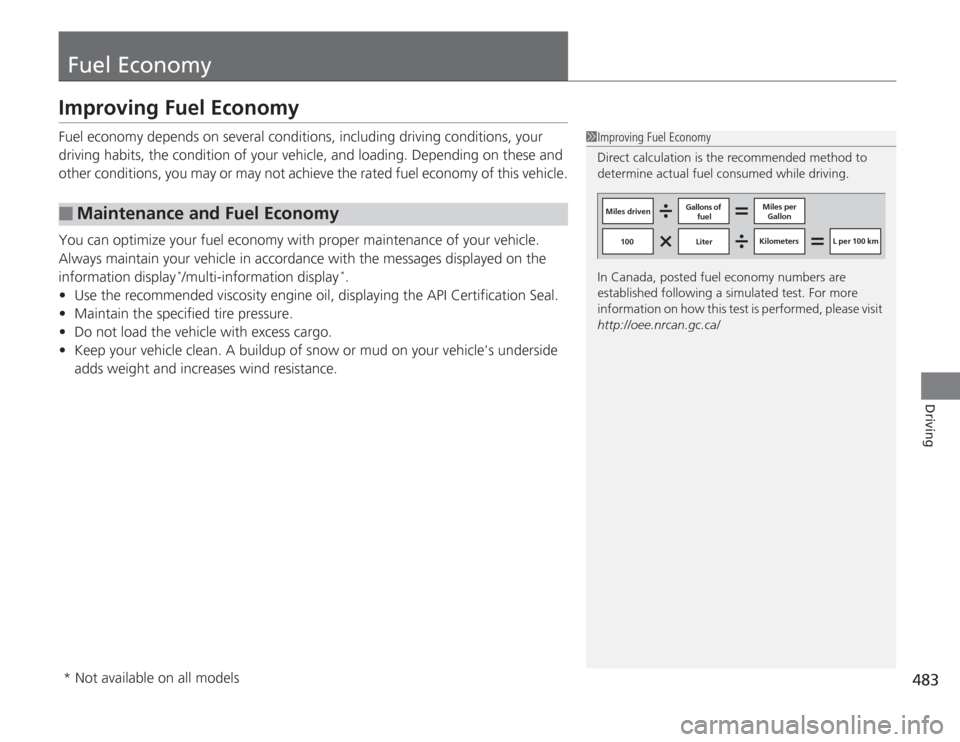
1Improving Fuel Economy
Direct calculation is the recommended method to
determine actual fuel consumed while driving.
In Canada, posted fuel economy numbers are
established following a simulated test. For more
information on how this test is pe rformed, please visit
http://oee.nrcan.gc.ca/
Miles driven Gallons of
fuel Miles per
Gallon
100 Liter Kilometers L per 100 km
* Not available on all models
Page 534 of 595
533
uuChecking and Maintaining Tires uWinter Tires
Maintenance
Winter TiresIf driving on snowy or frozen roads, mount all season marked M+S tires, snow tires, or tire
chains; reduce speed; and maintain sufficient distance between vehicles when driving.
Be particularly careful when operating the steering wheel or brakes to prevent
skidding.
Use tire chains, snow tires, or all season tires when necessary or according to the law.
When mounting, refer to the following points.
For winter tires:
• Select the size and load ranges that are the same as the original tires.
• Mount the tires to all four wheels.
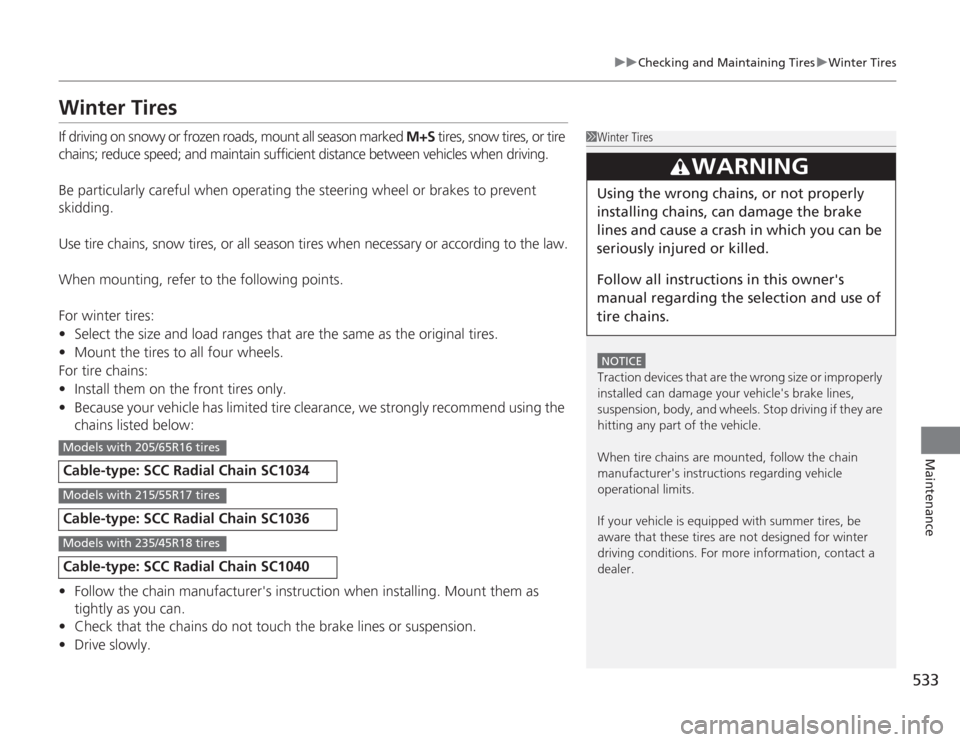
For tire chains:
• Install them on the front tires only.
• Because your vehicle has limited tire clearance, we strongly recommend using the
chains listed below:
• Follow the chain manufacturer's instruction when installing. Mount them as
tightly as you can.
• Check that the chains do not touch the brake lines or suspension.
• Drive slowly.Cable-type: SCC Radial Chain SC1034Cable-type: SCC Radial Chain SC1036Cable-type: SCC Radial Chain SC1040
1Winter Tires
NOTICETraction devices that are the wrong size or improperly
installed can damage your vehicle's brake lines,
suspension, body, and wheels. Stop driving if they are
hitting any part of the vehicle.
When tire chains are mounted, follow the chain
manufacturer's instructions regarding vehicle
operational limits.
If your vehicle is equipped with summer tires, be
aware that these tires are not designed for winter
driving conditions. For more information, contact a
dealer.
3
WARNING
Using the wrong chains, or not properly
installing chains, can damage the brake
lines and cause a crash in which you can be
seriously injured or killed.
Follow all instruc tions in this owner's
manual regarding the selection and use of
tire chains.
Models with 205/65R16 tiresModels with 215/55R17 tiresModels with 235/45R18 tires
Page 593 of 595
592Index
Radio (XM®) ...................................... 218, 257
Radio Data System (RDS) .......... 188, 216, 255
Range .................................................... 92, 95
RDS (Radio Data System) .......... 188, 216, 255
Readiness Codes (Emissions Testing) ....... 577
Rear Defogger/Heated Door Mirror Button ...................................................... 142
Rear Seat (Folding Down) ........................ 154
Rear Seat Heaters ..................................... 165
Rearview Camera ...................................... 480
Rearview Mirror ........................................ 146
Refueling ................................................... 481
Fuel Gauge ................................................ 89
Gasoline .................................. 481, 570, 572
Low Fuel Indicator ..................................... 72
Regulations ............................... 472, 528, 575
Remote Transmitter .................................. 111
Replacement Battery..................................................... 535
Bulbs ....................................................... 513
Fuses ............................................... 564, 565
Tires ........................................................ 531
Wiper Blade Rubber ................................. 523
Reporting Safety Defects ......................... 576
Resetting a Trip Meter ......................... 91, 95SSafe Driving................................................. 27
Safety Check ................................................ 31
Safety Labels ............................................... 65 Safety Message
........................................... 25
Seat Belts .................................................... 32
Adjusting the Shoulder Anchor.................. 36
Automatic Seat Belt Tensioners ................. 34
Checking................................................... 38
Fastening .................................................. 35
Installing a Child Seat with a Lap/Shoulder Seat Belt ......................................................... 59
Pregnant Women ...................................... 37
Reminder .................................................. 33
Warning Indicator ............................... 33, 71
Seat Heaters ...................................... 164, 165
Seats .......................................................... 148
Adjusting ................................................ 148
Front Seats .............................................. 148
Rear Seats ............................................... 154
Seat Heaters .................................... 164, 165
Security System ......................................... 124
Immobilizer System Indicator ..................... 77
Security System Alarm Indicator................. 77
SEL/RESET Button ....................................... 93
Select Lever ................. 17, 435, 437, 441, 443
Operation.................. 17, 436, 438, 442, 443
Releasing................................................. 557
Won’t Move ............................................ 557
Select/Reset Knob ....................................... 90
Selecting a Child Seat ................................. 56
Selector Knob (Audio) ...................... 180, 203
Shift Lever ................... 17, 435, 437, 441, 443
Shift Position Indicator ...... 70, 436, 438, 442
Shifting (Transmission) ..... 435, 437, 441, 443 Shoulder Anchor
........................................ 36
Side Airbags ............................................... 46
Side Curtain Airbags .................................. 48
Smart Entry with Push Button Start System ..................................................... 113
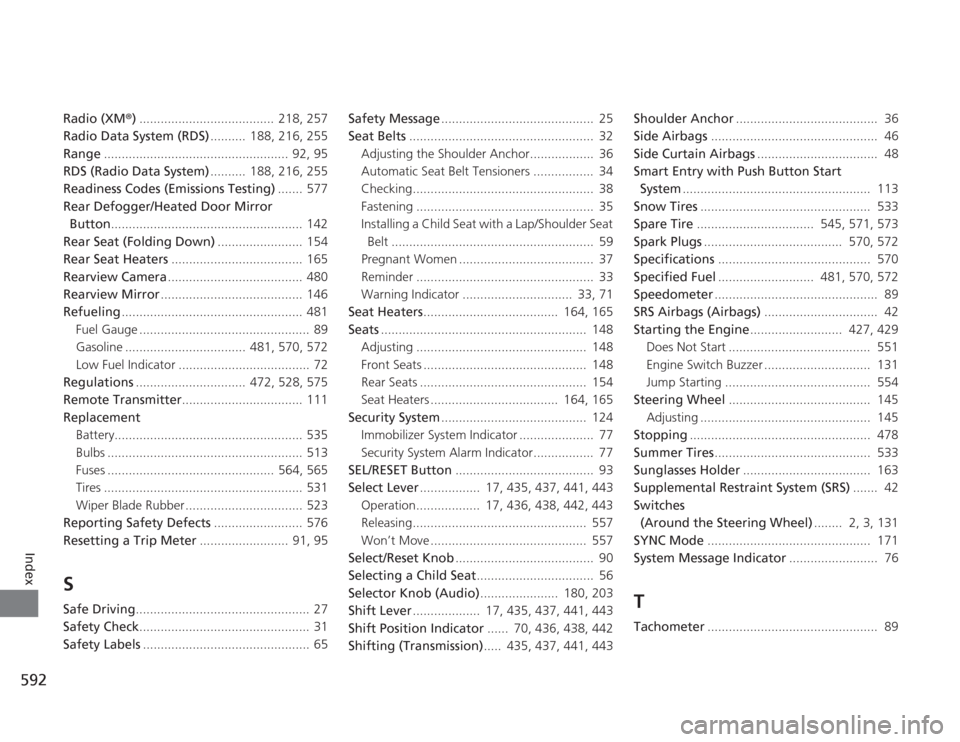
Snow Tires ................................................ 533
Spare Tire ................................. 545, 571, 573
Spark Plugs ....................................... 570, 572
Specifications ........................................... 570
Specified Fuel ........................... 481, 570, 572
Speedometer .............................................. 89
SRS Airbags (Airbags) ................................ 42
Starting the Engine .......................... 427, 429
Does Not Start ........................................ 551
Engine Switch Buzzer .............................. 131
Jump Starting ......................................... 554
Steering Wheel ........................................ 145
Adjusting ................................................ 145
Stopping ................................................... 478
Summer Tires ............................................ 533
Sunglasses Holder .................................... 163
Supplemental Restraint System (SRS) ....... 42
Switches (Around the Steering Wheel) ........ 2, 3, 131
SYNC Mode .............................................. 171
System Message Indicator ......................... 76
TTachometer................................................ 89
Page 595 of 595
594Index
Windows (Opening and Closing)............. 127
Windshield ................................................ 140
Cleaning .................................................. 541
Defrosting/Defogging ...................... 168, 170
Washer Fluid............................................ 512
Wiper Blades ........................................... 523
Wipers and Washers ................................ 140
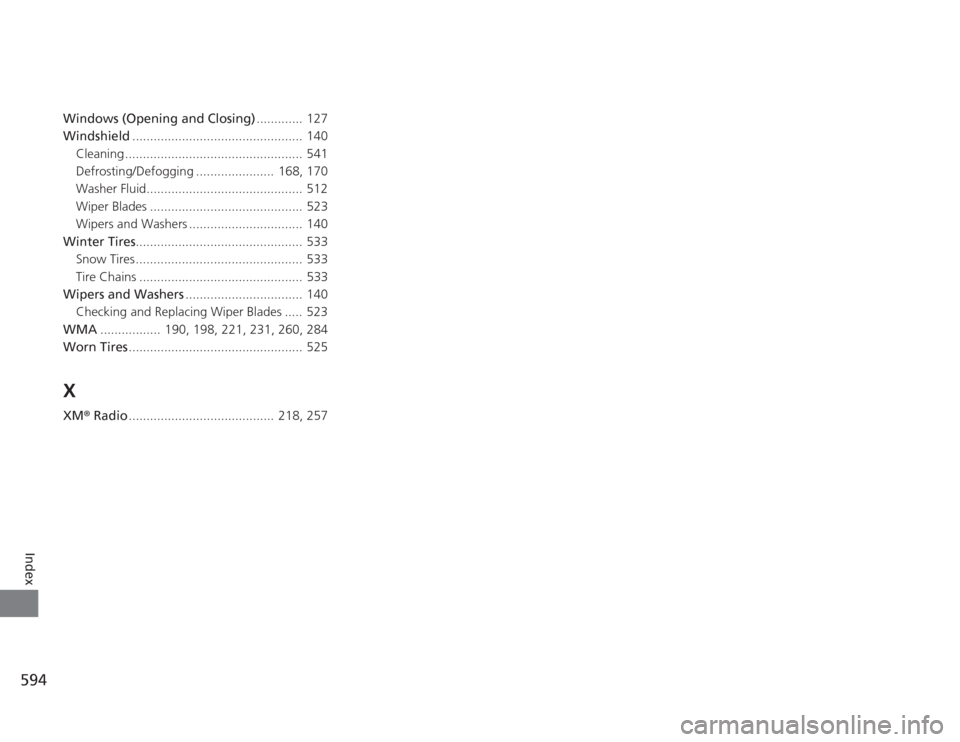
Winter Tires ............................................... 533
Snow Tires ............................................... 533
Tire Chains .............................................. 533
Wipers and Washers ................................. 140
Checking and Replacing Wiper Blades ..... 523
WMA ................. 190, 198, 221, 231, 260, 284
Worn Tires ................................................. 525XXM® Radio ......................................... 218, 257