oil pressure HONDA ACCORD 2017 9.G Quick Guide
[x] Cancel search | Manufacturer: HONDA, Model Year: 2017, Model line: ACCORD, Model: HONDA ACCORD 2017 9.GPages: 83, PDF Size: 6.77 MB
Page 4 of 83
| 1
V
ISUAL INDEX
*if equipped
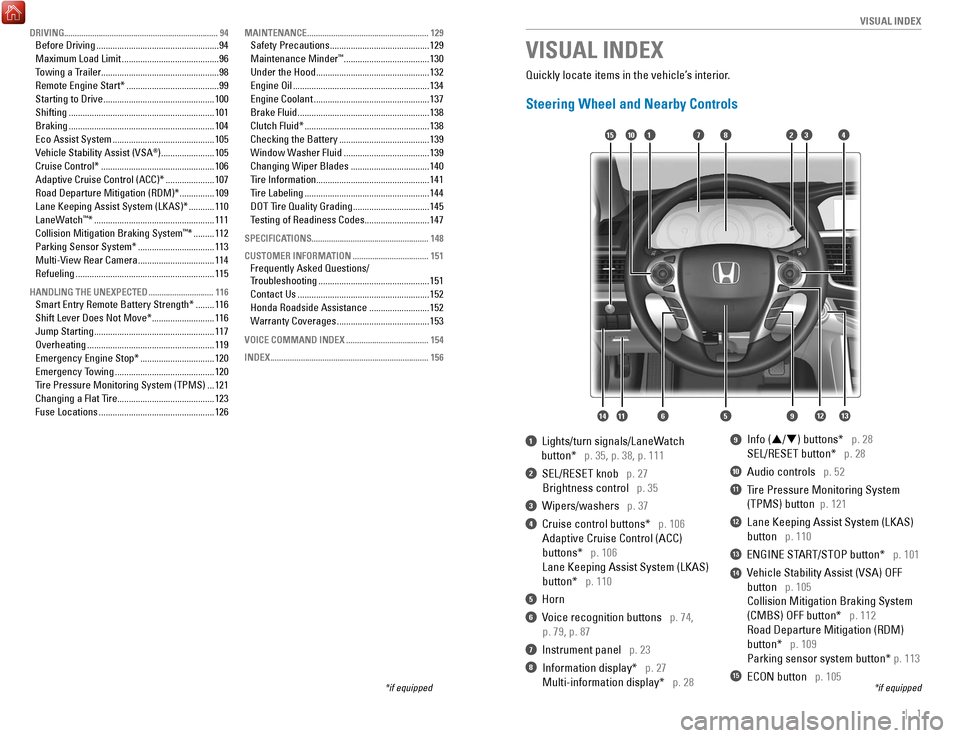
1 Lights/turn signals/LaneWatch
button* p. 35, p. 38, p. 111
2 SeL/reSeT knob p. 27
Brightness control p. 35
3 Wipers/washers p. 37
4 Cruise control buttons* p. 106
Adaptive Cruise Control (ACC)
buttons* p. 106
Lane Keeping Assist System (LKAS)
button* p. 110
5 Horn
6 voice recognition buttons p. 74,
p. 79, p. 87
7 Instrument panel p. 23
8 Information display* p. 27
Multi-information display* p. 28
9 Info (p/q) buttons* p. 28
SeL/reSeT button*
p. 28
10 Audio controls p. 52
11 Tire Pressure Monitoring System
(TPMS) button p. 121
12 Lane Keeping Assist System (LKAS)
button p. 110
13 eNGINe STArT/SToP button* p. 101
14 vehicle Stability Assist (vSA) oFF
button p. 105
Collision Mitigation Braking System
(CMBS) oFF button*
p. 112
road Departure Mitigation (rDM)
button* p. 109
Parking sensor system button* p. 113
15 eCoN button p. 105
VISUAL INDEX
*if equipped
Quickly locate items in the vehicle’s interior.
Steering Wheel and Nearby Controls
12
5
107415
116
38
9121314
DRIVING....................................................................... 94Before Driving ..................................................... 94
Maximum Load Limit
.......................................... 96
T
owing a Trailer...................................................98
remote engine Start* ........................................ 99
Starting to Drive
................................................ 100
Shifting
............................................................... 101
Braking
............................................................... 104
eco Assist System ............................................105
vehicle Stability Assist (vSA®) .......................105
Cruise Control*
................................................. 106
Adaptive Cruise Control (ACC)*
..................... 107
road Departure Mitigation (rDM)* ...............109
Lane Keeping Assist System (LKAS)*
........... 110
LaneW
atch
™* .................................................... 111
Collision Mitigation Braking System™* ......... 112
Parking Sensor System*
................................. 113
Multi-
view rear Camera ................................. 114
refueling ............................................................ 115
HANDLING THE UNEXPECTED ..............................116Smart entry remote Battery Strength* ........116
Shift Lever Does Not Move*
........................... 116
Jump Starting
.................................................... 117
overheating ....................................................... 119
emergency engine Stop* ................................120
emergency T
owing
........................................... 120
T
ire Pressure Monitoring System (TPMS)
... 121
Changing a Flat Tire
..........................................123
Fuse Locations
.................................................. 126
MAINTENANCE ........................................................ 129Safety Precautions ...........................................129
Maintenance Minder™ ..................................... 130
Under the Hood
................................................. 132
engine oil ........................................................... 134
engine Coolant ..................................................137
Brake Fluid
......................................................... 138
Clutch Fluid*
...................................................... 138
Checking the Battery
....................................... 139
Window W
asher Fluid
..................................... 139
Changing Wiper Blades
.................................. 140
T
ire Information.................................................141
Tire Labeling
...................................................... 144
D
oT T
ire Quality Grading
................................. 145
T
esting of
readiness Codes ............................ 147
SPECIFICATIONS...................................................... 148
CUSTOMER INFORMATION
................................... 151Frequently Asked Questions/
Troubleshooting ................................................ 151
Contact Us
......................................................... 152
Honda
roadside Assistance .......................... 152
W
arranty Coverages
........................................ 153
VOICE COMMAND INDEX ......................................154
INDEX
........................................................................\
. 156
Page 15 of 83

22 || 23
I
NSTRUMENT PANELSAFETY
INSTRUMENT PANEL
Learn about the indicators, gauges, and displays related to driving the \
vehicle.
Indicators briefly appear with each engine start and then go out.
red and amber
indicators are most critical. Blue and green indicators are used for gen\
er
al
information.
Malfunction Indicators
These are the most critical indicators. If they come on and stay lit whi\
le driving or at
any other time, there may be a problem. See your dealer if necessary.
Brake system
• Brake fluid is low.
• The brake system has a problem.
Press the brake pedal lightly to check pedal pressure. If normal, check \
the brake fluid level when you stop. If abnormal, take immediate actio\
n. If
necessary, downshift the transmission to slow the vehicle using engine
braking. Have your vehicle repaired immediately.
Low oil pressure
engine oil pressure is low
. Stop in a safe place.
open the hood. Check the oil
level, and add oil if necessary (see page 134). If the indicator does \
not tur
n
off, have your vehicle repaired immediately.
Charging system
The battery is not charging. Turn off all electrical items, but do not turn off
the vehicle to prevent further battery discharge. Have your vehicle repa\
ired
immediately.
Supplemental Restraint System (SRS)
There is a problem with one of the airbag systems or seat belt tensioner\
s.
Smart Entry system*
There is a problem with the smart entry system.
U.S.
Canada
*if equipped
Reporting Safety Defects
In the U.S.
If you believe that your vehicle has a defect which could cause a crash \
or could
cause injury or death, you should immediately inform the National Highway Traffic
Safety Administration (NHTSA) in addition to notifying American Honda \
Motor Co.,
Inc.
If NHTSA receives similar complaints, it may open an investigation, and \
if it finds
that a safety defect exists in a group of vehicles, it may order a recal\
l and remedy
campaign. However, NHTSA cannot become involved in individual problems
between you, your dealer, or American Honda Motor Co., Inc.
To contact NHTSA, you may call the
vehicle Safety Hotline toll-free at 1-888-327-
4236 (TTY: 1-800-424-9153); go to
http://www.safercar.gov; or write to: Administrator,
NHTSA, 1200 New Jersey Avenue, S
e., W
ashington, DC 20590. You can also obtain
other information about motor vehicle safety from http://www.safercar.gov.
In Canada
If you believe that your vehicle has a defect which could cause a crash \
or could
cause injury or death, you should immediately inform Honda Canada, Inc.,\
and you
may also inform Transport Canada.
If Transport Canada receives similar complaints, it may open an investigation, and if
it finds that a safety defect exists in a group of vehicles, it may le\
ad to a recall and
remedy campaign. However, Transport Canada cannot become involved in individual
problems between you, your dealer, or Honda Canada, Inc.
To contact Transport Canada’s Defect Investigations and
recalls Division, you may
call 1-800-333-0510. For more information on reporting safety defects or\
about motor
vehicle safety, go to http://www.tc.gc.ca/roadsafety.
Page 72 of 83

136 || 137
M
AINTENANCEMAINTENANCE
Engine Coolant
Park the vehicle on level ground. Check the reserve tank and the coolant\
level in the
radiator. We recommend Honda Long Life Antifreeze/Coolant Type 2.
Checking the Reserve Tank
1.
Check the amount of coolant in the reserve tank.
2.
If the coolant level is below the MIN mark, add
the specified coolant until it reaches the MAX
mark.
3.
Inspect the cooling system for leaks.
Adding Coolant 1.
Make sure the engine and radiator are cool.
2.
Turn the radiator cap counterclockwise and
relieve any pressure in the coolant system. Do
not push the cap down when turning.
3.
Push down and turn the radiator cap
counterclockwise to remove it.
4.
The coolant level should be up to the base of the
filler neck. Add coolant if it is low.
5.
Put the radiator cap back on, and tighten it fully.
6.
Pour coolant into the reserve tank until it reaches
the MAX mark. Put the cap back on the reserve
tank.
Reserve
tank
MAXMIN
If temperatures consistently below −22°F (−30°C) are expec\
ted, the coolant
mixture should be changed to a higher concentration. Consult a dealer fo\
r details
for more information.
NOTICE
Radiator ca p
removing the radiator cap while the engine is hot can cause the coolant t\
o
spray out, seriously scalding you.
Always let the engine and radiator cool down before removing the radiato\
r
cap.
WARNING
Pour the fluid slowly and carefully so you do not spill any. Clean up any spills
immediately; they can damage components in the engine compartment.
NOTICE
Resetting the Engine Oil Life
If you change or replace the vehicle’s engine oil yourself, you must reset the
engine oil life.
Models with information display
1.
Press the select/reset knob until the engine oil
life appears in the display.
2.
Press and hold the knob for 10 seconds or more,
until the display begins to blink.
3.
Press and hold the knob for 5 seconds or more.
The engine oil life display returns to 100%.
Models with multi-information display
Use the Info (p
/q) and S
eL/reSeT buttons on the steering wheel buttons to
control the display
.
1.
Scroll to the vehicle Settings screen, and select
it.
2.
Scroll to the Maintenance reset screen, and
select it.
3.
Select reset. The maintenance codes disappear
,
and the engine oil life display returns to 100%.
Failure to reset the Maintenance Minder display after a maintenance serv\
ice
results in the system showing incorrect maintenance intervals, which can\
lead to
serious mechanical problems.
NOTICE
Page 78 of 83
148 || 149
SPECIFICATIONS
SPECIFICATIONS
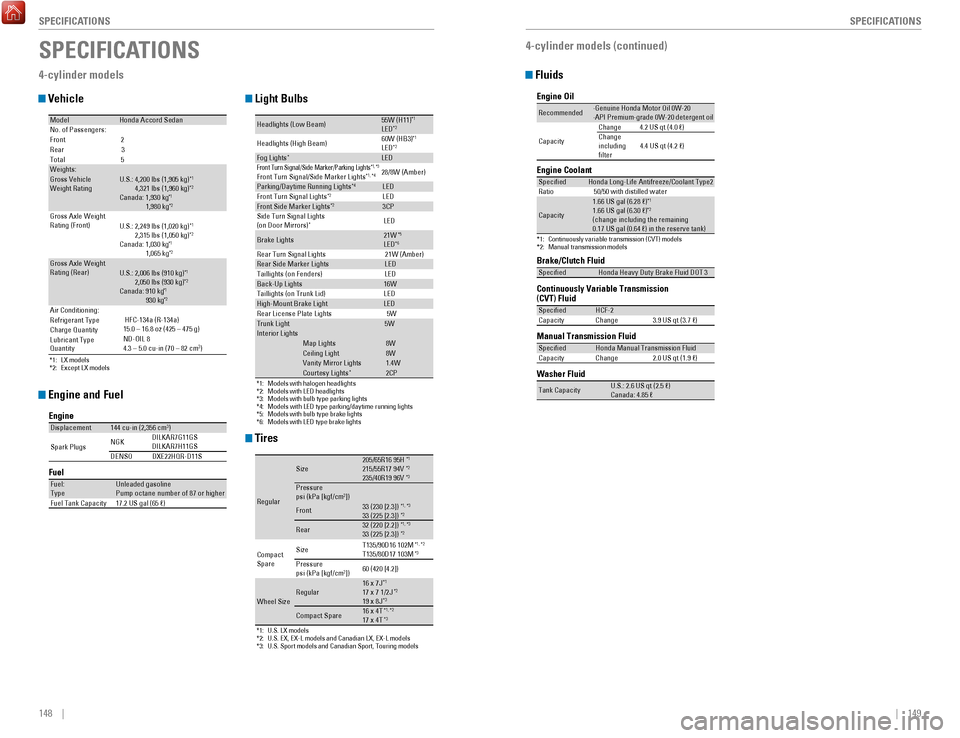
Fluids
4-cylinder models (continued)
Brake/Clutch Fluid
Continuously Variable Transmission (CVT) Fluid
Manual Transmission Fluid
Specie
dHonda Heavy Duty Brake Fluid DOT 3
SpeciedHCF-2
Capacity Change 3.9 US qt (3.7 )
SpeciedHonda Manual Transmission Flui d
Capacity Change 2.0 US qt (1.9 )
Engine Oil
Engine Coolan
t
*1:Continuously variable transmission (CVT) models*2:Manual transmission models
Recommended·Genuine Honda Motor Oil 0W-20
·API Premium-grade 0W-20 detergent oi l
Capacity Change
4.2 US qt (4.0 )
Change
including
lter 4.4 US qt (4.2 )
Specie
dHonda Long-Life Anti freeze/Coolant Type2
Ratio 50/50 with distilled wate r
Capacity
1.66 US gal (6.28 )*11.66 US gal (6.30 ) *2(change including the remaining
0.17 US gal (0.64 ) in the reserve tank)
Washer Flui d
Tank CapacityU.S.: 2.6 US qt (2.5 )
Canada: 4.85
SPECIFICATIONS
4-cylinder models
Vehicle
Engine and Fuel
Tires
Light Bulbs
*1: LX models
*2: Except LX models
ModelHonda Accord SedanNo. of Passengers:
Front 2
Rear 3
Tota l5
Weights:Gross Vehicle
Weight Rating U.S.: 4,200 lbs (1,905 kg )*1 4,321 lbs (1,960 kg)*2Canada: 1,930 kg*1 1,980 kg*2Gross Axle Weight
Rating (Front )U.S.: 2,249 lbs (1,020 kg )*1 2,315 lbs (1,050 kg)*2Canada: 1,030 kg*1 1,065 kg*2Gross Axle Weight
Rating (Rear)U.S.: 2,006 lbs (910 kg )*1 2,050 lbs (930 kg)*2Canada: 910 kg*1 930 kg*2Air Conditioning:
Refrigerant Type
Charge Quantity
Lubricant Type
Quantity HFC-134a (R-134a)
15.0 – 16.8 oz (425 – 475 g)
ND-OIL 8
4.3 – 5.0 cu-in (70 – 82 cm 3
)
Engine
FuelDisplacemen t144 cu-in (2,356 cm3)
Spark Plugs NG
K DILKAR7G11GS
DILKAR7H11GS
DENSO DXE22HQR-D11 S
Fuel:
TypeUnleaded gasoline
Pump octane number of 87 or higher
Fuel Tank Capacity 17.2 US gal (65 )
*1:U.S. LX models*2:U.S. EX, EX-L models and Canadian LX, EX-L models*3: U.S. Sport models and Canadian Sport, Touring models
Regular
Size205/65R16 95 H*1215/55R17 94V*2235/40R19 96V*3Pressure
psi (kPa [kgf/cm2])
Front33 (230 [2.3])*1, *333 (225 [2.3])*2
Rear32 (220 [2.2])*1, *333 (225 [2.3])*2
Compact
Spar e Size
T135/90D16 102M*1
, *2T135/80D17 103M*3Pressure
psi (kPa [kgf/cm2]) 60 (420 [4.2])
Wheel SizeRegular16 x 7J*117 x 7 1/2J*219 x 8J*3
Compact Spar
e16 x 4T*1, *217 x 4T*3
*1:Models with halogen headlights*2:Models with LED headlights*3:Models with bulb type parking lights*4:Models with LED type parking/daytime running lights*5:Models with bulb type brake lights*6: Models with LED type brake lights
Headlights (Low Beam)55W (H11 )*1LED*2
Headlights (High Beam )60W (HB3
)*1LED*2Fog Lights*LEDFront Turn Si gnal/Side Marker/Parki ng Ligh ts*1, *3Front Turn Signal/Side Marker Light s*1, *428/8W (Amber )
Parking/Daytime Running Lights*4LE D
Front Turn Signal Light s*2LEDFront Side Marker Lights*23CP
Side Turn Signal Lights
(on Door Mirrors )
*LED
Brake Lights21W*5LED*6Rear Turn Signal Lights 21W (Amber)Rear Side Marker LightsLED
Taillights (on Fenders) LED
Back-Up Lights16W
Taillights (on Trunk Lid) LED
High-Mount Brake LightLED
Rear License Plate Lights5WTrunk Light5WIn terior Light sMap Lights8WCeiling Ligh t8WVanity Mirror Light s1.4WCourtesy Lights*2CP
Page 79 of 83

150 || 151
CUSTOMER INFORMATION
SPECIFICATIONS
CUSTOMER INFORMATION
*if equipped
Learn about information specific to you as a Honda customer and how to\
get help.
Frequently Asked Questions/Troubleshooting
Below are some frequently asked questions and troubleshooting items that\
you may
have about the vehicle.
Q:
How do I set the vehicle clock?
A:
For vehicles without navigation, see page 49. For vehicles with navigati\
on, the
time is automatically set using GPS signals.
Q:
Why doesn’t the vehicle start when I press the ENGINE ST
ART/STOP button?*
A:
The brake pedal (and/or clutch pedal*) must be pressed to start the en\
gine.
Q:
What is the AUTO setting on my headlight lever?
A:
When in the AUTo position, the vehicle’
s exterior lights will automatically turn
on or off depending on the ambient lighting.
Q:
Why won’t the driver’
s door unlock when I grab the door handle, even though
the keyless access remote is within range?*
A:
If you pull the handle too quickly, the system may not have time to confirm the
door is unlocked. Wait to hear a beep to confirm the door is unlocked. If you are
wearing gloves, the system may be slow to respond.
Q:
After my battery was disconnected or went dead, the audio system is aski\
ng for
a code. Where do I find this?
A:
In most cases, you do not need to enter a code. Turn on the vehicle and the
audio system, and press and hold the power button until the system react\
ivates.
Q:
Why can’t I operate Pandora through the audio system?*
A:
Audio may be streaming through Bluetooth
Audio. Make sure Pandora mode
is selected and the phone cable is properly connected to the USB adapter\
cable (if using). Some phones may prompt you to “Allow” a connec\
tion.
Q:
Is my phone compatible with Bluetooth
features?
A:
v
isit handsfreelink.com
(U.S.) or www.handsfreelink.ca (Canada) to
check phone compatibility for Bluetooth
Audio, Bluetooth HandsFreeLink,
and SMS text messaging.
Q:
Every time I press the Talk button, the system gives me voice prompts. Can I turn
these off?*
A:
From the Home screen, select SeTTINGS. Select System, then select voice
Prompt. Select off.
6-cylinder models
Vehicle
Engine and Fuel
Tires
Light Bulbs
Fluids
ModelHonda Accord SedanNo. of Passengers:
Front
2
Rear 3
Tota l5
Weights:Gross Vehicle
Weight Rating U.S.: 4,542 lbs (2,060 kg)
Canada: 2,060 kg
Gross Axle Weight
Rating (Front)U.S.: 2,491 lbs (1,130 kg)
Canada: 1,130 kg
Gross Axle Weight
Rating (Rear)U.S.: 2,072 lbs (940 kg)
Canada: 940 kg
Air Conditioning:
Refrigerant Type
Charge Quantity
Lubricant Type
QuantityHFC-134a (R-134a)
15.0 – 16.8 oz (425 – 475 g) ND-OIL 8
4.3 – 5.0 cu-in (70 – 82 cm
3)
Engine
FuelDisplacemen t212 cu-in (3,471 cm3)
Spark Plugs NG
KI LZKR7B11
DENSO SXU22HCR11
Fuel:
TypeUnleaded gasoline
Pump octane number of 87 or higher
Fuel Tank Capacity 17.2 US gal (65 )
*1: EX-L V6 models*2: U.S. Touring models and Canadian V6 Touring models
Regular
Size215/55R17 94 V*1235/40R19 96V*2
Pressure
psi (kPa [kgf/cm2])33 (225 [2.3])*133 (230 [2.3])*2Front
Rear33 (225 [2.3])*132 (220 [2.2])*2
Compact
Spar e Size
T135/90D16 102M*1T135/80D17 103M*2Pressure
psi (kPa [kgf/cm2])
60 (420 [4.2])
Wheel SizeRegula
r17 x 7 1/2J*119 x 8J*2
Compact Spar e16 x 4T*117 x 4T*2
*1:Models with halogen headlights*2:Models with LED headlights*3:Models with bulb type parking lights*4:Models with LED type parking/daytime running lights*5:Models with bulb type brake lights*6: Models with LED type brake lights
Headlights (Low Beam)55W (H11)*1LED*2
Headlights (High Beam) 60W (HB3
)*1LED*2Fog LightsLEDFront Turn Si gnal/Side Marker/Parking Ligh ts*1, *3Front Turn Signal/Side Marker Lights*1, *428/8W (Amber )
Parking/Daytime Running Light s*4LED
Front Turn Signal Light s*2LEDFront Side Marker Lights*23CP
Side Turn Signal Lights
(on Door Mirrors) LE
D
Brake Lights21W*5LED*6Rear Turn Signal Lights 21W (Amber)Rear Side Marker LightsLED
Taillights (on Fenders) LED
Back-Up Lights16W
Taillights (on Trunk Lid) LED
High-Mount Brake Ligh tLED
Rear License Plate Lights 5W
Trunk Light5WInterior LightsMap Lights8WCeiling Ligh t8WVanity Mirror Light s1.4WCourtesy Lights2CP
Brake Fluid
Automatic Transmission Fluid
SpeciedHonda Heavy Duty Brake Fluid DOT 3
SpeciedHonda ATF DW-1
(automatic transmission uid )
Capacit yC hange3 .3 US qt (3.1 )
Engine Oil
Engine Coolan
t
Recommended·Genuine Honda Motor Oil 0W-2 0
·API Premium-grade 0W-20 detergent oi l
Capacity Chang
e4 .2 US qt (4.0 )
Change
including
lter 4.5 US qt (4.3 )
Specie
dHonda Long-Life Anti freeze/Coolant Type 2
Ratio 50/50 with distilled wate r
Capacity1.72 US gal (6.5 )
(change including the remaining
0.17 US gal (0.64 ) in the reserve tank )
Washer Fluid
Tank CapacityU.S.: 2.6 US qt (2.5 )
Canada: 4.85
Page 82 of 83
 ........................... 107
Braking .......")
156 || 157
INDEX
INDEX
Driving ........................................................................\
. 94
Adaptive Cruise Control (ACC) ........................... 107
Braking ................................................................... 104
Collision Mitigation Braking System ................. 112
Continuously variable Transmission (CvT) ...... 101
Cruise Control ....................................................... 106eco Assist System ................................................105eNGINe ST
A
rT/SToP button .............................. 101
Forward Collision W
arning (FCW)
.....109
, 110, 112
Ignition
................................................................... 100
Lane Keeping Assist System (LKAS) ................. 110
LaneW
atch
™ .......................................................... 111
Manual Transmission .......................................... 103
Maximum Load Limit .............................................. 96
Multi-view rear Camera ..................................... 114
Paddle Shifters ..................................................... 102
Parking Sensor System ....................................... 113
Power Mode .......................................................... 101refueling ................................................................ 115remote engine Start ..............................................99road Departure Mitigation (rDM)
..................... 109
Shifting
................................................................... 101
T
owing a Trailer
...................................................... 98vehicle Stability Assist (vSA®) ...........................105
Wiper Blades ........................................................ 140
Driving Position Memory System ........................... 43eco Assist System
................................................... 105
eCoN Button ............................................................ 105eCoN mode ................................................................ 26electric Power Steering (ePS) ................................24e-Mail ........................................................................\
.. 84emergency engine Stop .........................................120emergency T
owing
................................................. 120engine and Fuel ...............................................148
, 150
engine Coolant
......................................................... 137
engine oil
.................................................................. 134
eNGINe ST
A
rT/SToP button ................................ 101exterior Lights ...................................................... 26
, 35
Fastening a Seat Belt
................................................. 7
Flat T
ire
..................................................................... 123
Floor Mats .................................................................. 40
Fluids ................................................................. 149
, 150
FM/AM
radio ....................................................... 55
, 67
FM/AM
radio Commands ...................................... 155
Fog lights .................................................................... 26
Foot Brake ................................................................ 104
Frequently Asked Questions ................................. 151
Front Airbags (SrS) .................................................... 8
Front Door Inner Handle .......................................... 32
Fuel Information ...................................................... 115
Fuse Locations
......................................................... 126
Garage
opener .......................................................... 45
Hazards ....................................................................... 26
Headlight-Wiper Integration ................................... 37
Head restraints ......................................................... 41High beams
................................................................
26
High temperature ...................................................... 24
Home Address ........................................................... 89
HomeLink® Universal Transceiver.......................... 45
HondaLink™ ................................................................ 63
HondaLink™ Assist .................................................... 85
Honda roadside Assistance ................................. 152
Hood ........................................................................\
.. 132
Ignition ...................................................................... 100
Immobilizer ................................................................. 25
Information Display
................................................... 27
Instrument Panel
....................................................... 23
Interior Lights
............................................................. 35
Intermittent Wipers................................................... 37
iPod
® ..................................................................... 57, 70
iPod® Commands .................................................... 155
Jump Starting .......................................................... 117
Key ........................................................................\
....... 30
Lane Keeping Assist System (LKAS)
.............. 25, 110
LaneWatch
™ ............................................................. 111
Lap/Shoulder Seat Belts ............................................ 5
LATCH-Compatible Child Seat ................................. 17
Light Bulbs
........................................................ 148, 150
Light control
............................................................... 24
Lights ..................................................................... 26
, 35
LKAS
...................................................................... 25
, 26
Lock Tab
...................................................................... 32
Low fuel ...................................................................... 25
Low oil pressure ........................................................ 23
Low temperature ....................................................... 24
Low tire pressure ...................................................... 25
Maintenance
............................................................ 129
Battery
.................................................................... 139
Brake Fluid ............................................................. 138
Clutch Fluid ............................................................ 138engine Coolant ......................................................137engine oil ............................................................... 134
Maintenance Minder™ ......................................... 130
Service Codes ....................................................... 131
Under the Hood ..................................................... 132
Window W
asher Fluid
......................................... 139
Making a Call ....................................................... 76
, 82
Malfunction indicator lamp
..................................... 24
Malfunction Indicators
............................................. 23
Manual Seats............................................................. 40 Manual Transmission
............................................. 103
Map Legend ............................................................... 92
Master Door Lock Switch ........................................ 32
Maximum Load Limit................................................. 96
Mirrors
........................................................................\
44
Moonroof .................................................................... 34
Multi-Information Display (MID)
............................. 28
Multi-
view rear Camera ....................................... 114
Music search ........................................................... 155
INDEX
ABS........................................................................\
...... 24
ACC ........................................................................\
24
, 26
Accessory Power Socket
........................................ 50
Adaptive Cruise Control (ACC) ........................ 24
, 107
Address....................................................................... 89 Advanced Airbags
...................................................... 8
Aha™ radio ................................................................. 64
Airbags........................................................................\
.. 8 Airbag Care
............................................................. 13
Airbag System Components ................................. 12
Airbag System Indicators ..................................... 10
Ambient Meter
......................................................... 105
Android Auto
.............................................................. 66
Anti-Lock Brake System (ABS) ....................... 24
, 104
Apple CarPlay
™ .......................................................... 65
Apps ........................................................................\
.... 62
Audio Commands .................................................... 155
Audio operation ........................................................ 50
Aha™ radio .............................................................. 64
Android Auto ........................................................... 66
Apple CarPlay™ ....................................................... 65
Auxiliary Input Jack ............................................... 50
Bluetooth® Audio .............................................. 59, 72
Compact Disc (CD) ........................................... 56,
69
FM/AM
radio .................................................... 55
, 67
HondaLink
™ .............................................................. 63
iPod® ................................................................... 57, 70one Display Audio operation ...............................54
Pandora® ........................................................... 60, 73
SiriusXM® radio ..................................................... 68
Sound ....................................................................... 53
Steering Wheel Controls ....................................... 52
T
ouchscreen
operation ......................................... 61
USB Flash Drive ................................................ 58
, 71
USB Port
.................................................................. 50
Wi-Fi Connection .................................................... 64
Wireless Charger ................................................... 51
Auto High-Beam System
.............................. 24, 26, 36
Automatic Dimming
rearview Mirror .................... 44
Automatic Intermittent Wipers ............................... 38
AUX Commands
....................................................... 155
Auxiliary Input Jack
.................................................. 50
Battery ...................................................................... 139
Bluetooth® Audio ................................................ 59, 72
Bluetooth® Audio Commands ............................... 155Bluetooth
® Handsfreelink® (HFL) ............................
74
Call History ........................................................ 77
, 83
Dialing a Number
.............................................. 76
, 82
e-Mail ....................................................................... 84
HFL Controls ...................................................... 74
, 79
HondaLink
™ Assist .................................................. 85
Making a Call .................................................... 76
, 82
Pairing a Phone
................................................ 75
, 81
Phonebook
......................................................... 77
, 83
Siri
eyes Free .......................................................... 86
SMS T
ext Messaging
....................................... 78,
84
Speed Dial
......................................................... 76
, 82
Talk Button Tips
...................................................... 80
Brake Assist System
............................................... 104
Brake Fluid
............................................................... 138
Brake system ....................................................... 23
, 24
Braking...................................................................... 104 Brightness Control
.................................................... 35
Call History ........................................................... 77
, 83
Carbon Monoxide Gas................................................ 4
Changing a Flat Tire
................................................ 123
Changing Settings ..................................................... 48
Charging system
........................................................ 23
Childproof Door Locks
.............................................. 32
Child Safety ................................................................ 14
Child Seat ................................................................... 16
Adding Security with a T
ether
.............................. 19
LA
TCH-Compatible Child Seat
.............................. 17
Climate Control Commands ................................... 154
Climate Control System ............................................ 46
Clock........................................................................\
.... 49 Clutch Fluid............................................................... 138CMBS
™ ........................................................................\
26
Collision Mitigation Braking System™ ............ 24, 112
Compact Disc (CD) .............................................. 56
, 69
Compact Disc (CD) Commands
............................. 155
Condition Indicators ................................................. 25
Contact Us ................................................................ 152
Continuously variable Transmission (CvT) ......... 101
Cruise Control .......................................................... 106
CrUISe CoNTroL ..................................................... 26
CUSToMer Information
......................................... 151
Customized Features
................................................ 48
Dashboard and other Controls ................................. 2
Daytime running Lights (DrL)
................................. 24
Destination
................................................................. 89
Dialing a Number ................................................ 76
, 82
Door Mirrors
.............................................................. 44
Door open ................................................................... 25
Door operation .......................................................... 32
Doors ........................................................................\
... 31
DoT T
ire Quality Grading
....................................... 145