ECO HONDA ACCORD COUPE 2001 CF / 6.G Owners Manual
[x] Cancel search | Manufacturer: HONDA, Model Year: 2001, Model line: ACCORD COUPE, Model: HONDA ACCORD COUPE 2001 CF / 6.GPages: 372, PDF Size: 6.1 MB
Page 9 of 372
Important Safety Precautions
You'll find many safety recommendations throughout this
section, and throughout this manual.
The recommendations on this page are the ones we consider to be the
most important.
Always Wear Your Seat Belt A seat belt is your best protection in
all types of collisions. Airbags
supplement seat belts, but airbags
are designed to inflate only in a
moderate to severe frontal collision.
So even though your car is equipped
with airbags, make sure you and
your passengers always wear your
seat belts, and wear them properly.
(See page 14.)
Restrain All Children Children are safest when they are
properly restrained in the back seat,
not the front seat. A child who is too small for a seat belt must be properly
restrained in a child safety seat. (See
page 19.) Be Aware of Airbag Hazards
While airbags can save lives, they can cause serious or fatal injuries tooccupants who sit too close to them,
or are not properly restrained.
Infants, young children, and short adults are at the greatest risk. Be
sure to follow all instructions and
warnings in this manual. (See page 7.)
Don't Drink and Drive
Alcohol and driving don't mix. Even one drink can reduce your ability to
respond to changing conditions, and
your reaction time gets worse with every additional drink. So don't drink
and drive, and don't let your friendsdrink and drive, either. Control Your Speed
Excessive speed is a major factor in
crash injuries and deaths. Generally,
the higher the speed the greater the risk, but serious accidents can also
occur at lower speeds. Never drive
faster than is safe for current conditions, regardless of the
maximum speed posted.
Keep Your Car in Safe Condition
Having a tire blowout or a
mechanical failure can be extremely
hazardous. To reduce the possibility of such problems, check your tire
pressures and condition frequently, and perform all regularly scheduled
maintenance. (See page 224.)
Driver and Passenger Safety
Page 16 of 372
Protecting Adults
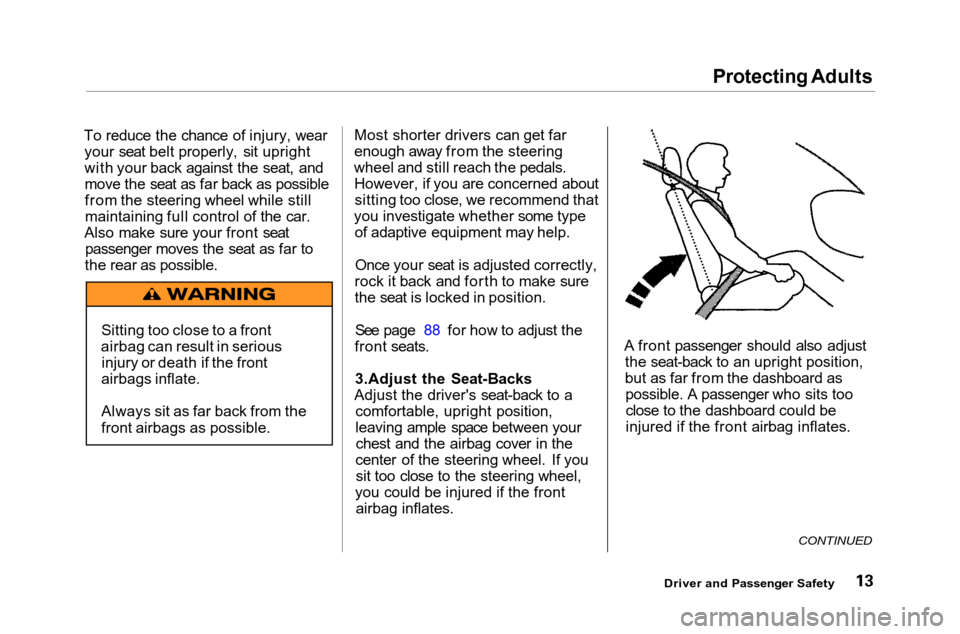
To reduce the chance of injury, wear your seat belt properly, sit upright
with your back against the seat, andmove the seat as far back as possible
from the steering wheel while stillmaintaining full control of the car.
Also make sure your front seat passenger moves the seat as far to
the rear as possible. Most shorter drivers can get far
enough away from the steering
wheel and still reach the pedals. However, if you are concerned aboutsitting too close, we recommend that
you investigate whether some type of adaptive equipment may help.
Once your seat is adjusted correctly,
rock it back and forth to make sure
the seat is locked in position.
See page 88 for how to adjust the
front seats.
3.Adjust the Seat-Backs
Adjust the driver's seat-back to a comfortable, upright position,
leaving ample space between yourchest and the airbag cover in the
center of the steering wheel. If you sit too close to the steering wheel,
you could be injured if the front airbag inflates. A front passenger should also adjust
the seat-back to an upright position,
but as far from the dashboard aspossible. A passenger who sits tooclose to the dashboard could be
injured if the front airbag inflates.
CONTINUED
Driver and Passenger Safety
Sitting too close to a front
airbag can result in serious injury or death if the front
airbags inflate.
Always sit as far back from the
front airbags as possible.
Page 23 of 372
Protecting Children
Additional Precautions to Parents Never hold an infant or child on
your lap. If you are not wearing a seat belt in a crash, you could be
thrown forward into the dashboard and crush the child.
If you are wearing a seat belt, the
child can be torn from your armsduring a crash. For example, if
your car crashes into a parked
vehicle at 30 mph (48 km/h), a 20-lb (9 kg) infant will become a600-lb (275 kg) force, and you will
not be able to hold on.
Never put a seat belt over yourself
and an infant or child. During a
crash, the belt could press deep
into the child and cause very
serious injuries.
Children Should Sit in the Back
Seat
According to accident statistics, children of all ages and sizes are
safer when they are restrained in the
back seat, not the front seat. The National Highway Traffic Safety
Administration and Transport Canada recommend that all children
ages 12 and under be properly
restrained in the back seat.
In the back seat, children are less
likely to be injured by striking hard
interior parts during a collision or
hard braking. Also, children cannot be injured by an inflating airbag
when they ride in the back. The Passenger's Front Airbag
Poses Serious Risks to ChildrenFront airbags have been designed to
help protect adults in a moderate to severe frontal collision. To do this,
the passenger's front airbag is quite
large, and it inflates with tremendous
speed.
Infants
Never put a rear-facing child seat inthe front seat of a vehicle equipped
with a passenger's front airbag.
If
the airbag inflates, it can hit the back
of the child seat with enough force
to kill or very seriously injure an
infant.
Driver and Passenger Safety
Page 26 of 372
Protecting Children
If a Child Requires Close
Attention
Many parents say they prefer to put
an infant or small child in the front
passenger seat so they can watch the
child, or because the child requires
attention.
Placing a child in the front seat
exposes the child to hazards from
the passenger's front airbag, and
paying close attention to a child distracts the driver from the
important tasks of driving, placing
both of you at risk.
If a child requires physical attention or frequent visual contact, we
strongly recommend that another
adult ride with the child in the back seat. The back seat is far safer for a
child than the front. Additional Safety Precautions
Use childproof door locks to
prevent children from opening the
doors. Using this feature will
prevent children from opening the doors and accidentally falling out (see page 80).
Use the main power window
switch to prevent children from
opening the rear windows. Using
this feature will prevent children
from playing with the windows,
which could expose them to
hazards or distract the driver (see page 97).
Do not leave children alone in your
vehicle. Leaving children without
adult supervision is illegal in most
states and Canadian provinces,
and can be very hazardous. For
example, infants and small
children left in a vehicle on a hot day can die from heatstroke. And
children left alone with the key in
the ignition can accidentally set
the vehicle in motion, possibly
injuring themselves or others.
Driver and Passenger Safety
Page 28 of 372
Protecting Children
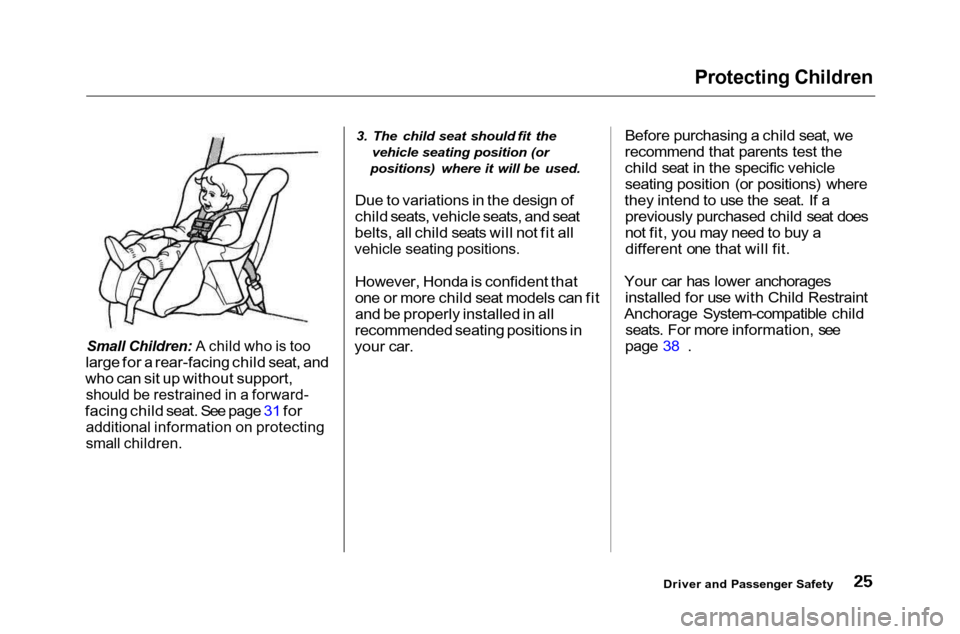
Small Children: A child who is too
large for a rear-facing child seat, and
who can sit up without support,
should be restrained in a forward-
facing child seat. See page 31 for
additional information on protecting
small children.
3. The child seat should fit the
vehicle seating position (or
positions) where it will be used.
Due to variations in the design of
child seats, vehicle seats, and seat
belts, all child seats will not fit all
vehicle seating positions.
However, Honda is confident that
one or more child seat models can fit
and be properly installed in all
recommended seating positions in
your car. Before purchasing a child seat, we
recommend that parents test the
child seat in the specific vehicle
seating position (or positions) where
they intend to use the seat. If a previously purchased child seat does
not fit, you may need to buy adifferent one that will fit.
Your car has lower anchorages installed for use with Child Restraint
Anchorage System-compatible child seats. For more information, see
page 38 .
Driver and Passenger Safety
Page 29 of 372
Protecting Children
Placing a Child Seat
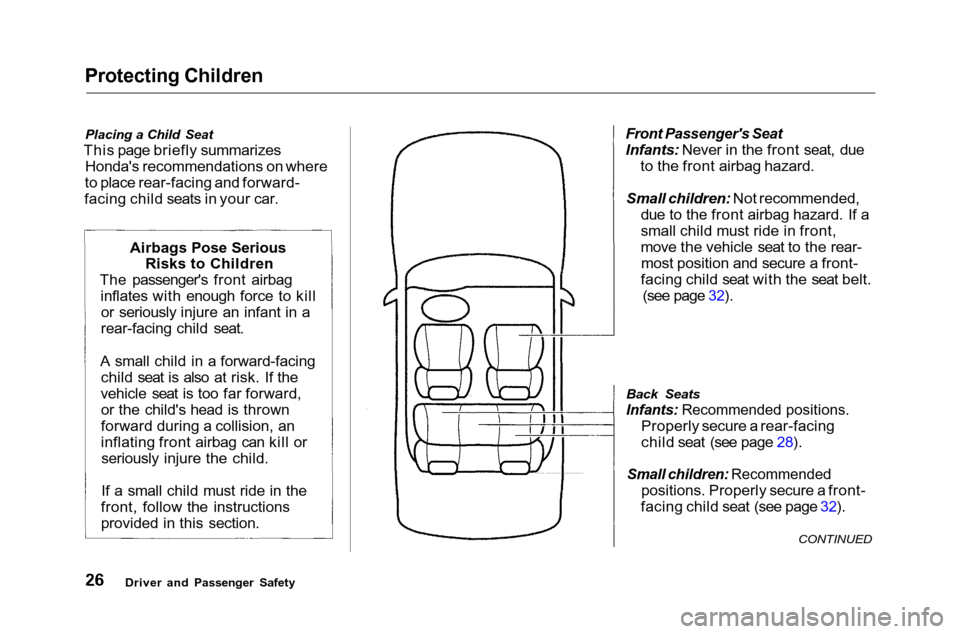
This page briefly summarizes Honda's recommendations on where
to place rear-facing and forward-
facing child seats in your car.
Front Passenger's Seat
Infants: Never in the front seat, due to the front airbag hazard.
Small children: Not recommended,
due to the front airbag hazard. If a
small child must ride in front,
move the vehicle seat to the rear-most position and secure a front-
facing child seat with the seat belt. (see page 32).
Back Seats
Infants: Recommended positions.
Properly secure a rear-facing
child seat (see page 28).
Small children: Recommended
positions. Properly secure a front-
facing child seat (see page 32).
Driver and Passenger Safety
CONTINUED
Airbags Pose Serious
Risks to Children
The passenger's front airbag inflates with enough force to killor seriously injure an infant in a
rear-facing child seat.
A small child in a forward-facing child seat is also at risk. If the
vehicle seat is too far forward, or the child's head is thrown
forward during a collision, an
inflating front airbag can kill orseriously injure the child.
If a small child must ride in the
front, follow the instructions
provided in this section.
Page 30 of 372
Protecting Children
Installing a Child Seat
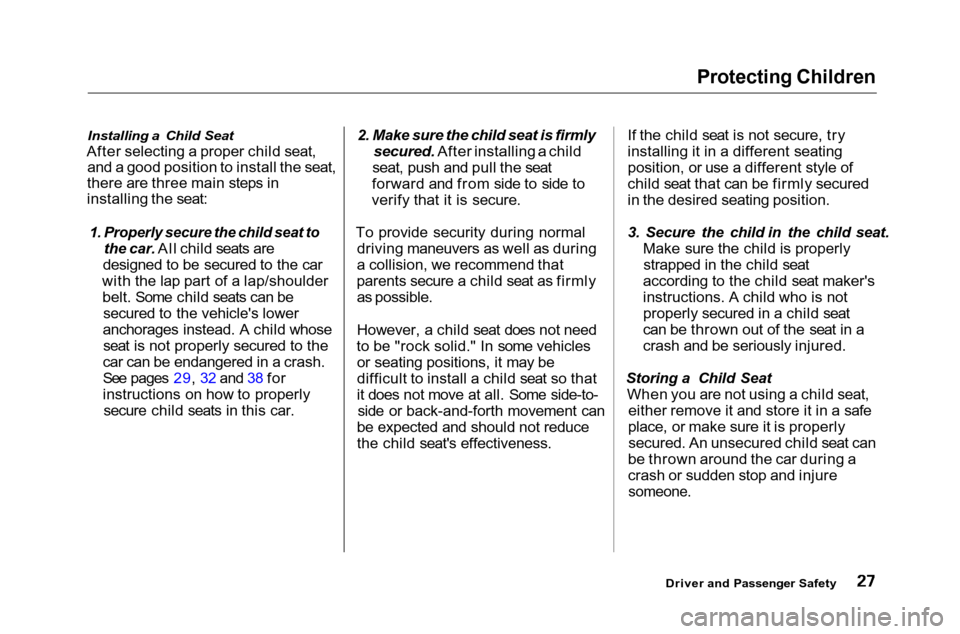
After selecting a proper child seat, and a good position to install the seat,
there are three main steps in
installing the seat:
1. Properly secure the child seat to
the car. All child seats are
designed to be secured to the car
with the lap part of a lap/shoulder belt. Some child seats can be secured to the vehicle's lower
anchorages instead. A child whose seat is not properly secured to the
car can be endangered in a crash.
See pages 29, 32 and 38 for
instructions on how to properly secure child seats in this car. 2. Make sure the child seat is firmly
secured. After installing a child
seat, push and pull the seat
forward and from side to side to
verify that it is secure.
To provide security during normal driving maneuvers as well as during
a collision, we recommend that
parents secure a child seat as firmly as possible.
However, a child seat does not need
to be "rock solid." In some vehicles or seating positions, it may be
difficult to install a child seat so that
it does not move at all. Some side-to- side or back-and-forth movement can
be expected and should not reduce
the child seat's effectiveness. If the child seat is not secure, try
installing it in a different seating
position, or use a different style of
child seat that can be firmly secured
in the desired seating position.
3. Secure the child in the child seat. Make sure the child is properlystrapped in the child seat
according to the child seat maker's
instructions. A child who is not
properly secured in a child seat
can be thrown out of the seat in a
crash and be seriously injured.
Storing a Child Seat When you are not using a child seat, either remove it and store it in a safe
place, or make sure it is properly secured. An unsecured child seat can
be thrown around the car during a
crash or sudden stop and injure
someone.
Driver and Passenger Safety
Page 31 of 372
Protecting Children
Protecting Infants
Child Seat Type
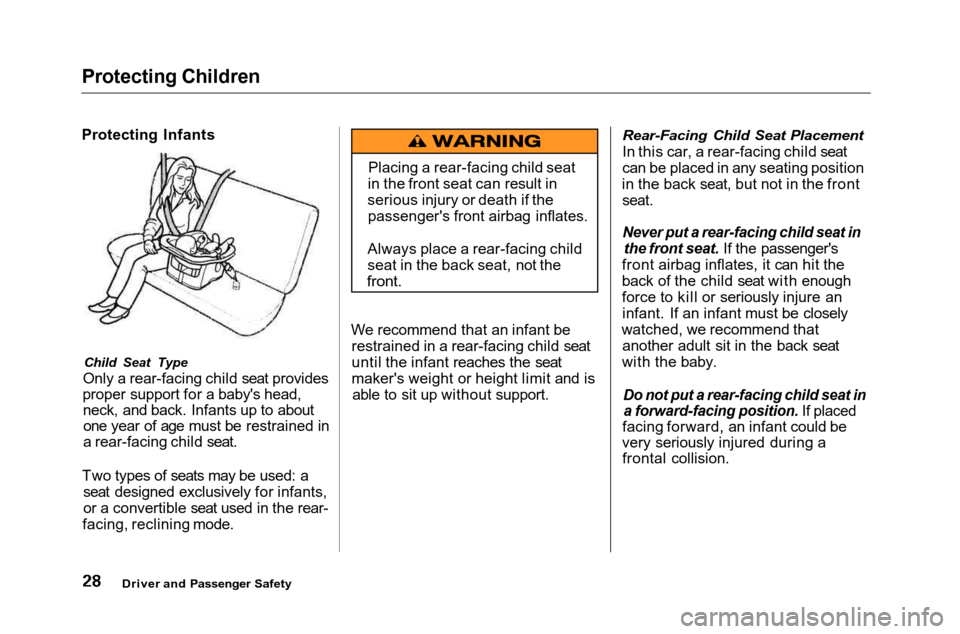
Only a rear-facing child seat provides
proper support for a baby's head, neck, and back. Infants up to aboutone year of age must be restrained in
a rear-facing child seat.
Two types of seats may be used: a seat designed exclusively for infants,
or a convertible seat used in the rear-
facing, reclining mode. We recommend that an infant be
restrained in a rear-facing child seat
until the infant reaches the seat
maker's weight or height limit and isable to sit up without support.
Rear-Facing Child Seat Placement
In this car, a rear-facing child seat
can be placed in any seating position
in the back seat, but not in the front
seat.
Never put a rear-facing child seat in
the front seat. If the passenger's
front airbag inflates, it can hit the
back of the child seat with enough
force to kill or seriously injure an infant. If an infant must be closely
watched, we recommend that another adult sit in the back seat
with the baby.
Do not put a rear-facing child seat in
a forward-facing position. If placed
facing forward, an infant could be
very seriously injured during a frontal collision.
Driver and Passenger Safety
Placing a rear-facing child seat
in the front seat can result in
serious injury or death if the passenger's front airbag inflates.
Always place a rear-facing child
seat in the back seat, not the
front.
Page 32 of 372
Protecting Children
When properly installed, a rear- facing child seat may prevent thedriver or a front-seat passenger from
moving the seat as far back as
recommended (see page 12). Or it
may prevent them from locking the seat-back in the desired upright
position (see page 13).
In either case, we recommend that
you place the child seat directly behind the front passenger seat,
move the front seat as far forward as
needed, and leave it unoccupied. Or
you may wish to get a smaller child seat that allows you to safely carry a
front passenger.
Rear-Facing Child Seat Installation
The lap/shoulder belts in the back seats have a locking mechanism that
must be activated to secure a child
seat.
The following pages provide instructions and tips on how tosecure a rear-facing child seat with
this type of seat belt.
If you have a child seat designed to
attach to the vehicle's lower
anchorages, follow the instructions
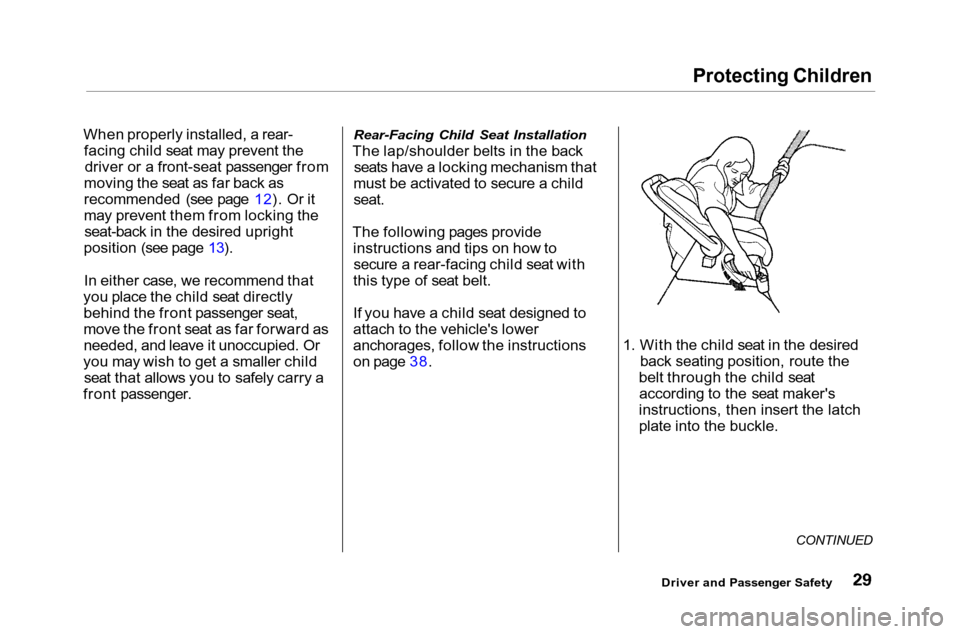
on page 38. 1. With the child seat in the desired
back seating position, route the
belt through the child seat according to the seat maker's
instructions, then insert the latch
plate into the buckle.
CONTINUED
Driver and Passenger Safety
Page 34 of 372
Protecting Children
Rear-Facing Child Seat Installation Tips
For proper protection, an infant must
ride in a reclined, or semi-reclined
position. To determine the proper
reclining angle, check with the baby's doctor or follow the seat maker's
recommendations.
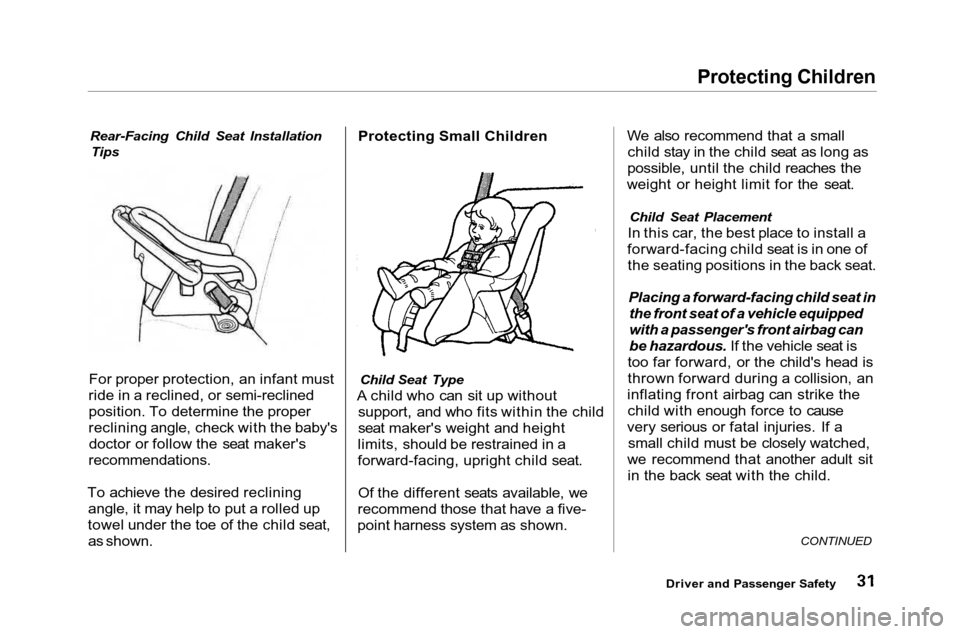
To achieve the desired reclining angle, it may help to put a rolled up
towel under the toe of the child seat, as shown. Protecting Small Children
Child Seat Type
A child who can sit up without support, and who fits within the child
seat maker's weight and height
limits, should be restrained in a
forward-facing, upright child seat.
Of the different seats available, we
recommend those that have a five-
point harness system as shown. We also recommend that a small
child stay in the child seat as long as
possible, until the child reaches the
weight or height limit for the seat.
Child Seat Placement
In this car, the best place to install a
forward-facing child seat is in one of the seating positions in the back seat.
Placing a forward-facing child seat inthe front seat of a vehicle equipped
with a passenger's front airbag can
be hazardous. If the vehicle seat is
too far forward, or the child's head is
thrown forward during a collision, an
inflating front airbag can strike the child with enough force to cause
very serious or fatal injuries. If a small child must be closely watched,
we recommend that another adult sit in the back seat with the child.
CONTINUED
Driver and Passenger Safety