weight HONDA ACCORD COUPE 2002 CL7 / 7.G Owners Manual
[x] Cancel search | Manufacturer: HONDA, Model Year: 2002, Model line: ACCORD COUPE, Model: HONDA ACCORD COUPE 2002 CL7 / 7.GPages: 375, PDF Size: 4.89 MB
Page 32 of 375
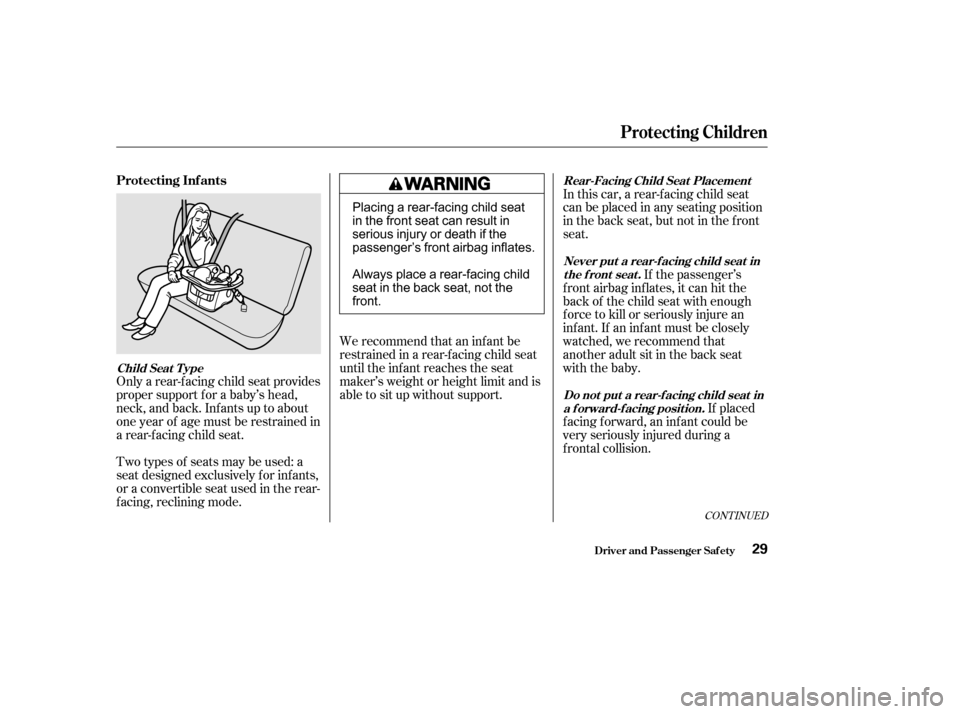
Only a rear-f acing child seat provides
proper support f or a baby’s head,
neck, and back. Inf ants up to about
one year of age must be restrained in
a rear-f acing child seat.In this car, a rear-f acing child seat
can be placed in any seating position
in the back seat, but not in the front
seat.
We recommend that an inf ant be
restrained in a rear-f acing child seat
until the inf ant reaches the seat
maker’s weight or height limit and is
able to sit up without support.
Two types of seats may be used: a
seat designed exclusively f or inf ants,
or a convertible seat used in the rear-
f acing, reclining mode. If the passenger’s
f ront airbag inf lates, it can hit the
back of the child seat with enough
f orce to kill or seriously injure an
inf ant. If an inf ant must be closely
watched, we recommend that
another adult sit in the back seat
with the baby.
If placed
f acing f orward, an inf ant could be
very seriously injured during a
f rontal collision.
CONT INUED
Protecting Inf ants
Child Seat T ype Rear-Facing Child Seat Placement
Never put a rear-f acing child seat inthe front seat.
Do not put a rear-f acing child seat ina f orward-f acing position.
Protecting Children
Driver and Passenger Saf ety29
Placing a rear-facing child seat
in the front seat can result in
serious injury or death if the
passenger’s front airbag inflates.
Always place a rear-facing child
seat in the back seat, not the
front.
Page 34 of 375
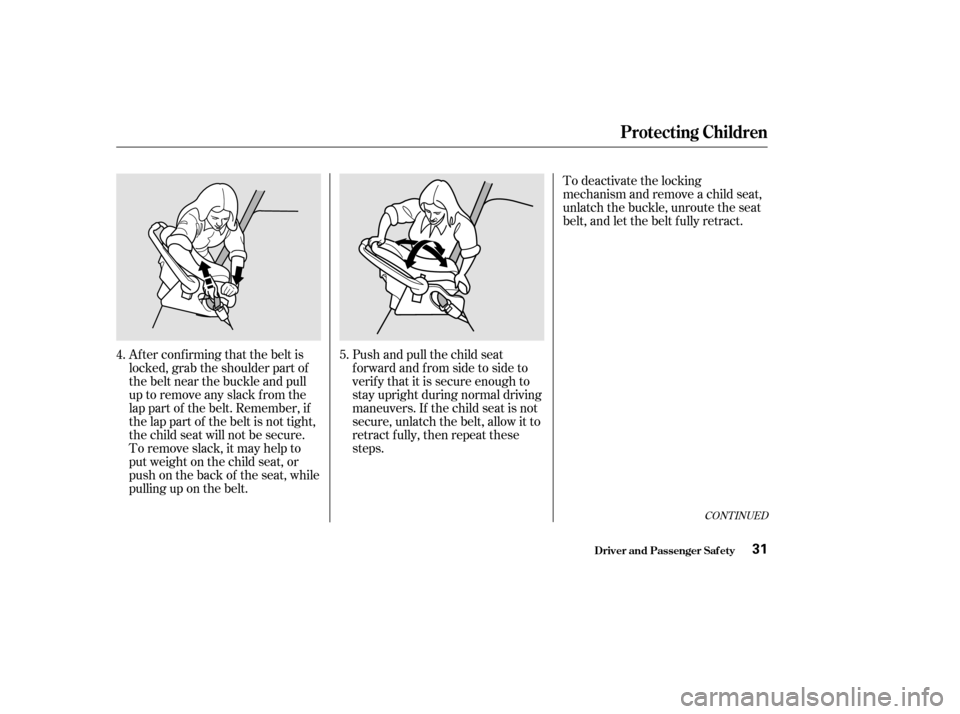
Af ter conf irming that the belt is
locked, grab the shoulder part of
the belt near the buckle and pull
up to remove any slack from the
lap part of the belt. Remember, if
the lap part of the belt is not tight,
the child seat will not be secure.
To remove slack, it may help to
putweightonthechildseat,or
push on the back of the seat, while
pulling up on the belt.Push and pull the child seat
f orward and f rom side to side to
verif y that it is secure enough to
stay upright during normal driving
maneuvers. If the child seat is not
secure, unlatch the belt, allow it to
retract f ully, then repeat these
steps.To deactivate the locking
mechanism and remove a child seat,
unlatch the buckle, unroute the seat
belt, and let the belt f ully retract.
4. 5.
CONT INUED
Protecting Children
Driver and Passenger Saf ety31
Page 36 of 375
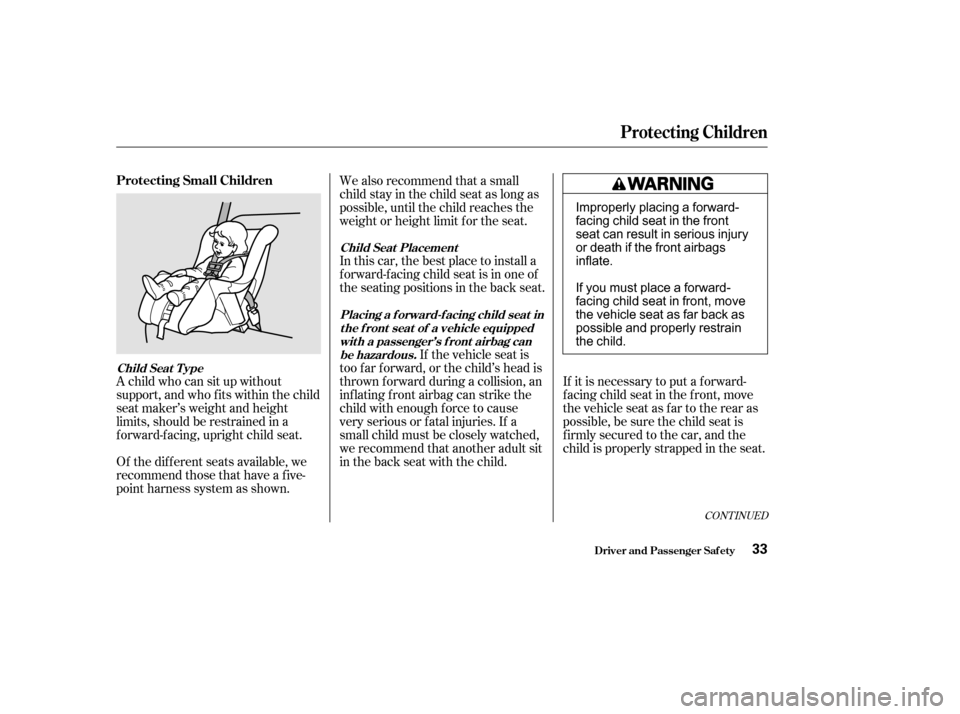
A child who can sit up without
support, and who f its within the child
seat maker’s weight and height
limits, should be restrained in a
f orward-f acing, upright child seat.
Of the different seats available, we
recommend those that have a f ive-
point harness system as shown.We also recommend that a small
child stay in the child seat as long as
possible, until the child reaches the
weight or height limit f or the seat.
In this car, the best place to install a
f orward-f acing child seat is in one of
the seating positions in the back seat.
If the vehicle seat is
too far forward, or the child’s head is
thrown f orward during a collision, an
inflating front airbag can strike the
child with enough f orce to cause
very serious or f atal injuries. If a
small child must be closely watched,
we recommend that another adult sit
in the back seat with the child. If it is necessary to put a f orward-
f acing child seat in the f ront, move
the vehicle seat as far to the rear as
possible, be sure the child seat is
f irmly secured to the car, and the
child is properly strapped in the seat.
CONT INUED
Protecting Small Children
Child Seat T ypeChild Seat Placement
Placing a f orward-f acing child seat int he f ront seat of a vehicle equippedwit h a passenger’s f ront airbag canbe hazardous.
Protecting Children
Driver and Passenger Saf ety33
Improperly placing a forward-
facing child seat in the front
seat can result in serious injury
or death if the front airbags
inflate.
Ifyoumustplaceaforward-
facing child seat in front, move
the vehicle seat as far back as
possible and properly restrain
the child.
Page 38 of 375
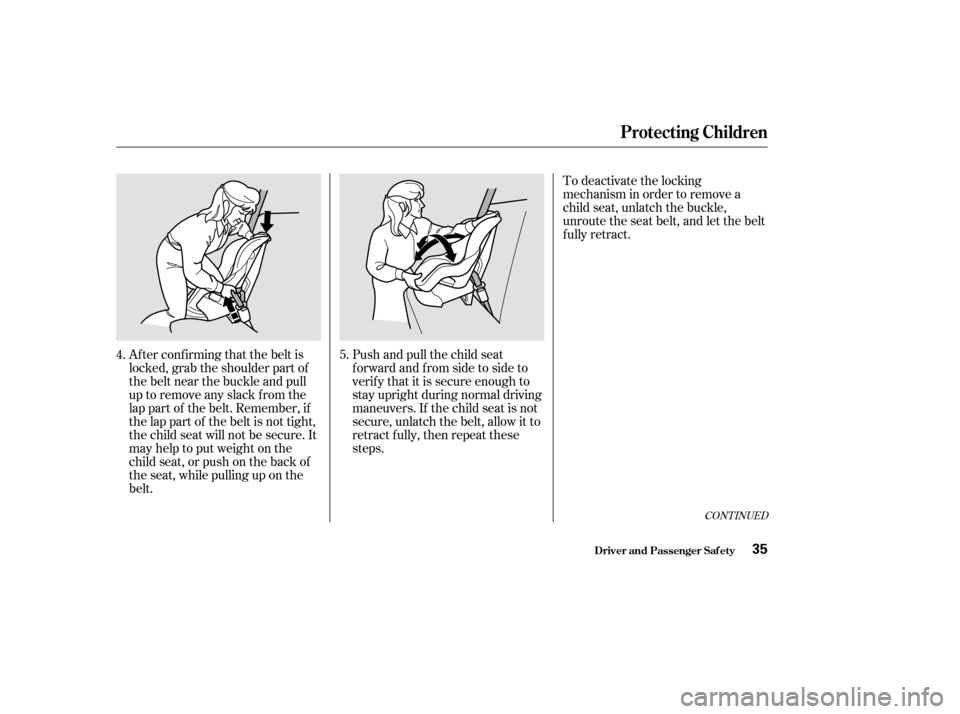
Af ter conf irming that the belt is
locked, grab the shoulder part of
the belt near the buckle and pull
up to remove any slack from the
lap part of the belt. Remember, if
the lap part of the belt is not tight,
the child seat will not be secure. It
mayhelptoputweightonthe
child seat, or push on the back of
the seat, while pulling up on the
belt.Push and pull the child seat
f orward and f rom side to side to
verif y that it is secure enough to
stay upright during normal driving
maneuvers. If the child seat is not
secure, unlatch the belt, allow it to
retract f ully, then repeat these
steps.To deactivate the locking
mechanism in order to remove a
child seat, unlatch the buckle,
unroute the seat belt, and let the belt
fully retract.
4. 5.
CONT INUED
Protecting Children
Driver and Passenger Saf ety35
Page 39 of 375

When a child reaches the
recommended weight or height limit
for a forward-facing child seat, the
child should sit in the back seat and
wear a lap/shoulder belt.
If you are not wearing a seat
belt in a crash, you could be
thrown f orward into the
dashboard and crush the child.
During a crash, the
belt could press deep into the child
and cause very serious injuries. If youarewearingaseatbelt,the
child can be torn f rom your arms
during a crash. For example, if
your car crashes into a parked
vehicleat30mph(48km/h),a
30-lb (14 kg) child will become a
900-lb (410 kg) f orce, and you will
not be able to hold on. If a child is too short f or the shoulder
part of the belt to properly f it, we
recommend that the child use a
booster seat until the child is tall
enough to use the seat belt without a
booster.
The f ollowing pages give
instructions on how to check proper
seat belt f it, what kind of booster
seat to use if one is needed, and
important precautions f or a child
who must sit in the f ront seat. Protecting L arger Children
A ddit ional Precaut ions f or Small
Children Never hold a small child on yourlap.
Never put a seat belt over yourselfand a child.
Protecting Children
Driver and Passenger Saf ety36
Allowing a larger child to sit
improperly in the front seat can
result in injury or death if the
passenger’s front airbag inflates.
If a larger child must sit in front,
make sure the child moves the
seat as far back as possible
and wears the seat belt properly.
Page 85 of 375
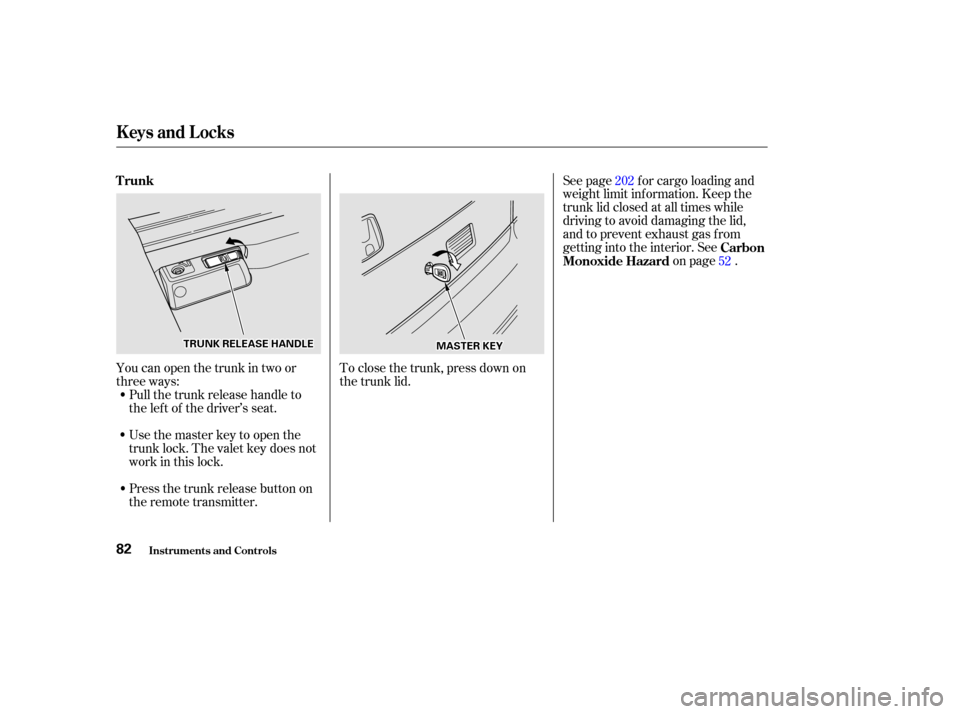
Usethemasterkeytoopenthe
trunk lock. The valet key does not
work in this lock.To close the trunk, press down on
the trunk lid. See page f or cargo loading and
weight limit inf ormation. Keep the
trunk lid closed at all times while
driving to avoid damaging the lid,
and to prevent exhaust gas from
getting into the interior. See
on page .
Pull the trunk release handle to
the lef t of the driver’s seat.
Press the trunk release button on
the remote transmitter.
Youcanopenthetrunkintwoor
three ways:
52
202
Trunk
Carbon
Monoxide Hazard
Keys and Locks
Inst rument s and Cont rols82
T T R
RU UN NKK R
REEL
LEE A
A S
SEE H
HA
AN
ND DL
LEE
M
MA
AS
STTE
ER
R K
KEEY
Y
Page 202 of 375

A cold engine uses more f uel than a
warm engine. It is not necessary to
‘‘warm-up’’ a cold engine by letting it
idle f or a long time. You can drive
away in about a minute, no matter
how cold it is outside. The engine
will warm up f aster, and you get
better f uel economy. To cut down on
the number of ‘‘cold starts,’’ try to
combine several short trips into one.
You can improve f uel economy by
driving moderately. Rapid acceler-
ation, abrupt cornering, and hard
braking use more f uel.
Always drive in the highest gear that
allows the engine to run and acceler-
ate smoothly.
The air conditioning puts an extra
load on the engine which makes it
usemorefuel.Turnoff theA/Cto
cut down on air conditioning use.
Use the f low-through ventilation
when the outside air temperature is
moderate.
Depending on traf f ic conditions, try
to maintain a constant speed. Every
time you slow down and speed up,
your car uses extra f uel. Use the
cruise control, when appropriate, to
increase f uel economy.
The condition of your car and your
driving habits are the two most
important things that affect the fuel
mileage you get.
Always maintain your car according
to the maintenance schedule. This
will keep it in top operating condition.
An important part of that mainte-
nance is the
(see page ). For
example, an underinf lated tire
causes more ‘‘rolling resistance,’’
which uses f uel. It also wears out
f aster, so check the tire pressure at
least monthly.
In winter, the build-up of snow on
your car’s underside adds weight and
rolling resistance. Frequent cleaning
helps your f uel mileage and reduces
thechanceof corrosion. 245
Vehicle Condition
Driving Habits
Owner Maintenance
Checks
Bef ore Driving
Fuel Economy
199
Page 205 of 375
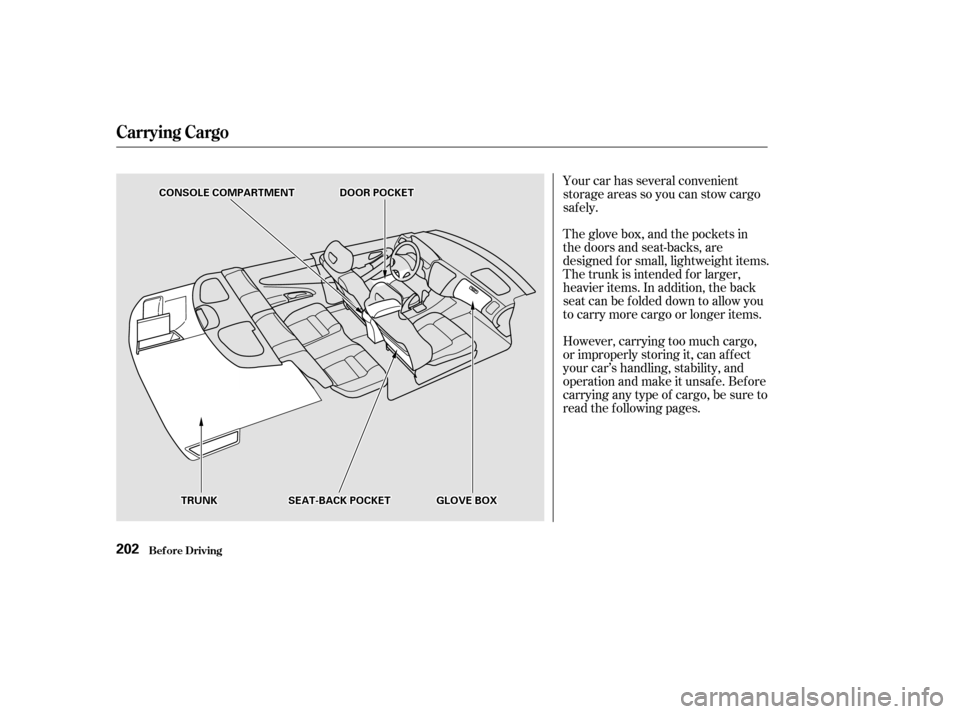
The glove box, and the pockets in
the doors and seat-backs, are
designed f or small, lightweight items.
The trunk is intended f or larger,
heavier items. In addition, the back
seatcanbefoldeddowntoallowyou
to carry more cargo or longer items. Your car has several convenient
storage areas so you can stow cargo
saf ely.
However, carrying too much cargo,
or improperly storing it, can af f ect
your car’s handling, stability, and
operation and make it unsafe. Before
carrying any type of cargo, be sure to
read the f ollowing pages.
Carrying Cargo
Bef ore Driving202
C COON NSSOOL LEE C
COOM M P
PA
A R
RTTM
M E
EN
NT T
G
GLLOOV VE
E B
BOOX X
S
SE EA
A T
T-
-B
BA A C
CKK P
PO
OC CKKEET
T
T
T R
RU UN NKK D
D
O
OO ORR P
PO
OC CKKEET
T
Page 206 of 375

Store or secure all items that could
be thrown around and hurt
someone during a crash.
Be sure items placed on the f loor
behind the f ront seats cannot roll
under the seats and interf ere with
the driver’s ability to operate the
pedals, or with the proper
operation of the seats.
Keep the glove box closed while
driving. If the lid is open, a
passenger could injure their knees
during a crash or sudden stop.
This f igure includes the total weight
of all occupants, cargo, accessories,
and the tongue weight if you are
towing a trailer.
The f inal number is the total weight
of cargo you can carry.
If you are towing a trailer, add the
tongue weight to the number
above. Add up the weight of all occupants.
To f igure out how much cargo you
can carry: The maximum load for your car is
850 lbs (395 kg).
Subtract the total f rom 850 lbs
(395 kg). Do not put any items on top of the
rear shelf . They can block your
view and be thrown around the car
during a crash.
Carrying Items in the Passenger
Compartment
Load Limit
Carrying Cargo
Bef ore Driving203
Overloading or improper
loading can affect handling and
stability and cause a crash in
which you can be hurt or killed.
Follow all load limits and other
loading guidelines in this
manual.
Page 207 of 375

Distribute cargo evenly on the
f loor of the trunk, placing the
heaviest items on the bottom and
as far forward as possible.
If you can carry any items on a
roof rack,besurethetotalweight
of the rack and the items does not
exceed the maximum allowable
weight. Please contact your Honda
dealer f or f urther inf ormation.You can use the cargo net to secure
small items in the trunk.
If you carry large items that
prevent you f rom closing the trunk
lid, exhaust gas can enter the
passenger area. To avoid the
possibility of carbon monoxide
poisoning, f ollow the instructions
on page . If youfolddownthebackseat,tie
down items that could be thrown
about the car during a crash or
sudden stop. 52
On EX and EX- V6models
Carrying Cargo in the Trunk or on
a Roof Rack Cargo Net
Carrying Cargo
Bef ore Driving204