TPMS HONDA ACCORD COUPE 2015 9.G User Guide
[x] Cancel search | Manufacturer: HONDA, Model Year: 2015, Model line: ACCORD COUPE, Model: HONDA ACCORD COUPE 2015 9.GPages: 557
Page 437 of 557
436
uuWhen Driving uTire Pressure Monitoring System (TPMS)
Driving
Tire Pressure Monitoring System (TPMS)Instead of directly measuring the pressure in each tire, the TPMS on this vehicle
monitors and compares the rolling radius and rotational characteristics of each
wheel and tire while you are driving to determine if one or more tires are
significantly under-inflated. This will cause the low tire pressure/TPMS indicator to
come.
You must start TPMS calibration every time you:
• Adjust the pressure in one or more tires.
• Rotate the tires.
• Replace one or more tires.
Before calibrating the TPMS:
• Set the cold tire pressure in all four tires.
2 Checking Tires P. 485
Make sure:
•The vehicle is at a complete stop.
• The shift lever is in
(N
.
• The shift lever is in
(P
.
• The ignition switch is in ON
(w
*1.
*1: Models with the smart entry system have an ENGINE START/STOP button instead of an
ignition switch.■
TPMS Calibration
1 Tire Pressure Monitoring System (TPMS)
The system does not monitor the tires when driving
at low speed.
Conditions such as low ambient temperature and
altitude change directly affect tire pressure and can
trigger the low tire pressure/TPMS indicator to come on.
Tire pressure checked and inflated in:•Warm weather can become under-inflated in
colder weather.•Cold weather can become over-inflated in warmer
weather.
The low tire pressure i ndicator will not come on as a
result of over inflation.
The TPMS may not function properly if tire type and
size are mixed. Make sure to use the same size and
type of tire. 2 Checking and Maintaining Tires P. 485
The low tire pressure/TP MS indicator may come on
with a delay or may not come on at all when:•You rapidly accele rate, decelerate, or turn the
steering wheel.•You drive on snowy or slippery roads.•Snow chains are used.
The low tire pressure/TP MS indicator may come on
under the following conditions:•A compact spare tire is used.•There is a heavier and uneven load on the tires,
such as when towing a trailer, than the condition at
calibration.•Snow chains are used.
Manual transmission modelsAutomatic transmission/CVT modelsAll models
Page 438 of 557
437
uuWhen Driving uTire Pressure Monitoring System (TPMS)
Driving
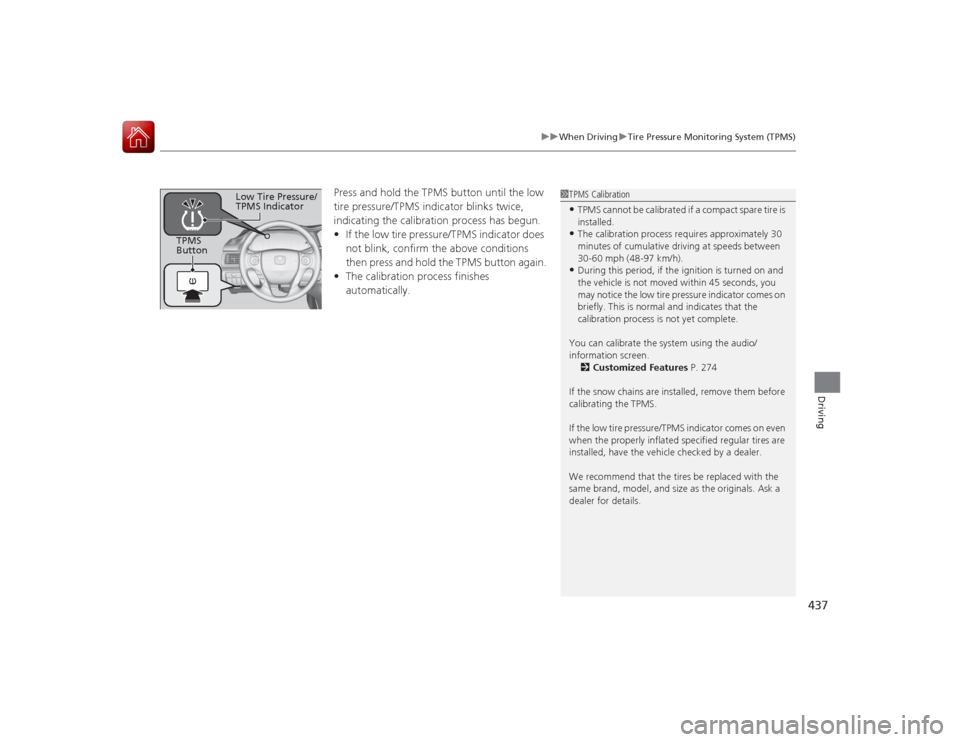
Press and hold the TPMS button until the low
tire pressure/TPMS indicator blinks twice,
indicating the calibration process has begun.
• If the low tire pressure/TPMS indicator does
not blink, confirm the above conditions
then press and hold the TPMS button again.
• The calibration process finishes
automatically.
1TPMS Calibration•TPMS cannot be calibrated if a compact spare tire is
installed.•The calibration process requires approximately 30
minutes of cumulative driving at speeds between
30-60 mph (48-97 km/h).•During this period, if the ignition is turned on and
the vehicle is not moved within 45 seconds, you
may notice the low tire pressure indicator comes on
briefly. This is normal and indicates that the
calibration process is not yet complete.
You can cali brate the system using the audio/
information screen. 2 Customized Features P. 274
If the snow chains are installed, remove them before
calibrating the TPMS.
If the low tire pressure/TPMS indicator comes on even
when the properly inflated specified regular tires are
installed, have the vehicle checked by a dealer.
We recommend that the tires be replaced with the
same brand, model, and size as the originals. Ask a
dealer for details.
TPMS
Button
Low Tire Pressure/
TPMS Indicator
Page 439 of 557
438
uuWhen Driving uTire Pressure Monitoring System (TPMS) - Required Federal Explanation
Driving
Tire Pressure Monitoring System (TPMS) - Required Federal ExplanationEach tire, including the spare (if provided), should be checked
monthly when cold and inflated to the inflation pressure
recommended by the vehicle manufa cturer on the vehicle placard
or tire inflation pressure label.
(If your vehicle has tires of a different size than the size indicated \
on the vehicle placard or tire inflation pressure label, you should
determine the proper tire inflation pressure for those tires.)
As an added safety feature, your vehicle has been equipped with
a tire pressure monitoring system (TPMS) that illuminates a low
tire pressure telltale
when one or more of your tire s is significantly under-inflated.
Accordingly, when the low tire pressure telltale illuminates, you
should stop and check your tires as soon as possible, and inflate
them to the proper pressure.
Driving on a significantly under-inflated tire causes the tire to
overheat and can lead to tire failure. Un der-inflation also reduces
fuel efficiency and tire tread life, and may affect the vehicle's
handling an d stopping ability.U.S. models
Page 440 of 557
439
uuWhen Driving uTire Pressure Monitoring System (TPMS) - Required Federal Explanation
Driving
Please note that the TPMS is not a substitute for proper tire
maintenance, and it is the driver's responsibility to maintain
correct tire pressure, even if un der-inflation has not reached the
level to trigger il lumination of the TPMS low tire pressure telltale.
Your vehicle has also been equipped with a TPMS malfunction
indicator to indicate when the system is no t operating properly.
The TPMS malfunctio n indicator is combined with the low tire
pressure telltale. When the system detects a malfunction, the
telltale will flash for approximately one minute and then remain
continuously illuminated. This sequen ce will continue upon
subsequent vehicle st art-ups as long as the malfunction exists.
When the malfunction indicator is illuminated, the system may
not be able to detect or signal low tire pressure as intended.
TPMS malfunctions may occur for a variety of reasons, including
the installation of replacement or alte rnate tires or wheels on the
vehicle that prevent the TPMS from functioning properly.
Always check the TPMS malfunction telltale after replacing one or
more tires or wheels on your vehicle to ensure that the
replacement or alternate tires and wheels allow the TPMS to
continue to function properly.
Page 486 of 557
485Maintenance
Checking and Maintaining TiresChecking TiresTo safely operate your vehicle, your tires must be of the proper type and size, in
good condition with adequate tread, and properly inflated.■Inflation guidelines
Properly inflated tires provide the best co mbination of handling, tread life, and comfort.
Refer to the driver’s doorjamb label or specification’s page for the specified pressure.
Underinflated tires wear unevenly, adversely affect handling and fuel economy, and
are more likely to fail from overheating.
Overinflated tires make your vehicle ride harshly, are more prone to road hazards,
and wear unevenly.
Every day before you drive, look at each of the tires. If one looks lower than the
others, check the pressure with a tire gauge.
At least once a month or before long trips, use a gauge to measure the pressure in
all tires, including the spare. Even tires in good condition can lose 1 to 2 psi (10 to
20 kPa, 0.1 to 0.2 kgf/cm
2) per month.
■Inspection guidelines
Every time you check inflation, also examine the tires and valve stems.
Look for:
• Bumps or bulges on the side or in the tread. Replace the tire if you find any cuts,
splits, or cracks in the side of the tire. Replace it if you see fabric or cord.
• Remove any foreign objects and inspect for air leaks.
• Uneven tread wear. Have a dealer check the wheel alignment.
• Excessive tread wear.2 Wear Indicators P. 490
•Cracks or other damage around valve stem.
1Checking Tires
Measure the air pressure when tires are cold. This
means the vehicle has been par ked for at least three
hours, or driven less than 1 mile (1.6 km). If
necessary, add or release air until the specified
pressure is reached.
If checked when hot, tire pressure can be as much as
4–6 psi (30–40 kPa, 0.3–0.4 kgf/cm
2) higher than if
checked when cold.
Whenever tire pressure is adjusted, you must
calibrate the TPMS. 2 TPMS Calibration P. 436
Have a dealer check the tires if you feel a consistent
vibration while driving. New tires and any that have
been removed and reinstalled should be properly
balanced.
3
WARNING
Using tires that are excessively worn or
improperly inflated can cause a crash in
which you can be seri ously hurt or killed.
Follow all instruc tions in this owner’s
manual regarding tire inflation and
maintenance.
Page 493 of 557
492
uuChecking and Maintaining Tires uTire Rotation
Maintenance
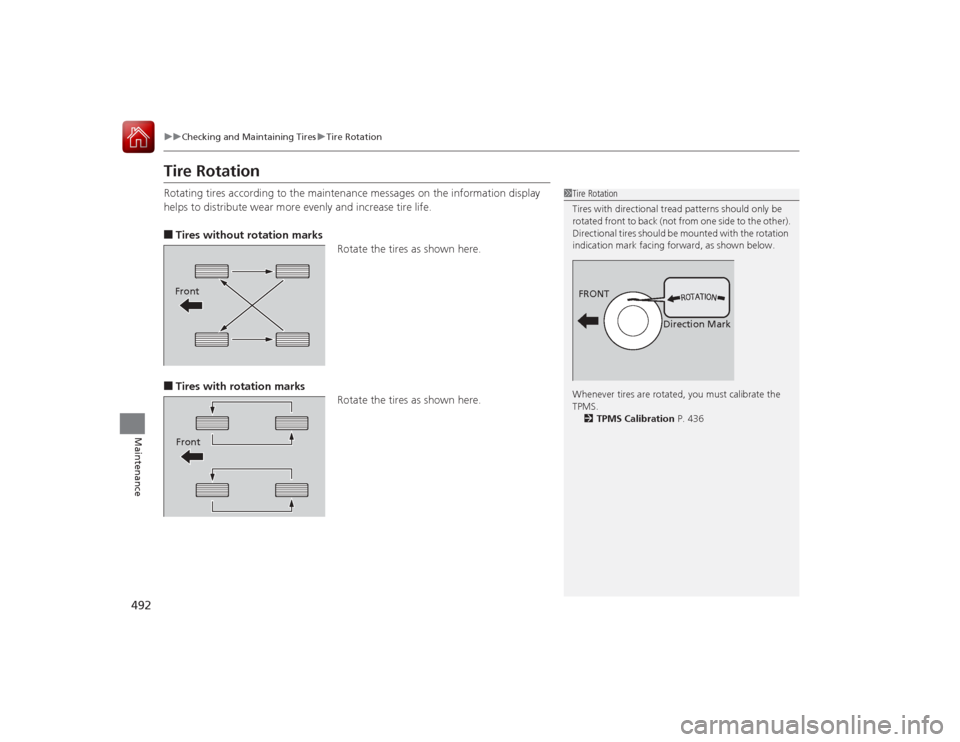
Tire RotationRotating tires according to the maintenance messages on the information display
helps to distribute wear more evenly and increase tire life.■Tires without rotation marks
Rotate the tires as shown here.■Tires with rotation marksRotate the tires as shown here.
1Tire Rotation
Tires with directional tread patterns should only be
rotated front to back (not from one side to the other).
Directional tires should be mounted with the rotation
indication mark facing forward, as shown below.
Whenever tires are rotate d, you must calibrate the
TPMS. 2 TPMS Calibration P. 436
FRONT
Direction Mark
FrontFront
Page 504 of 557
503
Handling the Unexpected
This chapter explains how to handle unexpected troubles.
Tools
Types of Tools .................................. 504
If a Tire Goes Flat Changing a Flat Tire ......................... 505
Engine Does Not Start Checking the Engine ........................ 511If the Smart Entry Remote Battery is Weak .......................................... 512Emergency Engine Stop ................... 513
Jump Starting .................................... 514
Shift Lever Does Not Move .............. 517Overheating
How to Handle Overheating............. 518
Indicator, Coming On/Blinking
If the Low Oil Pressure Indicator Comes On ............................................. 520If the Charging System Indicator Comes
On ................................................. 520
If the Malfunction Indicator Lamp Comes On or Blinks ................................... 521If the Brake System Indicator (Red) Comes On ........................... ....... 522
If the Electric Power Steering (EPS) System
Indicator Comes On............................ 522If the Low Tire Pressure/TPMS Indicator Comes On or Blinks ....................... 523
Fuses Fuse Locations ................................. 524
Inspecting and Changing Fuses ........ 526
Emergency Towing ........................... 527
Page 511 of 557
uuIf a Tire Goes Flat uChanging a Flat Tire
510Handling the Unexpected
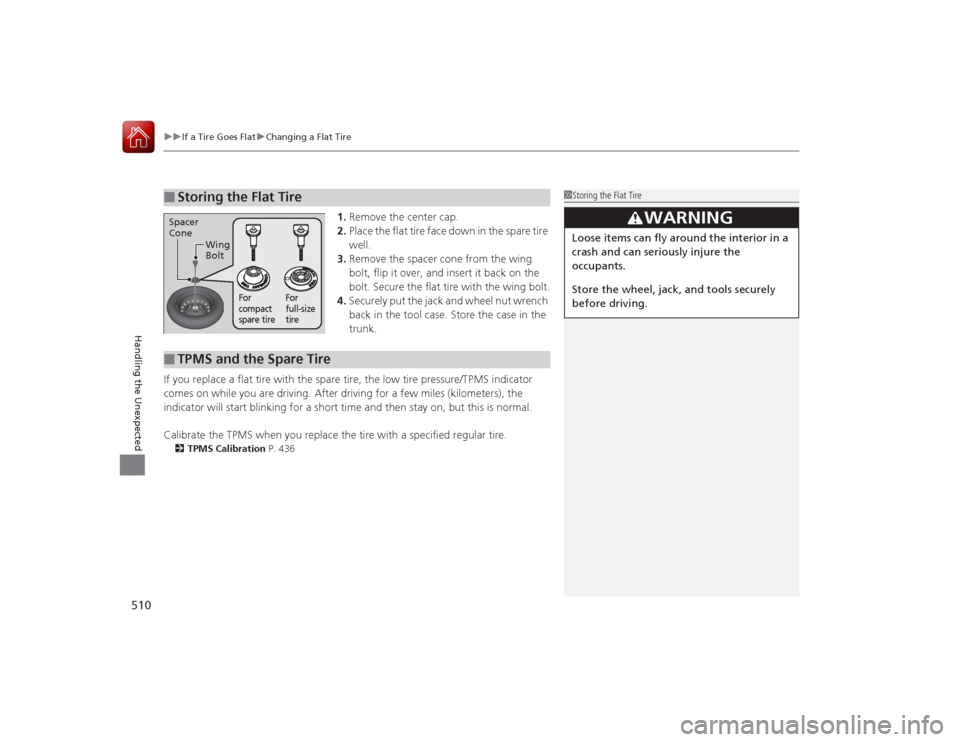
1. Remove the center cap.
2. Place the flat tire face down in the spare tire
well.
3. Remove the spacer cone from the wing
bolt, flip it over, and insert it back on the
bolt. Secure the flat tire with the wing bolt.
4. Securely put the jack and wheel nut wrench
back in the tool case. Store the case in the
trunk.
If you replace a flat tire with the spare tire, the low tire pressure/TPMS indicator
comes on while you are driving. After driving for a few miles (kilometers), the
indicator will start blinking for a short time and then stay on, but this is normal.
Calibrate the TPMS when you replace the tire with a specified regular tire.
2 TPMS Calibration P. 436■
Storing the Flat Tire
1Storing the Flat Tire
3
WARNING
Loose items can fly around the interior in a
crash and can seriously injure the
occupants.
Store the wheel, jack, and tools securely
before driving.
Spacer
Cone
Wing
Bolt
For
compact
spare tire For
full-size
tire
■
TPMS and the Spare Tire
Page 524 of 557
523
uuIndicator, Coming On/Blinking uIf the Low Tire Pressure/TPMS Indicator Comes On or Blinks
Handling the Unexpected
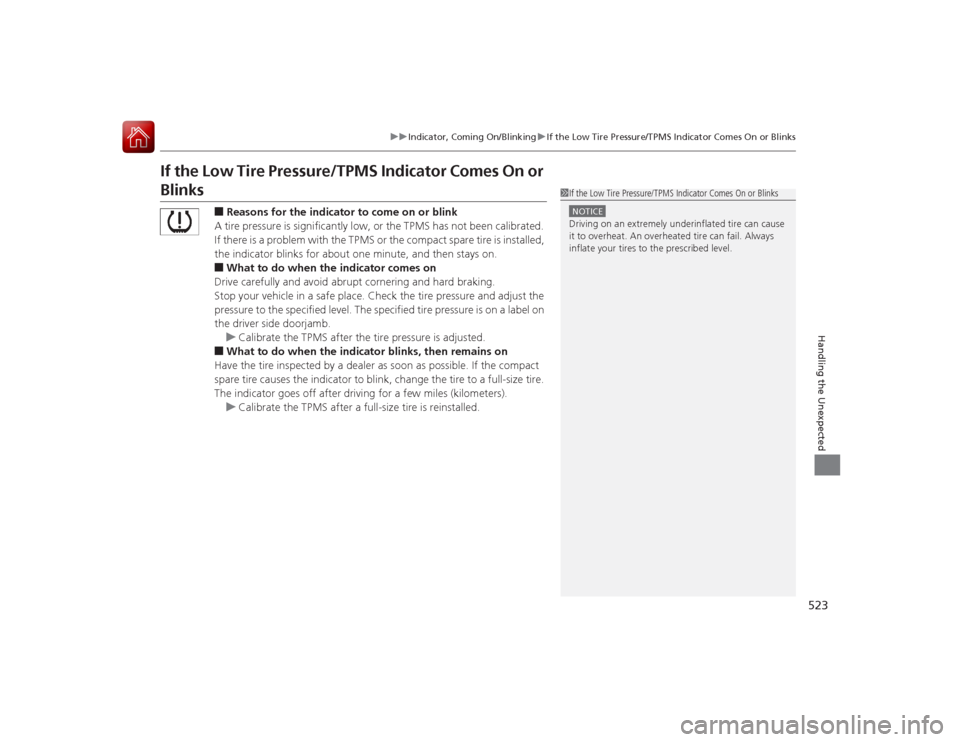
If the Low Tire Pressure/TPMS Indicator Comes On or Blinks
■Reasons for the indicator to come on or blink
A tire pressure is significantly low, or the TPMS has not been calibrated.
If there is a problem with the TPMS or the compact spare tire is installed,
the indicator blinks for about one minute, and then stays on.■What to do when the indicator comes on
Drive carefully and avoid abrupt cornering and hard braking.
Stop your vehicle in a safe place. Check the tire pressure and adjust the
pressure to the specified level. The specified tire pressure is on a label on
the driver side doorjamb. u Calibrate the TPMS after the tire pressure is adjusted.■What to do when the indicator blinks, then remains on
Have the tire inspected by a dealer as soon as possible. If the compact
spare tire causes the indicator to blink, change the tire to a full-size tire.
The indicator goes off after driving for a few miles (kilometers). u Calibrate the TPMS after a full-size tire is reinstalled.
1If the Low Tire Pressure/TPMS Indicator Comes On or BlinksNOTICEDriving on an extremely underinflated tire can cause
it to overheat. An overheated tire can fail. Always
inflate your tires to the prescribed level.
Page 551 of 557
550Index
Door and Trunk Open ................................ 72
ECON Mode ...................................... 77, 420
Electric Power Steering (EPS) System ............................................. 73, 522
Fog Light ................................................... 74
Forward Collision Warning (FCW) .............. 75
High Beam................................................. 74
Immobilizer System .................................... 74
Lane Departure Warning (LDW) ................. 76
Light Control ............................................. 78
Lights On ................................................... 74
Low Fuel .................................................... 71
Low Oil Pressure ................................ 69, 520
Low Tire Pressure/TPMS ............. 73, 436, 438
Maintenance Minder ......................... 77, 455
Malfunction Indicator Lamp ............... 69, 521
Parking Brake and Brake System ........ 68, 522
Seat Belt Reminder .............................. 33, 71
Security System Alarm ............................... 74
Smart Entry System .................................... 77
Starter System ........................................... 78
Supplemental Restraint System ............ 49, 72
Transmission .............................................. 71
Turn Signal and Hazard Warning ............... 73
Vehicle Stability Assist (VSA ®)
System ............................................. 72, 432
VSA ® OFF .......................................... 72, 433
Washer Level ............................................. 77
Information ............................................... 529
Information Display .................................... 82 Instant Fuel Economy
................................. 83
Instrument Panel ........................................ 67
Brightness Control................................... 120
Interface Dial ............................................ 211
Interior Lights ........................................... 135
Interior Rearview Mirror .......................... 125
JJack (Wheel Nut Wrench) ........................ 508
Jump Starting ........................................... 514KKey Number Tag ......................................... 89
Keyless Lockout Prevention ....................... 95
Keys ............................................................. 88
Lockout Prevention.................................... 95
Master Keys .............................................. 88
Number Tag .............................................. 89
Remote Transmitter ................................... 91
Types and Functions .................................. 88
Valet Key........................................... 89, 101
Won’t Turn ............................................... 23
Kickdown (Automatic Transmission/ CVT) ......................................................... 408
LLane Departure Warning (LDW) ............. 428
LaneWatch
TM............................................ 434
Language (HFL) ................................ 316, 352
LATCH (Child Seats) ................................... 57
Lights ................................................ 115, 475
Automatic............................................... 116
Bulb Replacement ................................... 475
Daytime Running Lights .......................... 118
Fog Lights ............................................... 117
High Beam Indicator ................................. 74
Interior.................................................... 135
Light Switches......................................... 115
Lights On Indicator.................................... 74
Turn Signals ............................................ 115
Load Limits ............................................... 395
Locking/Unlocking ..................................... 88
Auto Door Locking/Unlocking ................... 98
From Inside ............................................... 96
From Outside ............................................ 91
Keys.......................................................... 88
Using a Key............................................... 95
Lockout Prevention System ....................... 95
Low Battery Charge ................................. 520
Low Fuel Indicator ..................................... 71
Low Oil Pressure Indicator ................. 69, 520
Low Smart Entry Remote Signal Strength .................................................... 90
Lower Anchors ........................................... 57
Lubricant Specifications Chart ........ 530, 532
Luggage (Maximum Load Limit) ............. 395