transmission HONDA ACCORD SEDAN 2003 (in English) Owner's Guide
[x] Cancel search | Manufacturer: HONDA, Model Year: 2003, Model line: ACCORD SEDAN, Model: HONDA ACCORD SEDAN 2003Pages: 395, PDF Size: 5.8 MB
Page 281 of 395
The cooling system capacity is:Start the engine and let it run for
about 30 seconds. Then turn of f
the engine.
Fill the radiator with coolant up to
the base of the f iller neck.
Fill the reserve tank to the MAX
mark. Install the reserve tank cap.
Install the radiator cap, and
tighten it to the first stop.
Start the engine and let it run until
the radiator cooling f an comes on
at least twice. Then stop the
engine.
Remove the radiator cap. Pour
coolant into the radiator up to the
base of the f iller neck and into the
reserve tank up to the MAX mark. Start the engine and hold it at
1,500 rpm until the cooling f an
comes on. Turn of f the engine.
Check the coolant level in the
radiator and add coolant if needed.
Install the radiator cap, and
tighten it fully.
If necessary, f ill the reserve tank
to the MAX mark. Install the
reserve tank cap.
8.
9.
10. 16. 15. 14.
11.
12.
13.
With 5-speed manual transmission: With automatic transmission:6-cylinder models
Cooling Syst em
Maint enance278
1.35 US gal (5.1)
1.32 US gal (5.0
)
1.77 US gal (6.7
)
Page 283 of 395
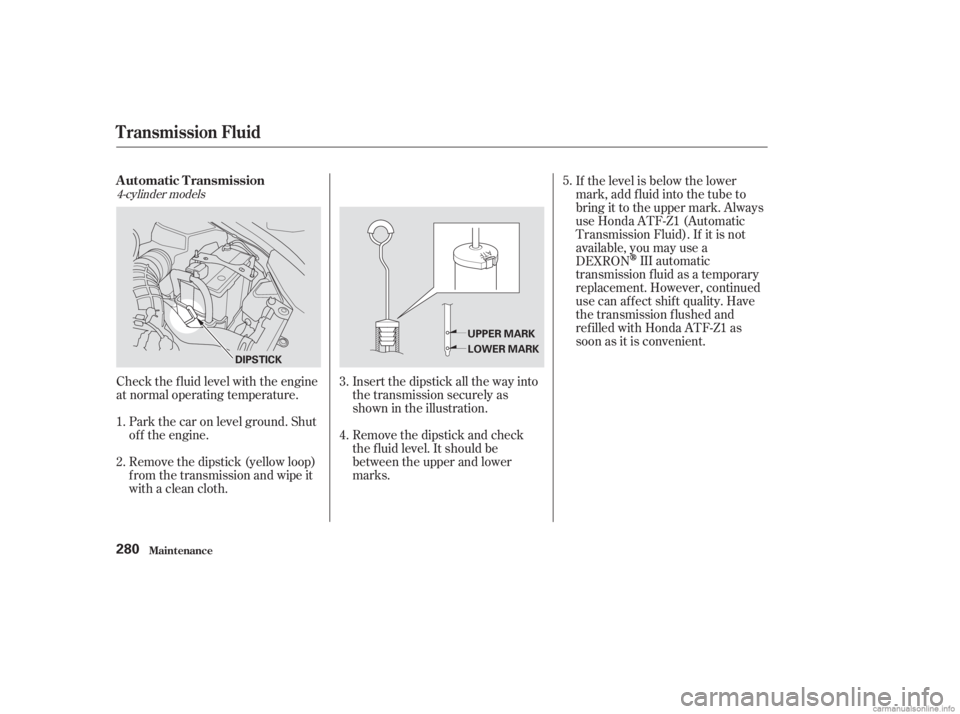
Remove the dipstick (yellow loop)
f rom the transmission and wipe it
with a clean cloth.
Check the f luid level with the engine
at normal operating temperature.
Insert the dipstick all the way into
the transmission securely as
shown in the illustration.
Remove the dipstick and check
the f luid level. It should be
between the upper and lower
marks.
Park the car on level ground. Shut
of f the engine. If the level is below the lower
mark, add f luid into the tube to
bring it to the upper mark. Always
use Honda ATF-Z1 (Automatic
Transmission Fluid). If it is not
available, you may use a
DEXRON
III automatic
transmission f luid as a temporary
replacement. However, continued
use can affect shift quality. Have
the transmission f lushed and
ref illed with Honda ATF-Z1 as
soon as it is convenient.
1.
2. 3.5.
4.
4-cylinder models
Automatic Transmission
T ransmission Fluid
Maint enance280
DIPSTICK UPPER MARK
LOWER MARK
Page 284 of 395
6-cylinder models
Check the f luid level with the engine
at normal operating temperature.Park the car on level ground. Shut
of f the engine.
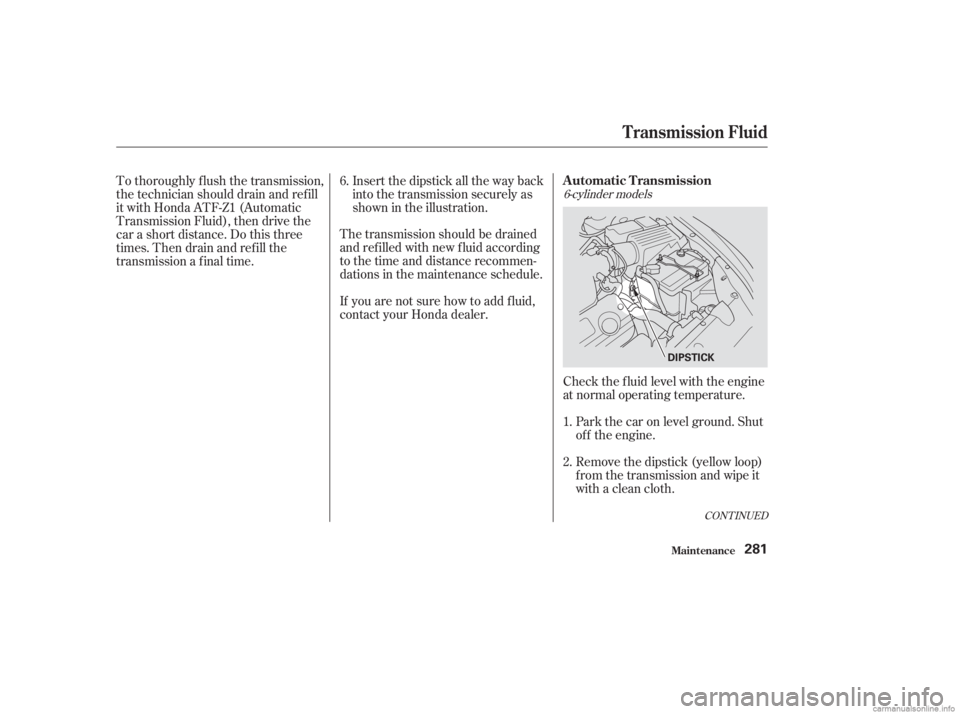
Remove the dipstick (yellow loop)
f rom the transmission and wipe it
with a clean cloth.
Insert the dipstick all the way back
into the transmission securely as
shown in the illustration.
The transmission should be drained
and ref illed with new f luid according
to the time and distance recommen-
dations in the maintenance schedule.
If you are not sure how to add f luid,
contact your Honda dealer.
To thoroughly f lush the transmission,
the technician should drain and ref ill
it with Honda ATF-Z1 (Automatic
Transmission Fluid), then drive the
car a short distance. Do this three
times. Then drain and ref ill the
transmission a f inal time.
1.
2.
6.
CONT INUED
Automatic Transmission
T ransmission Fluid
Maint enance281
DIPSTICK
Page 285 of 395
If the level is below the lower
mark, add f luid into the tube to
bring it to the upper mark. Always
use Honda ATF-Z1 (Automatic
Transmission Fluid). If it is not
available, you may use a
DEXRON
III automatic
transmission f luid as a temporary
replacement. However, continued
use can affect shift quality. Have
the transmission f lushed and
ref illed with Honda ATF-Z1 as
soon as it is convenient. To thoroughly f lush the transmission,
the technician should drain and ref ill
it with Honda ATF-Z1 (Automatic
Transmission Fluid), then drive the
car a short distance. Do this three
times. Then drain and refill the
transmission a final time.
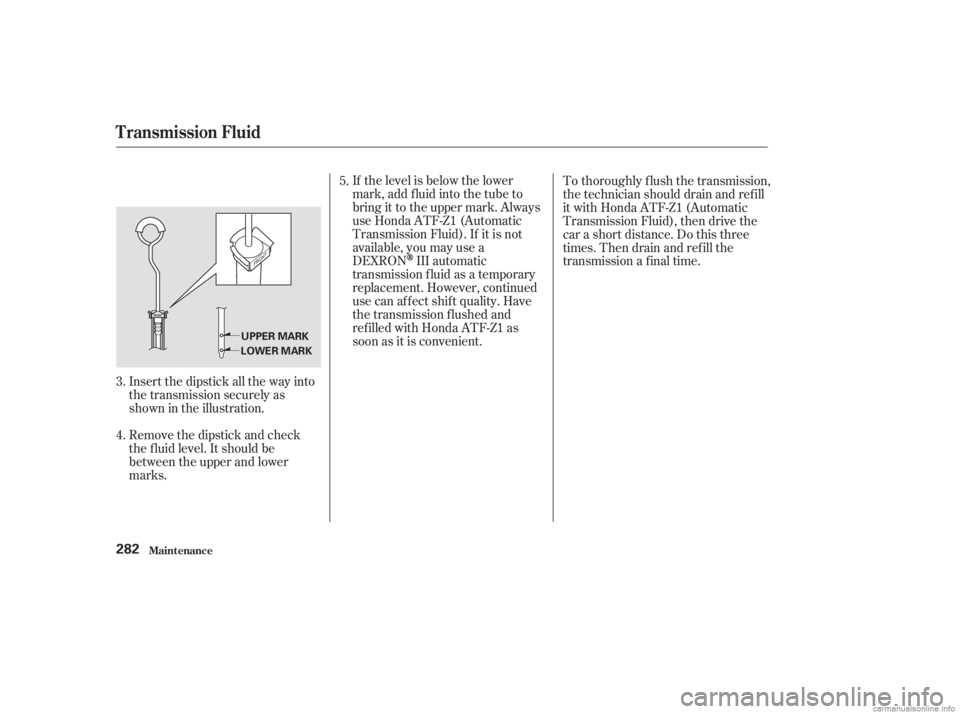
Remove the dipstick and check
the f luid level. It should be
between the upper and lower
marks. Insert the dipstick all the way into
the transmission securely as
shown in the illustration. 5.
3.
4.
T ransmission Fluid
Maint enance282
UPPER MARK
LOWER MARK
Page 286 of 395
If Honda MTF is not available, you
may use an SAE 10W-30 or 10W-40
viscosity motor oil with the API
Certif ication seal that says ‘‘FOR
GASOLINE ENGINES’’ as a
temporary replacement. However,
motor oil does not contain the proper
additives and continued use can
cause stif f er shif ting. Replace as
soon as it is convenient.
The transmission should be drained
and ref illed with new f luid according
to the time and distance recommen-
dations in the maintenance schedule.
Insert the dipstick all the way back
into the transmission securely as
shown in the illustration.
The transmission should be drained
and ref illed with new f luid according
to the time and distance recommen-
dations in the maintenance schedule.
If you are not sure how to add f luid,
contact your Honda dealer.
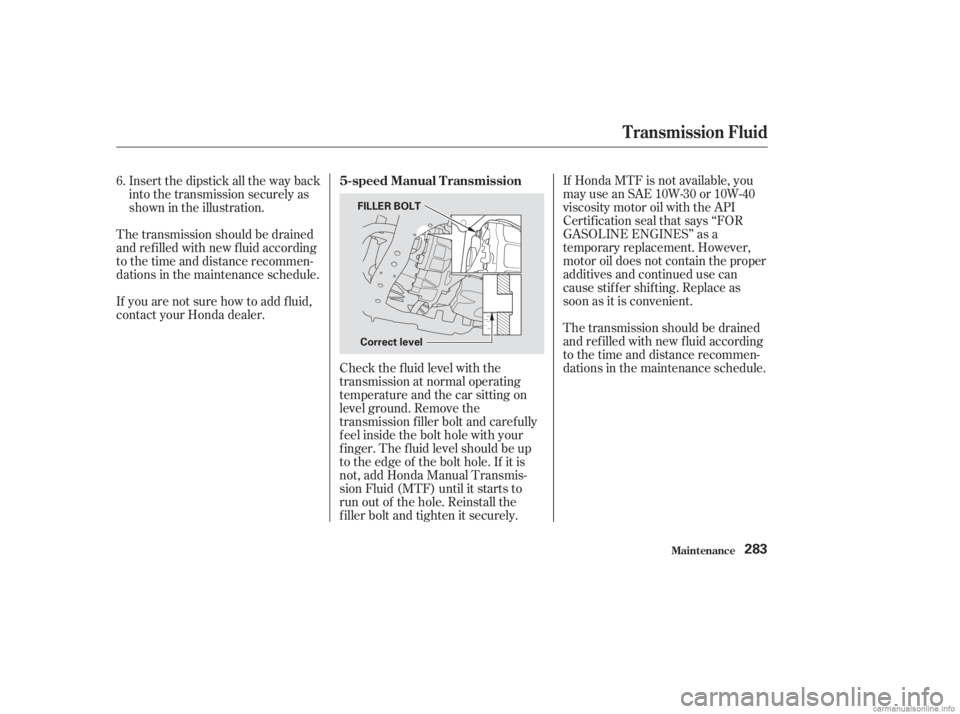
Check the f luid level with the
transmission at normal operating
temperature and the car sitting on
level ground. Remove the
transmission f iller bolt and caref ully
f eel inside the bolt hole with your
f inger. The f luid level should be up
to the edge of the bolt hole. If it is
not, add Honda Manual Transmis-
sion Fluid (MTF) until it starts to
run out of the hole. Reinstall the
f iller bolt and tighten it securely.
6.
5-speed Manual Transmission
T ransmission Fluid
Maint enance283
FILLER BOLT
Correct level
Page 287 of 395
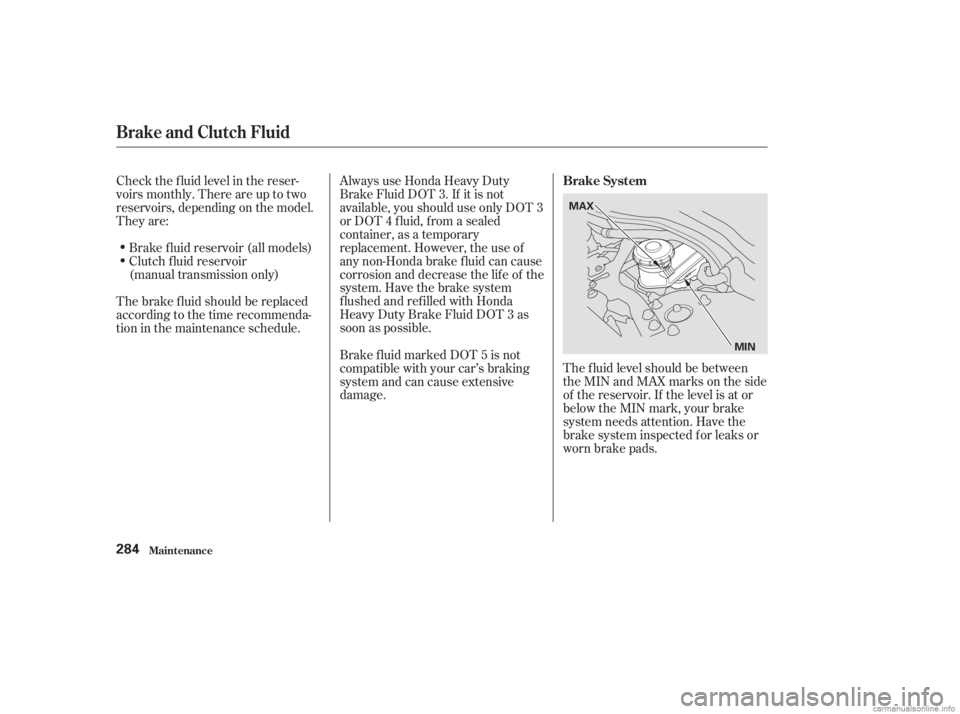
The f luid level should be between
theMINandMAXmarksontheside
of the reservoir. If the level is at or
below the MIN mark, your brake
system needs attention. Have the
brake system inspected f or leaks or
worn brake pads.
Always use Honda Heavy Duty
Brake Fluid DOT 3. If it is not
available, you should use only DOT 3
or DOT 4 f luid, f rom a sealed
container, as a temporary
replacement. However, the use of
any non-Honda brake fluid can cause
corrosion and decrease the lif e of the
system. Have the brake system
f lushed and ref illed with Honda
Heavy Duty Brake Fluid DOT 3 as
soon as possible.
Check the f luid level in the reser-
voirs monthly. There are up to two
reservoirs, depending on the model.
They are:
Brake f luid reservoir (all models)
Clutch f luid reservoir
(manual transmission only)
Brake f luid marked DOT 5 is not
compatible with your car’s braking
system and can cause extensive
damage.
The brake f luid should be replaced
according to the time recommenda-
tion in the maintenance schedule. Brake System
Brake and Clutch Fluid
Maint enance284
MAX
MIN
Page 326 of 395
Block the rear wheels.
Fill the f uel tank.
Wash and dry the exterior
completely.
Cleantheinterior.Makesurethe
carpeting, floor mats, etc. are
completely dry.
Leave the parking brake off. Put
the transmission in Reverse
(5-speed manual) or Park
(automatic).
If you need to park your car f or an
extended period (more than one
month), there are several things you
should do to prepare it f or storage.
Proper preparation helps prevent
deterioration and makes it easier to
get your car back on the road. If
possible, store your car indoors.
If the car is to be stored for a
longer period, it should be
supported on jackstands so the
tires are of f the ground.
Leave one window open slightly (if
the car is being stored indoors).
Disconnect the battery.
Support the f ront wiper blade
arms with a f olded towel or rag so
they do not touch the windshield.
To minimize sticking, apply a
silicone spray lubricant to all door
and trunk seals. Also, apply a car
body wax to the painted surf aces
that mate with the door and trunk
seals.
Change the engine oil and f ilter
(see page ).
If you store your car f or 1 year or
longer, have your Honda dealer
perf orm the inspections as soon as
youtakeitoutof storage(seepages
, ). The 6-cylinder model
needs the inspections called f or in
the 2 years/30,000 miles (48,000 km)
maintenance schedule (Normal
Conditions) and the 4-cylinder model
needs the inspections called f or in
the 2 years/40,000 miles (64,000 km)
maintenance schedule (Normal
Conditions). The replacements
called f or in the maintenance
schedule are not needed unless the
car has actually reached that time or
mileage.
Coverthecarwitha‘‘breathable’’
cover, one made f rom a porous
material such as cotton. Nonporous materials, such as
plastic sheeting, trap moisture,
which can damage the paint.
If possible, run the engine f or a
while periodically (pref erably once
amonth).
270 250 255
St oring Your Car
Maint enance323
Page 338 of 395
If you have a f lat tire while driving,
stop in a saf e place to change it.
Stopping in traf f ic or on the shoulder
of a busy road is dangerous. Drive
slowly along the shoulder until you
gettoanexitoranareatostopthat
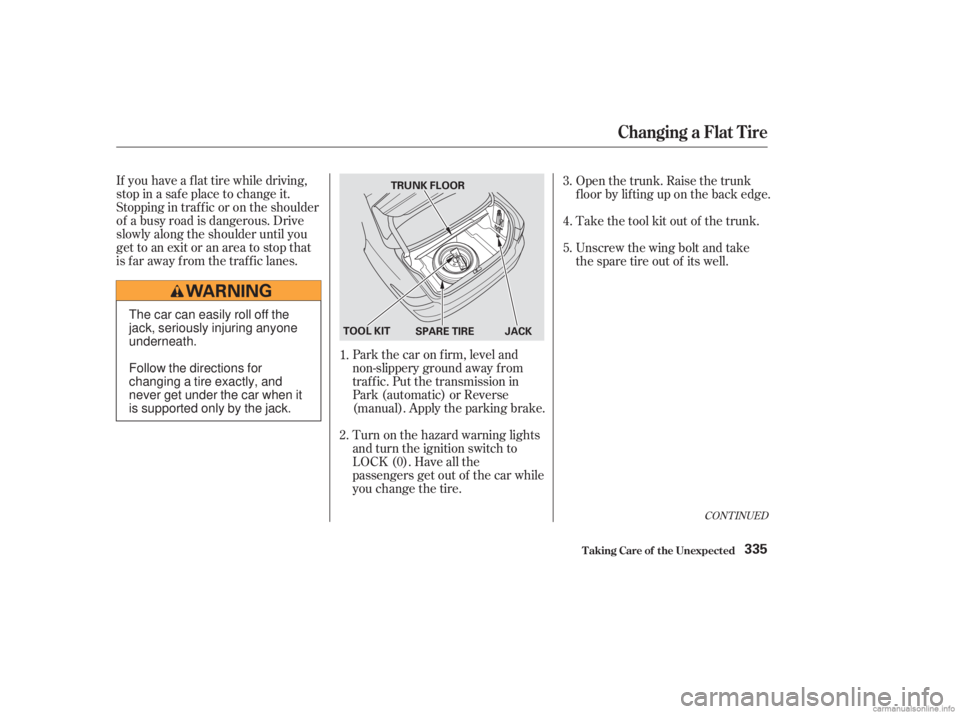
is far away from the traffic lanes.Open the trunk. Raise the trunk
f loor by lif ting up on the back edge.
Park the car on f irm, level and
non-slippery ground away f rom
traffic. Put the transmission in
Park (automatic) or Reverse
(manual). Apply the parking brake.
Turn on the hazard warning lights
and turn the ignition switch to
LOCK (0). Have all the
passengers get out of the car while
you change the tire. Take the tool kit out of the trunk.
Unscrew the wing bolt and take
the spare tire out of its well.
5. 4.
3.
2. 1.
CONT INUED
Changing a Flat T ire
T aking Care of t he Unexpect ed335
TRUNK FLOOR
SPARE TIRE JACK
TOOL KIT
The car can easily roll off the
jack, seriously injuring anyone
underneath.
Follow the directions for
changing a tire exactly, and
never get under the car when it
is supported only by the jack.
Page 343 of 395
Store the jack in its holder. Turn
the jack’s end bracket to lock it in
place. Replace the cover. Store the
tools.
Store the wheel cover or center
cap in the trunk. Make sure it does
not get scratched or damaged.Diagnosing why your engine won’t
start f alls into two areas, depending
on what you hear when you turn the
key to START (III):
You hear nothing, or almost
nothing. The engine’s starter
motor does not operate at all, or
operates very slowly.
You can hear the starter motor
operating normally, or the starter
motor sounds like it is spinning
f aster than normal, but the engine
does not start up and run. When you turn the ignition switch to
START (III), you do not hear the
normal noise of the engine trying to
start. You may hear a clicking sound
or series of clicks, or nothing at all.
Check these things:
Check the transmission interlock.
If you have a manual transmission,
the clutch pedal must be pushed
all the way to the f loor or the
starter will not operate. With an
automatic transmission, it must be
in Park or Neutral.
Turn the ignition switch to ON (II).
Turn on the headlights and check
their brightness. If the headlights
are very dim or don’t light at all,
the battery is discharged. See on page .
20.
21.
342
T aking Care of t he Unexpect ed
Changing a Flat Tire, If Your Engine Won’t Start
If Your Engine Won’t Start Nothing Happens or the StarterMotor Operates Very Slowly
Jump Starting
340
Loose items can fly around the
interior in a crash and could
seriously injure the occupants.
Store the wheel, jack, and tools
securely before driving.
Page 345 of 395
Turn of f all the electrical acces-
sories: climate control, stereo
system, lights, etc.
Put the transmission in Neutral or
Park, and set the parking brake. Open the hood and check the
physical condition of the battery
(see page ). In very cold
weather, check the condition of
the electrolyte. If it seems slushy
or like ice, do not try jump starting
until it thaws.
To jump start your car, f ollow these
directions closely:
If your car’s battery has run down,
you may be able to start the engine
by using a booster battery. Although
this seems like a simple procedure,
you should take several precautions.
You cannot start a Honda with an
automatic transmission by pushing
or pulling it.1.
2.294
T aking Care of t he Unexpect ed
Jump Starting
342
A battery can explode if you do
not follow the correct procedure,
seriously injuring anyone
nearby.
Keep all sparks, open flames,
and smoking materials away
from the battery.
If a battery sits in extreme cold, the
electrolyte inside can f reeze.
Attempting to jump start with a f rozen
battery can cause it to rupture.