battery HONDA CIVIC 1991 Owners Manual
[x] Cancel search | Manufacturer: HONDA, Model Year: 1991, Model line: CIVIC, Model: HONDA CIVIC 1991Pages: 136, PDF Size: 1.33 MB
Page 59 of 136

Starting the Engine
Before Starting
Manual Transmission:
1. Apply the parking brake.
2. Push the clutch pedal all the way in (see NOTE below). 3. Shift the transmission to neutral.
NOTE:
On cars equipped with manual transmissions, the engine will not
crank unless the clutch pedal is fully depressed.
Automatic Transmission:
1. Make sure the shift lever is in Park (P).
2. Apply the parking brake and the foot brake.
NOTE:
When starting in cold weather, keep all unnecessary electrical
circuits off (lights, defogger, etc.) for the best battery output.
Do not crank the engine for more than 15 seconds at a time. Wait
10 seconds before going to the next step.
Starting the Engine 1. With your foot off the accelerator start the engine by turning the key to the III position.
2. If the engine won't start within 15 seconds or starts but fails to continue to run, push the accelerator pedal halfway, and hold it
there while cranking the engine. Once the engine starts, release
the accelerator gradually as the engine speeds up.
3. If it doesn't start within 15 seconds, push the accelerator pedal down to the floor and hold it there while cranking in order to clearflooding. Try step 2 again.
Cold Weather at High Altitude Starting 1. When starting in cold weather at high altitude (above 8,000 feet), push the accelerator pedal about halfway and hold it there while
cranking the engine. Once the engine starts, release the accelerator gradually as the engine speeds up.
2. If it doesn't start within 15 seconds, push the accelerator pedal down to the floor and hold it there while cranking in order to clearflooding. Try step 1 again.
NOTE:
If the outside temperature is below freezing, or if your car has not
been driven for several days, warm up the engine for a few minutes
before driving.ProCarManuals.comMain Menu s t
Page 69 of 136

Check the following items at each fuel stop:
1. Engine oil level.
2. Radiator coolant level.
Check the following items periodically: 1. Brakes: for braking efficiency, brake pedal travel and hydraulic
fluid level.
2. Lights: for operation of headlights, taillights, side marker lights, stoplights, turn signals and back-up lights.
3. Tires: for correct pressures (including spare); inspect for cuts and uneven or excessive wear. Rotate every 7,500 miles (12,000 km)
in the pattern shown on page 97.
4. Steering: for excessive play or vibration while driving. 5. Exhaust system: for leaks or loose mounts.
6. Wipers: for operation of windshield wipers and washer, and condition of wiper blades.
7. Seat belts: for condition of fabric and buckles, and operation of the restraint mechanism.
8. Battery condition.
9. Clutch adjustment (clutch pedal free travel).
(cont'd)ProCarManuals.comMain Menu s t
Page 89 of 136
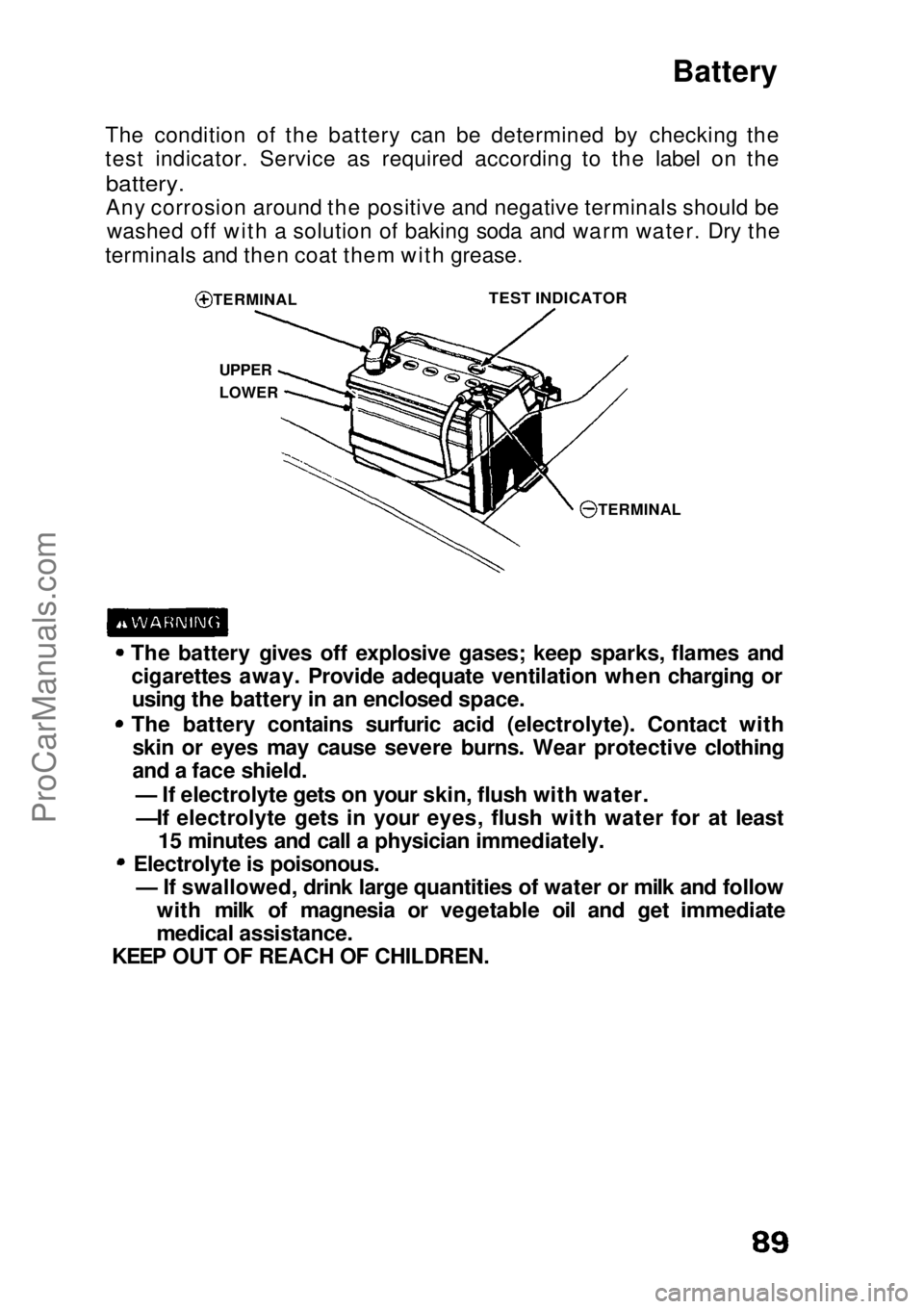
Battery
The condition of the battery can be determined by checking the
test indicator. Service as required according to the label on the
battery.
Any corrosion around the positive and negative terminals should be washed off with a solution of baking soda and warm water. Dry the
terminals and then coat them with grease.
TERMINAL
UPPER
LOWER
TEST INDICATOR
TERMINAL
The battery gives off explosive gases; keep sparks, flames and cigarettes away. Provide adequate ventilation when charging orusing the battery in an enclosed space.
The battery contains surfuric acid (electrolyte). Contact with skin or eyes may cause severe burns. Wear protective clothing
and a face shield.
— If electrolyte gets on your skin, flush with water.—If electrolyte gets in your eyes, flush with water for at least 15 minutes and call a physician immediately.
Electrolyte is poisonous. — If swallowed, drink large quantities of water or milk and follow with milk of magnesia or vegetable oil and get immediate
medical assistance.
KEEP OUT OF REACH OF CHILDREN.ProCarManuals.comMain Menu s t
Page 90 of 136
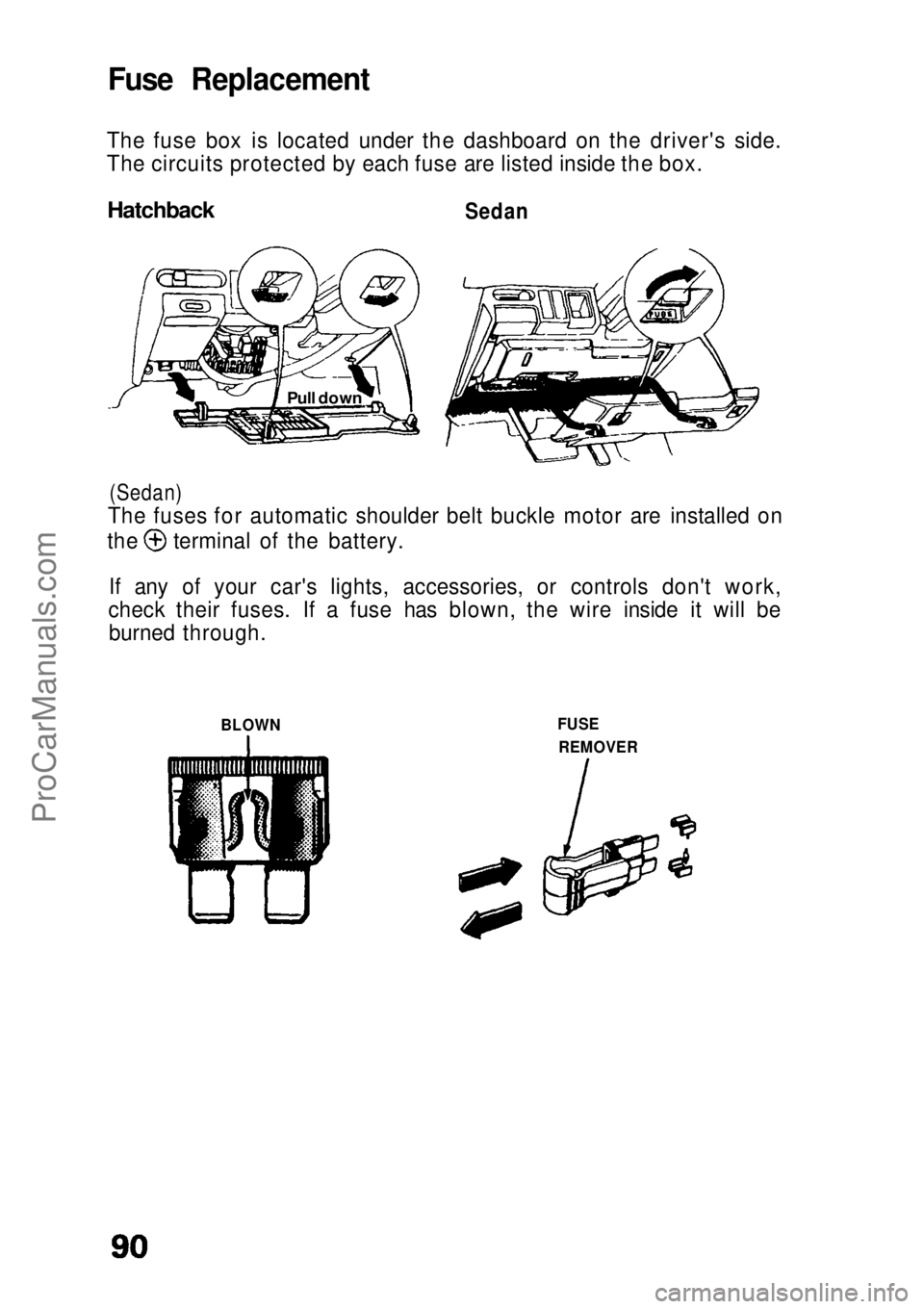
Fuse Replacement
The fuse box is located under the dashboard on the driver's side.
The circuits protected by each fuse are listed inside the box.
Hatchback
Sedan
(Sedan)
The fuses for automatic shoulder belt buckle motor are installed on the terminal of the battery.
If any of your car's lights, accessories, or controls don't work,
check their fuses. If a fuse has blown, the wire inside it will be burned through.
BLOWN FUSE
REMOVER
Pull downProCarManuals.comMain Menu s t
Page 91 of 136
Checking the fuses:
1 .Turn off the ignition and all other switches.
2. If you find a blown or possibly faulty fuse, use the fuse remover, stored beside the spare fuse to pull the blown fuse out of its clips.
3. Check all other fuses as well as the one you suspect.
4. Push in a new fuse of the same rating, and make sure it fits tightly in the clips. If it fits loosely, have your dealer fix it.If you don't have a spare, take a fuse of the same rating (or lower)
out of a circuit you may not need, like the radio or cigarette lighter.
Remember to replace the borrowed fuse and the missing spares.
CAUTION:
A blown fuse may be just a symptom of some other problem. If a new fuse blows right away, the cause should be diagnosed and
corrected by a qualified Honda technician. Never replace a fuse with anything but another fuse of the same or lower rating. A
higher capacity fuse could cause damage and even start a fire.
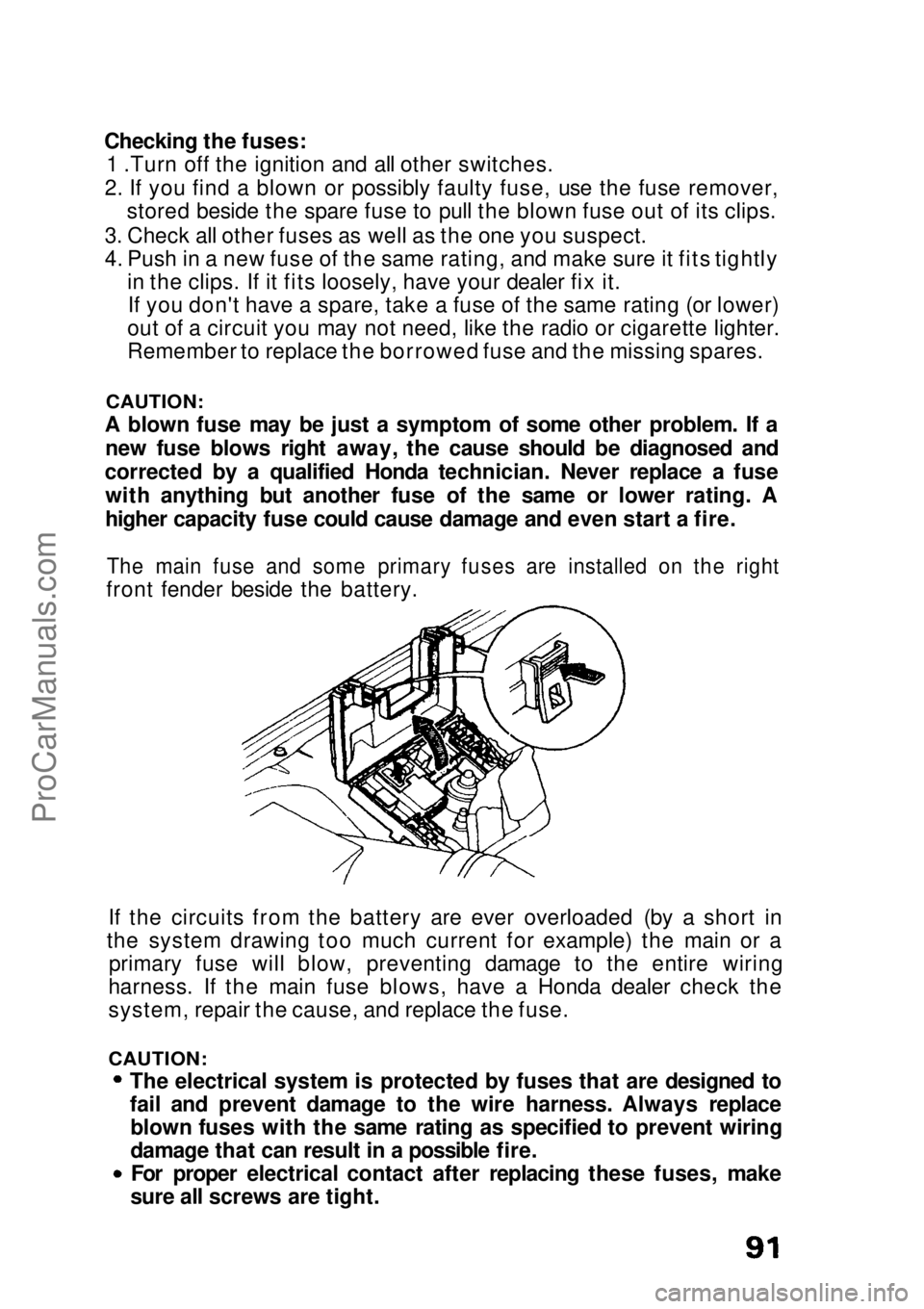
The main fuse and some primary fuses are installed on the right
front fender beside the battery.
If the circuits from the battery are ever overloaded (by a short in
the system drawing too much current for example) the main or a primary fuse will blow, preventing damage to the entire wiring
harness. If the main fuse blows, have a Honda dealer check the
system, repair the cause, and replace the fuse.
CAUTION:
The electrical system is protected by fuses that are designed to
fail and prevent damage to the wire harness. Always replaceblown fuses with the same rating as specified to prevent wiring
damage that can result in a possible fire.For proper electrical contact after replacing these fuses, make
sure all screws are tight.ProCarManuals.comMain Menu s t
Page 110 of 136
Jump Starting
To start a car with a dead battery, use another battery of the samevoltage, and the proper jumper cables.
Procedures other than those below could cause injury or
damage from battery acid spray, explosion or charging system
overload.
Never connect the jumper cable directly to the negative post of
the "dead" battery.
Never allow the two cars to touch each other. Never allow the jumper cable clamps to touch each other.
Never lean over the battery when making connections.
Never attempt to jump start a vehicle with a frozen battery. The
battery could rupture and explode. If you suspect a frozenbattery, remove the vent caps and check the fluid. If there
seems to be no fluid, or if you see ice, do not attempt a jump
start until the fluid thaws.
CAUTION:
If jumper cables are connected backwards, the car's main fuse
may blow.
1.Turn off all lights, heater and other electrical loads, set parking brake, and shift the transmission to Neutral or Park.
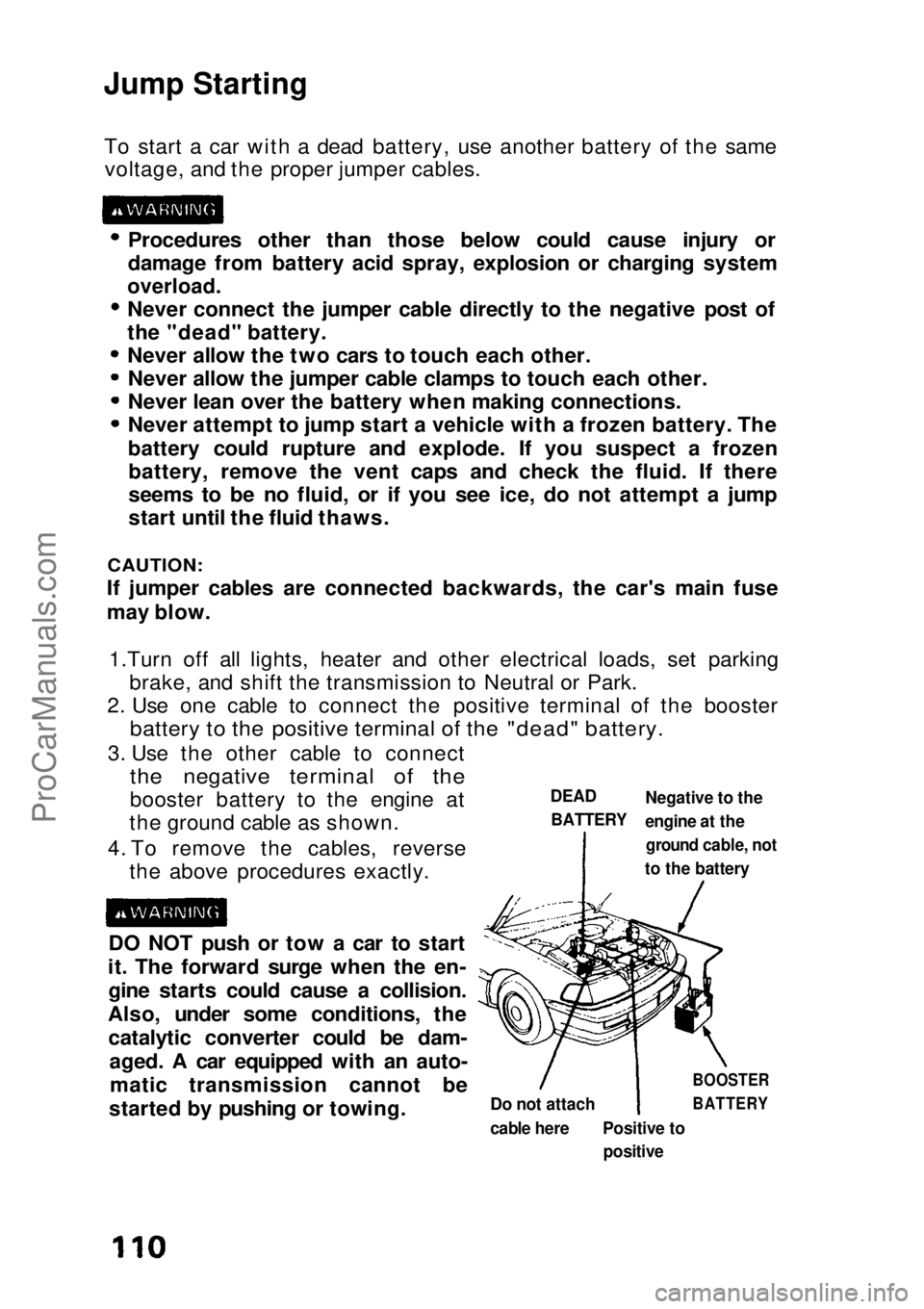
2. Use one cable to connect the positive terminal of the booster
battery to the positive terminal of the "dead" battery.
3. Use the other cable to connect
the negative terminal of the
booster battery to the engine at
the ground cable as shown.
4. To remove the cables, reverse the above procedures exactly.
DO NOT push or tow a car to start
it. The forward surge when the en- gine starts could cause a collision.
Also, under some conditions, the catalytic converter could be dam- aged. A car equipped with an auto-matic transmission cannot be
started by pushing or towing.
DEAD
BATTERY
Negative to the
engine at the
ground cable, not
to the battery
Do not attach
cable here
Positive to
positive
BOOSTER
BATTERYProCarManuals.comMain Menu s t
Page 113 of 136
Shoulder Belt Buckle (Sedan)
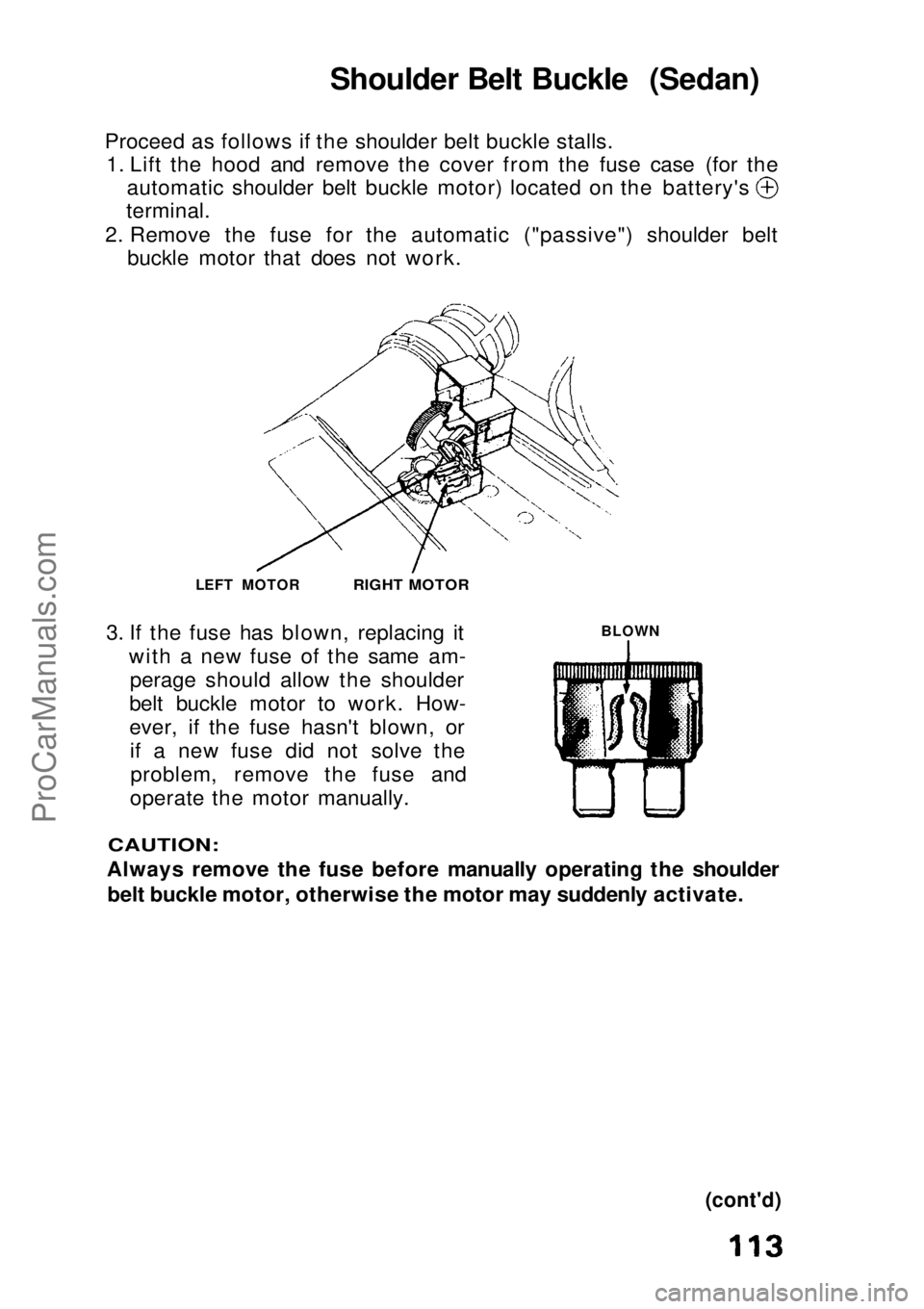
Proceed as follows if the shoulder belt buckle stalls. 1. Lift the hood and remove the cover from the fuse case (for the automatic shoulder belt buckle motor) located on the battery's
terminal.
2. Remove the fuse for the automatic ("passive") shoulder belt buckle motor that does not work.
LEFT MOTOR
RIGHT MOTOR
BLOWN
3. If the fuse has blown, replacing it
with a new fuse of the same am-perage should allow the shoulder
belt buckle motor to work. How-
ever, if the fuse hasn't blown, or if a new fuse did not solve theproblem, remove the fuse and
operate the motor manually.
CAUTION:
Always remove the fuse before manually operating the shoulder belt buckle motor, otherwise the motor may suddenly activate.
(cont'd)ProCarManuals.comMain Menu s t
Page 126 of 136
Catalytic Converter
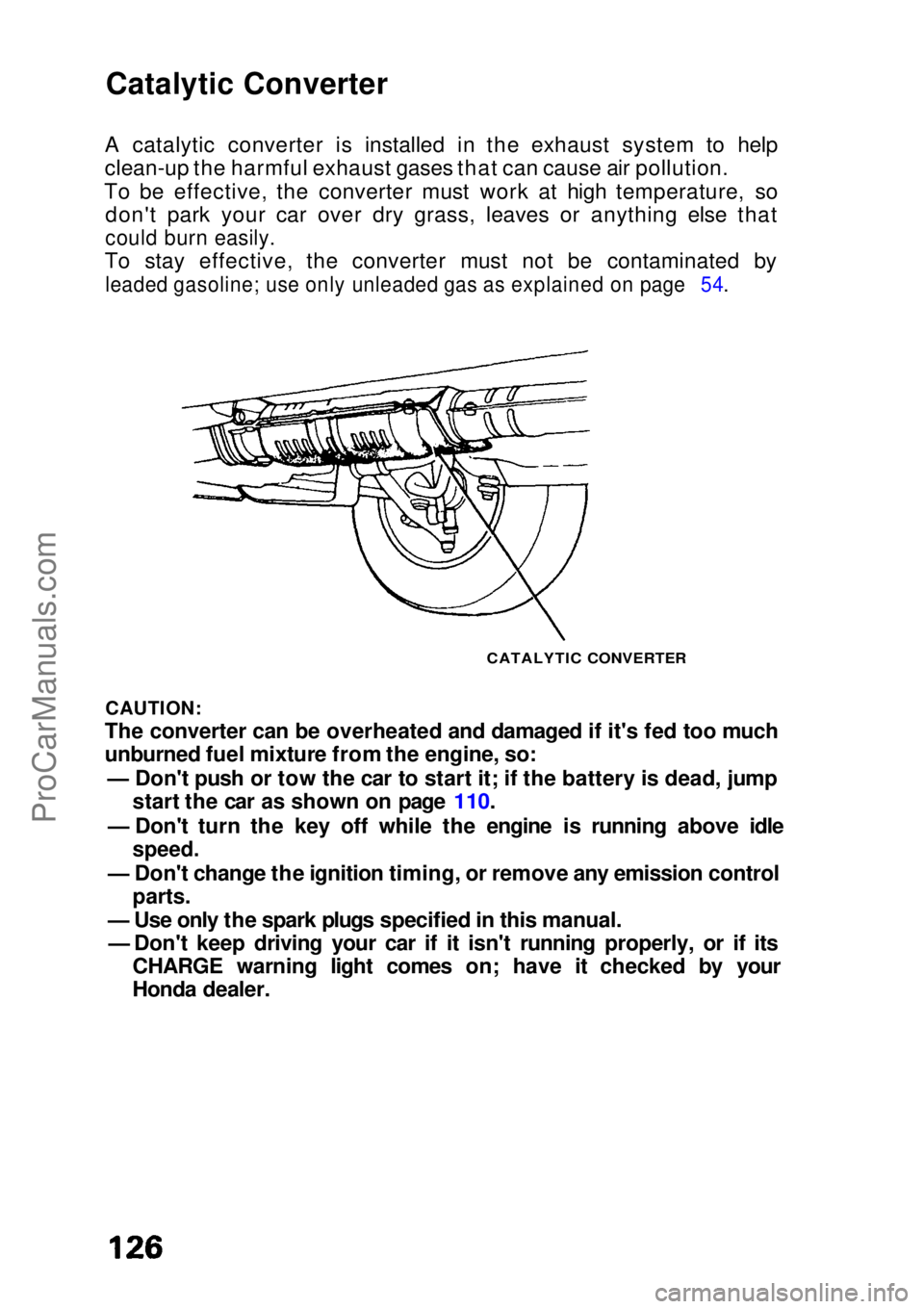
A catalytic converter is installed in the exhaust system to help
clean-up the harmful exhaust gases that can cause air pollution.
To be effective, the converter must work at high temperature, so don't park your car over dry grass, leaves or anything else that
could burn easily.
To stay effective, the converter must not be contaminated by
leaded gasoline; use only unleaded gas as explained on page 54.
CAUTION:
The converter can be overheated and damaged if it's fed too much
unburned fuel mixture from the engine, so:
— Don't push or tow the car to start it; if the battery is dead, jump start the car as shown on page 110.
— Don't turn the key off while the engine is running above idle
speed.
— Don't change the ignition timing, or remove any emission control
parts.
— Use only the spark plugs specified in this manual. — Don't keep driving your car if it isn't running properly, or if its CHARGE warning light comes on; have it checked by your
Honda dealer.
CATALYTIC CONVERTERProCarManuals.comMain Menu s t
Page 127 of 136

Warranty Service
Warranty
The following warranties are provided with every new vehicle. 1. New Car Limited Warranty
2. Emission Control Systems Defects Warranty
3. Emission Performance Warranty
4. Original Equipment Battery Limited Warranty 5. Rust Perforation Limited Warranty
6. Accessory Limited Warranty 7. Replacement Parts Limited Warranty
8. Replacement Muffler Lifetime Limited Warranty 9. Seat Belt Limited Warranty
10.Replacement Battery Limited Warranty
Your car's original tires are covered by their manufacturer. Tirewarranty information is in a separate booklet.
All warranty details pertaining to your car can be found in theWarranty booklet provided with your new car except the requiredmaintenance schedule which is contained here in the Owner's
Manual.
If you are unable to obtain warranty service or are dissatisfied with
the warranty decision or service you received at an authorized Honda dealership, you should review the matter with that
dealership's Service Manager. This will normally resolve your problem. If it does not resolve your problem you should appeal the
decision with the owner of the dealership. Please bear in mind that
your problem will likely be resolved at the dealership, using the
dealer's facilities, equipment and personnel. So it is very important
that your initial contact be with the dealer or his management.
After following these steps, if you wish to have the matter
reviewed by American Honda you should contact the Zone Office
serving your area, as shown on the map on the inside of the back
cover. When contacting American Honda, please provide the Zone
Office with the following information:
Vehicle Identification Number
Servicing Dealer Name and Address
Date of Purchase
Mileage on your Car
Your Name, Address, and Phone Number Nature of Problem
Selling Dealer
After a review of the facts, you will be advised of what can be done.ProCarManuals.comMain Menu s t
Page 129 of 136
Index
Battery
Charging System Warning Light.............................................. 30
Jump Starting ........................ 110
Maintenance............................. 89
Specification (Hatchback).... 116
Specification (Sedan)............ 119
Beeper System Fasten Seat Belt Beeper(Sedan).................................. 11
(Hatcback)............................ 15
Belts, Seat............. See "Seat Belts"
Body Repair.................................. 102
Brake Warning Light...................... 31 Brakes
Brake Failure Warning Light.... 31
Brake Fluid................................ 84
Brake System Design.............. 83
Brake Wear Indicators............. 84
Parking Brake........................... 42
Parking Brake Warning Light.. 31
Break-in Period................................. 2
Bulb
Replacement............................
92
Specification (Hatchback)....
117
Specification (Sedan)............
120
Buzzer........... See
"Beeper System"
Capacities (Hatchback)............... 115 Capacities (Sedan)....................... 118
Care and Cleaning.......................... 99
Catalytic Converter..................... 126 Certification Label....................... 121
Chains, Tires...................................
95
Check Engine
Warning Light......... 31
Child Proof Door Locks...................
5
Child Restraint
System................. 21
Cigarette Lighter............................ 44
Clock............................................... 42
Clutch Pedal Adjustment.............. 61
Compact Spare Tire.................... 104
Coolant Temperature Gauge ........
28
Cooling (with
A/C).........................
49
Cooling System..............................
80
Crankcase Emission Control
System................................... 124
Cruise Control Operation.................................. 39
Indicator.................................... 31
Defogger........................................ 34
Defroster........................................ 51
Doors
Child Proof Door Locks............. 5
Locks........................................... 3
Power Locks.............................. 4
Emergency
Changing a Flat Tire............... 105
Hazard Warning System ......... 37If Your Car Gets Stuck.......... 112
Jump Starting........................ 110
Shoulder Belt Buckle............. 113
Towing.................................... 111
Warning and Indicator Lights.. 29
Emission Controls........................ 124
Engine
Coolant...................................... 80
Coolant Temperature Gauge... 28
Exhaust Controls................... 125Identification Number............ 12
1
Oil and
Filter.............................. 76
OH Pressure Warning Light..... 30
Specification (Hatchback).... 116
Air Conditioner
Operation.................................. 47
Service...................................... 98
Air Filter.......................................... 86
Air Pressure, Tires......................... 94
Antifreeze.. See "Radiator Coolant" Anti-theft Steering Column Lock System ..................................... 57
Appearance Care........................ 100
Ashtrays......................................... 44
Automatic Seat Belt...................... 10
Automatic Transmission
Driving Technique.................... 66
Fluid........................................... 79
Operation.................................. 64
(cont'd)ProCarManuals.comMain Menu s t