tow HONDA CIVIC 1991 Owners Manual
[x] Cancel search | Manufacturer: HONDA, Model Year: 1991, Model line: CIVIC, Model: HONDA CIVIC 1991Pages: 136, PDF Size: 1.33 MB
Page 1 of 136
 to navigate through\
this reference.
For a printed owners manual, click on authorized")
1991 Civic Hatchback/Sedan Online Reference Owner's Manual
Use these links (and links throughout this manual) to navigate through\
this reference.
For a printed owner's manual, click on authorized manuals or go to www.h\
elminc.com.
Features & Safety ........................................................................\
........................................................ 2
What you should know before driving your car.
Starting & Driving........................................................................\
..................................................... 54
What gas to use, how to change gears, etc.
Maintenance ........................................................................\
............................................................... 68
The Required Maintenance Schedule and some items you can service.
Emergency Service ........................................................................\
.................................................. 103
Changing a flat, jump starting, towing. Consumer Information ........................................................................\
............................................ 121
Reporting Safety Detects, warranty service, vehicle identification numbe\
rs, etc.
Index ........................................................................\
........................................................................
129
Gas Station Information
Contents
Owner's Identification
ProCarManuals.com
Page 12 of 136
![HONDA CIVIC 1991 Owners Manual [Sedan]
Wearing the Front Seat Belts
The front seats have automatic ("passive") restraint systems consisting of shoulder belts and knee bolsters. For your safety, the manual lap belts must be](/img/13/57901/w960_57901-11.png "HONDA CIVIC 1991 Owners Manual [Sedan]
Wearing the Front Seat Belts
The front seats have automatic (\"passive\") restraint systems consisting of shoulder belts and knee bolsters. For your safety, the manual lap belts must be")
[Sedan]
Wearing the Front Seat Belts
The front seats have automatic ("passive") restraint systems consisting of shoulder belts and knee bolsters. For your safety, the manual lap belts must be worn together with the automatic
shoulder belts. The shoulder belts must remain permanently latched.
The automatic and manual belts have emergency locking retractors
designed to lock only during a sudden stop or impact. Otherwise,
they allow some freedom of movement in the seat.
Operation
1.Enter the car and close the door
completely. Move the seat a
comfortable distance from the
steering wheel, sit straight up and
well back in the seat.
Never drive the car with the doors
ajar. The front doors must be
closed completely for the front
seat belts to function properly.
2. Turn the ignition ON. The shoulder belt buckle will move to its rear locked position. The length of the shoulder belt will adjust
automatically to your body and seating position.
Make sure the shoulder belt goes over your shoulder and across
your body to evenly distribute the belt's restraining force.
If the belt is too near your neck and throat, move toward the
center of the seat.
Normal movement of the shoulder belt buckle may cause injury. Be sure all parts of your body, especially fingers and hands, are
clear of the shoulder buckle while it is moving.
(cont'd)ProCarManuals.comMain Menu s t
Page 16 of 136
![HONDA CIVIC 1991 Owners Manual [Hatchback]
Wearing the Front Seat Berts The automatic ("passive") lap/shoulder belt systems with emer-
gency locking retractors are designed to lock only during a suddenstop or impact. Other](/img/13/57901/w960_57901-15.png "HONDA CIVIC 1991 Owners Manual [Hatchback]
Wearing the Front Seat Berts The automatic (\"passive\") lap/shoulder belt systems with emer-
gency locking retractors are designed to lock only during a suddenstop or impact. Other")
[Hatchback]
Wearing the Front Seat Berts The automatic ("passive") lap/shoulder belt systems with emer-
gency locking retractors are designed to lock only during a suddenstop or impact. Otherwise, they allow you some freedom of move-ment in the seat. The lap/shoulder belt must remain permanently
latched.
NOTE:
The motion sensing lock mechanisms for the front belts are located in each door. Therefore, if a door is opened too quickly, the belt may
lock and the door cannot be opened further. If this happens, close
the door and open it again more slowly. Enter the car and close the door completely.
If a door is not completely closed, the warning lights in the ceiling
and in the instrument panel will come on and the beeper will
sound when the ignition switch is turned on (see page 17).
The driver's seat should be moved to a comfortable distance from
the steering wheel. Sit straight up and well back in the seat.
The seat belt should fit snugly against your body. The shoulder portion of the belt should go over your shoulder and across your
body to evenly distribute the belt's restraining force. Check that the lap portion of the belt is positioned low on your
hipbone and below your abdomen. This way, if the car is involved
in an accident, you will be less likely to slide under the seat belts.
If the belt is too near your neck and throat, move toward the
center of the seat.
Never drive the car with the doors ajar. The front doors must be
closed completely for the front seat belts to function properly.
(cont'd)ProCarManuals.comMain Menu s t
Page 20 of 136
Buckling the Rear Seat Belts
In the rear seat, there are two one-piece combination lap/shoulder
belts and a center lap belt.
The seat-backs and seat belts provide best restraint when the
occupant is sitting well back and straight up in the seat.
The right and left rear seat belts are one-piece combination lap/ shoulder belts with an emergency locking retractor designed to lock
only during a sudden stop or impact. Otherwise, they allow you
some freedom of movement in the seat.
NOTE:
The emergency locking system of the rear seat belts will also be activated if you pull the belt too fast. If this happens, release the
belt slightly then pull it out more slowly.
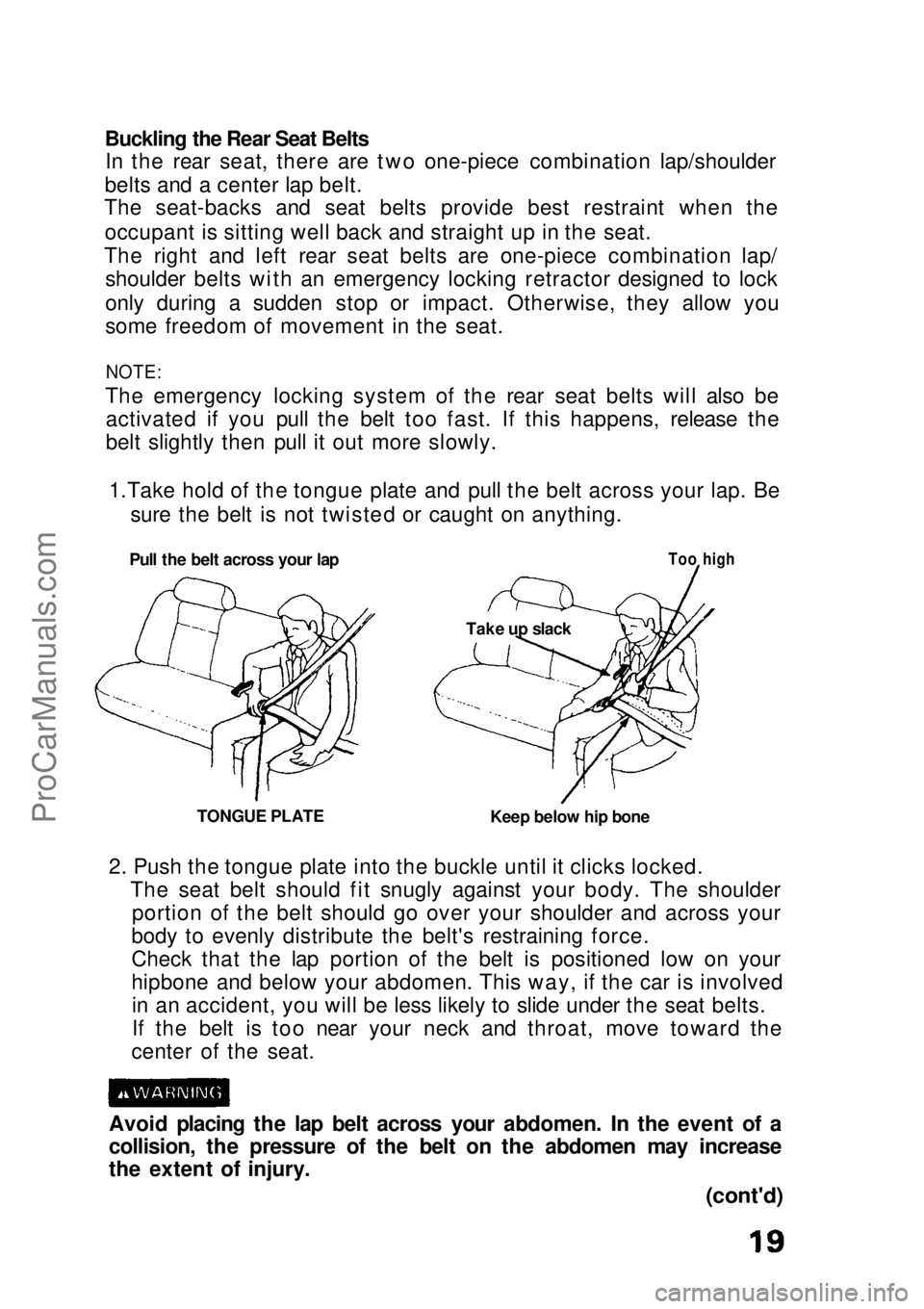
1.Take hold of the tongue plate and pull the belt across your lap. Be sure the belt is not twisted or caught on anything.
2. Push the tongue plate into the buckle until it clicks locked. The seat belt should fit snugly against your body. The shoulderportion of the belt should go over your shoulder and across your
body to evenly distribute the belt's restraining force.
Check that the lap portion of the belt is positioned low on your
hipbone and below your abdomen. This way, if the car is involved in an accident, you will be less likely to slide under the seat belts.
If the belt is too near your neck and throat, move toward the
center of the seat.
Avoid placing the lap belt across your abdomen. In the event of a
collision, the pressure of the belt on the abdomen may increase
the extent of injury.
(cont'd)
Pull the belt across your lap
TONGUE PLATE
Too high
Take up slack
Keep below hip bone
ProCarManuals.comMain Menu s t
Page 34 of 136
Windshield Wipers/Washer/Defogger
Windshield Wipers
(DX/Si Hatchback and Sedan)
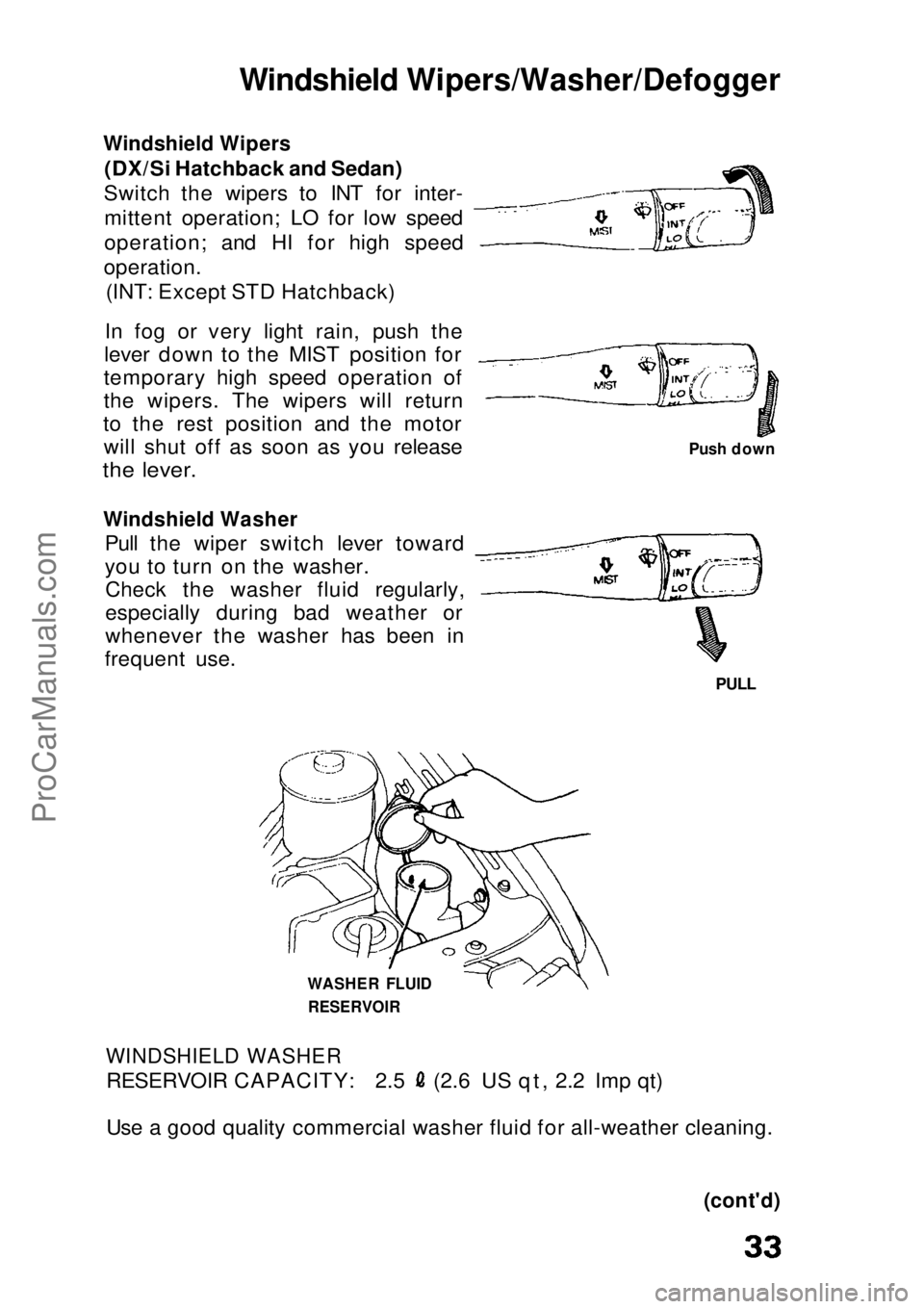
Switch the wipers to INT for inter- mittent operation; LO for low speed
operation; and HI for high speed
operation. (INT: Except STD Hatchback)
In fog or very light rain, push the
lever down to the MIST position for
temporary high speed operation of
the wipers. The wipers will return
to the rest position and the motor will shut off as soon as you release
the lever.
Windshield Washer
Pull the wiper switch lever toward
you to turn on the washer.Check the washer fluid regularly,
especially during bad weather or
whenever the washer has been in
frequent use.
PULL
WASHER FLUID RESERVOIR
WINDSHIELD WASHER
RESERVOIR CAPACITY: 2.5 (2.6 US qt, 2.2 Imp qt)
Use a good quality commercial washer fluid for all-weather cleaning.
(cont'd)
Push downProCarManuals.comMain Menu s t
Page 37 of 136
Lights
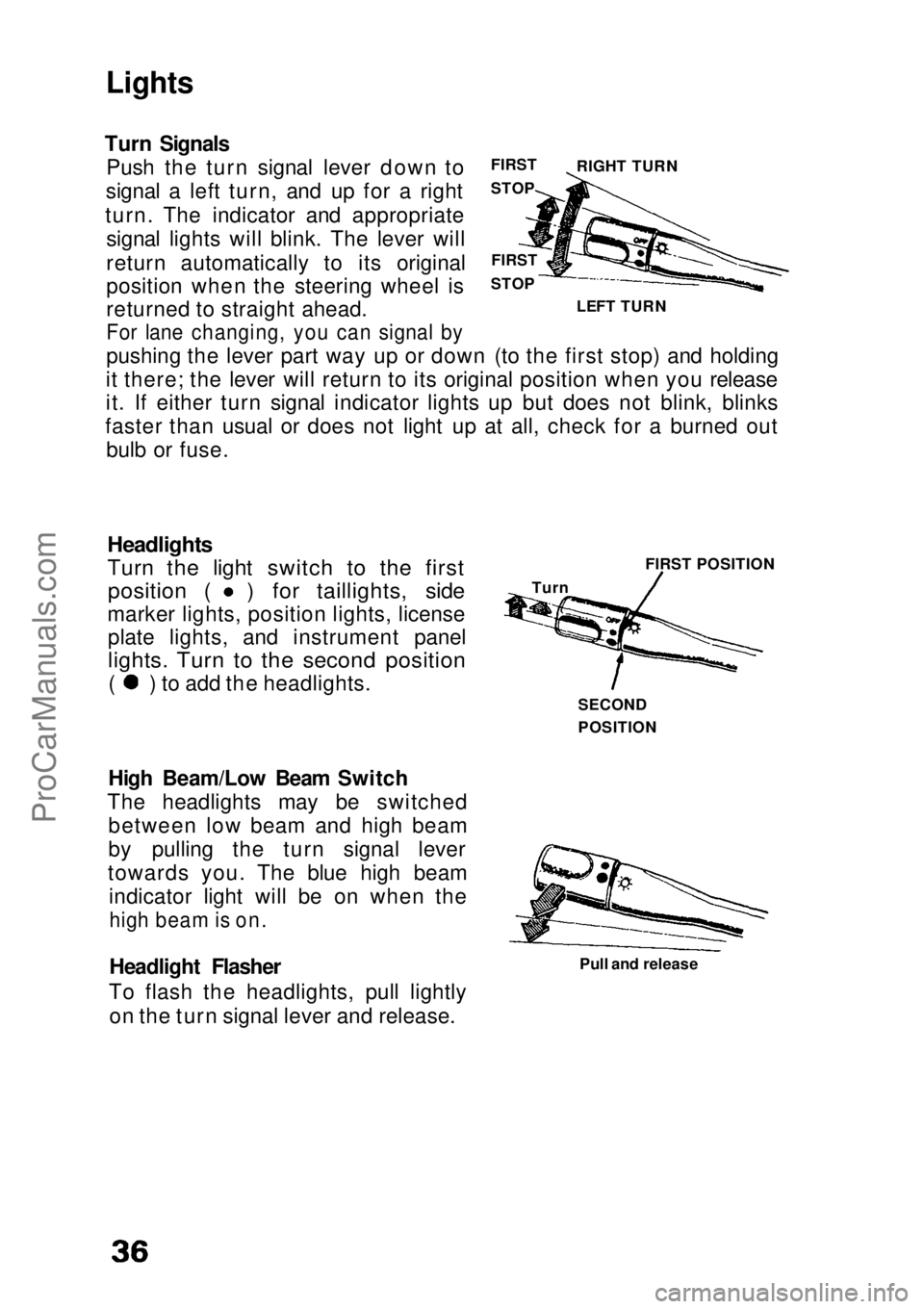
Turn Signals Push the turn signal lever down to
signal a left turn, and up for a right
turn. The indicator and appropriate signal lights will blink. The lever will
return automatically to its original
position when the steering wheel is
returned to straight ahead.
For lane changing, you can signal by
pushing the lever part way up or down (to the first stop) and holding
it there; the lever will return to its original position when you release
it. If either turn signal indicator lights up but does not blink, blinks
faster than usual or does not light up at all, check for a burned out bulb or fuse.
Headlights
Turn the light switch to the first
position ( ) for taillights, side
marker lights, position lights, license plate lights, and instrument panel
lights. Turn to the second position
( ) to add the headlights.
High Beam/Low Beam Switch
The headlights may be switched between low beam and high beam
by pulling the turn signal lever
towards you. The blue high beam indicator light will be on when the
high beam is on.
Headlight Flasher
To flash the headlights, pull lightly on the turn signal lever and release. Pull and release
FIRST
STOP
FIRST
STOP LEFT TURN RIGHT TURN
Turn FIRST POSITION
SECOND
POSITIONProCarManuals.comMain Menu s t
Page 45 of 136
Cigarette Lighter and Ashtrays
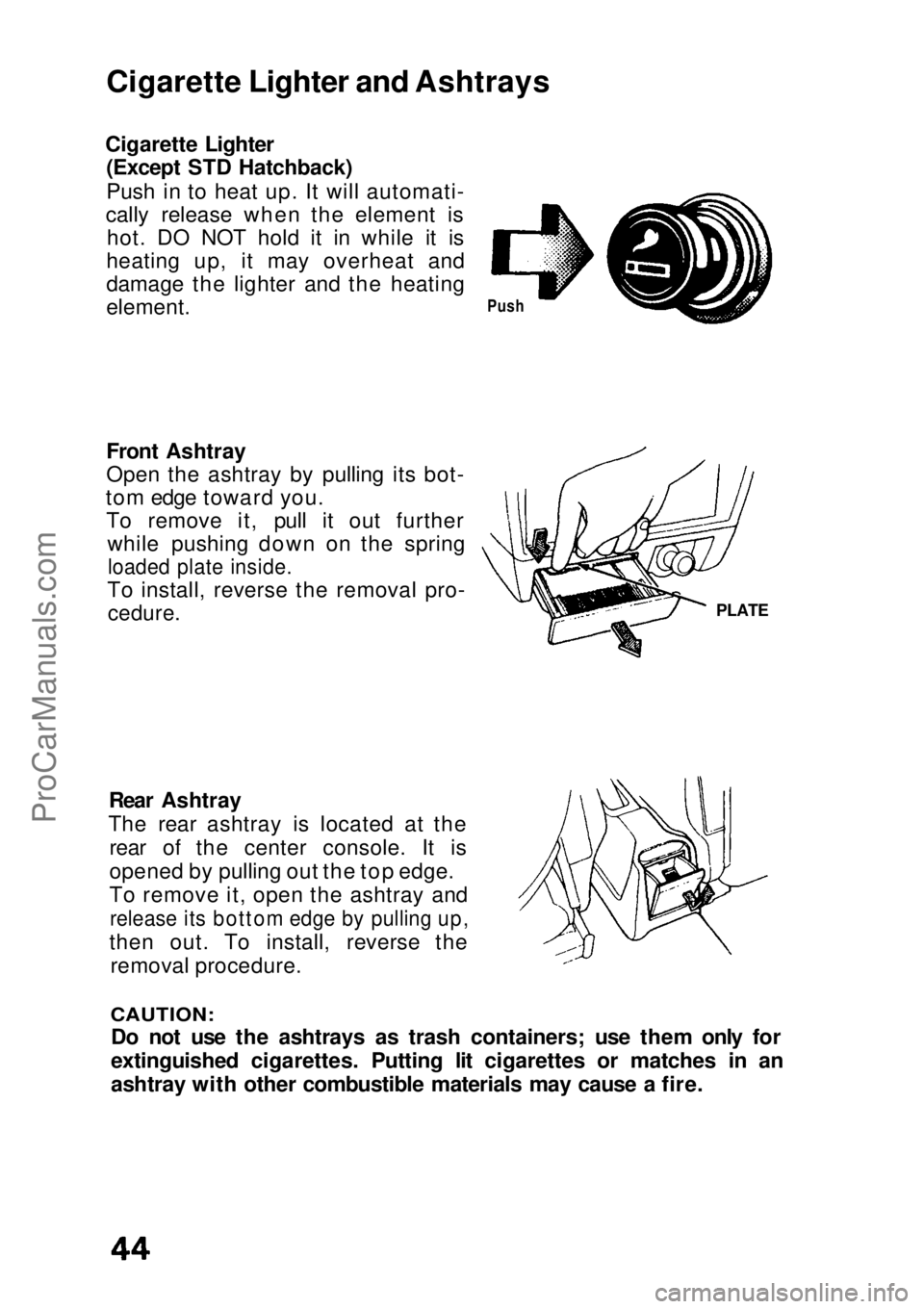
Cigarette Lighter (Except STD Hatchback)
Push in to heat up. It will automati-
cally release when the element is hot. DO NOT hold it in while it is
heating up, it may overheat and
damage the lighter and the heating
element.
Front Ashtray
Open the ashtray by pulling its bot-
tom edge toward you. To remove it, pull it out further while pushing down on the spring
loaded plate inside.
To install, reverse the removal pro-
cedure.
Rear Ashtray
The rear ashtray is located at the rear of the center console. It is
opened by pulling out the top edge.
To remove it, open the ashtray and
release its bottom edge by pulling up,
then out. To install, reverse the removal procedure.
CAUTION:
Do not use the ashtrays as trash containers; use them only for
extinguished cigarettes. Putting lit cigarettes or matches in an
ashtray with other combustible materials may cause a fire.
Push
PLATEProCarManuals.comMain Menu s t
Page 60 of 136
Safety Items
Before driving away, check that: The doors are closed properly.
The mirrors are properly adjusted, and the windows clean.
The driver and passengers are wearing properly adjusted seat
belts.
The head restraints are properly adjusted.
The warning and indicator lights are operating properly. The brake pedal feels normal.
All luggage and cargo is secured.
Nothing is interfering with the driver's feet or blocking vision to
the rear.
While driving remember to: Always drive defensively; expect the unexpected.Reduce your speed during night hours and bad weather.Follow at a safe distance; don't tailgate. Get off the highway when you are tired; stop and take a rest.
When stopping for repairs: Park the car well off the road.
Turn on the hazard warning flasher. Use flares or other warning devices to warn other motorists.
After parking your car: Apply the parking brake and shift to first gear if equipped with
manual transmission, or PARK on automatic transmission equip-ped cars.
Make sure the sunroof and windows are closed and the doors are
locked.
If parked on a hill:
1. Turn the front wheels away from the curb if facing uphill.
2. Turn the front wheels toward the curb if facing downhill.
Never leave children unattended in a parked car. Take your keys.ProCarManuals.comMain Menu s t
Page 67 of 136

Driving Technique
D4-4th
Use the D4 range for normal in-town and highway driving. The car
will start off in 1st and shift automatically to 2nd, 3rd, and 4th. The
further down you push the accelerator, the later the transmission will shift and the faster the car will accelerate.
D3-3rd
Use of D3 will allow the transmission to start off in 1st and shift
automatically to 2nd and 3rd. Use D3 when climbing grades to
prevent the transmission from "hunting" between 3rd and 4th gear;
or when increased braking is needed.
NOTE: If rapid acceleration is necessary, depress the accelerator to the
floor; the transmission will automatically shift down according to
load and engine speed. This applies to both D4 and D3 ranges.
2-2nd Use 2nd gear for increased engine braking when driving downhill,
and increased power when driving uphill; also for driving on slippery roads, and freeing the car from mud or sand, where 1st gear could provide too much power and cause skidding or wheelspin. The
maximum recommended speed in 2nd gear is:
62 mph (100 km/h)
R-Reverse
CAUTION:
Shift into or out of reverse only after the car has come to a
complete stop; the transmission may be damaged if you shift
while the car is moving.
P-Park
CAUTION:
Use this position when starting the engine, or when parking. Shift
into Park only when the car is COMPLETELY stopped.
N-Neutral
Use when starting the engine or during prolonged idling in traffic.
Shifting the Automatic (cont'd)ProCarManuals.comMain Menu s t
Page 88 of 136
Wiper Blades
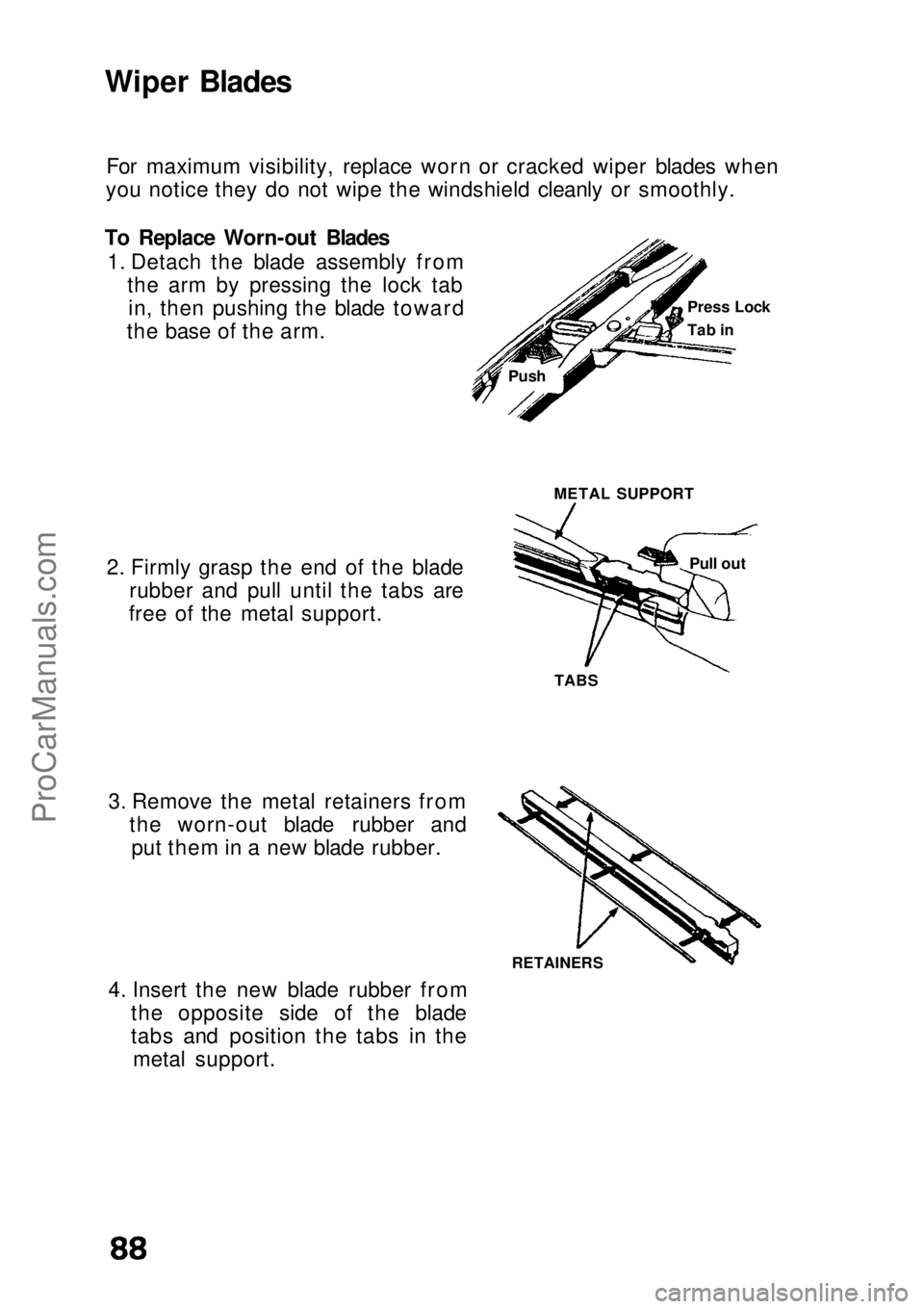
For maximum visibility, replace worn or cracked wiper blades when
you notice they do not wipe the windshield cleanly or smoothly.
To Replace Worn-out Blades 1. Detach the blade assembly from the arm by pressing the lock tabin, then pushing the blade toward
the base of the arm.
METAL SUPPORT
2. Firmly grasp the end of the blade rubber and pull until the tabs are
free of the metal support.
TABS
3. Remove the metal retainers from the worn-out blade rubber andput them in a new blade rubber.
RETAINERS
4. Insert the new blade rubber from the opposite side of the blade
tabs and position the tabs in themetal support. Press Lock
Tab in
Push
Pull outProCarManuals.comMain Menu s t