oil HONDA CIVIC 1998 6.G Workshop Manual
[x] Cancel search | Manufacturer: HONDA, Model Year: 1998, Model line: CIVIC, Model: HONDA CIVIC 1998 6.GPages: 2189, PDF Size: 69.39 MB
Page 1905 of 2189
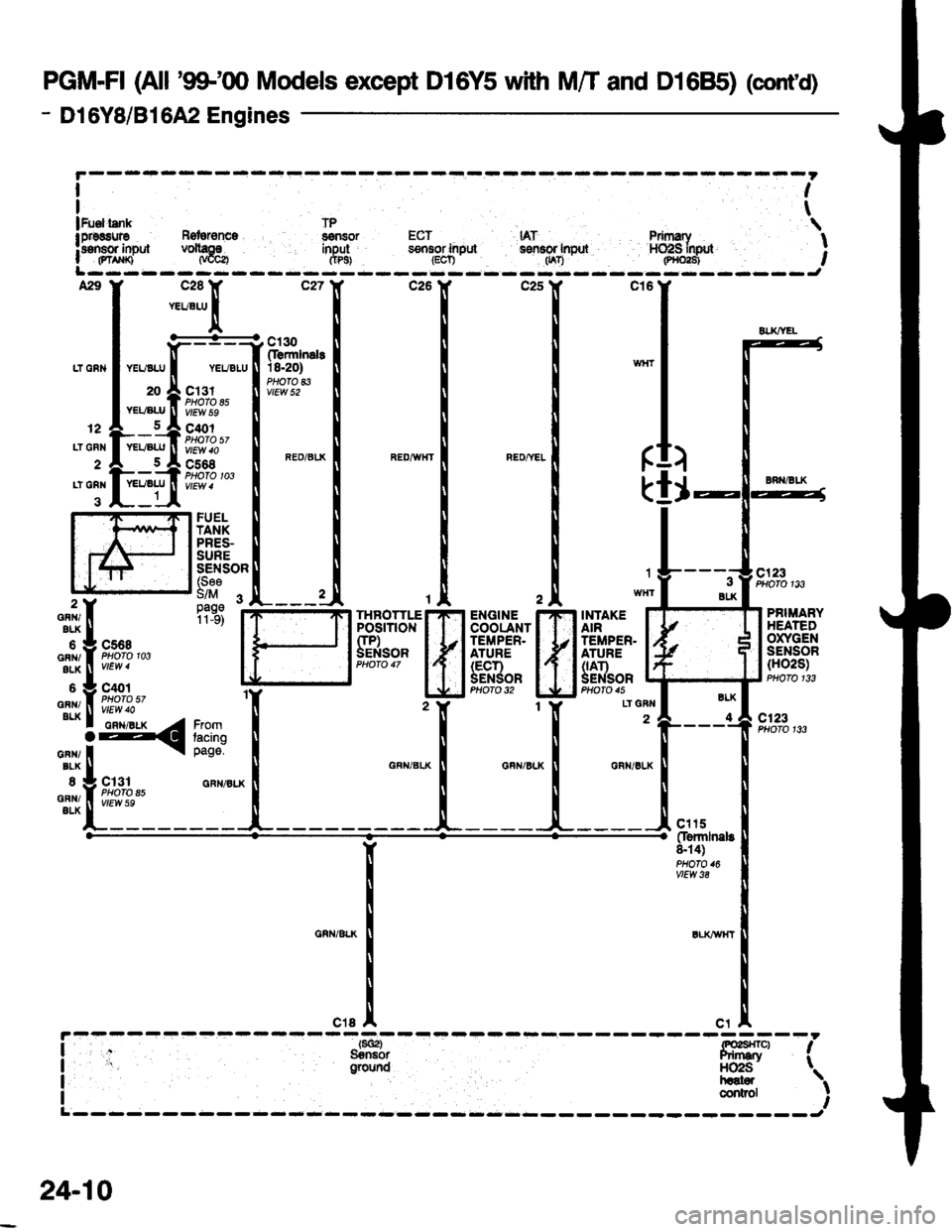
PGM-FI (All '9S"00 Models except D16Y5 with M/T and D1685) (cont'd)
- Dl6Y8/816A2 Engines
c123PHO|O 133
)
t
II
r
k
'l
ir
c27
3 crsoI (Termlnals
ll 18-20)
li#?t?,"
It
ll
I ".r,".*ll
lt
ll
I
lt
lL___3
H'I
t
I
I
I Rrol tankipressure Fobrsnco: ssnsot inDul volt4€| (Pr^No 0ccaL-- --- - -*'I
:*I-.
;iH$ffi1
l-Flitii!
lJri li::#'":l
"oil ??$j
"rt
*tinr+- l+-
*'.,9s,g';,, f
-:i*<'lrp !
-I$"";*", o"",".,. I"rnLi':______I
ALK
INTAKEAIRTEMPER.ATURE(rAr)SENSORPHO|O 15
PRIMARYHEATEDOXYGENSENSOR(H02S)PHOTO 13iF}$iH
:{
F#-H
{
c123PHOTO 133
LT GFII
2
ORN/ALX
c1r5(Iermlnalr8-14)PHOfO 16
I
I
I
I
24-10
Page 1957 of 2189
- How the Circuit Works
Battery voltage is supplied through tuse 56 to the
A,/C compressor clutch r€lay contacts at all times.
With the ignition switch in ON (ll), vollage is applied
to the coil of the A,/C compressor clutch relay
through fuse 17. When you push the A,/C switch
ON, and the heater fan switch is in position | , 2, 3,
or 4, a "ground" input is provided to the engine
control module (ECM) or powertrain control module
(PCM) through the l'lC thermostat and the l'lC
pressure switch.
The A,/C compressor clutch relay is grounded by the
engine control module (ECM) or powertrain control
module (PCM). When energized, the A'lC
compressor clutch relay allows battery voltage to
turn on the A,/C comDressor clutch.
The A,/C ON indicator light comes on when the A,/C
system is requested.
A,/C Thermostat
The A'lC thermostat is located on the evaoorator
housing. The A,/C thermostat turns off the A,/C
compressor clutch if the temperature at the
evaporator goes below 3'C (37'F). This prevents
condensation from freezing on the evaporator fins
and blocking the air delivery into the passenger
compartment. The blower motor will keep running
when the sensor turns off the comDressor.
A,/C Pressure Switch
The fuC oressure switch is located in the condenser
outlet line where refrigerant is in a high
temperature/high pressure liquid state. The switch
will sense abnormally high or low pressure, and
open the circuit. This removes ground, and the
compressor will stop running.
Thermal Protectot
The thermal protector, located on the A,/C
compressor, opens and turns the compressor off if it
senses high temperature. Once the compressor
cools, the switch will close and the compressor will
begin running again.
Refer to the Service Manual (Section 22,
Air Conditioning) for specific tests or
troubleshooting procedures.
62-3
Page 1961 of 2189
- How the Circuit Works
Radiator Fan
Voltage is provided at all times to the radiator fan
relay (contacts) through fuse 57. With the ignition
swilch in ON (ll), voltage is provided to the coil of
the relay through luse 17.
The radiator tan relay can be grounded through
either the engine coolant temperature switch or the
engine control module (ECM) or powertrain control
module (PCM).
The engine coolant temperature switch grounds
the radiator fan relay (coil) when the engine
coolant temperature exceeds 199'F (83'C). The
switch opens when coolanl temperature
decreases 3'- 8'C.
Condenser Fan
Voltage is provided at all times to the condenser fan
relay (contacts) through fuse 56. With the ignition
switch in ON (ll), voltage is provided to the coil of
the relay through fuse 17. When you push the A'lC
switch and put the heater fan switch in 1, 2,3, o( 4
position, the ly'C thermostat comes on, the
condenser fan relay energizes, and the condenser
fan motor runs.
A,/C Thermostat
The A,/C thermostat is located on the evaporator
housing. The A,/C thermostat tums off the A/C
compressor clutch if the temperature at the
evaporator goes below 3'C (37'F). This prevents
condensation from freezing on the evaporator fins
and blocking the air delivery into the passenger
compartment. lf the temperature goes below 3'C
(37"F) tuming off the Ay'C thermostat, ground will be
removed from the condenser fan relay. This will
deenergize the relay and remove voltage from the
condenser fan motor causing the fan to stop running.
Reter to the Service Manual (Section 23, Eleckical)
for specific tests or troubleshooting procedures.
63-3
Page 1964 of 2189
Rear Window Defogger
- How the Circuit Works
'96198 Models
Voltage is applied at all limes through tuse 50 to the
rear window detogger relay (contacts). With the
ignition switch in ON (ll), voltage is applied through
tuse 16 to the rear window defogger switch.
When you turn the switch ON, voltage is applied to
the defogger timer circuit. The timer circuit supplies
voltage to the rear window defogger relay (coil). The
relay energizes and supplies voltage to the rear
window defogger. The defogger grid then heats the
rear window to remove any condensation from the
glass.
The defogger timer circuit will automatically turn off
the rear window defogger after about 25 minutes.
Refer to the Service Manual (Section 23, Electrical)
for specific tests or troubleshooting procedures.
'99100 Models
Voltage is applied at all times through fuse 50 to the
rear window delogger relay (contacts). With lhe
ignition switch in ON (ll), voltage is applied through
fuse 16 to the heater control oanel.
When you turn the rear window defogger switch
ON, a signal is sent to lhe defogger timer circuit
built-into the heater control oanel. The timer circuit
supplies voltage to the rear window defogger relay
(coil). The relay energizes and supplies voltage to
the rear window defogger. The defogger grid then
heats the rear window to remove anv condensation
from the glass.
The defogger timer circuit will automatically turn otf
the rear window defogger after about 25 minutes.
Refer to the Seryice Manual (Section 23, Electrical)
for specific tesls or troubleshooting procedures.
64-2
I
a
a
Page 1977 of 2189

,\
c2Y
IIPNK II
III,0.+.P,0;1""
,--_. aivtEw60
' l', PNK I'T
i -t^-. 3l;33;" 'i'H;"^
i 1n''n"o :
: "n*l :,l
i z f czrs
;T
: fTl Pt[?5'" :
i l/ | LEVEL: l.-: I swrrcH _, I Sae Grourd
: ,9c215 g:"Jifll' ;,t'lY
I l--t
v-i ! czoz :| - PHOfO 19
"""r::I
I
t
PGM.FI
B6Y C3
"aor"au I
I YEURE'
See SeatBell R€minder
o\
Hol
c4t1
vlEw 60
ct01
vtEw 2e
ENGINE OILPRESSUREswrTcHClosed withlow oil pressure.PHOfO 131
Page 1980 of 2189
Gauges (cont'd)
- How the Gircuit Works
When the ignition switch is in ON (ll) or START (lll),
battery voltage is supplied through fuse 25 to the
gauges in the gauge assembly.
Speedometer and Odometer
The odometer and soeedometer drive circuits
receive pulses from the vehicle speed sensor
(VSS). The pulse rate increases as the car
accelerates. The frequency and duration of these
input pulses are measured and displayed by the
speedometer, odometer and tripmeter.
Tachometer
The tachometer drive circuit receives pulses from
the ignition control module (lCM) in the distributor
assembly or the ECM/PCM. The solid-state
lachometer then displays these pulses as engine
speed. For each 200 pulses per minute from the
ignition control modul€ (lCM) or the ECM/PCM, the
tachometer displays 100 RPM.
Engine Coolant Temperature Gauge
The engine coolant temperature gauge has two
intersecting coils wound around a permanent
magnet rotor. Voltage applied to the coils, through
fuse 25, generates a magnetic lield. The magnetic
field, controlled by the coolant temperature sending
unit, causes the rotor to rotate and the gauge
needle to move. As the resistance in the sending
unit varies, current through the gauge coils
changes. The gauge needle moves toward the coil
with the strongest magnetic field.
The 6ngine coolant temperature sending unit's
resistance varies from about 137 ohms at low
engine temperature to between 3H6 ohms at high
temperature (radiator fan running).
Refer to the Service Manual (Section 23, Electrical)
for specific tests or troubleshooting procedures.
81-2
(
Fuel Gauge (All except cX)
The fuel gauge has two intersecting coils wound
around a permanent magnet rotor. Voltage applied
to the coils, through tuse 25, generates a magnetic
field. The magnetic field, controlled by the fuel
gauge sending unit, causes the rotor to rotate and
the gauge needle to move. As the resislance in the
sending unit varies, current through the gauge coils
changes. The gauge needle moves toward the coil
with the strongest magnetic field.
The fuel gauge sending unit's resistance varies
from about 2-5 ohms at full, to about 110 ohms at
empty. When you turn the ignition switch off, the
gauge remains at the last reading until you turn the
ignition switch to ON (ll) or START (lll) again,
Refer to the Service Manual (Section 23, Electrical)
for specific tests or troubleshooting procedures.
Fuel Gauge (GX)
The fuel gauge has two intersecting coils wound
around a permanent magnet rotor. Voltage applied
to the coils, through fuse 25, generates a magnetic
field. The magnetic field, controlled by the PCM,
causes the rotor to rotate and the gauge needle to
move. The PCM calculates the gas quantity in the
fuel tank by using the fuel pressure value detected
by the tuel tank pressure sensor and the fuel
temperature value detected by the fuel tank
temperalure sensor, and outputs the signal to the
gauge assembly. The gauge needle moves toward
the coil with the strongest magnetic field.
When you turn the ignition switch off , the gauge
remains at the last reading until you turn the ignition
switch to ON (ll) or START (lll) again. When the
PCM detects a malfunction with the fuel pressure or
temperature, or detects a gas leak, the PCM
reduces the fuel meter to 0.
Refer to the Service Manual GX Supplement
(Section 11 , Fuel and Emissions) for specific tests
or troubleshooting procedures.
a
a
Page 1981 of 2189

A/T Gear Position Indicator
{\
-cw
@UNDER-DASHFUSE/RELAYBOX
r
See A/TControls
"Ttr
See Dash andConsole Lights
-AYlltFED I FED/BLK I
tl
YEL
A1
SEE A,TTControls,PGM.FI
I
;l
A/T GcarPoiltlo{|Indlc{or
GAUGEASSEMBLY
a\
t----Y---
BLKBLU
12
GRNA!/HT
c410
vtEw 35
BLKaLu
I
See A,/TControls
TI
:I
a
ta
A.t 3
BLKBLU
7
BLK/BLU
eui [SBruI
SeelnterlockSystem
I
;+
ar
l
-;-----;++
-l-rl
c433
A/TGEARPOStTtONswrTcH
Sec GroundDistribution,pag€ 1+7.
Y
I
I
aL__l+: G401
\
89
Page 2007 of 2189
![HONDA CIVIC 1998 6.G Workshop Manual Brake Lights
- All Coupes and96-98 Sedans
tl
UNDER-HOODFUSE/RELAYBOX
?-------
i t t!::o i
i ) SrTIr gee Power iI t 154 Distribution,
L--E-]-p3n:"1--.:
Without Cruise Control
See PowerDistribution,p](/img/13/6068/w960_6068-2006.png "HONDA CIVIC 1998 6.G Workshop Manual Brake Lights
- All Coupes and96-98 Sedans
tl
UNDER-HOODFUSE/RELAYBOX
?-------
i t t!::o i
i ) SrTIr gee Power iI t 154 Distribution,
L--E-]-p3n:\"1--.:
Without Cruise Control
See PowerDistribution,p")
Brake Lights
- All Coupes and'96-'98 Sedans
tl
UNDER-HOODFUSE/RELAYBOX
?-------
i t t!::o i
i ) SrTIr gee Power iI t 154 Distribution,
L--E-]-p3n:"'1--.:
Without Cruise Control
See PowerDistribution,page 1013.
BNAKE SWITCHClosed with brakepedal depressed.PHOTO 68
8 Y C3s2*nrlo." I i[o"'r?, *"r,o"no----awHr/GFN iWith Cruise Control t
*"r,n*[ ,r"r,o*[
r t 1 BRAKE SWTTCH l-'rt
LQlt'*'*t'**" l4J
n""n",.tr I o""*,1, !
o"*n"", I
*=Male-Female
terminals reversedfor '99-'00 models
GFN/II/HT13('99100 models except GX 17)GFN^^/HT2('99-'00 models except GX 10)
GFNMHT
c442fferminals'l ! -14)
PHO|O 125vtEw 54
c401
c563
(C562 '99100 models except GX) *
V|EW 42 GFN,ryVHT
Withoutoptional spoiler
r-
tPGM.FI\
withoptional spoilarGAN/
GFN/
BLK
110-15
+ 9,6,91o,",
\a
Page 2018 of 2189
Power Windows (contd)
- How the Circuit Works
CAUTION: You could iniure your arms, hands, or
fingers if you unintentionally switch the driver's
window to "automatic down" while working in
that door with the power on. Disconnect the
window switch conneclot or the battery when
working in the driver's door.
System Description
The operation of the power windows is controlled by
the main switch in the power window master switch.
When the main switch is in OFF, only the driver's door
window can be opened or closed. With the main
switch ON, all windows can be ooened or closed
either by swtches in the master panel, or swttches in
the doors. The driver's window switch also has an
automatic down mode which is tumed on by pushing
the switch down to its second oosition.
The power windows are driven by reversible motors.
Each motor is protect€d by a built-in circuit breaker.
lf the window switch is held on too long (with the
window obstructed, or after the window is fully up or
down), the circuit breaker opens the circuit. The
circuit breaker resets automaticallv as it cools.
Driver's Window
With the ignition switch in ON, voltage is provided to
the coil of the power window relay through fus€ 24.
The contacts of the power window relay close, and
voltage is applied to the driver's switch. When you
push the power window master switch to UP, voltage
is applied to the driver's window motor. (The motor's
ground path is back through the master power
window switch.) The driver's window motor then
drives the window up. When you push the switch to
DOWN, voltage is applied in the opposite direction
and the motor drives the window down.
Automatic Down (Driver's Window)
With the ignition switch in ON or START, voltage is
applied to the coil of the power window relay. The
contacts of the power window relay close and
voltage is applied lo the power window master
switch. When you push the driveas switch to the
AUTO DOWN position, voltage is applied through
the driver's switch to the driver's window motor. The
control unit receives pulses at the pulser input while
the motor is running. When the window is fully
down, the motor stops, and pulses are no longer
generated by the pulser. This is sensed by the
control unit at the pulser input, and voltage is no
longer applied to the driver's window motor.
Passenger Windows
With the ignition switch in ON, voltage is applied to
the coil of the power window relay through fuse 24.
The contacts of the power window relay then close,
applying voltage to the individual window switches
and the power window master switch. With the
master panel main switch ON, the passenger
windows can be ooerated from the individual
window switches or from tho master panel switches.
When you push the front passengsr's window
switch to UP, voltage is applied to the f ront
passenger's window motor. (The motor is grounded
through the contacts in the front passenger's
window switch and the oower window master
switch.) The window moves up as long as you hold
the switch in the UP position. lf you push the switch
to DOWN, voltage is applied in th€ opposite
direction to the front passenger's window motor, and
the window movss down as long as you hold the
switch in the DOWN Dosition. The window switches
in the other doors operate similarly.
When you push the front passenger's switch in the
master panel to UP, voltage is applied through the
front passenger's window switch contacts to the
front passengefs window motor. (The motor is
grounded through the contacts in the front
passenger's window switch and the power window
master switch.) The window moves up as long as
you hold the switch in the UP position. lf you push
the switch to DOWN, voltage is applied in the
opposite direction to lhe front passenger's window
motor, and the window moves down as long as you
hold the switch in the DOWN position. The other
passenger window switches in the master panel
operate similarly.
Refer to the Service Manual (Section 23, Electrical)
for specific tests or troubleshooting procedures.
120-4
Page 2024 of 2189
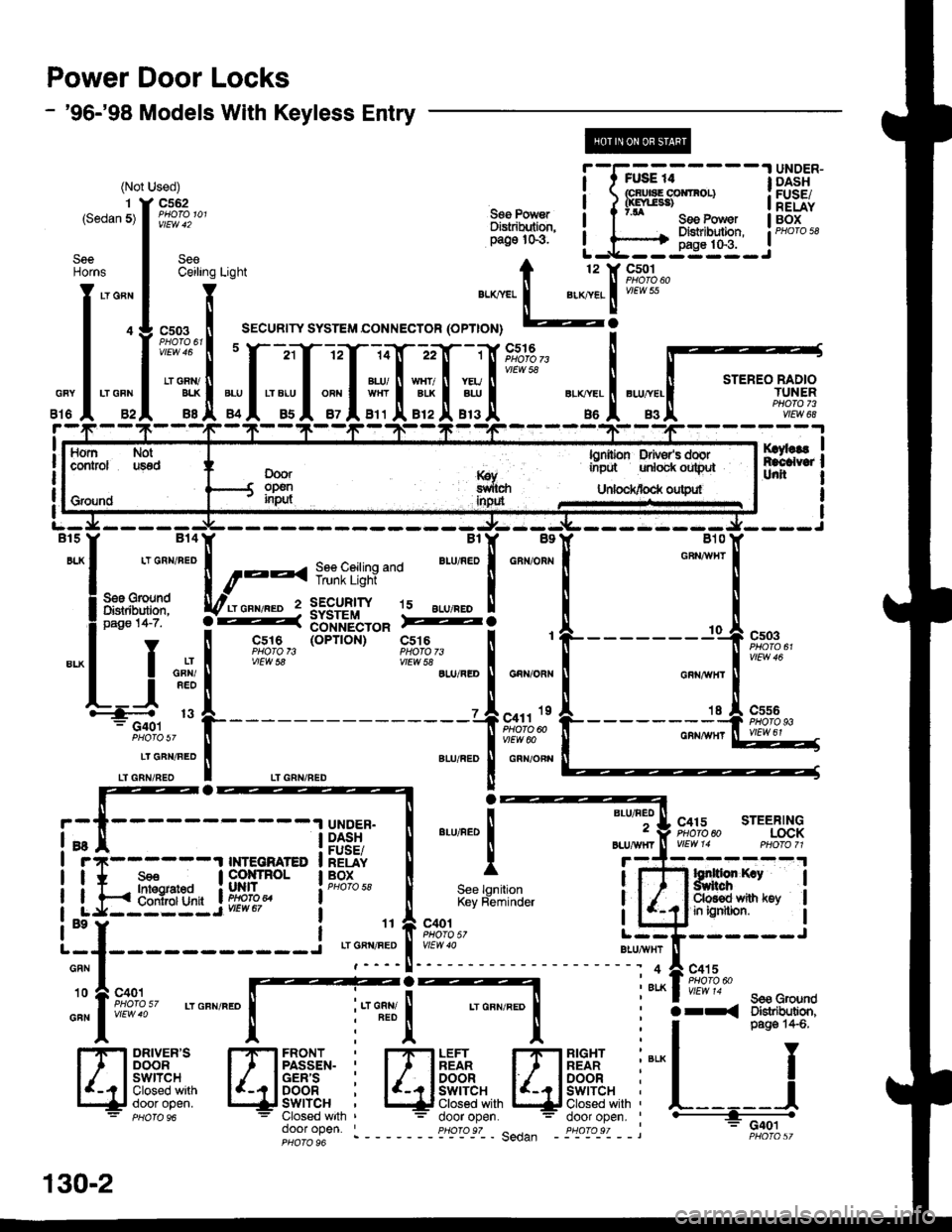
Power Door Locks
- '96-'98 Models With Keyless Entry
(NotUsed)
c562(Ssdan 5)
lOY,laEntcalYatrt oil
SeeCeiling
"*. IPHaTo 611
""#!
__ It
Seenorns
,J:l
ffi
!l*1'*
Rf,Ltr: a ?'* seePower IU6il'
il"d!rui' i.^h::Eii:,_J"'"'ou
t 12 't( 9_s!-1 .
",.*.*,.
1 ".*..1 i#??'o
sYsrEM coNNEcroR (oPTroN) -?
1 UNDER-FUAE 14I t rusE r4: Grul8E COirIFOL)I / 0(Enr38)See Power i ? 7.1 c.. o.Di8tributlon. ! | X;i*:
I DASHI FUSE/I RELAY
STEREO RADIOTUNERPHOTO 73vlEW 68
cs03
css6
;f,;z3,'9,*-
14n 22
BLU/ N WHT/ II YEUWHTI ALK I ALU
B11l'B12l.B13
'I tF;?,'
-xlru
c5l6
86 |' 83
''tl
*, **
t"
[ro**:"[fi*'
""i,
;: I;"il"."'Y' o-ft 3[tnlt$ro" Fi:a
I "* |
F,%',3,, (o"''on)
ir?rt,:*,"." I """,,":
See lgnitionKey Reminder
door ooen. ' pHoro s7 .------- Sa.lan -
f - | csre iofiib$'-" "c,s;rg,_ !
'
| ! "* I
"i3tr9"" 'LU,RED I GnNioR,.
!=4 ,. L----- --,1"n,,'.
-'-l i
i*-i---- ll}gii I
*,*"1
I r7r------'t TNTEGMTED I RELAY I Irrlll,l.I INTECru$ED I RELAY| * s€€ | cotlrRol lBox
LJaBIEIIL i9,Fis," ieHo'osa
BLU/HEO
2
Btu/,|\mr
C415 STEERINGPHOTO 60LOCK
I
I
I
BLUAIIXT
Hffirp;,ruml*-*i E;ffi*,ru
4
ALK
-- ---- J
c415
YtEw 14 sss G,g{rndarr< Olstrlhdion,
RIGHTREARDOORswrTcHClosed withdoor open.
""L___J
G401
130-2