valve clearance HONDA CIVIC 2002 7.G User Guide
[x] Cancel search | Manufacturer: HONDA, Model Year: 2002, Model line: CIVIC, Model: HONDA CIVIC 2002 7.GPages: 1139, PDF Size: 28.19 MB
Page 106 of 1139
10.
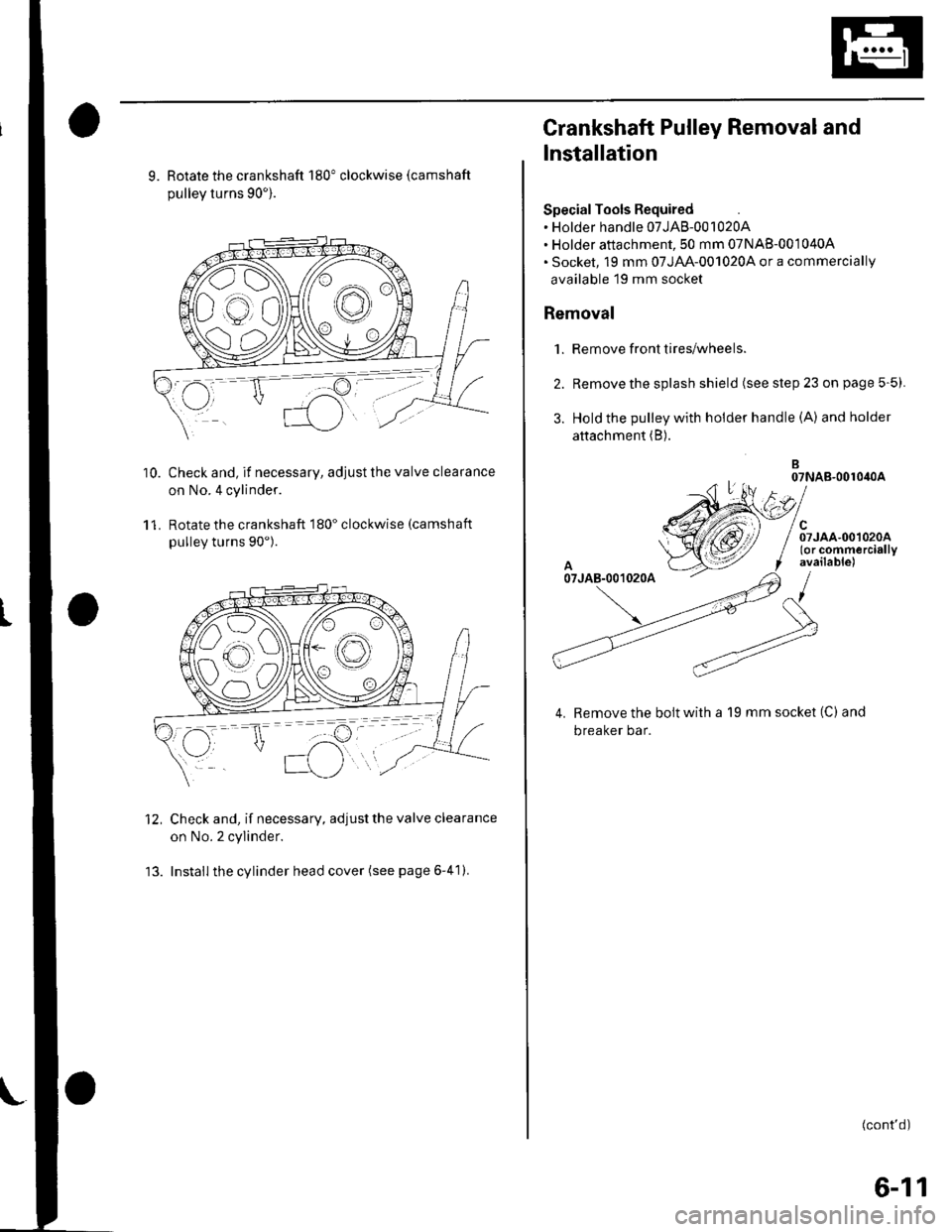
9. Rotate the crankshaft 180" clockwise (camshaft
pullev turns 90').
Check and, if necessary, adjust the valve clearance
on No.4 cylinder.
Rotate the crankshaft 180" clockwise (camshaft
pulley turns 90").
Check and, if necessary, adjust the valve clearance
on No. 2 cylinder.
Install the cylinder head cover (see page 6-41).
11.
12.
Crankshaft Pulley Removal and
Installation
Special Tools Required. Holder handle 07JAB-001020A. Holder attachment, 50 mm 07NAB-001040A. Socket, 19 mm 07JAA-001020,4 or a commercially
available 19 mm socket
Removal
1. Remove front tires/wheels.
2. Remove the splash shield (see step 23 on page 5-5).
3. Hold the pulley with holder handle (A) andholder
attachment (B).
B07NAB-001040A
el
/ Srroo.oo,oroo/ (or commercially
f available)
/
Remove the bolt with a 19 mm socket (C) and
breaker bar.
(cont'd)
6-11
Page 127 of 1139
Gylinder Head
Valve Inspection
1.Remove the valves (see page 6-31),
Measure the valve in these areas.
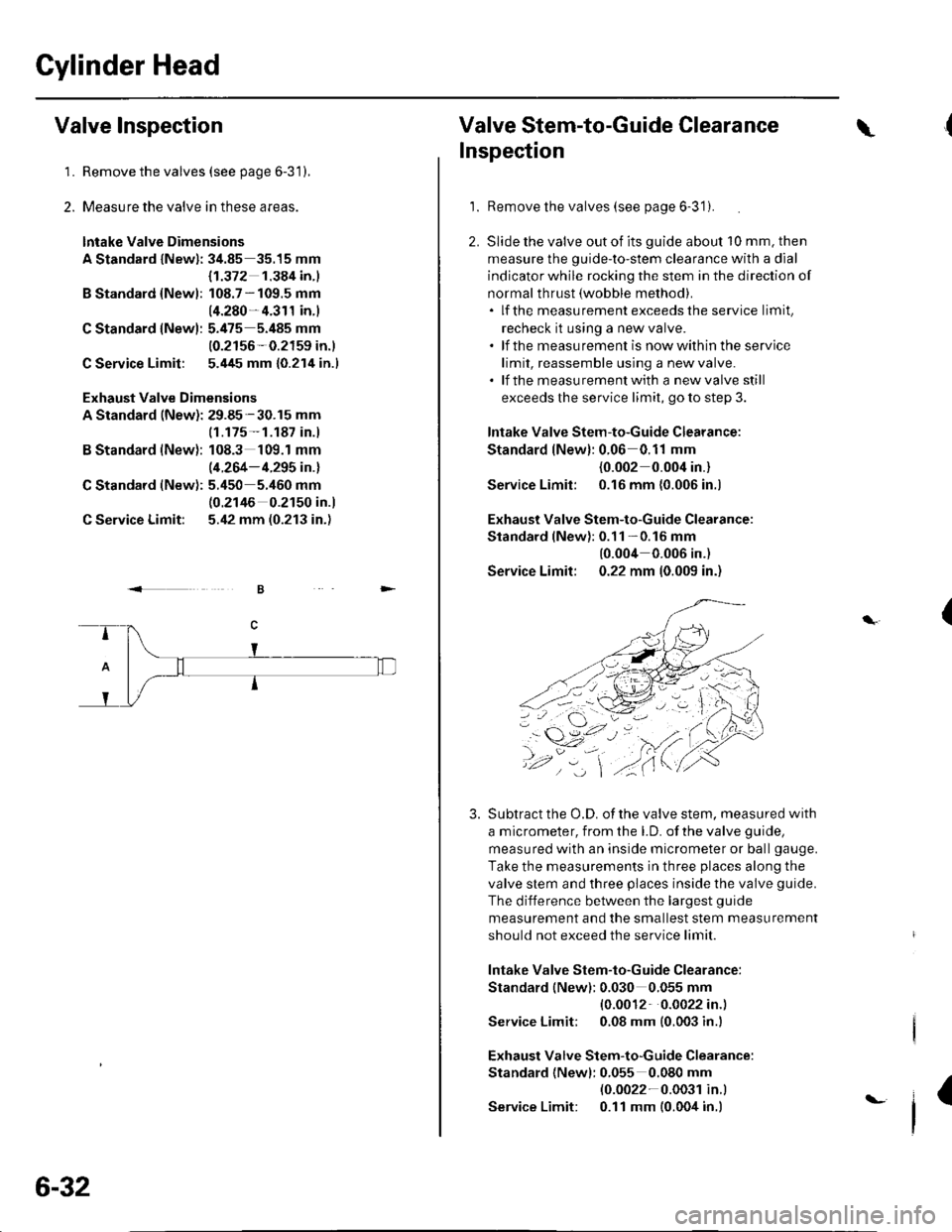
lntake Valve Dimensions
A Standard lNewl: 34.85 35.15 mm
B Standard {Newl:
C Standard lNew):
C Service Limit:
B Standard (New):
C Standard (New):
C Service Limit:
Exhaust Valve Dimensions
A Standard (New): 29.85-30.15 mm
{1.372 1.384 in.l
108.7 - 109.5 mm
14.280- 4.311 in.)
5.475 5.485 mm
10.2156-0.2159 in.)
5.445 mm {0.214 in.l
(1.175- 1.187 in.)
108.3 109.1 mm
(4.264- 4.295 in.l
5.450 5.460 mm(0.2146 0.2150 in.)
5.42 mm (0.213 in.)
2.
.<
6-32
t-
Valve Stem-to-Guide Clearance\
Inspection
1.Remove the valves (see page 6-3'1).
Slide the valve out of its guide about 10 mm. then
measure the guide-to-stem clearance with a dial
indicator while rocking the stem in the direction of
normal thrust (wobble method).. lf the measurement exceedsthe service limit,
recheck it using a new valve.. lf the measurement is nowwithin the service
limit, reassemble using a new valve.. lf the measurementwith a newvalve still
exceeds the service limit, go to step 3.
lntake Valve Stem-to-Guide Clearance:
Standard lNew): 0.06 0.11 mm
{0.002 0.004 in.}
Service Limil: 0.16 mm {0.006 in.)
Exhaust Valve Stem-to-Guide Clearance:
Standard lNewl:0.11 -0.16 mm
10.004 0.006 in.)
Service Limit: 0.22 mm 10.009 in.)
Subtract the O.D. of the valve stem. measured with
a micrometer, from the LD. of the valve guide,
measured with an inside micrometer or ball gauge.
Take the measurements in three places along the
valve stem and three places inside the valve guide.
The difference between the largest guide
measurement and the smallest stem measurement
should not exceed the service limit
lntake Valve Stem-to-Guide Clearance:
Standard (New): 0.030 0.055 mm
{0.0012 0.0022 in.)
Service Limit; 0.08 mm (0.003 in.l
Exhaust Valve Stem-to-Guide Clearance:
Standard {Newl: 0.055 0.080 mm(0.0022-0.003r in.l
Service Limit: 0.11 mm (0.004 in.)
(
3.
4,.
I
Page 128 of 1139
Valve Guide Replacement
Special Tools Required. Valve guide driver, 5.5 mm 07742-0010100. Valve guide reamer, 5.5 mm 07HAH-PJ7o108
1.Inspect valve stem-to-guide clearance (see page 6-
32t.
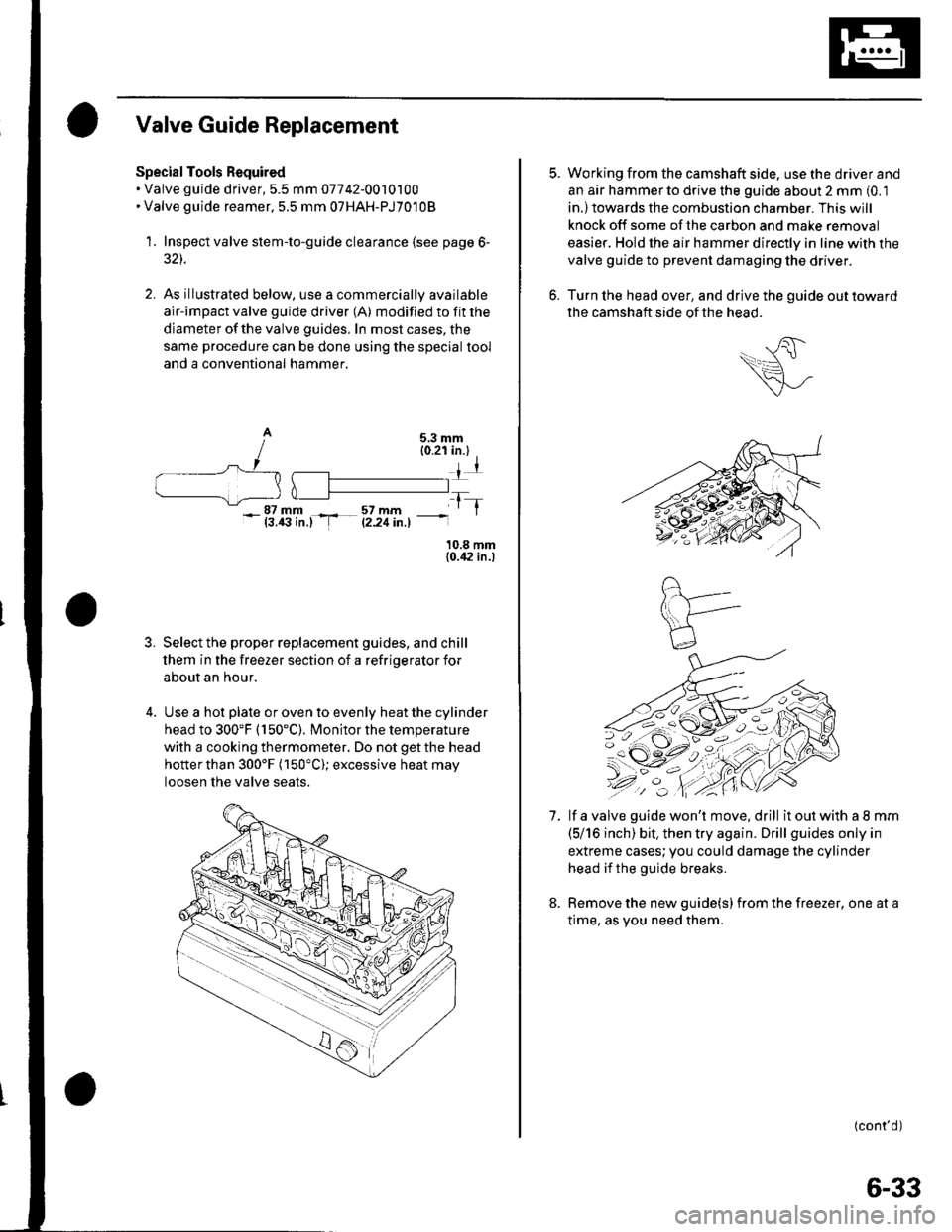
As illustrated below, use a commercially available
air-impact valve guide driver (A) modified to fit the
diameter of the valve guides. In most cases, the
same procedure can be done using the special tool
and a conventional hammer.
10.8 mm{0.,|2 in.)
3. Select the proper replacement guides, and chill
lhem in the freezer section of a refriqerator for
about an hour.
4. Use a hot plate or oven to evenly heat the cylinder
head to 300'F (150"C). Monitor the temperature
with a cooking thermometer. Do not getthe head
hotterthan 300'F (150"C); excessive heat may
loosen the valve seats.
-_|Jfillr-.-4fi'11., -
tT
7.
Working from the camshaft side. use the driver and
an aar hammerto drive the guide about 2 mm (0.1
in.)towards the combustion chamber. This will
knock off some of the carbon and make removal
easier. Hold the air hammer directly in line with the
valve guide to prevent damaging the driver.
Turn lhe head over, and drive the guide out toward
the camshaft side of the head.
lf a valve guide won't move, drill it out with a I mm
(5/16 inch) bit. then try again. Drill guides only in
extreme cases;you could damage the cylinder
head if the guide breaks.
Remove the new guide(s) from the freezer, one at a
time, as vou need them.
(cont'd)
6-33
Page 129 of 1139
Cylinder Head
Valve Guide Replacement (cont'dl
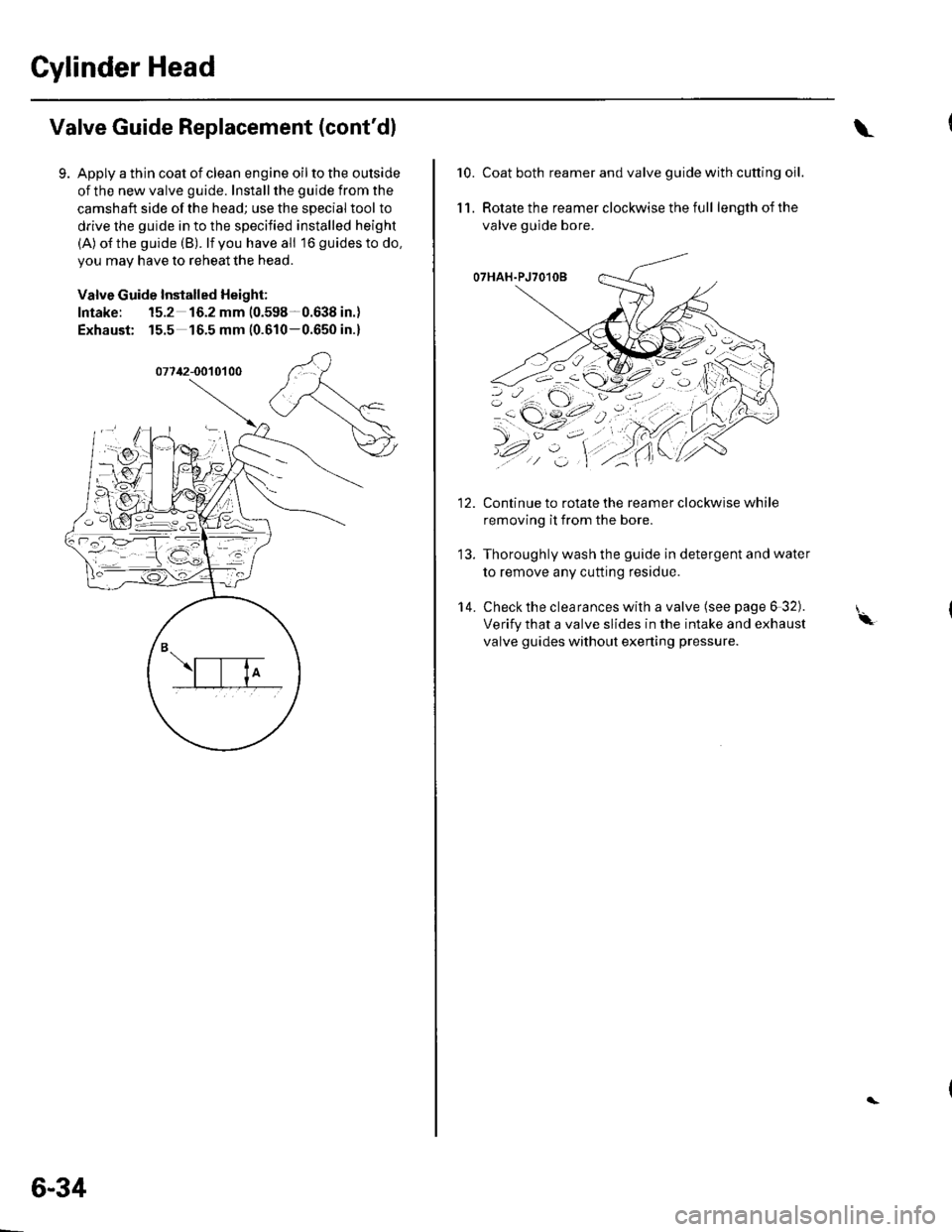
Apply a thin coat of clean engine oil to the outside
of the new valve guide. Install the guide from the
camshaft side of the head; use the special tool to
drive the guide in to the specified installed height
(A) o{the guide (B). lf you have all 16 guidesto do,
you may have to reheat the head.
Valve Guide Installed Height:
Intake: 15.2 16.2 mm (0.598-0.638 in.)
Exhaust: 15.5 16.5 mm (0.610-0.650 in.)
6-34
\
10.Coat both reamer and valve guide with cutting oil.
Rotate the reamer clockwise the full length of the
valve guide bore.
O7HAH.PJ7O1OB
Continue to rotate the reamer clockwise while
removing it from the bore.
Thoroughly wash the guide in detergent and water
to remove any cutting residue.
Check the clearances with a valve (see page 6 32).
Verify that a valve slides in the intake and exhaust
valve guides without exening pressure.
11.
14.
'-\
Page 130 of 1139
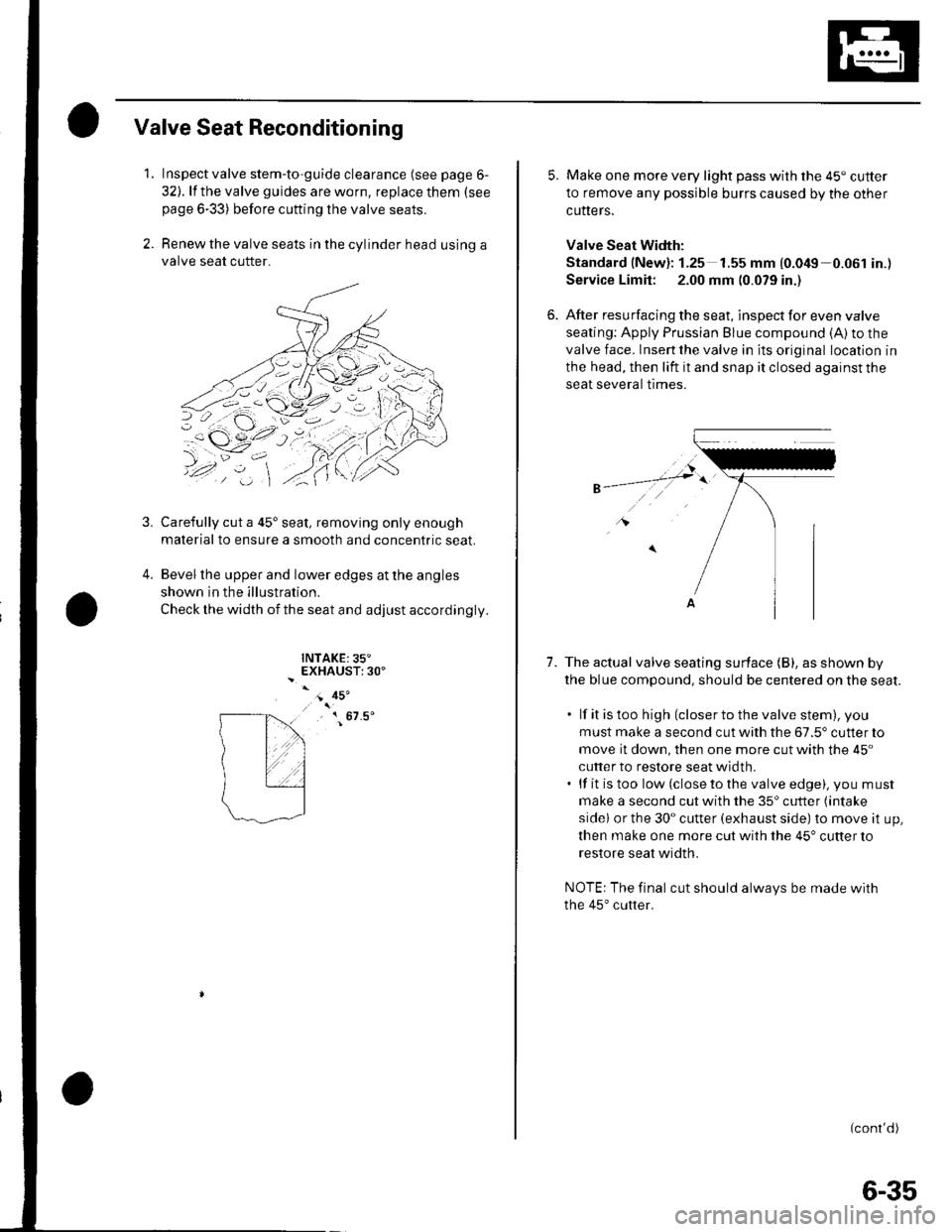
Valve Seat Reconditioning
1. Inspect valve stem-to-guide clearance (see page 6-
32). lf the valve guides are worn, replace them (see
page 6-33) before cutting the valve seats.
2. Renew the valve seats in the cylinder head using a
valve seat cutter.
Carefully cut a 45'seat, removing only enough
material to ensure a smooth and concentric seat.
Bevel the upper and lower edges at the angles
shown in the illustration.
Check the width of the seat and adjust accordingly.
INTAKE:35"EXHAUST:30'
3,
4.
- 45'
, { 67.5'
5. Make one more very light pass with the 45" cutter
to remove any possible burrs caused by the other
cutters.
Valve Seat Width:
Standard (New): 1.25 1.55 mm {0.049 0.061 in.)
Service Limit: 2.00 mm (0.079 in.)
6. After resurfacing the seat, inspect for even valve
seating: Apply Prussian Blue compound (A) to the
valve face. Insert the valve in its original location in
the head, then lift it and snap it closed against the
seat several trmes.
1.The actual valve seating surface (B), as shown by
the blue compound, should be centered on the seat.
. lf it is too high (closer to the valve stem), you
must make a second cut with the 67.5' cutter to
move it down, then one more cut with the 45"
cutter to restore seat width.. lf it is too low (close to the valve edge), you must
make a second cut with the 35'cutter (intake
sidel or the 30" cutter (exhaust side) to move it up,
then make one more cut with the 45" cutter to
restore seat width.
NOTE: The final cut should always be made with
the 45'cutter.
(cont'd)
6-35
Page 133 of 1139
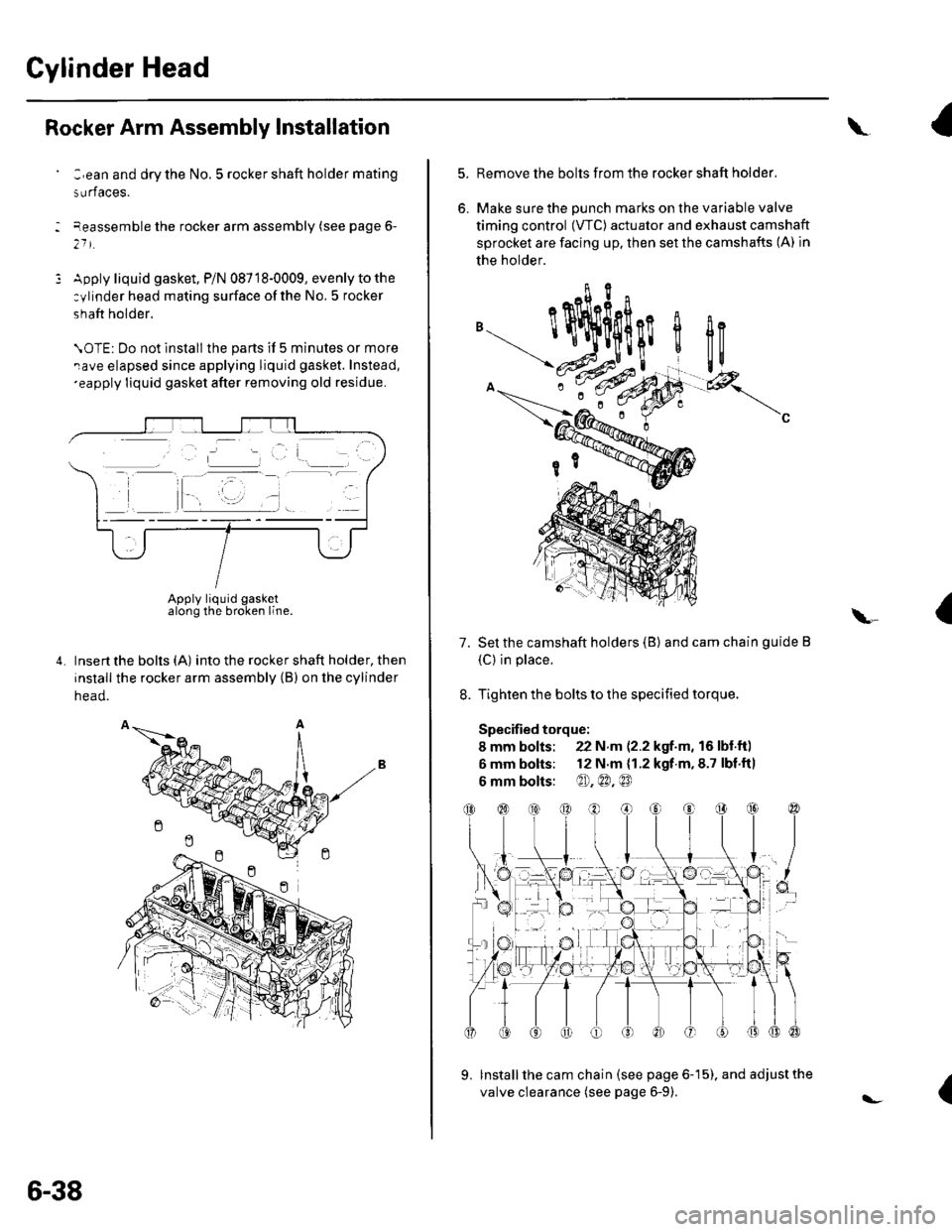
Cylinder Head
Rocker Arm Assembly Installation
:,ean and dry the No. 5 rocker shaft holder mating
surfaces.
eeassemble the rocker arm assembly (see page 6-
21 t.
Apply liquid gasket, P/N 08718-0009, evenly to the
:ylinder head mating surface ofthe No. 5 rocker
shaft holder.
\OTE: Do not lnstall the parts if 5 minutes or more
rave elapsed since applying liquid gasket. Instead,'eapply liquid gasket after removing old residue.
Insert the bolts (A) into the rocker shaft holder, then
install the rocker arm assembly (B) on the cylinder
head.
Apply liquid gasketalong the broken line.
6-38
l-
\
5.
6.
Remove the bolts from the rocker shaft holder.
Make sure the DUnch marks on the variable valve
timing control (VTC) actuator and exhaust camshaft
sprocket are facing up. then set the camshafts (A) in
the holder.
Set the camshaft holders (B) and cam chain guide B
(C) in place.
Tighten the bolts to the specified torque.
Specified torque:
8 mm bolts: 22 N.m (2.2 kgf.m, 16 lbl.ft)
6 mm bolts: 12 N.m {1.2 kgf.m,8.7 lbf.fil
6 mm bolts: @),@.@
lnstall the cam chain (see page 6-15). and adjust the
valve clearance (see page 6-9).
I
flc
a\-
7.
{
Page 136 of 1139
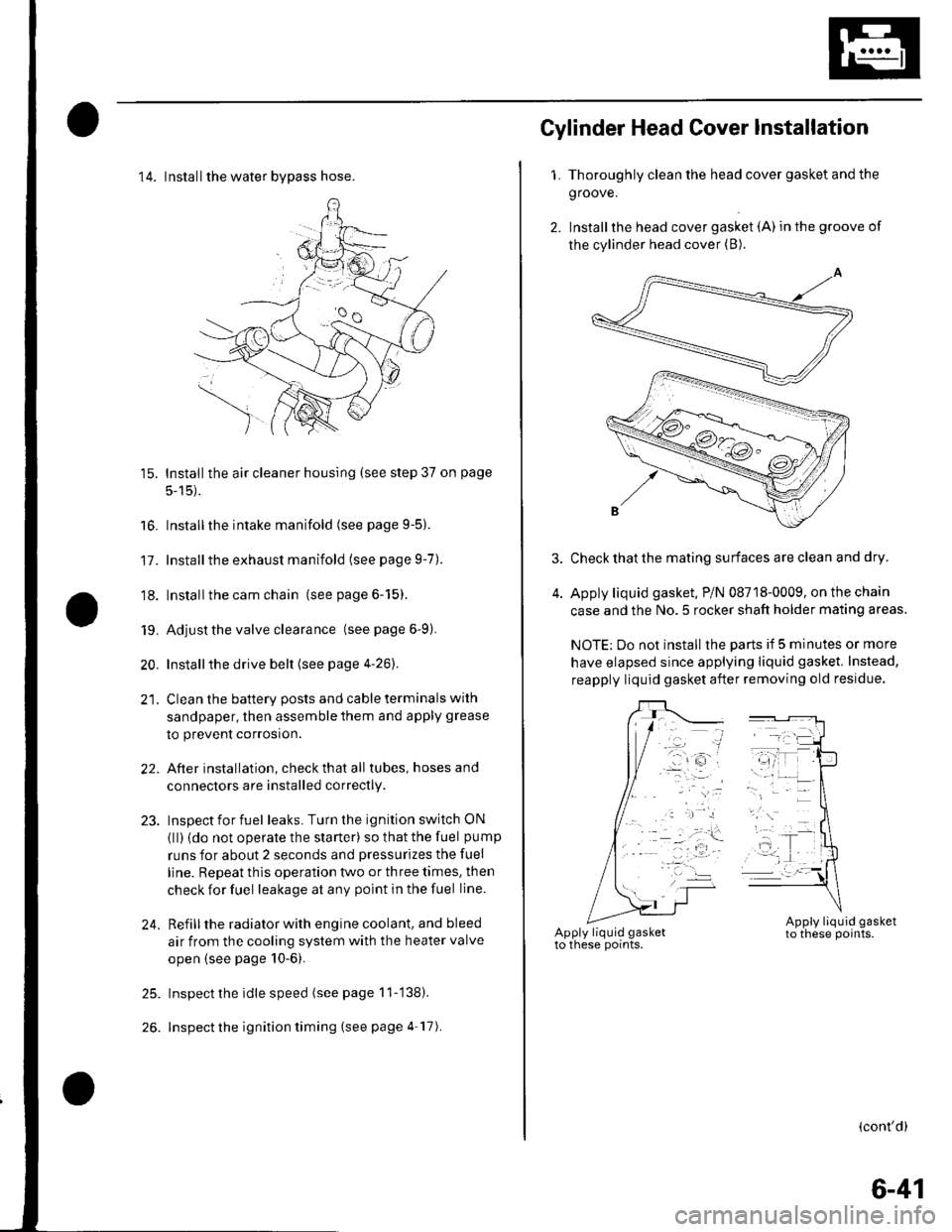
14. Installthe water bvpass hose.
15. Installthe air cleaner housing (see step 37 on page
5-15).
16. Installthe intake manifold (see page 9-5).
17. Installthe exhaust manifold (see page 9-7).
'18. Installthe cam chain (see page 6-15).
19. Adjust the valve clearance (seepage6-9).
20. Installthe drive belt (see page 4-26).
21. Clean the battery posts and cable terminals with
sandpaper, then assemble them and apply grease
to prevent corrosion.
22. After installation, checkthatall tubes, hosesand
connectors are installed correctly.
23. Inspectforfuel leaks. Turn the ignition switch ON
{ll) {do not operate the starter) so that the fuel pump
runs for about 2 seconds and pressurizes the fuel
line. Repeat thls operation two or three times, then
check for fuel leakage at any point in the fuel line.
24. Refillthe radiator with engine coolant, and bleed
air from the cooling system with the heater valve
open (see page 10-6).
25. Inspect the idle speed (see page 11-'138).
26. Inspect the ignition timing (see page 4-17).
Gylinder Head Cover lnstallation
1. Thoroughly clean the head cover gasket and the
groove.
2. Installthe head cover gasket (A) in the groove of
the cylinder head cover (B).
Check that the mating surfaces are clean and dry.
Apply liquid gasket. P/N 08718-0009, on the chain
case and the No.5 rocker shaft holder mating areas.
NOTE: Do not install the parts if 5 minutes or more
have elapsed since applying liquid gasket. Instead,
reapply liquid gasket after removing old residue.
(cont'd)
6-41
Page 277 of 1139
PGM-FI System
DTC Troubleshooting (cont'dl
DTC P0171: Fuel System Too Lean
DTC P0172: Fuel System Too Rich
NOTE: lf some of the DTCS listed below are stored at
the same time as DfC PO17'l and/ot PO172,
troubleshoot those DTCS first, then recheck for P0171
andlot P0112.
P0107, P0108. P1 128. P1 129: Manifold absolute
pressure (MAP) sensor
P1 162. P1 166, P 1 167: 4,,/F sensor (Sensor 1 ) heater
P0137, P0138: Secondary HO2S (Sensor 2)
P014'l: Secondary HO2S (Sensor 2) heater
P1259: VTEC system
1. Check the fuel pressure (see page 11-'145).
ls luel pressure OK?
YES Go to step 2.
NO Check these items:
. lf the pressure is too high, replace the fuel
pressure regulator (see page 11-152).1. lf the pressure istoo low.checkthefuel pump,
the fuel feed pipe, the fuel filter, and replace the
fuel pressure regulator (see page 11-152).I
2. Start the engine. Hold the engine at 3,000 rpm with
no load (in neutral) until the radiator fan comes on.
11-70
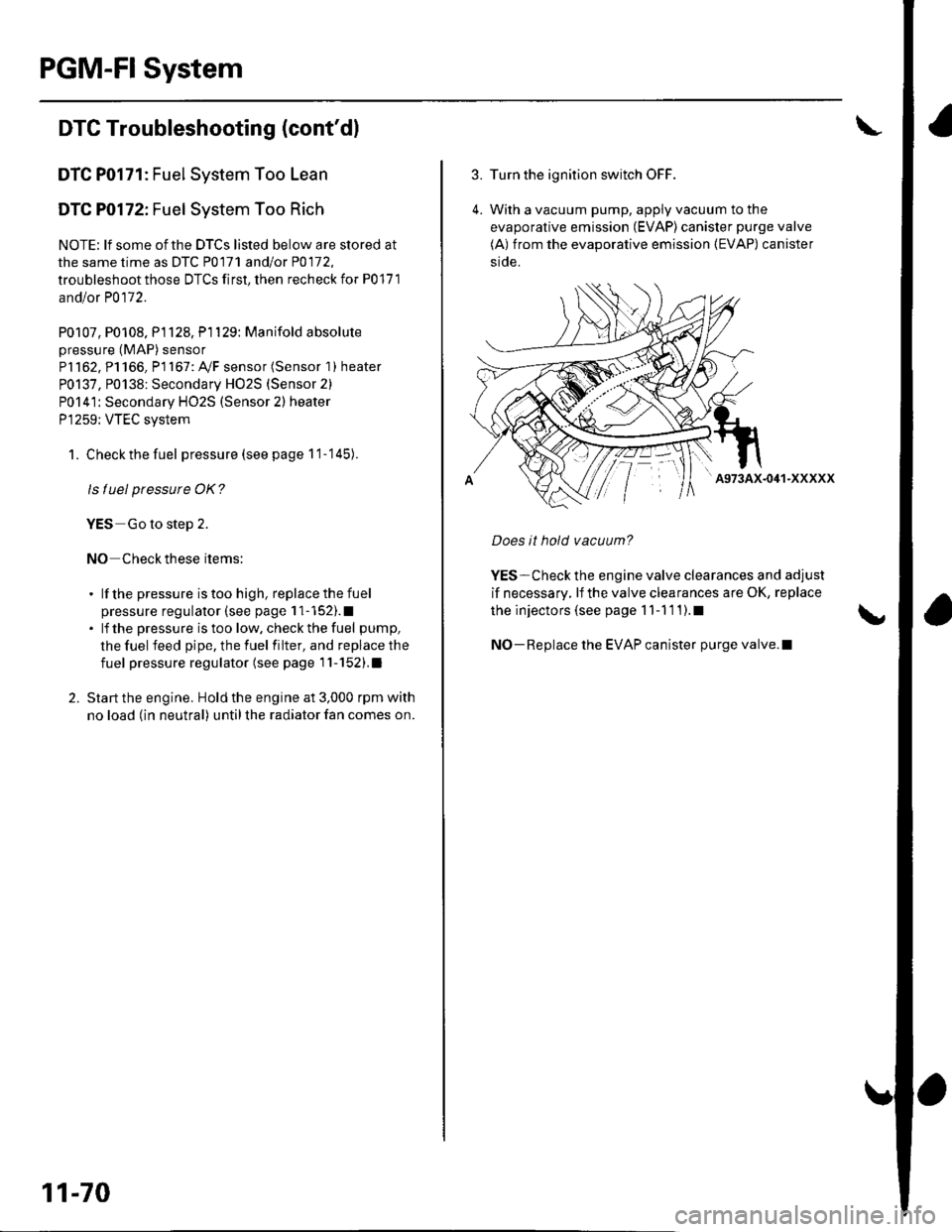
3. Turn the ignition switch OFF.
4. With a vacuum pump, apply vacuum to the
evaporative emission (EVAP) canister purge valve
(A) from the evaporative emission (EVAP) canister
side.
' A973AX-041-XXXXX
Does it hold vacuum?
YES-Check the engine valve clearances and adjust
if necessary, lf the valve clearances are OK, replace
the injectors (see page 1 1-1 1 1).1
NO-Replace the EVAP canister purge valve.l
Page 278 of 1139
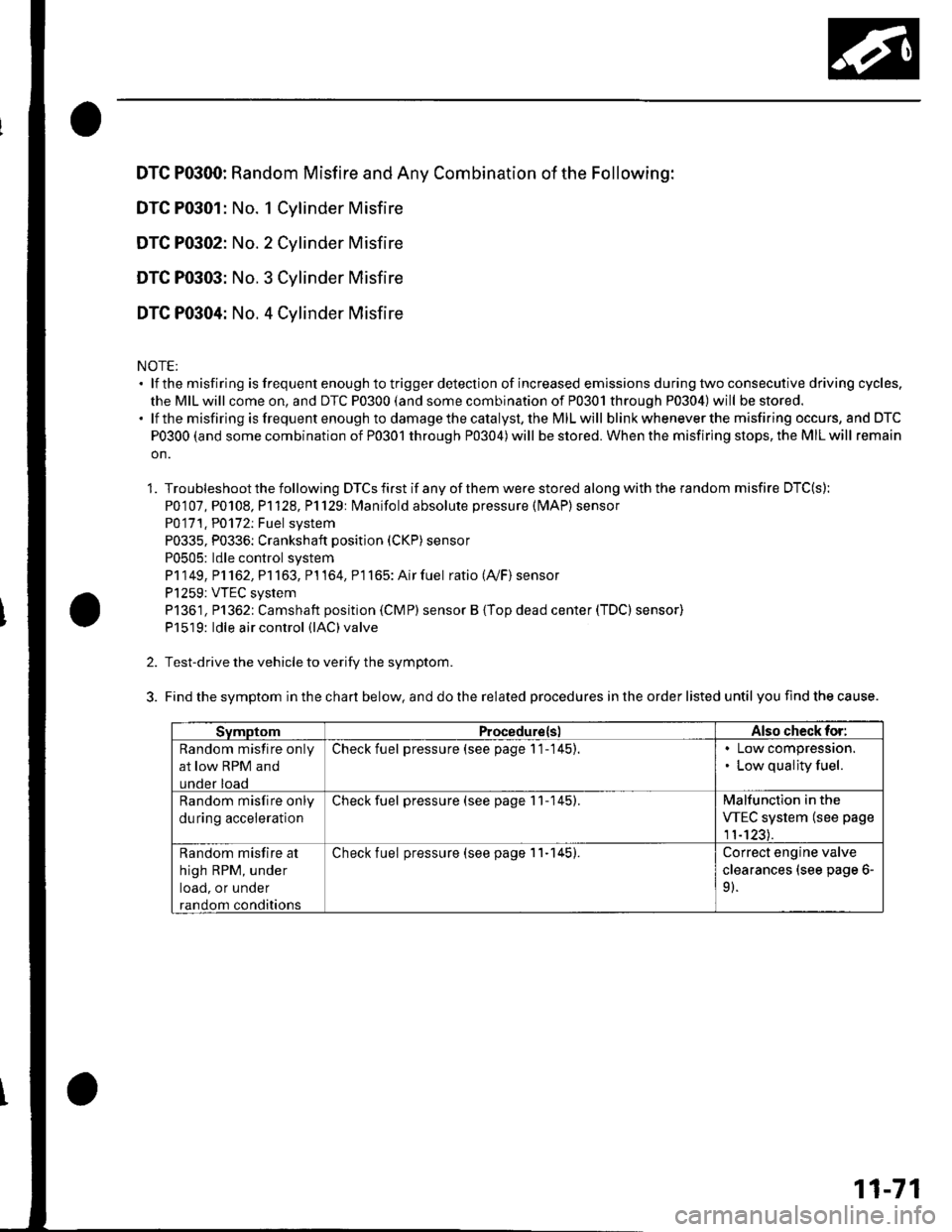
DTC P0300: Random Misfire and Any Combination of the Following:
DTC P0301: No. 1 Cylinder Misfire
DTC P0302: No. 2 Cvlinder Misfire
DTC P0303: No, 3 Cvlinder Misfire
DTC P0304: No. 4 Cvlinder Misfire
NOTE:. lfthe misfiring is frequent enough to trigger detection of increased emissions during two consecutive driving cycles.
the MIL will come on, and DTC P0300 (and some comlrination of P0301 through P0304) will be stored.. lf the misfiring is frequent enough to damage the catalyst, the MIL will blink whenever the misfiring occurs, and OTC
P0300 (and some combination of P0301 through P0304) will be stored. When the misfirlng stops, the MIL will remain
on.
1. Troubleshoot the following DTCs first if any of them were stored along with the random misfire DTC(s):
P0'107, P0108, P1128, P1129r N4anifold absolute pressure (MAP) sensor
P0111. P0'172t Fuel svstem
P0335. P0336: Crankshaft position (CKP) sensor
P0505: ldle control system
P1 149, Pl 162, P1 163, P1 164, P 1 165: Air fuel ratio (Ay'F) sensor
P1259: VTEC system
P1361, P1362: Camshaft position (CMP) sensor B {Top dead center (TDC) sensor)
P1519: ldle air control (lAC) valve
2. Test-drive the vehicle to verify the symptom.
3. Findthesymptom inthechart below, and dothe related procedures in the order listed until you find the cause.
SymptomProcedure(slAlso check foi:
Random misfire only
at low RPM and
under load
Check fuel pressure (see page 1 1-145).. Low compressron.. Low quality fuel.
Random misfire only
du ring acceleration
Check fuel pressure (see page 11-145).Malfunction in the
VTEC system (see page
1't-123).
Random misfire at
high RPM, under
load, or under
random conditions
Check fuel pressure (see page 11-145).Correct engine valve
clearances (see page 6-
91.
11-71
Page 334 of 1139
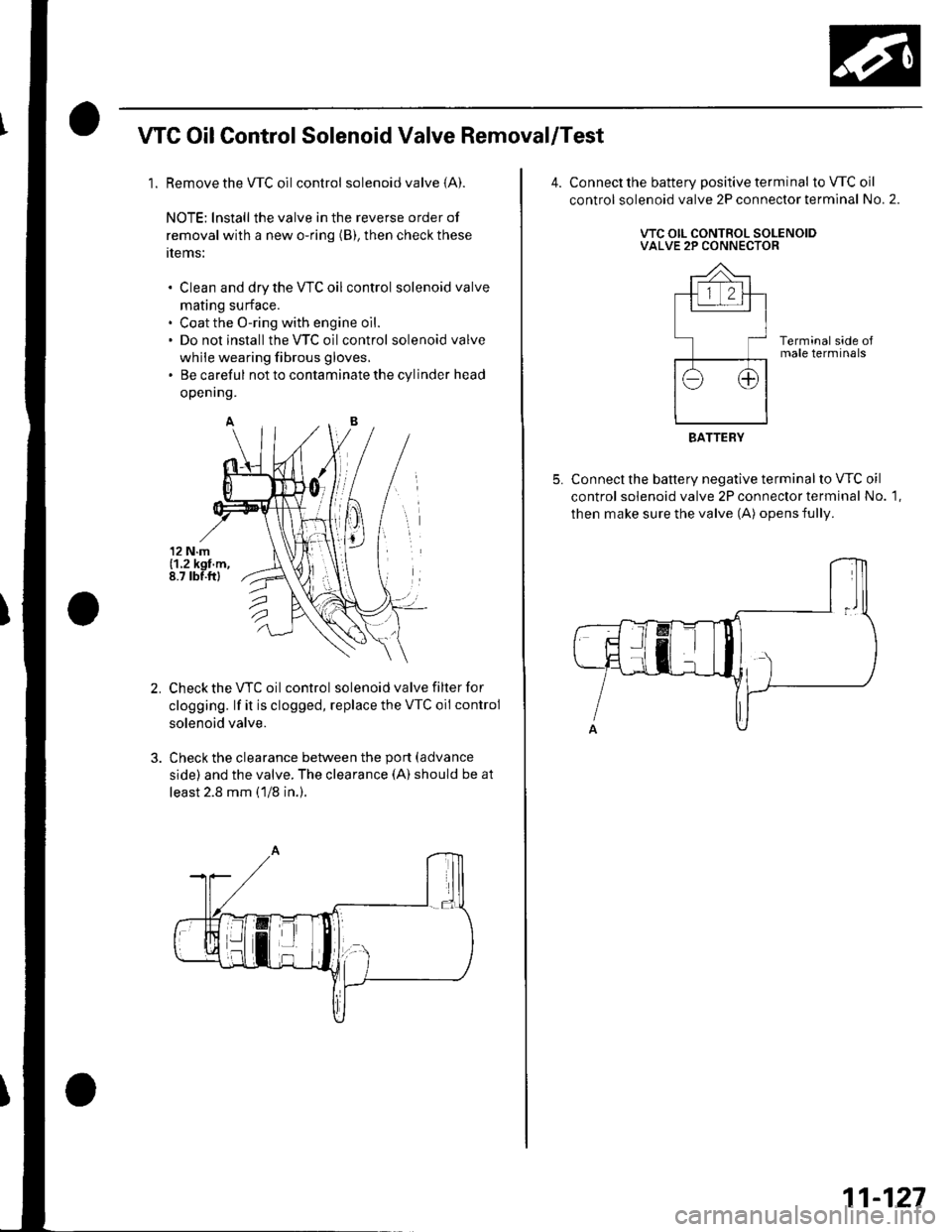
WC OilControl Solenoid Valve Removal/Test
1. Remove the WC oilcontrol solenoid valve (A).
NOTE: lnstall the valve in the reverse order of
removal with a new o-ring (B), then check these
tlems:
Clean and dry the VTC oil control solenoid valve
mating surface.
Coat the O-ring with engine oil.
Do not install the VTC oilcontrol solenoid valve
while wearing fibrous gloves,
Be careful not to contaminate the cylinder head
openrng.
Check the VTC oil control solenoid valve filter for
clogging. lf it is clogged, replace the VTC oil control
solenoid valve.
Check the clearance between the port (advance
side) and the valve. The clearance (A) should be at
least 2.8 mm (1/8 in.).
Connect the battery positive terminal to VTC oil
control solenoid valve 2P connector terminal No. 2.
VTC OIL CONTROL SOLENOIDVALVE 2P CONNECTOR
Terminal side oJmale terminals
Connect the battery negative terminal to VTC oil
control solenoid valve 2P connector terminal No. 1,
then make sure the valve (A) opens fully.
BATTERY
11-127