Pump HONDA CIVIC 2002 7.G Repair Manual
[x] Cancel search | Manufacturer: HONDA, Model Year: 2002, Model line: CIVIC, Model: HONDA CIVIC 2002 7.GPages: 1139, PDF Size: 28.19 MB
Page 390 of 1139
25.
26.
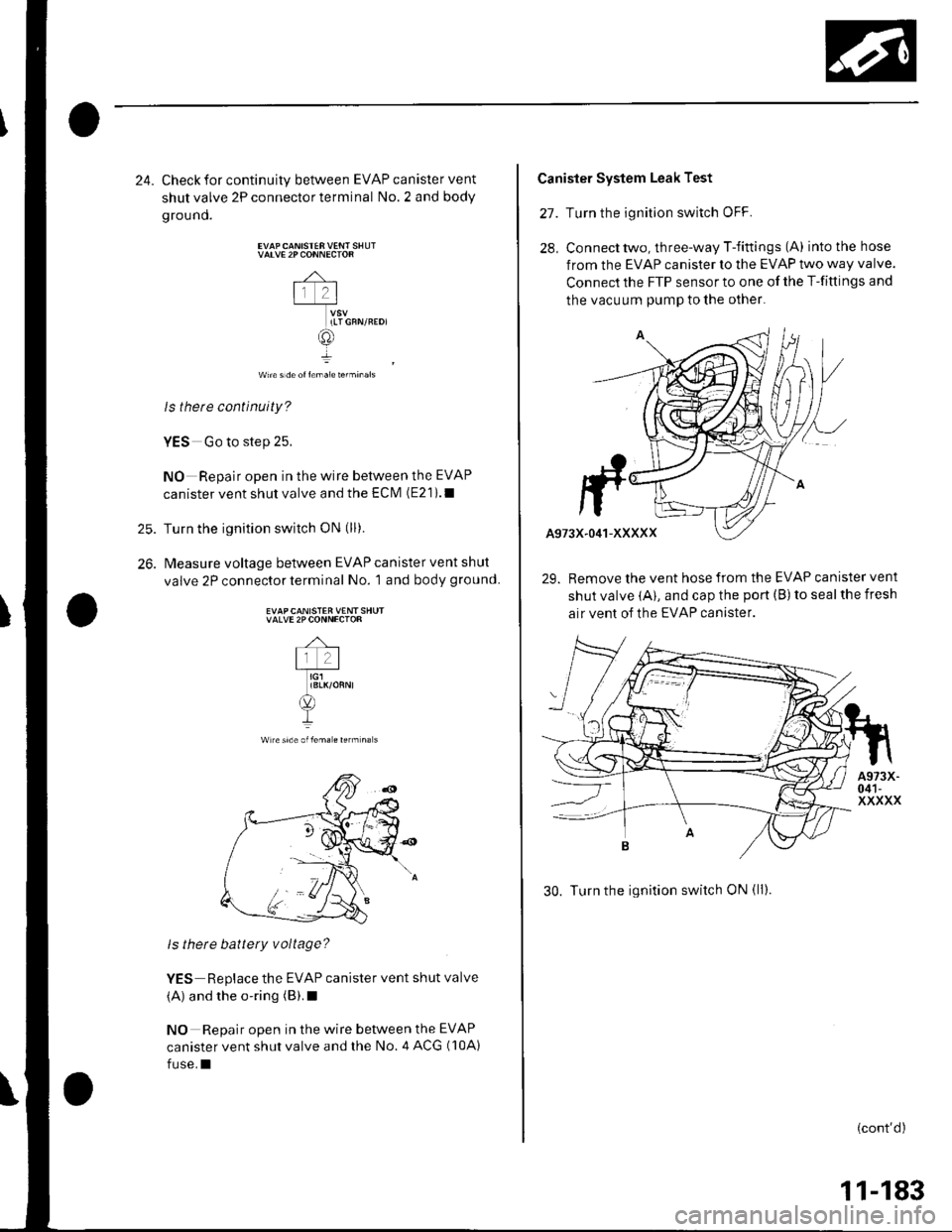
24. Check for continuity between EVAP canister vent
shutvalve 2Pconnectorterminal No.2 and body
ground.
VATVE 2P CONNECTOR
-4-
lr 2l-T_*u
ILTGFN/REDI
@
wn€ s de ol l€ma1e terminals
ls therc continuity?
YES Go to step 25.
NO Repair open in the wire between the EVAP
canister vent shut valve and the ECIVI (E21).1
Turn the ignition switch oN (ll).
Measure voltage between EVAP canister vent shut
valve 2P connector terminal No. 1 and body ground.
EVAPCANISTER VENT SHUTVALVE 2PCONNECTOR
Wlreside oflem. € rerm na s
ls there battery voltage?
YES Replace the EVAP canister vent shut valve
(A) and the o-ring (B).I
NO Repair open in the wire between the EVAP
canister vent shut valve and the No. 4 ACG (10A)
fuse.I
Canister System Leak Test
27. Turn the ignition switch oFF.
28, Connecttwo, three-way T-fittings (A) intothehose
from the EVAP canister to the EVAP two way valve.
Connect the FTP sensor to one of the T-fittings and
the vacuum pump to the othel
29. Remove the vent hose from the EVAP canister vent
shut valve (A), and cap the port (B) to seal the fresh
air vent of the EVAP canister.
30. Turn the ignition switch ON (ll).
(cont'd)
11-183
Page 391 of 1139
EVAP System
DTC Troubleshooting (cont'dl
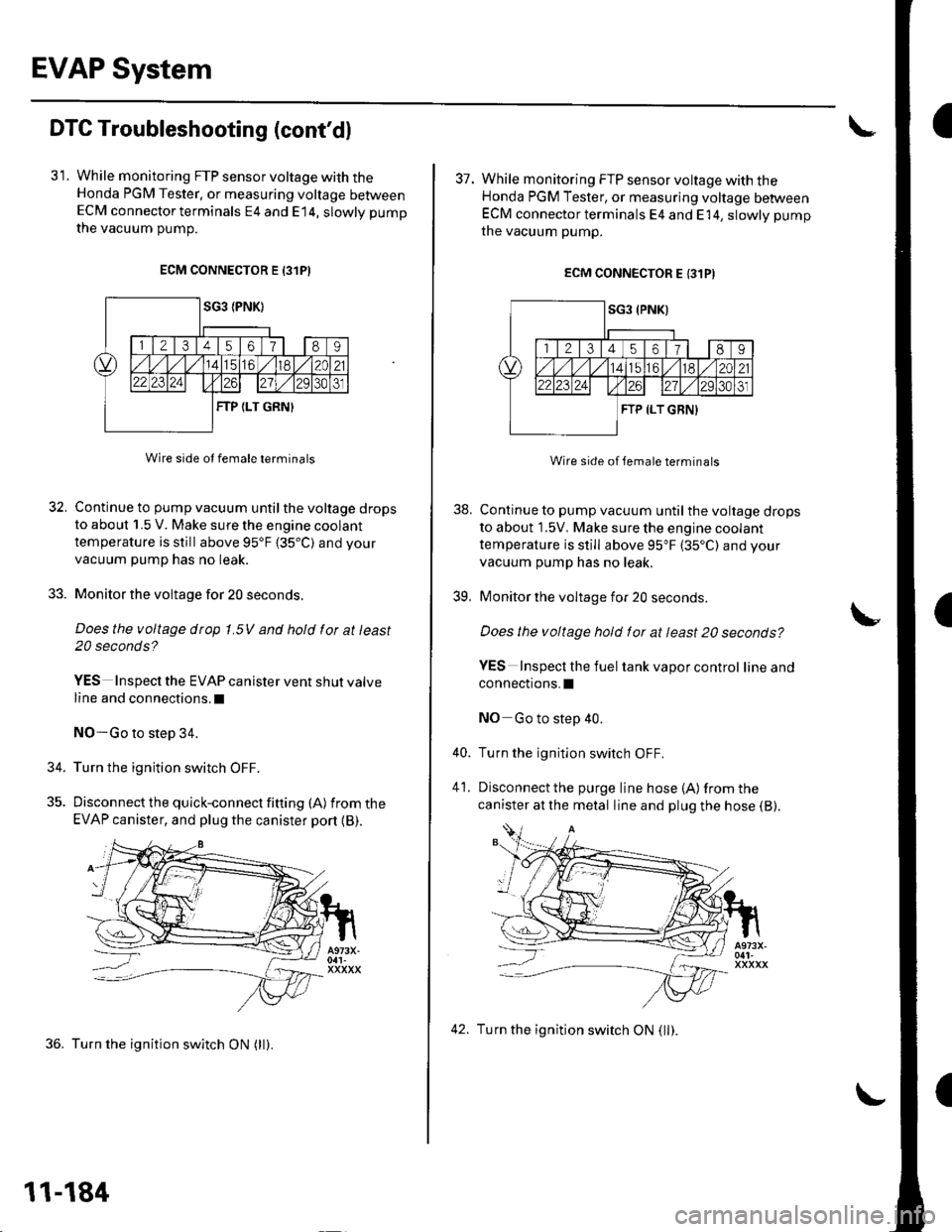
31. While monitoring FTP sensor voltage with theHonda PGM Tester, or measuring voltage betweenECM connector terminals E4 and E14, slowly pump
the vacuum oumD.
ECM CONNECTOR E 13lPI
Wire side ot female terminals
32. Continue to pump vacuum until the voltage drops
to about 1.5 V. Make sure the engine coolant
temperature is still above 95'F 135.C) and your
vacuum pump has no leak.
33. Monitor the voltage for 20 seconds.
Does the voltage drop 1.5V and hold for at least
20 seconds?
YES Inspect the EVAP canister vent shut valve
line and connections.l
NO-Go to step 34.
34. Turn the ignition switch OFF.
35. Discon nect the quick-con nect fitting (A) fromthe
EVAP canister, and plug the canister port {B).
36. Turn the ignition switch ON (ll).
11-184
42. Turn the ignition switch ON (ll).
I
38.
39.
37. While monitoring FTP sensor voltage with theHonda PGM Tester, or measuring voltage betweenECM connector terminals E4 and E 14, slowly pump
the vacuum pump.
ECM CONNECTOR E {31PI
Wire side of lemale terminals
Continue to pump vacuum until the voltage drops
to about 1.5V. Make sure the engine coolant
temperature is still above 95"F (35"C) and your
vacuum pump has no leak.
Monitor the voltage for 20 seconds
Does the voltage hold for at least 20 seconds?
YES Inspecl the fuel tank vapor control lineand
connections.I
NO Go to step 40.
Turn the ignition switch OFF.
Disconnect the purge line hose {A) from the
canister at the metal line and plug the hose (B).
40.
41.
Page 392 of 1139
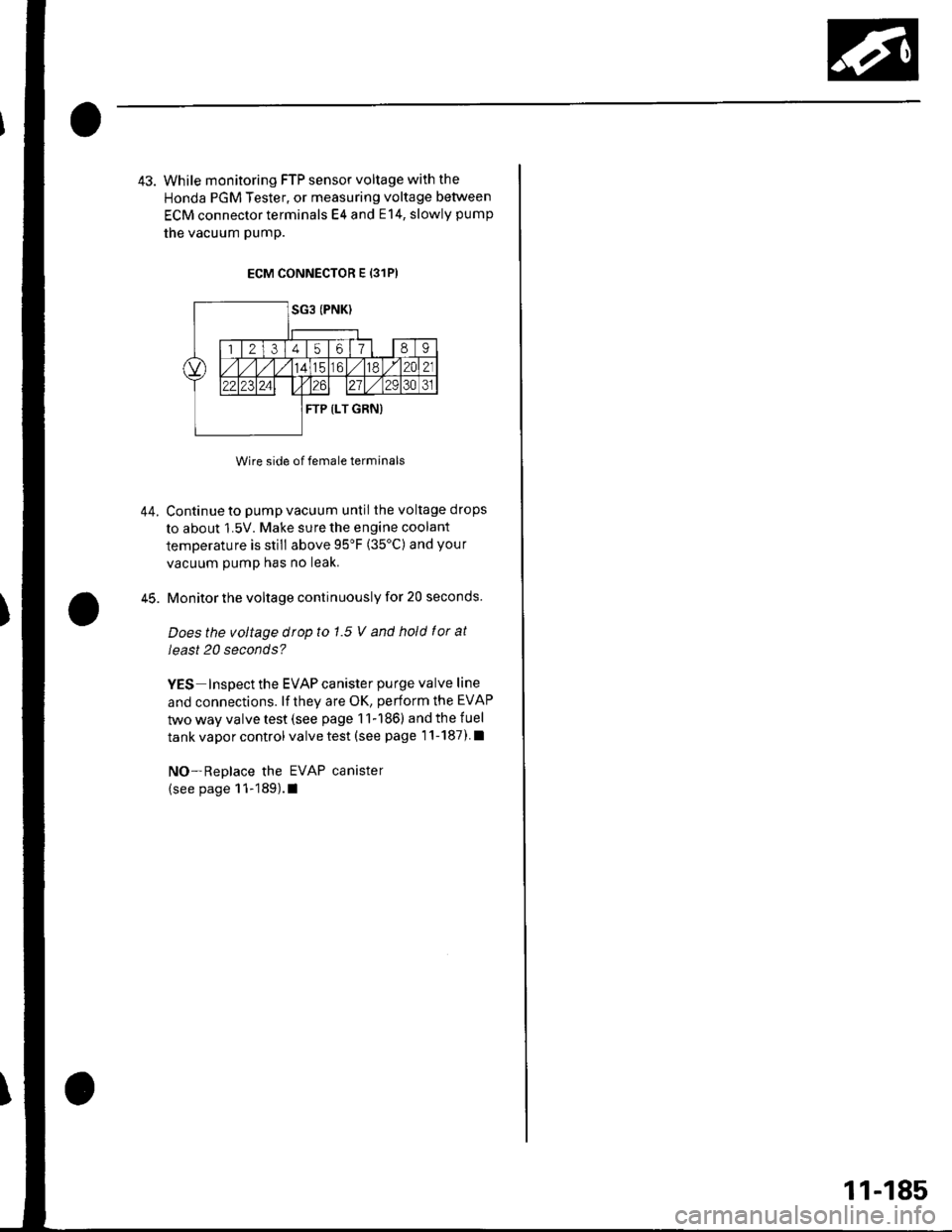
43. While monitoring FTP sensor voltage with the
Honda PGM Tester, or measuring voltage between
ECM connector terminals E4 and E14, slowly pump
the vacuum pump.
ECM CONNECTOR E {31P)
Wire side of female terminals
Continue to pump vacuum until the voltage drops
to about 1.5V. Make sure the engine coolant
temperature is still above 95'F (35'C) and your
vacuum pump has no leak.
Monitor the voltage continuously for 20 seconds.
Does the voltage drop to 1.5 V and hold f or at
least 20 seconds?
YES Inspect the EVAP canister purge valve line
and connections. lf they are OK, perform the EVAP
two way valve test (see page 11-186) and the fuel
tank vapor control valve test (see page 1'l-187) l
NO-Replace the EVAP canister
(see page 11-189).1
44.
45.
11-185
Page 393 of 1139
EVAP System
EVAP Two Way Valve Test
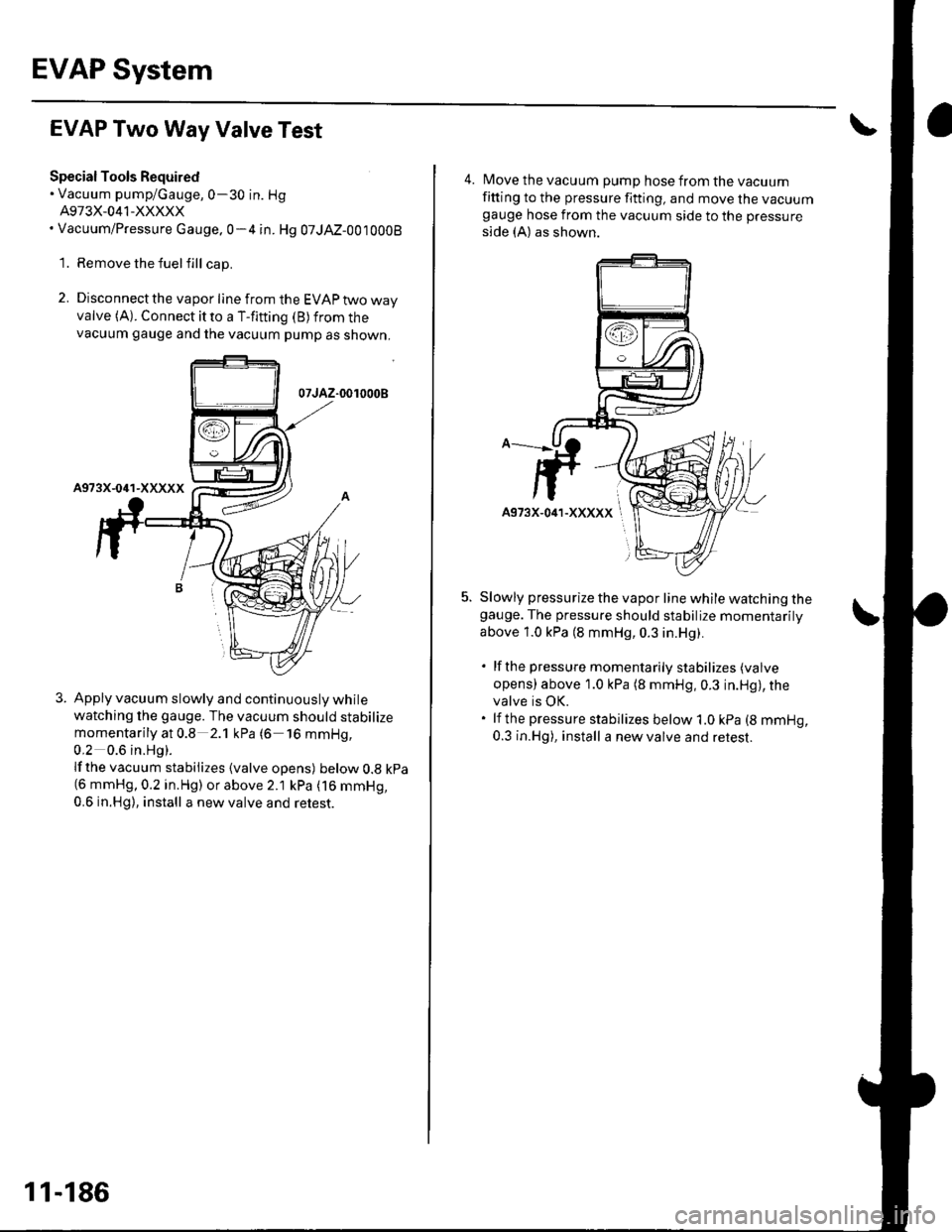
Special Tools Required. Vacuum pump/Gauge,0-30 in. Hg
A973X-041-XXXXX. Vacuum/Pressure cauge.0-4 in. Hg 07JAZ-0010008
1. Remove the fuelfill cap.
2. Disconnect the vapor line from the EVAP two wayvalve (A). Connect it to a T-fitting (B) from thevacuum gauge and the vacuum pump as shown,
07JAZ-0010008
Apply vacuum slowly and continuously while
watching the gauge. The vacuum should stabilize
momentarily at 0.8 2.1 kPa (6 16 mmHg,
0,2 0.6 in.Hg).
lf the vacuum stabilizes {valve opens) below 0.8 kpa(6 mmHg,0.2 in.Hg) or above 2.1 kPa (16 mmHg,
0.6 in.Hg), install a new valve and retest.
11-186
4. Move the vacuum pump hose from the vacuumfitting to the pressure fitting, and move the vacuumgauge hose from the vacuum side to the pressure
side (A) as shown.
Slowly pressurize the vapor line while watching thegauge. The pressure should stabilize momentarilV
above 1.0 kPa (8 mmHg, 0.3 in.Hg).
. lfthe pressure momentarily stabilizes (valve
opens) above 1.0 kPa (8 mmHg,0.3 in.Hg), thevalve is OK.. lf the pressure stabilizes below 1.0 kPa (8 mmHg,
0.3 in.Hg), install a new valve and retest.
Page 394 of 1139
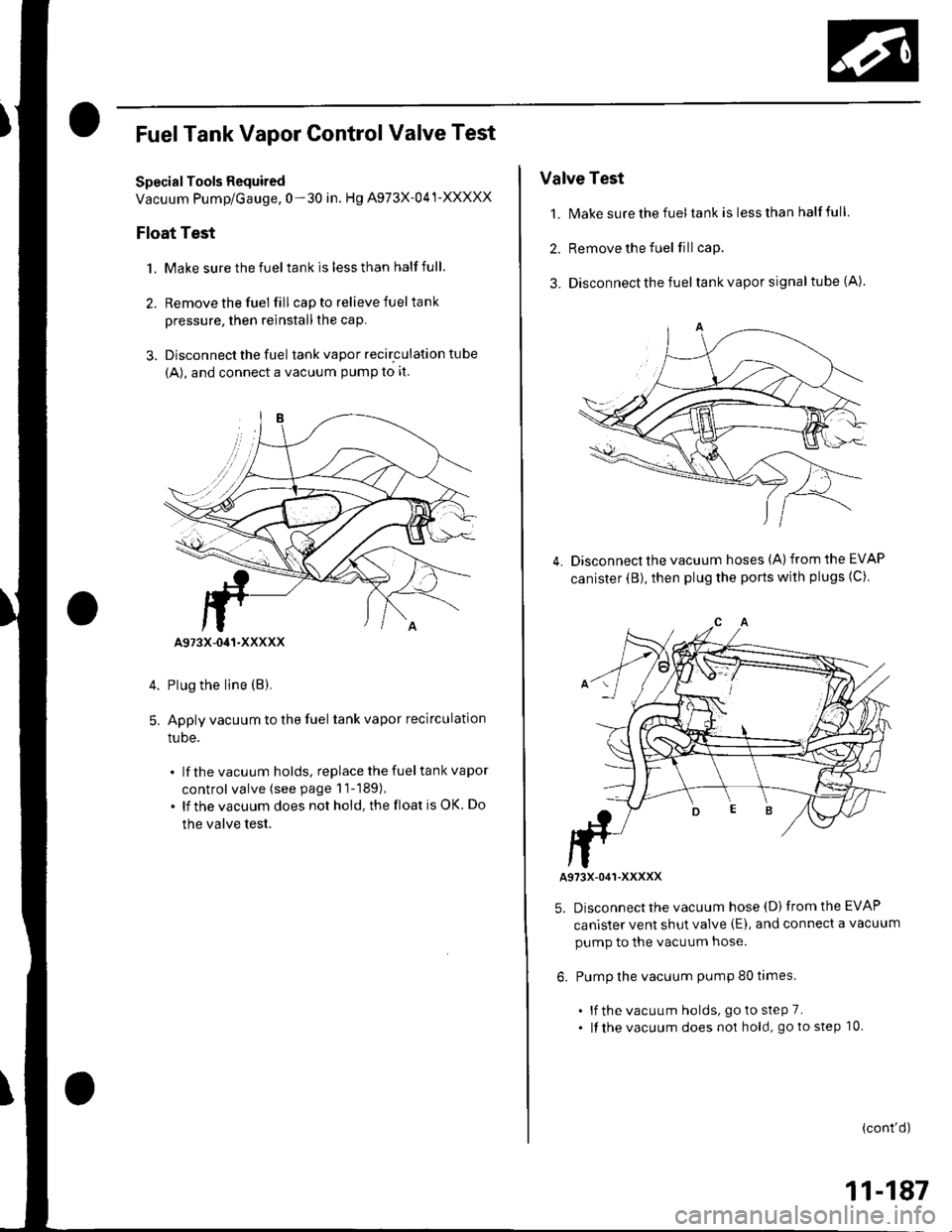
FuelTank Vapor Control Valve Test
Special Tools Required
Vacuum Pump/Gauge, 0-30 in. Hg A973X-041-XXXXX
Float Test
1. Make sure the fuel tank is less than half full.
2. Remove the fuel fill cap to relieve fuel tank
pressure, then reinstall the cap.
3. Disconnect the fuel tank vapor recirculation tube
{A), and connect a vacuum PumP to it.
Plug the line (B).
Apply vacuum to the fuel tank vapor recirculation
tuDe.
lf the vacuum holds, replace the fuel tank vapor
control valve (see page 11-189).
lf the vacuum does not hold, the float is OK. Do
the valve test.
5.
A973X-041-XXXXX
Valve Test
1. N4ake sure the fuel tank is less than half full
2. Remove the fuel fill cap.
3. Disconnect the fuel tank vapor signal tube (A).
Disconnect the vacuum hoses (A) from the EVAP
canister (B), then plug the ports with plugs (C)4.
A973X-O41-XXXXX
5. Disconnect the vacuum hose (D) from the EVAP
canister vent shut valve (E), and connect a vacuum
pump to the vacuum hose.
6. Pump the vacuum pump 80 times.
. lf the vacuum holds, goto steP 7.. lf the vacuum does no1 hold, go to step 10.
(cont'd)
11-187
Page 395 of 1139
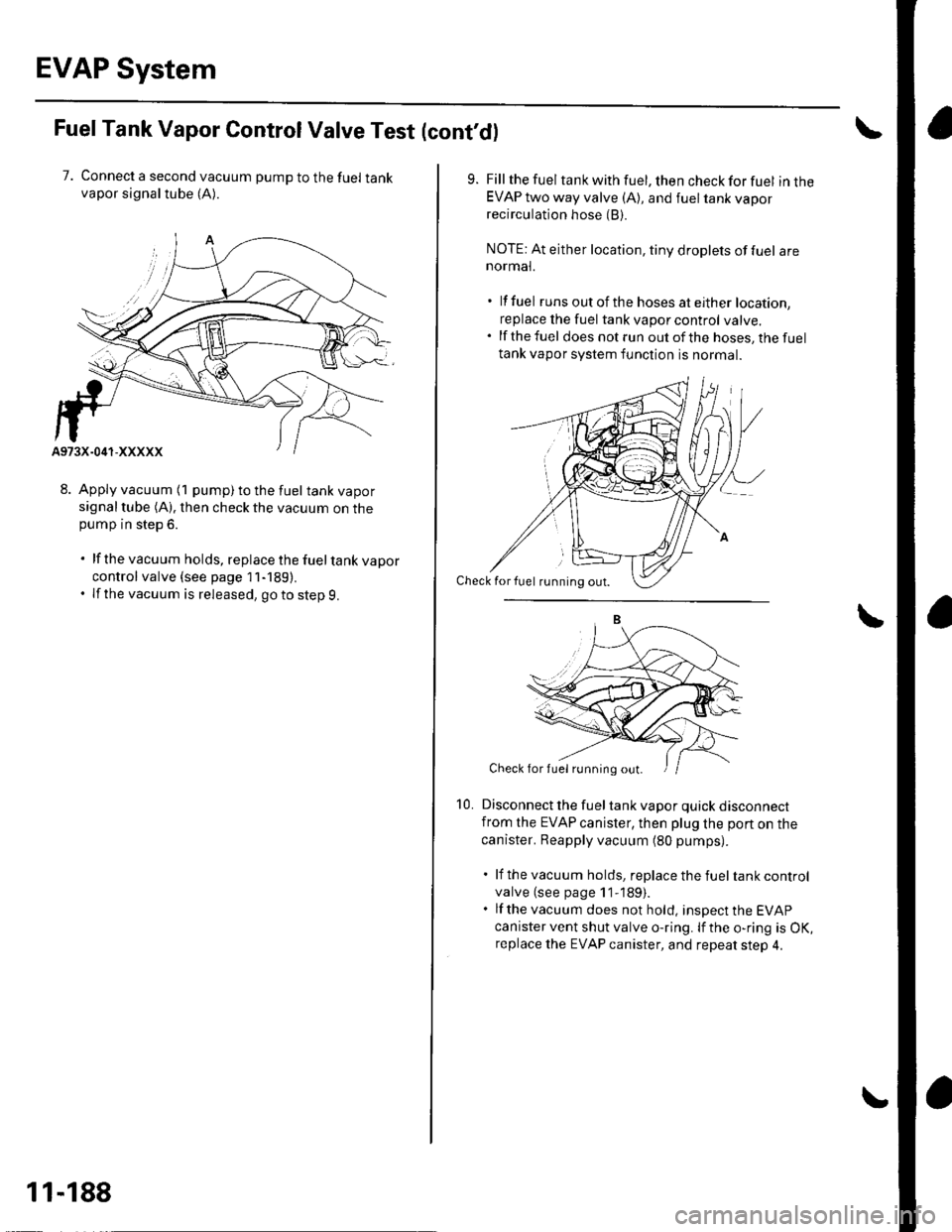
EVAP System
FuelTank Vapor ControlValve Test (cont'd)
7. Connect a second vacuum pump to the fuel tankvapor signaltube (A).
8. Apply vacuum (1 pump) to the fuel tank vaporsignal tube (A). then check the vacuum on thepump in step 6.
. lf the vacuum holds, replace the fueltank vapor
control valve {see page 11-189).. If the vacuum is released, goto step 9.
11-188
10.
Fill the fuel tank with fuel, then check for fuel in theEVAP two way valve (A), and fuel tank vaporrecirculation hose (B).
NOTE: At either location, tiny droplets of fuel arenormal.
. lf fuel runs out of th e hoses at either location,
replace the fuel tank vapor control valve..lfthefuel does not run out of the hoses, the fuel
tank vapor system function is normal.
Disconnect the fuel tank vapor quick disconnectfrom the EVAP canister, then plug lhe port on the
canister. Reapply vacuum (80 pumps).
. lf the vacuum holds, replace the fuel tank control
valve (see page 1 1-189).. lf the vacuum does not hold, insDect the EVAP
canister vent shut valve o-ring. lf the o-ring is OK,replace the EVAP canister, and repeat step 4.
Check for fuel rirnning out.
Check for fuel running out.
Page 405 of 1139
Clutch
Slave Cylinder Replacement (cont'd)
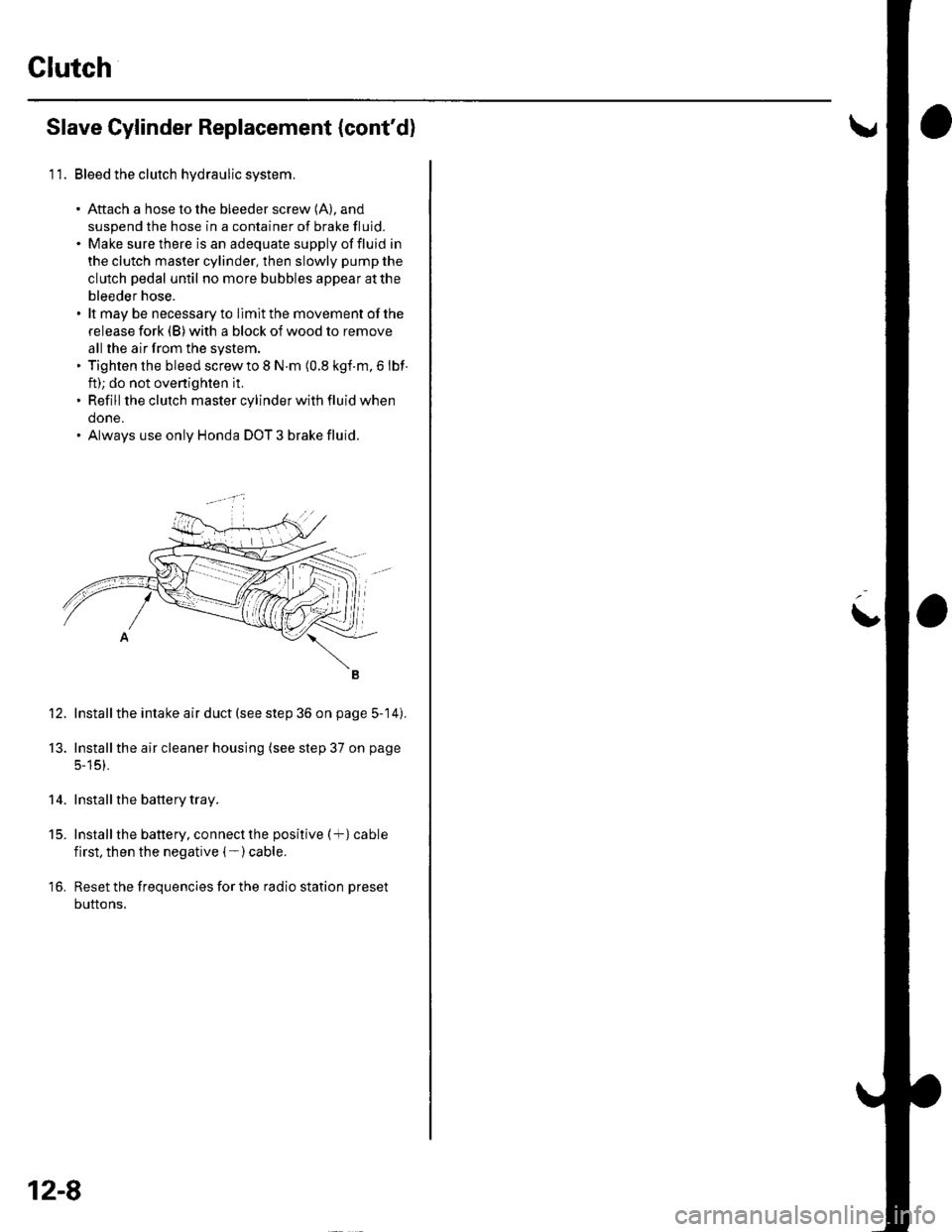
11. Bleed the clutch hydraulic system.
. Aftach a hose to the bleeder screw (A), and
suspend the hose in a container of brake fluid.. Make sure there is an adequate supply offluid in
the clutch master cylinder, then slowly pump the
clutch pedal until no more bubbles appear atthe
bleeder hose.. lt may be necessary to llmit the movement of the
release fork (B) with a block of wood to remove
all the air from the system.. Tighten the bleed screw to I N.m (0.8 kgf.m, 6 lbf
ft); do not ovenighten it,. Refill the clutch master cylinder with fluid when
done.. Always use only Honda DOT 3 brake fluid.
Install the intake air duct (see step 36 on page 5-14).
Installthe air cleaner housing (see step 37 on page
5-15).
Install the battery tray.
Install the battery, connect the positive (+) cable
first, then the negative (- ) cable.
Reset the frequencies for the radio station preset
buttons,
12.
13.
14.
t5.
16.
12-8
L
Page 600 of 1139
Rapid brake pad wear. Vehicle vibration {after a long
drivel, or High, hard brake pedal
1. Drive the vehicle until the brakes drag or untilthe
pedal is high and hard. This can take 20 or more
brake pedal applications during an extended test
drive.
2. With the engine running, raise the vehicle on a lift,
and spin all four wheels by hand.
ls there btake drag at any of the wheels?
YES Go to step 3.
NO Look for other causes of the pad wear, high
pedal, or vehicle vibration.I
3. Turn the engine off, pump the brake pedal to
deplete the vacuum in the brake booster, and then
spin the wheels again to check for brake drag.
ls therc brake dtag at any ot the wheels?
YES-Go to step 4.
NO Replace the brake booster.I
4. Without removing the brake lines, unbolt and
separate the master cylinder from the booster, then
spin the wheels lo check for brake drag.
ls there btake drag at any of the wheels?
YES Go to step 5,
NO-Check the brake pedal position switch
adjustment and pedal free play.I
5. Loosen the hydraulic lines at the master cylinder,
then spin the wheels to check for brake drag.
ls there brake drag at any of the wheels?
YES Go to step 6.
NO- Replace the master cylinder.l
6. Loosen the bleeder screws at each caliper, then
spin the wheels to check for brake drag.
Is there brake drag at any of the wheels?
YES Disassemble and repair the caliper on the
wheel(s) with brake drag.l
NO Inspect brake hose (s)/line (s).
19-5
Page 603 of 1139
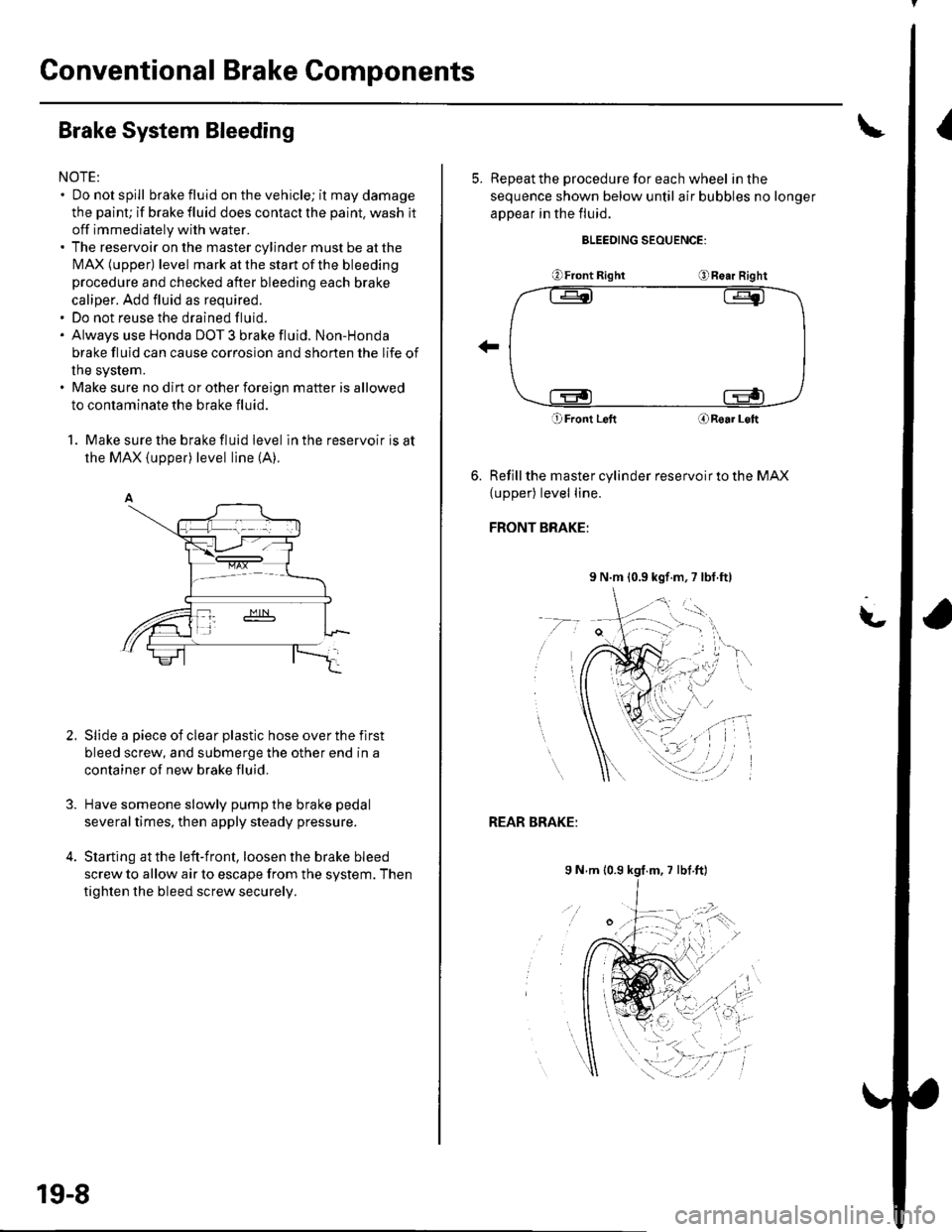
Conventional Brake Components
Brake System Bleeding
NOTE:. Do not spill brake fluid on the vehicle; it may damage
the painU if brake fluid does contact the paint. wash it
off immediately with water.. The reservoir on the master cylinder must be at the
MAX (upper) level mark at the start of the bleeding
procedure and checked after bleeding each brake
caliper. Add fluid as required.. Do not reuse the drained fluid.. Always use Honda DOT 3 brake fluid. Non-Honda
brake fluid can cause corrosion and shorten the life of
the system.. Make sure no din or other foreign matter is allowed
to contaminate the brake fluid.
1. Make sure the brake fluid level in the reservoir is at
the MAX (upper) level line (A).
Slide a piece of clear plastic hose over the flrst
bleed screw, and submerge the other end in a
container of new brake fluid.
Have someone slowly pump the brake pedal
severaltimes, then apply steady pressure.
Starting at the left-front, loosen the brake bleed
screw to allow air to escape from the system. Then
tighten the bleed screw securely.
2.
19-8
5. ReDeatthe procedure for each wheel in the
sequence shown below until air bubbles no longer
appear in the fluid.
BLEEDING SEOUENCE:
OFront RightORe.r Right
O Front LeftORoar Loft
Refill the master cylinder reservoir to the MAX
{upper) level line.
FRONT BRAKE:
9 N.m 10.9 kgf.m,7 lbl.ft)
t-
REAR BRAKE:
9 N m 10.9 kgf.m, 7 lbf ft)
Page 625 of 1139
General Troubleshooting Information
ABS Indicator
. lf the system is OK,theABS indicator goes off 2
seconds after turning the ignition switch ON (ll)
without starting the engine, and then comes on again
and goes off 2 seconds later after starting the engine.
This occurs because the ABS control unitisturned
on by the lG2 power source.. The ABS indicator comes on when the ABS control
unit detects a problem in the system. However, even
though the system is operating properly, the indicator
will come on under these conditions:- Only the drive wheels rotate- One drive wheel is stuck- The vehicle goes into a spin- The ABS continues to operate for a long time.- The vehicle is subjected to an electrical signal
disturbance
To determine the actual cause of the problem, question
the customer about the problem. taking the above
condilions into consideration.
. When a Droblem is detected and lhe ABS indicator
comes on, there are cases when the indicator stays
on until the ignition switch is turned OFF, and cases
when the indicator goes off automatically when the
sYstem returns to normal.- DTC 61: The ABS indicator goes off automatically
when the system returns to normal.- DTC 11, 13,15,17 ,31,32,33, 34, 35, 36, 37, 38, 54,
or 81: The ABS indicator stays on until the ignition
switch is turned OFF whether or not the system
returns to normal.- DfC 12, 14, 16, 1a,21,51,52, or 53; The ABS
indicator goes off when the vehicle is driven again
and the system is OK after the ignition switch is
turned from OFF to ON {ll}.
Diagnostic Trouble Code {DTCI
. The memory can hold three DTCS. However, when
the same DTC is detected more than once, the more
recent DTC is written over the earlier one.
Therefore, when the same problem is detected
repeatedly, it is memorized as a single DTC.. The DTCs are in the order they occurred, beginning
with the most recent.. The DTCS are memorized in the EEPROM (non-
volatile memory). Therefore. the memorized DTCs
are not cleared when the battery is disconnected, the
ignition switch is turned off, or the system returns to
normal. Do the specified procedures to clear the
DTCs.
Self-diagnosis
. Self-diagnosis can be classified into two categories:- Initial diagnosis:
Done right after the engine starts and until the ABS
indicator goes off- Regular diagnosis:
Done rightafterthe initial diagnosis until the
ignition switch is turned OFF. When a problem is detected by self-diagnosis, the
system does the following:- Turns the ABS indicator on- Memorizes the DTC- Stops ABS control
Kickback
The pump motor operates when the ABS is functioning,
and the fluid in the reservoir is forced out to the master
cylinder, causing kickback at the brake pedal.
Pump Motor
. The pump motor operates when the ABS is
functioning.. The ABS control unit checks the pump motor
operation when the vehicle is started the first time
after the ignition switch is turned ON (ll). You may
hear the motor operate at this time, but it is normal.
(cont'd)
19-31