Rear suspension HONDA CIVIC 2003 7.G User Guide
[x] Cancel search | Manufacturer: HONDA, Model Year: 2003, Model line: CIVIC, Model: HONDA CIVIC 2003 7.GPages: 1139, PDF Size: 28.19 MB
Page 561 of 1139
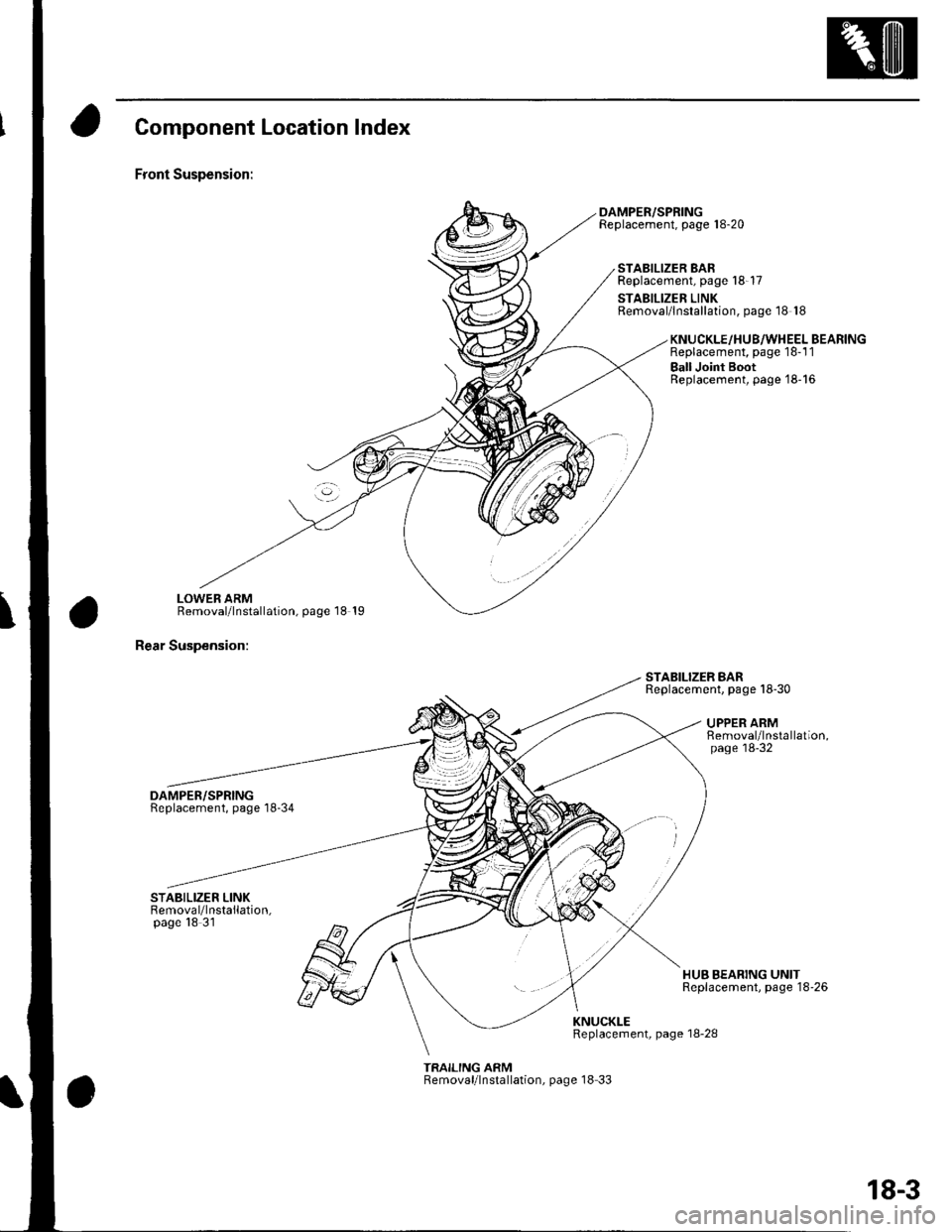
Component Location Index
Front Suspension:
LOWEB ARMRemoval/lnstallation, page 18 19
Rear Suspension:
DAMPER/SPRINGReplacement, page'18-34
DAMPER/SPRINGReplacement, page 18-20
STABILIZER BARReplacement, page 18-17
STABILIZER LINKRemoval/lnstallation, page 18 18
STABILIZER BARReplacement. page 18-30
KNUCKLE/HU8/WHEEL BEARINGReplacement, page 18-1 1
Ball Joint BootReplacement, page'18-16
UPPER ARMRemoval/lnstallation,page'18-32
HUB BEARING UNITReplacement, page 18'26
KNUCKLEReplacement, page 18-28
TRAILING ARMRemoval/lnstallation, page 18 33
18-3
Page 562 of 1139
Front and Rear Suspension
WheelAlignment
The suspension can be adjusted for front camber, front
toe, and rear toe. However, each of these adjustments
are interrelated to each other. For example, when you
adjust the toe, the camber changes. Therefore, you
must adjust the front wheel alignment whenever you
adjust the camber or toe.
Pre-Alignment Checks
For proper inspection and adjustment of the wheel
alignment, do these checks:
1. Release the parking brake to avoid an incorrect
measurement.
Make sure the suspension is not modified.
Check the tire size and tire pressure
Tire size:
Front/rear: 195/60R15
Tire pressure:
Front: 230 kPa {2.3 kgf/cm',33 psil
Rear: 210 kPa |'2.1 kgf/cm', 30 psi)
Check the runout of the wheels and tires.
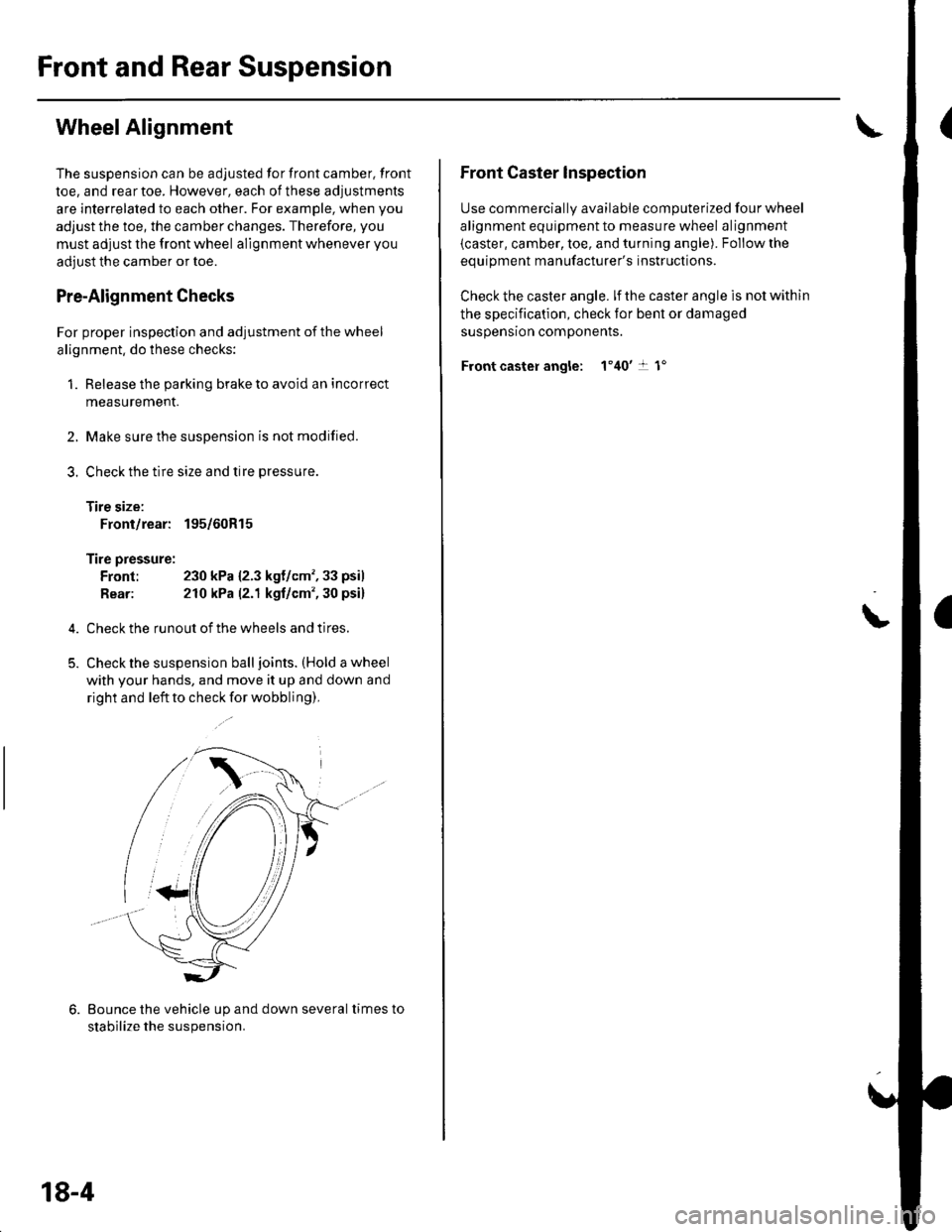
Check the suspension ball joints. (Hold a wheel
with your hands, and move it up and down and
right and left to check for wobbling),
2.
3.
Bounce the vehicle up and down several times to
stabilize the suspension.
18-4
Front Caster lnspection
Use commerciallv available comDuterized four wheel
alignment equipment to measure wheel alignment
(caster, camber, toe, and turning angle). Follow the
eouioment manufacturer's instructions.
Check the caster angle. lf the caster angle is not within
the specification, check for bent or damaged
susoensron comoonents.
Front caster angle: 1'40't 1"
\
Page 564 of 1139
Front and Rear Suspension
Wheel Alignment (cont'd)
7.
Raise the front of the vehicle, and support it with
safety stands in the proper location (see page 1-8).
Remove the front wheels.
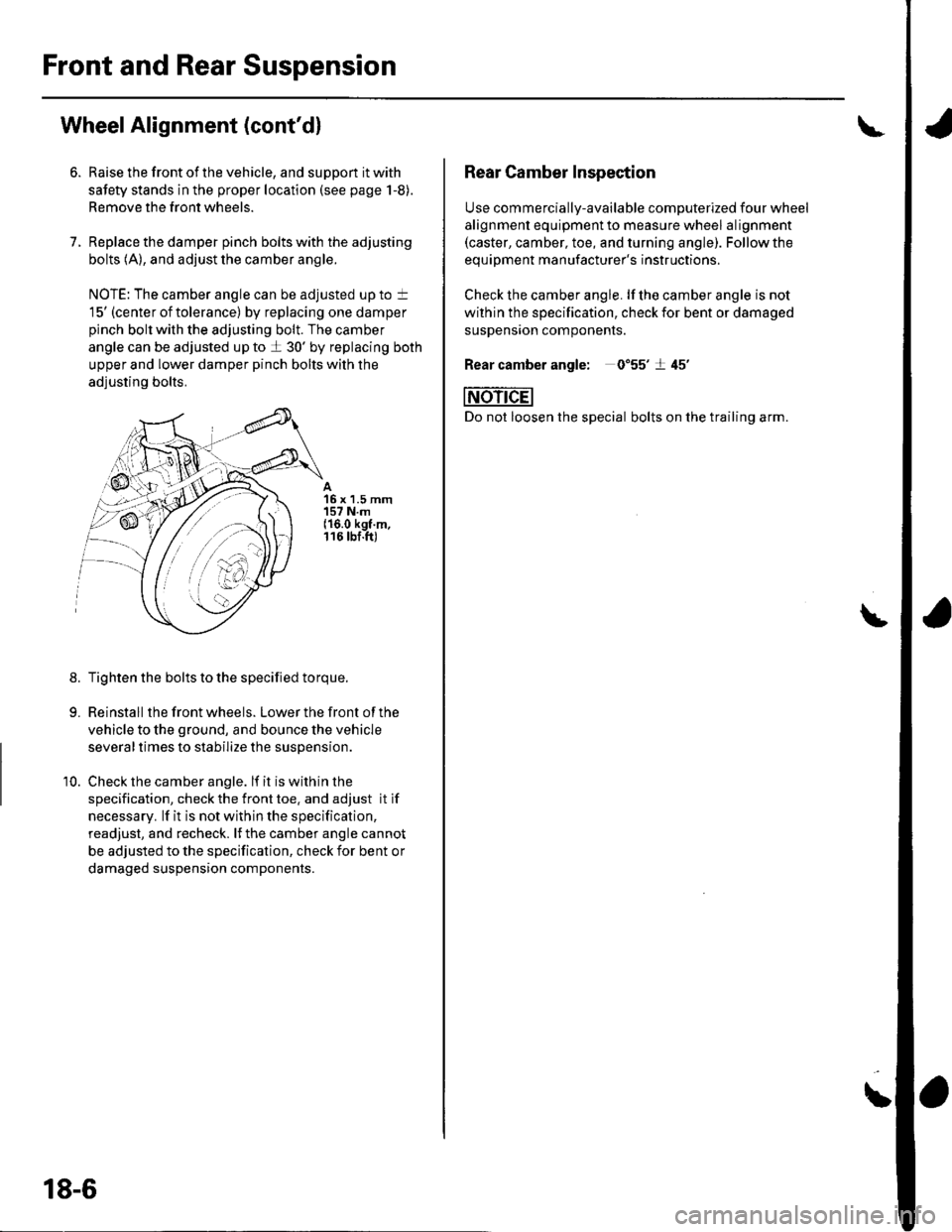
Replace the damper pinch bolts with the adjusting
bolts (A), and adjust the camber angle.
NOTE: The camber angle can be adjusted up to t
15' (center of tolerance) by replacing one damper
pinch bolt with the adjusting bolt. The camber
angle can be adjusted up to a 30' by replacing both
upper and lower damper pinch bolts with the
adjusting bolts.
15 x 1.5 mm157 N.m{16.0 kgt.m,116 tbf.ft)
8.Tighten the bolts to the specified torque.
Reinstall the front wheels. Lower the front of the
vehicle to the ground, and bounce the vehicle
several times to stabilize the suspension.
Check the camber angle. lf it is within the
specification, check the front toe. and adjust it if
necessary. lf it is not within the specification,
readjust, and recheck. lJ the camber angle cannot
be adjusted to the specification, check for bent or
damaged suspension components.
10.
'rntr
i,iY. a
.:r,//
18-6
Rear Camber Inspection
Use commercially-available computerized four wheel
alignment equipment to measure wheel alignment(caster, camber, toe, and turning angle). Follow the
eouiDment manufacturer's instructions.
Check the camber angle. lf lhe camber angle is not
within the specification, check for bent or damaged
susDenston comoonenrs.
0"55't 45'
bolts on the trailing arm.
Rear camber angle: 0
NOn-dEl
Do not loosen the special
\
Page 566 of 1139
Front and Rear Suspension
Wheel Alignment (cont'dl
Turning Angle Inspection
Use commercially-available computerized four wheel
alignment equipment to measure wheel alignment(caster. camber, toe, and turning angle). Followthe
equiDment manufacturer's instructions.
1. Turn the steering wheel fullytotherightandleft
while applying the brake, and check the turning
angles of both front wheels, lf the turning angle is
not within the specification or the inward turning
angles differ between the right and left side, go to
steD 2.
Turning angle:
lnward: 34'00'+ 2'
Outward: 28'00' {reference)
Check the toe. lf it is correct, but the turning angle
is not within the specification, check ior bent or
damaged suspension components,
18-8
Wheel Bearing End Play Inspec'tion
1. Raise lhe vehicle, and support it with safety stands
in the proper location (see page 1-8). Remove the
wheels.
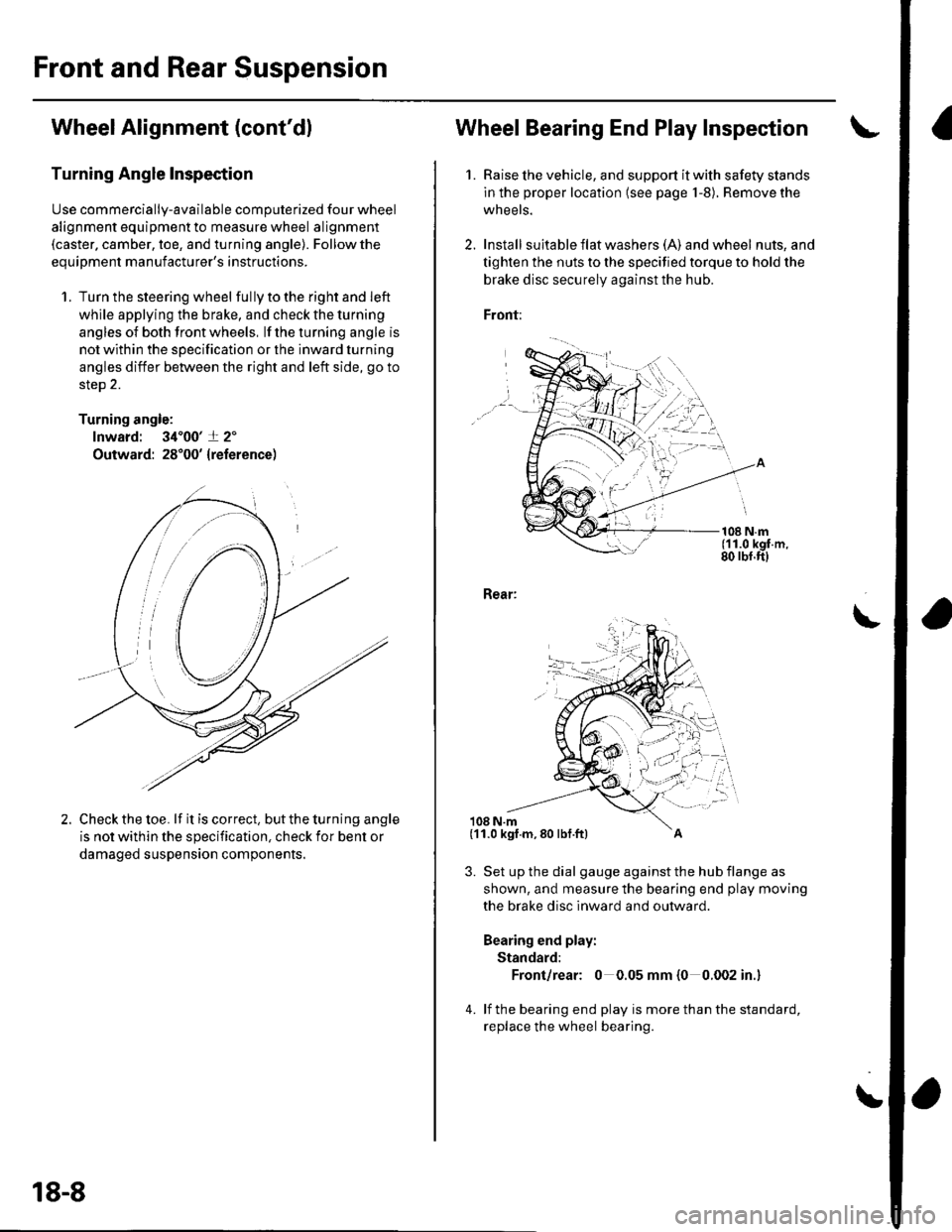
2. Install suita ble f lat washe rs (A) and wheel nuts, and
tighten the nuts to the specified torque to hold the
brake disc securely against the hub.
Front:
108 N.m(11.0 kgf.m,80 rbf.ft)
Rear:
108 N.m
3. Set up the dial gauge against the hub flange as
shown, and measure the bearing end play moving
the brake disc inward and outward.
Bearing end play:
Standard:
Front/rear: 0 0.05 mm {0 0.002 in.}
4. lf the bearing end play is more than the standard,
replace the wheel bearing.
\
(11.0 kgf.m,80 lbf.ft)
Page 568 of 1139
Front and Rear Suspension
BallJoint Removal
Special Tools Required
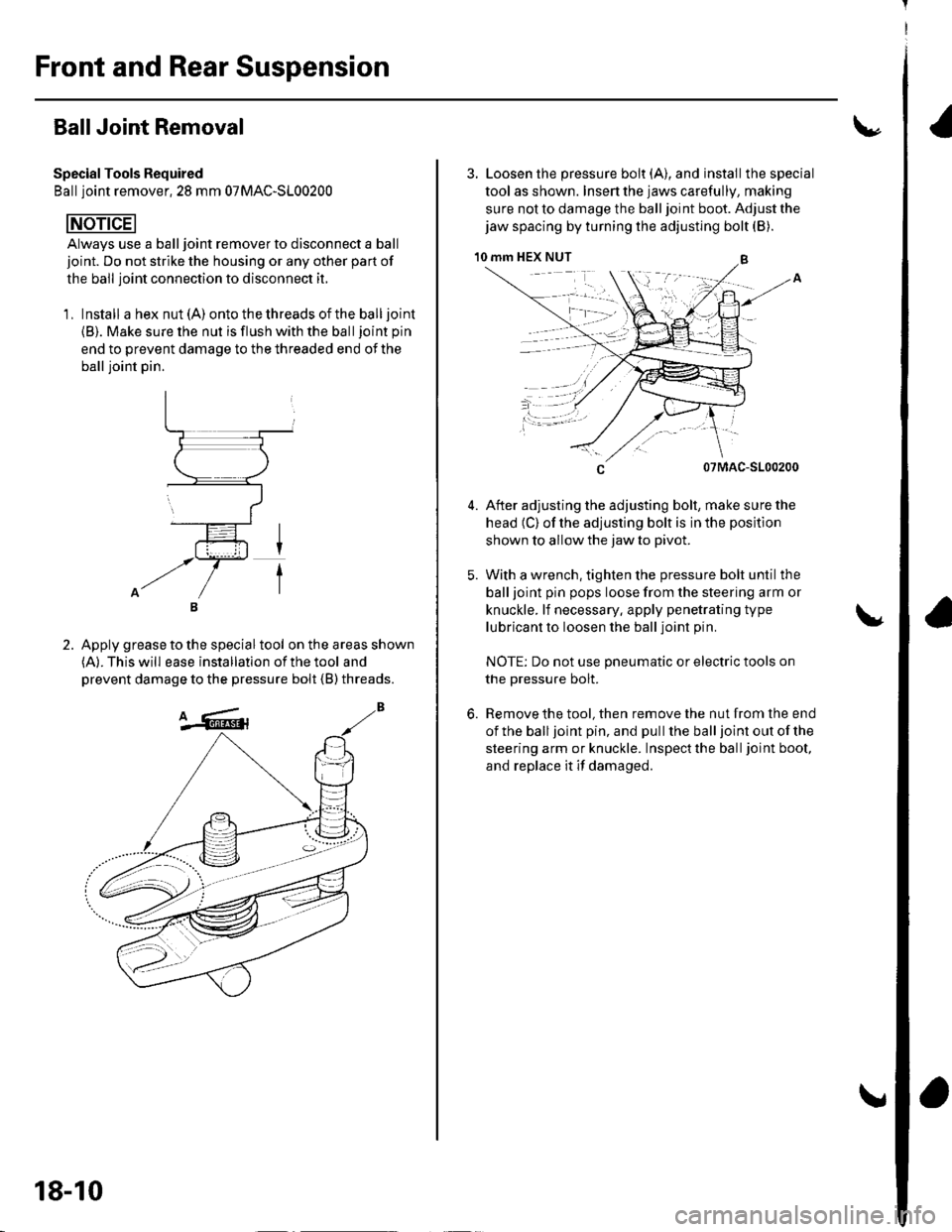
Ball ioint remover.2S mm 07MAC-SL00200
Always use a ball joint remover to disconnect a ball
joint. Do not strike the housing or any other part of
the ball joint connection to disconnect it.
'1, Install a hex nut (A) ontothethreadsoftheballjoint
{B). Make sure the nut is flush with the balljoint pin
end to prevent damage to the threaded end of the
ball ioint oin.
Apply grease to the special tool on the areas shown(A). This will ease installation of the tool and
prevent damage to the pressure bolt {B) threads.
2.
18-10
3. Loosen the pressure bolt (A), and installthe special
tool as shown. Insen the jaws carefully, making
sure not to damage the ball joint boot. Adjust the
jaw spacing by turning the adjusting bolt (B).
10 mm HEX NUT
5.
07MAC-S100200
After adjusting the adjusting bolt, make sure the
head (C) of the adjusting bolt is in the position
shown to allow the jaw to pivot.
With a wrench, tighten the pressure bolt until the
ball ioint pin pops loose from the steering arm or
knuckle. lf necessary. apply penetrating type
lubricant to loosen the ball joint pin
NOTE: Do not use pneumatic or electric tools on
the pressure bolt.
Remove the tool, then remove the nut from the end
ofthe balljoint pin, and pullthe balljoint out ofthe
steering arm or knuckle. Inspectthe balljoint boot,
and replace it if damaged.
6.
Page 584 of 1139
Rear Suspension
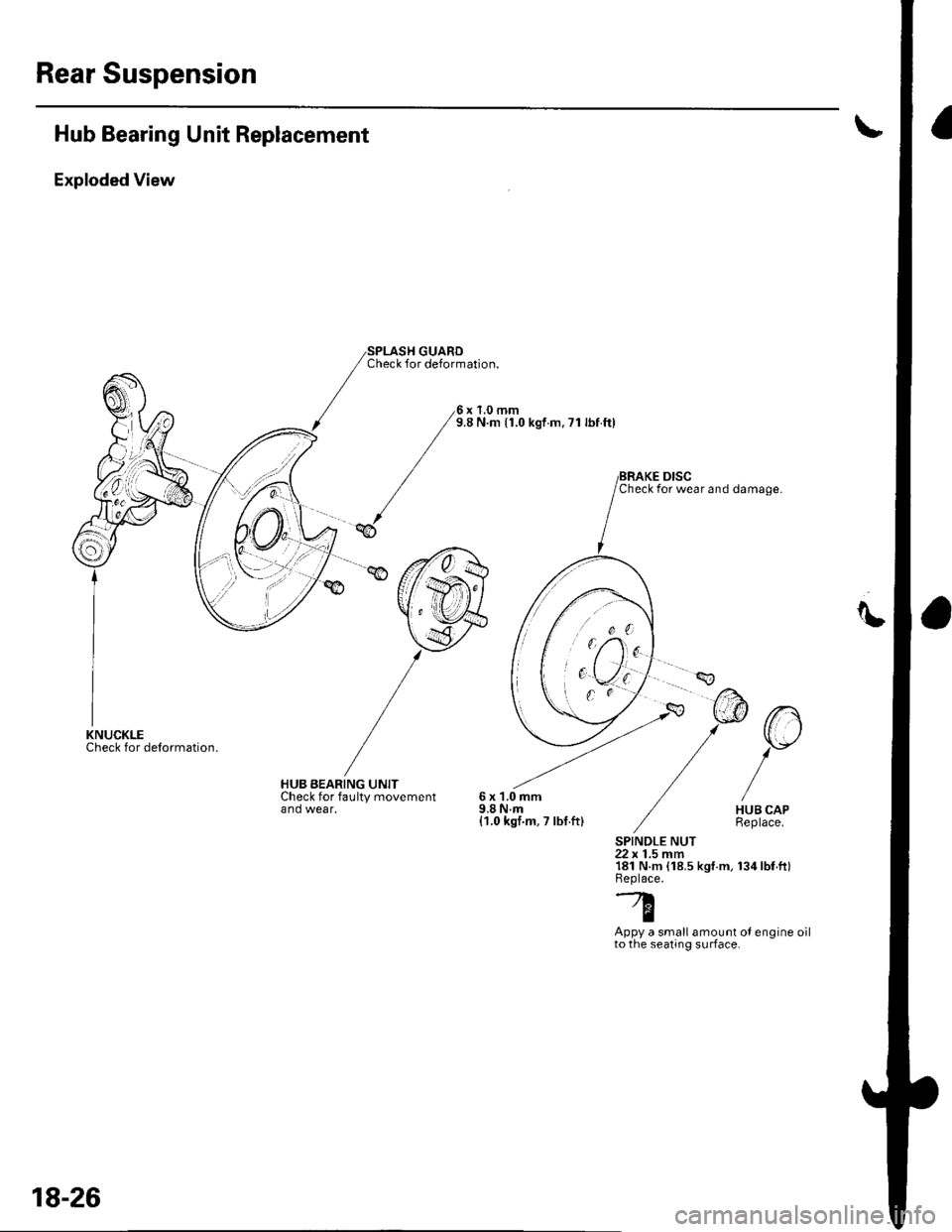
Hub Bearing Unit Replacement
Exploded View
Check for delormation.
SPLASH GUARDCheck for deformation.
x 1.0 mm9.8 N.m (1.0 kgf.m, ?1 lbf ftl
HUB BEARING UNITCheck for faulty movementand wear.6x1.0mm9,8 N.m{1.0 kgf.m, 7 lbf.ft}
un
Y
HUB CAPReplace.
SPINDLE NUT22 x 1.5 mm181 N.m {18.5 kgt.m, 134lbf.ft}Beplace.-A
TAppy a small amount oI engine oilto the seating surface.
Check for wear and damage.
,, o0'[',/-\'
KNUCKLE
18-26
Page 586 of 1139
Rear Suspension
Hub Bearing Unit Replacement
(cont'd)
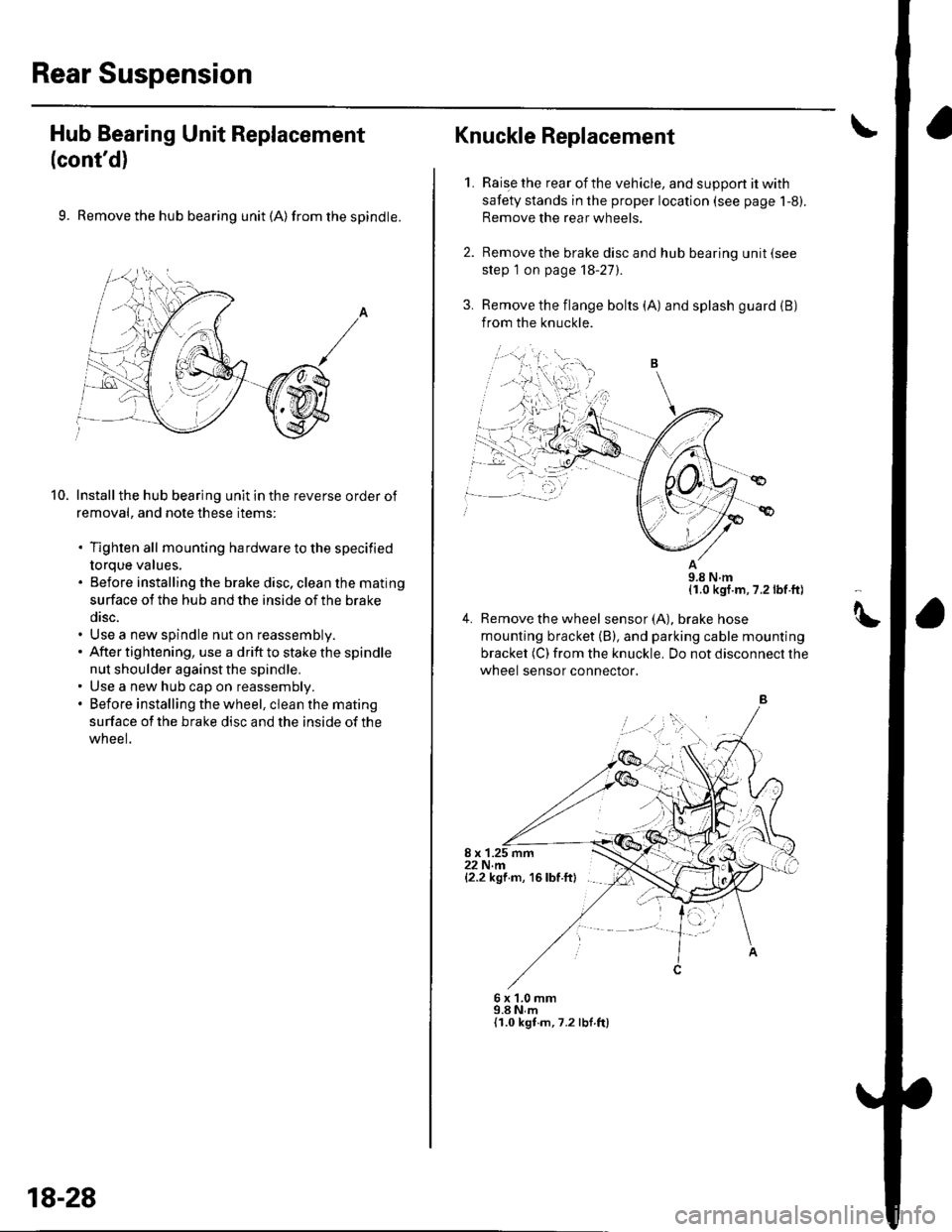
9. Remove the hub bearing unit (A) from the spindle.
Install the hub bearing unit in the reverse order of
removal, and note these items:
. Tighten all mounting hardware to the specified
torque values,. Before installing the brake disc, clean the mating
surface ot the hub and the inside of the brake
disc.. Use a new spindle nut on reassembly.. After tightening, use a drift to stake the spindle
nut shoulder against the spindle.. Use a new hub cap on reassembly.. Before installing the wheel, clean the mating
surface of the brake disc and the inside of the
wneel.
10.
,=,,,
18-28
Raise the rear of the vehicle, and suppon it with
safety stands in the proper location (see page 1-8).
Remove the rear wheels.
Remove the brake disc and hub bearing unit (see
step 1 on page 18-27).
Remove the flange bolts (A) and splash guard (B)
from the knuckle.
11.0 kgf.m, 7.2 lbf ft)
4. Remove the wheel sensor(A), braKe nose
mounting bracket (B), and parking cable mounting
bracket (C) from the knuckle. Do not disconnect the
wheel sensor connector.
8 x 1.25 mm22 N.m{2.2 kgf m, 16 lbf ftl
Knuckle Replacement
1.
6x1.0mm9.8 N,m{I.0 kgt.m,7.2 lbf ft)
tt
Page 588 of 1139
Rear Suspension
1.
Stabilizer Bar Replacement
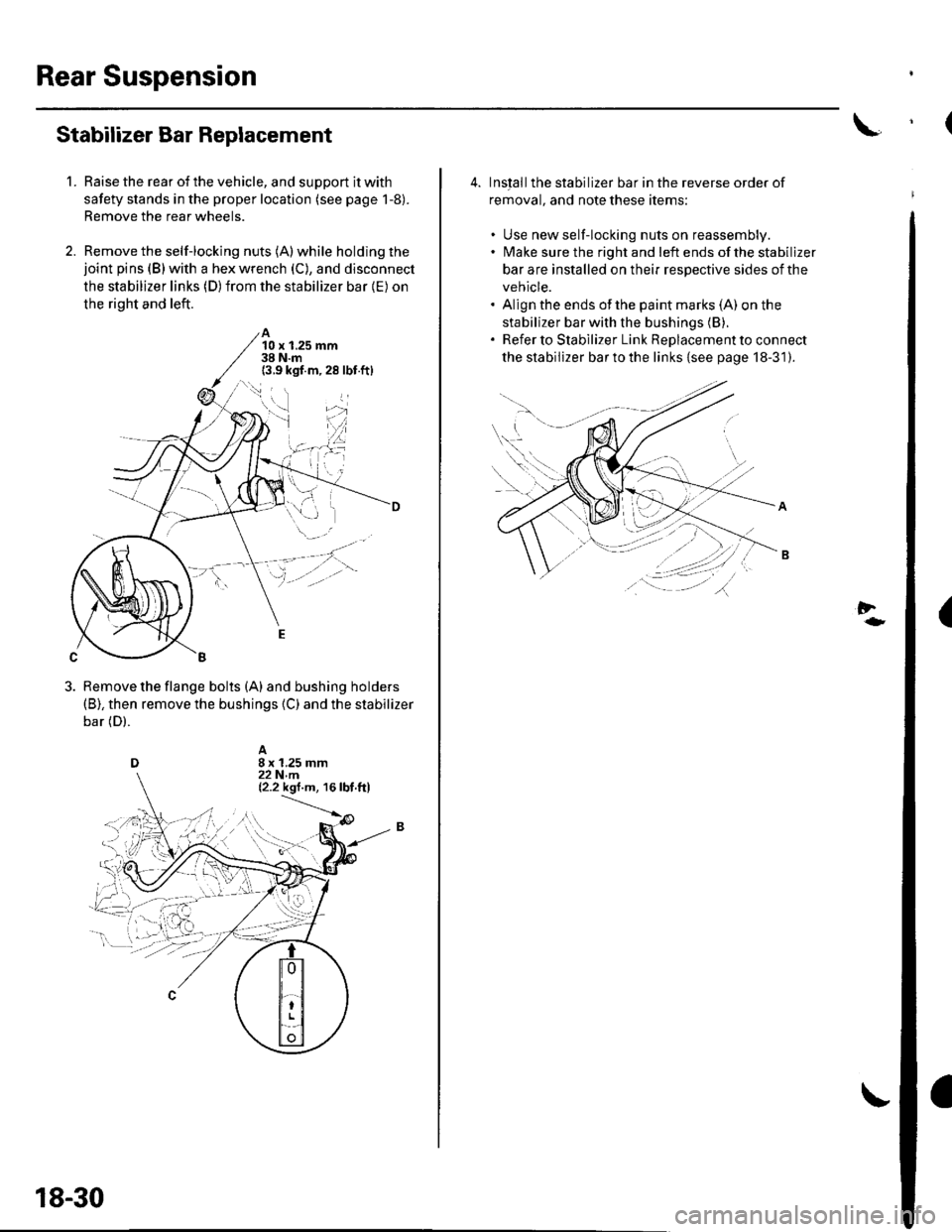
Raise the rear of the vehicle, and support it with
safety stands in the proper location (see page 1-8).
Remove the rear wheels.
Remove the self-locking nuts (A) while holding thejoint pins (B) with a hex wrench (C), and disconnect
the stabilizer links (D) from the stabilizer bar {E) on
the right and left.
A10 x 1.25 mm38 N.m(3.9 kgf.m,28 lbf.ft)
Remove the flange bolts (A) and bushing holders(B), then remove the bushings {C) and the stabilizer
bar (D).
18-30
4. Inslallthe stabilizer bar in the reverse order of
removal, and note these items:
. Use new self-locking nuts on reassembly.. lMake sure the right and left ends of the stabilizer
bar are installed on their respective sides of the
vehicle.. Align the ends of the paint marks (A) on the
stabilizer bar with the bushings (B).
. Refer to Stabilizer Link ReDlacement to connect
the stabilizer bar to the links {see page 18-31).
Al\.... '..: .
.----'';-r'--\---r-
-tt'.,'t),
(
Page 589 of 1139
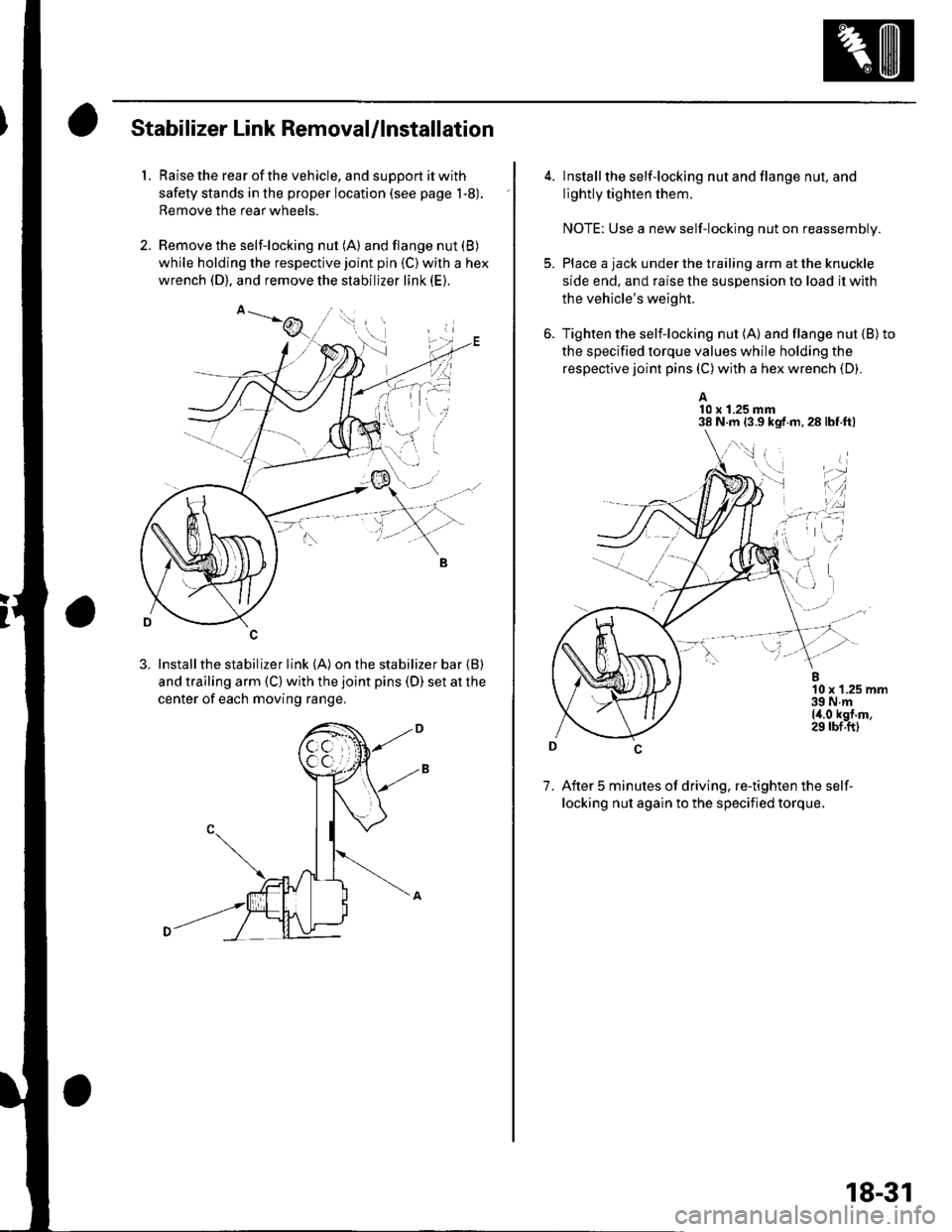
Stabilizer Link Removal/lnstallation
1. Raise the rear of the vehicle, and support it with
safety stands in the proper location (see page 1-8).
Remove the rear wheels.
2. Remove the self-locking nut (A) and flange nut (B)
while holding the respective joint pin {C) wilh a hex
wrench (D), and remove the stabilizer link (E).
3. Installthe stabilizer link (A) on the stabilizer bar {B)
and trailing arm (C) with the joint pins (D) set at the
center of each moving range,
4. lnstall the self-locking nut and flange nut, and
lightly tighten them.
NOTE: Use a new self-locking nut on reassembly.
Place a jack under the trailing arm at the knuckle
side end. and raise the suspension lo load it with
the vehicle's weight.
Tighten the selflocking nut (A) and flange nut {B)to
the specified torque values while holding the
respective joint pins (C) with a hex wrench (D).
A10 x 1.25 mm38 N.m 13.9 kgf.m,28lbf.ftl
7. After 5 minutes of driving, re-tighten the self-
locking nut again to the specified torque.
\,1 i
i'-r d
*l'',:
18-31
Page 590 of 1139
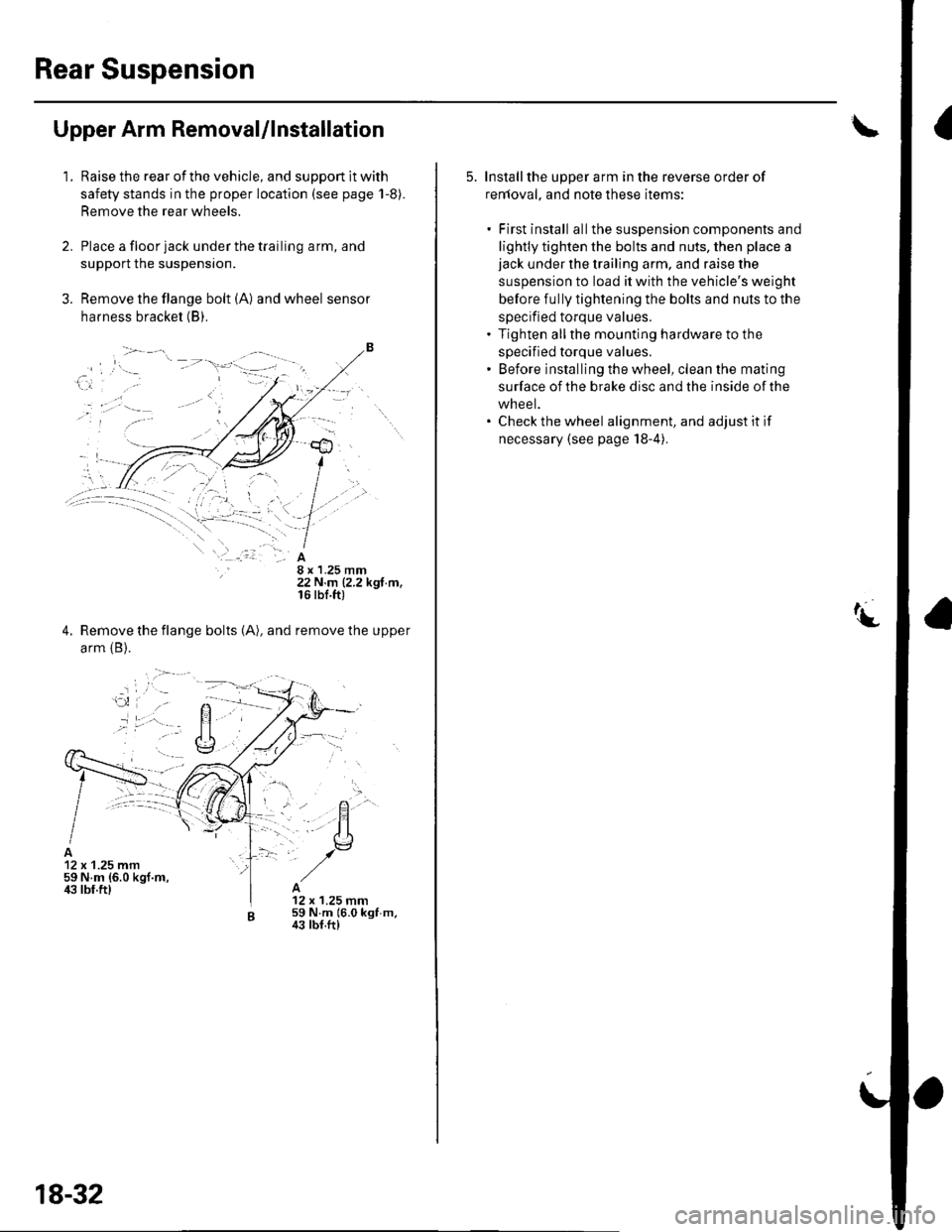
Rear Suspension
Upper Arm Removal/lnstallation
1.Raise the rear of the vehicle, and support lt with
safety stands in the proper location (see page 1-8).
Remove the rear wheels.
Place a floor jack under the trailing arm, and
support the suspensron.
Remove the flange bolt (A) and wheel sensor
harness bracket (B).
8 x 1.25 mm22 N.m (2.2 kgf.m,16 rbf.ft)
Remove the flange bolts (A), and remove the upper
arm {B).
12 x 1.25 mm59 N.m {6.0 kgf.m,ir3 lbf.ft)12 x 1.25 mm59 N.m 16.0 kgf m,43 tbf.ft)
18-32
5. Installthe upper arm in the reverse order of
renloval, and note these items:
. First install allthe suspension components and
lightly tighten the bolts and nuts, then place ajack under the trailing arm, and raise the
suspension to load it with the vehicle's weight
before fully tightening the bolts and nuts to the
specified torque values.. Tighten allthe mounting hardware to the
specified torque values.' Before installing the wheel, clean the mating
surface of the brake disc and the inside of the
wheel.. Check the wheel alignment, and adjust it if
necessary (see page 18-4).