fuel pressure HONDA CIVIC 2003 7.G Owner's Manual
[x] Cancel search | Manufacturer: HONDA, Model Year: 2003, Model line: CIVIC, Model: HONDA CIVIC 2003 7.GPages: 1139, PDF Size: 28.19 MB
Page 278 of 1139
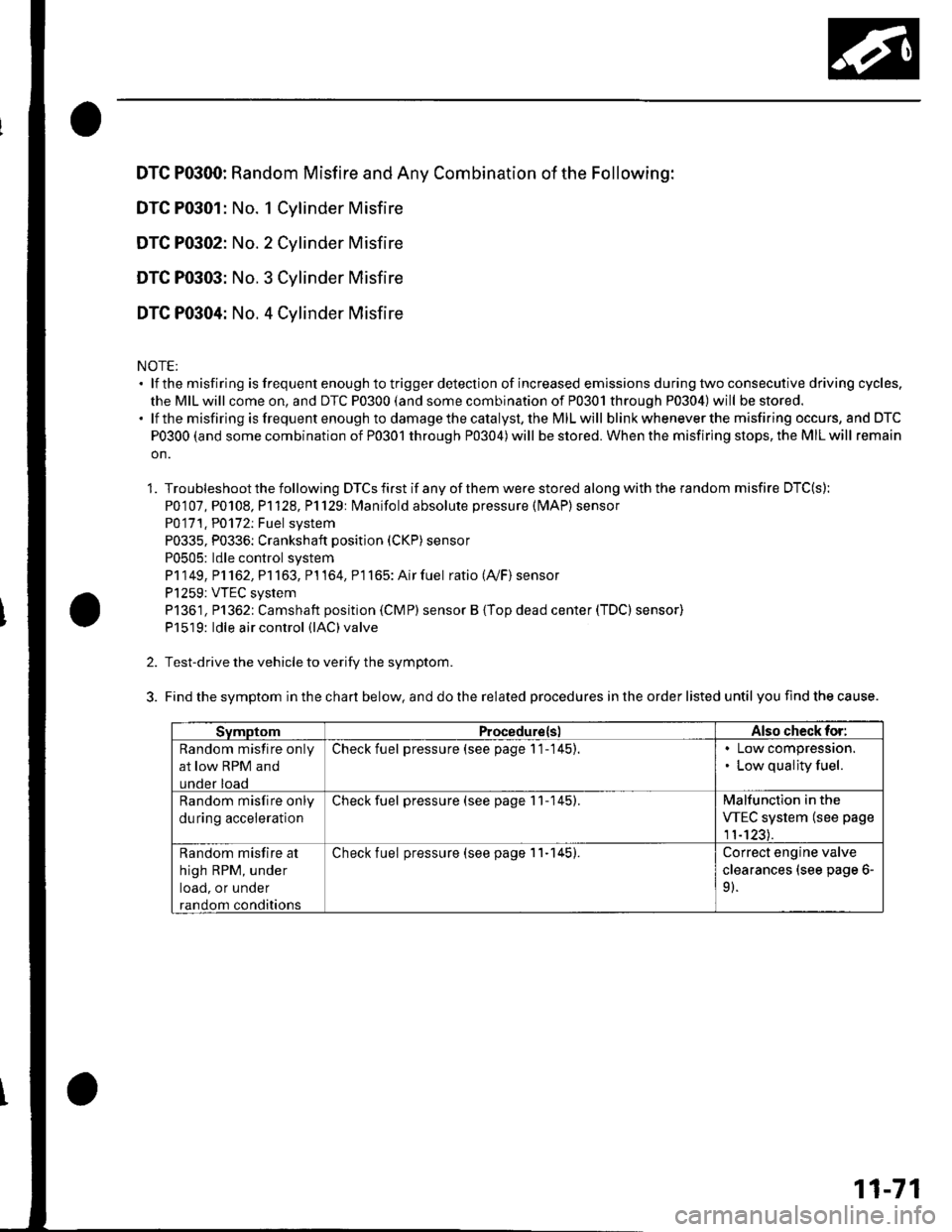
DTC P0300: Random Misfire and Any Combination of the Following:
DTC P0301: No. 1 Cylinder Misfire
DTC P0302: No. 2 Cvlinder Misfire
DTC P0303: No, 3 Cvlinder Misfire
DTC P0304: No. 4 Cvlinder Misfire
NOTE:. lfthe misfiring is frequent enough to trigger detection of increased emissions during two consecutive driving cycles.
the MIL will come on, and DTC P0300 (and some comlrination of P0301 through P0304) will be stored.. lf the misfiring is frequent enough to damage the catalyst, the MIL will blink whenever the misfiring occurs, and OTC
P0300 (and some combination of P0301 through P0304) will be stored. When the misfirlng stops, the MIL will remain
on.
1. Troubleshoot the following DTCs first if any of them were stored along with the random misfire DTC(s):
P0'107, P0108, P1128, P1129r N4anifold absolute pressure (MAP) sensor
P0111. P0'172t Fuel svstem
P0335. P0336: Crankshaft position (CKP) sensor
P0505: ldle control system
P1 149, Pl 162, P1 163, P1 164, P 1 165: Air fuel ratio (Ay'F) sensor
P1259: VTEC system
P1361, P1362: Camshaft position (CMP) sensor B {Top dead center (TDC) sensor)
P1519: ldle air control (lAC) valve
2. Test-drive the vehicle to verify the symptom.
3. Findthesymptom inthechart below, and dothe related procedures in the order listed until you find the cause.
SymptomProcedure(slAlso check foi:
Random misfire only
at low RPM and
under load
Check fuel pressure (see page 1 1-145).. Low compressron.. Low quality fuel.
Random misfire only
du ring acceleration
Check fuel pressure (see page 11-145).Malfunction in the
VTEC system (see page
1't-123).
Random misfire at
high RPM, under
load, or under
random conditions
Check fuel pressure (see page 11-145).Correct engine valve
clearances (see page 6-
91.
11-71
Page 304 of 1139
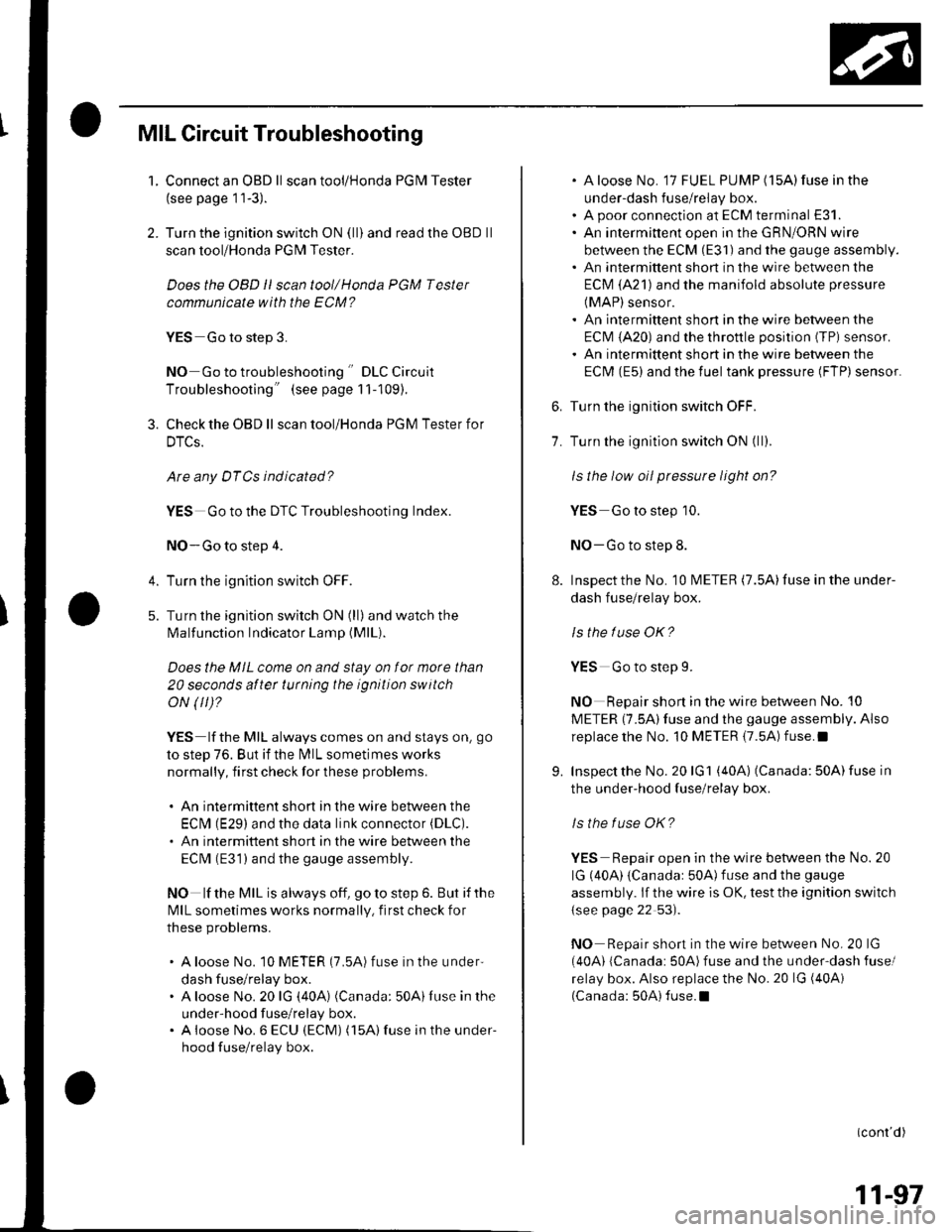
MIL Circuit Troubleshooting
1. Connect an OBD ll scan tool/Honda PGM Tester
(see page 11-3).
2. Turn the ignition switch ON (ll) and read the OBD ll
scan tool/Honda PGM Tester.
Does the OBD ll scan tool/Honda PGM Tester
communicate with the ECM?
YES Go to step 3.
NO Go to troubleshooting " DLC Circuit
Troubleshooting" (see page 11-109).
3. Check the OBD ll scan tool/Honda PGM Testerfor
DTCs.
Are any DTCs ind icated?
YES Go to the DTC Troubleshooting Index.
NO-Go to step 4.
4. Turn the ignition switch OFF.
5. Turn the ignition switch ON (ll)and watch the
lMalfunction Indicator Lamp (MlL).
Does the MIL come on and stay on for more than
20 seconds aftet turning the ignition switch
oN (tr)?
YES lf the MIL always comes on and stays on, go
to step 76. But if the lMlL sometimes works
normally, first check for these problems.
. An intermittent short in the wire between the
ECIM (E29) and the data link connector (DLC).
. An intermittent short in the wire between the
ECM (E31) and the gauge assembly.
NO lf the MIL is always off, go to step 6. But if the
lvllL sometimes works normally, first check for
these problems.
. A loose No. 10 METER (7.5A) fuse in the under
dash fuse/relay box.. A loose No. 20 lG (40A) (Canada: 50A)Iuse in the
under-hood fuse/relay box.. A ioose No. 6 ECU (ECM) (15A) fuse in the under-
hood fuse/relay box.
. A loose No. 17 FUEL PUMP (15A)fuse in the
under-dash fuse/relay box.. A poor connection at ECM terminal E31.. An intermittent open in the GRN/ORN wire
between the ECM (E31) and the gauge assembly.. An intermittent short in the wire between the
ECM (A21) and the manifold absolute pressure
(MAP) sensor.. An intermittent short in the wire between the
ECI\4 (A20) and the throttle posilion (TPi sensor.. An intermittent short in the wire between the
ECM (E5) and the fuel tank pressure (FTP) sensor.
6. Turn the ignition switch OFF.
7. Turn the ignition switch ON (ll).
ls the low oil pressure light on?
YES Go to step 10.
NO-Go to step 8.
8. Inspectthe No. 10 l\4ETER (7.5A)fuse inthe under-
dash fuse/relay box.
ls the luse OK?
YES Go to step L
NO Repair shon in the wire between No. 10
METER (7.5A)fuse and the gauge assembly. Also
replacethe No. 10 METER {7.5A) fuse.l
9. Inspect the No. 20 lG1 (40A) (Canada: 50A) fuse in
the under-hood fuse/relay box.
ls the f use OK?
YES Repair open in the wire between the No. 20
lG (40A) {Canadar 50A)fuse and the gauge
assembly. lf the wire is OK, test the ignition switch
{see page 22 53).
NO Repair short in the wire between No. 20 lG
(40A) lCanada: 50A)fuse and the under'dash fusel
relay box. Also replace the No.20 lG (40Ai
(Canada: 50A) fuse.I
(conr'd)
11-97
Page 313 of 1139
PGM-FI System
67.
MIL Circuit Troubleshooting (cont'd)
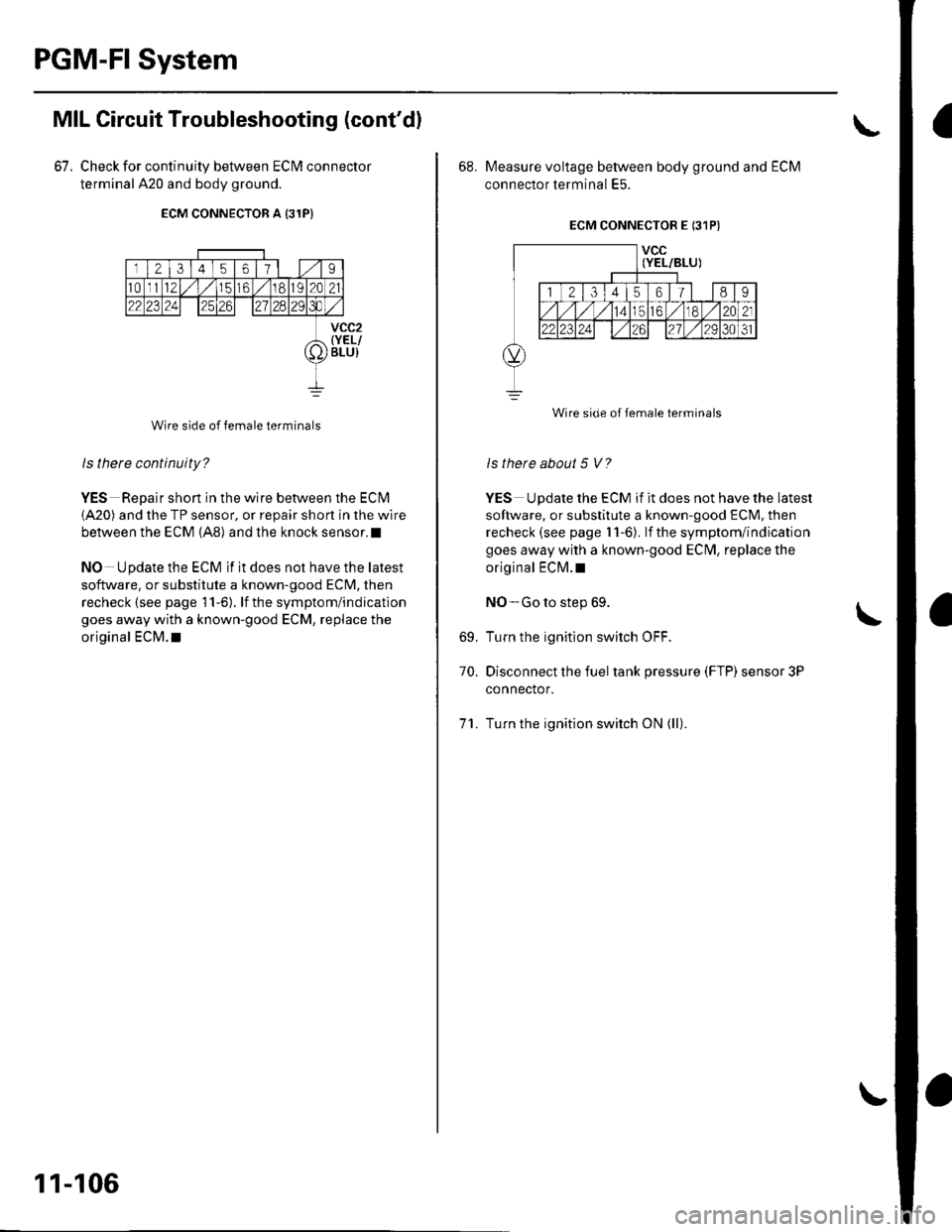
Check for continuity between ECIM connector
terminal A20 and body ground.
ECM CONNECTOR A (31P)
rl2l3145ot/9
10t1121,/ 1,/1516ta,92A21
22 '3241 12526n
o
Wire side of female terminals
ls there continuity?
YES Repair shon in the wire between the ECN4
{A20) and the TP sensor, or repair short in the wire
between the ECM (A8) and the knock sensor. t
NO Update the ECM if it does not have the latest
software. or substitute a known-good ECM, then
recheck (see page l1-6). lf the symptom/indication
goes away with a known-good ECM, replace the
original ECM.t
vcc2{YEL/BLU}
11-106
68. Measure voltage between body ground and ECM
connector terminal E5.
ECM CONNECTOR E (31PI
Is there about 5 V?
YES U pdate the ECM if it does not have the latest
software, or substitute a known-good ECM, then
recheck (see page 11-6). lf the symptom/indication
goes away with a known-good EClvl, replace the
original ECM.t
NO-Go to step 69.
Turn the ignition switch OFF.
Disconnect the fuel tank pressure (FTP) sensor 3P
connector.
Turn the ignition switch ON (ll).
69.
70.
11.
Wire side of female terminals
Page 318 of 1139
Injector Replacement
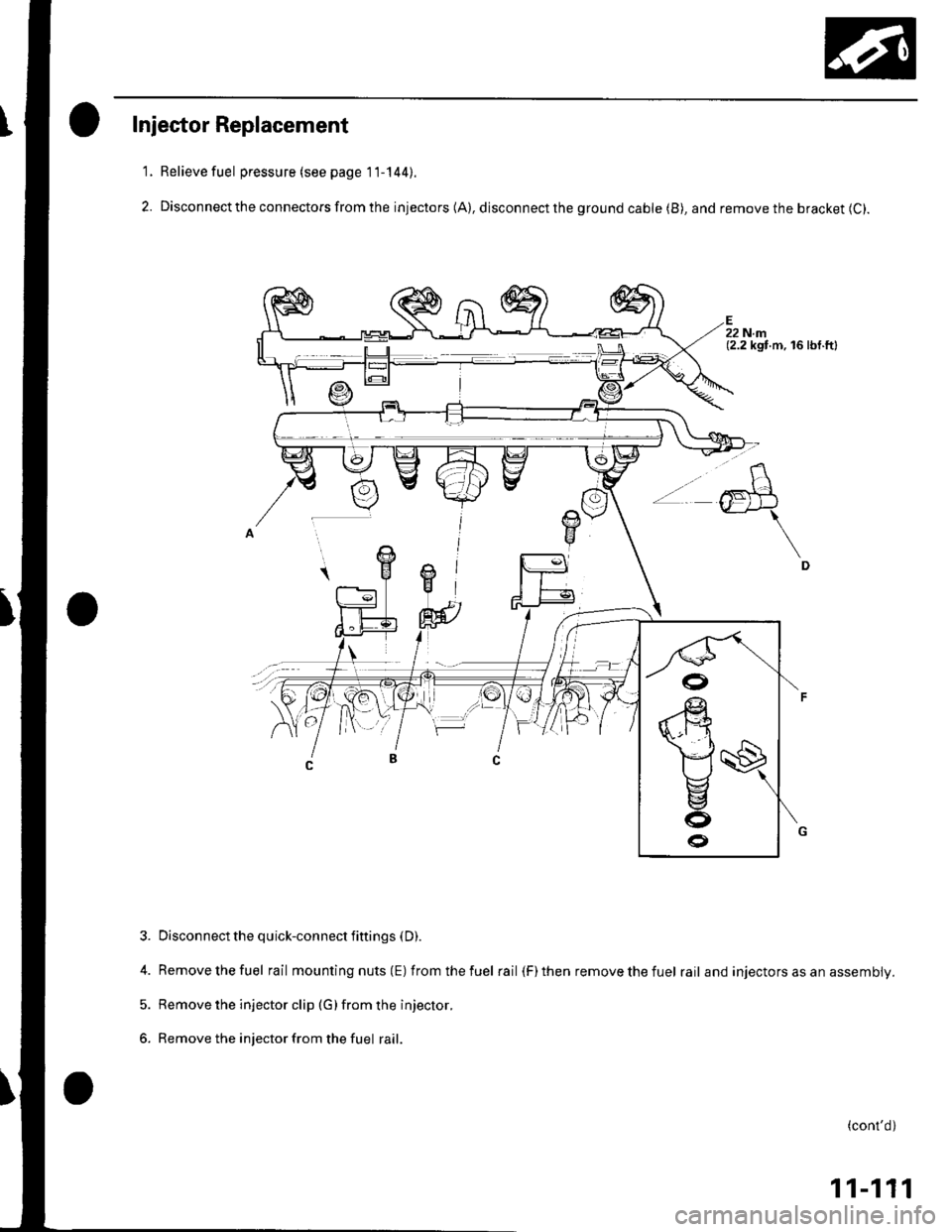
Relieve fuel pressure (see page 1 l-144).
Disconnect the connectors from the injectors (A), disconnect the ground cable (B), and remove the bracket (C).
(2.2 kgf.m, l6 lbf.ftl
ffi \*\
3. Disconnect the quick-connect fittings (D).
4. Removethefuel rail mountingnuts(E) fromthefuel rail (F)then removethefuel rail and injectors asan assembly.
5. Remove the injector clip (G)from the injector.
6. Remove the injector from the fuel rail.
(cont'd)
11-111
1.
2.
o
Page 319 of 1139
PGM-FI System
Injector Replacement (cont'd)
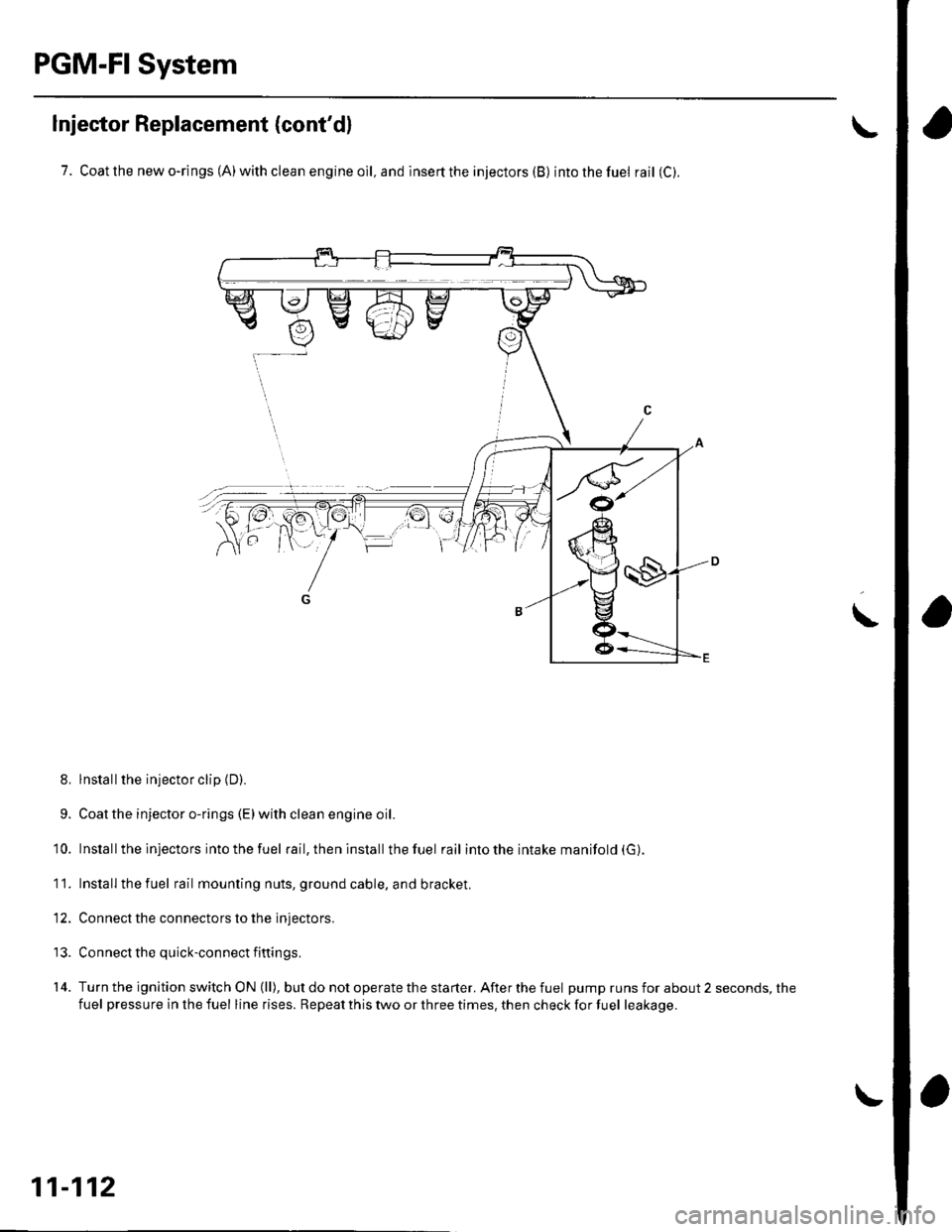
7. Coatthenewo-rings(A)withcleanengineoll,andinserttheinjectors(B) intothefuel rail (C).
8, lnstall the injector clip {D).
9. Coat the injector o-rings (E)with clean engine oil.
10. Installthe injectors intothefuel rail, then install the fuel rail intotheintakemanifold(G).
1 '1. Install the fuel rail mounting nuts, ground cable. and bracket.
12. Connect the connectors to the injectors.
13. Connect the quick-connect fittings.
14. Turnthe ignition switch ON (ll), butdo notoperatethe starter. Afterthefuel pump runs for about 2 seconds, the
fuel pressure in the fuel line rises. Repeat this two or three times. then check for fuel leakage.
\
11-112
Page 351 of 1139
FuelSupply System
Fuel Pressure Relieving
Before disconnecting fuel lines or hoses, relieve
pressure from the system by disconnecting the fuel
tube/quick connect fitting in the engine compartment.
1. Turn the ignition switch OFF,
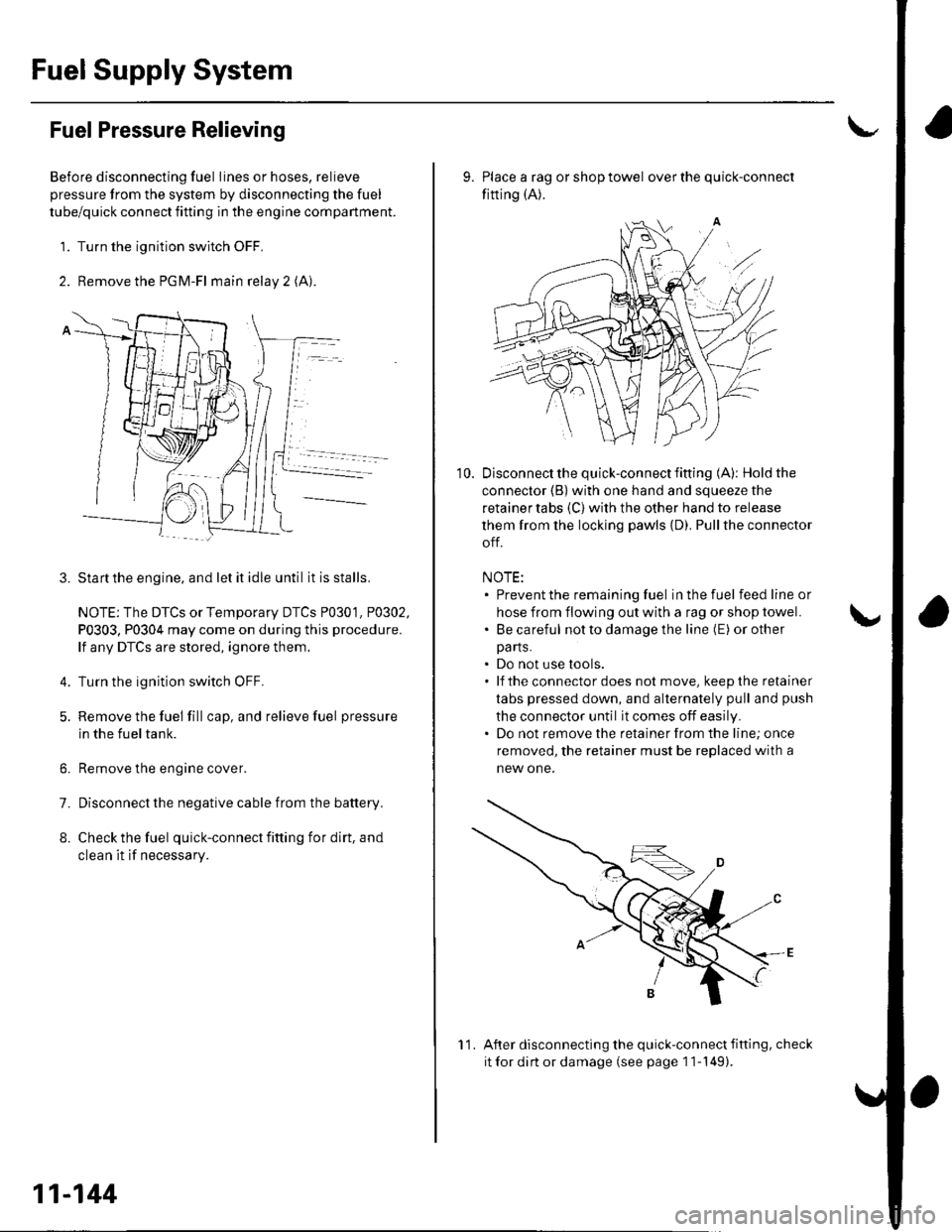
2. Remove the PGM-Fl main relay 2 (A).
Startthe engine, and let it idle until it is stalls.
NOTE: The DTCS or Temporary DTCS P0301. P0302,
P0303, P0304 may come on during this procedure.
lf any DTCS are stored, ignore them.
Turn the ignition switch OFF.
Remove the fuel fill cap, and relieve fuel pressure
in the fueltank.
Remove the engine cover.
Disconnect the negative cable from the battery.
Check the fuel quick-connect fitting for dirt, and
clean it if necessary.
3.
4.
6.
7.
8.
11-144
11
10.
9. Place a rag or shop towel over the quick-connect
fitting (A).
Disconnect the quick-connect fifting (A): Hold the
connector (B) with one hand and squeeze the
retainer tabs (C) with the other hand to release
them from the locking pawls {D). Pullthe connector
off.
NOTE:. Prevent the remaining fuel in the fuel feedlineor
hose from flowing out with a rag or shop towel.. Be careful notto damage the line (E) or other
pa rts.. Do not use tools.. lf theconnectordoes not move, keepthe retainer
tabs pressed down, and alternately pull and push
the connector until it comes off easily.. Do not remove the retainer from the line; once
removed, the retainer must be replaced with a
new one.
After disconnecting the quick-connect fifting, check
it for dirt or damage (see page 1 1-149).
Page 352 of 1139
Fuel Pressure Test
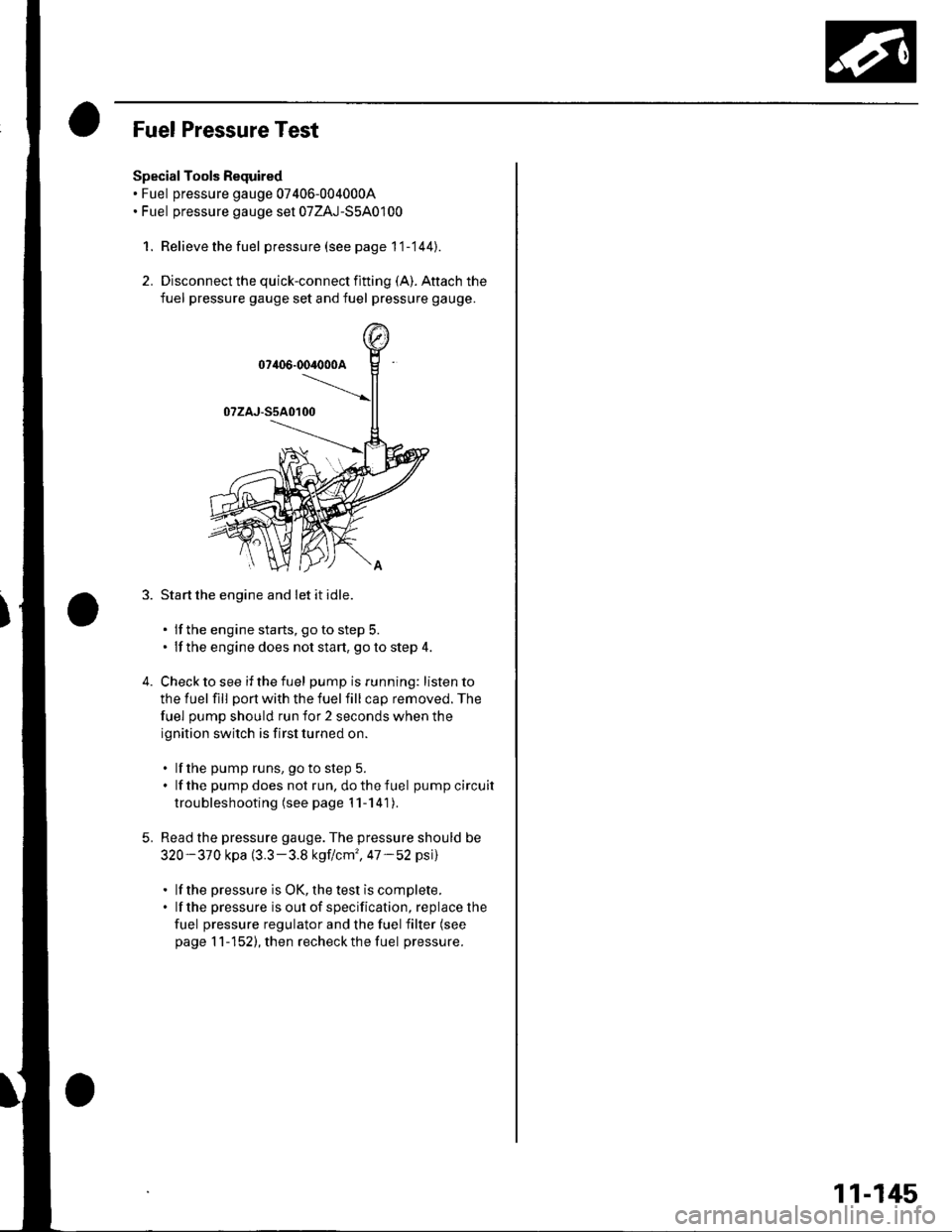
Special Tools Required. Fuel pressure gauge 07406-0040004. Fuel pressure gauge sel 07ZAJ-S5A0100
1. Relieve the fuel pressure (see page 1'1-144).
2. Disconnect the quick-connect fitting (A). Aftach the
fuel pressure gauge set and fuel pressure gauge.
Start the engine and let it idle.
. lf the engine starts, goto step 5.. lf the engine does not start, goto step 4.
Check to see if the fuel pump is running: listen to
the fuel fill port with the fuel fill cap removed. The
fuel pump should run for 2 seconds when the
ignition switch is first turned on.
. lf the pump runs, go to step 5.. lf the pump does not run, do the fuel pump circuit
troubleshooting (see page 1 1-1 41 ).
Read the pressure gauge. The pressure should be
320-370 kpa (3.3-3.8 kgf/cm', a7-52 psi)
. lf the pressure is OK, the test is complete.. lf the pressure is out of specification, replace the
fuel pressure regulator and the fuel filter (see
page 11-152), then recheck the fuel pressure.
5.
11-145
Page 356 of 1139
2.
Fuel Line/Ouick-Gonnect Fittings Removal
1. Relieve fuel pressure (see page 1'l-144).
Check the fuel quick-connect fiftings for din, and
clean if necessary.
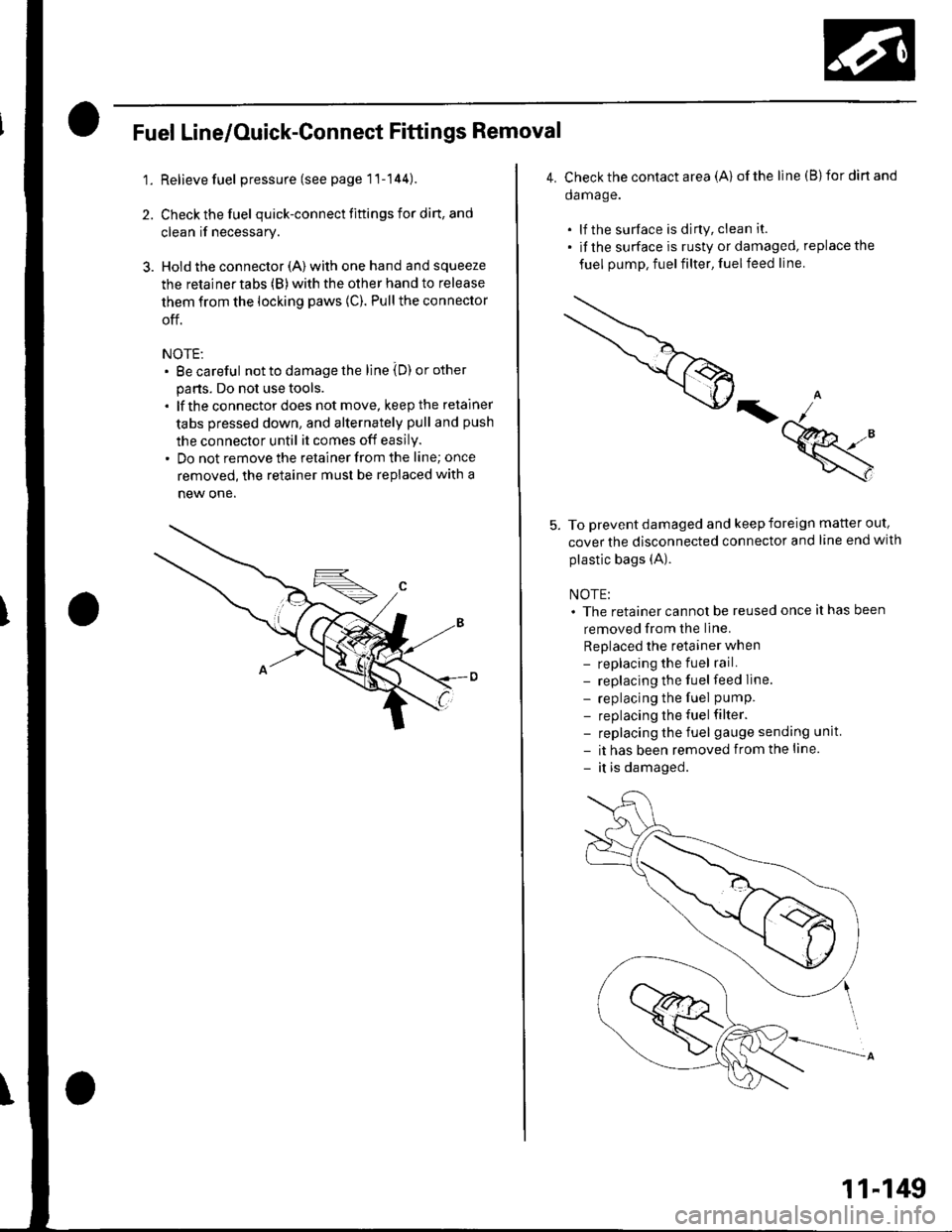
Hold the connector (A) with one hand and squeeze
the retainertabs (B)with the other hand to release
them from the locking paws (C). Pull the connector
off.
NOTE:. Be careful not to damage the line iD) or other
parts. Do not use tools.. lf the connectordoes not move, keep the retainer
tabs pressed down, and alternately pull and push
the connector until it comes off easily.. Do not remove the retainer from the line; once
removed, the retainer must be replaced with a
new one.
4. C heck the contact a rea (A) of the line (B)for dirt and
da mage.
. lf the surface is dirty, clean it.. if the surface is rusty or damaged, replace the
fuel pump, fuelfilter, fuelfeed line.
=k
To prevent damaged and keep foreign matter out,
cover the disconnected connector and line end with
plastic bags (A).
NOTE:. The retainer cannot be reused once it has been
removed from the line.
Replaced the retainer when- replacing the fuel rail.- replacing the fuel feed Iine.
- replacing the fuel pumP.
- replacing the fuel filter.- replacing the fuel gauge sending unit
- it has been removed from the line.
- it is damaged.
11-149
Page 358 of 1139
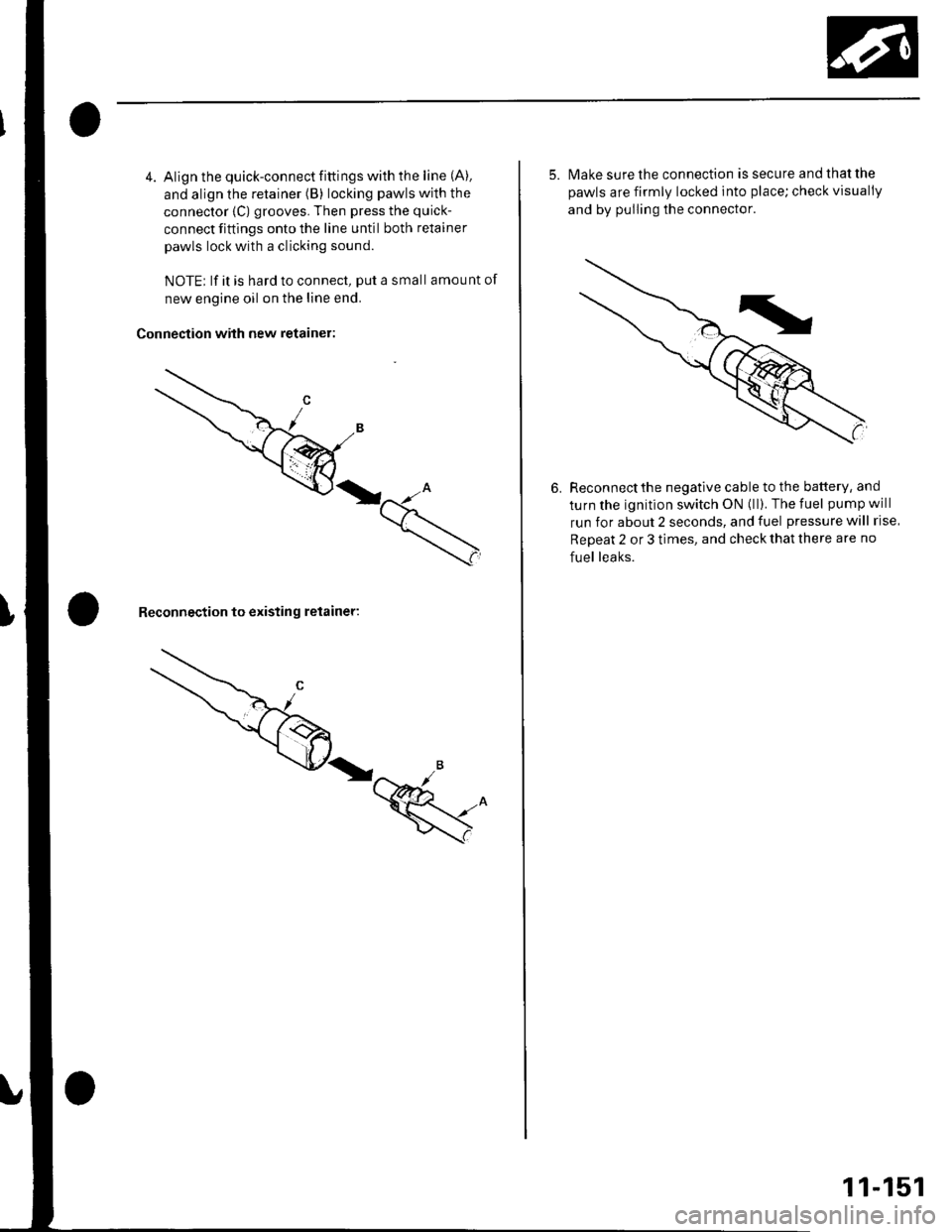
4. Align the quick-connect fittings with the line (A).
and align the retainer (B) locking pawls with the
connector {C) grooves. Then press the quick-
connect fittings onto the line until both retainer
pawls lock with a clicking sound.
NOTE; lf it is hard to connect, put a small amount of
new engine oil on the line end.
Connection with new retainer:
Reconnection to existing retainer:
5. lvlake sure the connection is secure and that the
pawls are firmly locked into place; check visually
and by pulling the connector.
6. Reconnectthe negative cable to the battery, and
turn the ignition switch ON (ll). The fuel pump will
run for about 2 seconds, and fuel pressure will rise
Repeat 2 or 3 times, and check that there are no
fuel leaks.
11-151
Page 359 of 1139
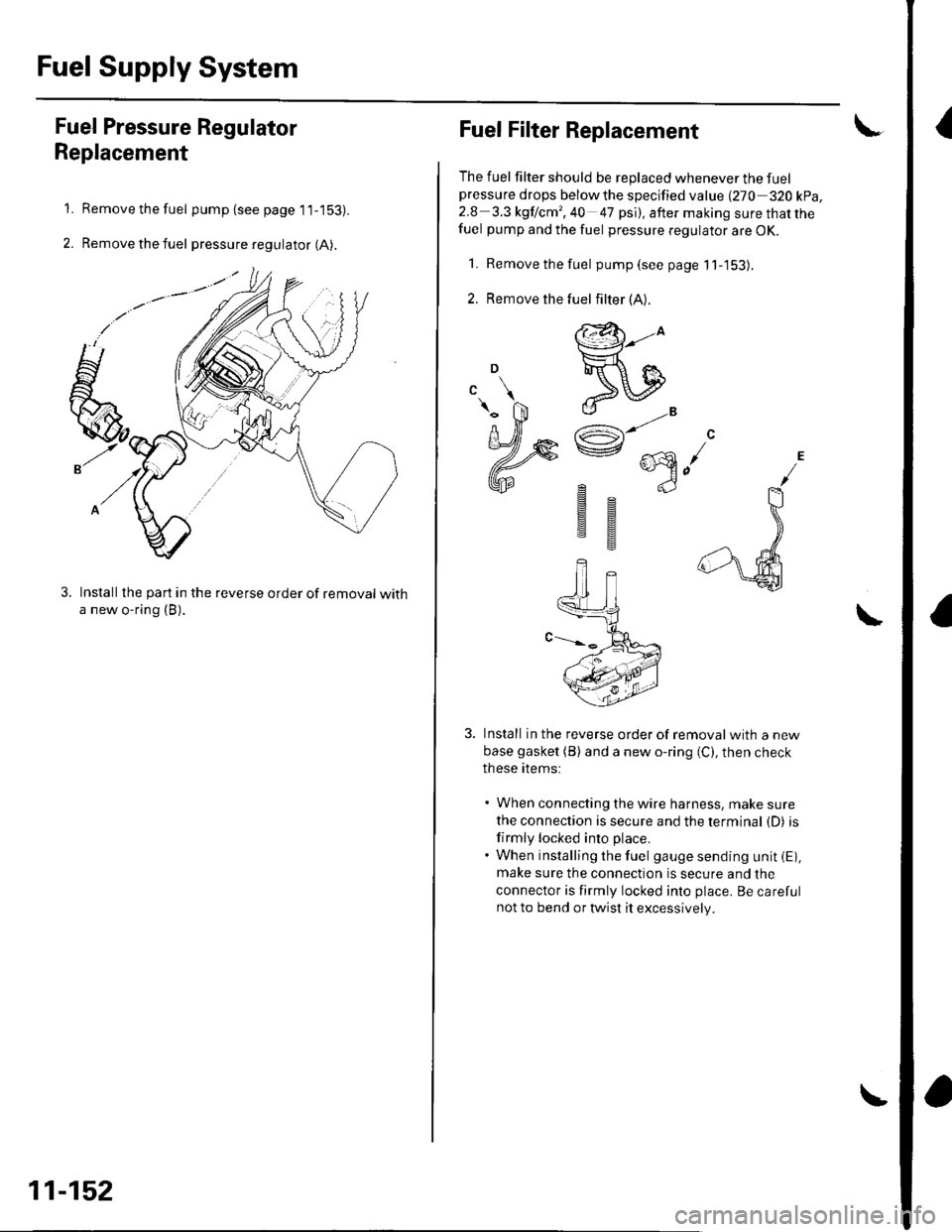
Fuel Supply System
{Fuel Pressure Regulator
Replacement
Remove the fuel pump (see page 1 1-153).
Remove the fuel pressure regulator (A).
Installthe part in the reverse order of removal witha new o-ring (B).
1.
2.
11-152
Fuel Filter Replacement
The fuel filter should be replaced whenever the fuelpressure drops belowthe specified value {270 320 kpa,2.8 3.3 kgf lcm', 40 47 psi), after making sure that thefuel pump and the fuel pressure regulator are OK.
1. Remove the fuel pump(seepagell-'153).
2. Remove the
Install in the reverse order of removalwith a new
base gasket (B) and a new o-ring (C), then check
these items:
' When connecting the wire harness, make sure
the connection is secure and the terminal (D) is
firmly locked into place.. When installing the fuel gauge sending unit iE),make sure the connection is secure and the
connector is firmly locked into place. Be carefulnot to bend or twist it excessively.
\
fuel filter (A).
@-to
ReIJ
e"^AR^ ...\e @n-)
gs
sg