v tec HONDA CIVIC 2003 7.G Repair Manual
[x] Cancel search | Manufacturer: HONDA, Model Year: 2003, Model line: CIVIC, Model: HONDA CIVIC 2003 7.GPages: 1139, PDF Size: 28.19 MB
Page 524 of 1139
DTC 22: Vehicle Speed Sensor Signal
DTC 23: Engine Speed Signal
NOTE:. lf the MIL indicator is ON, troubleshoot the PGIVI-Fl
system first.. Even though the system is operating normally, the
EPS indicator will come on under the following
conditions.
- Condition 1:. The vehicle was traveling at least '12.4 mph(20 km/h), then. A rapld change in vehicle speed was detected,
then. The vehicle (or the vehicle speed sensor signal)
stopped for at least 5 seconds, and. The engine speed was still 1,640 rpm or higher for
at least 5 seconds- Condition 2:
After the vehicle (or the vehicle speed sensor
signal) has stopped for at least 10 seconds, yetthe
engine speed was still 1,640 rpm or higher for at
least 20 seconds.- Condition 3:
When the vehicle speed is 10 km/h (6.2 mph) or
above and the engine is running at 280 rpm or
below for 3 seconds.
1. Start the engine and check the tachometer.
ls the tachometer working correctly?
YES- Go to step 2.
NO-Go to step 9.
2. Test-drive the vehicle above 15 km/h {9.3 mph).
ls the speedometer working correctly?
YES Go to step 3.
NO-Perform the speedometer system
troubleshooting {see page 22-651.a
3.Block the rear wheels and raise the vehicle, and
make sure it is securely supported.
Turn the ignition switch ON (ll).
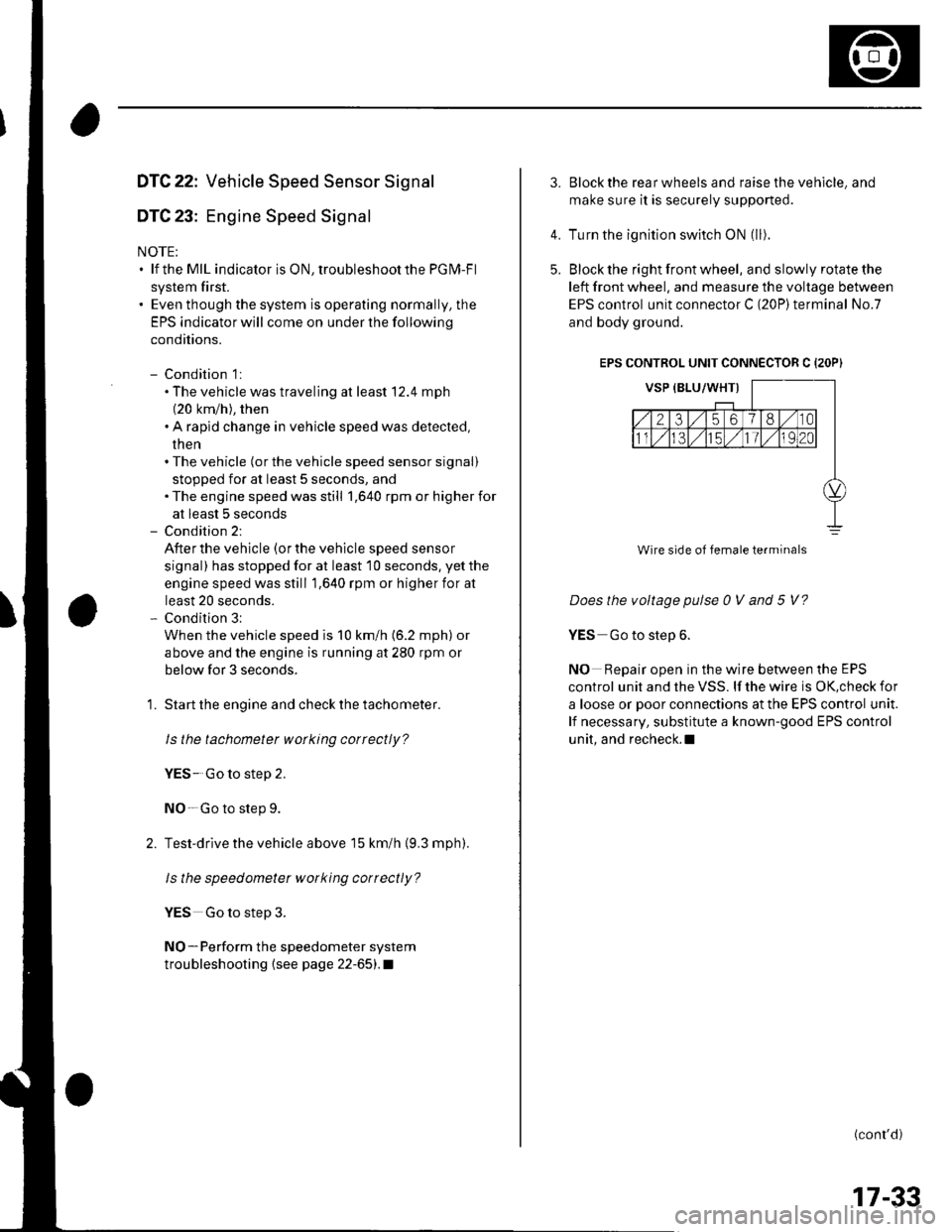
Block the right front wheel, and slowly rotate the
left front wheel, and measure the voltage between
EPS control unit connector C (20P)terminal No.7
and body ground.
EPS CONTROL UNIT CONNECTOR C {2OP)
Does the voltage pulse 0 V and 5 V?
YES Go to step 6.
NO Repair open in the wire between the EPS
control unit and the VSS. lf the wire is OK,check for
a loose or poor connections at the EPS control unit.
lf necessary, substitute a known-good EPS control
unit, and recheck.l
(conr'd)
4.
5.
Wire side of female terminals
17-33
Page 625 of 1139
General Troubleshooting Information
ABS Indicator
. lf the system is OK,theABS indicator goes off 2
seconds after turning the ignition switch ON (ll)
without starting the engine, and then comes on again
and goes off 2 seconds later after starting the engine.
This occurs because the ABS control unitisturned
on by the lG2 power source.. The ABS indicator comes on when the ABS control
unit detects a problem in the system. However, even
though the system is operating properly, the indicator
will come on under these conditions:- Only the drive wheels rotate- One drive wheel is stuck- The vehicle goes into a spin- The ABS continues to operate for a long time.- The vehicle is subjected to an electrical signal
disturbance
To determine the actual cause of the problem, question
the customer about the problem. taking the above
condilions into consideration.
. When a Droblem is detected and lhe ABS indicator
comes on, there are cases when the indicator stays
on until the ignition switch is turned OFF, and cases
when the indicator goes off automatically when the
sYstem returns to normal.- DTC 61: The ABS indicator goes off automatically
when the system returns to normal.- DTC 11, 13,15,17 ,31,32,33, 34, 35, 36, 37, 38, 54,
or 81: The ABS indicator stays on until the ignition
switch is turned OFF whether or not the system
returns to normal.- DfC 12, 14, 16, 1a,21,51,52, or 53; The ABS
indicator goes off when the vehicle is driven again
and the system is OK after the ignition switch is
turned from OFF to ON {ll}.
Diagnostic Trouble Code {DTCI
. The memory can hold three DTCS. However, when
the same DTC is detected more than once, the more
recent DTC is written over the earlier one.
Therefore, when the same problem is detected
repeatedly, it is memorized as a single DTC.. The DTCs are in the order they occurred, beginning
with the most recent.. The DTCS are memorized in the EEPROM (non-
volatile memory). Therefore. the memorized DTCs
are not cleared when the battery is disconnected, the
ignition switch is turned off, or the system returns to
normal. Do the specified procedures to clear the
DTCs.
Self-diagnosis
. Self-diagnosis can be classified into two categories:- Initial diagnosis:
Done right after the engine starts and until the ABS
indicator goes off- Regular diagnosis:
Done rightafterthe initial diagnosis until the
ignition switch is turned OFF. When a problem is detected by self-diagnosis, the
system does the following:- Turns the ABS indicator on- Memorizes the DTC- Stops ABS control
Kickback
The pump motor operates when the ABS is functioning,
and the fluid in the reservoir is forced out to the master
cylinder, causing kickback at the brake pedal.
Pump Motor
. The pump motor operates when the ABS is
functioning.. The ABS control unit checks the pump motor
operation when the vehicle is started the first time
after the ignition switch is turned ON (ll). You may
hear the motor operate at this time, but it is normal.
(cont'd)
19-31
Page 628 of 1139
ABS Gomponents
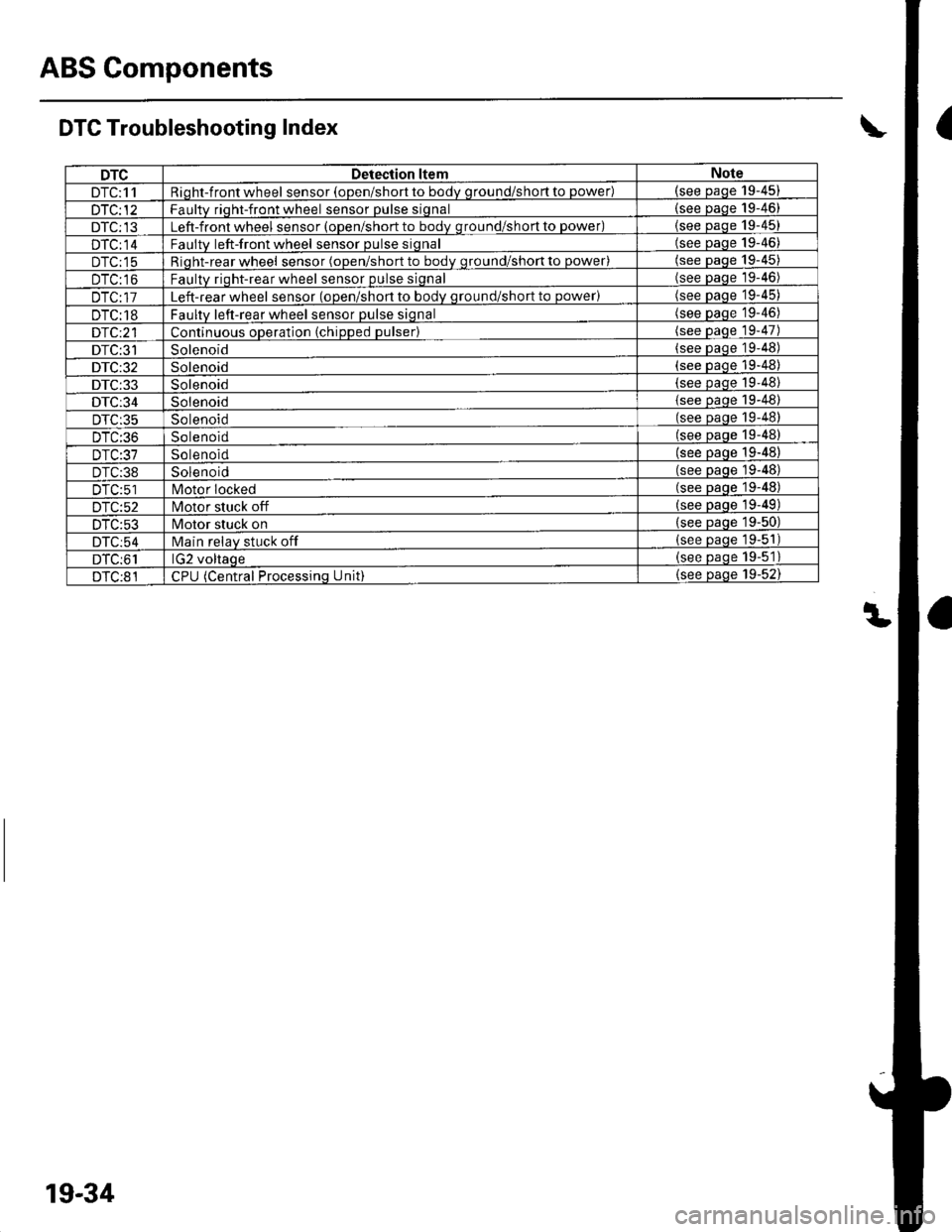
DTC Troubleshooting Index
DTCDetection ltemNote
DTC:11Rioht-front wheel sensor {ooen/short to bodv qround/short to power)(see oaoe 19-45)
DTC:12Faultv riqht-front wheel sensor oulse siqnal{see oaoe 19-46)
DTC:13Left-front wheel sensor {oDen/short to bodv qround/short to power)(see oaqe 19-45)
DTC:14Faultv left-front wheel sensor Dulse srqnal(see paqe 19-46)
DTC;15Riqht-rear wheel sensor (oDen/short to bodv qround/short to power)(see Daqe 19-45)
DTC:16Faultv riqht-rear wheel sensor oulse siqnal(see paqe 19-46)
DTC:17Left-rear wheel sensor (open/short to bodv qround/short to power)(see Daoe '19-45)
DTC:18Faultv left-rear wheel sensor Dulse siqnal(see Daqe '19-46)
Drc:2lContinuous oDeration (chioDed Dulser)(see paqe 19-47)
DTC:3'lSolenoid(see Daoe 19-48)
DTC:32Solenoid{see Daqe 19-48)
DTC:33Solenoid{see Daoe 19'48)
DTC:34Solenoidlsee oaqe 19-48)
DTC:35Solenoid(see paqe 19-48)
DTC;36So le no id(see Daqe 19-48)
DTC:37So le noid(see Daqe 19-48)
DTC:38Sole no id(see Daoe 19-48)
DTC:51lvlotor Iocked(see Daqe 19-48)
DTC:52lvlotor stuck off(see Daoe 19-49)
DTC:53lMotor stuck on(see Daoe 19-50)
DTC:54Main relav stuck off(see paqe 19-51
DTC:61lG2 voltaqe{see oaqe 19-5'l
DTC:81cPU (Central Processinq Unit){see paqe 19-52)
19-34
Page 630 of 1139
ABS Gomponents
System Description
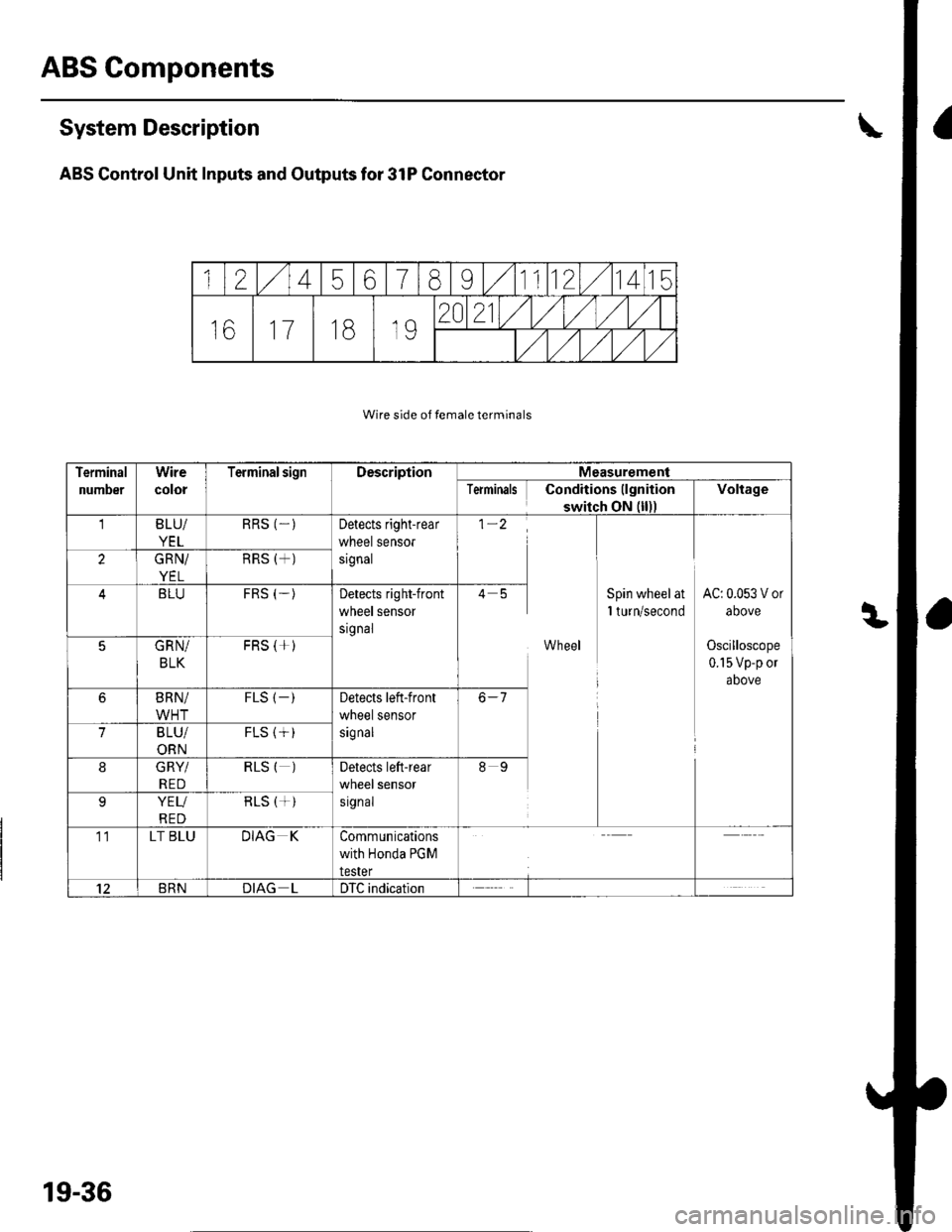
ABS Control Unit Inputs and Outputs for 31P Connector
Wire side of temale terminals
124567BI11121415
16111B19
20?1/t/t/l/t/
Terminal
number
Wire
color
Terminal signDescriptionMeasurement
TerminalsConditions llgnition
switch ON (ll))Voltage
BLU/
YEL
RRSDetects righfrear
wneetsensor
srgnal
;a-_-l
6-7
Wheel
Spin wheelat
I turn/second
AC: 0.053 V or
above
Oscilloscope
0.15 Vp-p or
above
GRN/
YEL
RRS (+)
BLUFRS (-)Detects right-front
wneetsensor
srgnal
5GRN/
BLK
FRS (+)
6BRN/
WHT
FLS (_)Detects left-front
wneet sensor
srgnal7BLU/
ORN
FLS {+)
8GRY/
RED
RLS HDetects left-rear
wneetsensor
srgnal
89
9YEU
RED
RLS (+)
11LT BLUDIAG KCommunications
with Honda PGM
rester
12BRNDIAG LDTC indication
19-36
Page 631 of 1139
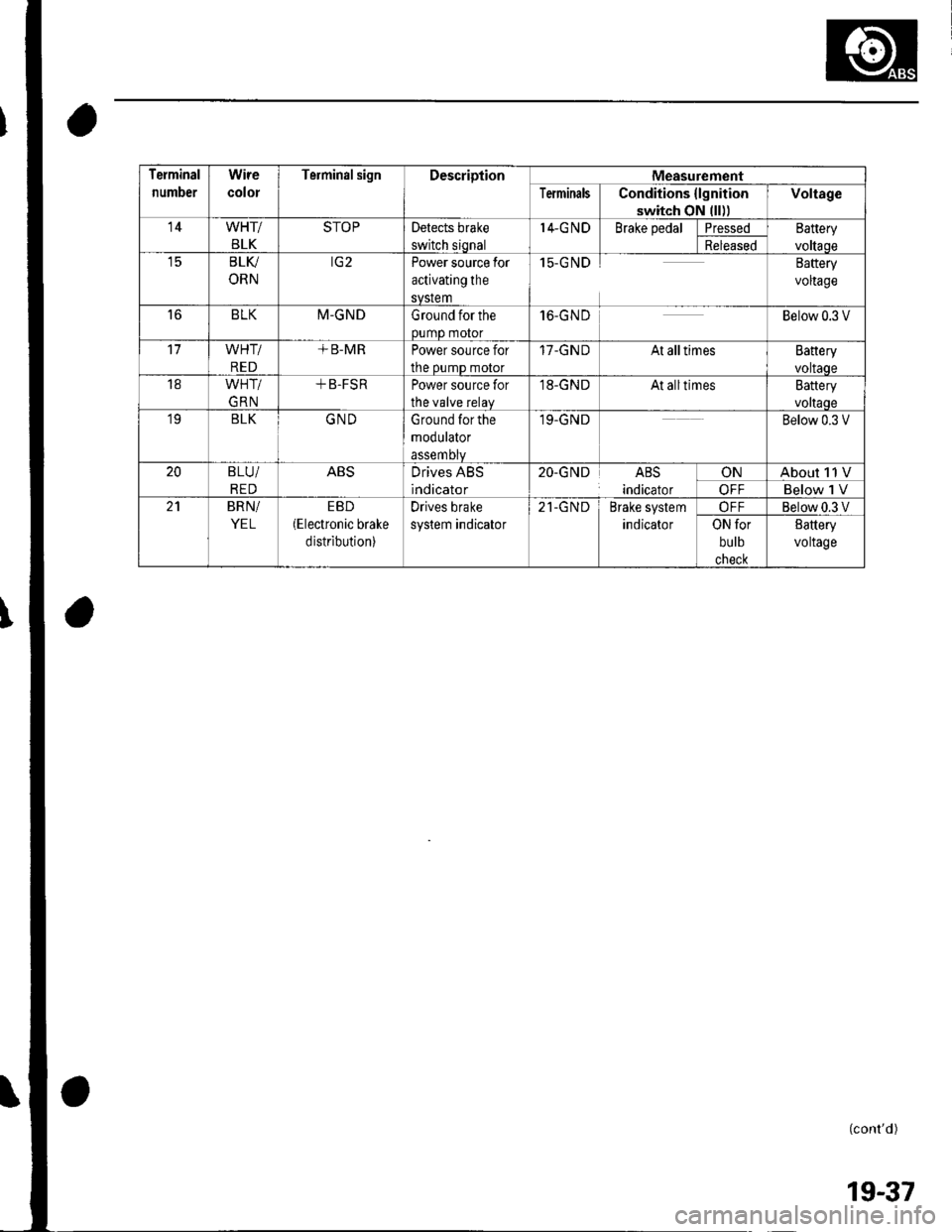
Terminal
number
Wire
color
TerminalsignDescriptionMeasurement
TerminalsConditions {lgnition
switch oN lll))
Voltage
14WHT/
BLK
STOPDetects brake
switch siqnal
I4-G NDBrake pedalPressedEattery
voltaoeReleased
t5BLV
ORN
rG2Power source for
activating the
svstem
15-GNDBaftery
voltage
16BLKM-GNDGround for the
0umD motor
16-GN DBelow 0.3 V
WHT/
RED
+ B-MRPower source for
the oumD motor
17-GNDAt alltimesBattery
voltaoe
18WHT/
GRN
+ B-FSRPower source for
the valve relav
,18-GNDAt alltimesBattery
voltaoe'19BLKGNDGround for the
modulator
assemDtv
19.GNDBelow 0.3 V
20B LU/
RED
ABSDrives ABS
indicator
20-GNDABS
indicator
ONAbout 11 V
OFFBelow 1 V
BRN/
YEL
EBD(Electronic brake
distribution)
Drives brake
system indicator
21-GNDBrake system
indicator
OFFBelow 0.3 V
ON for
bulb
cnecK
8attery
voltage
(cont'd )
19-37
Page 633 of 1139
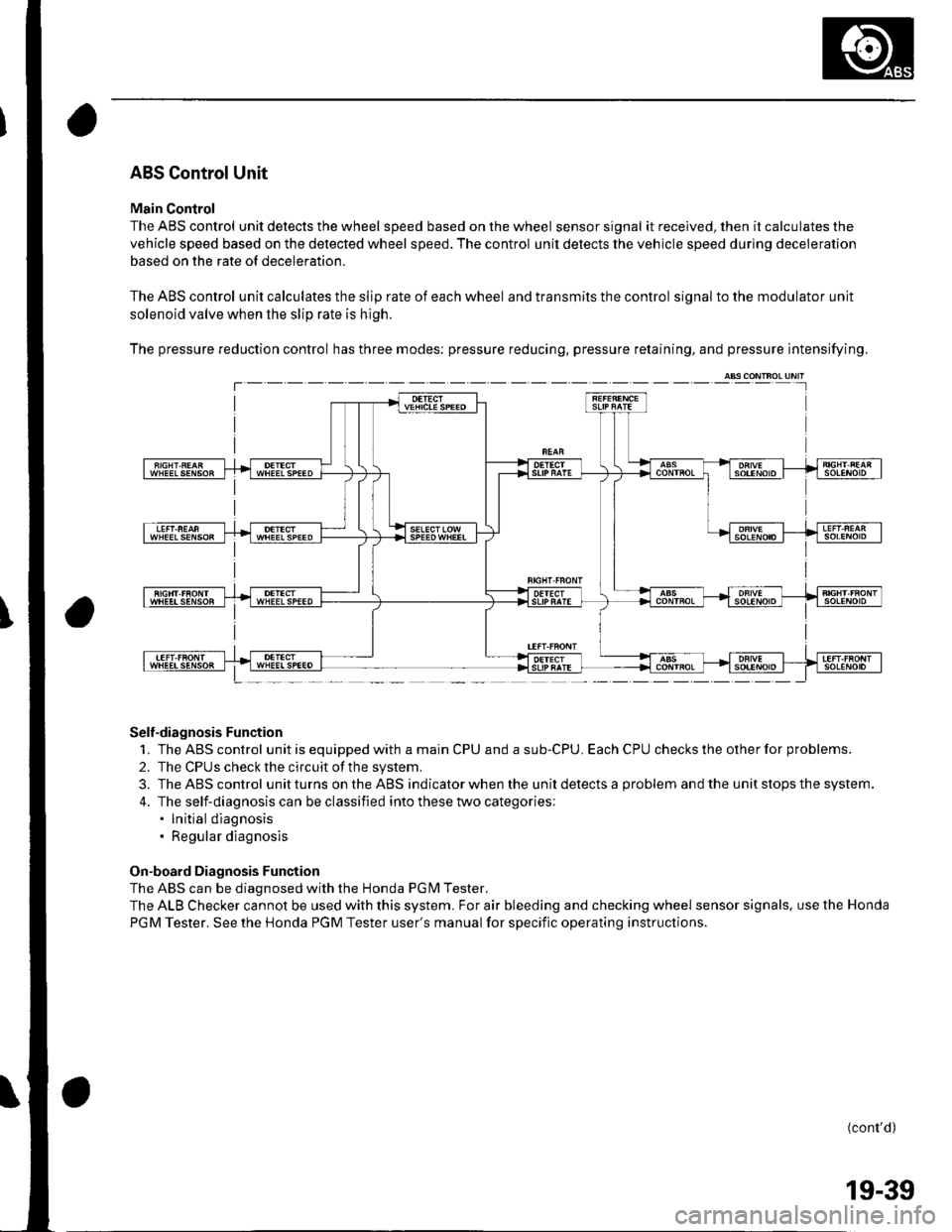
ABS Control Unit
Main Control
The ABS control unit detects the wheel speed based on the wheel sensor signal it received, then it calculates the
vehicle speed based on the detected wheel speed. The control unit detects the vehicle speed during deceleration
based on the rate of deceleration.
The ABS control unit calculates the slip rate of each wheel and transmits the control signal to the modulator unit
solenoid valve when the slip rate is high.
The pressure reduction control has three modes: pressure reducing, pressure retaining, and pressure intensifying.
Self-diagnosis Function
1. TheABScontrol unitisequippedwithamainCPUandasub-CPU.EachCPUcheckstheotherforproblems.
2. The CPUS check the circuit of the system.
3. TheABScontrol unitturns ontheABS ind icator when the unitdetectsa problem andthe unit stops th e system.
4. The self-diagnosis can be classified into these two categories:. lnitial diagnosis. Regular diagnosis
On-board Diagnosis Function
The ABS can be diagnosed with the Honda PGM Tester.
The ALB Checker cannot be used with this system. For air bleeding and checking wheel sensor signals. use the Honda
PGM Tester. See the Honda PGM Tester user's manual for specific operating instructions.
(cont'd)
T---
19-39
Page 635 of 1139
t
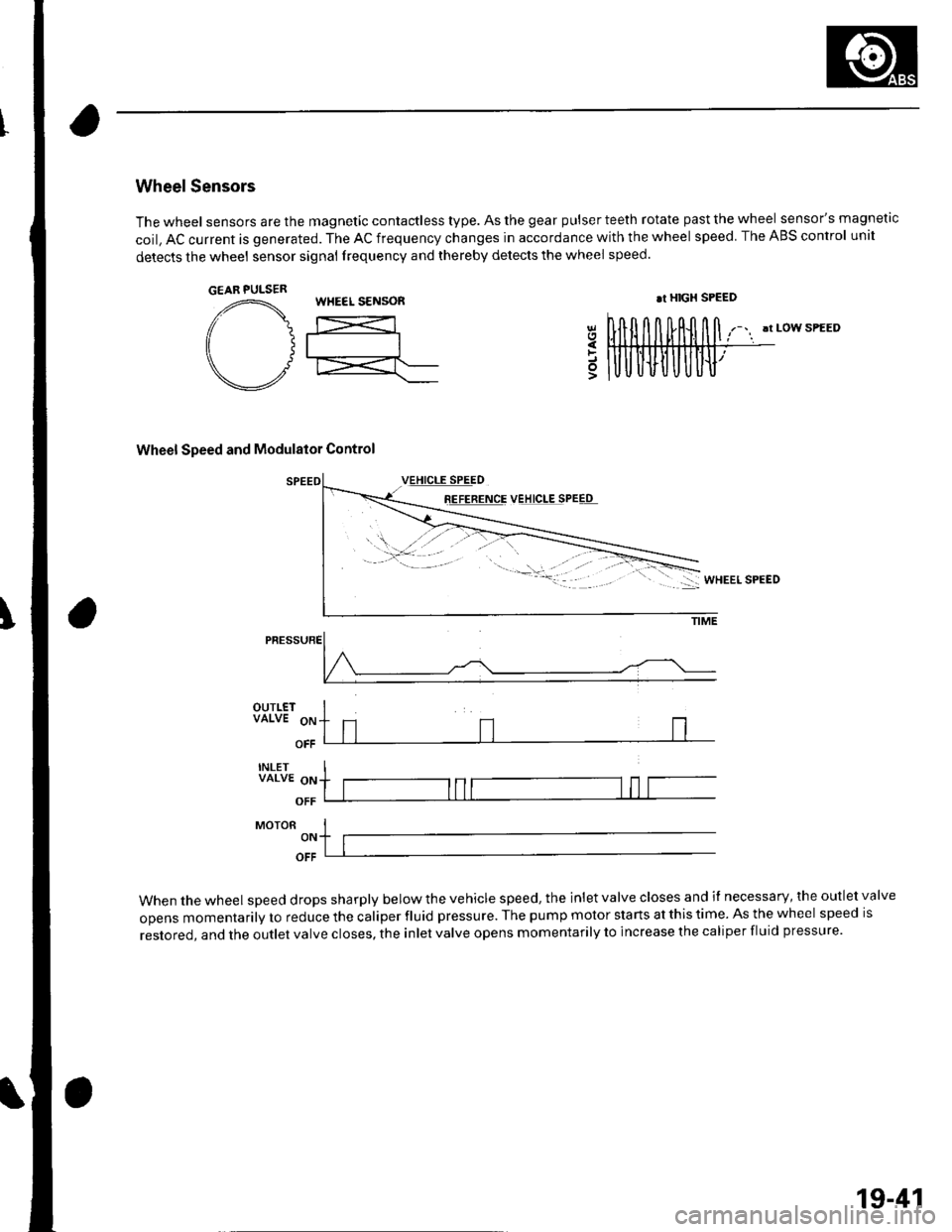
Wheel Sensors
The wheel sensors are the magnetic contactless type. As the gear pulser teeth rotate past the wheel sensor's magnetic
coil, AC current is generated. The AC frequency changes in accordance with the wheel speed. The ABS control unit
detects the wheel sensor signal frequency and thereby detects the wheel speed.
!t LOW SPEED
Wheel Speed and Modulator Control
8E!EEETqE VEJ!q!ESPEEq
5
PRESSURE
OUTLETVALVE 9p
OFF
INLETVALVE oN
OFF
MoroR I-,. ltlOFF
When the wheel speed drops sharply below the vehicle speed, the inlet valve closes and il necessary, the outlet valve
opens momentarily to reduce the caliper fluid pressure. The pump motor starts at this time. As the wheel speed is
restored, and the outlet valve closes, the inlet valve opens momentarily to increase the caliper fluid pressure.
GEAR PULSERWHEEL S€NSOR.r HIGX SPEED
19-41
Page 655 of 1139
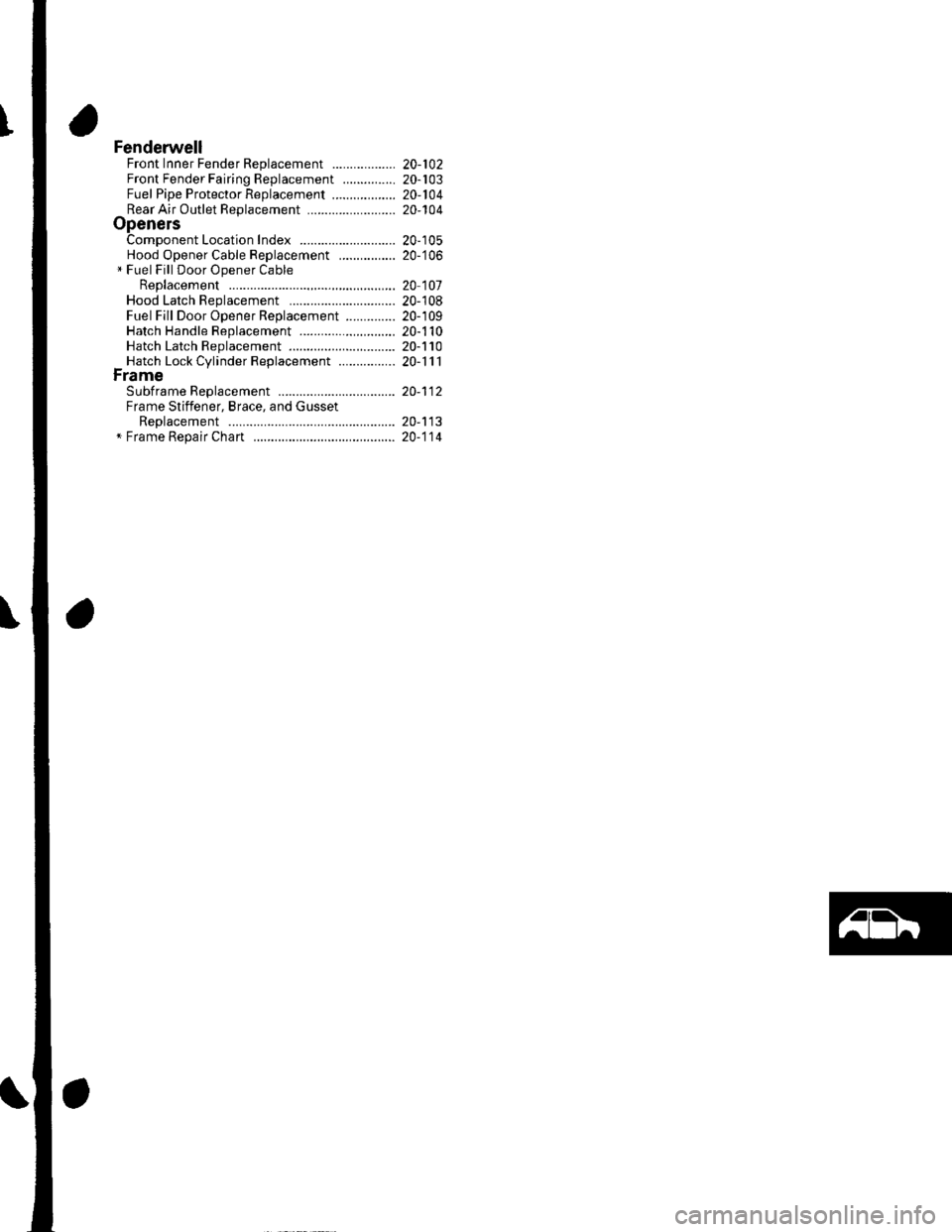
FenderwellFront Inner Fender ReplacementFront Fender Fairing Replacement ...............Fuel Pipe Protector ReplacementRear Air Outlet Rep1acement .........................OpenersComponent Location Index ...........................Hood Opener Cable Replacement ................* Fuel Fill Door Opener CableReplacement
Hood Latch Rep1acement ..............................Fuel Fill Door Opener Replacement ..............Hatch Handle Replacement ...........................Hatch Latch Replacement ..............................Hatch Lock Cylinder Replacement ................FrameSubf rame Replacement ................................. 20-112Frame Stiffener, Brace, and GussetReplacement ............. 20-113r Fremp RFnrir Chrrr ................ 20-114
20-10220-10320-10420-'to4
20-10520-106
20 107
20-10820-10920-1 1020-11020-111
Page 657 of 1139
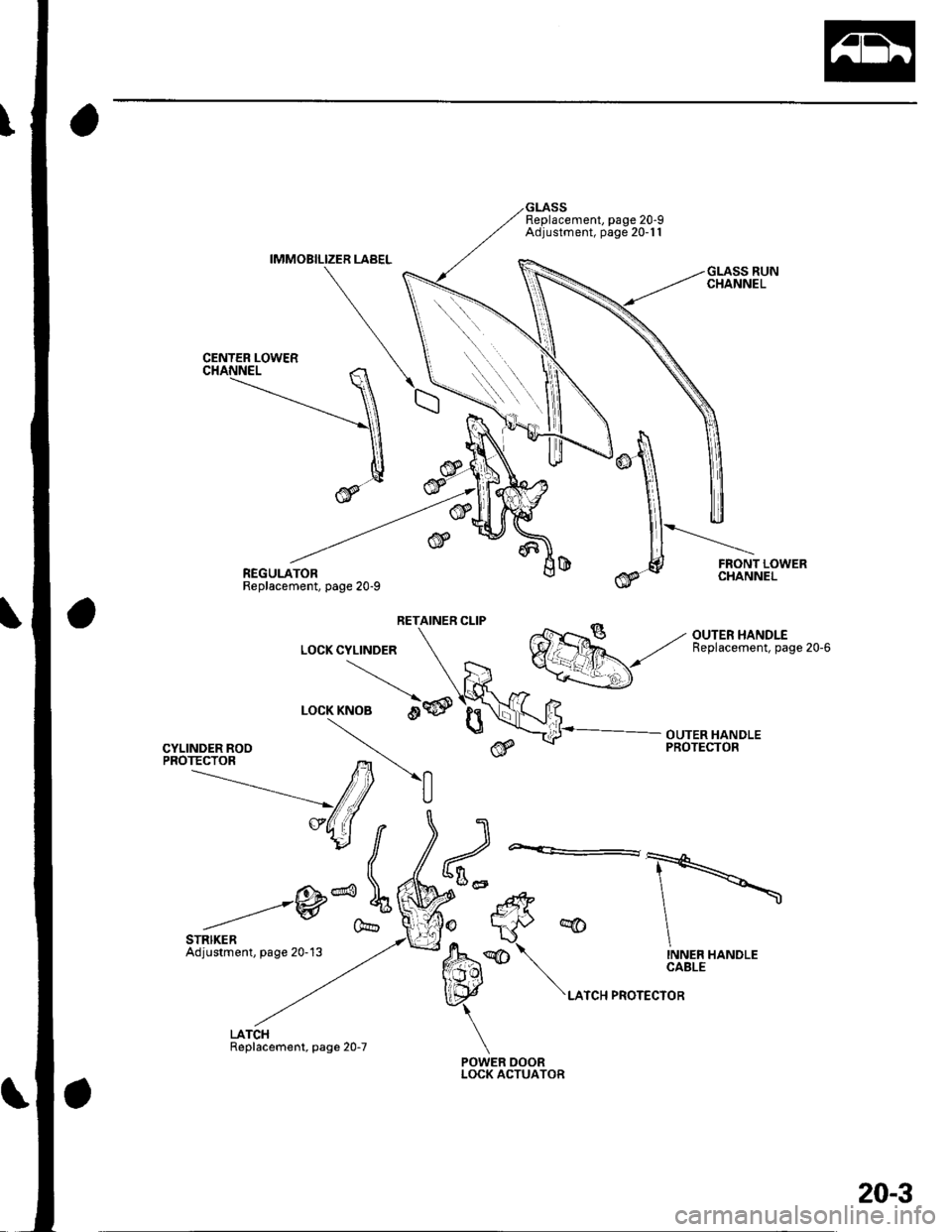
IMMOBILIZER LABEL
REGULATORReplacement, page 20-9
CYLINDER ROOPROTECTOR
GLASSReplacement, page 20-9Adjustment, page 20-11
@
/6X@-W(
STRIKERAdjustment, page 20- 13
LATCHReplacement, page 20-7
RETAINER CLIP
POWER DOORLOCK ACTUATOR
OUTER HANDLEPROTECTOR
LOCK CYLINDER
\\LOCKKNOB O
,-\tt \
v4,,( ,E)il
20-3
Page 658 of 1139
Doors
Door Panel Removal/lnstallation
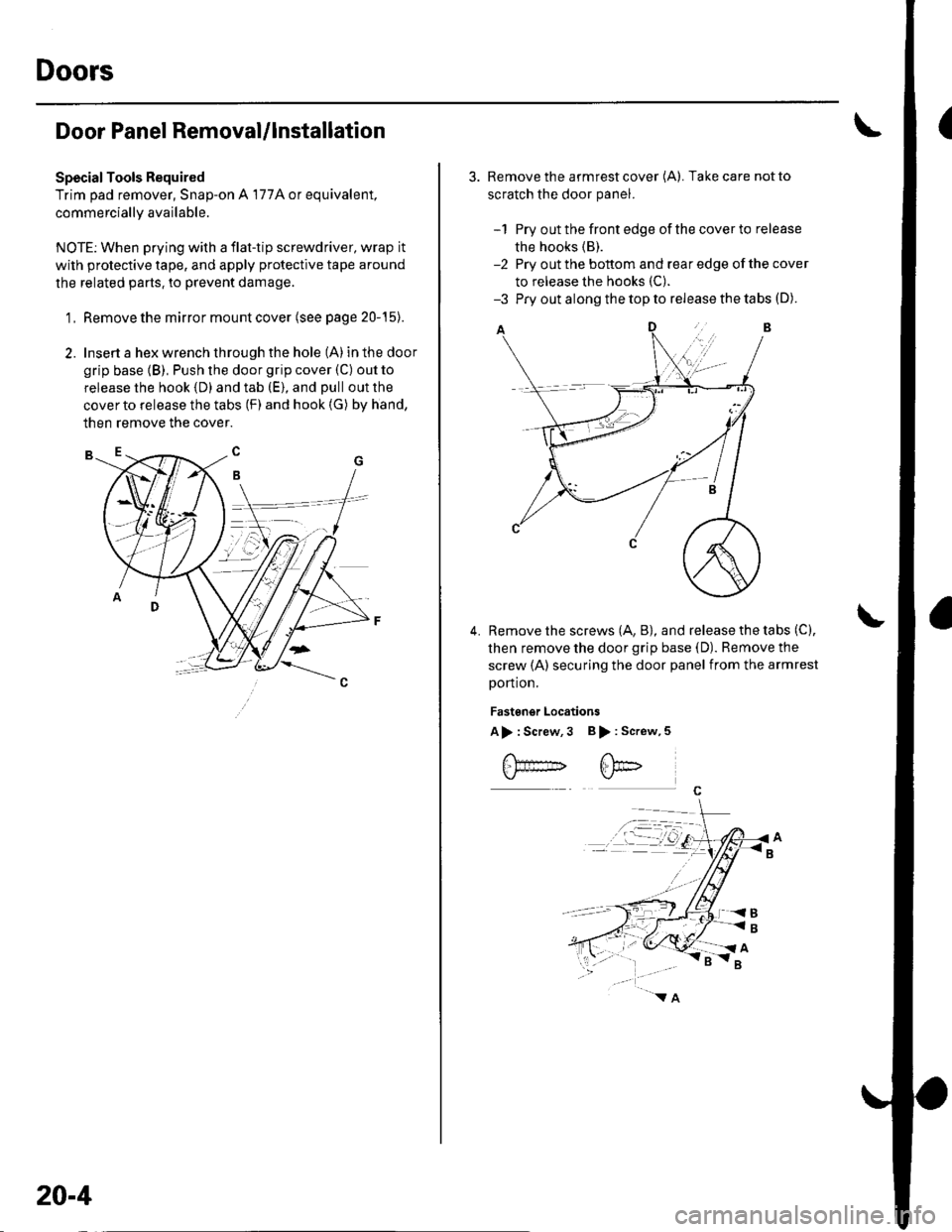
SpecialTools Required
Trim pad remover, Snap-on A 177A or equivalent,
commercially available.
NOTE: When prying with a flat-tip screwdriver, wrap it
with protective tape, and apply protective tape around
the related parts. to prevent damage.
1 . Remove the mirror mount cover (see page 20-15).
2. Insert a hex wrench through the hole (A) in the door
grip base (B), Push the door grip cover (C) out to
release the hook (D) and tab (E), and pull out the
cover to release the tabs (F) and hook (G) by hand,
then remove the cover.
20-4
3. Remove the armrest cover (A). Take care not to
scratch the door panel.
-1 Pry out the front edge of the cover to release
the hooks (B).
-2 Pry out the bottom and rear edge of the cover
to release the hooks (C).
-3 Pry out along the top to release the tabs (D).
Remove the screws (A, B), and release the tabs (C),
then remove the door grip base (D). Remove the
screw (A) securing the door panel from the armrest
portion.
Fastgngr Locations
A> : Screw,3 B > : Screw,5
4.