engine HONDA CIVIC 2010 8.G Owners Manual
[x] Cancel search | Manufacturer: HONDA, Model Year: 2010, Model line: CIVIC, Model: HONDA CIVIC 2010 8.GPages: 387, PDF Size: 6.47 MB
Page 377 of 387

The emissions control systems are
designed and certif ied to work to-
gether in reducing emissions to
levels that comply with the Clean Air
Act. To make sure the emissions
remain low, you should use only new
Honda replacement parts or their
equivalent f or repairs. Using lower
qualitypartsmayincreasethe
emissions f rom your vehicle.
The emissions control systems are
covered by warranties separate f rom
the rest of your vehicle. Read your
warranty manual f or more inf orma-
tion.
The PGM-FI system uses sequential
multiport f uel injection. It has three
subsystems: air intake, engine
control, and f uel control. The
powertrain control module (PCM) in
automatic transmission vehicles or
the engine control module (ECM) in
manual transmission vehicles uses
various sensors to determine how
much air is going into the engine. It then controls how much f uel to inject
under all operating conditions.
This system constantly adjusts the
ignition timing, reducing the amount
of HC, CO, and NOx produced.
The exhaust emissions controls
includethreeorfoursystems:
PGM-FI, ignition timing control,
exhaust gas recirculation, and three
way catalytic converter. These
systems work together to control the
engine’s combustion and minimize
the amount of HC, CO, and NOx that
come out the tailpipe. The exhaust
emissions control systems are
separate f rom the crankcase and
evaporative emissions control
systems.
The three way catalytic converter is
in the exhaust system. Through
chemical reactions, it converts HC,
CO, and NOx in the engine’s exhaust
to carbon dioxide (CO ), nitrogen
(N ), and water vapor.
The exhaust gas recirculation (EGR)
system takes some of the exhaust
gas and routes it back into the intake
manif old. Adding exhaust gas to the
air/f uel mixture reduces the amount
of NOx produced when the f uel is
burned.
2
2
Except Si model
Exhaust Emissions Controls Replacement Parts
PGM-FI Syst emIgnit ion T iming Cont rol Syst em
Exhaust Gas Recirculat ion (EGR)Syst em
Three Way Catalytic Converter
Emissions Cont rols
364
Table of Contents
Page 378 of 387
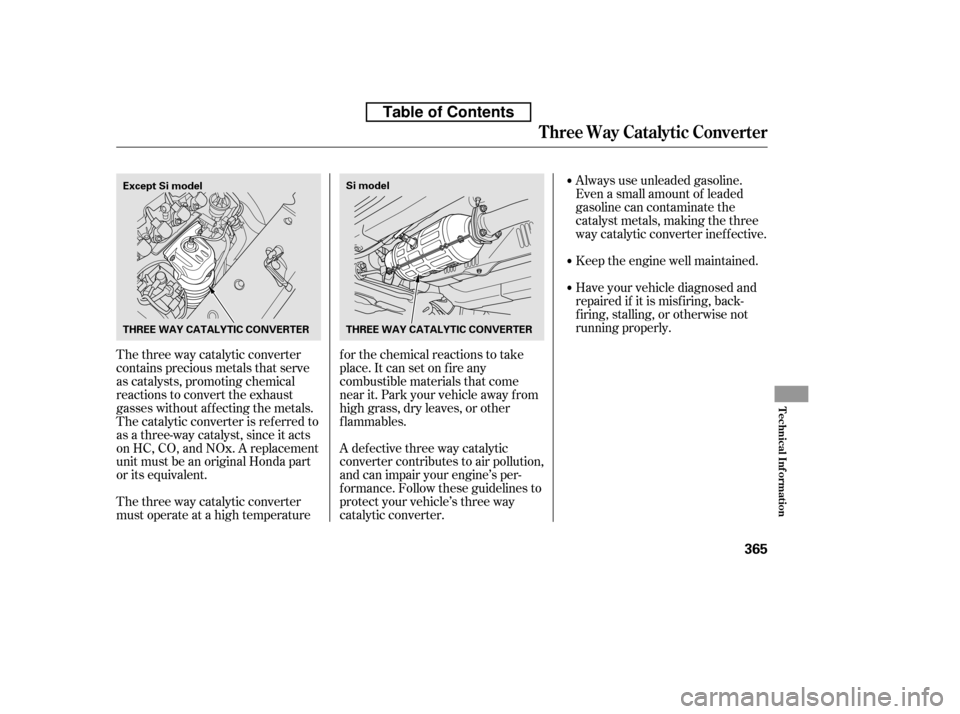
The three way catalytic converter
contains precious metals that serve
as catalysts, promoting chemical
reactions to convert the exhaust
gasses without af f ecting the metals.
The catalytic converter is ref erred to
as a three-way catalyst, since it acts
on HC, CO, and NOx. A replacement
unit must be an original Honda part
or its equivalent.
The three way catalytic converter
must operate at a high temperaturefor the chemical reactions to take
place. It can set on f ire any
combustible materials that come
near it. Park your vehicle away from
high grass, dry leaves, or other
f lammables.
A defective three way catalytic
converter contributes to air pollution,
and can impair your engine’s per-
f ormance. Follow these guidelines to
protect your vehicle’s three way
catalytic converter. Always use unleaded gasoline.
Even a small amount of leaded
gasoline can contaminate the
catalyst metals, making the three
way catalytic converter inef f ective.
Keep the engine well maintained.
Have your vehicle diagnosed and
repaired if it is misf iring, back-
f iring, stalling, or otherwise not
running properly.
Three Way Catalytic Converter
T echnical Inf ormation
365
THREE WAY CATALYTIC CONVERTER
THREE WAY CATALYTIC CONVERTER
Except Si model
Si model
Table of Contents
Page 379 of 387

If you take your vehicle f or an
emissions test shortly af ter the
battery has been disconnected or
gone dead, it may not pass the test.
This is because of certain ‘‘readiness
codes’’ that must be set in the on-
board diagnostics f or the emissions
systems. These codes are erased
when the battery is disconnected,
and set again only after several days
of driving under a variety of
conditions.Without touching the accelerator
pedal, start the engine, and let it
idle f or 20 seconds.
Make sure the vehicle has been
parked with the engine of f f or 6
hours or more.
Make sure the ambient
temperature is between 40° and
95°F (4° and 35°C).
If the testing f acility determines that
the readiness codes are not set, you
will be requested to return at a later
date to complete the test. If you must
get the vehicle retested within the
next two or three days, you can
condition the vehicle f or retesting by
doing the f ollowing.
Make sure the gas tank is nearly,
but not completely, f ull (around
3/4). Keep the vehicle in Park
(automatic transmission) or
neutral (manual transmission).
Increase the engine speed to 2,000
rpm,andholditthereuntilthe
temperature gauge rises to at least
1/4of thescale(about3minutes).
Without touching the accelerator
pedal, let the engine idle f or 20
seconds.
1. 2.3. 4.5. 6.
T esting of Readiness Codes
Emissions T est ing
366
Table of Contents
Page 380 of 387

Select a nearby lightly traveled
major highway where you can
maintain a speed of 50 to 60 mph
(80to97km/h)foratleast20
minutes. Drive on the highway in
D (automatic) or 5th (manual). Do
notusethecruisecontrol.When
traffic allows, drive for 90 seconds
without moving the accelerator
pedal. (Vehicle speed may vary
slightly; this is okay.) If you cannot
do this f or a continuous 90
seconds because of traf f ic
conditions, drive f or at least 30
seconds, then repeat it two more
times (for a total of 90 seconds).Then drive in city/suburban
traffic for at least 10 minutes.
When traf f ic conditions allow, let
the vehicle coast f or several
seconds without using the
accelerator pedal or the brake
pedal.
Make sure the vehicle has been
parked with the engine of f f or 30
minutes.
If the testing f acility determines the
readiness codes are still not set, see
your dealer.
7.
8. 9.
Emissions T est ing
T echnical Inf ormation
367
Table of Contents
Page 386 of 387

T he publications shown below can be purchased f rom Helm
Incorporated. You can order by phone or online:Call Helm Inc. at 1-800-782-4356 (credit card orders only)
Go online at
If you are interested in other years or models, contact Helm Inc.
at 1-800-782-4356.
Covers maintenance and recommended procedures f or
repair to engine and chassis components. It is written
f or the journeyman mechanic, but it is simple enough
f or most mechanically inclined owners to understand.
Complements the Service Manual by providing in-depth
troubleshooting inf ormation f or each electrical circuit
in your vehicle.
Describes the procedures involved in the replacement
of damaged body parts.
Purchasing Factory Authorized Manuals Service Manual:
Electrical T roubleshooting Manual:
Body Repair Manual:
(U.S. only)
Authorized Manuals
Authorized Manuals
373
Publication
Form Number
61SNA0A
61SNA0AEL
61SNA30
31SNA640 31SNA830
31SNAM40 31SNAQ40 HON-R Form Description
2006-2010 Honda Civic 2/4 Door Service Manual 2006-2010 Honda Civic 2/4 Door
Electrical Troubleshooting Manual
2006-2010 Model Series Honda Civic 2/4 Door
Body Repair Manual
2010 Honda Civic 4 Door Owner’s Manual 2010 Honda Civic
Navigation System Owner’s Manual
2010 Honda Civic Honda Service History
2010 Honda Civic 4 Door Technology Reference Guide Order Form for Previous Years-Indicate
Year and Model Desired
www. helminc. com
Table of Contents
Page 387 of 387

Service Inf ormat ion Summary
Automatic Transmission Fluid: Brake Fluid:
Gasoline:
Tire Pressure (measured cold):
Recommended Engine Oil:
Fuel Tank Capacity: Manual Transmission Fluid:
Power Steering Fluid:
Except Si Si
Except Si Si
Except Si Si
All models except Si and
Canadian DX-G (M/T) EX-L,U.S.LX,LX-S,EX,
Canadian Sport
DX, Canadian DX-G Si
Honda Heavy Duty Brake Fluid
DOT 3 preferred, or a DOT 3 or
DOT 4 brake fluid as a temporary
replacement (see page ).
Front/Rear:
30 psi (210 kPa , 2.1 kgf/cm
)
Unleaded gasoline, pump octane
number of 87 or higher.
4.6 US qt (4.4
)
Oil change capacity (including
filter):
API Premium grade 5W-30
detergent oil (see page ). 3.9 US qt (3.7
)
Oil change capacity (including
filter):
API Premium grade 5W-20
detergent oil (see page ).
13.2 US gal (50
)
Honda Manual Transmission
Fluid preferred, or an SAE 10W-30
or 10W-40 motor oil as a
temporary replacement (see page
).
Capacity (including differential):
1.5 US qt (1.4
)
1.6 US qt (1.5
)
Honda Power Steering Fluid
preferred, or another brand of
power steering fluid as a
temporary replacement. Do not
use ATF (see page ).
Honda Genuine ATF-Z1
(automatic transmission fluid)
(see page ).
60 psi (420 kPa , 4.2 kgf/cm
)
Spare Tire: 33 psi (230 kPa , 2.3 kgf/cm
)
32 psi (220 kPa , 2.2 kgf/cm
)
Premium unleaded gasoline,
pump octane number of 91 or
higher recommended (see ‘‘Fuel
Recommendations’’ on page ).
238
291
291 298
299
301 300