exhaust HONDA CIVIC 2012 9.G Owners Manual
[x] Cancel search | Manufacturer: HONDA, Model Year: 2012, Model line: CIVIC, Model: HONDA CIVIC 2012 9.GPages: 345, PDF Size: 9.02 MB
Page 2 of 345
Contents
Child Safety P. 50 Exhaust Gas Hazard P. 62 Safety Labels P. 63
Opening and Closing the Trunk P. 109 Security System P. 112 Opening and Closing the Windows P. 114
Operating the Switches Around the Steering Wheel P. 117 Adjusting the Mirrors P. 125
Interior Lights/Interior Convenience Items P. 134 Heating and Cooling*
P. 140
Audio Error Messages *
P. 172 General Information on the Audio System *
P. 174
When Driving P. 211 Braking P. 229 Parking Your Vehicle P. 233
Accessories and Modifications P. 238
Maintenance Under the Hood P. 251 Replacing Light Bulbs P. 268
Checking and Maintaining Tires P. 280 Battery P. 289 Remote Transmitter Care *
P. 290
Cleaning P. 292
Engine Does Not Start P. 306 Jump Starting P. 307 Shift Lever Does Not Move P. 310
Fuses P. 318 Emergency Towing P. 321
Devices that Emit Radio Waves P. 329 Reporting Safety Defects P. 330
Authorized Manuals P. 335 Customer Service Information P. 336
Quick Reference GuideP. 2
Safe DrivingP. 23
Instrument PanelP. 65
ControlsP. 97
FeaturesP. 143
DrivingP. 201
MaintenanceP. 239
Handling the UnexpectedP. 297
InformationP. 323
IndexP. 337
2012 Civic 4D Online Reference Owner's Manual
Note: All page numbers referenced in this document are hyperlinked.
Page 9 of 345
8
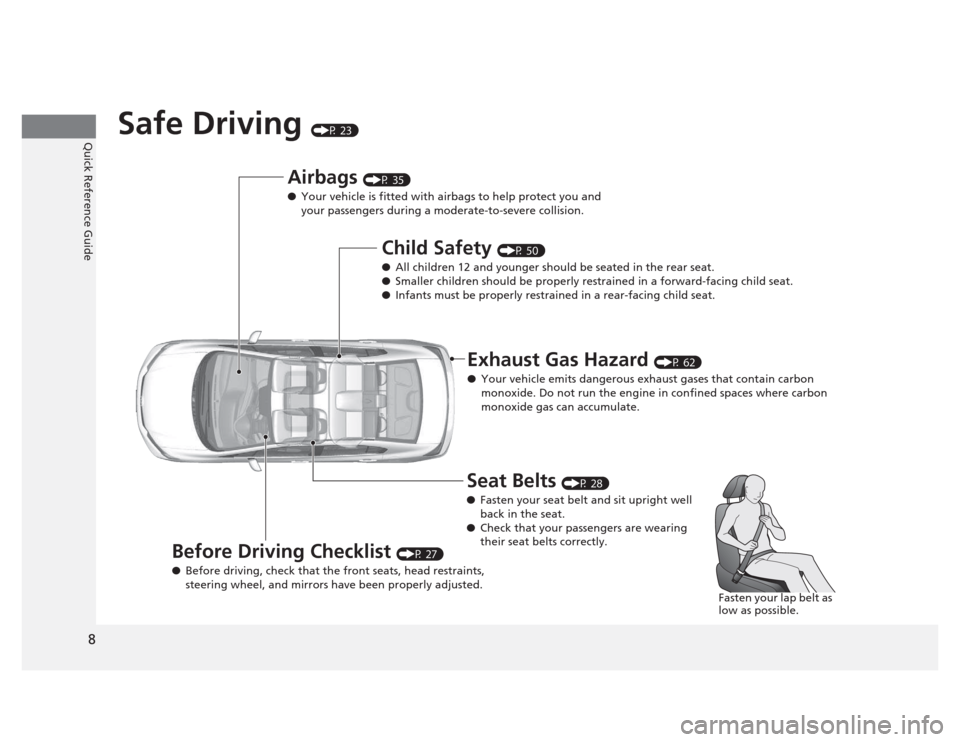
Quick Reference GuideSafe Driving (P 23)
Airbags (P 35)
● Your vehicle is fitted with airbags to help protect you and
your passengers during a moderate-to-severe collision.
Child Safety (P 50)
● All children 12 and younger should be seated in the rear seat.
● Smaller children should be properly restrained in a forward-facing child seat.
● Infants must be properly restrained in a rear-facing child seat.
Exhaust Gas Hazard (P 62)
● Your vehicle emits dangerous exhaust gases that contain carbon
monoxide. Do not run the engine in confined spaces where carbon
monoxide gas can accumulate.
Before Driving Checklist (P 27)
● Before driving, check that the front seats, head restraints,
steering wheel, and mirrors have been properly adjusted. Seat Belts
(P 28)
● Fasten your seat belt and sit upright well
back in the seat.
● Check that your passengers are wearing
their seat belts correctly.
Fasten your lap belt as
low as possible.
Page 24 of 345
23
Safe Driving
You can find many safety recommendations throughout this chapter, and throughout this manual.
For Safe Driving
Important Safety Precautions ............. 24
Your Vehicle's Safety Features............ 26
Seat Belts
About Your Seat Belts ........................ 28
Fastening a Seat Belt .......................... 31
Seat Belt Inspection............................ 34
Airbags Airbag System Components ............... 35
Types of Airbags ................................ 38
Front Airbags (SRS) ............................ 38
Side Airbags....................................... 42 Side Curtain Airbags .......................... 45
Airbag System Indicators.................... 46
Airbag Care ....................................... 49
Child Safety
Protecting Child Passengers ............... 50Safety of Infants and Small Children ....... 52
Safety of Larger Children ................... 60
Exhaust Gas Hazard Carbon Monoxide Gas ....................... 62
Safety Labels
Label Locations .................................. 63
Page 63 of 345
62
Safe Driving
Exhaust Gas Hazard
Carbon Monoxide Gas
The engine exhaust from this vehicle contains carbon monoxide, a colorless,
odorless, and highly toxic gas. As long as you properly maintain your vehicle, carbon
monoxide gas will not get into the interior. ■Have the exhaust system inspected for leaks whenever
• The exhaust system is making an unusual noise.
• The exhaust system may have been damaged.
• The vehicle is raised for an oil change.
When you operate a vehicle with the trunk open, airflow can pull exhaust gas into
the interior and create a hazardous condition. If you must drive with the trunk open,
open all the windows and set the heating and cooling *
system as shown below.
1. Select the fresh air mode.
2. Select the mode.
3. Set the fan speed to high.
4. Set the temperature control to a comfortable setting.
Adjust the heating and cooling *
system in the same manner if you sit in your parked
vehicle with the engine running.
1Carbon Monoxide Gas
An enclosed area such as a garage can quickly fill up with carbon monoxide gas.
Do not run the engine with the garage door closed.
Even when the garage door is open, drive out of the
garage immediately after starting the engine.
3WARNING
Carbon monoxide gas is toxic.
Breathing it can cause unconsciousness and
even kill you.
Avoid any enclosed areas or activities that
expose you to carbon monoxide.
* Not available on all models
Page 86 of 345
Continued85
uuGauges and DisplaysuMulti-Information Display*
Instrument Panel
Shows the outside temperature in Fahrenheit (U.S.) or Celsius (Canada). ■
Adjusting the outside temperature display
Adjust the temperature reading up to ±5°F or ±3°C if the temperature reading seems incorrect.
Use the multi-information display's customized features to correct the temperature. 2 Customized Features P. 86
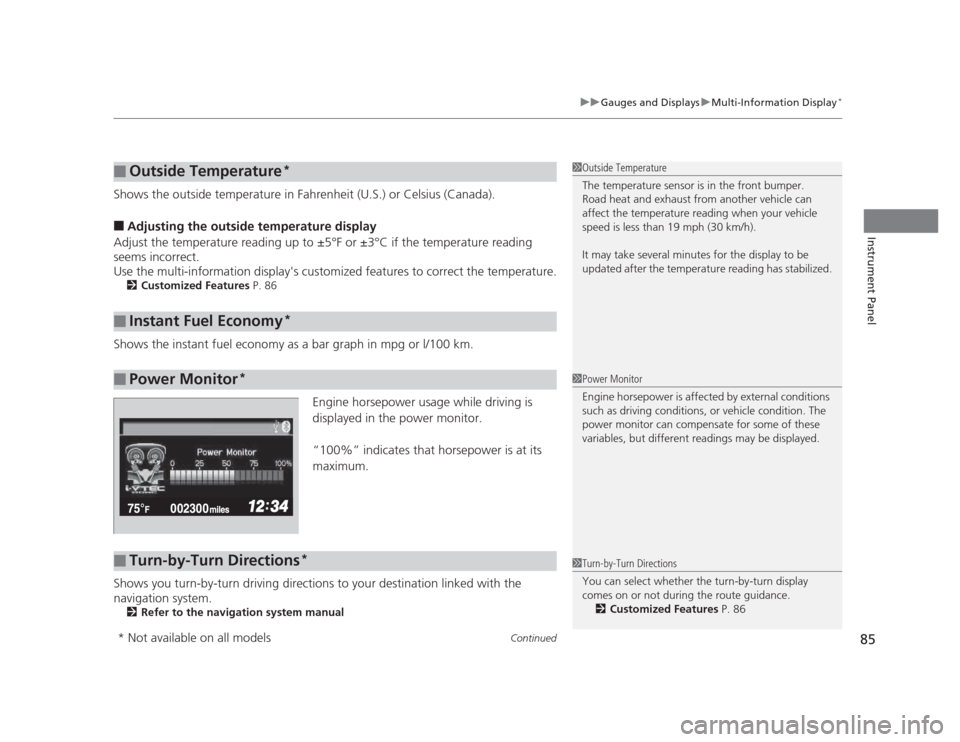
Shows the instant fuel economy as a bar graph in mpg or l/100 km. Engine horsepower usage while driving is
displayed in the power monitor.
“100%” indicates that horsepower is at its maximum.
Shows you turn-by-turn driving directions to your destination linked with the
navigation system. 2 Refer to the navigation system manual
■Outside Temperature *
■Instant Fuel Economy *
■Power Monitor*
1Outside Temperature
The temperature sensor is in the front bumper.
Road heat and exhaust from another vehicle can
affect the temperature reading when your vehicle
speed is less than 19 mph (30 km/h).
It may take several minutes for the display to be
updated after the temperature reading has stabilized.
1Power Monitor
Engine horsepower is affected by external conditions
such as driving conditions, or vehicle condition. The
power monitor can compensate for some of these
variables, but different readings may be displayed.
■Turn-by-Turn Directions
*1Turn-by-Turn Directions
You can select whether the turn-by-turn display
comes on or not during the route guidance.
2 Customized Features P. 86
* Not available on all models
Page 110 of 345
109
Continued
Controls
Opening and Closing the Trunk
Precautions for Opening/Closing the Trunk ■
Opening the trunk
Open the trunk all the way.
uIf it is not fully opened, the trunk lid may begin to close under its own weight.
■ Closing the trunk
Keep the trunk lid closed while driving to:
uAvoid possible damage.
uPrevent exhaust gas from leaking into the vehicle.
2 Exhaust Gas Hazard P. 62
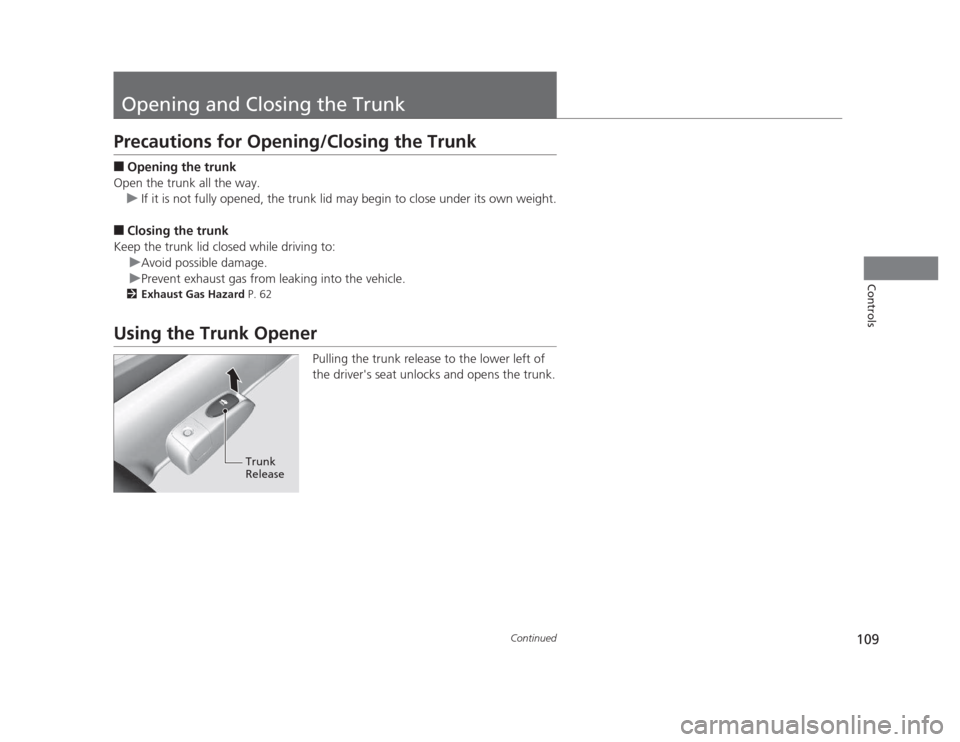
Using the Trunk Opener
Pulling the trunk release to the lower left of
the driver's seat unlocks and opens the trunk.
Trunk
Release
Page 133 of 345
132
uuAdjusting the SeatsuRear Seats
Controls
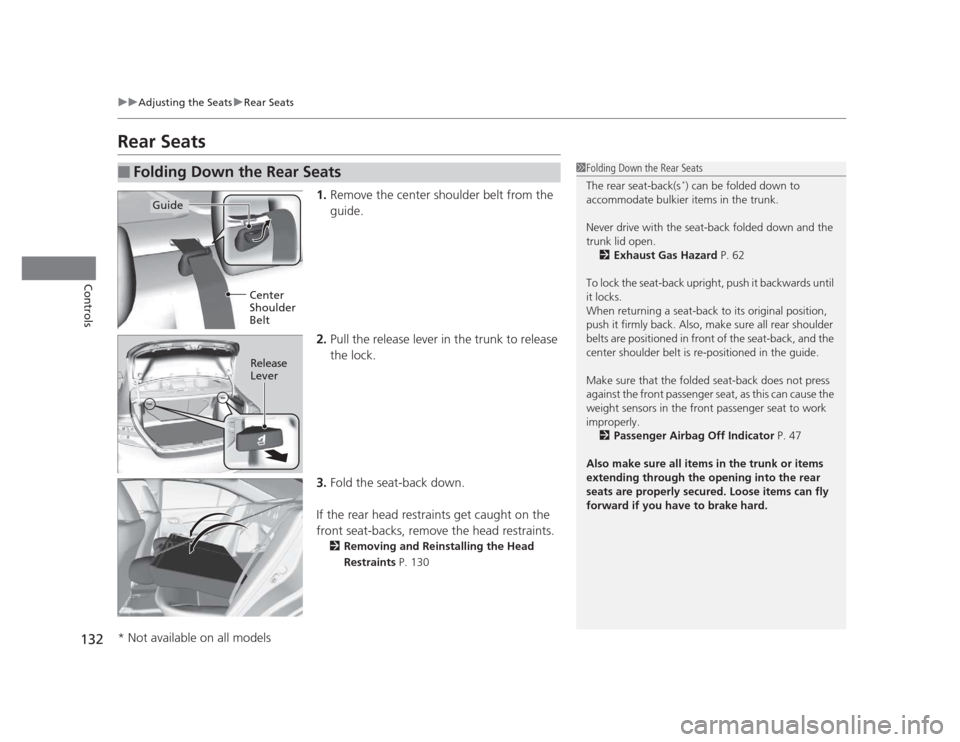
Rear Seats1.Remove the center shoulder belt from the
guide.
2. Pull the release lever in the trunk to release
the lock.
3. Fold the seat-back down.
If the rear head restraints get caught on the
front seat-backs, remove the head restraints. 2 Removing and Reinstalling the Head
Restraints P. 130
■Folding Down the Rear Seats1Folding Down the Rear Seats
The rear seat-back(s *
) can be folded down to
accommodate bulkier items in the trunk.
Never drive with the seat-back folded down and the
trunk lid open.
2 Exhaust Gas Hazard P. 62
To lock the seat-back upright, push it backwards until
it locks.
When returning a seat-back to its original position,
push it firmly back. Also, make sure all rear shoulder
belts are positioned in front of the seat-back, and the
center shoulder belt is re-positioned in the guide.
Make sure that the folded seat-back does not press against the front passenger seat, as this can cause the
weight sensors in the front passenger seat to work
improperly. 2 Passenger Airbag Off Indicator P. 47
Also make sure all items in the trunk or items
extending through the opening into the rear
seats are properly secured. Loose items can fly
forward if you have to brake hard.
Guide
Center
Shoulder
Belt
Release Lever
* Not available on all models
Page 212 of 345
211
Continued
Driving
When Driving
Starting the Engine
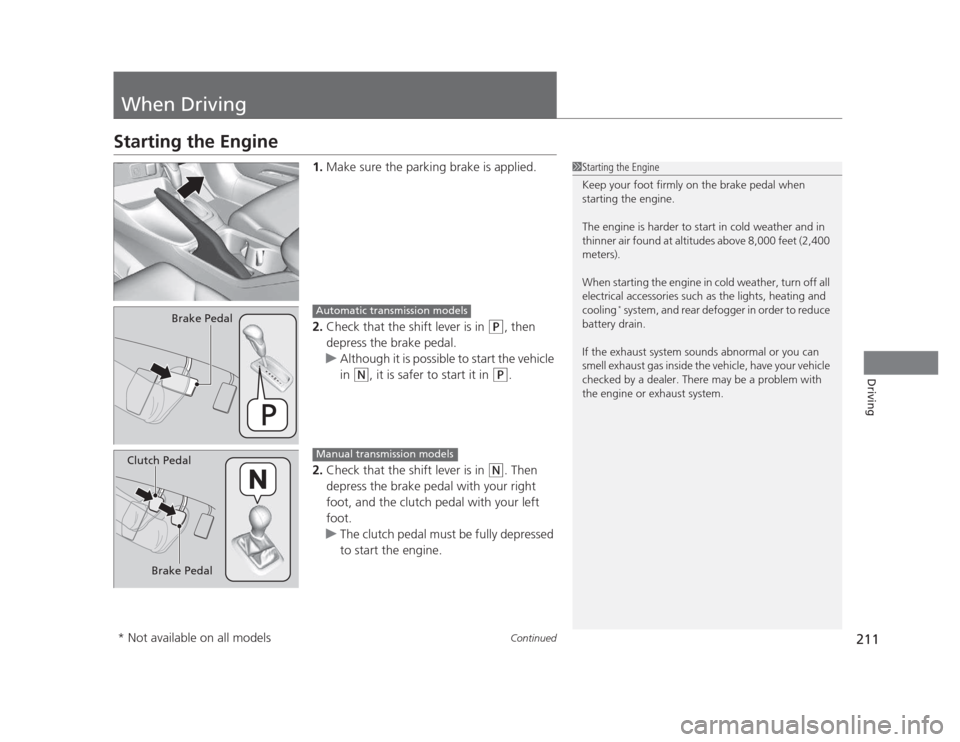
1.Make sure the parking brake is applied.
2. Check that the shift lever is in
(P , then
depress the brake pedal.
uAlthough it is possible to start the vehicle
in
(N , it is safer to start it in (P.
2. Check that the shift lever is in
(N . Then
depress the brake pedal with your right
foot, and the clutch pedal with your left foot.
uThe clutch pedal must be fully depressed
to start the engine.
1Starting the Engine
Keep your foot firmly on the brake pedal when
starting the engine.
The engine is harder to start in cold weather and in
thinner air found at altitudes above 8,000 feet (2,400 meters).
When starting the engine in cold weather, turn off all
electrical accessories such as the lights, heating and cooling *
system, and rear defogger in order to reduce
battery drain.
If the exhaust system sounds abnormal or you can
smell exhaust gas inside the vehicle, have your vehicle
checked by a dealer. There may be a problem with
the engine or exhaust system.
Brake PedalAutomatic transmission models
Brake Pedal
Clutch Pedal
Manual transmission models
* Not available on all models
Page 234 of 345
233
Driving
Parking Your Vehicle
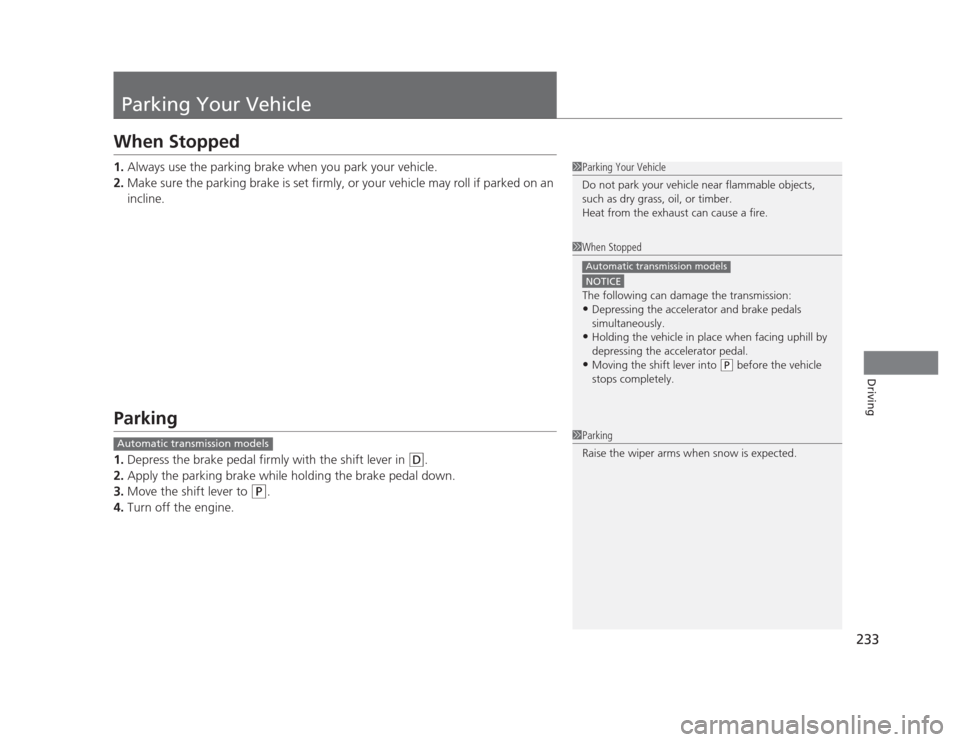
When Stopped 1.Always use the parking brake when you park your vehicle.
2. Make sure the parking brake is set firmly, or your vehicle may roll if parked on an
incline.
Parking 1.Depress the brake pedal firmly with the shift lever in
(D .
2. Apply the parking brake while holding the brake pedal down.
3. Move the shift lever to
(P .
4. Turn off the engine.
1Parking Your Vehicle
Do not park your vehicle near flammable objects,
such as dry grass, oil, or timber.
Heat from the exhaust can cause a fire.
1When Stopped
NOTICE
The following can damage the transmission: •Depressing the accelerator and brake pedals
simultaneously.
• Holding the vehicle in place when facing uphill by
depressing the accelerator pedal.
• Moving the shift lever into
(P before the vehicle
stops completely.
Automatic transmission models
1Parking
Raise the wiper arms when snow is expected.Automatic transmission models
Page 242 of 345
241
uuBefore Performing MaintenanceuSafety When Performing Maintenance
Maintenance
Safety When Performing Maintenance
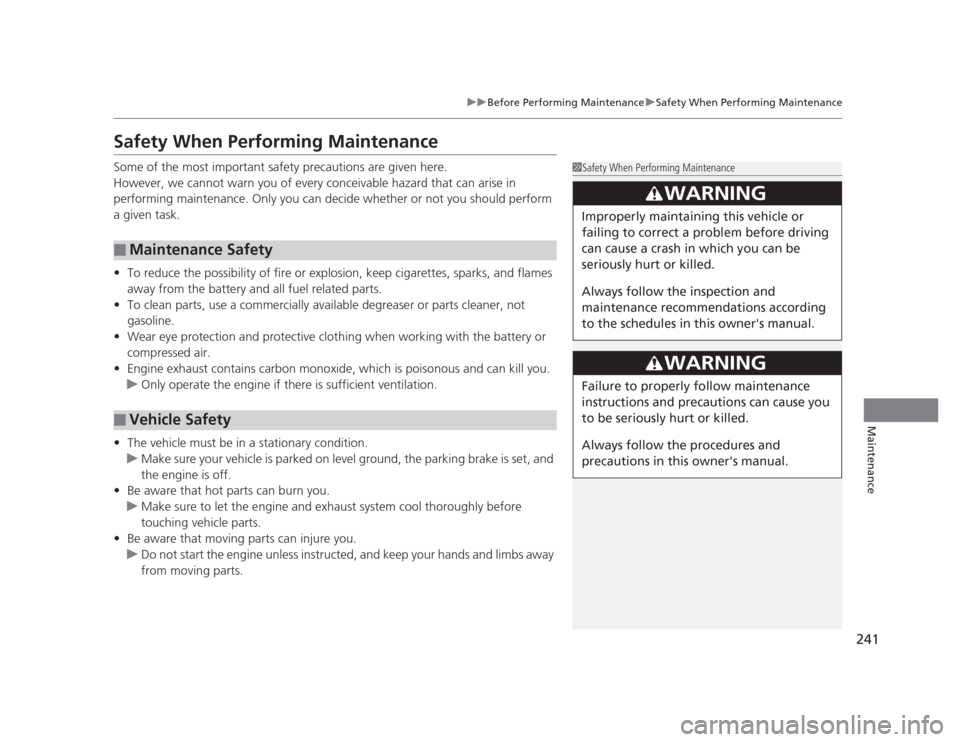
Some of the most important safety precautions are given here.
However, we cannot warn you of every conceivable hazard that can arise in
performing maintenance. Only you can decide whether or not you should perform
a given task. • To reduce the possibility of fire or explosion, keep cigarettes, sparks, and flames
away from the battery and all fuel related parts.
• To clean parts, use a commercially available degreaser or parts cleaner, not
gasoline.
• Wear eye protection and protective clothing when working with the battery or
compressed air.
• Engine exhaust contains carbon monoxide, which is poisonous and can kill you.
uOnly operate the engine if there is sufficient ventilation.
• The vehicle must be in a stationary condition.
uMake sure your vehicle is parked on level ground, the parking brake is set, and
the engine is off.
• Be aware that hot parts can burn you.
uMake sure to let the engine and exhaust system cool thoroughly before
touching vehicle parts.
• Be aware that moving parts can injure you.
uDo not start the engine unless instructed, and keep your hands and limbs away
from moving parts.
■Maintenance Safety
■Vehicle Safety
1Safety When Performing Maintenance
3WARNING
Improperly maintaining this vehicle or
failing to correct a problem before driving
can cause a crash in which you can be
seriously hurt or killed.
Always follow the inspection and
maintenance recommendations according
to the schedules in this owner's manual.
3WARNING
Failure to properly follow maintenance
instructions and precautions can cause you
to be seriously hurt or killed.
Always follow the procedures and
precautions in this owner's manual.