engine HONDA CIVIC 2013 9.G Owners Manual
[x] Cancel search | Manufacturer: HONDA, Model Year: 2013, Model line: CIVIC, Model: HONDA CIVIC 2013 9.GPages: 367, PDF Size: 8.43 MB
Page 340 of 367
339
uuIndicator, Coming On/Blinking uIf the Brake System Indicator Comes On
Handling the Unexpected
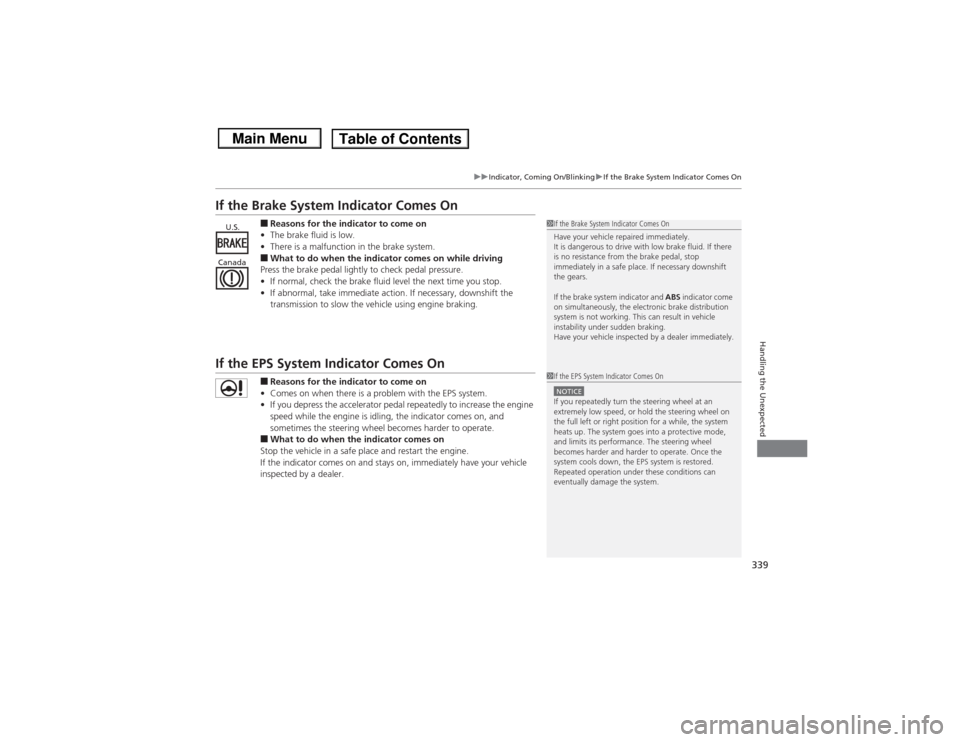
If the Brake System Indicator Comes On
■Reasons for the indicator to come on
• The brake fluid is low.
• There is a malfunction in the brake system.■What to do when the indicator comes on while driving
Press the brake pedal lightly to check pedal pressure.
• If normal, check the brake fluid level the next time you stop.
• If abnormal, take immediate action. If necessary, downshift the
transmission to slow the vehicle using engine braking.
If the EPS System Indicator Comes On
■Reasons for the indicator to come on
• Comes on when there is a problem with the EPS system.
• If you depress the accelerator pedal repeatedly to increase the engine
speed while the engine is idling, the indicator comes on, and
sometimes the steering wheel becomes harder to operate.■What to do when the indicator comes on
Stop the vehicle in a safe place and restart the engine.
If the indicator comes on and stays on, immediately have your vehicle
inspected by a dealer.
1 If the Brake System Indicator Comes On
Have your vehicle repaired immediately.
It is dangerous to drive with low brake fluid. If there
is no resistance from the brake pedal, stop
immediately in a safe place. If necessary downshift
the gears.
If the brake system indicator and ABS indicator come
on simultaneously, the electronic brake distribution
system is not working. This can result in vehicle
instability under sudden braking.
Have your vehicle inspected by a dealer immediately.
U.S.
Canada
1 If the EPS System Indicator Comes OnNOTICEIf you repeatedly turn the steering wheel at an
extremely low speed, or hold the steering wheel on
the full left or right position for a while, the system
heats up. The system goes into a protective mode,
and limits its performance. The steering wheel
becomes harder and harder to operate. Once the
system cools down, the EPS system is restored.
Repeated operation under these conditions can
eventually damage the system.
Page 342 of 367
341
Continued
Handling the Unexpected
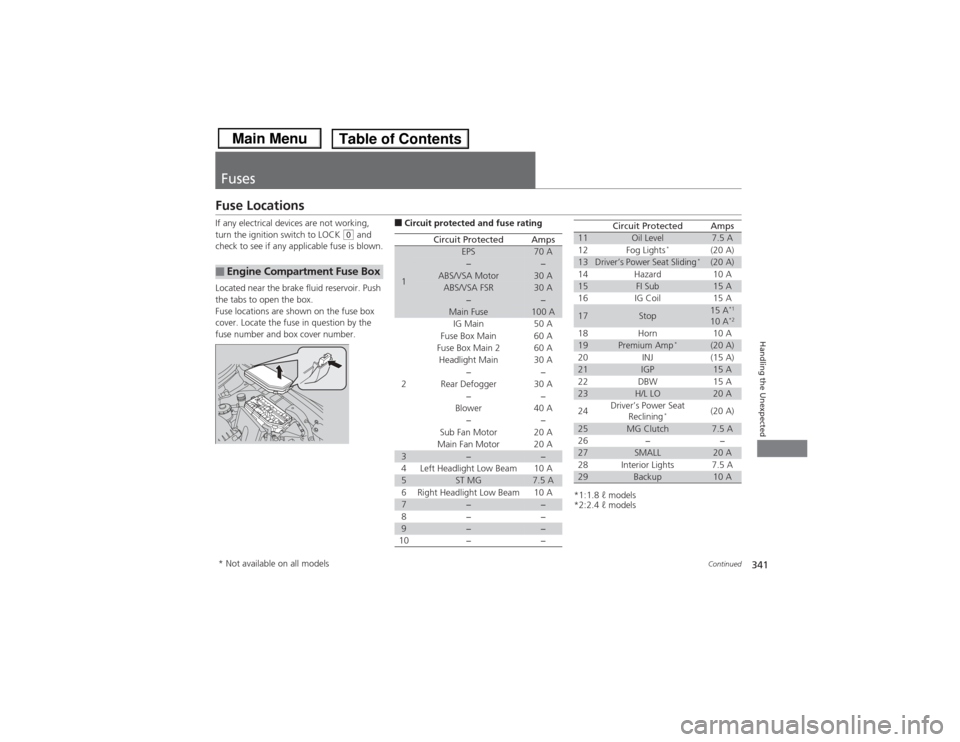
FusesFuse LocationsIf any electrical devices are not working,
turn the ignition switch to LOCK
(0 and
check to see if any applicable fuse is blown.
Located near the brake fluid reservoir. Push
the tabs to open the box.
Fuse locations are shown on the fuse box
cover. Locate the fuse in question by the
fuse number and box cover number.
■Engine Compartment Fuse Box
■Circuit protected and fuse rating
Circuit Protected
Amps
1
EPS
70 A
−
−
ABS/VSA Motor
30 A
ABS/VSA FSR
30 A
−
−
Main Fuse
100 A
2
IG Main
50 A
Fuse Box Main 60 A
Fuse Box Main 2
60 A
Headlight Main 30 A
−
−
Rear Defogger 30 A −−
Blower 40 A
−−
Sub Fan Motor 20 A
Main Fan Motor 20 A
3
−
−
4 Left Headlight Low Beam 10 A
5
ST MG
7.5 A
6 Right Headlight Low Beam 10 A
7
−
−
8− −
9
−
−
10 − −
*1:1.8 ℓ models
*2:2.4 ℓ models11
Oil Level
7.5 A
12 Fog Lights
*
(20 A)
13
Driver’s Power Seat Sliding
*
(20 A)
14 Hazard 10 A
15
FI Sub
15 A
16 IG Coil 15 A
17
Stop
15 A
*1
10 A
*2
18 Horn 10 A19
Premium Amp
*
(20 A)
20 INJ (15 A)
21
IGP
15 A
22 DBW 15 A
23
H/L LO
20 A
24 Driver’s Power Seat
Reclining
*
(20 A)
25
MG Clutch
7.5 A
26 − −
27
SMALL
20 A
28 Interior Lights 7.5 A
29
Backup
10 A
Circuit Protected
Amps
* Not available on all models
Page 344 of 367
343
uuFuses uInspecting and Changing Fuses
Handling the Unexpected
Inspecting and Changing Fuses
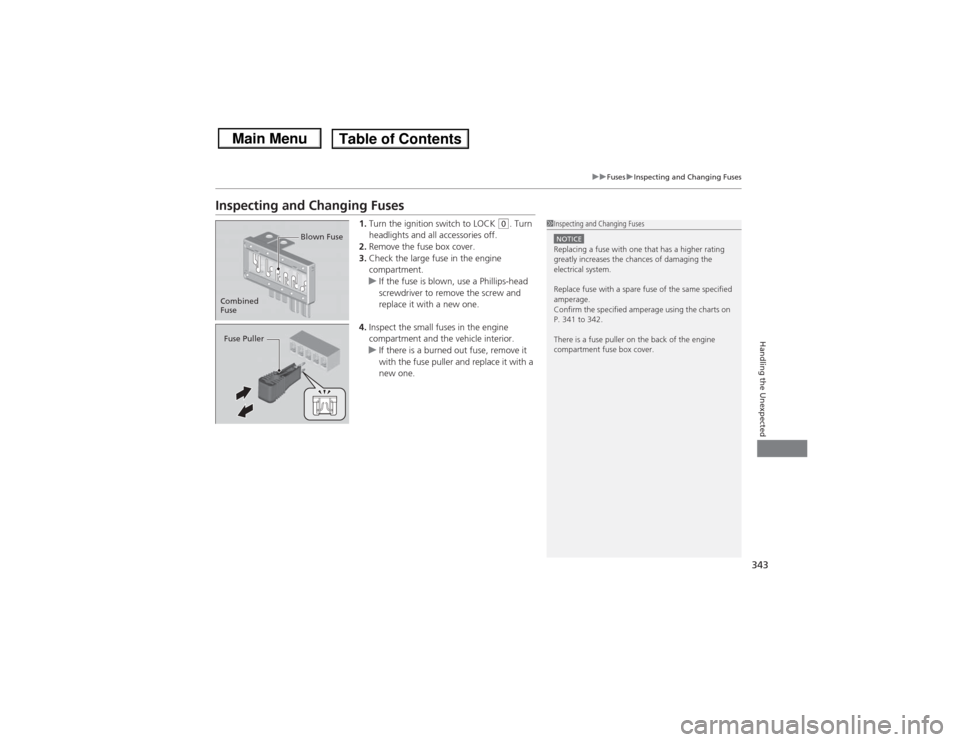
1. Turn the ignition switch to LOCK
(0. Turn
headlights and all accessories off.
2. Remove the fuse box cover.
3. Check the large fuse in the engine
compartment.
u If the fuse is blown, use a Phillips-head
screwdriver to remove the screw and
replace it with a new one.
4. Inspect the small fuses in the engine
compartment and the vehicle interior.
u If there is a burned out fuse, remove it
with the fuse puller and replace it with a
new one.
1Inspecting and Changing FusesNOTICEReplacing a fuse with one that has a higher rating
greatly increases the chances of damaging the
electrical system.
Replace fuse with a spare fuse of the same specified
amperage.
Confirm the specified amperage using the charts on
P. 341 to 342.
There is a fuse puller on the back of the engine
compartment fuse box cover.
Combined
Fuse Blown FuseFuse Puller
Page 346 of 367
345
Information
This chapter includes your vehicle's specifications, locations of identification numbers, and otherinformation required by regulation.
Specifications.................................... 346
Identification NumbersVehicle Identification Nu mber (VIN) ...... 350Engine Number and Transmission
Number...................................... 350Devices that Emit Radio Waves ....... 351
Reporting Safety Defects ................. 352Emissions Testing
Testing of Readiness Codes.............. 353
Warranty Coverages ........................ 355
Authorized Manuals ......................... 357
Customer Service Information ......... 358
Page 347 of 367
346Information
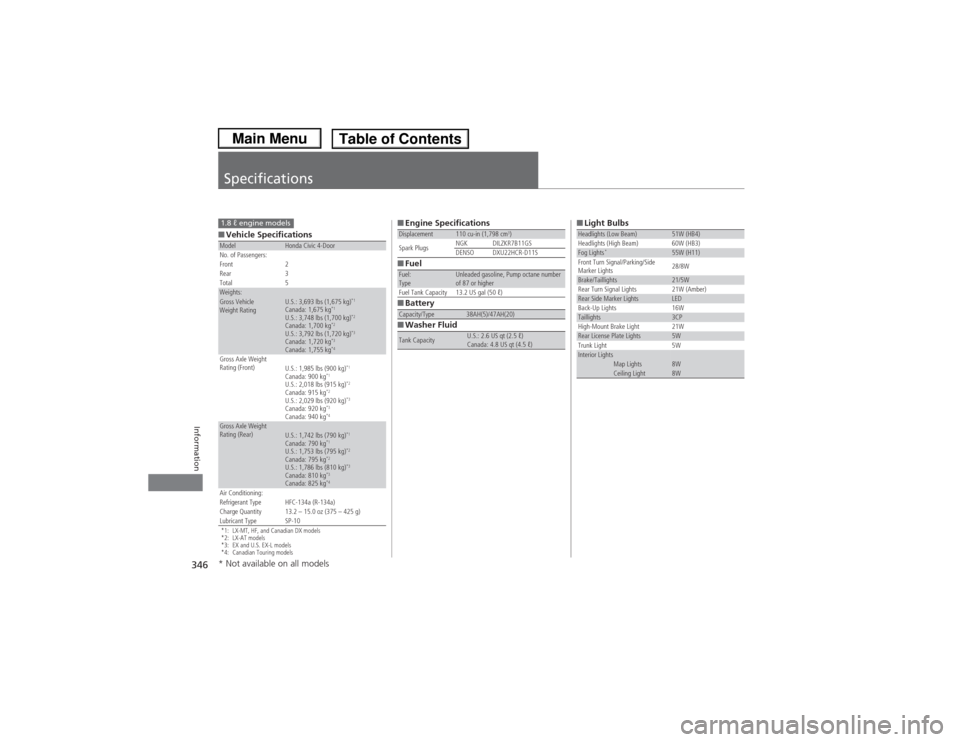
Specifications■Vehicle Specifications*1: LX-MT, HF, and Canadian DX models
*2: LX-AT models
*3: EX and U.S. EX-L models
*4: Canadian Touring modelsModel
Honda Civic 4-Door
No. of Passengers:
Front 2
Rear 3
Total 5
Weights:Gross Vehicle
Weight Rating
U.S.: 3,693 lbs (1,675 kg)
*1
Canada: 1,675 kg
*1
U.S.: 3,748 lbs (1,700 kg)
*2
Canada: 1,700 kg
*2
U.S.: 3,792 lbs (1,720 kg)
*3
Canada: 1,720 kg
*3
Canada: 1,755 kg
*4
Gross Axle Weight
Rating (Front)
U.S.: 1,985 lbs (900 kg)
*1
Canada: 900 kg
*1
U.S.: 2,018 lbs (915 kg)
*2
Canada: 915 kg
*2
U.S.: 2,029 lbs (920 kg)
*3
Canada: 920 kg
*3
Canada: 940 kg
*4
Gross Axle Weight
Rating (Rear)
U.S.: 1,742 lbs (790 kg)
*1
Canada: 790 kg
*1
U.S.: 1,753 lbs (795 kg)
*2
Canada: 795 kg
*2
U.S.: 1,786 lbs (810 kg)
*3
Canada: 810 kg
*3
Canada: 825 kg
*4
Air Conditioning:
Refrigerant Type HFC-134a (R-134a)
Charge Quantity 13.2 – 15.0 oz (375 – 425 g)
Lubricant Type SP-101.8 ℓ engine models
■ Engine Specifications
■ Fuel
■ Battery
■ Washer FluidDisplacement
110 cu-in (1,798 cm
3)
Spark Plugs NGK DILZKR7B11GS
DENSO DXU22HCR-D11S
Fuel:
Type
Unleaded gasoline, Pump octane number
of 87 or higher
Fuel Tank Capacity 13.2 US gal (50 ℓ)
Capacity/Type
38AH(5)/47AH(20)
Tank Capacity
U.S.: 2.6 US qt (2.5 ℓ)
Canada: 4.8 US qt (4.5 ℓ)
■ Light BulbsHeadlights (Low Beam)
51W (HB4)
Headlights (High Beam) 60W (HB3)
Fog Lights
*
55W (H11)
Front Turn Signal/Parking/Side
Marker Lights 28/8W
Brake/Taillights
21/5W
Rear Turn Signal Lights 21W (Amber)
Rear Side Marker Lights
LED
Back-Up Lights 16W
Taillights
3CP
High-Mount Brake Light 21W
Rear License Plate Lights
5W
Trunk Light 5W
Interior Lights
Map Lights
8W
Ceiling Light
8W
* Not available on all models
Page 348 of 367
347
uuSpecifications u
Continued
Information
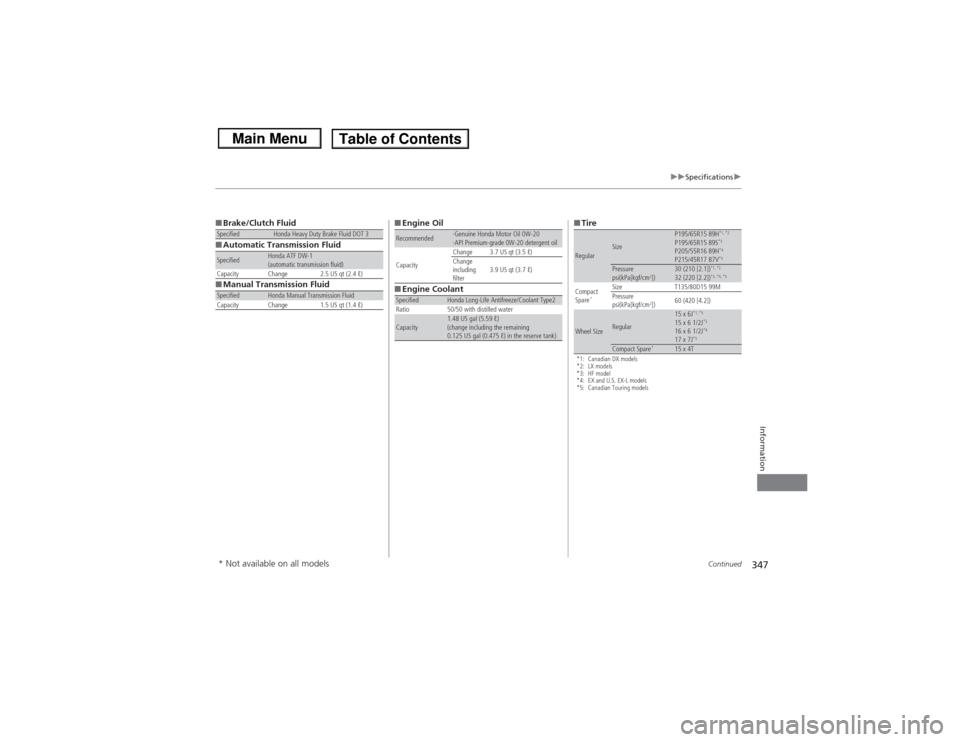
■Brake/Clutch Fluid
■ Automatic Transmission Fluid
■ Manual Transmission FluidSpecified
Honda Heavy Duty Brake Fluid DOT 3
Specified
Honda ATF DW-1
(automatic transmission fluid)
Capacity Change 2.5 US qt (2.4 ℓ)
Specified
Honda Manual Transmission Fluid
Capacity Change 1.5 US qt (1.4 ℓ)
■ Engine Oil
■ Engine CoolantRecommended
·Genuine Honda Motor Oil 0W-20
·API Premium-grade 0W-20 detergent oil
Capacity Change 3.7 US qt (3.5 ℓ)
Change
including
filter
3.9 US qt (3.7 ℓ)
Specified
Honda Long-Life Antifreeze/Coolant Type2
Ratio 50/50 with distilled water
Capacity
1.48 US gal (5.59 ℓ)
(change including the remaining
0.125 US gal (0.475 ℓ) in the reserve tank)
■ Tire*1: Canadian DX models
*2: LX models
*3: HF model
*4: EX and U.S. EX-L models
*5: Canadian Touring modelsRegular
Size
P195/65R15 89H
*1, *2
P195/65R15 89S
*3
P205/55R16 89H
*4
P215/45R17 87V
*5
Pressure
psi(kPa[kgf/cm
2])
30 (210 [2.1])
*1, *2
32 (220 [2.2])
*3, *4, *5
Compact
Spare
*
Size T135/80D15 99M
Pressure
psi(kPa[kgf/cm
2]) 60 (420 [4.2])
Wheel Size
Regular
15 x 6J
*1, *3
15 x 6 1/2J
*2
16 x 6 1/2J
*4
17 x 7J
*5
Compact Spare
*
15 x 4T
* Not available on all models
Page 349 of 367
348
uuSpecifications u
Information
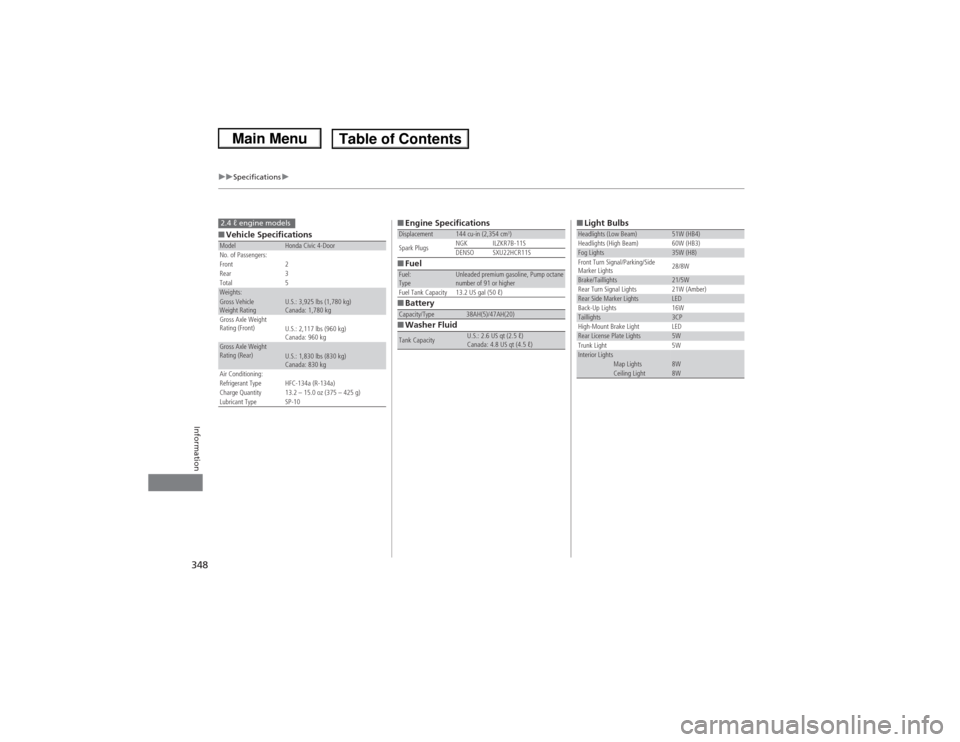
■Vehicle SpecificationsModel
Honda Civic 4-Door
No. of Passengers:
Front 2
Rear 3
Total 5
Weights:Gross Vehicle
Weight Rating
U.S.: 3,925 lbs (1,780 kg)
Canada: 1,780 kg
Gross Axle Weight
Rating (Front)
U.S.: 2,117 lbs (960 kg)
Canada: 960 kg
Gross Axle Weight
Rating (Rear)
U.S.: 1,830 lbs (830 kg)
Canada: 830 kg
Air Conditioning:
Refrigerant Type HFC-134a (R-134a)
Charge Quantity 13.2 – 15.0 oz (375 – 425 g)
Lubricant Type SP-10
2.4 ℓ engine models
■ Engine Specifications
■ Fuel
■ Battery
■ Washer FluidDisplacement
144 cu-in (2,354 cm
3)
Spark Plugs NGK ILZKR7B-11S
DENSO SXU22HCR11S
Fuel:
Type
Unleaded premium gasoline, Pump octane
number of 91 or higher
Fuel Tank Capacity 13.2 US gal (50 ℓ)
Capacity/Type
38AH(5)/47AH(20)
Tank Capacity
U.S.: 2.6 US qt (2.5 ℓ)
Canada: 4.8 US qt (4.5 ℓ)
■ Light BulbsHeadlights (Low Beam)
51W (HB4)
Headlights (High Beam) 60W (HB3)
Fog Lights
35W (H8)
Front Turn Signal/Parking/Side
Marker Lights 28/8W
Brake/Taillights
21/5W
Rear Turn Signal Lights 21W (Amber)
Rear Side Marker Lights
LED
Back-Up Lights 16W
Taillights
3CP
High-Mount Brake Light LED
Rear License Plate Lights
5W
Trunk Light 5W
Interior Lights
Map Lights
8W
Ceiling Light
8W
Page 350 of 367
349
uuSpecifications u
Information
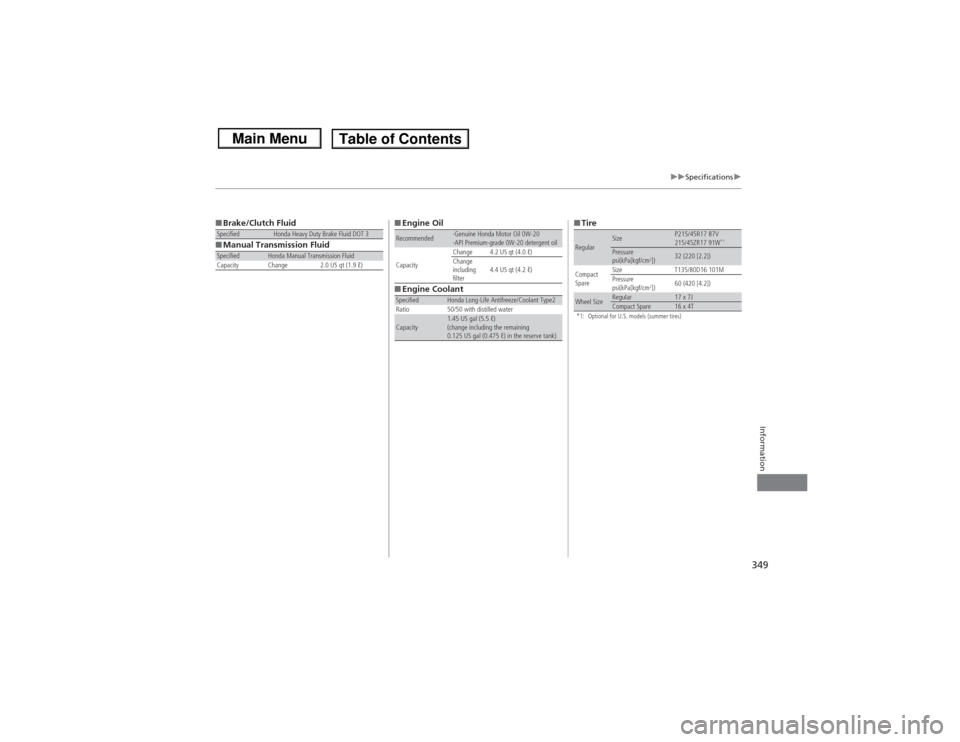
■Brake/Clutch Fluid
■ Manual Transmission FluidSpecified
Honda Heavy Duty Brake Fluid DOT 3
Specified
Honda Manual Transmission Fluid
Capacity Change 2.0 US qt (1.9 ℓ)
■ Engine Oil
■ Engine CoolantRecommended
·Genuine Honda Motor Oil 0W-20
·API Premium-grade 0W-20 detergent oil
Capacity Change 4.2 US qt (4.0 ℓ)
Change
including
filter
4.4 US qt (4.2 ℓ)
Specified
Honda Long-Life Antifreeze/Coolant Type2
Ratio 50/50 with distilled water
Capacity
1.45 US gal (5.5 ℓ)
(change including the remaining
0.125 US gal (0.475 ℓ) in the reserve tank)
■ Tire*1: Optional for U.S. models (summer tires)Regular
Size
P215/45R17 87V
215/45ZR17 91W
*1
Pressure
psi(kPa[kgf/cm
2])
32 (220 [2.2])
Compact
Spare Size
T135/80D16 101M
Pressure
psi(kPa[kgf/cm
2]) 60 (420 [4.2])
Wheel Size
Regular
17 x 7J
Compact Spare
16 x 4T
Page 351 of 367
350Information
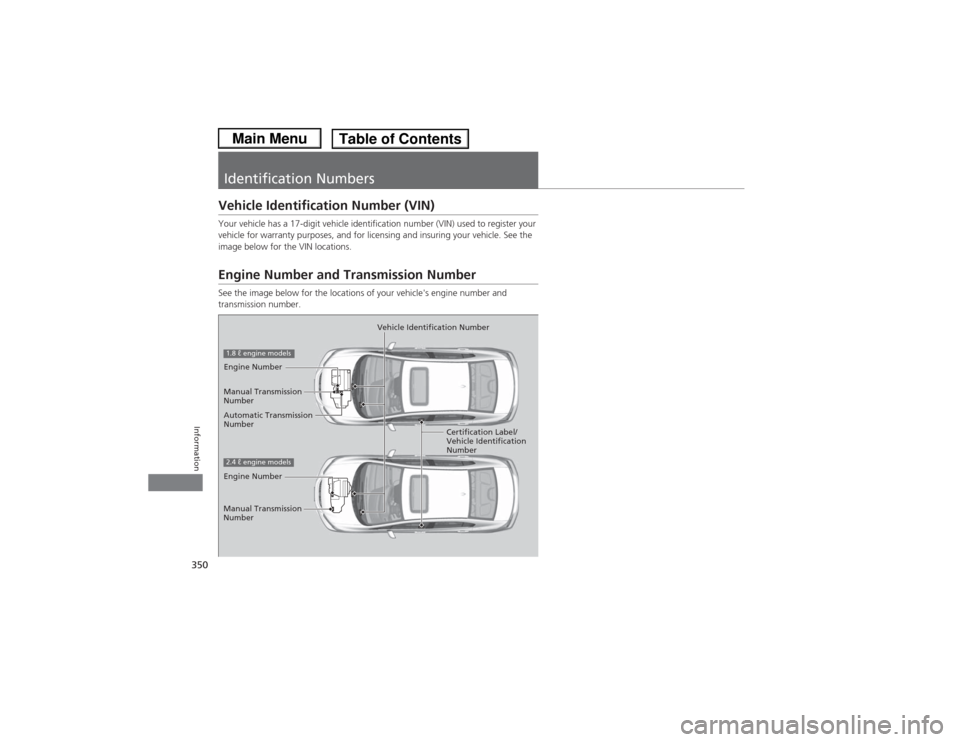
Identification NumbersVehicle Identification Number (VIN)Your vehicle has a 17-digit vehicle identification number (VIN) used to register your
vehicle for warranty purposes, and for licensing and insuring your vehicle. See the
image below for the VIN locations.Engine Number and Transmission NumberSee the image below for the locations of your vehicle's engine number and
transmission number.
Vehicle Identification Number
Engine Number
Certification Label/
Vehicle Identification
Number
Manual Transmission
Number
Automatic Transmission
Number
2.4 ℓ engine models1.8 ℓ engine modelsEngine Number
Manual Transmission
Number
Page 354 of 367
353
Continued
Information
Emissions TestingTesting of Readiness CodesYour vehicle uses “readiness codes,” as part of its onboard self diagnostic system.
Some states refer to these codes during testing to see if your vehicle's emissions
components are working properly.
The codes may not be read if you go through the testing just after the battery has
gone dead or been disconnected.
To check if they are set, turn the ignition switch to ON
(w, without starting the
engine. The malfunction indicator lamp will come on for several seconds. If it then
goes off, the readiness codes are set. If it blinks five times, the readiness codes are
not set.
If you are required to have your vehicle tested before the readiness codes are ready,
prepare the vehicle for retesting by doing the following:
1. Fill the gas tank to approximately 3/4 full.
2. Park the vehicle and leave the engine off for 6 hours or more.
3. Make sure the ambient temperature is between 40°F and 95°F (4°C and 35°C).
4. Start the engine without touching the accelerator pedal, and let it idle for 20
seconds.
5. Keep the vehicle in
(P (automatic transmission) or
(N (manual transmission).
Increase the engine speed to 2,000 rpm, and hold it there for about 3 minutes.
6. Let the engine idle with your foot off the accelerator for 20 seconds.
1Testing of Readiness Codes
The readiness codes are erased when the battery is
disconnected, and set again only after several days of
driving under a variety of conditions.
If a testing facility determines that the readiness
codes are not set, you may be requested to return at
a later date to complete the test.
If the testing facility determines the readiness codes
are still not set, see a dealer.