flat tire HONDA CIVIC 2014 9.G User Guide
[x] Cancel search | Manufacturer: HONDA, Model Year: 2014, Model line: CIVIC, Model: HONDA CIVIC 2014 9.GPages: 469, PDF Size: 17.32 MB
Page 396 of 469
395
uuChecking and Maintaining Tires uDOT Tire Quality Grading (U.S. Vehicles)
Maintenance
The traction grades, from highest to lowest, are AA, A, B, and C.
Those grades represent the tire's ability to stop on wet pavement
as measured under controlle d conditions on specified
government test surfaces of asphalt and concrete. A tire marked
C may have poor traction performance.
The temperature grades are A (the highest), B, and C,
representing the tire's resistance to the generation of heat and its
ability to dissipate heat when tested under controlled conditions
on a specified indo or laboratory test wheel. Sustained high
temperature can cause the material of the tire to degenerate and
reduce tire life, and excessive temperature can lead to sudden tire
failure. The grade C corresponds to a level of performance which
all passenger car tires must meet under the Federal Motor Vehicle
Safety Standard No. 109. Grades B and A represent higher levels
of performance on the laboratory test wheel than the minimum
required by law.■
Traction
■
Temperature
1 TractionWarning: The traction grade
assigned to this tire is based on
straight-ahead braking traction tests,
and does not include acceleration,
cornering, hydroplaning, or peak
traction characteristics.1TemperatureWarning: The temperature grade for
this tire is established for a tire that is
properly inflated and not
overloaded. Excessive speed,
underinflation, or excessive loading,
either separately or in combination,
can cause heat buildup and possible
tire failure.
Page 397 of 469
396
uuChecking and Maintaining Tires uWear Indicators
Maintenance
Wear Indicators
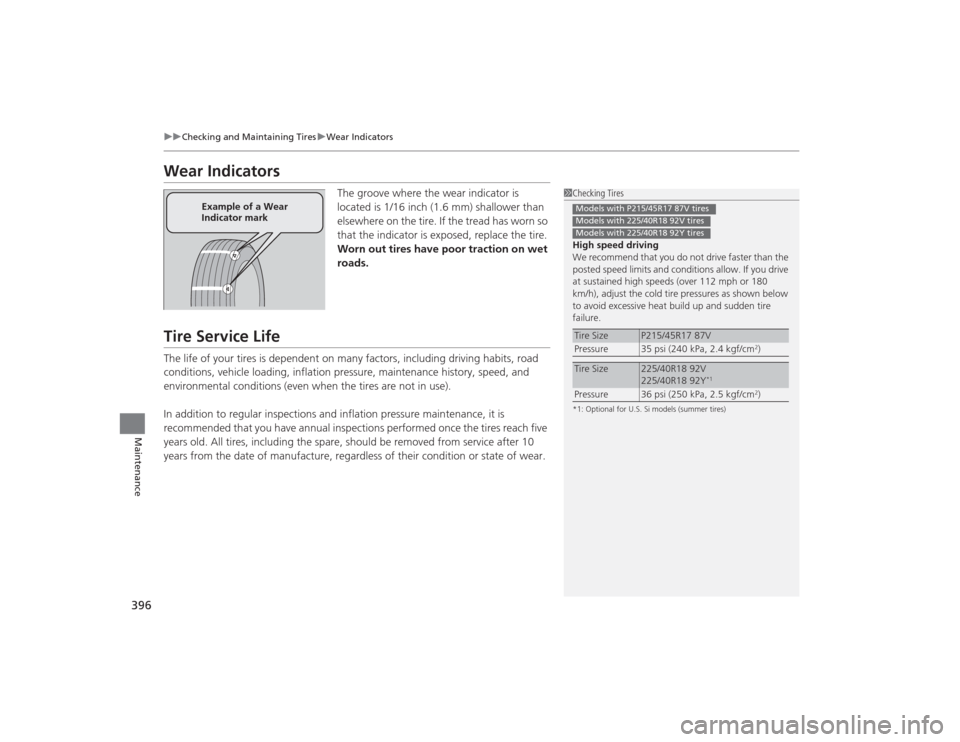
The groove where the wear indicator is
located is 1/16 inch (1.6 mm) shallower than
elsewhere on the tire. If the tread has worn so
that the indicator is exposed, replace the tire.
Worn out tires have poor traction on wet
roads.
Tire Service LifeThe life of your tires is dependent on many factors, including driving habits, road
conditions, vehicle loading, inflation pressure, maintenance history, speed, and
environmental conditions (even when the tires are not in use).
In addition to regular inspections and inflation pressure maintenance, it is
recommended that you have annual inspections performed once the tires reach five
years old. All tires, including the spare, should be removed from service after 10
years from the date of manufacture, regardless of their condition or state of wear.
1Checking Tires
High speed driving
We recommend that you do not drive faster than the
posted speed limits and conditions allow. If you drive
at sustained high speeds (over 112 mph or 180
km/h), adjust the cold tire pressures as shown below
to avoid excessive heat build up and sudden tire
failure.*1: Optional for U.S. Si models (summer tires)Tire Size
P215/45R17 87V
Pressure 35 psi (240 kPa, 2.4 kgf/cm
2)
Tire Size
225/40R18 92V
225/40R18 92Y
*1
Pressure 36 psi (250 kPa, 2.5 kgf/cm
2)
Models with P215/45R17 87V tiresModels with 225/40R18 92V tiresModels with 225/40R18 92Y tires
Example of a Wear
Indicator mark
Page 410 of 469

409
Handling the Unexpected
This chapter explains how to handle unexpected troubles.
Tools
Types of Tools .................................. 410
If a Tire Goes Flat Changing a Flat Tire ......................... 411
Temporarily Repairing a Flat Tire....... 418
Engine Does Not Start Checking the Engine ........................ 426If the Smart Entry Remote Battery is Weak .......................................... 427Emergency Engine Stop ................... 428
Jump Starting .................................... 429
Shift Lever Does Not Move .............. 432Overheating
How to Handle Overheating............. 433
Indicator, Coming On/Blinking
If the Low Oil Pressure Indicator Comes On ............................................. 435If the Charging System Indicator Comes
On ................................................. 435
If the Malfunction Indicator Lamp Comes On or Blinks ................................... 436If the Brake System Indicator (Red) Comes On .................................................... 437
If the Electric Power Steering (EPS) System
Indicator Comes On ............................. 437If the Low Tire Pressure/TPMS Indicator Comes On or Blinks ....................... 438
Fuses Fuse Locations ................................. 439
Inspecting and Changing Fuses ........ 441
Emergency Towing ........................... 442
Page 412 of 469
411
Continued
Handling the Unexpected
If a Tire Goes FlatChanging a Flat TireIf a tire goes flat while driving, grasp the steering wheel firmly, and brake gradually
to reduce speed. Then, stop in a safe place. Replace the flat tire with a compact
spare tire. Go to a dealer as soon as possible to have the full-size tire repaired or
replaced.
1.Park the vehicle on firm, level, and non-slippery surface, and apply the parking
brake.
2. Put the shift lever in
(P
.
2. Put the shift lever in
(R
.
3. Turn on the hazard warning lights and turn the ignition switch to LOCK
(0
*1.
*1: Models with the smart entry system have an ENGINE START/STOP button instead of an
ignition switch.Models with compact spare tire
1 Changing a Flat Tire
Periodically check the tire pressure of the compact
spare. It should be set to the specified pressure.
Specified Pressure: 60 psi (420 kPa, 4.2 kgf/cm
2)
When driving with the compact spare tire, keep the
vehicle speed under 50 mph (80 km/h). Replace with
a full-size tire as soon as possible.
The compact spare tire and wheel in your vehicle are
specifically for this model. Do not use them with
another vehicle. Do not use another type of compact
spare tire or wheel with your vehicle.
Do not mount tire chains on a compact spare tire.
If a chain-mounted front tire goes flat, remove one of
the full-size rear tires and replace it with the compact
spare tire. Remove the flat front tire and replace it
with the full-size tire that was removed from the rear.
Mount the tire chains on the front tire.
Automatic transmission (CVT) modelsManual transmission modelsAll models
Page 413 of 469
uuIf a Tire Goes Flat uChanging a Flat Tire
412Handling the Unexpected
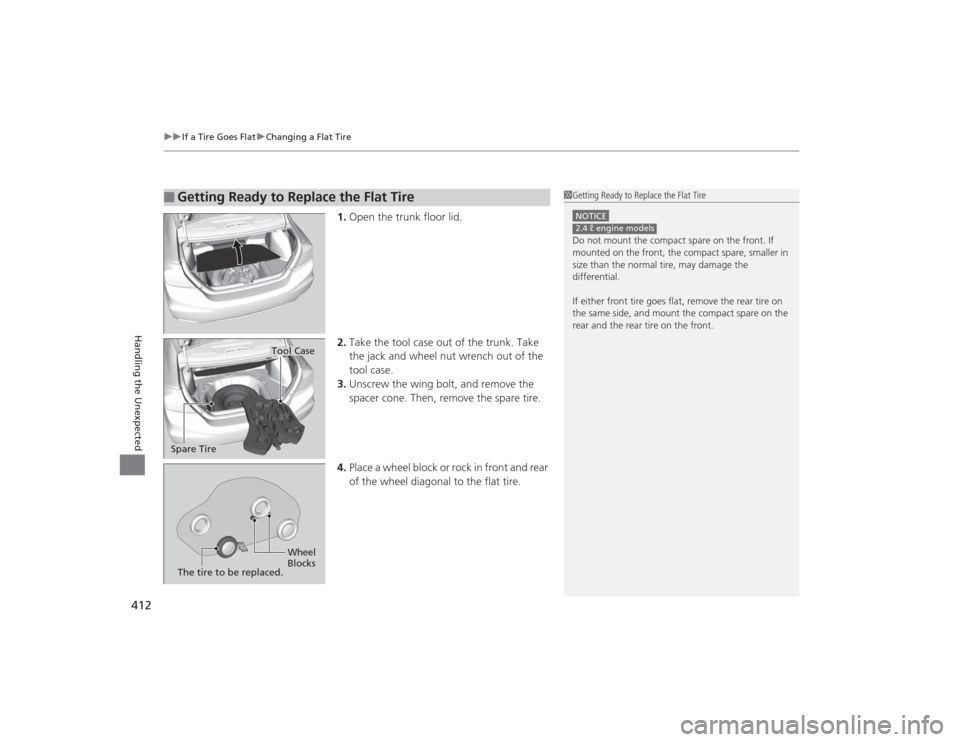
1. Open the trunk floor lid.
2. Take the tool case out of the trunk. Take
the jack and wheel nut wrench out of the
tool case.
3. Unscrew the wing bolt, and remove the
spacer cone. Then, remove the spare tire.
4. Place a wheel block or rock in front and rear
of the wheel diagonal to the flat tire.
■
Getting Ready to Replace the Flat Tire
1Getting Ready to Replace the Flat TireNOTICEDo not mount the compact spare on the front. If
mounted on the front, the compact spare, smaller in
size than the normal tire, may damage the
differential.
If either front tire goes fl at, remove the rear tire on
the same side, and mount the compact spare on the
rear and the rear tire on the front.2.4 ℓ engine models
Tool Case
Spare Tire
Wheel
Blocks
The tire to be replaced.
Page 414 of 469
413
uuIf a Tire Goes Flat uChanging a Flat Tire
Continued
Handling the Unexpected
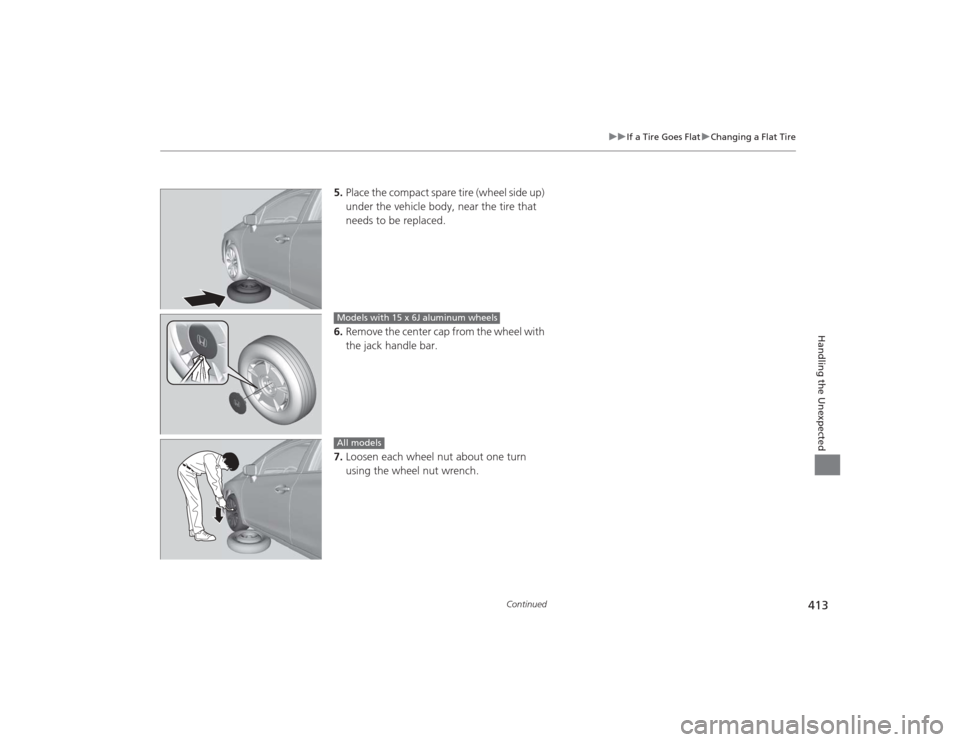
5. Place the compact spare tire (wheel side up)
under the vehicle body, near the tire that
needs to be replaced.
6. Remove the center cap from the wheel with
the jack handle bar.
7. Loosen each wheel nut about one turn
using the wheel nut wrench.Models with 15 x 6J aluminum wheelsAll models
Page 415 of 469
uuIf a Tire Goes Flat uChanging a Flat Tire
414Handling the Unexpected
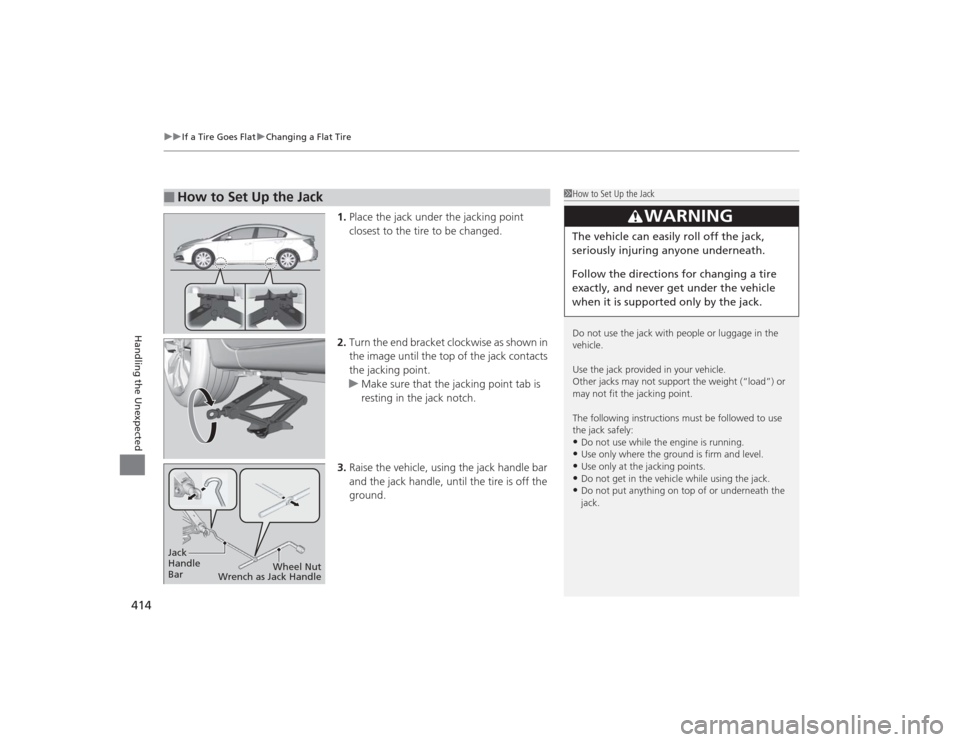
1. Place the jack under the jacking point
closest to the tire to be changed.
2. Turn the end bracket clockwise as shown in
the image until the top of the jack contacts
the jacking point.
u Make sure that the jacking point tab is
resting in the jack notch.
3. Raise the vehicle, using the jack handle bar
and the jack handle, until the tire is off the
ground.
■
How to Set Up the Jack
1How to Set Up the Jack
Do not use the jack with people or luggage in the
vehicle.
Use the jack provided in your vehicle.
Other jacks may not support the weight (“load”) or
may not fit the jacking point.
The following instructions must be followed to use
the jack safely:•Do not use while the engine is running.•Use only where the ground is firm and level.•Use only at the jacking points.•Do not get in the vehicle while using the jack.•Do not put anything on top of or underneath the
jack.
3
WARNING
The vehicle can easily roll off the jack,
seriously injuring anyone underneath.
Follow the directions for changing a tire
exactly, and never get under the vehicle
when it is supported only by the jack.
Jack
Handle
Bar Wheel Nut
Wrench as Jack Handle
Page 416 of 469
Continued
415
uuIf a Tire Goes Flat uChanging a Flat Tire
Handling the Unexpected
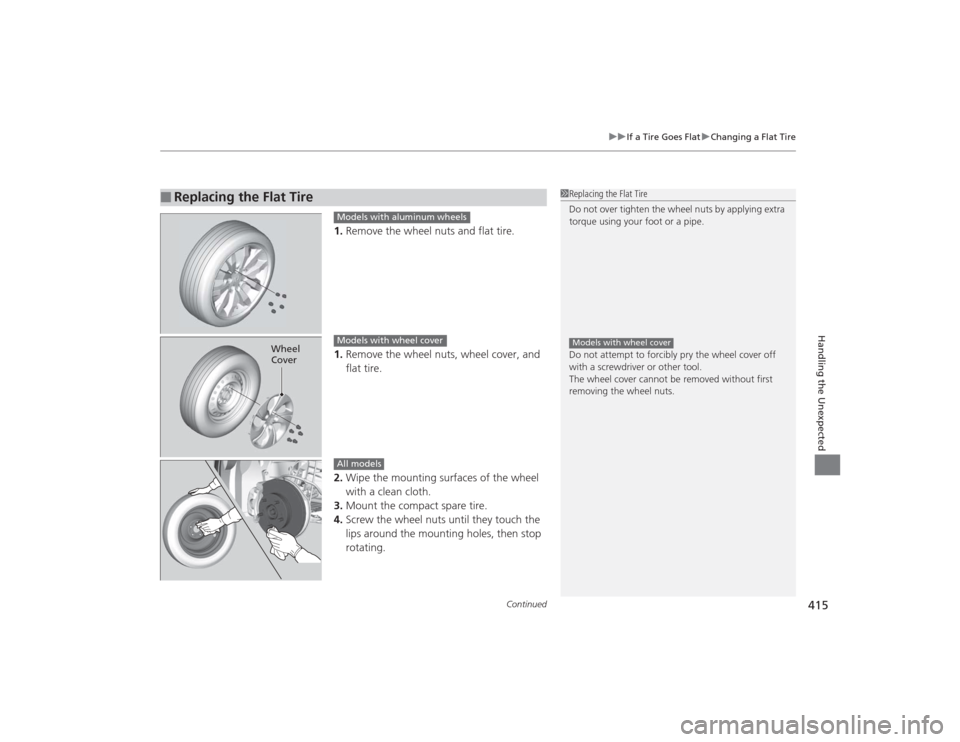
1. Remove the wheel nuts and flat tire.
1. Remove the wheel nuts, wheel cover, and
flat tire.
2. Wipe the mounting surfaces of the wheel
with a clean cloth.
3. Mount the compact spare tire.
4. Screw the wheel nuts until they touch the
lips around the mounting holes, then stop
rotating.
■
Replacing the Flat Tire
1Replacing the Flat Tire
Do not over tighten the wheel nuts by applying extra
torque using your foot or a pipe.
Do not attempt to forcibly pr y the wheel cover off
with a screwdriver or other tool.
The wheel cover cannot be removed without first
removing the wheel nuts.Models with wheel cover
Models with aluminum wheels
Wheel
Cover
Models with wheel coverAll models
Page 417 of 469
uuIf a Tire Goes Flat uChanging a Flat Tire
416Handling the Unexpected
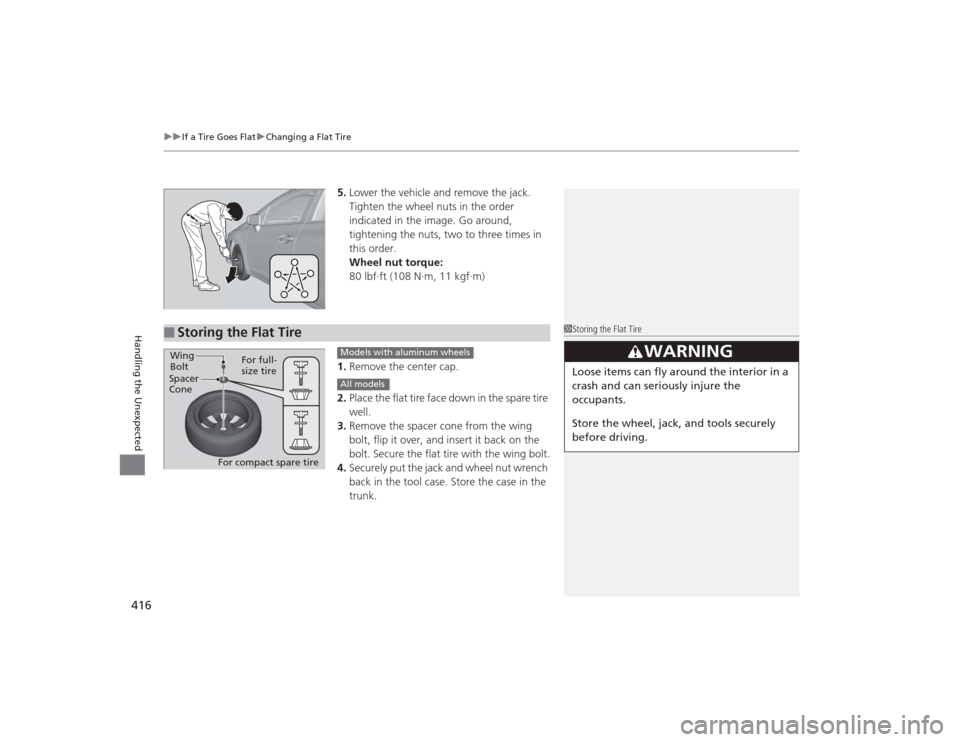
5. Lower the vehicle and remove the jack.
Tighten the wheel nuts in the order
indicated in the image. Go around,
tightening the nuts, two to three times in
this order.
Wheel nut torque:
80 lbf∙ft (108 N∙m, 11 kgf∙m)
1. Remove the center cap.
2. Place the flat tire face down in the spare tire
well.
3. Remove the spacer cone from the wing
bolt, flip it over, and insert it back on the
bolt. Secure the flat tire with the wing bolt.
4. Securely put the jack and wheel nut wrench
back in the tool case. Store the case in the
trunk.
■
Storing the Flat Tire
1Storing the Flat Tire
3
WARNING
Loose items can fly around the interior in a
crash and can seriously injure the
occupants.
Store the wheel, jack, and tools securely
before driving.
Spacer
ConeWing
Bolt
For compact spare tireFor full-
size tire
Models with aluminum wheelsAll models
Page 418 of 469
417
uuIf a Tire Goes Flat uChanging a Flat Tire
Handling the Unexpected
If you replace a flat tire with the spare tire, the low tire pressure/TPMS indicator
comes on while you are driving. After driving for a few miles (kilometers), the
indicator will start blinking for a short time and then stay on. CHECK TPMS
SYSTEM appears on the i-MID, but this is normal.
Calibrate the TPMS when you replace the tire with a specified regular tire.2 TPMS Calibration P. 333■
TPMS and the Spare TireU.S. models