battery HONDA CIVIC 2015 9.G Quick Guide
[x] Cancel search | Manufacturer: HONDA, Model Year: 2015, Model line: CIVIC, Model: HONDA CIVIC 2015 9.GPages: 79, PDF Size: 18.16 MB
Page 4 of 79
| 1
VISUAL INDEX
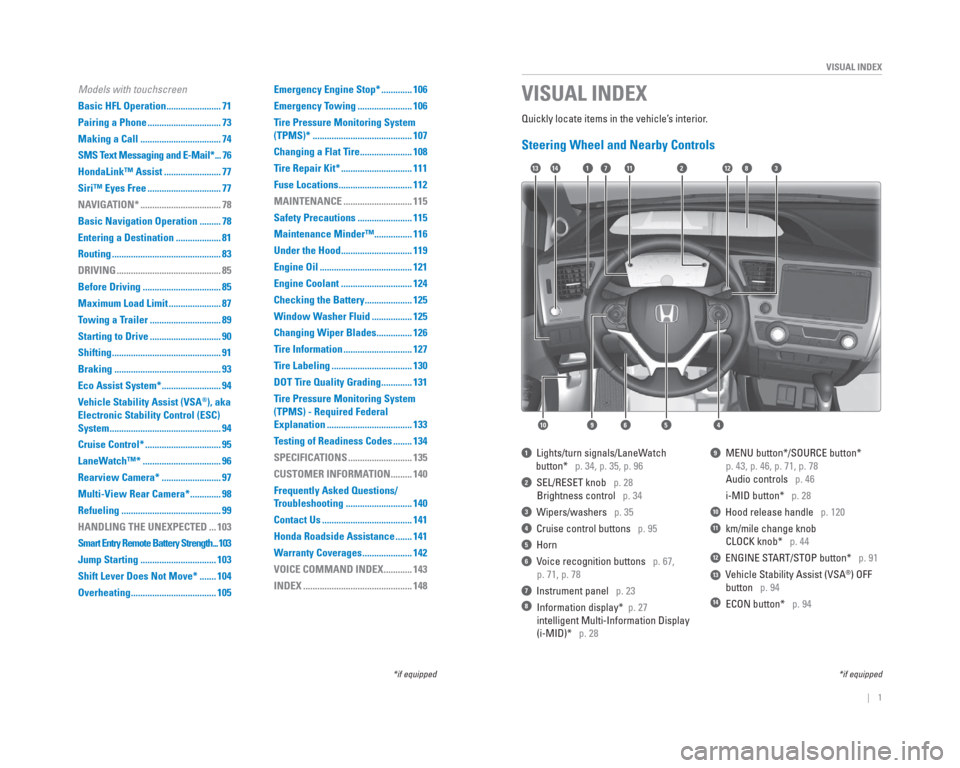
Quickly locate items in the vehicle’s interior.
Steering Wheel and Nearby Controls
1 Lights/turn signals/LaneWatch
button* p. 34, p. 35, p. 96
2 SEL/RESET knob p. 28
Brightness control p. 34
3 Wipers/washers p. 35
4 Cruise control buttons p. 95
5 Horn
6 Voice recognition buttons p. 67,
p. 71, p. 78
7 Instrument panel p. 23
8 Information display* p. 27
intelligent Multi-Information Display
(i-MID)* p. 28
9 MENU button*/SOURCE button*
p. 43, p. 46, p. 71, p. 78
Audio controls p. 46
i-MID button* p. 28
10 Hood release handle p. 120
11 km/mile change knob
CLOCK knob* p. 44
12 ENGINE START/STOP button* p. 91
13 Vehicle Stability Assist (VSA®) OFF
button p. 94
14 ECON button* p. 94
VISUAL INDEX
*if equipped
1138
54
12
10
7112314
69
Models with touchscreen
Basic HFL Operation ....................... 71
Pairing a Phone ............................... 73
Making a Call .................................. 74
SMS Text Messaging and E-Mail* ... 76
HondaLink™ Assist ........................ 77
Siri™ Eyes Free ............................... 77
NAVIGATION* .................................. 78
Basic Navigation Operation ......... 78
Entering a Destination ................... 81
Routing .............................................. 83
DRIVING ............................................ 85
Before Driving ................................. 85
Maximum Load Limit ...................... 87
Towing a Trailer .............................. 89
Starting to Drive .............................. 90
Shifting .............................................. 91
Braking ............................................. 93
Eco Assist System* ......................... 94
Vehicle Stability Assist (VSA
®), aka
Electronic Stability Control (ESC)
System ............................................... 94
Cruise Control* ................................ 95
LaneWatch™* ................................. 96
Rearview Camera* ......................... 97
Multi-View Rear Camera* ............. 98
Refueling .......................................... 99
HANDLING THE UNEXPECTED ... 103
Smart Entry Remote Battery Strength ... 103
Jump Starting ................................ 103
Shift Lever Does Not Move* ....... 104
Overheating .................................... 105 Emergency Engine Stop* ............. 106
Emergency Towing ....................... 106
Tire Pressure Monitoring System
(TPMS)* .......................................... 107
Changing a Flat Tire ...................... 108
Tire Repair Kit* .............................. 111
Fuse Locations ............................... 112
MAINTENANCE ............................. 115
Safety Precautions ....................... 115
Maintenance Minder™................ 116
Under the Hood .............................. 119
Engine Oil ....................................... 121
Engine Coolant .............................. 124
Checking the Battery .................... 125
Window Washer Fluid ................. 125
Changing Wiper Blades ............... 126
Tire Information ............................. 127
Tire Labeling .................................. 130
DOT Tire Quality Grading ............. 131
Tire Pressure Monitoring System
(TPMS) - Required Federal
Explanation .................................... 133
Testing of Readiness Codes ........ 134
SPECIFICATIONS ........................... 135
CUSTOMER INFORMATION ......... 140
Frequently Asked Questions/
Troubleshooting ............................ 140
Contact Us ...................................... 141
Honda Roadside Assistance ....... 141
Warranty Coverages ..................... 142
VOICE COMMAND INDEX ............ 143
INDEX .............................................. 148
*if equipped
Page 15 of 79

22 || 23
INSTRUMENT PANEL
SAFETY
Learn about the indicators, gauges, and displays related to driving the \
vehicle.
Indicators briefl y appear with each engine start and then go out. Red and amber
indicators are most critical. Blue and green indicators are used for gen\
eral
information.
Malfunction Indicators
These are the most critical indicators. If they come on and stay lit whi\
le driving or at
any other time, there may be a problem. See your dealer if necessary.
Brake system
• Brake fl uid is low.
• The brake system has a problem.
Press the brake pedal lightly to check pedal pressure. If normal, check \
the brake fl uid level when you stop. If abnormal, take immediate action. If
necessary, downshift the transmission to slow the vehicle using engine
braking. Have your vehicle repaired immediately.
Low oil pressure
Engine oil pressure is low. Stop in a safe place. Open the hood. Check the oil
level, and add oil if necessary (see page 121). If the indicator does \
not turn
off, have your vehicle repaired immediately.
Charging system
The battery is not charging. Turn off all electrical items, but do not turn off
the vehicle to prevent further battery discharge. Have your vehicle repa\
ired
immediately.
Supplemental Restraint System (SRS)
There is a problem with one of the airbag systems or seat belt tensioner\
s.
Smart Entry system*
There is a problem with the smart entry system.
U.S.
Canada
INSTRUMENT PANEL
*if equipped
Reporting Safety Defects
In the U.S.
If you believe that your vehicle has a defect which could cause a crash \
or could
cause injury or death, you should immediately inform the National Highwa\
y Traffi c
Safety Administration (NHTSA) in addition to notifying American Honda \
Motor Co.,
Inc.
If NHTSA receives similar complaints, it may open an investigation, and \
if it fi nds
that a safety defect exists in a group of vehicles, it may order a recal\
l and remedy
campaign. However, NHTSA cannot become involved in individual problems
between you, your dealer, or American Honda Motor Co., Inc.
To contact NHTSA, you may call the Vehicle Safety Hotline toll-free at 1-888-327-
4236 (TTY: 1-800-424-9153); go to http://www.safercar.gov; or write to: Administrator,
NHTSA, 1200 New Jersey Avenue, SE., Washington, DC 20590. You can also obtain
other information about motor vehicle safety from http://www.safercar.gov.
In Canada
If you believe that your vehicle has a defect which could cause a crash \
or could
cause injury or death, you should immediately inform Honda Canada, Inc.,\
and you
may also inform Transport Canada.
If Transport Canada receives similar complaints, it may open an investigatio\
n, and if
it fi nds that a safety defect exists in a group of vehicles, it may lead to a\
recall and
remedy campaign. However, Transport Canada cannot become involved in individual
problems between you, your dealer, or Honda Canada, Inc.
To contact Transport Canada’s Defect Investigations and Recalls Division, you may
call 1-800-333-0510. For more information on reporting safety defects or\
about motor
vehicle safety, go to http://www.tc.gc.ca/roadsafety.
Page 49 of 79
90 || 91
DRIVING
DRIVING
Starting to Drive
Turn on the vehicle and start the engine to begin driving.
Before Starting the Engine
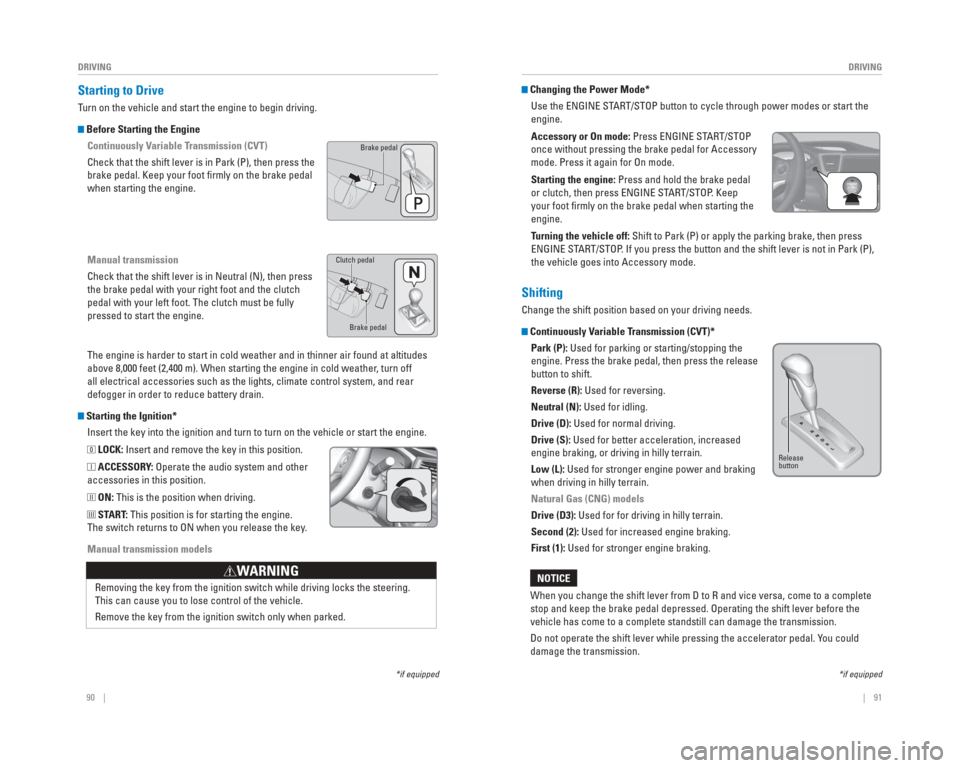
Continuously Variable Transmission (CVT)
Check that the shift lever is in Park (P), then press the
brake pedal. Keep your foot fi rmly on the brake pedal
when starting the engine.
Manual transmission
Check that the shift lever is in Neutral (N), then press
the brake pedal with your right foot and the clutch
pedal with your left foot. The clutch must be fully
pressed to start the engine.
The engine is harder to start in cold weather and in thinner air found a\
t altitudes
above 8,000 feet (2,400 m). When starting the engine in cold weather, turn off
all electrical accessories such as the lights, climate control system, a\
nd rear
defogger in order to reduce battery drain.
Starting the Ignition*Insert the key into the ignition and turn to turn on the vehicle or star\
t the engine.
0 LOCK: Insert and remove the key in this position.
I ACCESSORY: Operate the audio system and other
accessories in this position.
II ON: This is the position when driving.
III START: This position is for starting the engine.
The switch returns to ON when you release the key.
Manual transmission models
Brake pedal
Brake pedal
Clutch pedal
Removing the key from the ignition switch while driving locks the steeri\
ng.
This can cause you to lose control of the vehicle.
Remove the key from the ignition switch only when parked.
W
ARNING
*if equipped
Changing the Power Mode*
Use the ENGINE START/STOP button to cycle through power modes or start the
engine.
Accessory or On mode: Press ENGINE START/STOP
once without pressing the brake pedal for Accessory
mode. Press it again for On mode.
Starting the engine: Press and hold the brake pedal
or clutch, then press ENGINE START/STOP. Keep
your foot fi rmly on the brake pedal when starting the
engine.
Turning the vehicle off: Shift to Park (P) or apply the parking brake, then press
ENGINE START/STOP. If you press the button and the shift lever is not in Park (P),
the vehicle goes into Accessory mode.
Shifting
Change the shift position based on your driving needs.
Continuously Variable Transmission (CVT)*Park (P): Used for parking or starting/stopping the
engine. Press the brake pedal, then press the release
button to shift.
Reverse (R): Used for reversing.
Neutral (N): Used for idling.
Drive (D): Used for normal driving.
Drive (S): Used for better acceleration, increased
engine braking, or driving in hilly terrain.
Low (L): Used for stronger engine power and braking
when driving in hilly terrain.
Natural Gas (CNG) models
Drive (D3): Used for for driving in hilly terrain.
Second (2): Used for increased engine braking.
First (1): Used for stronger engine braking.
Release
button
When you change the shift lever from D to R and vice versa, come to a co\
mplete
stop and keep the brake pedal depressed. Operating the shift lever befor\
e the
vehicle has come to a complete standstill can damage the transmission.
Do not operate the shift lever while pressing the accelerator pedal. You could
damage the transmission.
NOTICE
*if equipped
Page 55 of 79
, the
fuel system may have a leak. Turn o")
102 || 103
HANDLING THE UNEXPECTED
DRIVING
If a Fuel Leak Is Detected
If you smell natural gas or hear a hissing sound (except when refueling\
), the
fuel system may have a leak. Turn off the manual shut-off valve immediately. You
should locate the valve before driving in case you need to turn it off q\
uickly.
1. Park your vehicle outside in a well-ventilated area, away from heat, sparks, and fl ame. Apply the
parking brake. Turn off the vehicle.
2. Open all windows and the trunk for proper ventilation.
3. Turn the manual shut-off valve one-quarter turn clockwise (as shown). The valve is turned to OFF.
4. Call a professional towing service (see page 106). Do not continue driving. Have the vehicle towed to
an authorized Civic Natural Gas dealer.
Manual shut-off valve
Learn about what to do in critical or emergency situations.
Smart Entry Remote Battery Strength
If the battery life in your remote transmitter is weak, a message appear\
s in the
display with information on how to start the engine.
1. Touch the back of the remote transmitter to the ENGINE START/STOP button while the indicator is
fl ashing.
2. With the brake pedal or clutch pedal pressed, press the ENGINE START/STOP button within 10
seconds.
Jump Starting
Turn off the power to electric devices, such as audio and lights. Turn off the engine,
then open the hood.
1. Connect the fi rst jumper cable to your vehicle’s battery (+) terminal.
2. Connect the other end of the fi rst jumper cable to the booster battery (+) terminal. Use a 12-volt
booster battery only.
3. Connect the second jumper cable to the booster battery (-) terminal.
4. Connect the other end of the second jumper cable to the grounding point as shown. Do not connect
this jumper cable to any other part.
5. If your vehicle is connected to another vehicle, start the assisting vehicle’s engine and increase its
rpm slightly.
6. Attempt to start your vehicle’s engine. If it turns over slowly, make sure that the jumper cables have
good metal-to-metal contact.
HANDLING THE UNEXPECTED
1.8 ℓ engine models
2.4 ℓ en gine mo dels
Booster battery
Booster battery
1.8 ℓ en gine mo dels
2.4 ℓ en gine mo dels
Page 56 of 79

104 || 105
HANDLING THE UNEXPECTED
HANDLING THE UNEXPECTED
WARNING: Battery posts, terminals, and related accessories contain lead and lead\
compounds. Wash your hands after handling.
After the Engine Starts
Once your vehicle’s engine has started, remove the jumper cables in the following
order:
1. Disconnect the jumper cable from your engine hanger.
2. Disconnect the other end of the jumper cable from the assisting vehicle’\
s (-) terminal.
3. Disconnect the jumper cable from your vehicle’s (+) terminal.
4. Disconnect the other end of the jumper cable from the assisting vehicle’\
s (+) terminal.
5. Have your vehicle inspected by a nearby service station or a dealer.
Shift Lever Does Not Move*
Follow the procedure below if you cannot move the shift lever out of Par\
k (P).
1. Set the parking brake.
2. Remove the key from the ignition, or remove the built-in key from the remote transmitter.
3. Wrap a cloth around the tip of a small fl at-tip screwdriver to remove the cover of the shift lock
release slot. Put the tip of the fl at-tip screwdriver
into the slot and remove it as shown in the image.
4. Insert the key into the shift lock release slot.
5. While pushing the key down, press the shift lever release button and place the shift lever into Neutral
(N). The lock is now released. Have the shift lever
checked by a dealer as soon as possible.
*if equipped
Slot
Cover
Release
button Shift lock
release slot
A battery can explode if you do not follow the correct procedure, seriou\
sly
injuring anyone nearby.
Keep all sparks, open fl ames, and smoking materials away from the battery.
WARNING
Overheating
If the temperature gauge needle is at the H mark, the engine suddenly lo\
ses power,
or steam or spray comes out from under the hood, your engine is overheat\
ing.
1. Immediately park the vehicle in a safe place. Turn
off all accessories and turn on the hazard warning
lights.
2. If steam or spray is not present: Keep the engine
running and open the hood.
If steam or spray is present: Turn off the engine and wait until it subsides. Then, open the hood.
3. Check that the cooling fan is operating and stop the engine once the tem\
perature gauge needle comes down. If the cooling fan is not operating, immediatel\
y stop
the engine.
4. Once the engine has cooled down, inspect the coolant level and check the\
cooling system components for leaks. If the coolant level in the reserve\
tank
is low, add coolant until it reaches the MAX mark. If there is no coolant in t\
he
reserve tank, make sure the radiator is cool, then cover the radiator ca\
p with a
heavy cloth and open the cap. If necessary, add coolant up to the base of the
fi ller neck, and put the cap back on.
Once the engine has cooled suffi ciently, restart it and check the temperature gauge.
If the temperature needle has gone down, resume driving. If it has not g\
one down,
contact a dealer for repairs.
Reserve tank
MAXMIN
Steam and spray from an overheated engine can seriously scald you.
Do not open the hood if steam is coming out.
WARNING
Removing the radiator cap while the engine is hot can cause the coolant \
to
spray out, seriously scalding you.
Always let the engine and radiator cool down before removing the radiato\
r cap.
WARNING
Continuing to drive with the temperature gauge needle at the H mark may \
damage
the engine.
NOTICE
Page 61 of 79
114 || 115
MAINTENANCE
HANDLING THE UNEXPECTED
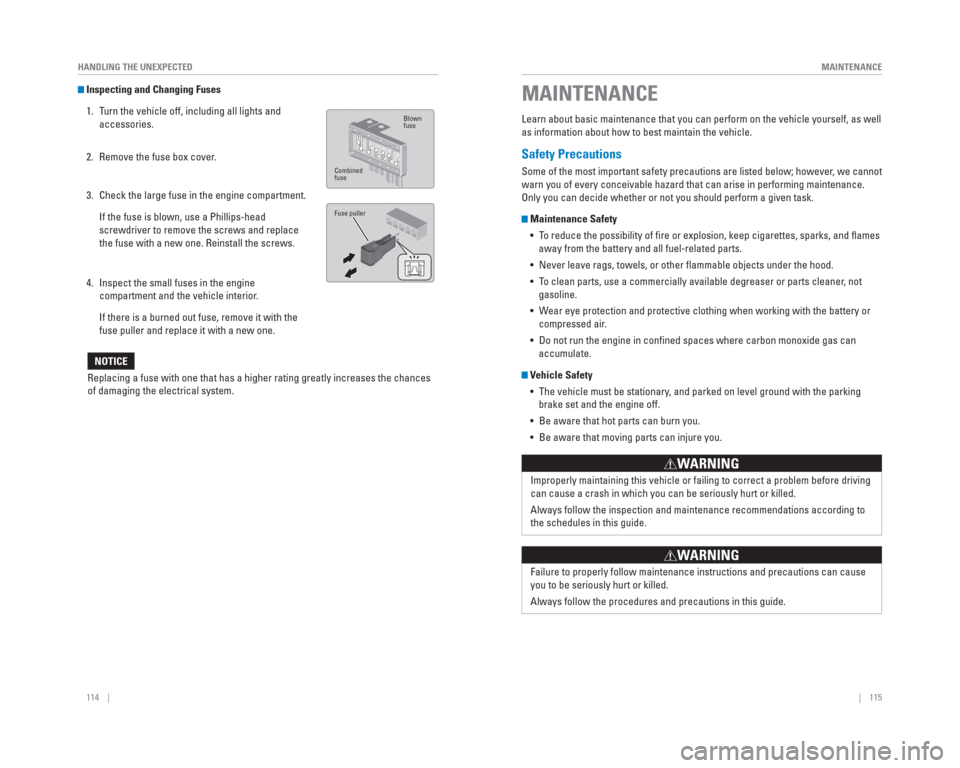
Inspecting and Changing Fuses
1. Turn the vehicle off, including all lights and accessories.
2. Remove the fuse box cover.
3. Check the large fuse in the engine compartment.
If the fuse is blown, use a Phillips-head screwdriver to remove the screws and replace
the fuse with a new one. Reinstall the screws.
4. Inspect the small fuses in the engine compartment and the vehicle interior.
If there is a burned out fuse, remove it with the fuse puller and replace it with a new one.
Replacing a fuse with one that has a higher rating greatly increases the\
chances
of damaging the electrical system.
NOTICE
Blown
fuse
Combined
fuse
Fuse puller
Learn about basic maintenance that you can perform on the vehicle yourse\
lf, as well
as information about how to best maintain the vehicle.
Safety Precautions
Some of the most important safety precautions are listed below; however, we cannot
warn you of every conceivable hazard that can arise in performing mainte\
nance.
Only you can decide whether or not you should perform a given task.
Maintenance Safety • To reduce the possibility of fi re or explosion, keep cigarettes, sparks, and fl ames away from the battery and all fuel-related parts.
• Never leave rags, towels, or other fl ammable objects under the hood.
• To clean parts, use a commercially available degreaser or parts cleaner, not gasoline.
• Wear eye protection and protective clothing when working with the battery\
or compressed air.
• Do not run the engine in confi ned spaces where carbon monoxide gas can accumulate.
Vehicle Safety
• The vehicle must be stationary, and parked on level ground with the parking brake set and the engine off.
• Be aware that hot parts can burn you.
• Be aware that moving parts can injure you.
Improperly maintaining this vehicle or failing to correct a problem befo\
re driving
can cause a crash in which you can be seriously hurt or killed.
Always follow the inspection and maintenance recommendations according t\
o
the schedules in this guide.
WARNING
Failure to properly follow maintenance instructions and precautions can \
cause
you to be seriously hurt or killed.
Always follow the procedures and precautions in this guide.
WARNING
MAINTENANCE
Page 63 of 79
118 || 119
MAINTENANCE
MAINTENANCE
Natural Gas (CNG) models
CODE Maintenance Main Items
A Replace engine oil • *1
B Replace engine oil• *1 and oil filter
Replace fuel filter element (low pressure)
•
Drain fuel filter (high pressure)
•
Inspect front and rear brakes/service as necessary
•
Check parking brake adjustment
•
Inspect tie rod ends, steering gearbox, and boots
•
Inspect suspension components
•
Inspect driveshaft boots
•
Inspect brake hoses and lines (Including ABS/ VSA)
•
Inspect all fluid levels and condition of fluids
•
Inspect exhaust system
•
#
Inspect fuel lines and connections
• #
Check the expiration date for TRK bottle
•
CODE Maintenance Sub Items
1 Rotate tires •
2 Replace air cleaner element •
*2
Replace dust and pollen filter
• *3
Replace fuel filter element (high pressure)
•
Inspect drive belt
•
Inspect valve clearance
•
Inspect fuel tank
•
*4
3 Replace transmission fluid •
4 Replace spark plugs •
5 Replace engine coolant •
*1: If a message SERVICE does not appear more than 12 months after the display is reset, change the
engine oil every year.
# : See information on maintenance and emissions warranty.
*2: If you drive in dusty conditions, replace the air cleaner element every 15,000 miles (24,000 km).
*3: If you drive primarily in urban areas that have high concentrations of soot in the air from industry and
from diesel-powered vehicles, replace the dust and pollen filter every 15,000 miles (24,000 km).
*4: If sub item 2 does not appear more than 36 months after the display is reset, inspect the fuel tank
every three years.
See CNG tank expiration and production dates for inspection and replacement information.
Fuel tank should be replaced 15 years after it was manufactured.
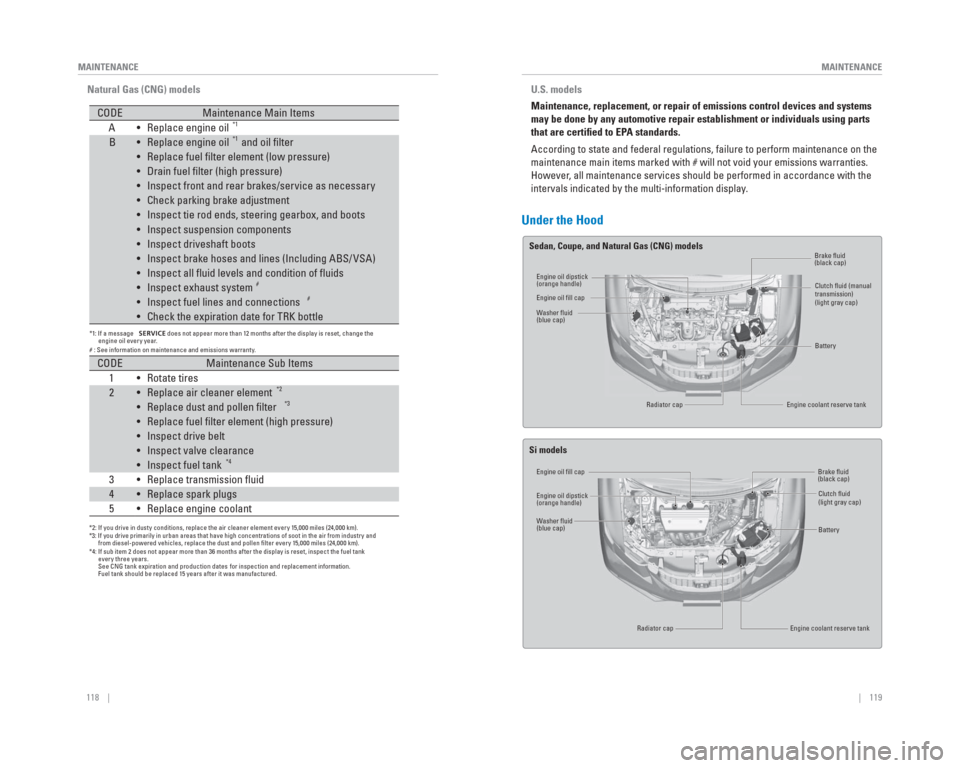
Under the Hood
Engine oil dipstick
(orange handle)
Engine oil dipstick
(orange handle) Brake fl
uid
(black cap)
Brake fl uid
(black cap)
Clutch fl
uid (manual
transmission)
(light gray cap)
Clutch fl uid
(light gray cap)
Battery
Battery
Engine coolant reserve tank
Engine coolant reserve tank
Engine oil fi
ll cap
Engine oil fi ll cap
W
asher fl uid
(blue cap)
W asher fl uid
(blue cap) Radiator cap
Radiator cap
U.S. models
Maintenance, replacement, or repair of emissions control devices and sys\
tems
may be done by any automotive repair establishment or individuals using \
parts
that are certi ed to EP A standards.
According to state and federal regulations, failure to perform maintenan\
ce on the
maintenance main items marked with # will not void your emissions warran\
ties.
However , all maintenance services should be performed in accordance with the
intervals indicated by the multi-information display .
Sedan, Coupe, and Natural Gas (CNG) models
Si models
Page 66 of 79

124 || 125
MAINTENANCE
MAINTENANCE
Engine Coolant
Park the vehicle on level ground. Check the reserve tank and the coolant\
level in the
radiator. We recommend Honda Long Life Antifreeze/Coolant Type 2.
Checking the Reserve Tank
1. Check the amount of coolant in the reserve tank.
2. If the coolant level is below the MIN mark, add the specifi ed coolant until it reaches the MAX
mark.
3. Inspect the cooling system for leaks.
Adding Coolant 1. Make sure the engine and radiator are cool.
2. Turn the radiator cap counterclockwise and relieve any pressure in the coolant system. Do
not push the cap down when turning.
3. Push down and turn the radiator cap counterclockwise to remove it.
4. The coolant level should be up to the base of the fi ller neck. Add coolant if it is low.
5. Put the radiator cap back on, and tighten it fully.
6. Pour coolant into the reserve tank until it reaches the MAX mark. Put the cap back on the reserve
tank.
If temperatures consistently below −22°F (−30°C) are expec\
ted, the coolant
mixture should be changed to a higher concentration. Consult a dealer fo\
r details
for more information.
NOTICE
Radiator cap
Pour the fl
uid slowly and carefully so you do not spill any . Clean up any spills
immediately; they can damage components in the engine compartment.
NOTICE
Reserve tank MAX
MIN
Removing the radiator cap while the engine is hot can cause the coolant \
to
spray out, seriously scalding you.
Always let the engine and radiator cool down before removing the radiato\
r
cap.
WARNING
Checking the
Battery
Check the battery terminals for corrosion monthly .
W ARNING: Battery posts, terminals, and related accessories contain lead and lead\
compounds. W ash your hands after handling.
Window Washer Fluid
If the washer fl uid level is low , fi ll the washer reservoir .
Canadian models
If the washer fl uid level is low , the washer level
indicator or a message appears. The battery gives off explosive hydrogen gas during normal operation.
A spark or fl
ame can cause the battery to explode with enough force to kill or
seriously hurt you.
When conducting any battery maintenance, wear protective clothing and a \
face shield, or have a skilled technician do it.
W ARNING
Do not use engine antifreeze or a vinegar/water solution in the windshie\
ld washer
reservoir . Antifreeze can damage your vehicle’ s paint. A vinegar/water solution can
damage the windshield washer pump.
NOTICE
Page 71 of 79

134 || 135
SPECIFICATIONS
MAINTENANCE
Testing of Readiness Codes
Your vehicle has “readiness codes” as part of the onboard self-diag\
nostic system.
Some states refer to these codes as a test to see if your vehicle’s emissions
components are working properly. The codes may not be read if you go through the
testing just after the battery has gone dead or been disconnected.
To check if they are set, turn the vehicle on without starting the engine\
. The
malfunction indicator lamp will come on for several seconds. If it goes \
off, the
readiness codes are set. If it blinks fi ve times, the readiness codes are not set.
If you are required to have your vehicle tested before the readiness cod\
es are set,
prepare the vehicle for retesting by doing the following:
1. Fill the gas tank to approximately 3/4 full.
2. Park the vehicle and leave the engine off for 6 hours or more.
3. Make sure the ambient temperature is between 40°F and 95°F (4°\
C and 35°C).
4. Start the engine without touching the accelerator pedal, and let it idle\
for 20
seconds.
5. Keep the vehicle in Park (P) or Neutral for manual transmission. Incre\
ase the engine speed to 2,000 rpm, and hold it there for about 3 minutes.
6. Let the engine idle with your foot off the accelerator for 20 seconds.
7. Select a nearby, lightly traveled major highway where you can maintain a speed of 50 to 60 mph (80 to 97 km/h) for at least 20 minutes. Drive on the \
highway
with the vehicle in Drive (D) or 5th gear. Do not use cruise control. When traffi c
allows, drive for 90 seconds without using the accelerator pedal. (Vehicle speed
may vary slightly; this is OK.) If you cannot do this for a continuous \
90 seconds
because of traffi c conditions, drive for at least 30 seconds, then repeat two more
times (for a total of 90 seconds).
8. Drive in city/suburban traffi c for at least 10 minutes. When traffi c conditions allow, let the vehicle coast for several seconds without using the accelerato\
r
pedal or the brake pedal.
9. Park the vehicle and leave the engine off for 30 minutes.
The readiness codes are erased when the battery is disconnected, and set\
again
only after several days of driving under a variety of conditions.
If a testing facility determines that the readiness codes are not set, y\
ou may be
requested to return at a later date to complete the test, or see your de\
aler.
Vehicle
Engine and Fuel
Tires
Light Bulbs
Fluids
*1: LX-MT, HF, and Canadian DX models
*2: LX-CVT models
*3: EX and EX-L models
*4: Canadian Touring models
ModelHonda Civic 4-Door
No. of Passengers:
Front
Rear
Total
Weights:Gross Vehicle
Weight Rating U.S.: 3,693 lbs (1,675 kg)*1Canada: 1,675 kg*1U.S.: 3,748 lbs (1,700 kg)*2Canada: 1,700 kg*2U.S.: 3,792 lbs (1,720 kg)*3Canada: 1,720 kg*3Canada: 1,755 kg*4
Gross Axle Weight
Rating (Front)U.S.: 1,984 lbs (900 kg)*1Canada: 900 kg*1U.S.: 2,017 lbs (915 kg)*2Canada: 915 kg*2U.S.: 2,028 lbs (920 kg)*3Canada: 920 kg*3Canada: 940 kg*4Gross Axle Weight
Rating (Rear)U.S.: 1,742 lbs (790 kg)*1Canada: 790 kg*1U.S.: 1,753 lbs (795 kg)*2Canada: 795 kg*2U.S.: 1,786 lbs (810 kg)*3Canada: 810 kg*3Canada: 825 kg*4
Air Conditioning:
Refrigerant Type HFC-134a (R-134a)
Charge Quantity13.2 – 15.0 oz (375 – 425 g)
Lubricant TypeSP-10
2
3
5
Fuel Engine Specifications
Displacement110 cu-in (1,798 cm3)
Spark Plugs NGK
DENSO
Fuel:
TypeUnleaded gasoline, Pump
octane number of 87 or higher
Fuel Tank Capacity 13.2 US gal (50 ℓ)
DILZKR7B11GS
DXU22HCR-D11S
*1: Canadian DX model
*2: LX model
*3: HF model *4: EX model
*5: U.S. EX-L and Canadian
Touring models
RegularSizeP195/65R15 89H*1, *2P195/65R15 89S*3P205/55R16 89H*4P215/45R17 87V*5Pressure
psi (kPa [kgf/cm2])30 (210 [2.1])*1, *232 (220 [2.2])*3, *4, *5
Compact
Spare*Size
T135/80D15 99M
Pressure
psi (kPa [kgf/cm
2]) 60 (420 [4.2])
Wheel SizeRegular15 x 6J*1, *315 x 6 1/2J*216 x 6 1/2J*417 x 7J*5Compact Spare*15 x 4T
Headlights (Low Beam)51W (HB4)
Headlights (High Beam)
Fog Lights*55W (H11)
Front Turn Signal/Parking/Side
Marker Lights 28/8W (Amber)
Brake/Taillights21/5W
Rear Turn Signal Lights
Rear Side Marker LightsLED
Back-Up Lights
Taillights3CP
High-Mount Brake Light
Rear License Plate Lights5W
Trunk Light
Interior LightsMap Lights*8WCeiling Light8W
60W (HB3)
21W (Amber)
16W
21W
5W
Brake/Clutch Fluid
Automatic Transmission (CVT) Fluid
Manual Transmission FluidSpecifiedHonda Heavy Duty Brake Fluid DOT 3
SpecifiedHCF-2
Capacity
SpecifiedHonda Manual Transmission Fluid
Capacity
Engine Oil
Engine Coolant
Recommended· Honda Genuine Motor Oil 0W-20
· API Premium-grade 0W-20
detergent oil
Capacity Change
Change
including
filter
3.9 US qt (3.7 ℓ)
SpecifiedHonda Long-Life Antifreeze/Coolant
Type2
Ratio
Capacity1.48 US gal (5.59 ℓ)
(change including the remaining 0.125
US gal (0.475 ℓ) in the reserve tank)
Washer Fluid
Tank CapacityU.S.: 2.6 US qt (2.5 ℓ)
Canada: 4.8 US qt (4.5 ℓ)
3.6 US qt (3.4 ℓ)Change
Change 1.5 US qt (1.4 ℓ)
3.7 US qt (3.5 ℓ)
50/50 with distilled water
SPECIFICATIONS
Civic Sedan
Page 74 of 79
140 || 141
CUSTOMER INFORMATION
CUSTOMER INFORMATION
Learn about information specifi c to you as a Honda customer and how to get help.
Frequently Asked Questions/ Troubleshooting
Below are some frequently asked questions and troubleshooting items that\
you may
have about the vehicle.
Q: How do I set the vehicle clock?
A: For vehicles without navigation, see page 44. For vehicles with navigati\
on, the
time is automatically set using GPS signals.
Q: Why doesn’t the vehicle start when I press the ENGINE START/STOP button?*
A: The brake pedal must be pressed to start the engine.
Q: What is the AUTO setting on my headlight lever?
A: When in the AUTO position, the vehicle’s exterior lights will automatically turn
on or off depending on the ambient lighting.
Q: Why won’t the driver’s door unlock when I grab the door handle, even though
the keyless access remote is within range?*
A: If you pull the handle too quickly, the system may not have time to confi rm the
door is unlocked. Wait to hear a beep to confi rm the door is unlocked. If you are
wearing gloves, the system may be slow to respond.
Q: After my battery was disconnected or went dead, the audio system is aski\
ng for
a code. Where do I nd this?
A: In most cases, you do not need to enter a code. Turn on the vehicle and the
audio system, and press and hold the power button until the system react\
ivates.
Q: Why can’t I operate Pandora
® through the audio system?*
A: Audio may be streaming through Bluetooth
® Audio. Make sure Pandora mode
is selected and the phone cable is properly connected to the USB adapter\
cable (if using). Some phones may prompt you to “Allow” a connec\
tion.
Q: Is my phone compatible with Bluetooth features?
A: Visit handsfreelink.com (U.S.) or www.handsfreelink.ca (Canada) to
check phone compatibility for Bluetooth
® Audio, Bluetooth® HandsFreeLink®,
and SMS text messaging.
Q: Every time I press the Talk button, the system gives me voice prompts. Can I turn
these off?*
A: From the Home screen, select SETTINGS. Select System, then select Voice
Prompt. Select Off.
CUSTOMER INFORMATION
*if equipped
Contact Us
Honda dealer personnel are trained professionals. They should be able to\
answer
all your questions. If you encounter a problem that your dealership does\
not solve
to your satisfaction, please discuss it with the dealership’s service manager or
general manager. If you are dissatisfi ed with the decision made by the dealership’s
management, contact Honda Automobile Customer Service.
U.S. Owners:
American Honda Motor Co., Inc.
Honda Automobile Customer Service
1919 Torrance Blvd.
Mail Stop 500-2N-7A
Torrance, CA 90501-2746
Tel: (800) 999-1009
In Puerto Rico and
the U.S. Virgin Islands:
Bella International
P.O. Box 190816
San Juan, PR 00919-0816
Tel: (787) 620-7546
When you call or write, please give us the following information:
• Vehicle Identifi cation Number
• Date of purchase
• Odometer reading of your vehicle
• Your name, address, and telephone number
• A detailed descripton of the problem
• Name of the dealer who sold the vehicle to you
Honda Roadside Assistance
24-hour emergency road service is available to you in the United States \
and
Canada throughout your 3-year/36,000-mile warranty term. Services includ\
e
jump starting, fl at tire and lockout assistance, towing, and more (limitations apply).
Call (866) 864-5211 (U.S.) or (800) 465-7587 (Canada). Canadian Owners:
Honda Canada, Inc.
Customer Relations
180 Honda Blvd.
Markham, ON
L6C 0H9
Tel: (888) 946-6329
Fax: (877) 939-0909
e-mail: [email protected]
*if equipped