seats HONDA CIVIC 2017 10.G Owners Manual
[x] Cancel search | Manufacturer: HONDA, Model Year: 2017, Model line: CIVIC, Model: HONDA CIVIC 2017 10.GPages: 601, PDF Size: 32.51 MB
Page 3 of 601
Contents
This owner’s manual should be considered a permanent part of the
vehicle and should remain with the vehicle when it is sold.
This owner’s manual covers all models of your vehicle. You may find
descriptions of equipment and features that are not on your
particular model.
Images throughout this owner’s manual (including the front cover)
represent features and equipment that are available on some, but
not all, models. Your particular mo del may not have some of these
features.
This owner’s manual is for vehicles sold in the United States and
Canada.
The information and specifications in cluded in this publication were
in effect at the time of approval for printing. Honda Motor Co., Ltd.
reserves the right, however, to discontinue or change specifications
or design at any time without notice and without incurring any
obligation.2 Safe Driving P. 33
For Safe Driving P. 34 Seat Belts P. 38 Airbags P. 46
2Instrument Panel P. 75
Indicators P. 76 Gauges and Displays P. 108
2Controls P. 127
Clock P. 128 Locking and Unlocking the Doors P. 130
Opening and Closing the Moonroof* P. 156
Adjusting the Seats P. 173
Climate Control System
* P. 196
2 Features P. 203
Audio System P. 204 Audio System Basic Operation P. 211, 229
Customized Features P. 308 Bluetooth® HandsFreeLink ®* P. 339, 362
2Driving P. 395
Before Driving P. 396 Towing a Trailer P. 401
Multi-View Rear Camera P. 474 Refueling P. 476
2Maintenance P. 481
Before Performing Maintenance P. 482 Maintenance MinderTM P. 485
Checking and Maintaining Wiper Blades P. 519
Heating System
*/Climate Control System* Maintenance P. 535
2 Handling the Unexpected P. 543
Tools P. 544 If a Tire Goes Flat P. 545
Overheating P. 559 Indicator, Coming On/Blinking P. 561
When You Cannot Open the Trunk P. 573 Refueling P. 574
2Information P. 575
Specifications P. 576 Identification Numbers P. 580
Emissions Testing P. 583 Warranty Coverages P. 585
17 CIVIC 4D HCM (KA KC KL)-31TBA6100.book 2 ページ 2016年8月31日 水曜日 午後6時5分
Page 11 of 601
10
Quick Reference Guide
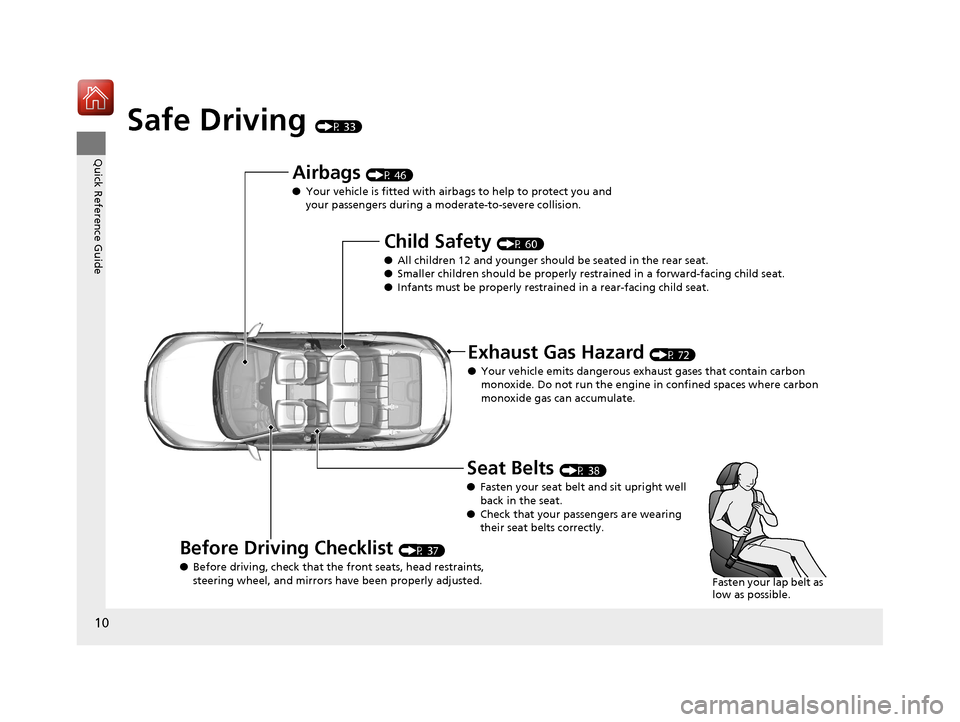
Safe Driving (P 33)
Airbags (P 46)
● Your vehicle is fitted with airbags to help to protect you and
your passengers during a moderate-to-severe collision.
Child Safety (P 60)
● All children 12 and younger should be seated in the rear seat.
● Smaller children should be properly restra ined in a forward-facing child seat.
● Infants must be properly restrained in a rear-facing child seat.
Exhaust Gas Hazard (P 72)
● Your vehicle emits dangerous exhaust gases that contain carbon
monoxide. Do not run the engine in confined spaces where carbon
monoxide gas can accumulate.
Before Driving Checklist (P 37)
● Before driving, check that the front seats, head restraints,
steering wheel, and mirrors have been properly adjusted.
Seat Belts (P 38)
● Fasten your seat belt and sit upright well
back in the seat.
● Check that your passengers are wearing
their seat belts correctly.
Fasten your lap belt as
low as possible.
17 CIVIC 4D HCM (KA KC KL)-31TBA6100.book 10 ページ 2016年8月31日 水曜日 午後6時5分
Page 37 of 601
36
uuFor Safe Driving uYour Vehicle’s Safety Features
Safe Driving
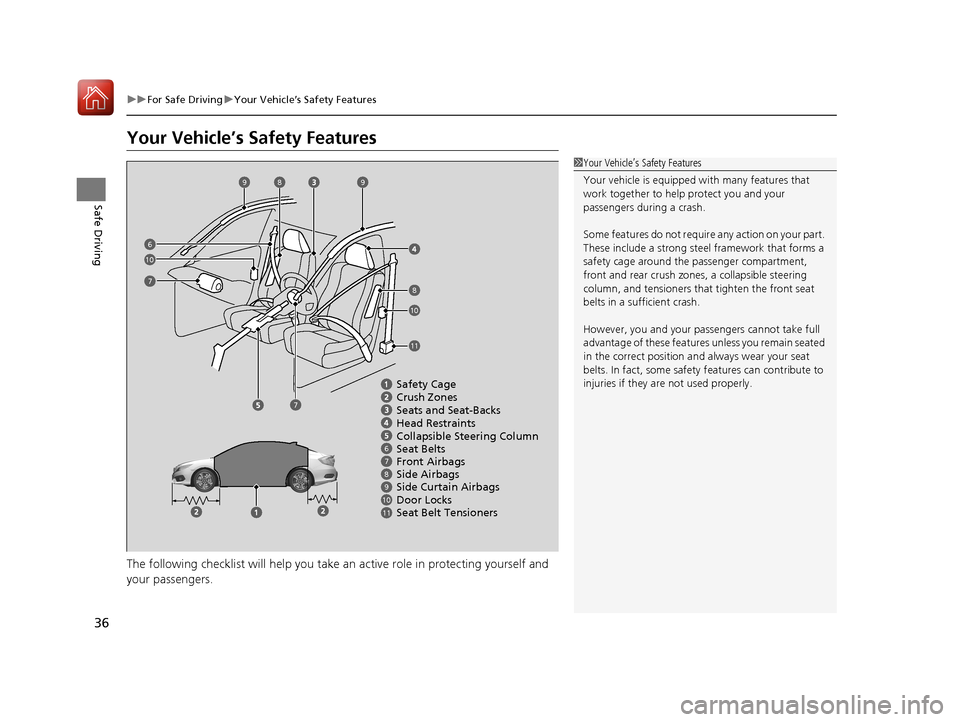
Your Vehicle’s Safety Features
The following checklist will help you take an active role in protecting yourself and
your passengers.
1 Your Vehicle’s Safety Features
Your vehicle is equipped wi th many features that
work together to help protect you and your
passengers during a crash.
Some features do not require any action on your part.
These include a strong steel framework that forms a
safety cage around the passenger compartment,
front and rear crush zone s, a collapsible steering
column, and tensioners that tighten the front seat
belts in a sufficient crash.
However, you and your passe ngers cannot take full
advantage of these features unless you remain seated
in the correct position and always wear your seat
belts. In fact, some safety features can contribute to
injuries if they are not used properly.
67891011
Safety Cage
Crush Zones
Seats and Seat-Backs
Head Restraints
Collapsible Steering Column
Seat Belts
Front Airbags
Side Curtain Airbags
Door Locks Side Airbags
Seat Belt Tensioners
7
7
99
8
8
10
10
6
11
17 CIVIC 4D HCM (KA KC KL)-31TBA6100.book 36 ページ 2016年8月31日 水曜日 午後6時5分
Page 38 of 601
37
uuFor Safe Driving uSafety Checklist
Safe Driving
Safety Checklist
For the safety of you and your passengers, make a habit of checking these items
each time before you drive.
• After everyone has entered the vehicle, be sure all doors are closed and locked.
Locking the doors helps prevent an occupant from being ejected and an outsider
from unexpectedly opening a door.
2 Locking/Unlocking the Doors from the Inside P. 140
•Adjust your seat to a position suitable for driving. Be sure the front seats are
adjusted as far to the rear as possible while allowing the driver to control the
vehicle. Sitting too close to a front airbag can result in serious or fatal injury in a
crash.
2 Adjusting the Seats P. 173
•Adjust head restraints to the proper position. Head restraints are most effective
when the center of the head restraint aligns with the center of your head. Taller
persons should adjust their head restraint to the highest position.
2 Adjusting the Front Head Restraints P. 176
•Always wear your seat belt, and make sure you wear it properly. Confirm that any
passengers are properly belted as well.
2 Fastening a Seat Belt P. 42
•Protect children by using seat belts or chil d seats according to a child’s age, height
and weight.
2 Child Safety P. 60
1Safety Checklist
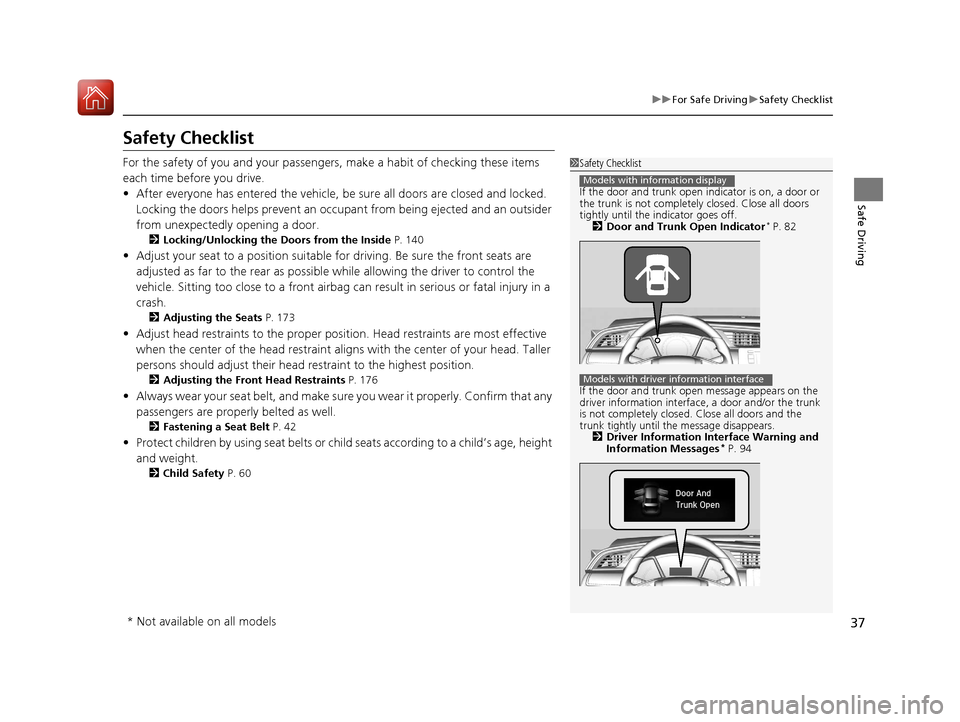
If the door and trunk open indicator is on, a door or
the trunk is not complete ly closed. Close all doors
tightly until the indicator goes off. 2 Door and Trunk Open Indicator
* P. 82
If the door and trunk open message appears on the
driver information interface , a door and/or the trunk
is not completely closed. Close all doors and the
trunk tightly until the message disappears. 2 Driver Information Interface Warning and
Information Messages
* P. 94
Models with information display
Models with driver information interface
* Not available on all models
17 CIVIC 4D HCM (KA KC KL)-31TBA6100.book 37 ページ 2016年8月31日 水曜日 午後6時5分
Page 39 of 601
38
Safe Driving
Seat Belts
About Your Seat Belts
Seat belts are the single most effective safety device because they keep you
connected to the vehicle so that you can take advantage of many built-in safety
features. They also help keep you from be ing thrown against the inside of the
vehicle, against other passengers, or out of the vehicle. When worn properly, seat
belts also keep your body pr operly positioned in a crash so that you can take full
advantage of the additional protec tion provided by the airbags.
In addition, seat belts help protect you in almost every type of crash, including:
- frontal impacts
- side impacts
- rear impacts
- rollovers
■Lap/shoulder seat belts
All five seating positions are equipped with lap/shoulder seat belts with emergency
locking retractors. In normal driving the re tractor lets you move freely while keeping
some tension on the belt. During a collision or sudden stop the retractor locks to
restrain your body. The front passenger’s an d rear seat belts also have a lockable
retractor for use with child seats.
2 Installing a Child Seat with a Lap/Shoulder Seat Belt P. 67
1About Your Seat Belts
Seat belts cannot complete ly protect you in every
crash. But in most cases, seat belts can reduce your
risk of serious injury.
Most states and all Canadian provinces and territories
require you to w ear seat belts.
The emergency locking retrac tor may lock if you lean
forward too quickly. Slower movements will allow
the belt to extend fu lly without locking.
3WARNING
Not wearing a seat belt properly increases
the chance of serious injury or death in a
crash, even though your vehicle has
airbags.
Be sure you and your passengers always
wear seat belts and wear them properly.
17 CIVIC 4D HCM (KA KC KL)-31TBA6100.book 38 ページ 2016年8月31日 水曜日 午後6時5分
Page 42 of 601
41
uuSeat Belts uAbout Your Seat Belts
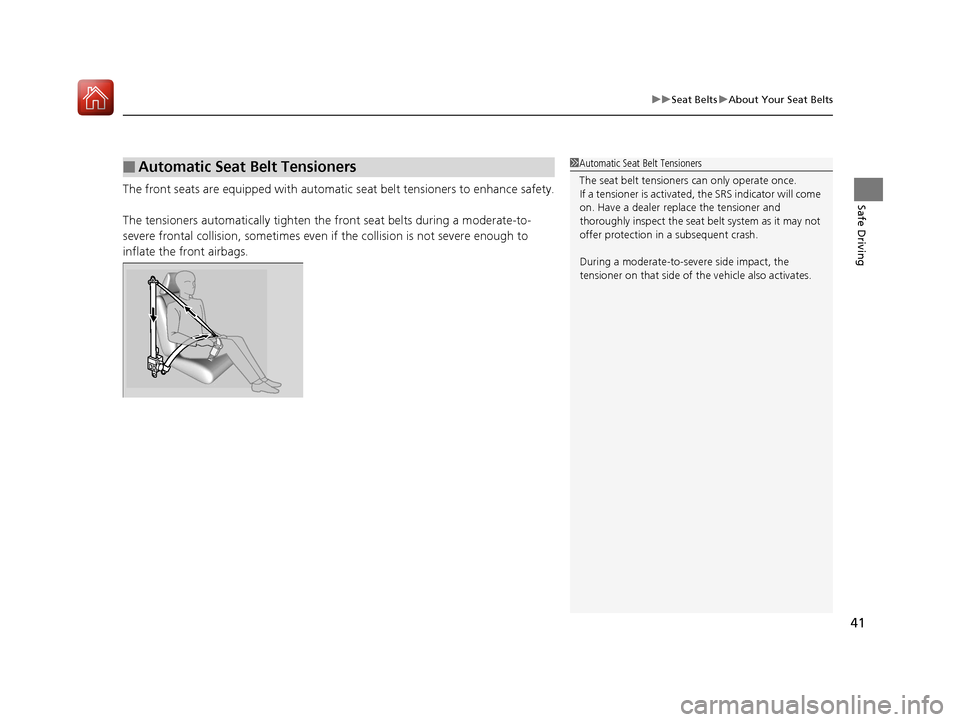
Safe DrivingThe front seats are equipped with automatic seat belt tensioners to enhance safety.
The tensioners automatically tighten the front seat belts during a moderate-to-
severe frontal collision, sometimes even if the collision is not severe enough to
inflate the front airbags.
■Automatic Seat Belt Tensioners1 Automatic Seat Belt Tensioners
The seat belt tensioners can only operate once.
If a tensioner is activated, the SRS indicator will come
on. Have a dealer replace the tensioner and
thoroughly inspect the seat belt system as it may not
offer protection in a subsequent crash.
During a moderate-to-sev ere side impact, the
tensioner on that side of the vehicle also activates.
17 CIVIC 4D HCM (KA KC KL)-31TBA6100.book 41 ページ 2016年8月31日 水曜日 午後6時5分
Page 43 of 601
42
uuSeat Belts uFastening a Seat Belt
Safe Driving
Fastening a Seat Belt
After adjusting a front seat to the proper position, and while sitting upright and well
back in the seat:
2 Adjusting the Seats P. 173
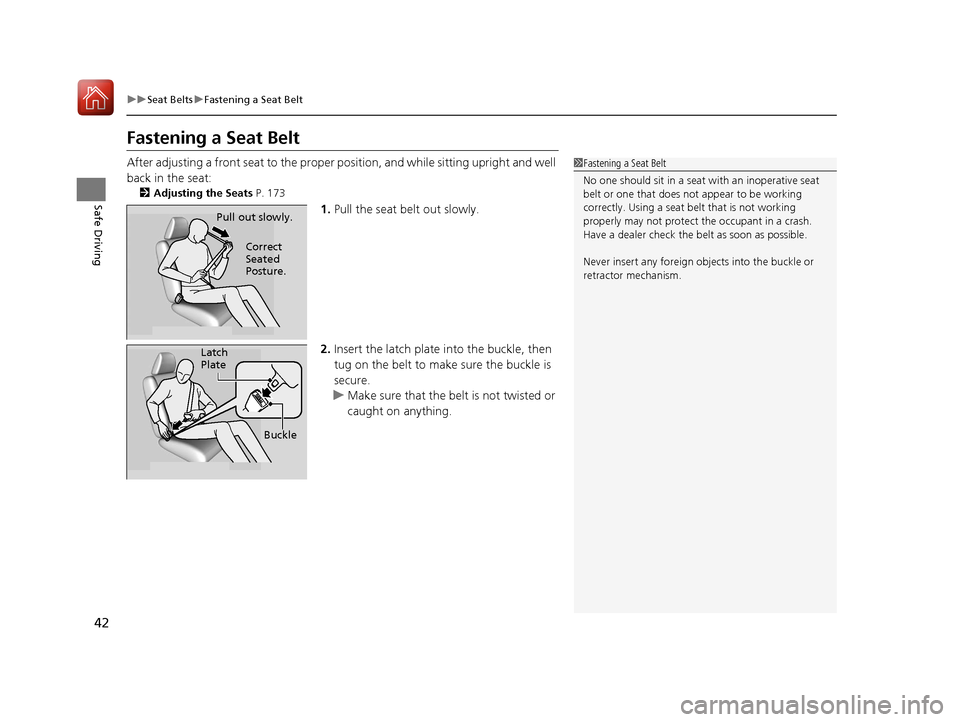
1.Pull the seat belt out slowly.
2. Insert the latch plate into the buckle, then
tug on the belt to make sure the buckle is
secure.
u Make sure that the belt is not twisted or
caught on anything.
1Fastening a Seat Belt
No one should sit in a seat with an inoperative seat
belt or one that does not appear to be working
correctly. Using a seat be lt that is not working
properly may not protect the occupant in a crash.
Have a dealer check the belt as soon as possible.
Never insert any foreign obj ects into the buckle or
retractor mechanism.
Pull out slowly.
Correct
Seated
Posture.
Latch
Plate
Buckle
17 CIVIC 4D HCM (KA KC KL)-31TBA6100.book 42 ページ 2016年8月31日 水曜日 午後6時5分
Page 44 of 601
Continued43
uuSeat Belts uFastening a Seat Belt
Safe Driving
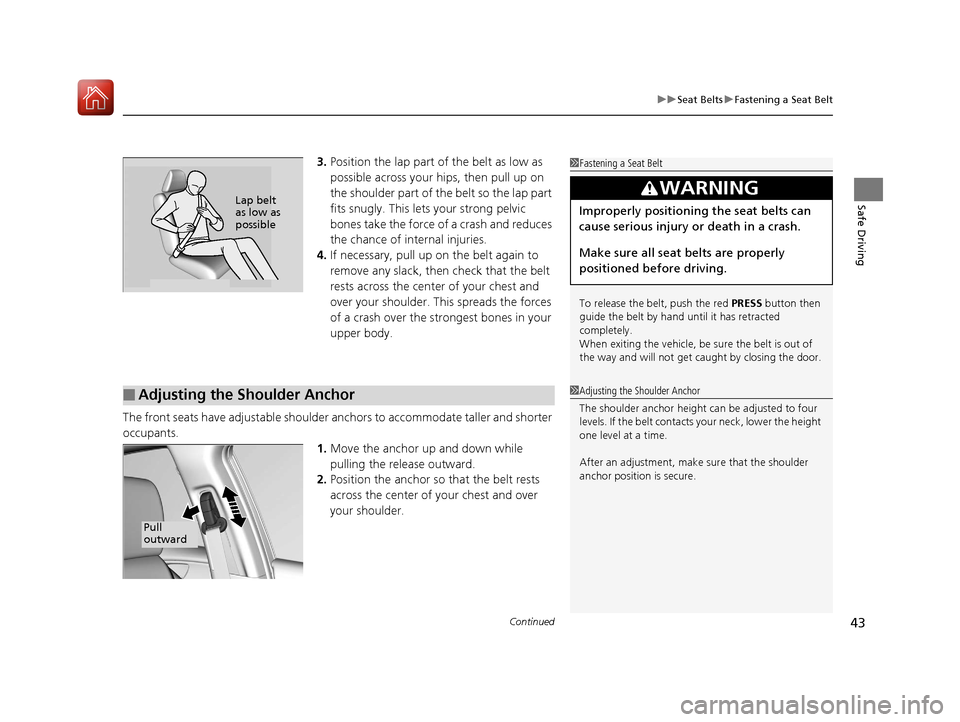
3. Position the lap part of the belt as low as
possible across your hips, then pull up on
the shoulder part of the belt so the lap part
fits snugly. This lets your strong pelvic
bones take the force of a crash and reduces
the chance of internal injuries.
4. If necessary, pull up on the belt again to
remove any slack, then check that the belt
rests across the center of your chest and
over your shoulder. This spreads the forces
of a crash over the strongest bones in your
upper body.
The front seats have adjustab le shoulder anchors to accommodate taller and shorter
occupants.
1.Move the anchor up and down while
pulling the release outward.
2. Position the anchor so that the belt rests
across the center of your chest and over
your shoulder.1 Fastening a Seat Belt
To release the belt, push the red PRESS button then
guide the belt by hand until it has retracted
completely.
When exiting the vehicle, be sure the belt is out of
the way and will not get ca ught by closing the door.
3WARNING
Improperly positioning the seat belts can
cause serious injury or death in a crash.
Make sure all seat belts are properly
positioned before driving.Lap belt
as low as
possible
■Adjusting the Shoulder Anchor1Adjusting the Shoulder Anchor
The shoulder anchor height can be adjusted to four
levels. If the belt contacts your neck, lower the height
one level at a time.
After an adjustment, make sure that the shoulder
anchor position is secure.
Pull
outward
17 CIVIC 4D HCM (KA KC KL)-31TBA6100.book 43 ページ 2016年8月31日 水曜日 午後6時5分
Page 50 of 601
49
uuAirbags uTypes of Airbags
Continued
Safe Driving
Types of Airbags
Your vehicle is equipped wi th three types of airbags:
• Front airbags: Airbags in front of the driver’s and front passenger’s seats.
• Side airbags: Airbags in the driver’s and front passenger’s seat-backs.
• Side curtain airbags: Airbags above the side windows.
Each is discussed in the following pages.
Front Airbags (SRS)
The front SRS airbags inflate in a moderate-to-severe frontal collision to help protect
the head and chest of the driver and/or front passenger.
SRS (Supplemental Restraint System) indica tes that the airbags are designed to
supplement seat belts, not replace them . Seat belts are the occupant's primary
restraint system.
The front airbags are housed in the center of the steering wheel for the driver, and
in the dashboard for the front pass enger. Both airbags are marked SRS AIRBAG.
*1: Models with the smart entry system have an ENGINE START/STOP button instead of an
ignition switch.
■Housing Locations
1 Types of Airbags
The airbags can inflate whenever the ignition switch
is in ON
(w*1.
After an airbag inflates in a crash, you may see a
small amount of smoke. This is from the combustion
process of the infl ator material and is not harmful.
People with respiratory pr oblems may experience
some temporary discomfort. If this occurs, get out of
the vehicle as soon as it is safe to do so.
1 Front Airbags (SRS)
Dual-Stage, Multiple-Threshold Front Airbags
(SRS)
Your vehicle is equipped wi th dual-stage, multiple-
threshold front airbags (SRS).
During a frontal crash severe enough to cause one or
both front airbags to deploy, the airbags can inflate
at different rates, dependi ng on the severity of the
crash, whether or not the se at belts are latched, and/
or other factors. Frontal airbags are designed to
supplement the seat belts to help to reduce the
likelihood of head and chest injuries in frontal
crashes.
17 CIVIC 4D HCM (KA KC KL)-31TBA6100.book 49 ページ 2016年8月31日 水曜日 午後6時5分
Page 53 of 601
uuAirbags uFront Airbags (SRS)
52
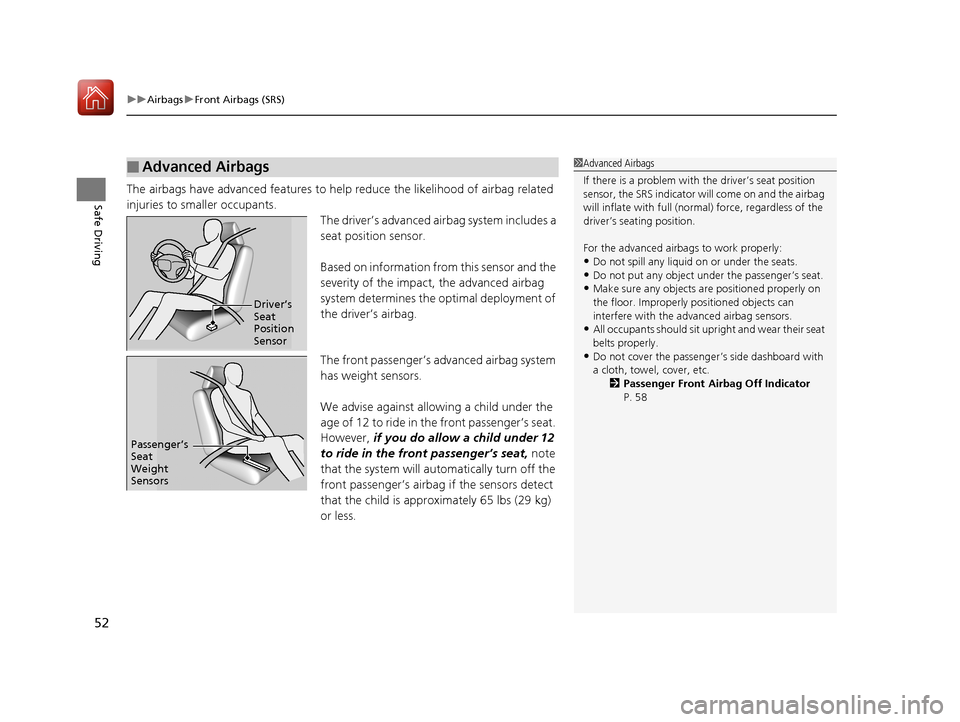
Safe DrivingThe airbags have advanced features to help reduce the likelihood of airbag related
injuries to smaller occupants.
The driver’s advanced airbag system includes a
seat position sensor.
Based on information from this sensor and the
severity of the impact, the advanced airbag
system determines the optimal deployment of
the driver’s airbag.
The front passenger’s ad vanced airbag system
has weight sensors.
We advise against allowing a child under the
age of 12 to ride in th e front passenger’s seat.
However, if you do allow a child under 12
to ride in the front passenger’s seat, note
that the system will automatically turn off the
front passenger’s airbag if the sensors detect
that the child is appr oximately 65 lbs (29 kg)
or less.
■Advanced Airbags1 Advanced Airbags
If there is a problem with the driver’s seat position
sensor, the SRS indicator wi ll come on and the airbag
will inflate with full (normal) force, regardless of the
driver’s seating position.
For the advanced airbags to work properly:
•Do not spill any liquid on or under the seats.•Do not put any object under the passenger’s seat.
•Make sure any objects are positioned properly on
the floor. Improperly pos itioned objects can
interfere with the advanced airbag sensors.
•All occupants should sit upri ght and wear their seat
belts properly.
•Do not cover the passenger ’s side dashboard with
a cloth, towel, cover, etc. 2Passenger Front Airbag Off Indicator
P. 58
Driver’s
Seat
Position
Sensor
Passenger’s
Seat
Weight
Sensors
17 CIVIC 4D HCM (KA KC KL)-31TBA6100.book 52 ページ 2016年8月31日 水曜日 午後6時5分