engine HONDA CIVIC 2022 Owners Manual
[x] Cancel search | Manufacturer: HONDA, Model Year: 2022, Model line: CIVIC, Model: HONDA CIVIC 2022Pages: 700, PDF Size: 13.98 MB
Page 670 of 700
669
uuFuses uInspecting and Changing Fuses
Handling the Unexpected
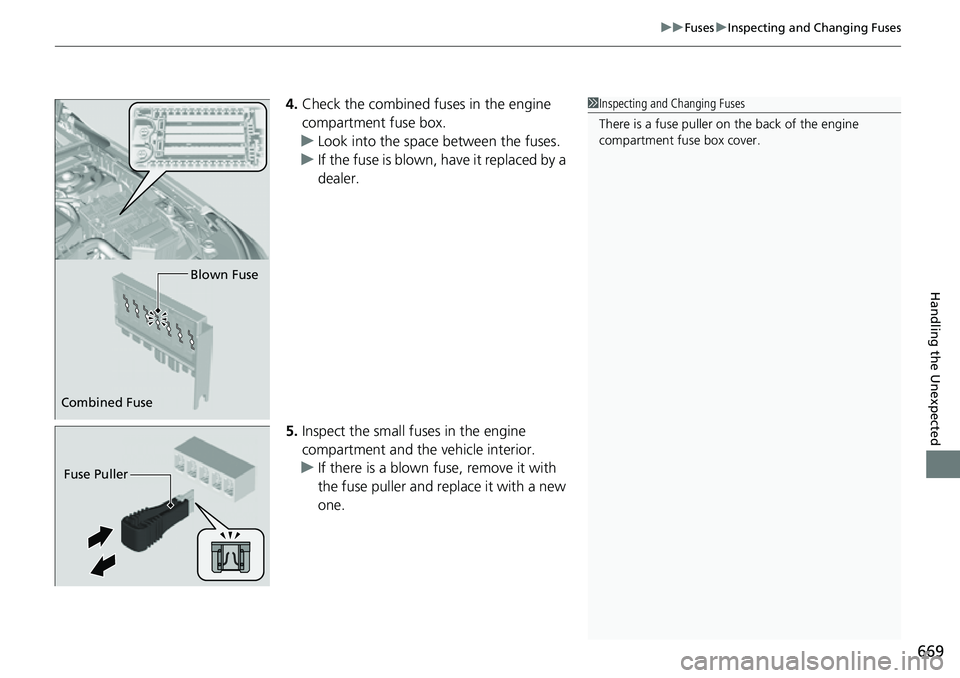
4. Check the combined fu ses in the engine
compartment fuse box.
u Look into the space between the fuses.
u If the fuse is blown, have it replaced by a
dealer.
5. Inspect the small fu ses in the engine
compartment and the vehicle interior.
u If there is a blown fuse, remove it with
the fuse puller and replace it with a new
one.1Inspecting and Changing Fuses
There is a fuse puller on the back of the engine
compartment fuse box cover.
Combined Fuse Blown Fuse
Fuse Puller
Page 674 of 700
673
Handling the Unexpected
Refueling
Refueling From a Portable Fuel Container
If you have run out of fuel and need to refuel your vehicle from a portable fuel
container, use the funnel provided with your vehicle.
1.Turn off the engine.
2. Press on the edge of the fuel fill door until
you hear a click when the driver’s door is
unlocked.
u The fuel fill door opens.
3. Take the funnel out of the tool case in the
trunk.
2 Types of Tools P. 640
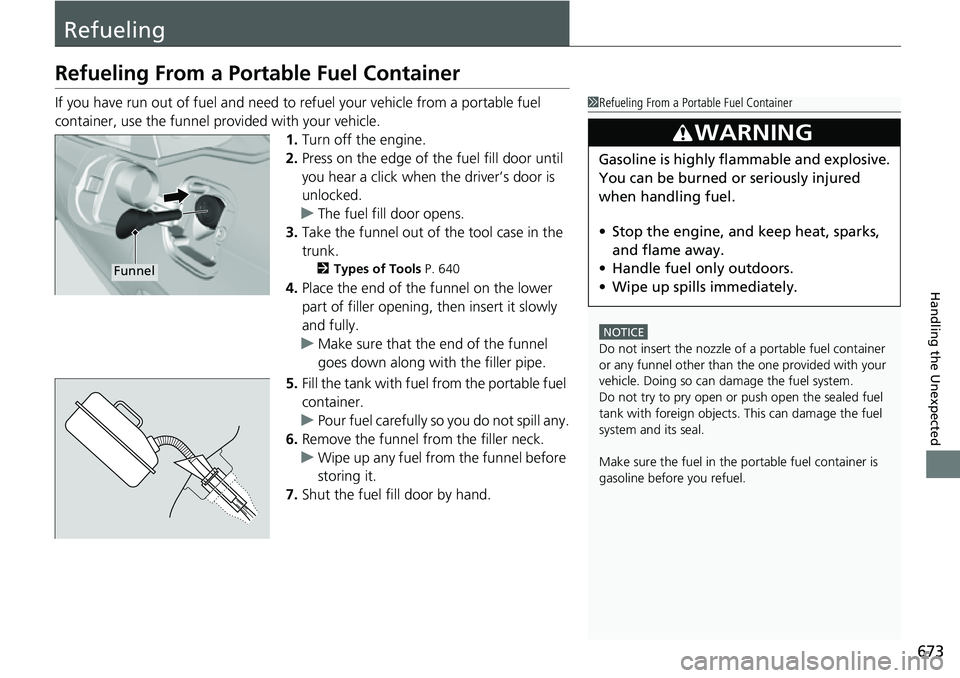
4.Place the end of the funnel on the lower
part of filler opening, then insert it slowly
and fully.
u Make sure that the end of the funnel
goes down along with the filler pipe.
5. Fill the tank with fuel from the portable fuel
container.
u Pour fuel carefully so you do not spill any.
6. Remove the funnel from the filler neck.
u Wipe up any fuel from the funnel before
storing it.
7. Shut the fuel fill door by hand.
1Refueling From a Portable Fuel Container
NOTICE
Do not insert the nozzle of a portable fuel container
or any funnel other than the one provided with your
vehicle. Doing so can damage the fuel system.
Do not try to pry open or push open the sealed fuel
tank with foreign objects. This can damage the fuel
system and its seal.
Make sure the fuel in the portable fuel container is
gasoline before you refuel.
3WARNING
Gasoline is highly flammable and explosive.
You can be burned or seriously injured
when handling fuel.
• Stop the engine, and keep heat, sparks,
and flame away.
• Handle fuel only outdoors.
• Wipe up spills immediately.
Funnel
Page 676 of 700
675
Information
This chapter includes your vehicle's specifications, locations of identification numbers, and other
information required by regulation.
Specifications .................................... 676
Identification Numbers Vehicle Identification Number (VIN), Engine Number, and Transmission
Number ......................................... 680
Devices that Emit Radio Waves ....... 681
Reporting Safety Defects ................. 682Emissions Testing
Testing of Readiness Codes.............. 683
Warranty Coverages ........................ 685
Authorized Manuals ......................... 688
Customer Service Information ......... 689
Page 677 of 700
676
Information
Specifications
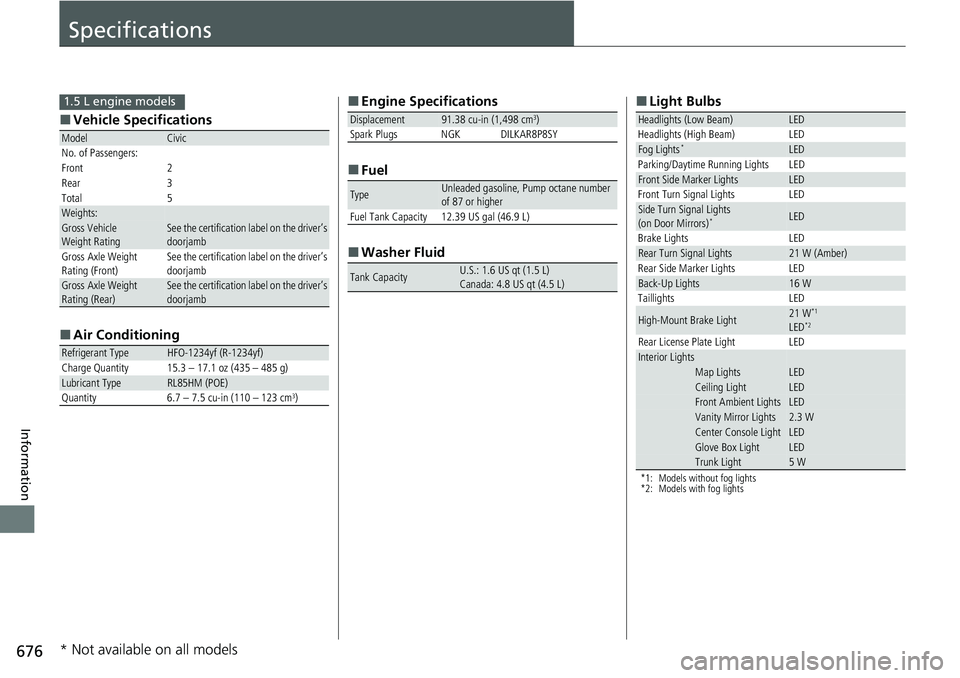
■Vehicle Specifications
■ Air Conditioning
ModelCivic
No. of Passengers:
Front 2
Rear 3
Total 5
Weights:Gross Vehicle
Weight RatingSee the certification label on the driver’s
doorjamb
Gross Axle Weight
Rating (Front)See the certification label on the driver’s
doorjamb
Gross Axle Weight
Rating (Rear)See the certification label on the driver’s
doorjamb
Refrigerant TypeHFO-1234yf (R-1234yf)
Charge Quantity 15.3 – 17.1 oz (435 – 485 g)
Lubricant TypeRL85HM (POE)
Quantity 6.7 – 7.5 cu-in (110 – 123 cm3)
1.5 L engine models■ Engine Specifications
■ Fuel
■ Washer Fluid
Displacement91.38 cu-in (1,498 cm3)
Spark Plugs NGK DILKAR8P8SY
TypeUnleaded gasoline, Pump octane number
of 87 or higher
Fuel Tank Capacity 12.39 US gal (46.9 L)
Tank CapacityU.S.: 1.6 US qt (1.5 L)
Canada: 4.8 US qt (4.5 L)
■ Light Bulbs
*1: Models without fog lights
*2: Models with fog lights
Headlights (Low Beam)LED
Headlights (High Beam) LED
Fog Lights*LED
Parking/Daytime Running Lights LED
Front Side Marker LightsLED
Front Turn Signal Lights LED
Side Turn Signal Lights
(on Door Mirrors)*LED
Brake Lights LED
Rear Turn Signal Lights21 W (Amber)
Rear Side Marker Lights LED
Back-Up Lights16 W
Taillights LED
High-Mount Brake Light21 W*1
LED*2
Rear License Plate Light LEDInterior LightsMap LightsLEDCeiling LightLEDFront Ambient LightsLEDVanity Mirror Lights2.3 WCenter Console LightLEDGlove Box LightLEDTrunk Light5 W
* Not available on all models
Page 678 of 700
677
uuSpecifications u
Continued
Information
■
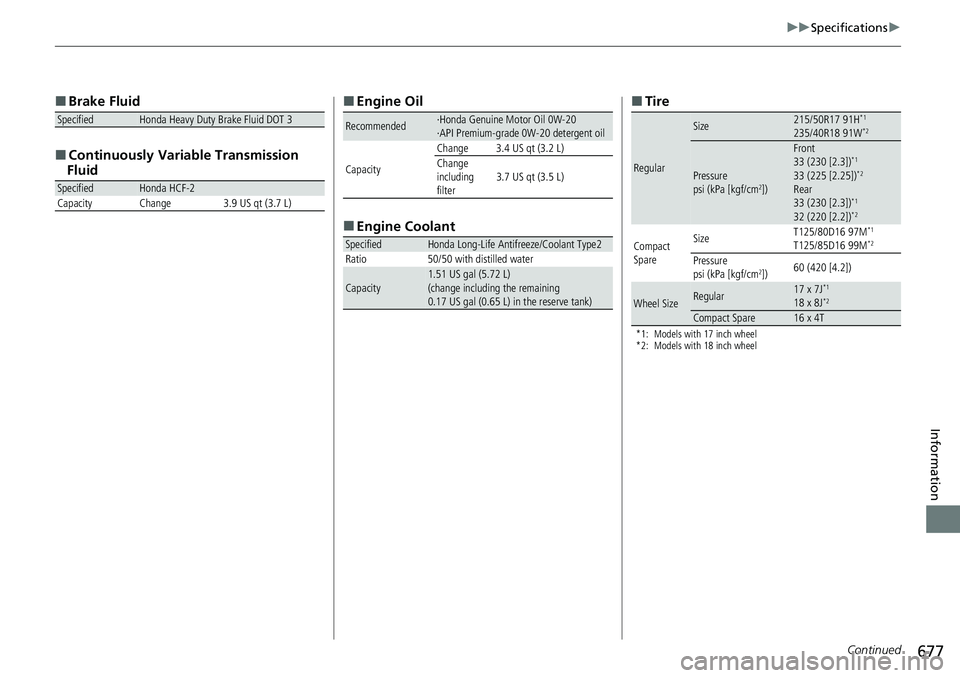
Brake Fluid
■ Continuously Variable Transmission
Fluid
SpecifiedHonda Heavy Duty Brake Fluid DOT 3
SpecifiedHonda HCF-2
Capacity Change 3.9 US qt (3.7 L)
■ Engine Oil
■ Engine Coolant
Recommended·Honda Genuine Motor Oil 0W-20
·API Premium-grade 0W-20 detergent oil
Capacity Change 3.4 US qt (3.2 L)
Change
including
filter
3.7 US qt (3.5 L)
SpecifiedHonda Long-Life Antifreeze/Coolant Type2
Ratio 50/50 with distilled water
Capacity1.51 US gal (5.72 L)
(change including the remaining
0.17 US gal (0.65 L) in the reserve tank)
■ Tire
*1: Models with 17 inch wheel
*2: Models with 18 inch wheel
Regular
Size215/50R17 91H*1
235/40R18 91W*2
Pressure
psi (kPa [kgf/cm2])
Front
33 (230 [2.3])*1
33 (225 [2.25])*2
Rear
33 (230 [2.3])*1
32 (220 [2.2])*2
Compact
Spare Size
T125/80D16 97M
*1
T125/85D16 99M*2
Pressure
psi (kPa [kgf/cm2])
60 (420 [4.2])
Wheel SizeRegular17 x 7J*1
18 x 8J*2
Compact Spare16 x 4T
Page 679 of 700
678
uuSpecifications u
Information
■
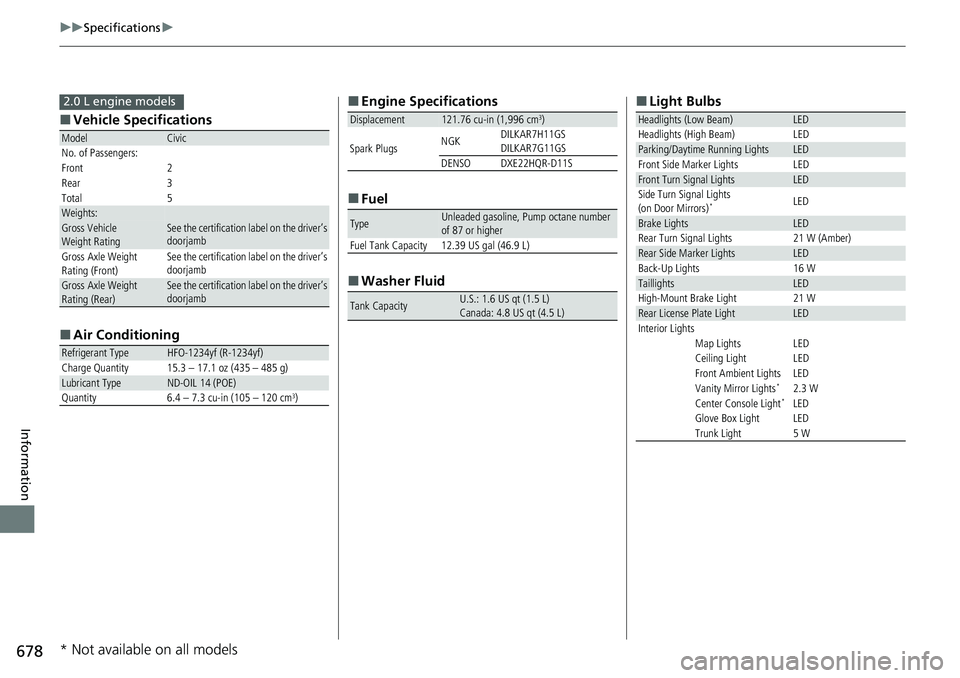
Vehicle Specifications
■ Air Conditioning
ModelCivic
No. of Passengers:
Front 2
Rear 3
Total 5
Weights:Gross Vehicle
Weight Rating See the certification label on the driver’s
doorjamb
Gross Axle Weight
Rating (Front)See the certification label on the driver’s
doorjamb
Gross Axle Weight
Rating (Rear)See the certification label on the driver’s
doorjamb
Refrigerant TypeHFO-1234yf (R-1234yf)
Charge Quantity 15.3 – 17.1 oz (435 – 485 g)
Lubricant TypeND-OIL 14 (POE)
Quantity 6.4 – 7.3 cu-in (105 – 120 cm3)
2.0 L engine models■ Engine Specifications
■ Fuel
■ Washer Fluid
Displacement121.76 cu-in (1,996 cm3)
Spark Plugs NGK
DILKAR7H11GS
DILKAR7G11GS
DENSO DXE22HQR-D11S
TypeUnleaded gasoline, Pump octane number
of 87 or higher
Fuel Tank Capacity 12.39 US gal (46.9 L)
Tank CapacityU.S.: 1.6 US qt (1.5 L)
Canada: 4.8 US qt (4.5 L)
■ Light Bulbs
Headlights (Low Beam)LED
Headlights (High Beam) LED
Parking/Daytime Running LightsLED
Front Side Marker Lights LED
Front Turn Signal LightsLED
Side Turn Signal Lights
(on Door Mirrors)
*LED
Brake LightsLED
Rear Turn Signal Lights 21 W (Amber)
Rear Side Marker LightsLED
Back-Up Lights 16 W
TaillightsLED
High-Mount Brake Light 21 W
Rear License Plate LightLED
Interior Lights Map Lights LED
Ceiling Light LED
Front Ambient Lights LED
Vanity Mirror Lights
*2.3 W
Center Console Light*LED
Glove Box Light LED
Trunk Light 5 W
* Not available on all models
Page 680 of 700
679
uuSpecifications u
Information
■
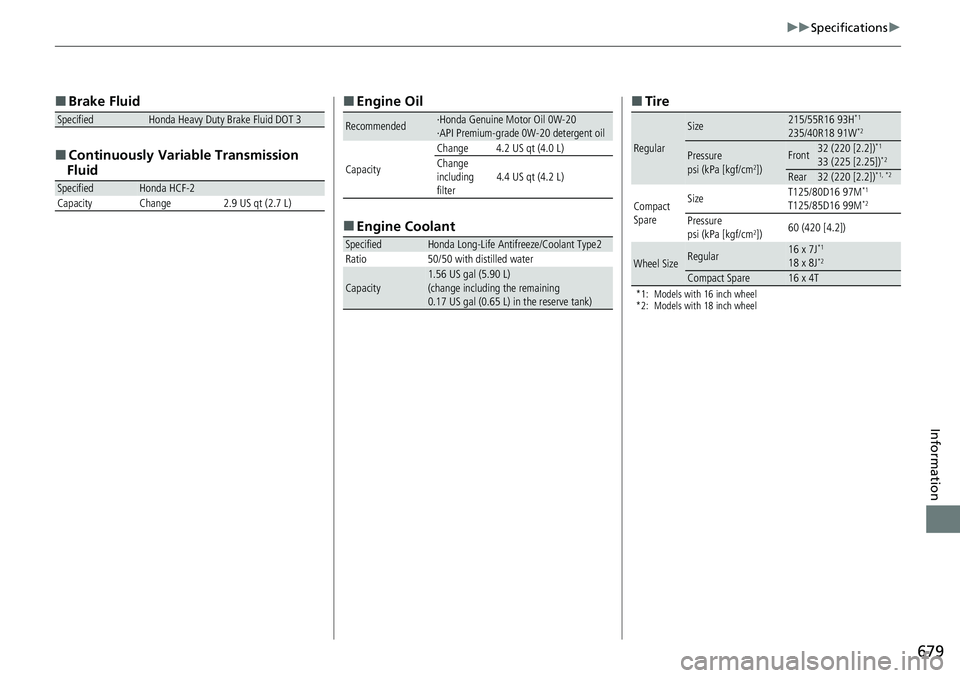
Brake Fluid
■ Continuously Variable Transmission
Fluid
SpecifiedHonda Heavy Duty Brake Fluid DOT 3
SpecifiedHonda HCF-2
Capacity Change 2.9 US qt (2.7 L)
■ Engine Oil
■ Engine Coolant
Recommended·Honda Genuine Motor Oil 0W-20
·API Premium-grade 0W-20 detergent oil
Capacity Change 4.2 US qt (4.0 L)
Change
including
filter
4.4 US qt (4.2 L)
SpecifiedHonda Long-Life Antifreeze/Coolant Type2
Ratio 50/50 with distilled water
Capacity1.56 US gal (5.90 L)
(change including the remaining
0.17 US gal (0.65 L) in the reserve tank)
■ Tire
*1: Models with 16 inch wheel
*2: Models with 18 inch wheel
Regular
Size215/55R16 93H*1
235/40R18 91W*2
Pressure
psi (kPa [kgf/cm2])Front32 (220 [2.2])*1
33 (225 [2.25])*2
Rear32 (220 [2.2])*1, *2
Compact
Spare Size
T125/80D16 97M
*1
T125/85D16 99M*2
Pressure
psi (kPa [kgf/cm2])60 (420 [4.2])
Wheel SizeRegular16 x 7J*1
18 x 8J*2
Compact Spare16 x 4T
Page 681 of 700
680
Information
Identification Numbers
Vehicle Identification Number (VIN), Engine Number,
and Transmission Number
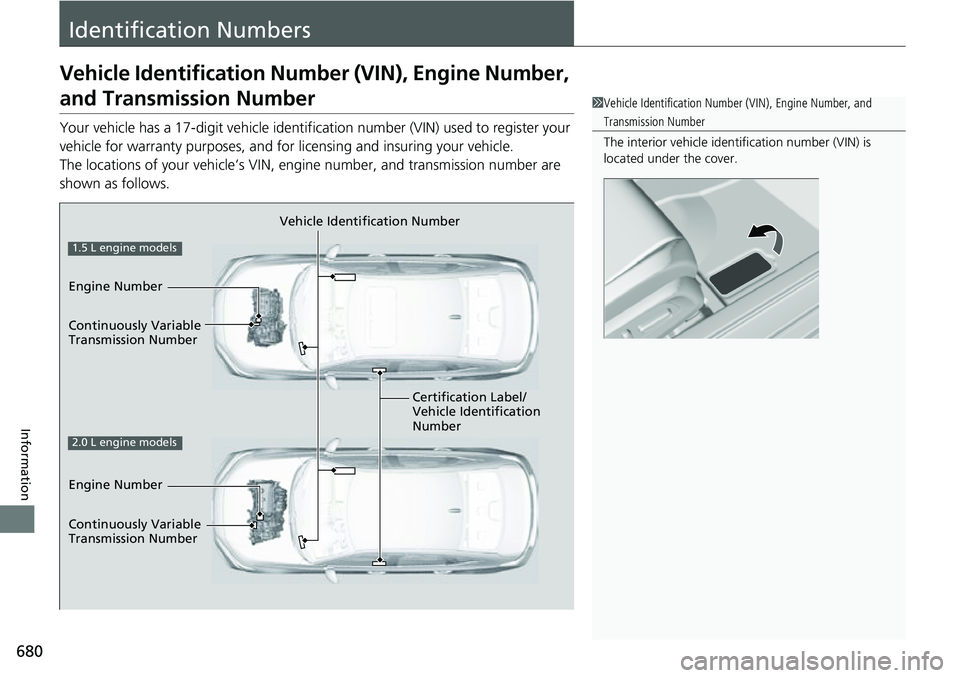
Your vehicle has a 17-digit vehicle identifi cation number (VIN) used to register your
vehicle for warranty purposes, and for licensing and insuring your vehicle.
The locations of your vehicle’s VIN, engine number, and transmission number are
shown as follows.
1 Vehicle Identification Number (VIN), Engine Number, and
Transmission Number
The interior vehicle identification number (VIN) is
located under the cover.
Vehicle Identification Number
Engine Number
Certification Label/
Vehicle Identification
Number
2.0 L engine models
1.5 L engine models
Continuously Variable
Transmission Number
Engine Number
Continuously Variable
Transmission Number
Page 684 of 700
683Continued
Information
Emissions Testing
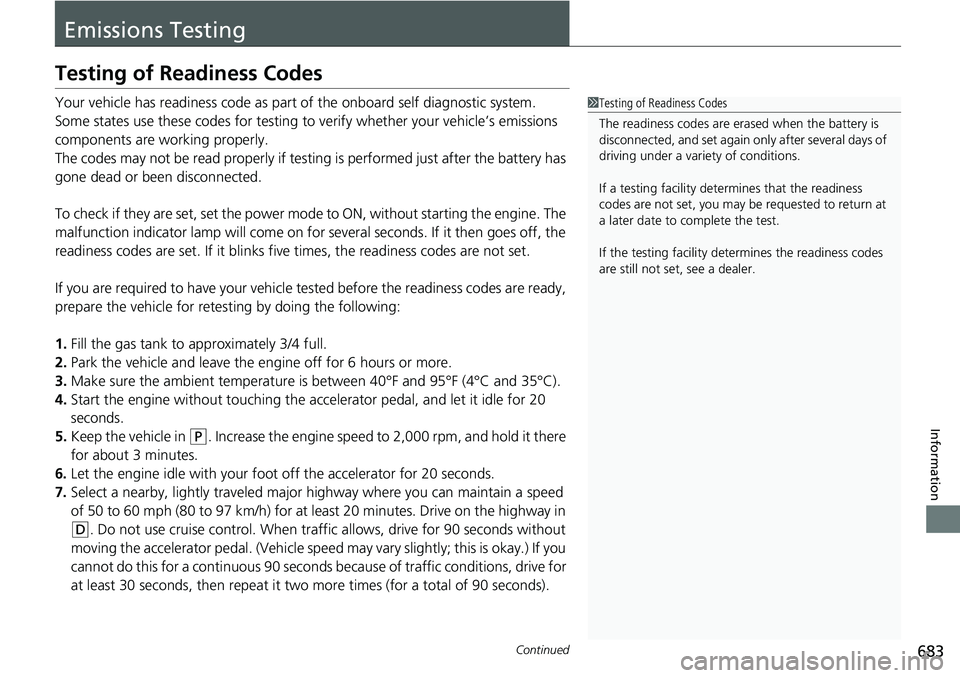
Testing of Readiness Codes
Your vehicle has readiness code as part of the onboard self diagnostic system.
Some states use these codes for testing to verify whether your vehicle’s emissions
components are working properly.
The codes may not be read properly if testing is performed just after the battery has
gone dead or been disconnected.
To check if they are set, set the power mo de to ON, without starting the engine. The
malfunction indicator lamp will come on for several seconds. If it then goes off, the
readiness codes are set. If it blinks fi ve times, the readiness codes are not set.
If you are required to have your vehicle te sted before the readiness codes are ready,
prepare the vehicle for retest ing by doing the following:
1. Fill the gas tank to approximately 3/4 full.
2. Park the vehicle and leave the engine off for 6 hours or more.
3. Make sure the ambient temperature is between 40°F and 95°F (4°C and 35°C).
4. Start the engine without touching the ac celerator pedal, and let it idle for 20
seconds.
5. Keep the vehicle in
(P. Increase the engine speed to 2,000 rpm, and hold it there
for about 3 minutes.
6. Let the engine idle with your foot off the accelerator for 20 seconds.
7. Select a nearby, lightly traveled major hi ghway where you can maintain a speed
of 50 to 60 mph (80 to 97 km/h) for at least 20 minutes. Drive on the highway in
(D. Do not use cruise control. When traffi c allows, drive for 90 seconds without
moving the accelerator pedal. (V ehicle speed may vary slightly; this is okay.) If you
cannot do this for a continuous 90 seconds because of traffic conditions, drive for
at least 30 seconds, then repeat it two more times (for a total of 90 seconds).
1Testing of Readiness Codes
The readiness codes are erased when the battery is
disconnected, and set again onl y after several days of
driving under a variety of conditions.
If a testing facility determines that the readiness
codes are not set, you may be requested to return at
a later date to complete the test.
If the testing facility determines the readiness codes
are still not set, see a dealer.
Page 685 of 700
684
uuEmissions Testing uTesting of Readiness Codes
Information
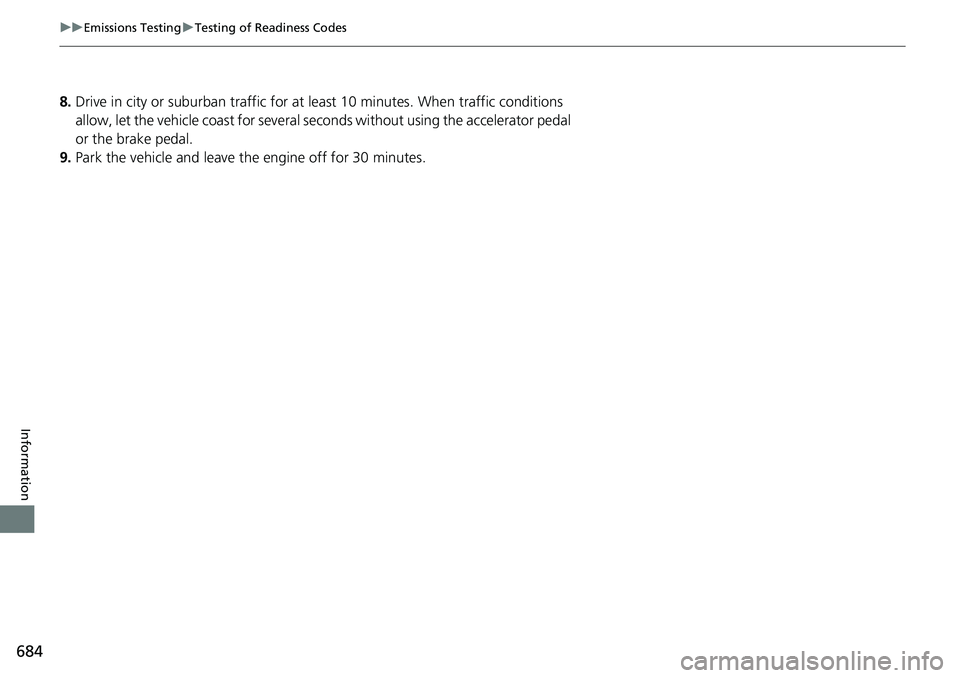
8. Drive in city or suburban traffic for at le ast 10 minutes. When traffic conditions
allow, let the vehicle coast for several se conds without using the accelerator pedal
or the brake pedal.
9. Park the vehicle and leave the engine off for 30 minutes.