wheel HONDA CIVIC 2022 Owners Manual
[x] Cancel search | Manufacturer: HONDA, Model Year: 2022, Model line: CIVIC, Model: HONDA CIVIC 2022Pages: 700, PDF Size: 13.98 MB
Page 642 of 700
641Continued
Handling the Unexpected
If a Tire Goes Flat
Changing a Flat Tire
If a tire goes flat while driving, grasp the steering wheel firmly, and brake gradually
to reduce speed. Then, stop in a safe plac e. Replace the flat tire with a compact
spare tire. Go to a dealer as soon as possib le to have the full-size tire repaired or
replaced.
1. Park the vehicle on a firm, level, non-slippery surface and apply the parking brake.
2. Put the transmission into
(P.
3. Turn on the hazard warning lights an d set the power mode to VEHICLE OFF.
1Changing a Flat Tire
Follow compact spare precautions:
Periodically check the tire pressure of the compact
spare. It should be set to the specified pressure.
Specified Pressure: 60 psi (420 kPa, 4.2 kgf/cm
2)
When driving with the compact spare tire, keep the
vehicle speed under 50 mph (80 km/h). Replace with
a full-size tire as soon as possible.
The compact spare tire and wheel in your vehicle are
specifically for this model. Do not use them with
another vehicle. Do not us e another type of compact
spare tire or wheel with your vehicle.
Do not mount tire chains on a compact spare tire.
If a chain-mounted front tire goes flat, remove one of
the full-size rear tires and replace it with the compact
spare tire. Remove the flat front tire and replace it
with the full-size tire that was removed from the rear.
Mount the tire chains on the front tire.
NOTICE
Do not use the jack if it doesn’t work properly. Call
your dealer or a prof essional towing service.
Page 643 of 700
642
uuIf a Tire Goes Flat uChanging a Flat Tire
Handling the Unexpected
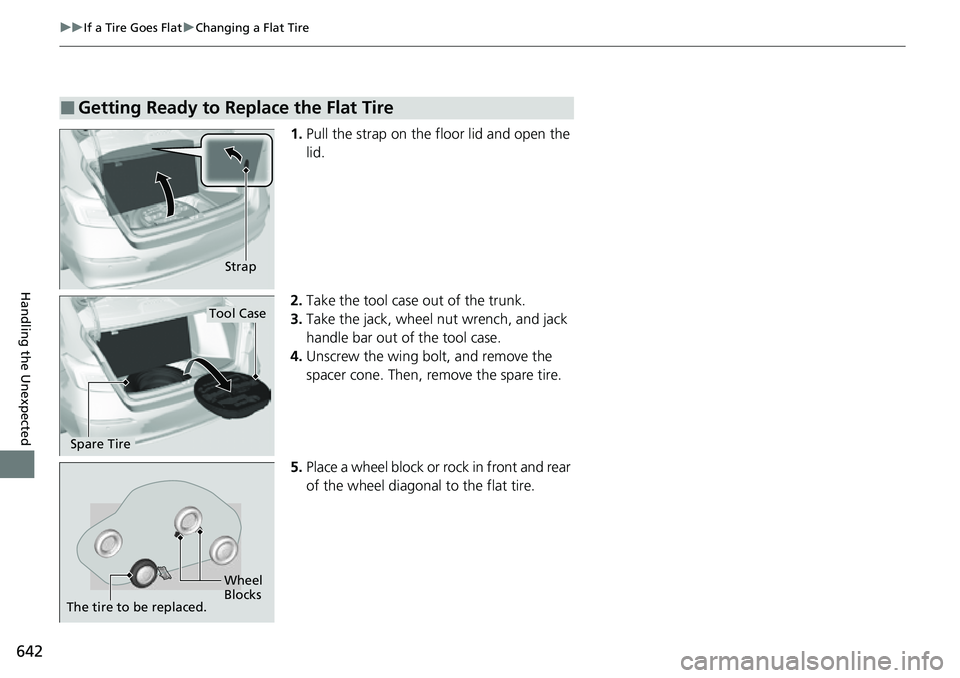
1. Pull the strap on the floor lid and open the
lid.
2. Take the tool case out of the trunk.
3. Take the jack, wheel nut wrench, and jack
handle bar out of the tool case.
4. Unscrew the wing bolt, and remove the
spacer cone. Then, remove the spare tire.
5. Place a wheel block or rock in front and rear
of the wheel diagonal to the flat tire.
■Getting Ready to Replace the Flat Tire
Strap
Tool Case
Spare Tire
Wheel
Blocks
The tire to be replaced.
Page 644 of 700
643
uuIf a Tire Goes Flat uChanging a Flat Tire
Continued
Handling the Unexpected
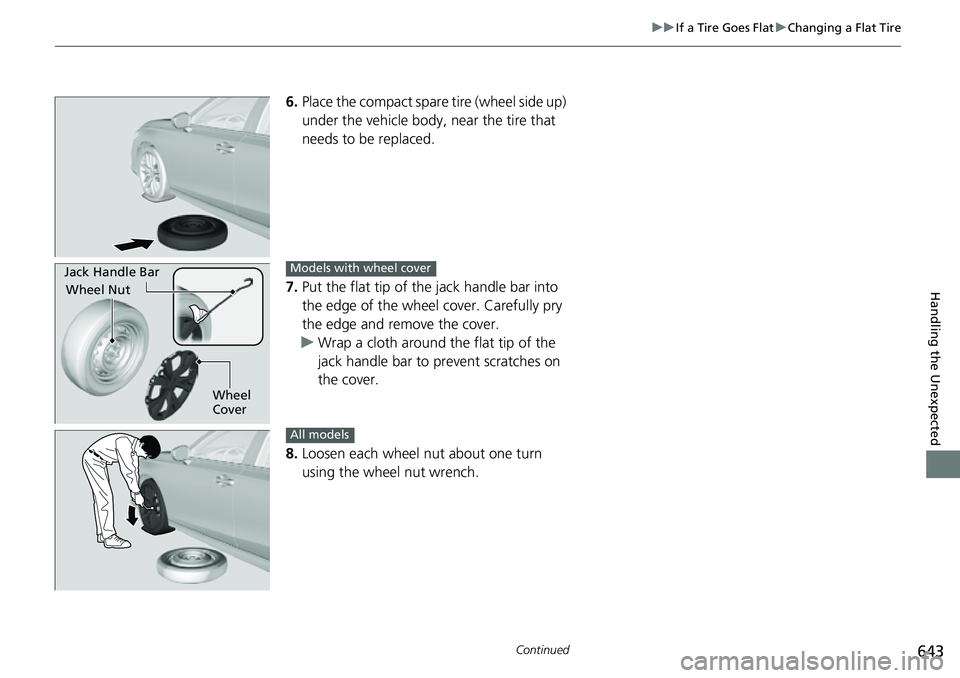
6. Place the compact spare tire (wheel side up)
under the vehicle body, near the tire that
needs to be replaced.
7. Put the flat tip of the jack handle bar into
the edge of the wheel cover. Carefully pry
the edge and remove the cover.
u Wrap a cloth around the flat tip of the
jack handle bar to prevent scratches on
the cover.
8. Loosen each wheel nut about one turn
using the wheel nut wrench.
Jack Handle Bar
Wheel Nut
Wheel
CoverModels with wheel cover
All models
Page 645 of 700
uuIf a Tire Goes Flat uChanging a Flat Tire
644
Handling the Unexpected
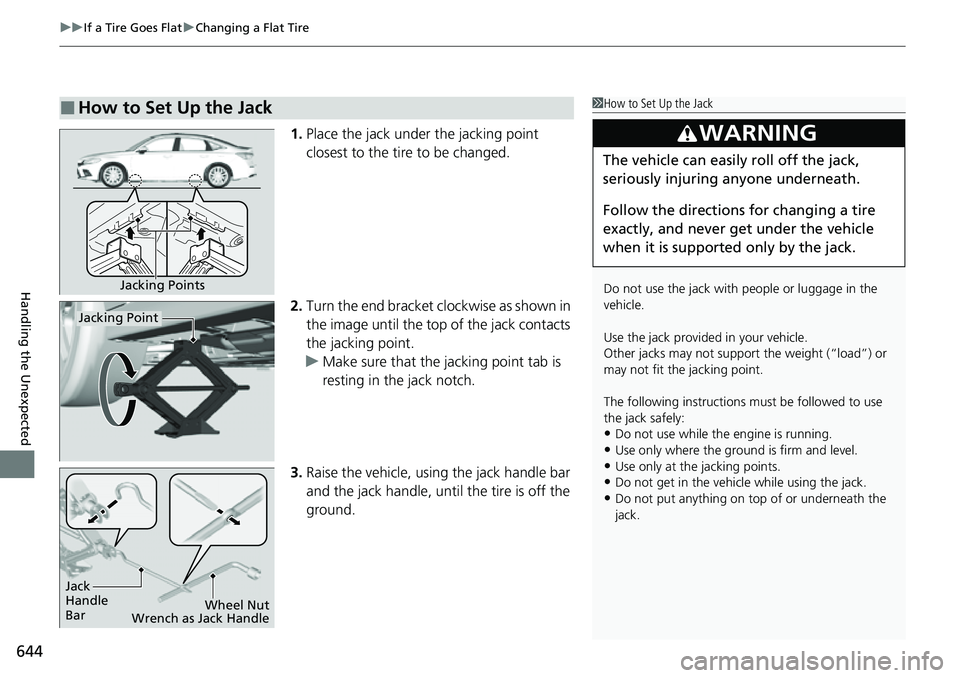
1. Place the jack under the jacking point
closest to the tire to be changed.
2. Turn the end bracket cl ockwise as shown in
the image until the top of the jack contacts
the jacking point.
u Make sure that the jacking point tab is
resting in the jack notch.
3. Raise the vehicle, using the jack handle bar
and the jack handle, until the tire is off the
ground.
■How to Set Up the Jack1How to Set Up the Jack
Do not use the jack with people or luggage in the
vehicle.
Use the jack provided in your vehicle.
Other jacks may not support the weight (“load”) or
may not fit the jacking point.
The following instructions must be followed to use
the jack safely:
•Do not use while the engine is running.
•Use only where the ground is firm and level.
•Use only at the jacking points.•Do not get in the vehicl e while using the jack.
•Do not put anything on top of or underneath the
jack.
3WARNING
The vehicle can easily roll off the jack,
seriously injuring anyone underneath.
Follow the directions for changing a tire
exactly, and never get under the vehicle
when it is supported only by the jack.
Jacking Points
Jacking Point
Jack
Handle
Bar Wheel Nut
Wrench as Jack Handle
Page 646 of 700
Continued645
uuIf a Tire Goes Flat uChanging a Flat Tire
Handling the Unexpected
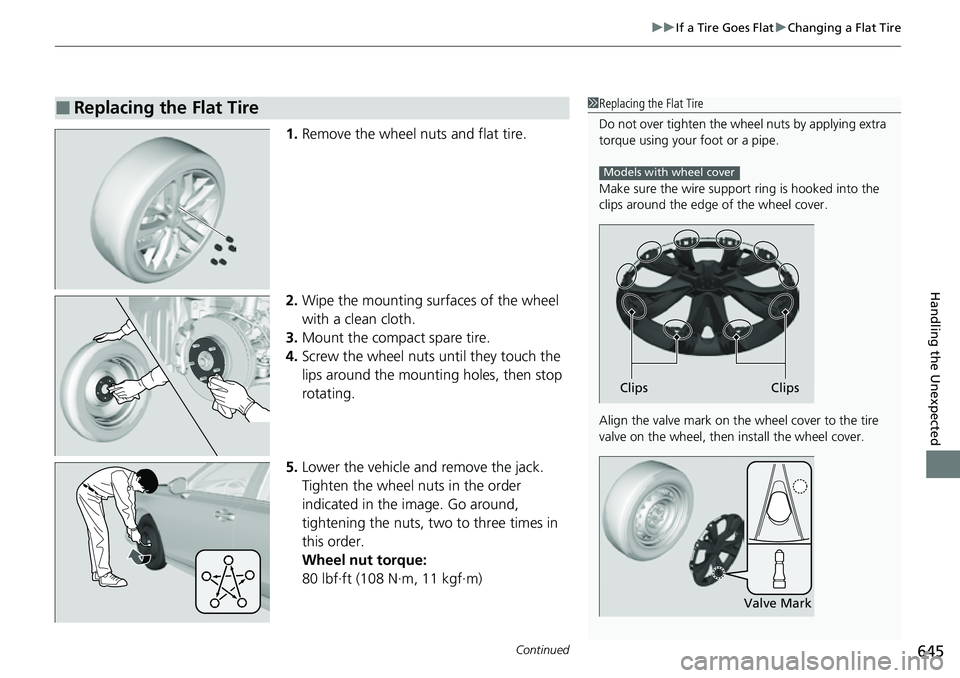
1. Remove the wheel nuts and flat tire.
2. Wipe the mounting surfaces of the wheel
with a clean cloth.
3. Mount the compact spare tire.
4. Screw the wheel nuts until they touch the
lips around the mounting holes, then stop
rotating.
5. Lower the vehicle and remove the jack.
Tighten the wheel nuts in the order
indicated in the image. Go around,
tightening the nuts, two to three times in
this order.
Wheel nut torque:
80 lbf∙ft (108 N∙m, 11 kgf∙m)
■Replacing the Flat Tire1Replacing the Flat Tire
Do not over tighten the wheel nuts by applying extra
torque using your foot or a pipe.
Make sure the wire support ring is hooked into the
clips around the edge of the wheel cover.
Align the valve mark on the wheel cover to the tire
valve on the wheel, then install the wheel cover.
Models with wheel cover
Clips Clips
Valve Mark
Page 647 of 700
uuIf a Tire Goes Flat uChanging a Flat Tire
646
Handling the Unexpected
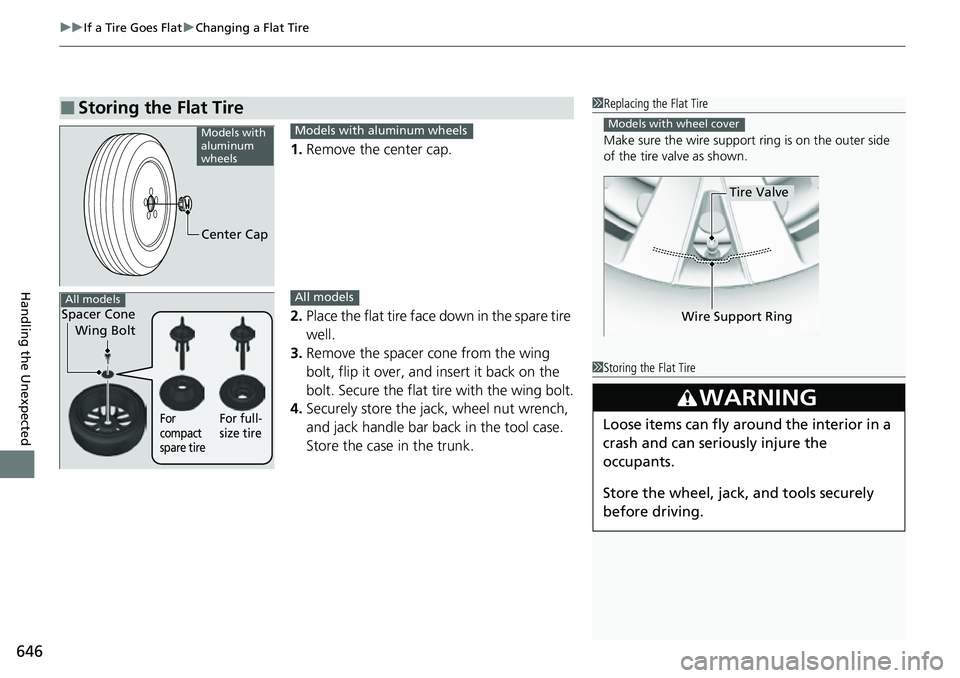
1. Remove the center cap.
2. Place the flat tire face down in the spare tire
well.
3. Remove the spacer cone from the wing
bolt, flip it over, and insert it back on the
bolt. Secure the flat tire with the wing bolt.
4. Securely store the jack, wheel nut wrench,
and jack handle bar back in the tool case.
Store the case in the trunk.
■Storing the Flat Tire1Replacing the Flat Tire
Make sure the wire support ring is on the outer side
of the tire valve as shown.
Models with wheel cover
Tire Valve
Wire Support Ring
1 Storing the Flat Tire
3WARNING
Loose items can fly around the interior in a
crash and can seriously injure the
occupants.
Store the wheel, jack, and tools securely
before driving.
Models with
aluminum
wheels
Center Cap
Models with aluminum wheels
Spacer Cone
Wing Bolt
For
compact
spare tireFor full-
size tire
All modelsAll models
Page 652 of 700
651
uuEngine Does Not StartuEmergency Engine Stop
Handling the Unexpected
Emergency Engine Stop
The ENGINE START/STOP button may be used to stop the engine due to an
emergency situation even while driving. If you must stop the engine, do either of the
following operations:
• Press and hold the ENGINE START/STOP button for about two seconds.
• Firmly press the ENGINE START/STOP button three times.
The steering wheel will not lock. However, because turning off the engine disables
the power assist the engine provides to the steering and braking systems, it will
require significantly more physical effort an d time to steer and slow the vehicle. Use
both feet on the brake pedal to slow down the vehicle and stop immediately in a
safe place.
The power mode is in ACCESSORY when the engine is stopped.
To change the mode to VEHICLE OFF, put the transmission into
(P after the vehicle
comes to a complete stop.
1 Emergency Engine Stop
Do not press the ENGINE START/STOP button while
driving unless it is absolute ly necessary for the engine
to be turned off.
If you press the ENGINE START/STOP button while
driving, the beeper sounds.
Page 671 of 700
670
Handling the Unexpected
Emergency Towing
Call a professional towing service if you need to tow your vehicle.
■Flat bed equipment
The operator loads your vehicle on the back of a truck.
This is the best way to transport your vehicle.
■Wheel lift equipment
The tow truck uses two pivoti ng arms that go under the front tires and lift them off
the ground. The rear tires remain on the ground. This is an acceptable way to
tow your vehicle.
1 Emergency Towing
NOTICE
Trying to lift or tow your vehicle by the bumpers will
cause serious damage. The bumpers are not designed
to support the vehicle's weight.
Make sure the parking brake is released. If you
cannot release the parking brake, your vehicle must
be transported by the flat bed equipment. 2 Parking Brake P. 554
NOTICE
Improper towing such as towing behind a
motorhome or other motor vehicle can damage the
transmission.
Never tow your vehicle with just a rope or chain.
It is very dangerous since ropes or chains may shift
from side to side or break.
Page 678 of 700
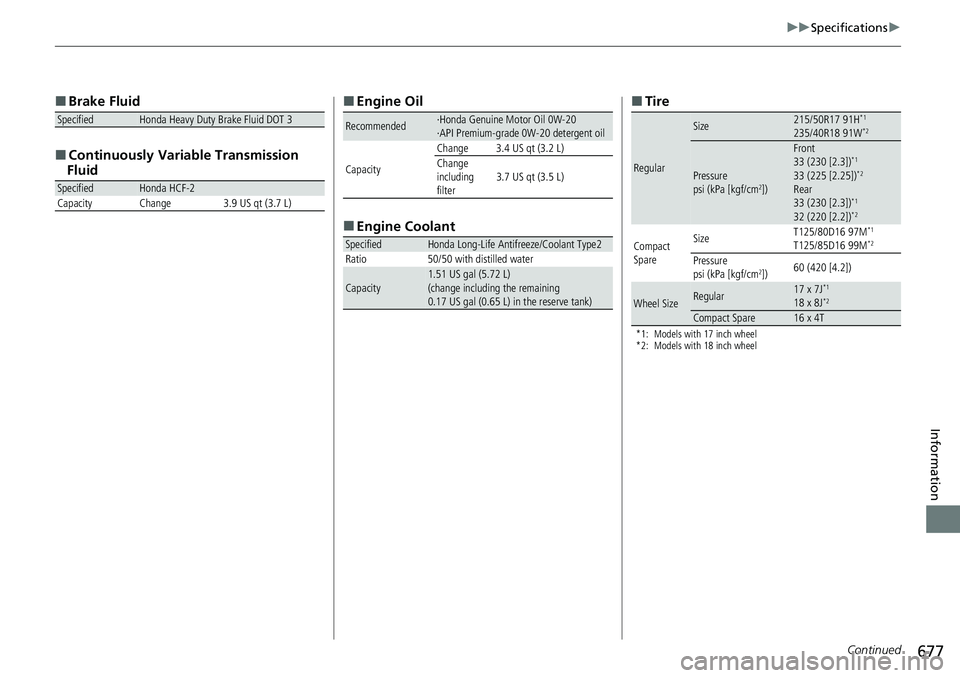
677
uuSpecifications u
Continued
Information
■
Brake Fluid
■ Continuously Variable Transmission
Fluid
SpecifiedHonda Heavy Duty Brake Fluid DOT 3
SpecifiedHonda HCF-2
Capacity Change 3.9 US qt (3.7 L)
■ Engine Oil
■ Engine Coolant
Recommended·Honda Genuine Motor Oil 0W-20
·API Premium-grade 0W-20 detergent oil
Capacity Change 3.4 US qt (3.2 L)
Change
including
filter
3.7 US qt (3.5 L)
SpecifiedHonda Long-Life Antifreeze/Coolant Type2
Ratio 50/50 with distilled water
Capacity1.51 US gal (5.72 L)
(change including the remaining
0.17 US gal (0.65 L) in the reserve tank)
■ Tire
*1: Models with 17 inch wheel
*2: Models with 18 inch wheel
Regular
Size215/50R17 91H*1
235/40R18 91W*2
Pressure
psi (kPa [kgf/cm2])
Front
33 (230 [2.3])*1
33 (225 [2.25])*2
Rear
33 (230 [2.3])*1
32 (220 [2.2])*2
Compact
Spare Size
T125/80D16 97M
*1
T125/85D16 99M*2
Pressure
psi (kPa [kgf/cm2])
60 (420 [4.2])
Wheel SizeRegular17 x 7J*1
18 x 8J*2
Compact Spare16 x 4T
Page 680 of 700
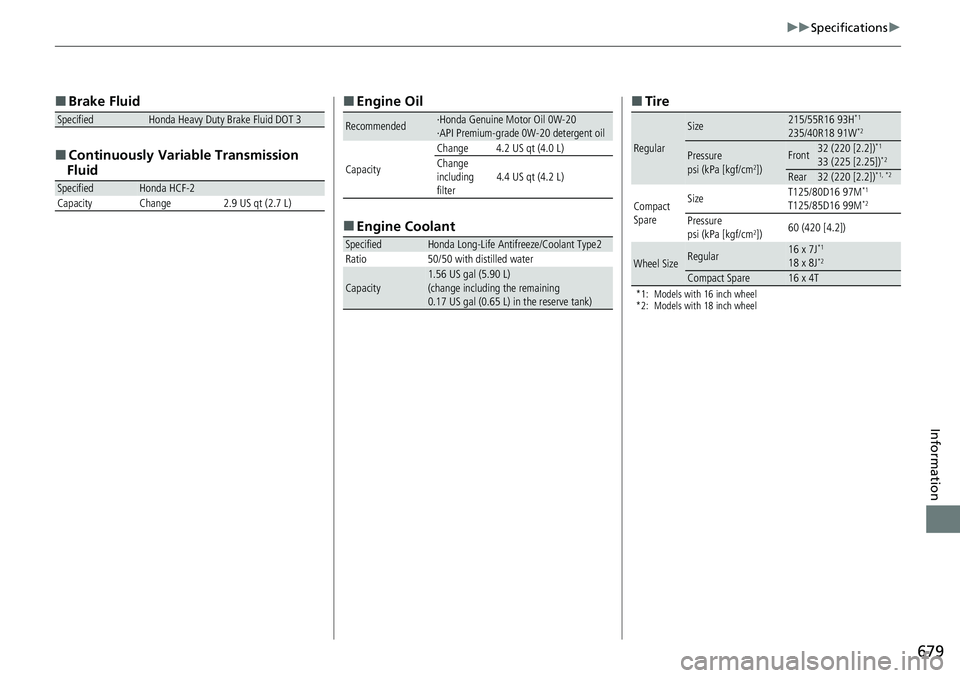
679
uuSpecifications u
Information
■
Brake Fluid
■ Continuously Variable Transmission
Fluid
SpecifiedHonda Heavy Duty Brake Fluid DOT 3
SpecifiedHonda HCF-2
Capacity Change 2.9 US qt (2.7 L)
■ Engine Oil
■ Engine Coolant
Recommended·Honda Genuine Motor Oil 0W-20
·API Premium-grade 0W-20 detergent oil
Capacity Change 4.2 US qt (4.0 L)
Change
including
filter
4.4 US qt (4.2 L)
SpecifiedHonda Long-Life Antifreeze/Coolant Type2
Ratio 50/50 with distilled water
Capacity1.56 US gal (5.90 L)
(change including the remaining
0.17 US gal (0.65 L) in the reserve tank)
■ Tire
*1: Models with 16 inch wheel
*2: Models with 18 inch wheel
Regular
Size215/55R16 93H*1
235/40R18 91W*2
Pressure
psi (kPa [kgf/cm2])Front32 (220 [2.2])*1
33 (225 [2.25])*2
Rear32 (220 [2.2])*1, *2
Compact
Spare Size
T125/80D16 97M
*1
T125/85D16 99M*2
Pressure
psi (kPa [kgf/cm2])60 (420 [4.2])
Wheel SizeRegular16 x 7J*1
18 x 8J*2
Compact Spare16 x 4T