engine cover HONDA CIVIC 2022 User Guide
[x] Cancel search | Manufacturer: HONDA, Model Year: 2022, Model line: CIVIC, Model: HONDA CIVIC 2022Pages: 700, PDF Size: 13.98 MB
Page 658 of 700
657
uuOverheating uHow to Handle Overheating
Handling the Unexpected
■Next thing to do
1.Check that the cooling fan is operating and
stop the engine once the Engine
temperature too hot. Do not drive.
Allow engine to cool. message on the
driver information interface disappears.
u If the cooling fan is not operating,
immediately stop the engine.
2. Once the engine has cooled down, inspect
the coolant level and check the cooling
system components for leaks.
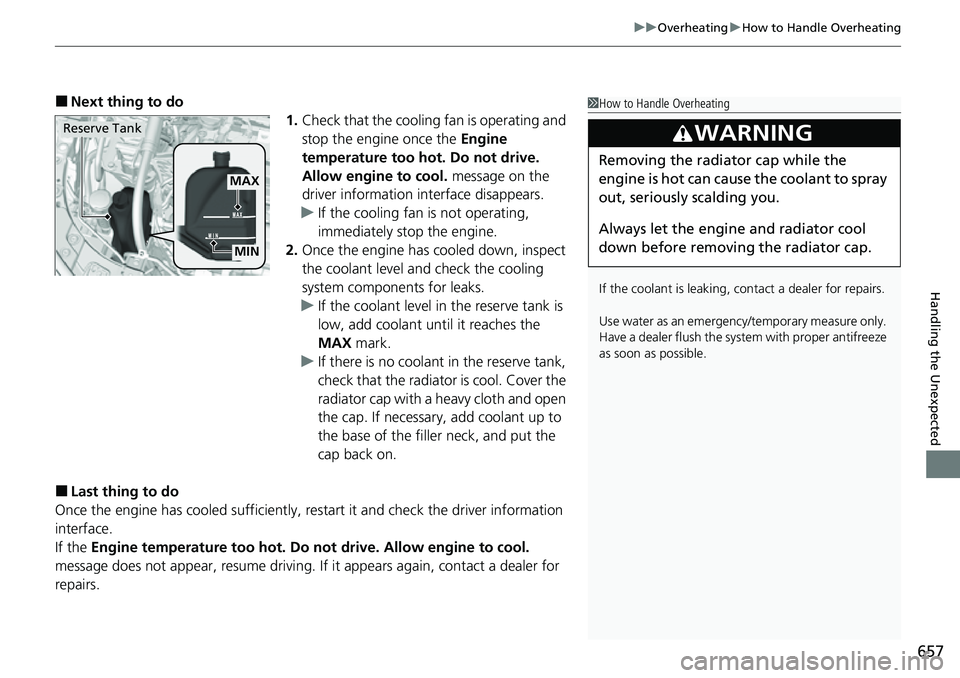
u If the coolant level in the reserve tank is
low, add coolant until it reaches the
MAX mark.
u If there is no coolant in the reserve tank,
check that the radiator is cool. Cover the
radiator cap with a heavy cloth and open
the cap. If necessary, add coolant up to
the base of the filler neck, and put the
cap back on.
■Last thing to do
Once the engine has cooled sufficiently, restart it and check the driver information
interface.
If the Engine temperature too hot. Do no t drive. Allow engine to cool.
message does not appear, resume driving. If it appears again, contact a dealer for
repairs.
1 How to Handle Overheating
If the coolant is leaking, contact a dealer for repairs.
Use water as an emergency/temporary measure only.
Have a dealer flush the system with proper antifreeze
as soon as possible.
3WARNING
Removing the radiator cap while the
engine is hot can cause the coolant to spray
out, seriously scalding you.
Always let the engine and radiator cool
down before removing the radiator cap.
MAX
Reserve Tank
MIN
Page 665 of 700
664
Handling the Unexpected
Fuses
Fuse Locations
If any electrical devices are not working, set the power mode to VEHICLE OFF and
check to see if any app licable fuse is blown.
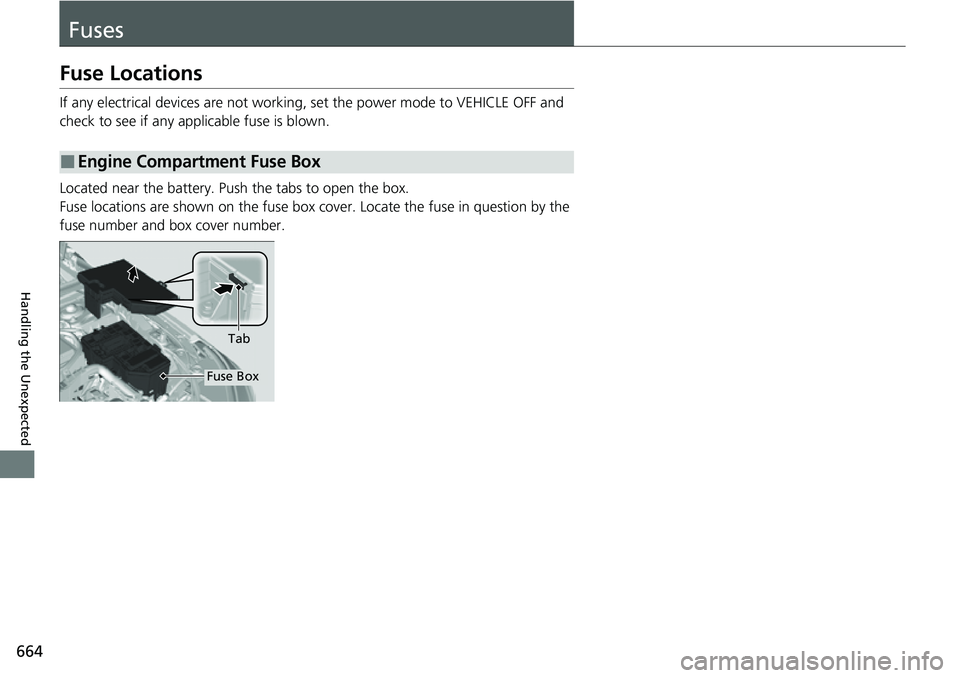
Located near the battery. Push the tabs to open the box.
Fuse locations are shown on the fuse box cover. Locate the fuse in question by the
fuse number and box cover number.
■Engine Compartment Fuse Box
Fuse Box
Tab
Page 669 of 700
668
uuFuses uInspecting and Changing Fuses
Handling the Unexpected
Inspecting and Changing Fuses
1. Set the power mode to VEHICLE OFF. Turn
headlights and all accessories off.
2. Remove the fuse box cover.
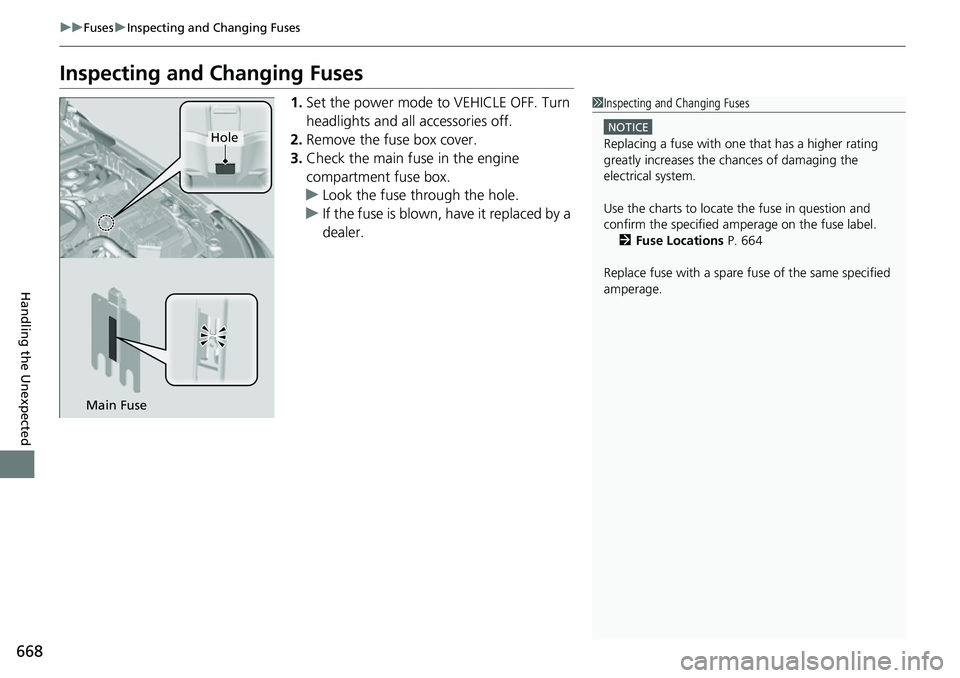
3. Check the main fuse in the engine
compartment fuse box.
u Look the fuse through the hole.
u If the fuse is blown, have it replaced by a
dealer.1Inspecting and Changing Fuses
NOTICE
Replacing a fuse with on e that has a higher rating
greatly increases the chances of damaging the
electrical system.
Use the charts to locate the fuse in question and
confirm the specified amperage on the fuse label. 2 Fuse Locations P. 664
Replace fuse with a spare fuse of the same specified
amperage.
Main Fuse
Hole
Page 670 of 700
669
uuFuses uInspecting and Changing Fuses
Handling the Unexpected
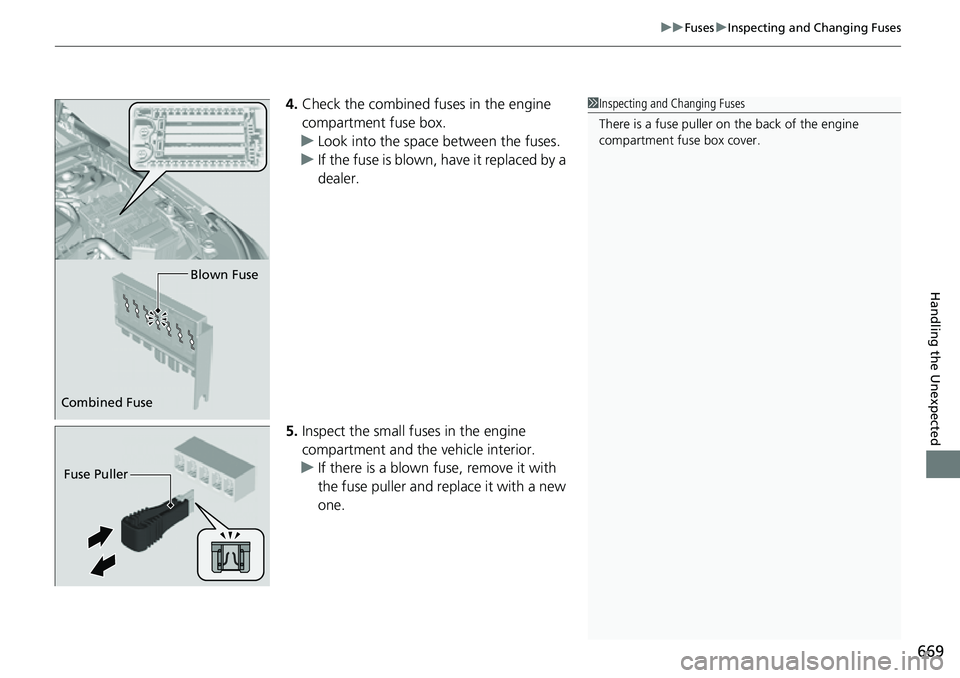
4. Check the combined fu ses in the engine
compartment fuse box.
u Look into the space between the fuses.
u If the fuse is blown, have it replaced by a
dealer.
5. Inspect the small fu ses in the engine
compartment and the vehicle interior.
u If there is a blown fuse, remove it with
the fuse puller and replace it with a new
one.1Inspecting and Changing Fuses
There is a fuse puller on the back of the engine
compartment fuse box cover.
Combined Fuse Blown Fuse
Fuse Puller
Page 676 of 700
675
Information
This chapter includes your vehicle's specifications, locations of identification numbers, and other
information required by regulation.
Specifications .................................... 676
Identification Numbers Vehicle Identification Number (VIN), Engine Number, and Transmission
Number ......................................... 680
Devices that Emit Radio Waves ....... 681
Reporting Safety Defects ................. 682Emissions Testing
Testing of Readiness Codes.............. 683
Warranty Coverages ........................ 685
Authorized Manuals ......................... 688
Customer Service Information ......... 689
Page 681 of 700
680
Information
Identification Numbers
Vehicle Identification Number (VIN), Engine Number,
and Transmission Number
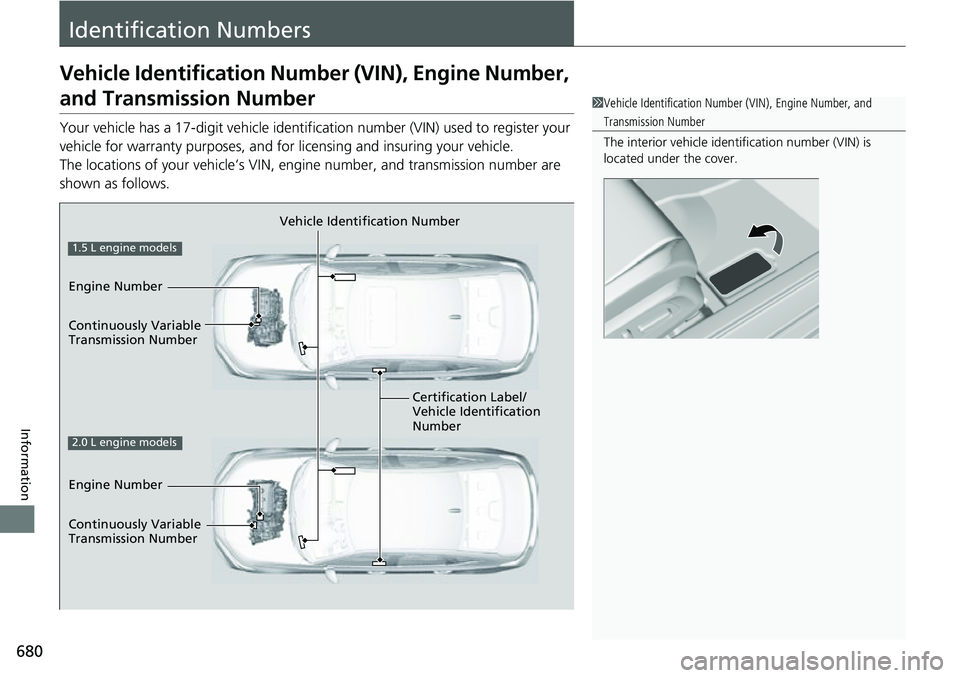
Your vehicle has a 17-digit vehicle identifi cation number (VIN) used to register your
vehicle for warranty purposes, and for licensing and insuring your vehicle.
The locations of your vehicle’s VIN, engine number, and transmission number are
shown as follows.
1 Vehicle Identification Number (VIN), Engine Number, and
Transmission Number
The interior vehicle identification number (VIN) is
located under the cover.
Vehicle Identification Number
Engine Number
Certification Label/
Vehicle Identification
Number
2.0 L engine models
1.5 L engine models
Continuously Variable
Transmission Number
Engine Number
Continuously Variable
Transmission Number