warning HONDA CIVIC 2022 User Guide
[x] Cancel search | Manufacturer: HONDA, Model Year: 2022, Model line: CIVIC, Model: HONDA CIVIC 2022Pages: 700, PDF Size: 13.98 MB
Page 74 of 700
73
uuChild Safety uSafety of Infants and Small Children
Continued
Safe Driving
Safety of Infants and Small Children
An infant must be properly restrained in a rear-facing child seat until the infant
reaches the seat manufacturer’s weight or height limit for the seat.
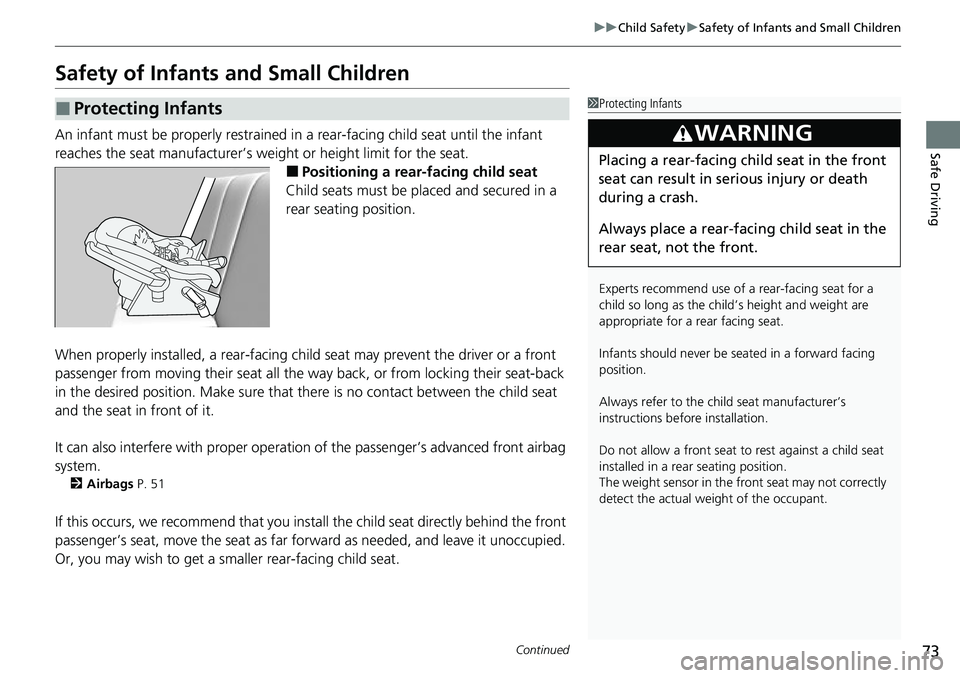
■Positioning a rear-facing child seat
Child seats must be placed and secured in a
rear seating position.
When properly installed, a rear-facing chil d seat may prevent the driver or a front
passenger from moving their seat all the wa y back, or from locking their seat-back
in the desired position. Make sure that there is no contact between the child seat
and the seat in front of it.
It can also interfere with proper operation of the passenger’s advanced front airbag
system.
2 Airbags P. 51
If this occurs, we recommend that you insta ll the child seat directly behind the front
passenger’s seat, move the seat as far fo rward as needed, and leave it unoccupied.
Or, you may wish to get a smaller rear-facing child seat.
■Protecting Infants1 Protecting Infants
Experts recommend use of a rear-facing seat for a
child so long as the child’ s height and weight are
appropriate for a rear facing seat.
Infants should never be s eated in a forward facing
position.
Always refer to the child seat manufacturer’s
instructions before installation.
Do not allow a front seat to rest against a child seat
installed in a rear seating position.
The weight sensor in the fr ont seat may not correctly
detect the actual weight of the occupant.
3WARNING
Placing a rear-facing child seat in the front
seat can result in serious injury or death
during a crash.
Always place a rear-fac ing child seat in the
rear seat, not the front.
Page 75 of 700
uuChild Safety uSafety of Infants and Small Children
74
Safe DrivingIf a child has exceeded the weight and heig ht limitations of a rearward-facing child
seat, the child should be properly restrained in a firmly secured forward-facing child
seat until they exceed the weight and height limitations for the forward-facing child
seat.
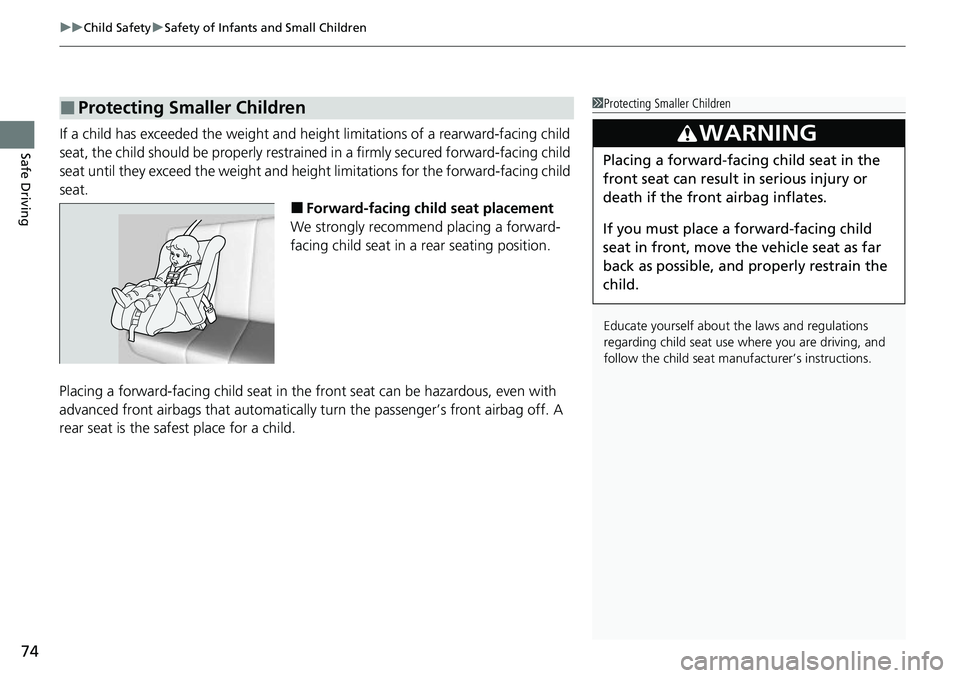
■Forward-facing child seat placement
We strongly recommend placing a forward-
facing child seat in a rear seating position.
Placing a forward-facing child seat in the front seat can be hazardous, even with
advanced front airbags that automatically turn the passenger’s front airbag off. A
rear seat is the safest place for a child.
■Protecting Smaller Children1 Protecting Smaller Children
Educate yourself about th e laws and regulations
regarding child seat use wh ere you are driving, and
follow the child seat manufacturer’s instructions.
3WARNING
Placing a forward-facing child seat in the
front seat can result in serious injury or
death if the front airbag inflates.
If you must place a forward-facing child
seat in front, move the vehicle seat as far
back as possible, and properly restrain the
child.
Page 77 of 700
uuChild Safety uSafety of Infants and Small Children
76
Safe DrivingA LATCH-compatible child seat can be installed in either of the two outer rear seats. A child
seat is attached to the lower anchors with either the rigid or flexible type of connectors.
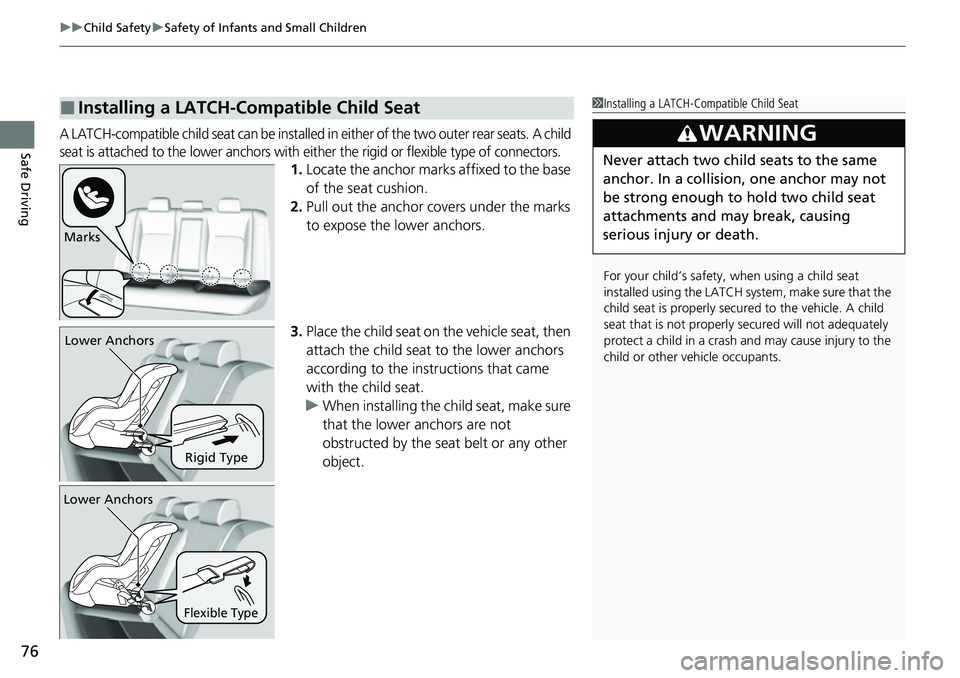
1. Locate the anchor marks affixed to the base
of the seat cushion.
2. Pull out the anchor covers under the marks
to expose the lower anchors.
3. Place the child seat on the vehicle seat, then
attach the child seat to the lower anchors
according to the instructions that came
with the child seat.
u When installing the child seat, make sure
that the lower anchors are not
obstructed by the seat belt or any other
object.
■Installing a LATCH-Compatible Child Seat1Installing a LATCH-Compatible Child Seat
For your child’s safety, when using a child seat
installed using the LATCH system, make sure that the
child seat is properly secured to the vehicle. A child
seat that is not properly secured will not adequately
protect a child in a crash and may cause injury to the
child or other vehicle occupants.
3WARNING
Never attach two child seats to the same
anchor. In a collision, one anchor may not
be strong enough to hold two child seat
attachments and may break, causing
serious injury or death.
Marks
Rigid Type
Lower Anchors
Flexible Type
Lower Anchors
Page 78 of 700
Continued77
uuChild Safety uSafety of Infants and Small Children
Safe Driving
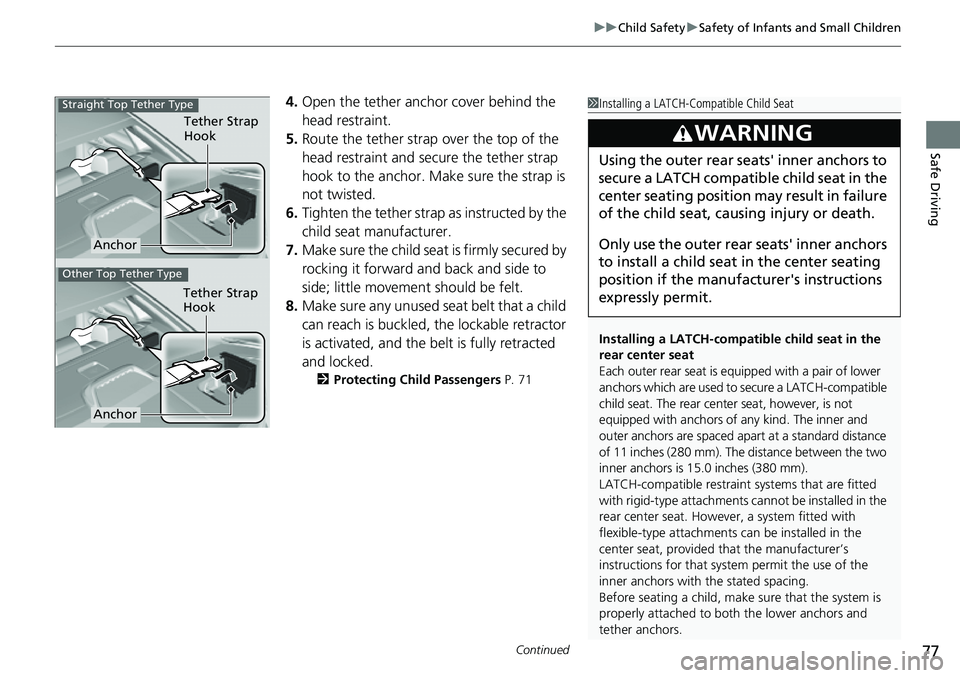
4. Open the tether anchor cover behind the
head restraint.
5. Route the tether strap over the top of the
head restraint and secure the tether strap
hook to the anchor. Make sure the strap is
not twisted.
6. Tighten the tether strap as instructed by the
child seat manufacturer.
7. Make sure the child seat is firmly secured by
rocking it forward and back and side to
side; little movement should be felt.
8. Make sure any unused seat belt that a child
can reach is buckled, the lockable retractor
is activated, and the be lt is fully retracted
and locked.
2 Protecting Child Passengers P. 71
1Installing a LATCH-Compatible Child Seat
Installing a LATCH-compatible child seat in the
rear center seat
Each outer rear seat is equipped with a pair of lower
anchors which are used to secure a LATCH-compatible
child seat. The rear center seat, however, is not
equipped with anchors of any kind. The inner and
outer anchors are spaced apart at a standard distance
of 11 inches (280 mm). The distance between the two
inner anchors is 15.0 inches (380 mm).
LATCH-compatible restraint systems that are fitted
with rigid-type attachments cannot be installed in the
rear center seat. However, a system fitted with
flexible-type attachments can be installed in the
center seat, provided that the manufacturer’s
instructions for that system permit the use of the
inner anchors with the stated spacing.
Before seating a child, make sure that the system is
properly attached to both the lower anchors and
tether anchors.
3WARNING
Using the outer rear seats' inner anchors to
secure a LATCH compatib le child seat in the
center seating position may result in failure
of the child seat, causing injury or death.
Only use the outer rear seats' inner anchors
to install a child seat in the center seating
position if the manufa cturer's instructions
expressly permit.
Tether Strap
Hook
Anchor
Straight Top Tether Type
Tether Strap
Hook
Anchor
Other Top Tether Type
Page 83 of 700
82
uuChild Safety uSafety of Larger Children
Safe Driving
Safety of Larger Children
The following pages give instructions on how to check proper seat belt fit, what kind
of booster seat to use if one is needed, and important precautions for a child who
must sit in front.
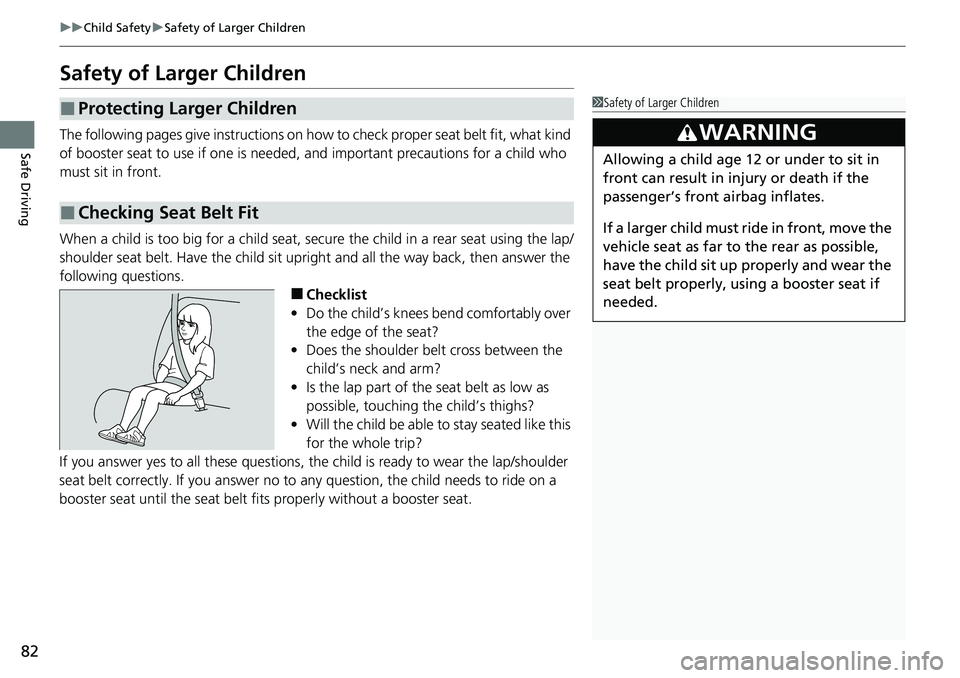
When a child is too big for a child seat, secure the child in a rear seat using the lap/
shoulder seat belt. Have the child sit upright and all the way back, then answer the
following questions.
■Checklist
• Do the child’s knees bend comfortably over
the edge of the seat?
• Does the shoulder belt cross between the
child’s neck and arm?
• Is the lap part of the seat belt as low as
possible, touching the child’s thighs?
• Will the child be able to stay seated like this
for the whole trip?
If you answer yes to all thes e questions, the child is read y to wear the lap/shoulder
seat belt correctly. If you answer no to any question, the child needs to ride on a
booster seat until the seat belt fits properly without a booster seat.
■Protecting Larger Children
■Checking Seat Belt Fit
1 Safety of Larger Children
3WARNING
Allowing a child age 12 or under to sit in
front can result in injury or death if the
passenger’s front airbag inflates.
If a larger child must ride in front, move the
vehicle seat as far to the rear as possible,
have the child sit up properly and wear the
seat belt properly, using a booster seat if
needed.
Page 85 of 700
84
Safe Driving
Exhaust Gas Hazard
Carbon Monoxide Gas
The engine exhaust from this vehicle contains carbon monoxide, a colorless,
odorless, and highly toxic gas. As long as you properly maintain your vehicle, carbon
monoxide gas will not get into the interior.
■Have the exhaust system in spected for leaks whenever
• The exhaust system is m aking an unusual noise.
• The exhaust system may have been damaged.
• The vehicle is raised for an oil change.
When you operate a vehicle with the trunk open, airflow can pull exhaust gas into
the interior and create a hazardous condition. If you must drive with the trunk open,
open all the windows and set the climate control system as shown below.
1. Select the fresh air mode.
2. Select the mode.
3. Set the fan speed to high.
4. Set the temperature control to a comfortable setting.
Adjust the climate control system in the same manner if you sit in your parked
vehicle with the engine running.
1 Carbon Monoxide Gas
An enclosed area such as a garage can quickly fill up
with carbon monoxide gas.
Do not run the engine with the garage door closed.
Even when the garage door is open, drive out of the
garage immediat ely after starting the engine.
3WARNING
Carbon monoxide gas is toxic.
Breathing it can cause unconsciousness and
even kill you.
Avoid any enclosed areas or activities that
expose you to carbon monoxide.
Page 90 of 700
89
uuIndicators u
Continued
Instrument Panel
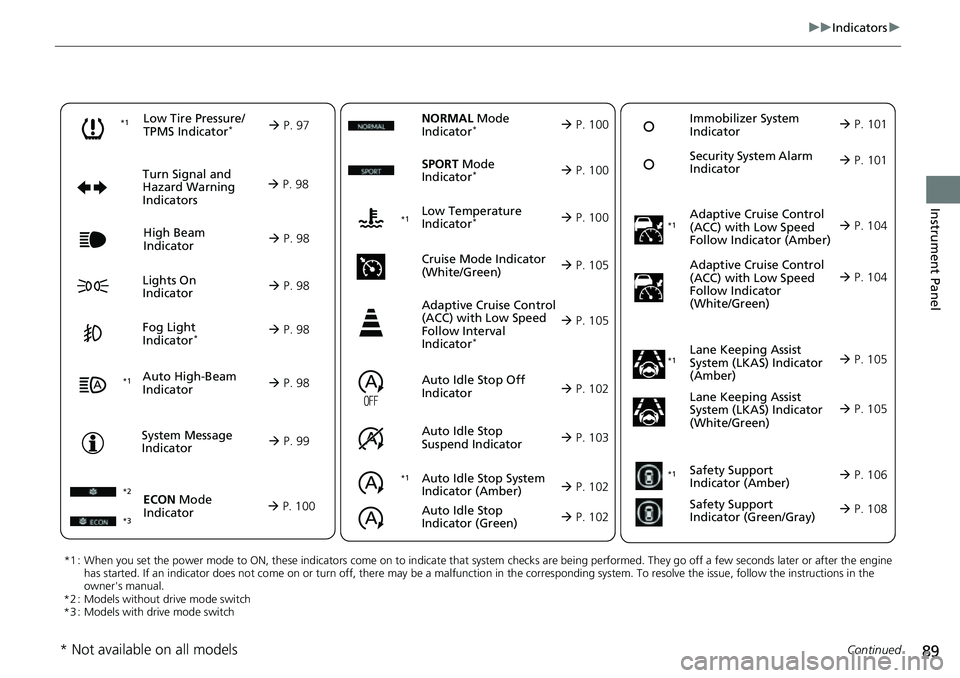
*1 : When you set the power mode to ON, these indicators come on to indicate that system checks are being performed. They go off a few seconds later or after the engine
has started. If an indicator does not come on or turn off, ther e may be a malfunction in the corresponding system. To resolve the issue, follow the instructions in the
owner's manual.
*2 : Models without drive mode switch
*3 : Models with drive mode switch
Auto High-Beam
Indicator
Low Tire Pressure/
TPMS Indicator*
Turn Signal and
Hazard Warning
Indicators
Lights On
Indicator High Beam
Indicator
Fog Light
Indicator*
System Message
Indicator Adaptive Cruise Control
(ACC) with Low Speed
Follow Indicator (Amber)
Lane Keeping Assist
System (LKAS) Indicator
(Amber)
Safety Support
Indicator (Green/Gray)
P. 97
Au
to Idle Stop System
Indica
tor (Amber)
P. 102
P. 98
P. 98
P. 104
*1
P. 98
P. 98
P. 98 Immobilizer System
Indicator
P.
101
Se
curity System Alarm
Indicator
P.
101
P. 99
P. 105
P. 108
*1
Adaptive Cruise Control
(ACC) with Low Speed
Follow Indicator
(White/Green) P. 104
*1
Lane Keeping Assist
System (LKAS) Indicator
(White/Green)
P. 105
*1 *1Safety Support
Indicator (Amber)
P. 106
*1
NORMAL Mode
Indicator* P. 100
Auto Idle Stop Off
Indicator
P. 102
Auto
Idle Stop
Suspen
d Indicator P. 103
ECON Mode
Indicator
P. 100
*3
SPORT Mode
Indicator* P. 100
Low Temperature
Indicator* P. 100
Cruise Mode Indicator
(Whi
te/Green)
P. 105
Adaptive Cruise Control
(ACC) with Low Speed
Follow Interval
Indicator
*
P. 105
*2 *1
Auto Idle Stop
Indicator (Green)
P. 102
* Not available on all models
Page 99 of 700
98
uuIndicators u
Instrument Panel
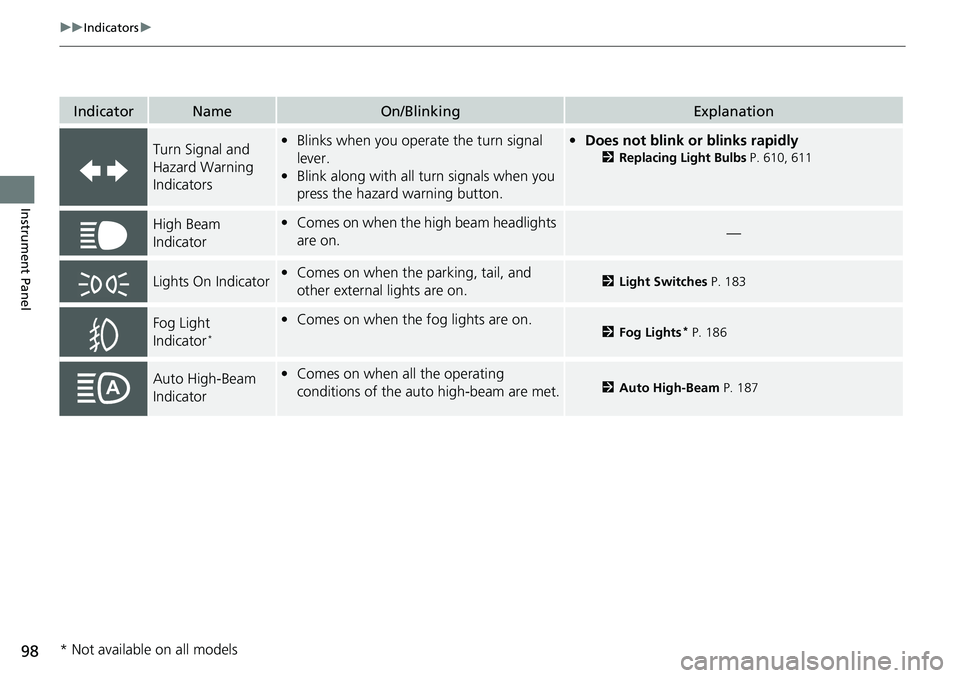
IndicatorNameOn/BlinkingExplanation
Turn Signal and
Hazard Warning
Indicators•Blinks when you operate the turn signal
lever.
• Blink along with all turn signals when you
press the hazard warning button.• Does not blink or blinks rapidly
2 Replacing Light Bulbs P. 610, 611
High Beam
Indicator•Comes on when the high beam headlights
are on.—
Lights On Indicator•Comes on when the parking, tail, and
other external lights are on.2 Light Switches P. 183
Fog Light
Indicator*
•Comes on when the fog lights are on.2 Fog Lights* P. 186
Auto High-Beam
Indicator•Comes on when all the operating
conditions of the au to high-beam are met.2Auto High-Beam P. 187
* Not available on all models
Page 100 of 700
99
uuIndicators u
Continued
Instrument Panel
IndicatorNameOn/BlinkingExplanation
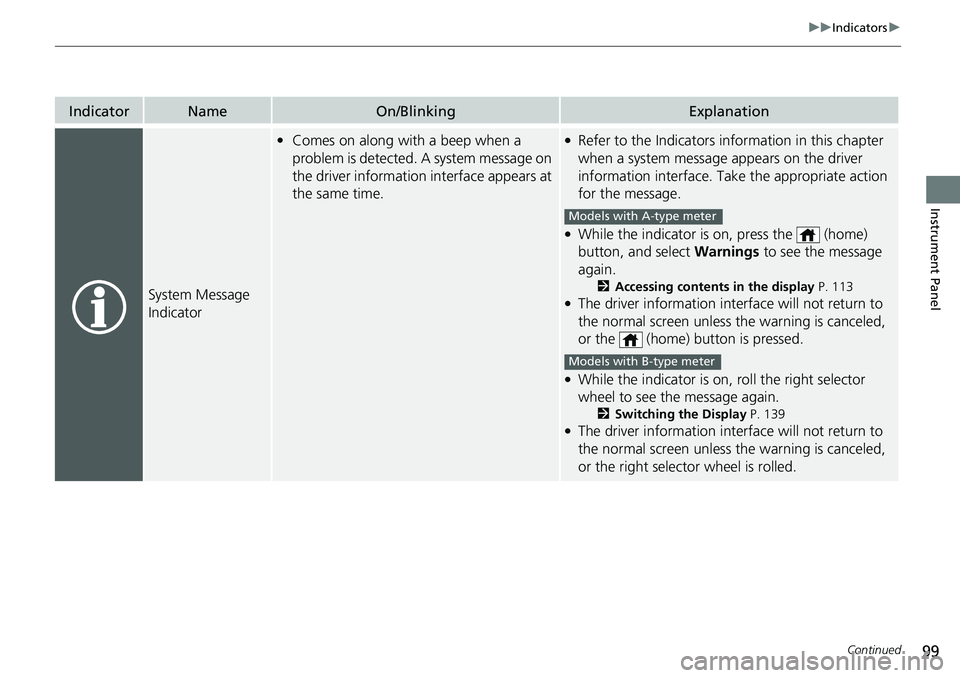
System Message
Indicator
•Comes on along with a beep when a
problem is detected. A system message on
the driver information interface appears at
the same time.●Refer to the Indicators information in this chapter
when a system message appears on the driver
information interface. Take the appropriate action
for the message.
●While the indicator is on, press the (home)
button, and select Warnings to see the message
again.
2 Accessing contents in the display P. 113●The driver information inte rface will not return to
the normal screen unless the warning is canceled,
or the (home) button is pressed.
●While the indicator is on, roll the right selector
wheel to see the message again.
2 Switching the Display P. 139●The driver information inte rface will not return to
the normal screen unless the warning is canceled,
or the right selector wheel is rolled.
Models with A-type meter
Models with B-type meter
Page 114 of 700
113
uuGauges and Driver Information Interface uDriver Information Interface
Continued
Instrument Panel
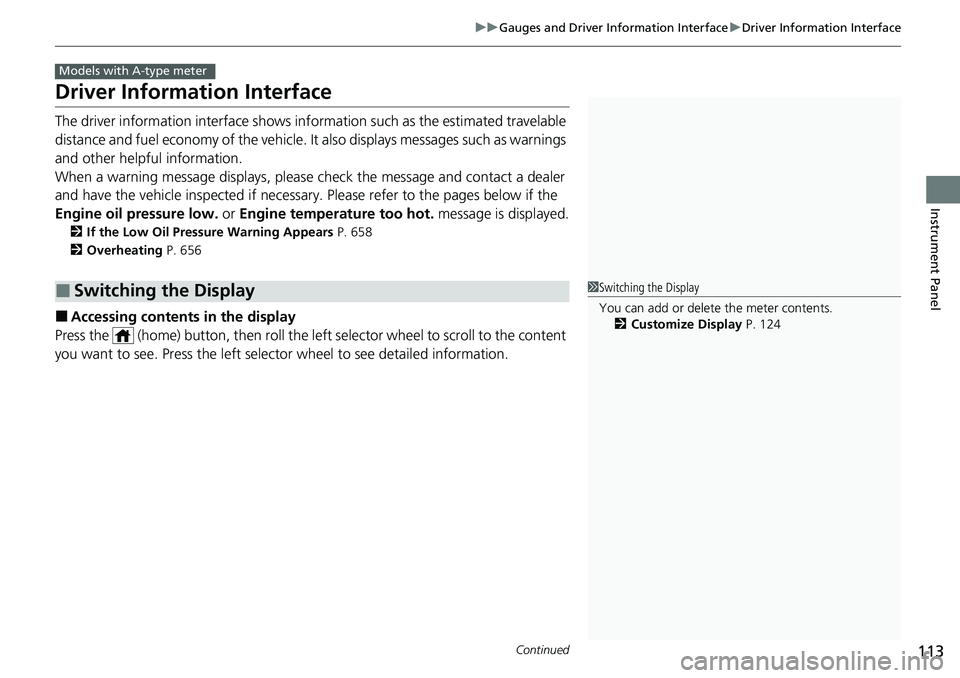
Driver Information Interface
The driver information interface shows information such as the estimated travelable
distance and fuel economy of the vehicle. It also displays messages such as warnings
and other helpful information.
When a warning message displays, please check the message and contact a dealer
and have the vehicle inspected if necessary . Please refer to the pages below if the
Engine oil pressure low. or Engine temperature too hot. message is displayed.
2If the Low Oil Pressure Warning Appears P. 658
2 Overheating P. 656
■Accessing contents in the display
Press the (home) button, then roll the le ft selector wheel to scroll to the content
you want to see. Press the left sele ctor wheel to see detailed information.
■Switching the Display
Models with A-type meter
1Switching the Display
You can add or delete the meter contents.
2 Customize Display P. 124