tires HONDA CIVIC 2022 Owners Manual
[x] Cancel search | Manufacturer: HONDA, Model Year: 2022, Model line: CIVIC, Model: HONDA CIVIC 2022Pages: 700, PDF Size: 13.98 MB
Page 8 of 700
Contents
Child Safety P. 71Exhaust Gas Hazard P. 84Safety Labels P. 85
Opening and Closing the Trunk P. 170 Security System P. 173 Windows P. 176
Mirrors P. 196 Seats P. 198
Climate Control System P. 222
Audio Error Messages P. 332 General Information on the Audio System P. 334
Bluetooth ® HandsFreeLink ® P. 389, 409 Refuel Recommend P. 428
When Driving P. 436 Honda Sensing ® P. 473 Braking P. 554 Parki ng Your Vehicle P. 562
Fuel Economy and CO
2 Emissions P. 578 Turbo Engine Vehicle* P. 579
Maintenance Under the Hood P. 595 Replacing Light Bulbs P. 610
Checking and Maintaining Tires P. 617 Batt ery P. 627 Remote Transmitter Care P. 629
Cleaning P. 631 Accessories and Modifications P. 636
Engine Does Not Start P. 648 If the Battery Is Dead P. 652
Indicator, Coming On/Blinking P. 658 Fuses P. 664Emergency Towing P. 670
If You Cannot Open the Trunk P. 672 Refueling P. 673
Devices that Emit Radio Waves P. 681 Reporting Safety Defects P. 682
Authorized Manuals P. 688 Customer Service Information P. 689
Quick Reference GuideP. 8
Safe DrivingP. 37
Instrument PanelP. 87
ControlsP. 153
FeaturesP. 229
DrivingP. 429
MaintenanceP. 581
Handling the UnexpectedP. 639
InformationP. 675
IndexP. 690
Page 13 of 700
Visual Index
12
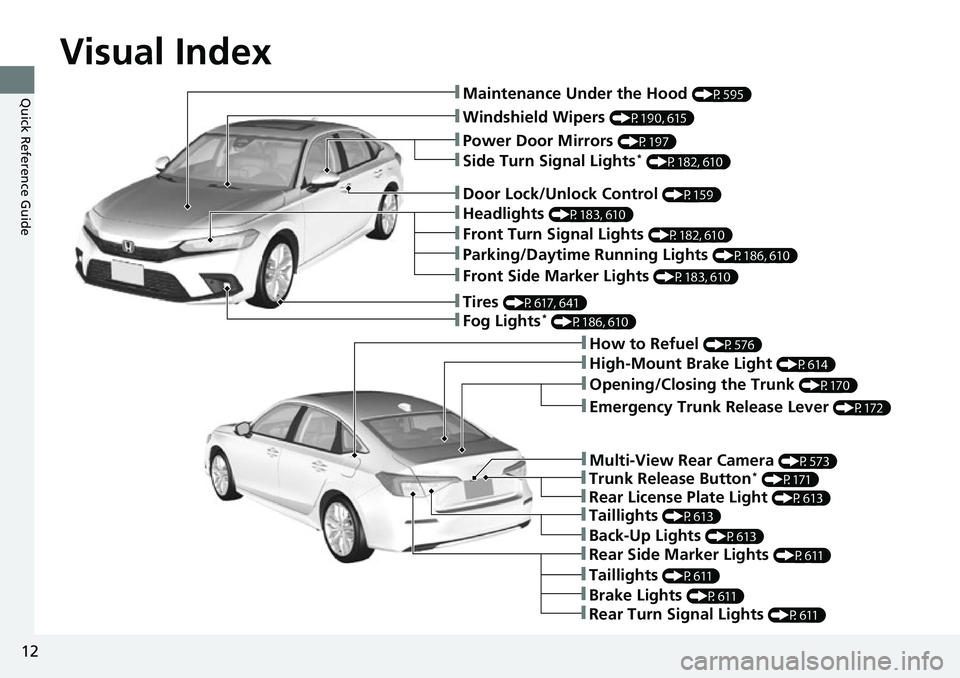
Quick Reference Guide❚Maintenance Under the Hood (P595)
❚Windshield Wipers (P190, 615)
❚Tires (P617, 641)
❚Fog Lights* (P186, 610)
❚Power Door Mirrors (P197)
❚How to Refuel (P576)
❚High-Mount Brake Light (P614)
❚Emergency Trunk Release Lever (P172)
❚Opening/Closing the Trunk (P170)
❚Door Lock/Unlock Control (P159)
❚Side Turn Signal Lights* (P182, 610)
❚Headlights (P183, 610)
❚Front Turn Signal Lights (P182, 610)
❚Front Side Marker Lights (P183, 610)
❚Taillights (P613)
❚Brake Lights (P611)
❚Rear Turn Signal Lights (P611)
❚Rear Side Marker Lights (P611)
❚Taillights (P611)
❚Parking/Daytime Running Lights (P186, 610)
❚Multi-View Rear Camera (P573)
❚Trunk Release Button* (P171)
❚Rear License Plate Light (P613)
❚Back-Up Lights (P613)
Page 32 of 700
31
Quick Reference Guide
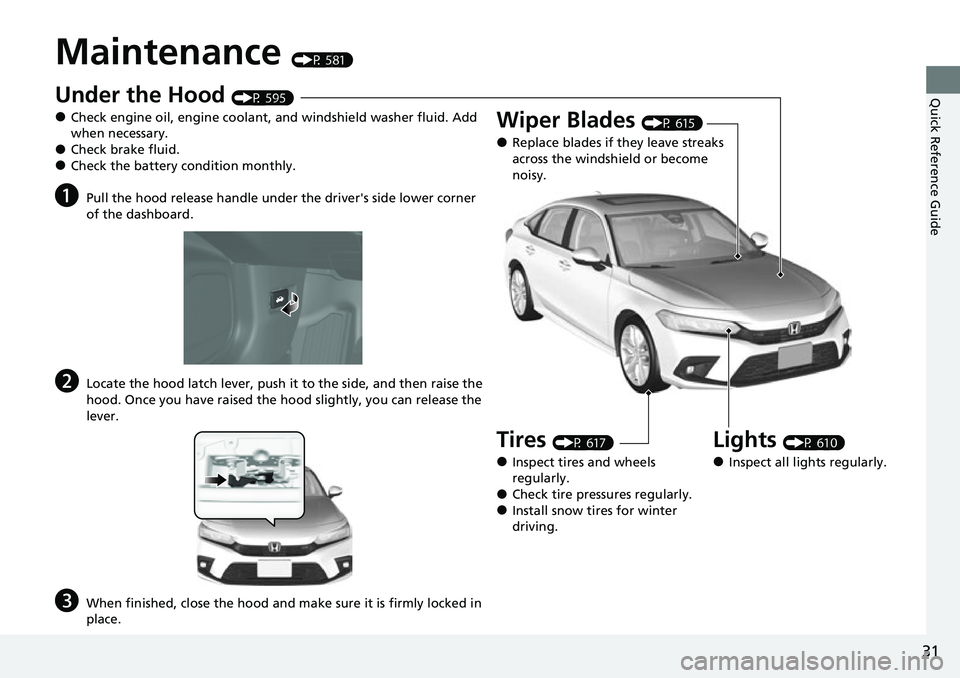
Maintenance (P 581)
Under the Hood (P 595)
●Check engine oil, engine coolant, and windshield washer fluid. Add
when necessary.
●Check brake fluid.●Check the battery condition monthly.
aPull the hood release handle under the driver's side lower corner
of the dashboard.
bLocate the hood latch lever, push it to the side, and then raise the
hood. Once you have raised the hood slightly, you can release the
lever.
cWhen finished, close the hood and make sure it is firmly locked in
place.
Lights (P 610)
●Inspect all lights regularly.
Wiper Blades (P 615)
●Replace blades if they leave streaks
across the windshield or become
noisy.
Tires (P 617)
●Inspect tires and wheels
regularly.
●Check tire pressures regularly.●Install snow tires for winter
driving.
Page 98 of 700
97
uuIndicators u
Continued
Instrument Panel
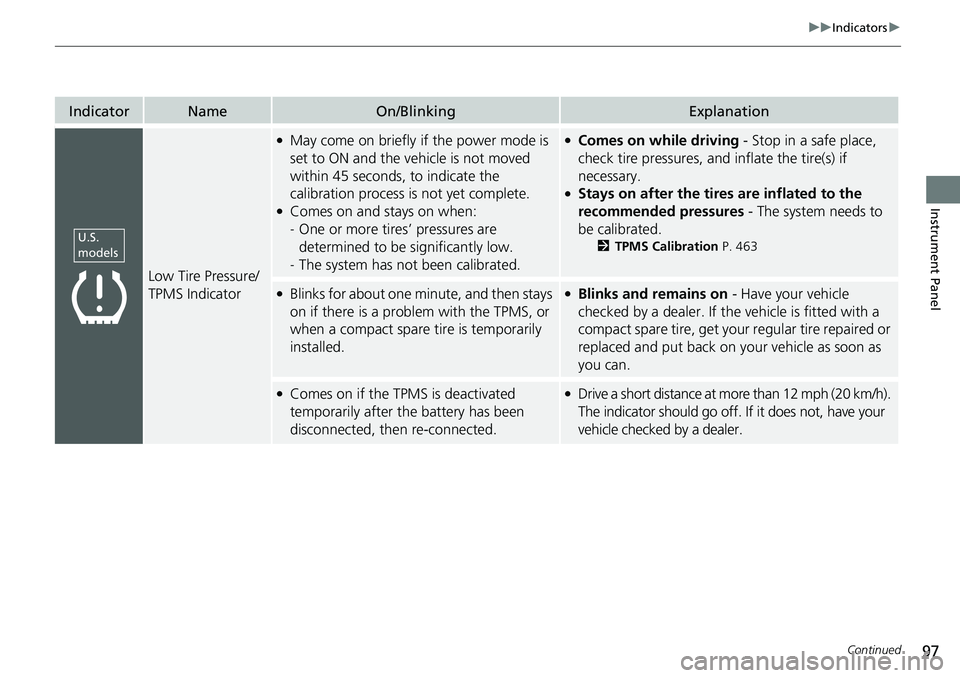
IndicatorNameOn/BlinkingExplanation
Low Tire Pressure/
TPMS Indicator
●May come on briefly if the power mode is
set to ON and the vehicle is not moved
within 45 seconds, to indicate the
calibration process is not yet complete.
●Comes on and stays on when:
-One or more tires’ pressures are
determined to be significantly low.
- The system has not been calibrated.
●Comes on while driving - Stop in a safe place,
check tire pressures, and inflate the tire(s) if
necessary.
●Stays on after the tires are inflated to the
recommended pressures - The system needs to
be calibrated.
2 TPMS Calibration P. 463
●Blinks for about one minute, and then stays
on if there is a problem with the TPMS, or
when a compact spare tire is temporarily
installed.●Blinks and remains on - Have your vehicle
checked by a dealer. If th e vehicle is fitted with a
compact spare tire, get your regular tire repaired or
replaced and put back on your vehicle as soon as
you can.
●Comes on if the TPMS is deactivated
temporarily after the battery has been
disconnected, then re-connected.●Drive a short distance at more than 12 mph (20 km/h).
The indicator should go off. If it does not, have your
vehicle checked by a dealer.
U.S.
models
Page 431 of 700
430
Driving
Before Driving
Driving Preparation
Check the following items before you start driving.
• Make sure there are no obstructions on the windows, door mirrors, exterior
lights, or other parts of the vehicle.
u Remove any frost, snow, or ice.
u Remove any snow on the roof, as this can slip down and obstruct your field of
vision while driving. If frozen solid , remove ice once it has softened.
u When removing ice from around the wheels, be sure not to damage the wheel
or wheel components.
• Make sure the hood is securely closed.
u If the hood opens while driving, your front view will be blocked.
• Make sure the tires are in good condition.
u Check air pressures, and check for damage and excessive wear.
2Checking and Maintaining Tires P. 617
•Make sure there are no people or ob jects behind or around the vehicle.
u There are blind spots from the inside.
■Exterior Checks1Exterior Checks
NOTICE
When doors are frozen s hut, use warm water around
the door edges to melt any ice. Do not try to force
them open, as this can damage the rubber trim
around the doors. When done, wipe dry to avoid
further freezing.
Do not pour warm water into the key cylinder.
You will be unable to insert the key if the water
freezes in the hole.
Heat from the engine and exhaust can ignite
flammable material s left under the hood, causing a
fire. If you've parked y our vehicle for an extended
period, inspect and remove any debris that may have
collected, such as dried grass and leaves that have
fallen or have been carried in for use as a nest by a
small animal. Also, check under the hood for leftover
flammable materials after you or someone else has
performed maintenance on your vehicle.
Page 432 of 700
Continued431
uuBefore Driving uDriving Preparation
Driving
• Store or secure all items on board properly.
u Carrying too much cargo, or improperly storing it, can affect your vehicle’s
handling, stability, sto pping distance, and tires, and make it unsafe.
2Maximum Load Limit P. 433
•Do not pile items higher than the seat height.
u They can block your view and may be thrown forward in the event of sudden
braking.
• Do not place anything in the front seat footwells. Make sure to secure the floor
mat.
u An object or unsecured floor mat can in terfere with your brake and accelerator
pedal operation while driving.
• If you have any animals on board, do not let them move around in the vehicle.
u They may interfere with driving and a crash could occur.
• Securely close and lock all doors and the trunk.
2 Locking/Unlocking the Doors from the Inside P. 166
•Adjust your seating position properly.
u Adjust the front h ead restraint, too.
2Seats P. 198
2 Adjusting the Front Head Restraints P. 204
•Adjust the mirrors and steering wheel properly.
u Adjust them while sitting in the proper driving position.
2 Mirrors P. 196
2 Adjusting the Steering Wheel P. 195
■Interior Checks1Interior Checks
The headlight aim is set by the factory, and does not
need to be adjusted. Howeve r, if you regularly carry
heavy items in the trunk, have the aiming readjusted
at a dealer or by a qualified technician.
Page 448 of 700
Continued447
uuWhen Driving uShifting
Driving
Use the paddle shifters to change between 1st and 7th speeds without releasing
your hands from the steering wheel. The transmission switches to the 7-speed
manual shift mode when you pull a paddle shifter while driving. This mode is useful
when engine braking is needed.
■When the transmi ssion is in (D:
The shift mode goes into the 7-speed ma nual shift mode temporarily, and the
number is displayed in the shift indicator.
The 7-speed manual shift mode is canceled automatically if you drive at constant
speed or accelerate, and the number in the shift indicator goes off.
You can cancel this mode by pulling the
(+ paddle shifter for a few seconds.
The 7-speed manual shift mode is especial ly useful when reducing the vehicle speed
temporarily before making a turn.
■When the transmi ssion is in (D with SPORT mode:
The shift mode goes into the 7-speed manual shift mode. The M indicator and the
speed number are displayed in the shift indicator. As the vehicle speed slows down,
the transmission automatically shifts down accordingly. When the vehicle comes to
a stop, it automatically shifts down into 1st.
If the vehicle speed increases and the engi ne speed reaches near the tachometer’s
red zone, the transmission automatically shifts up.
You can only pull away in 1st speed.
When canceling the 7-speed manual shift m ode, use the drive mode switch to select
other than SPORT mode or pull the
(+ paddle shifter for a few seconds. When the
7-speed manual shift mode is canceled, the M indicator and shift indicator will turn
off.
■7-Speed Manual Shift Mode1 7-Speed Manual Shift Mode
In the 7-speed manual shif t mode, the transmission
shifts up or down by opera ting either paddle shifter
under the following conditions:
Shift Up: The engine sp eed reaches the lowest
threshold of the higher speed position.
Shift Down: The engine sp eed reaches the highest
threshold of the lower speed position.
When the engine speed reaches near the
tachometer’s red zone, the transmission shifts up
automatically.
When the engine speed reaches the lowest threshold
of the selected speed positi on, the transmission shifts
down automatically.
Operating the paddle shifte rs on slippery surfaces
may cause the tires to lock up. In this case, the 7-
speed manual shift mode is canceled and goes back
to the normal
( D driving mode.
Page 463 of 700
462
uuWhen Driving uTire Pressure Monitoring System (TPMS)
Driving
Tire Pressure Monitoring System (TPMS)
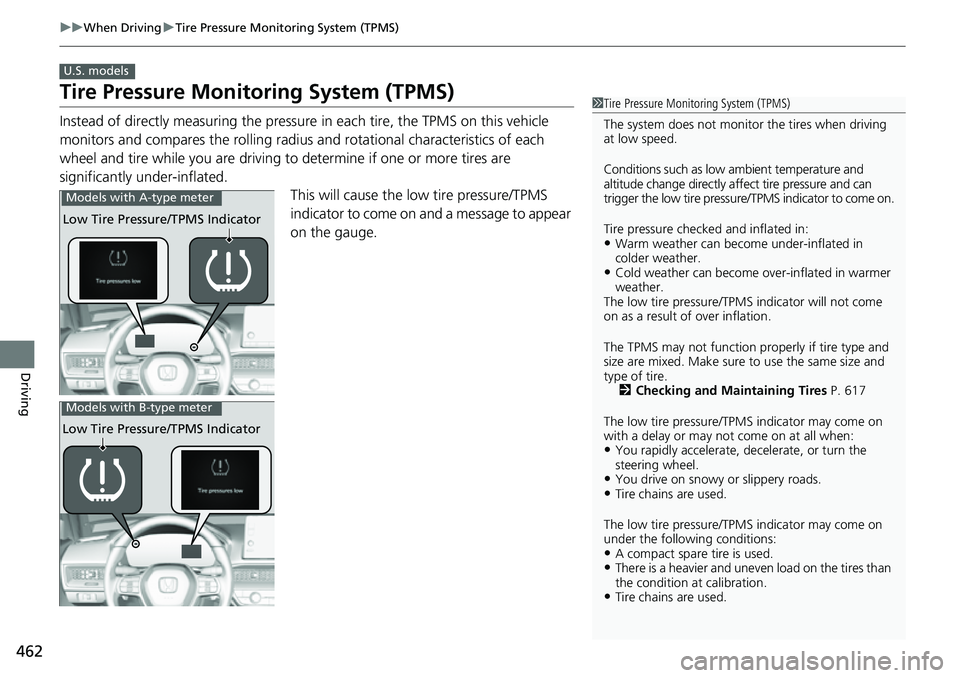
Instead of directly measuring the pressu re in each tire, the TPMS on this vehicle
monitors and compares the rolling radius and rotational characteristics of each
wheel and tire while you are driving to determine if one or more tires are
significantly under-inflated. This will cause the low tire pressure/TPMS
indicator to come on and a message to appear
on the gauge.
U.S. models
1 Tire Pressure Monitoring System (TPMS)
The system does not monitor the tires when driving
at low speed.
Conditions such as low ambient temperature and
altitude change directly a ffect tire pressure and can
trigger the low tire pressure/TPMS indicator to come on.
Tire pressure checked and inflated in:
•Warm weather can beco me under-inflated in
colder weather.
•Cold weather can become over-inflated in warmer
weather.
The low tire pressure/TPMS indicator will not come
on as a result of over inflation.
The TPMS may not function pr operly if tire type and
size are mixed. Make sure to use the same size and
type of tire. 2 Checking and Maintaining Tires P. 617
The low tire pressure/TPMS indicator may come on
with a delay or may not come on at all when:
•You rapidly accelerate, decelerate, or turn the
steering wheel.
•You drive on snowy or slippery roads.•Tire chains are used.
The low tire pressure/TPMS indicator may come on
under the following conditions:
•A compact spare tire is used.•There is a heavier and uneve n load on the tires than
the condition at calibration.
•Tire chains are used.
Low Tire Pressure/TPMS Indicator
Models with A-type meter
Low Tire Pressure/TPMS Indicator
Models with B-type meter
Page 464 of 700
Continued463
uuWhen Driving uTire Pressure Monitoring System (TPMS)
Driving
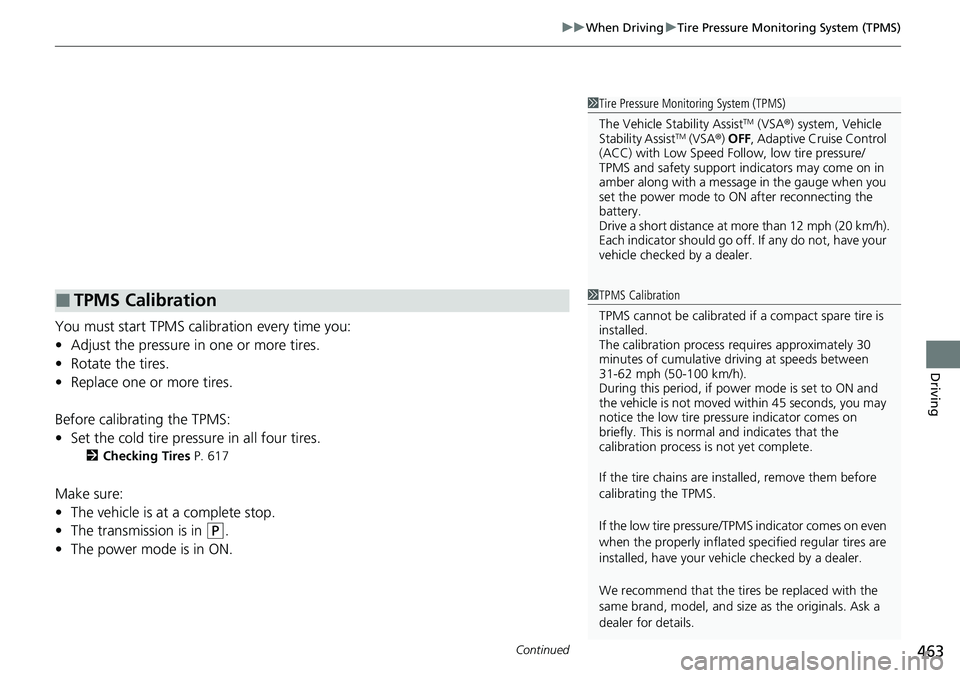
You must start TPMS calibration every time you:
• Adjust the pressure in one or more tires.
• Rotate the tires.
• Replace one or more tires.
Before calibrating the TPMS:
• Set the cold tire pressure in all four tires.
2 Checking Tires P. 617
Make sure:
•The vehicle is at a complete stop.
• The transmission is in
(P.
• The power mode is in ON.
1Tire Pressure Monitoring System (TPMS)
The Vehicle Stability Assist
TM (VSA ®) system, Vehicle
Stability AssistTM (VSA ®) OFF , Adaptive Cruise Control
(ACC) with Low Speed Follow, low tire pressure/
TPMS and safety support i ndicators may come on in
amber along with a message in the gauge when you
set the power mode to ON after reconnecting the
battery.
Drive a short distance at more than 12 mph (20 km/h).
Each indicator should go off. If any do not, have your
vehicle checked by a dealer.
■TPMS Calibration1 TPMS Calibration
TPMS cannot be calibrated if a compact spare tire is
installed.
The calibration process requires approximately 30
minutes of cumulative dr iving at speeds between
31-62 mph (50-100 km/h).
During this period, if power mode is set to ON and
the vehicle is not moved within 45 seconds, you may
notice the low tire pres sure indicator comes on
briefly. This is normal and indicates that the
calibration process is not yet complete.
If the tire chains are installed, remove them before
calibrating the TPMS.
If the low tire pressure/TPMS indicator comes on even
when the properly inflated specified regular tires are
installed, have your vehi cle checked by a dealer.
We recommend that the tires be replaced with the
same brand, model, and size as the originals. Ask a
dealer for details.
Page 468 of 700
467
uuWhen Driving uTire Pressure Monitoring System (TPMS) - Required Federal Explanation
Continued
Driving
Tire Pressure Monitoring System (TPMS) - Required
Federal Explanation
Each tire, including the spare (if provided), should be checked
monthly when cold and inflated to the inflation pressure
recommended by the vehicle manufa cturer on the vehicle placard
or tire inflation pressure label.
(If your vehicle has tires of a diff erent size than the size indicated
on the vehicle placard or tire inflation pressure label, you should
determine the proper tire inflat ion pressure for those tires.)
As an added safety feature, your vehicle has been equipped with
a tire pressure monitoring system (TPMS) that illuminates a low
tire pressure telltale
when one or more of your tires is significantly under-inflated.
Accordingly, when the low tire pressure telltale illuminates, you
should stop and check your tires as soon as possible, and inflate
them to the proper pressure.
Driving on a significantly under-inf lated tire causes the tire to
overheat and can lead to tire fail ure. Under-inflation also reduces
fuel efficiency and tire tread life, and may affect the vehicle's
handling and stopping ability.
U.S. models